Finished reading on: June 18, 2018
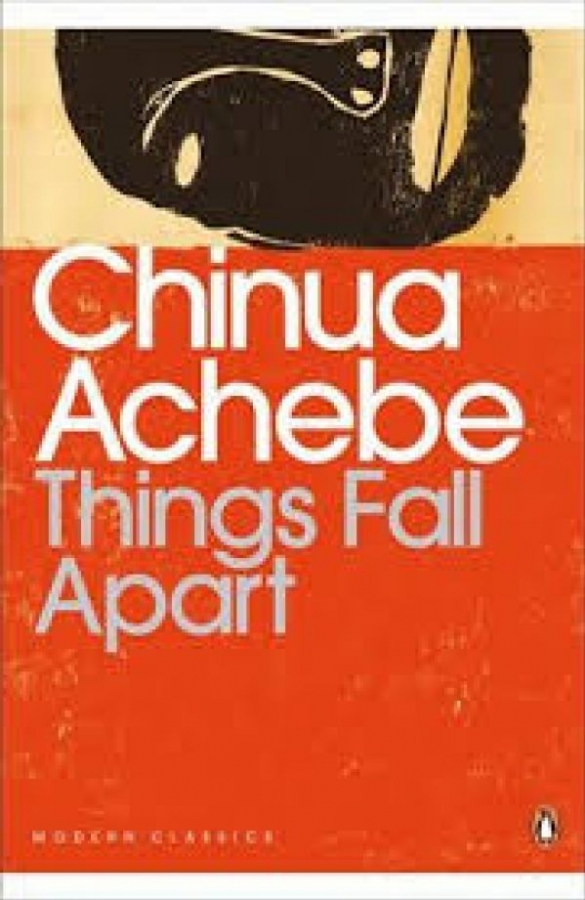
Things Fall Apart (things fall apart)
Title of the original version reviewed: «Things Fall Apart (le cose crollano)»
AI Translation Notice: This review was translated from the original Italian using artificial intelligence. Book quotes and excerpts are translated interpretations and will not match the author's original English phrasing or official published translations.
The novel forms part of a trilogy alongside two other works, No Longer at Ease (1960) and Arrow of God (1964): an expansive fresco depicting the impact of colonialism on African society.
In this narrative, the setting is established across the nine villages of Umuofia, in Nigeria; the historical period is that which immediately precedes the arrival of the colonizers.
Things Fall Apart recounts, precisely, the demise of an agrarian civilization, shaped by the cycle of the seasons and governed by immutable, perennial codes.
It is a realm forged of certainties yet inherently magical, teeming with elusive and mythical figures; its people are immersed in a living natural world, accustomed to accepting its benevolence alongside its wrath.
A person's existence
unfolded from birth to death through a continuum of transitional rites, drawing them ever closer to the realm of their ancestors
.
Achebe depicts this society through exquisite and stately elegiac forms; he does so without self-indulgence or nostalgia, for those certainties also stemmed from the collective acceptance of an unyielding hierarchy and an inertia that entrapped human beings.
The arrival of the white conqueror and his religion does not shatter an idyllic world; it also dismantles laws and customs that were often brutal and inscrutable, leaving
Umuofia bewildered like a startled animal, ears pricked, scenting the silent, ominous air without knowing which path to take
.
It would be reductive, however, to read the novel solely through its social and political dimensions; it chronicles the story of a man, meditating on power and its eventual fall.
Okonkwo is a formidable warrior whose renown reaches beyond Umuofia, to the extent that the elders regard him as
among the bravest champions since the clan's founder wrestled a wilderness spirit for seven days and seven nights
.
His extensive properties and grand compound, his numerous wives and many children enable Okonkwo to aspire to the highest ranks of society.
For him, this represents redemption from the legacy of his father, who had squandered everything and brought dishonor upon the household.
It is an honor of high standing when the village elders resolve to place in Okonkwo’s charge a boy from another tribe, surrendered as compensation for the killing of an Umuofia maiden.
Ikemefuna is resilient and robust, swiftly earning Okonkwo’s esteem and affection.
Ah, if only he were his eldest son, instead of Nwoye, who is so frail as to recall Okonkwo’s own father! A deep bond also forms between Ikemefuna and Nwoye, the former assuming the role of an elder brother, at once protective and vigorous.
The Oracle of the Hills and the Caves hands down Ikemefuna’s death sentence; he must be slain in accordance with an unbending, immutable law governing those given in retribution for a crime.
This boy looks to you as a father.
Take no part in his death
, an elder cautions, conveying the village’s decree to Okonkwo.
Okonkwo would be excused from taking part in the gruesome execution; yet he cannot bring himself to withdraw, bound by a social standing he feels driven to maintain.
And so Okonkwo follows Ikemefuna on his unsuspecting path toward death.
The unfortunate boy recalls the tunes his mother used to sing to him:
he felt like a child all over again, comforted by the thought of returning home to his mother
.
He is struck down and cries out:
Father, they are killing me! Seized by terror, Okonkwo unsheathed his machete and dealt the finishing blow, terrified of being perceived as weak. (...) Nwoye had heard rumors that twins were cast into clay vessels and abandoned in the forest, yet he had never crossed paths with them until now. A sudden shudder had coursed through him and his mind seemed to grow dim, like a solitary wanderer encountering a sinister spirit upon the road at night. Something had broken within his spirit then. That very tremor fell upon him once more when his father walked through the door that evening after putting Ikemefuna to death.
With this episode begins Okonkwo’s downfall; after all, what he has done is
the sort of transgression for which the deity obliterates an entire lineage
.
During a funeral gathering, Okonkwo accidentally slays a youth of Umuofia: custom dictates that he must go into exile for seven years, accompanied by his entire family.
He resigns himself to this destiny; clearly his personal guardian spirit, his chi, was not forged for greatness.
He knows, too, that once he returns to his village he will no longer be able to aspire to the summit of society, no matter how immense his valor and wealth might be.
Yet while Okonkwo bows to ancestral mandates, he can in no way reconcile himself to the colonizer's rules, particularly when they strike at his own flesh and blood: his eldest son Nwoye converts to Christianity, renouncing family, tradition, and the ancient gods.
Then, upon realizing that Umuofia is capitulating without resistance, he commits an individual act of rebellion: he strikes down the white man’s messenger, a traitor to his own people.
Nothing remains for him but to end his own life, hanging himself: his world has collapsed.
Much like in Aeschylean tragedy, Okonkwo seems driven solely by the divine, by his chi
, by ancestral decrees, by ageless rituals: at bottom, he carries no guilt for participating in Ikemefuna's execution.
Achebe is too accomplished a writer to lapse into stereotypes: a pivotal strength of the novel lies precisely in the psychology of its characters; they maneuver within their human contradictions, caught between social strictures, affections, and ambitions.
Ezinma, Okonkwo’s favorite daughter (ah, if only she were a boy!), is carried off by an ecstatic priestess to the shrine of the cave deity.
Her mother trails behind in despair, yet lacks the courage to cross into the cavern, such is the awe commanded by the ancient faith.
Okonkwo arrives with his machete, the consummate warrior, prepared to defend and, if necessary, tear his beloved daughter away, even against the divine will.
Yet we must ask: why was he not willing to make that very same choice for Ikemefuna, or for Nwoye? Out of ambition, or simply because he did not love them enough? Furthermore, why do the gods strike him down, even when he complied with the cruel ancestral laws? And why does he resort to suicide, fully aware that one who takes his own life may only be buried by strangers, bringing ruin upon his entire house? As observed in the introduction,
Achebe's characters do not seek our consent to be human; they offer no apologies for their complexity (or for being African, or human, or so extraordinarily alive).
The setting, narrative, and characters captivate because they are rendered in prose that approaches perfection: unadorned, fluid, capable of interweaving English with vernacular idioms, conveying both the ambiguous allure of a civilization and the profoundly authentic, layered feelings of its protagonists.
It is true that the subject is Africa, yet the refined craft and narrative pacing—with its deliberate suspensions and its oscillation between quietude and catastrophe—lead us into a universal dimension: the underlying subject is the enduring fate of the human condition, transcending both time and space.
Why read it? Mesmerizing, a masterpiece.