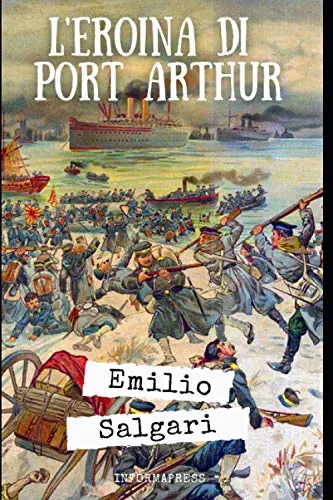
The Heroine of Port Arthur
Emilio Salgari was exceptionally swift at fashioning stories around events that gripped the public imagination; he did so by blending a certain exoticism with wars and romantic intrigues. Such had been the case with *La capitana del Yucatan* and *Le Stragi delle Filippine* (see the reviews on this site), and so it is in this novel, published under a pseudonym in 1904. The backdrop is the Russo-Japanese War of 1904–1905, in which > "little Japan," as the Russians contemptuously called it, confronted and defeated the vast Russian Empire. The setting is Port Arthur, the gateway to the conquest of Korea and at the time in Russian hands. The narrative opens with a scene of simultaneous splendor and decay: a *daimyo* (that is, a feudal lord) passes through the crowd alongside his stunning daughter, Shima. > She was barely sixteen, (...) not tall, exquisitely proportioned, with deep black eyes that bore no trace of slant, (...) skin with alabaster hues, (...) with a lovely little mouth, its somewhat thin lips hinting at an extraordinary resolve. A lavish reception is set to take place at the daimyo’s residence to celebrate Shima's betrothal to Boris, a Russian officer. The prospective groom fails to appear: he is having an affair with a geisha and knows that war with Japan is imminent, rendering marriage to a Japanese woman impossible. The city is steeped in an atmosphere of tense anticipation, which allows the two women to face one another: Shima, > with blazing eyes and an inflamed countenance, demands to know whether the geisha truly loves Boris; the other implores her to let her keep her love, > why wrest from me, a poor geisha, the love of a single man—the only one who has ever truly loved me, and whom I love? I am a wretched flower cast to the mercy of the wind, destined to wither unless someone gathers me and exposes me to the dew and the sun. Never in his numerous novels had Salgari chronicled a conflict of such passion and social resonance, pitting a beautiful, wealthy aristocrat against a destitute prostitute in love. In a writer so attuned to public sentiment, one detects echoes of Gabriele D'Annunzio, Guido Gozzano, Gian Pietro Lucini, and French *poètes maudits* such as Paul Verlaine and Charles Baudelaire. Regrettably, this social and romantic conflict fails to evolve, cut short by the outbreak of war; upon both women falls a single, overriding duty: to serve the homeland, Japan. > The homeland!, exclaimed the geisha, in a sudden burst of fervor, (...) The danger facing our homeland in this solemn hour unites the common people and the nobility for the supreme defense of the country, bridging the abysses that divide them, Shima said in a solemn voice. She drew her into her arms and kissed her on the forehead, saying: for the homeland! And we are no longer in distant Port Arthur; it is as if we were commemorating the martyrs of Dogali and Adwa, the heroes who defended the Nation against the fierce Ethiopians! Salgari extols a nationalist, colonialist, and irredentist Italy, which would march exultantly into Libya and later to liberate Trento and Trieste in the catastrophic slaughter of the First World War. "Little" Japan becomes the mirror of modern Italy: its war dead the future martyrs, the two women the archetypes of all the mothers, wives, and daughters who will sacrifice their personal affections for the Motherland. A keen reader of war correspondence, Salgari displays a remarkable grasp of the dynamics of the naval clash unfolding at Port Arthur, where the formidable Japanese fleet, deftly commanded and equipped, pinned the Russian vessels inside the harbor before closing the city in a pincer movement from sea and land. Yet it is precisely the sheer scale and protracted duration of the battle that make it difficult for Salgari to provide overall clarity and highlight the dramatic turns of events. The author operates far better when only a few ships clash, making it easy to focus the reader’s gaze on the pivotal locations of the action. In the same vein, Salgari abandons his customary narrative blueprint of a central figure supported by secondary characters. Here that role might have belonged to Shima, but the "heroine" is overwhelmed by events, struggling to coexist with the minor figures. And where is the enemy, the traitor Boris? This incomplete and ill-defined system of characters stands as the novel's primary weakness. Why read it? For a fleeting spell, one conjures up the Salgari of *Il Corsaro Nero* (see the review on this site).

The Idiot
The novel pivots on the figure of Prince Myshkin, who returns to Russia after an extended stay in Switzerland, where he was treated for "idiocy"—that is, mental illness. The protagonist’s trajectory unfolds within a setting crowded with characters, from the somber Rogozhin (virtually the personification of evil) to a succession of opportunists and nihilists, through to two female characters (Nastasya and Aglaya) who, albeit in different ways, vie for Myshkin’s love. The clash between the two women, Nastasya’s flight from Myshkin (who intended to marry her out of pity rather than love), and Rogozhin’s murder of Nastasya ultimately drive Myshkin back into madness. The novel’s central theme is Myshkin’s innocence within a false, devious, and ambiguous world that the protagonist does not comprehend, and whose conventions and rules he tends rather to disrupt through spontaneous and sincere behavior. Myshkin constitutes a disruptive element to which society fails to respond, bewildered and taken aback as it is. The dilemma is the one voiced by Aglaya’s parents: > There was something strange about the matter, and just how strange, exactly? Or was there, rather, nothing strange at all? . Naturally, the parents seek an answer in the opinion of society and its most prominent figures, arranging a reception at which Myshkin will astonish (and partly mesmerize) everyone with his disconcerting behavior. In some ways, Myshkin recalls the figure of Christ in the famous encounter with the Grand Inquisitor in *The Brothers Karamazov*: sincerity, simplicity, a sense of pity, and the will to bestow love are all elements alien to our society, and somehow misunderstood or rejected. Madness is thus not a negative condition, but a different—and truer—vantage point on reality and human relations. The characters seem somehow to grasp Myshkin’s power; they are drawn to it, yet dread it. Nastasya understands him better than the others, yet shrinks from him for fear of hurting him; Aglaya loves him, yet wishes he were different, more compliant with the rules of society; and Rogozhin hates him precisely because he perceives that Nastasya is irreversibly drawn to Myshkin’s nature. The other characters too—and they are countless—act out of the same ambivalent sentiment, wavering between contempt and admiration. Alongside this central theme run innumerable other lines of inquiry, some characteristic of contemporary society (such as the nihilism already explored in *Demons*), others more universal: among the most compelling are the anticipation of death and the anguish that grips humankind, the face as a mirror of the soul and of the observer, and the theme of evil and hatred, embodied by Rogozhin and evoked within the gloomy atmosphere of his house. *The Idiot* is a singular novel. It is highly traditional in its narrative style, which is so overburdened with dialogue as to almost resemble a play, yet it is profoundly innovative in terms of the themes it addresses. The near-total absence of the religious theme (dominant in *The Brothers Karamazov*) allows for the explosion of other concerns closer to an existential dimension, in which the individual must seek selfhood autonomously rather than relying on divinity or metaphysics. Even more than his other novels, *The Idiot* gives expression to the "new man" and thereby opens the door to postmodernism. The narrative pacing is not consistently compelling (closer to *Demons* than to *Crime and Punishment* or *The Brothers Karamazov*), and in strictly literary terms, it is not particularly successful.
The Shadow of the Wind
The setting is Barcelona during Franco's Spain, in the 1950s. The son of a bookseller is taken by his father (a dealer in antiquarian and rare books) to the Cemetery of Forgotten Books, a repository for all those volumes no one will ever seek out. Here, the boy picks up a novel by a Spanish author. Reading it draws him into a sequence of events that unfolds across his youth, in a sort of parallel narrative: the tribulations that engulfed the author's life (betrayed friendship, love for a girl who turns out to be his sister, her death, and ultimately persecution by a former friend turned brutal police officer) seem to recur in the boy's own existence. The young man gradually uncovers what happened to the author, finds himself similarly hounded by a vicious policeman, and seems destined to lose the woman he loves, just as the writer did. The book concludes with a happy ending: the villain is killed and the young man is free to marry. The opening of the tale seems intriguing, with this premise of forgotten books heralding a plot woven between the mysterious allure of books and the discovery of the life that lies behind the author and the stories told. Yet this promising start is lost in a plot that grows increasingly predictable, where the constant reliance on “telling” (characters recalling episodes from the author’s life) renders the book verbose and often tedious. As so often happens, the novel is too long, overloaded with themes and characters (frequently superfluous to the narrative), and provides far too little sense of place. The result is a touch of boredom.
The Order
The novel’s settings are the Finnish winter and spring, while the historical context is the war between the White forces, fighting to defend the country’s independence, and the Red forces, intent on extending the communist revolution to Finland as well. War, intertwined with a wild and pristine natural world, forms the backdrop to the ordeal of an imprisoned woman and her interactions with the judge (an alcoholic, paranoid writer) and the soldier, with whom she lived for eight days on a deserted island and by whom she is expecting a child. The entire story unfolds within a former asylum, where one of the protagonists is a poor madman who believes he is photographing ghosts, laying bare the sheer absurdity of events. Finally, there is also a young boy, the orphaned son of the woman’s friend, who suffers violence at the hands of his grandfather and cousins before ultimately being rescued by her. Alongside the plot and the characters’ trajectories, brief introductions to each chapter depict the behavior of wolves and humanity’s attempts to exterminate them in an apparently endless struggle. It is then, perhaps, that the meaning of the book begins to emerge—a work that remains, in certain respects, cryptic and elusive. The woman is a she-wolf: fierce and determined, yet devoted to her young—both the boy in her care and the child fathered by the soldier. In a hostile environment, pitted against a judge who is both cunning and cruel, the woman, like a she-wolf, moves with calculated shrewdness. By contrast, the soldier (a young man who enlisted to redeem himself both from professional failure and from his father) behaves like “a dog”: time and again he saves the woman’s life, falls in love with her, remains loyal, and dies to protect her. Two heroes, then: the woman is the positive hero, who does not passively endure the absurdities of war, but reacts, confronting them with her gaze fixed on the future; she ultimately prevails, restoring hope to a child and carrying within her the germ of a new horizon. The soldier is the negative hero, a weak man destroyed by war who nevertheless, unlike the others, salvages his dignity through the very act of protecting the woman. The book possesses profound depth and addresses a remarkably timely theme. In a society that is unraveling, the future must be confronted with strength and tenacity.
The Watchmaker of Brest
In his splendid biography of Matteo Ricci (*The Memory Palace of Matteo Ricci*, published in Italy by Adelphi), Jonathan D. Spence recounts how the Jesuit missionary won over the Chinese mandarins with the gift of clocks brought from Europe. What astonished the Confucian elite was the exquisite mechanics of seventeenth-century Europe and the notion that time could be dissected into infinitely small increments, capable of deconstructing and even halting the flow of events. Perhaps this was what de Giovanni had in mind when entitling this novel: a "quasi-noir" that blends the discovery of one's past and identity with the machinations of a shadowy "Entity." There are two temporal dimensions: a washed-out professor of medieval history is prompted by a young journalist to uncover the truth behind the unsolved murder of a magistrate and his driver, only to discover that the killer was his own father—a terrorist from the 1960s and a skilled maker of mechanical devices, ranging from explosives to innocent clocks; on another timeline, set many years earlier, a naive young woman begins a relationship with a powerful cardinal whose assistant, acting on his superior’s instructions, arranges the girl's elimination with the help of a mysterious operative. How do these two storylines intertwine, and how do they culminate, perhaps, on the Atlantic coast—in Brest, no less? We will not reveal that, so as not to spoil the surprise for the reader. Already in a 2022 novel, *L'equazione del cuore* (see the review on this site), the author had departed from classic, deeply atmospheric Italian-style noir to examine the conflict between rationality and emotion, drawing inspiration from the physicist Dirac's equation, according to which bonds of love do not evolve—they remain intertwined forever. Here too, in this narrative, de Giovanni relies on the metaphor of clockwork gears to show how the past incessantly resurfaces, binding two people—the professor and the young journalist—in an unsought yet indissoluble knot. Narratively speaking, the plot is excessively constrained by the criminal schemes of Power, embodied here by the influential Cardinal and his ambitious assistant. Why get bogged down in such an implausible plot, when it would have sufficed to explore the theme of an unaccepted memory—one nonetheless vital if one wishes to live an authentic existence? By attempting to cram together too many subplots and too many literary genres, the author has produced a bloated, redundant potboiler that only fitfully hits the stride of a noir. Further marring the narrative is the layering of temporal planes, which clear up only near the very end, failing to generate any real suspense. Finally, it is regrettable that de Giovanni has severed all ties with Naples, depriving the tale of a rooted setting, which consequently remains entirely evanescent. Why not read it? It is boring.
The Last Lombard
It is a historical novel set in the year 900, during the disintegration of the Lombard world. The protagonist, Arechi, is educated at the papal court, later becomes a powerful lord of Cividale, and returns to the papal court as guardian of the papal throne. He leads a life of crime and intrigue, only to repent on his deathbed. The book is insipid. There is no characterization of the characters, nor of the protagonist himself, who makes inexplicable choices, such as abandoning his beloved wife out of jealousy. Nor is there even any real historical setting, and events simply follow one another as though part of a bare chronicle, with frequent lapses into the macabre and predictable visions of a corrupt and secretive Church.

The Sentimental Man
An opera singer recounts a dream in which he relived a love affair: several years earlier, in Madrid, he had met and spent time with a couple—the wife of a prominent businessman and her male companion. The singer had fallen in love with the woman, whose husband later killed himself out of despair. While writing down the contents of the dream, news reaches him of the accidental death of his former girlfriend. The device of the recounted dream seems intended to recreate that atmosphere of enchantment, present with greater force in the author's other novel, recently reviewed. In truth, the author intended to tell a love story to demonstrate how that feeling > always requires something fictitious beyond what reality affords it. Love is based to a great extent on its anticipation and its memory . From this point of view, the true protagonist is the husband, who did not opt for reality but lives in yearning and thus in an expectation of love, constituted by his wife's acceptance of his affection and passion. I do not know why, but the book recalls a Pirandellian plot, insofar as the impression emerges that reality is not what it appears to be, but rather what one would wish it were, and despair is born precisely at the moment one realizes the profound divergence between reality and imagination. The various protagonists—the wife, the companion, the husband, and the former girlfriend herself (who held no importance while alive, yet acquires it through her death)—are analogous to Pirandello’s *Six Characters in Search of an Author*. They are attempting to escape unreality through the opera singer, who appears to be a passive subject in the affair, enduring events that he actually sets in motion. Does the passivity with which the singer accepts being abandoned by the woman perhaps intend to signal the prosaic nature of reality compared to the depth and vitality of the imagination? The book is very well written, but it possesses less depth, stylistically as well, compared to the previous one.
The Bloody Pearl
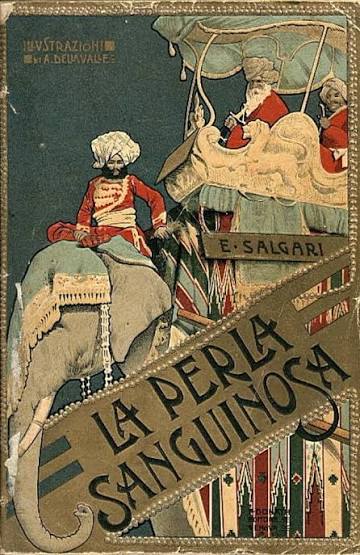
Although he went by the moniker "Captain Salgari," the Veronese writer never actually traveled; for his novels, he relied on the numerous accounts of explorers and geographers who brought back to Europe tales of hitherto unknown worlds—accounts that blended reliable reports with fanciful inventions, steeped in a burgeoning racism. Our author was always deft at promptly seizing upon "the trend," chasing the public’s appetite for strange and exotic novelties. Right from the mysterious and evocative title, one enters the atmosphere: *La perla sanguinosa* (*The Bloody Pearl*) is a pearl of rare beauty, stolen from a sacred temple in Ceylon (modern-day Sri Lanka) and steeped in the color of the blood of the thief who took it, only to drown later in the great shoal of Manaar, an extensive shallow reef situated between southern India and Ceylon. Behind the pearl lies a love story: a maiden has been forced to become a Buddhist nun and can only be redeemed through the delivery of the bloody pearl; vying for both pearl and maiden are a humble pearl diver and the One-Eyed, a villainous impostor. Both are held in the prison of Port Cornwallis, a British penal colony located in the Andaman archipelago, a group of islands in the center of the Bay of Bengal. It is from this prison that the novel sets forth: three inmates (our diver, an English sailor, and an Indian machinist, all wrongfully imprisoned) manage to escape the colony and head toward Ceylon in a fragile boat to recover the bloody pearl and redeem the beloved maiden. Not only are they pursued by the One-Eyed, but they must also confront a series of ordeals: from the assault of a sea vampire—perhaps a "lamprey," a fish with a sucker mouth that feeds on blood—to a terrible storm with gigantic waves, culminating in their capture by the Queen of Nicobar, who wishes to take the handsome Englishman as her husband, much like Circe with Odysseus. Salgari’s imagination knows no bounds, conjuring up the Vadassi, whose valiant chieftain Adikar—fascinated by Napoleon—sought to emulate his deeds and lead his people to triumph, a sort of feral Sandokan; and what of the "crucified dolphins," in reality a small cetacean that inhabits Antarctic waters, far removed from the Bay of Bengal. To this muddled wealth of geographical, zoological, and anthropological references corresponds an equally muddled plot, packed with adventures that are all too often repetitive and prolix. Salgari’s narrative formula hinges on a central protagonist flanked by supporting characters who leaven the narration and throw the hero into sharp relief. When he departed from this model successfully, as in *Capitan Tempesta* and *La stella dell'Araucania* (see the reviews on this site), it was because he proved capable of constructing a compelling, intense love story. The setting, while ever-present, always remained in the background, instrumental in evoking an exotic and mysterious atmosphere. Here, the narrative functions are inverted: setting takes center stage; the band of fleeing prisoners is flat, devoid of a true leader (the Englishman predictably emerges, yet remains a faded figure), and lacks any clear hierarchy of roles; the love story remains suspended and remote, and the villain is easily defeated. Layering adventure upon harrowing description fails to impart rhythm to the narrative or captivate the reader. One finds solace only in a few isolated descriptions, as in the recounting of the struggle with the vampire: > it had wrapped itself around my body with all its tentacles, and the monster’s eyes—those huge, glaucous eyes—were fixed upon me, motionless, as if relishing my torment; and through that nearly transparent body, I watched the transfusion of my own blood flowing from the suckers into its mouth and passing thence into the ventricle. Why read it? As a testament to how the world was viewed in nineteenth-century Italy.
The Fourth Summer
Following an eventful journey and having lost her luggage, the young doctor Andrea Dalvina Zanardelli arrives in Ravenna to take up work at the Marina di Ravenna sanatorium, where "scrofulous" children from the orphanage are treated. The year is 1943. Dalvina comes from an affluent family on Lake Garda. Her very first encounter surprises her, when at the station she is asked whether she needs to go to Marina or to Abyssinia. Then there is this strange landscape, so distant from her idea of the sea: > a sort of swamp, a pool of rippled water that one sensed was barely deeper than a puddle, and which are called "valli" (or piallasse), like those in her mountains. From the outset, she felt its charm, a > wild charm, (...) burdened by the toil of poor folk, (...) the camaraderie among the sailors, the respectful silence with which they greeted one another while puffing on clay pipes, and because of all this (...) she felt rather at home. For her, the lovely girl *with apricot-coloured hair*, little was needed: > her character demanded frankness, authenticity, for she felt she belonged to simple stories. And so she immediately took to the sanatorium, > the absolute radiance of the place, the ceaseless breaking of the waves, the briny taste clinging to the flesh, (... the orderly simplicity of the rooms and the quiet diligence of the nuns, bearing peculiar names such as Leopola, Nolasca, Zoefe, Benespera, Galizia: a community of religious women devoted to Saint Dalmazia, yet always and above all women, with their secrets and their loves, not necessarily directed solely to Christ. Over the span of a few months, a "simple" story unfolds—a microhistory set against the grand history sweeping across Italy, from the Allied landing to Mussolini's downfall and the German invasion. Up until 8 September 1943, the author recounts these events through the madness of the sanatorium’s previous physician, who was removed and institutionalized because he believes himself to be Benito Mussolini: a deft metaphor for the folly that dragged our country into war. Then, at a certain point, it is no longer possible to hide behind the incurable rhetorical delusions of a poor madman: > the word "bombing" had just entered, with all its disruptive force, into the organized routine of the sanatorium. What had seemed stable and everlasting now wavered, was no more, and by any measure of logic no guarantee, no immunity could be foreseen. For just a while longer, we readers hope to remain immune to the war, able to follow Dalvina as she discovers herself, her body yearning for love, and her maternal side, which binds her inextricably to a poor scrofulous boy—not out of pity, but because > she felt those whispers creep into her flesh, cross barriers and defenses, and reawaken an intimate, indecipherable unease that made her start, and certainly not because of the mysterious origin of the words. Yet destiny looms over us all, its meaning difficult to discern because it pays no heed to Love and Hope: > bombs are hardly obedient, nor are they intelligent. They go wherever they please. (...) Yearning to dream. And so who knows, perhaps she had made up this whole fable of nuns, sea, and children. Her children. These are Dalvina's final thoughts. And had everything remained a dream, might she have been saved? Paolo Casadio possesses the ability to take small, real facts—the fruit of meticulous archival research—and build stories that invariably feature an enchanted "Setting", steeped in mystery and magic. In his debut novel, *Il bambino del treno*, it is a small station along the Faenza–Florence railway line that serves as the backdrop to a true event. In the subsequent *Fiordicotone*, the setting is Lugo di Romagna, although this narrative effort is less successful than the former because the author scatters his focus across too many themes and departs from his smooth, elegant prose—Casadio's quintessential virtue (see the reviews on this site). Here, by contrast, the Romagnol author is at his best: the reconstruction of Marina di Ravenna's atmosphere, so different from what it is today, evokes in the reader indecipherable, fairy-tale sensations, and it is easy to imagine how captivating it must have been for an educated girl from the North; the nuns' personalities are portrayed with affectionate irony, and we seem to see them right before our eyes, in their feminine passions and their nonetheless steadfast faith; and what of the "scrofulous" children, growing increasingly unruly and lively as their health improves (thanks also to the herbs of the pine woods); and then that gem of the delusional patient who believes himself to be Mussolini, amusing yet realistic. Perhaps the only shortcoming concerns the figure of Dalvina, drawn with insufficient psychological depth and constantly relying on hints of past wounds, which remain unresolved and prevent us from fully grasping her personality. And finally, we readers are left disappointed, having expected a happy ending. Why read it? It is a wonderful novel, an enjoyable and compelling read.

Lineage and Blood
In fifteenth-century Transylvania, > there is a story fording rivers, flying through leafy woods, and snagging on the lips of passersby. A tale that horrifies, (...) an immortal creature of violent hunger, thirsty for blood, seemingly roams the countryside. (...) For two months, a comet has been furrowing the sky like a knife wound from which drips the blood of creation. It is Dracula—not the historical Count Vlad Dracula, who, despite his cruelty, was certainly neither immortal nor nourished by the blood of his victims. In our story, he is Radu, a slight adolescent, a predator ever ready to spring at the throat, > swift as a flea, but with a lethal bite, (...) a maddened, spurting moth. In a narrative paced by death itself, within an environment ravaged by wars, violence, and massacres, enveloped in a bleak, terrifying atmosphere where the sun never seems to shine, a small family struggles to survive: Maria, the mother, deeply versed in herbs, even those that kill—a witch, perhaps; Anna, the daughter who, still a child, must protect her newborn brother; and Radu himself, who, still an infant, must feed on blood, unable to draw sustenance from his mother's depleted milk. > He is tiny, purple, smeared with blood and woman's humors. He ought to die, says the midwife, because > he is not wanted by the spirits of the wind, (...) Anna snatches him from her hands and presses him to her chest; his first wail is born there, in the arms of his little sister. And so Radu, the future "vampire," is the fruit of his little sister's love—she carries him along, watches over him and hides him, giving him whatever meager food she can find. In the forest, the small family must defend themselves against wild beasts; when abducted, they must save themselves from men. There is no need to delve further into the plot, intensely Gothic in its framework, so surreal as to verge on "Fantasy"; it is better to let oneself be carried away by the imagination, and to consider this tale, so distant in time, as ultimately a metaphor for our current condition: wars, massacres, violence, and genocides can only give birth to a Monster; and we are left to wonder whether Anna did right in saving and nourishing Dracula, offering him all her love. There is no sense in comparing this novel to Bram Stoker's *Dracula* (see the review on this site): a work steeped in positivism that recounts the clash between science and the unknowable, where Dracula is not a real character, but an allegory for our deepest, unutterable drives. Perhaps, beyond its Gothic undertones, the novel is the continuation of *La Colpa* (see the review on this site). Certain themes seem to recur: the untamed environment (here Transylvania, there the desertified Marecchia); in both, "the lucid madness of constructing possibilities that are terrible because they are plausible, (...) a naked, reddened, dripping Prometheus..."; an existential dimension where only friendship and love can save. In *La stirpe e il sangue*, written ten years after *La Colpa*, it seems the author has slipped into that very precipice envisioned in the 2012 novel, and only by retreating into Fantasy was she able to survive. The fundamental merit of the narrative lies in the writing: short yet evocative sentences, almost prose verse, that embed themselves in the reader's mind. One senses the influence of a poet like Beatrice Masini. Why read it? It is gory, at times excessively so, but the prose captivates. And so tender is the figure of Anna.

The Eternal Virgin
The author imagines a former schoolmate, now a film producer, proposing that he write the screenplay for a film based on *Michael Kohlhaas*, an 1810 novella by Heinrich von Kleist. The plot lends itself to a theme particularly dear to Kenzaburo Oe: that of freedom and rebellion against the abuses of Power. Set in the sixteenth century, Von Kleist's novella recounts the story of a horse dealer who refuses to accept being robbed and humiliated by a powerful feudal lord and, stubbornly and desperately, fights for Justice. It is only natural for Kenzaburo to transpose this tragic tale to the peasant uprisings that shook Japan in the second half of the nineteenth century, which swept through the writer's own native village, as previously described in *The Water Forest* (see the review on this site). Such is the context thus far; yet from the very first pages, one senses that something else lies beneath the plot, as though the screenplay were unleashing primordial forces that well up from the underground of the human soul. Unlike Fyodor Dostoevsky's *Notes from Underground* (see the review on this site), here it is not malice, but that subtle, ambiguous, and shameless desire for erotic fantasies that can still overpower an old man. Indeed, the novel is structured around two distinct periods in Kenzaburo's life: in the first, he is already an established writer, yet deeply depressed and trapped in a severe creative crisis; in the second, he is an elderly gentleman in physical decline. The clue to an "underground" theme beneath the official plot is found in the quotation of a poem by Edgar Allan Poe, written in 1849, the year of Poe's death (how many "allegorical" references abound in the great Japanese author!): "It was many and many a year ago / in a kingdom by the sea / that a maiden there lived whom you may know / by the name of Annabel Lee; / and this maiden she lived with no other thought / than to love and be loved by me". These are Poe's verses, laden with erotic evocations; but who is Annabel Lee to Kenzaburo Oe? She is Sakura-san, a Japanese actress famous in Hollywood whom the producer wishes to cast as the lead in the film on Michael Kohlhaas. As coincidence would have it, Kenzaburo had already seen the young Sakura—and had been "captivated" by her—in a short film on Annabel, where Sakura, then still a child, starred in the final scene in the guise of a > maiden in a flowing white gown, who beneath the purity of the image possessed > something ambiguous and mysterious. The novel's plot unfolds around Sakura's "underground," beyond her calm, self-assured demeanor. First of all, the actress is determined to center the film on the woman who led the peasant revolt in the second half of the nineteenth century and who was gang-raped before being murdered: the ordeal of this woman, known in legend as Meisuke's mother, was the subject of a stage play organized by Kenzaburo's grandmother and mother, in which the writer took part as a young boy. Later, the writer learns that Sakura is known as the "Eternal Virgin": while still a child, Sakura was taken to America by a soldier who became her husband and launched her film career; a man who loved her, yet with whom Sakura was never able to consummate a full sexual relationship. It is from this that a recurring nightmare of Sakura's arises: > in the dream I felt an unspeakable fear, yet I didn't quite know why; I couldn't bring it into focus. And yet in that short film on Annabel Lee, directed by her husband himself, such purity shone through the image of the child Sakura reclining on a tree trunk by the riverbank, just as in Poe's poem. But there was something else, something hideous in the short film's ending—a conclusion kept hidden, and which Sakura unconsciously sought to retrace as the lead in the theatrical staging of the tragic tale of Meisuke's mother. > Thanks to an extremely placid and bucolic passage, I was even able to imagine Meisuke's mother setting out along a mountain path leading deep into the forest. (...) I felt a profound regret, thinking that I had lived so many years without reflecting deeply on what might truly lie hidden beyond this path; I had become a seventy-year-old man who had done nothing but listen to that melody, so simple and pure (Beethoven's Piano Sonata Opus 111, accompanying the short film on Annabel Lee), which dragged me inexorably toward the unknown. I could not, and will never be able to, rid myself of the image of that thick, stubby thumb forcing its way into that small slit.... > I awake in the darkness that precedes dawn, floundering among the agonized shreds of dreams that still linger in my consciousness, in search of a burning sensation of anticipation. (..) I have slept with my arms and legs bent to the side, in the posture of someone who refuses to remember his own nature or the predicament in which he finds himself. So writes Kenzaburo Oe in *The Silent Cry* (see the review on this site), as if to express what we have repressed our whole lives, only for it to return in old age, fiercer than ever. In *The Eternal Virgin*, it is an old man's erotic impulses, in a narrative revolving around a woman who is captivating precisely because of her deepest secrets—so deeply buried in the "underground" of the soul as to be unknown even to herself. Artistic creation is essential to dredge a lifetime of grief back to the surface. The novel is a hymn to literature, to its capacity to interweave historical events, literary references, self-reflection, and therapeutic powers. One senses an undercurrent of regret for what was left undone, and unlived. It is a flawless novel! To be sure, with subtle irony, Kenzaburo pokes fun at his own tendency to lose himself in the narrative, to often be verbose and rambling. That cannot be said of this work: the plot develops seamlessly, steering the reader with a steady hand toward the dark core of the story. The success of the narrative stems, perhaps, from having focused on a single character who grows and asserts herself, slowly but inexorably, throughout the novel, in search of herself and of her determination to remain authentic, like a Japanese Anna Karenina (see the review of Tolstoy's masterpiece on this site). The prose flows with elegance and precision, displaying such stylistic mastery as to leave one astounded. Why read it? It is a masterpiece.
The Killer's Tears
Children are increasingly the innocent victims of war, violence, and death. One need only consider what we are witnessing today, in Ukraine and Palestine. For a child who has seen their parents murdered, is it still possible to rebuild a life? And can one forge a relationship with the killer capable of saving his soul? This novel is aimed at adolescents, yet it tackles weighty themes—unfortunately through a narrative approach reminiscent of Antoine de Saint-Exupéry's *The Little Prince*: bland, moralistic, implausible (see the review of *The Little Prince* on this site). Pablo lives with his parents in a small house in the far south of Chile, > where no one ever arrives by chance. Angel is a killer. When taken in by Pablo's parents, he cannot help but murder them, because it is the only thing he knows how to do. While Pablo is away from the house, > out there, from the sea, dense rainclouds were rolling in. (...) Angel drew a knife and plunged it into the man's throat, then into the woman's. On the table, wine and blood mingled, staining red all the deep cracks in the wood. Angel does not kill Pablo. > Sparing the brat made him feel relieved. And, besides, he could send him to the well to fetch water. Over time, a complex relationship develops between Angel and Pablo; it is a bond of mutual dependence: for Angel, it is the first time he has ever felt affection for anyone; for Pablo, > Angel is the only person who cared for him, fed him, gave him the fox (which they had taken in when it was still a cub), (...) in a world where only the dead can rest, the living must grit their teeth and endure their existence. One day, walking across the vast and desolate Chilean countryside, Pablo and Angel come across an isolated house in a forest, where an old woodcutter lives. Here, they could live in peace; the goodness inherent in every man could even express itself in Angel. > There are very discreet metamorphoses, said the old man; those that happen to our soul, for example, are not always visible. (...) Angel seized the knife hidden in his pocket; he felt the handle between his fingers. (...) He stepped toward Pablo. (...) He laid his eyes on Pablo. (...) “Here,” he said, “this is for you.” The silence was absolute. The knife blade reflected the flicker of the candles. We can rediscover peace and brotherhood if even the worst of murderers can love a child. An important theme is handled in a superficial and ambiguous way. First and foremost, it is implausible that a child who witnessed the murder of his parents could overcome the trauma as easily as Pablo does: this trivializes Evil, reducing it to something inconsequential. Secondly, love cannot save the soul of a wicked man unless he acknowledges his guilt and seeks forgiveness. Weeping and making a noble gesture are not enough. Why not read it? It is false.
The Thief and the Dogs
The novel depicts the gradual exhaustion of a man who, upon his release from prison, finds himself abandoned by the most significant figures in his life (his wife, his daughter, and his friend) and pursues an impossible revenge. It is a psychological and introspective journey (a sort of inward retreat) during which the protagonist fails even to perceive the love of those around him (the woman who took him into her home), dominated as he is by a delusion of omnipotence and victimhood that causes him to lose sight of genuine feelings in his pursuit of nothing but vengeance. No distinct setting emerges: Cairo and Egyptian society merely serve as a backdrop, but the narrative could just as easily be set in any other city. This is an apt choice, as the story is psychological and therefore common to all human beings, rather than bound to a specific social context. Yet, as an introspective work, it fails to leave a strong impression, and both the plot and the depiction of emotions feel predictable.
The Lantern of Diogenes
This is a narrative that can be divided into two parts. In the first, the author recounts his bicycle journey from Milan to the Romagna coast, although, in reality, he stops in the mountains of Modena. The second part depicts his stay in Bellaria. The first part is very fine and lively. One senses a feeling of escapism, of flight from the city and industrial society; the landscape, the inns, and the people encountered are described in a style that is ironic yet affectionate. In these pages, there also prevails a literary self-indulgence, in both diction and references, which comes at the expense of the narrative’s spontaneity. In the second part, this characteristic becomes more pronounced, accompanied by a lyricism that seeks effect for its own sake and remains redundant in relation to the story’s content. The subject, indeed, is Romagna at the beginning of the twentieth century, with the harshness of its life, its poverty, and its squalor. The journey to Comacchio is remarkable: the arduous bicycle route, the town in the evening, the overnight stay, and so forth. The depiction of the family living in a shack on the beach takes on almost Verist undertones: the man’s ravenous meal, the children’s curiosity, and the woman’s ragged clothes. Yet the powerful character of these pages is lost in a generic, conservative moralism, when the writer reminds us that misfortunes can strike any social class: his companion suffers from a serious illness that forces him onto a strict diet! As the 1935 Treccani Encyclopedia writes (an era beyond suspicion from a political standpoint), Panzini’s work tends, > despite its classicist premises and its intentions of objectivity, of composure... , toward lyrical confession, impressionistic notation, an interior soliloquy varied by melodic cadences and veritable flights of song ; all traits that made reading another work, *Viaggio di un povero letterato*, unbearable.
The Dark Side of the Moon
> Come to this wall if you hate your place/and face a taste of cosmic space/where no form of life can exist/and objects do nothing but fall (Joseph Brodsky, *The Berlin Wall Song*, 1983, from the special insert of *Internazionale*, 2019). This poem apt encapsulates the narrative under review, set in Berlin in 1975. It is no coincidence that the opening image is that of a bird falling, as if out of nowhere, at the feet of one of the protagonists, sixteen-year-old Sven. The boy has just fallen in love with a peer: green-haired Cloe. > I wish I could remember what we talked about. I really do. And yet, nothing. What I remember is that Cloe’s right shoe and my left shoe brushed against each other (...); I remember her skin, on her wrist, almost translucent, and her tense arms and her head hunched into her shoulders. Her hair. (...) Every now and then Cloe would turn and give me a strange look . It would seem like a typical adolescent story, and for a long time the narrative unfolds slowly and prosaically around the two teenagers, who alternate as narrators with a somewhat repetitive cadence. We gather from subtle clues that Sven and Cloe’s circumstances are profoundly different. Sven lives in a “normal” family: his parents, small shopkeepers, would still like to control the boy, but are too consumed by arguing and separating. Cloe was abandoned by her mother, has an eccentric, fragile father who drifts through precarious jobs, and must care for her grandmother, who suffers from Alzheimer’s. She survives an attempted rape, is at times seized by suicidal urges, and procures a gun to avenge the assault given her father’s pusillanimous inertia; inwardly, she scoffs at the romantic Sven for wanting to help her. > Trust by the bucketload. In what he does. In who he is. In what awaits him. Probably, he even trusts me. (...) Stomach-turning stuff . But this is Berlin, where a Wall divides the city, and to those who, like Cloe and Sven, live in the West, the East seems a mysterious place, albeit so remarkably similar: > streets and buildings, and more streets and other buildings, just like here. Perhaps, looking closer, it would have been different, but I had never been to East Berlin. There had never been any reason . Kurt, Sven’s best friend, wants to liberate Frida, his childhood sweetheart who lives in East Berlin. The plan fails because Kurt and Frida are taken prisoner by a criminal gang; upon learning this, Sven resolves to go rescue them, and Cloe decides to help him. Why? Does she love him after all? Nothing of the sort. > Berlin is at our feet, burning in the sunset, (...) it is a promise. And the East burns too, where I have never been, yet even just seeing it from here, (...) it is a promise. (...) A promise of adventures like the ones when I was little, but more exciting. And wilder. (...) My hand gripping a gun. Nothing is real. That is why I want to enjoy everything, and I want to suck every moment down to the marrow . In an adventure that tastes of a thriller and lacks a happy ending, Cloe is irrevocably lost, but Sven fails to grasp this and searches for her in vain. One is led to wonder whether this is merely an adolescent story, or rather a tale that speaks of ourselves, of that “no man’s land,” of that > painful time that for me and you and all of us painfully wears away (Arrigo Bertolucci "time wears away" from *Viaggio d'inverno*). And if the poet finds his son again in the crowd at midday Mass, such is not the case for Sven: with a restless, naive gaze he searches for Cloe through a tumultuous and indifferent Berlin, believing that love alone can save her, can redeem us. Bleak is our fate! It is a fine novel: the writing is clear and precise, the protagonists intense, and the plot well-crafted, gripping us from a certain point onward and building suspense. At times one gets the impression of something contrived, deliberately engineered, but this feeling is overcome by the landscape of Berlin—deeply loved by the two authors—and by its steering clear of the expected conclusion, the happy ending. Why read it? Highly compelling; the figure of Cloe is fascinating!

White Nights
> I am a Dreamer... I have so little real life! In reality, I have lived moments such as these so rarely that I hope to make them live again in my dreams. I will dream of you all night, every week, every month, all year round.... This is how the first-person narrator expresses himself when, one night, he meets a weeping girl who also describes herself as a "dreamer." We will never learn his name; hers we discover is Nasten'ka, and she lives with her grandmother, who keeps her pinned to her skirt with a safety pin to prevent her from wandering off. It is a peculiar sort of cloistering, given that Nasten'ka slips out into the night without trouble and has embarked on a relationship with a young neighbor who promised to marry her—an improbable, "tear-jerking" tale that would have seduced no one but our naive Dreamer. On the other hand, he is a young man disillusioned with life, possessing *a fantasy sick with anguish*, waiting for a > spark from which to flare up a fire to warm the frozen heart, from which to revive that which was once so dear, which touched the soul and made the blood boil, which drew tears from the eyes and deceived so majestically. And if for Nasten'ka the encounter is a way to console herself and, if you will, a coquettish, self-victimizing pose to win admiration and toy with feelings, for the Dreamer the young woman is the continuation of the Dream, of a fantasy of Love. > Oh Nasten'ka, Nasten'ka, if only you knew how alone I am. the Dreamer cries out, as though the girl could, or wished to, fill his void. Poor Dreamer! The subtle game of seduction is carried to the point where our Dreamer is ready to marry her, given that Nasten'ka's betrothed has failed to show up to honor his promise of taking her to the altar. Better a Dreamer than an old maid pinned to her grandmother's skirts! > I had looked at her... She had leaned against me more heavily. At that moment a young man passed us by. (...) God, what a cry! What a shudder! How she tore herself from my arms to run toward him. (...) I remained there, for a long time, watching them... In the end, both had vanished from my sight. In her fine introduction, Sarah Tardino evokes the distant love of the Provençal poet Jaufré Rudel; in this light, Nasten'ka would be a Fantasy of Love, a figure both idealized and real who, as Giosuè Carducci sang, "three times the trembling mouth / with love’s kiss did kiss." Far too much grace for the wretched Dreamer! This interpretation focuses attention on the relationship between the two youths, losing sight of the core of the tale: the Dream. Within a narrative structure hinged upon dialogue, the story is actually a long soliloquy, in which the part recounted by Nasten'ka is merely the distorted mirror of the Dreamer's suffering and of his need to construct a narrative wherein he is the protagonist, the savior of the sorrowful maiden. In this dialogue born of the Dreamer's fantasy, Nasten'ka asks herself > why can we not all be like brothers? (...) Why can one not speak plainly what is in one's heart...? Why can the Dream not become real, I would add? Why can one not meet someone to confide in, and fall in love with, with whom to escape from loneliness? Or perhaps, it is better to go on dreaming. Why read it? A fragile tale, difficult to grasp, yet admirably written.
Reading
The book aims to be a middle ground between a praise of books—that is, of reading—and the very meaning of reading. The author surveys numerous writers and texts to ultimately demonstrate how writing manages to portray, in differing ways, seemingly similar situations and contexts. Furthermore, reading is an introspective process through which people actively interpret the resonances emerging from events and words. Writing is thus the conduit between a story and the reader's personal life: rather than merely understanding the writer, the reader pursues their own spiritual path, activated and nourished by reading. Two statements from the book leave a lasting impression, one from the writer’s perspective and the other from the reader’s: Petrarch says in *Epistulae Familiares* > I want my reader, whoever he may be, to think only of me... I do not want him to attend to his business and study at the same time; I do not want him to master effortlessly what I wrote not without effort ; Machiavelli says in a 1513 letter to Vettori: > when evening comes, I return home and enter my study... and for four hours I feel no boredom; I forget every worry, I do not fear poverty; death does not dismay me . The book is an enjoyable read, but it feels a «bit strained», lacking a true underlying thread.
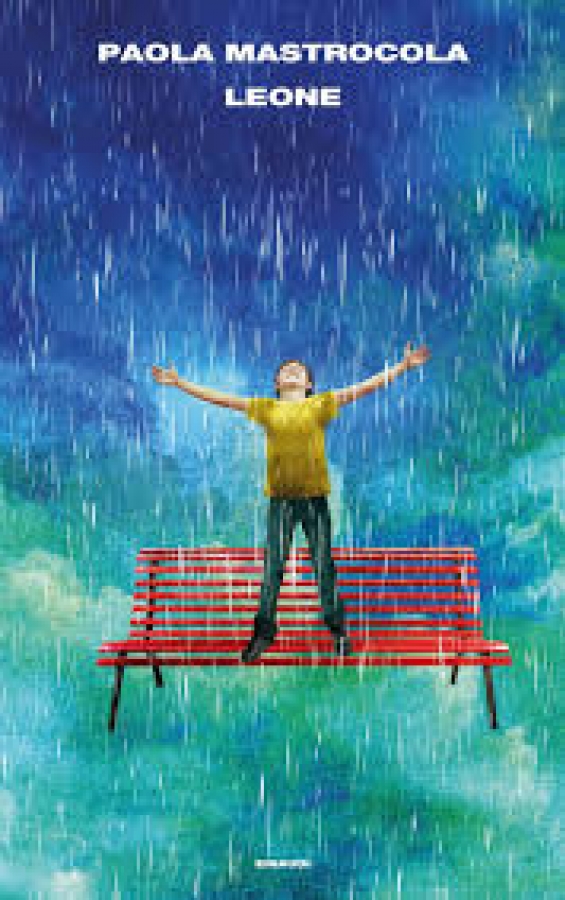
Lion
Social convention would have parents serve as the solid foundation of the family, and children as its fragile walls, in need of guidance and support. In this strange novel, that is not the case. Katia, a divorced mother, lives in uncertainty, > she felt somewhat on the border, between city and countryside, between the world as it had been and the new one just beginning. She was comfortable there, suspended halfway. (...) She had no great desires or hopes. It was merely the notion that perhaps, one fine day, things might take a different turn for her . Leone, on the other hand, a six-year-old boy, possesses an unshakable certainty: he prays, because he believes in Jesus, even if only in the form of a ceramic figurine. What harm is there in that? ask Katia’s friends, mildly incredulous and affectionately wry; yet the child heads in an unexpected direction—and, truth be told, an unconventional one in our falsely devout society. Katia is worried, racked with guilt; Leone of all people, so profoundly disoriented. > A child who seemed to have gotten lost in the middle of something, a wood at night during the age of dinosaurs. (...) At times he seems to her like an angel, stranded in their kitchen, trying to flutter about without a sky . Through a singular lens—the need to pray—the author explores the bond between mother and son. She > felt brimming with tenderness for this child who had come into her life just like that, without her ever having decided on it. Like a mushroom, a flower. (...) A flower might not have any passersby at all, if it happens to grow on a patch of land where no one ever walks. It can happen that a flower is born and no one ever sees it. And what about children? And Leone, who “moved diagonally rather than straight,” who tried to > exist as little as possible. (...) Exercises in nonexistence, one might say. (...) Jesus, please make them stop talking about me . The author avoids any potential psychological detours toward dissecting parent-child relationships; she has no interest in seizing upon the narrative to offer futile wisdom or banal insights: she chronicles the events gently, passing no judgment on the mother or the other adults. This is a virtue—one that might have led us to appreciate the tale had the author managed to impart narrative rhythm to the story, rather than allowing herself to drift into a slow, tedious progression. Perhaps realizing, at a certain point, that the narrative was fraying into nothingness, the author resorted to the miraculous, and even to a new deluge. Prayer becomes redemptive of humanity’s sins, and Leone a miniature, modern-day Jesus. Yet that is not quite it, because—further degrading the quality of the narrative—Mastrocola never commits herself, maintaining a hypocritical, pseudo-secular stance. The reader comes away embittered. It could have been an interesting story; it proved instead to be a cloying tale: if the intention was to demonstrate that there exists within us, from childhood onward, an innate yearning for the sacred, and that prayer is an intrinsic dimension of existence, this theological question is trivialized by a narrative far too inadequate for the subject's complexity. Compounding matters is the prose style: a repetitive writing built upon flat phrasing, marked by an excessive reliance on the full stop, by verbless complete sentences—in short, an approach that willingly slips into the simplistic vernacular of journalistic or television storytelling: there would be nothing wrong with this, were the novel supported by a compelling plot and by a penetrating, evocative analysis of characters and circumstances. Why not read it? It is pointless, and ultimately cloying.
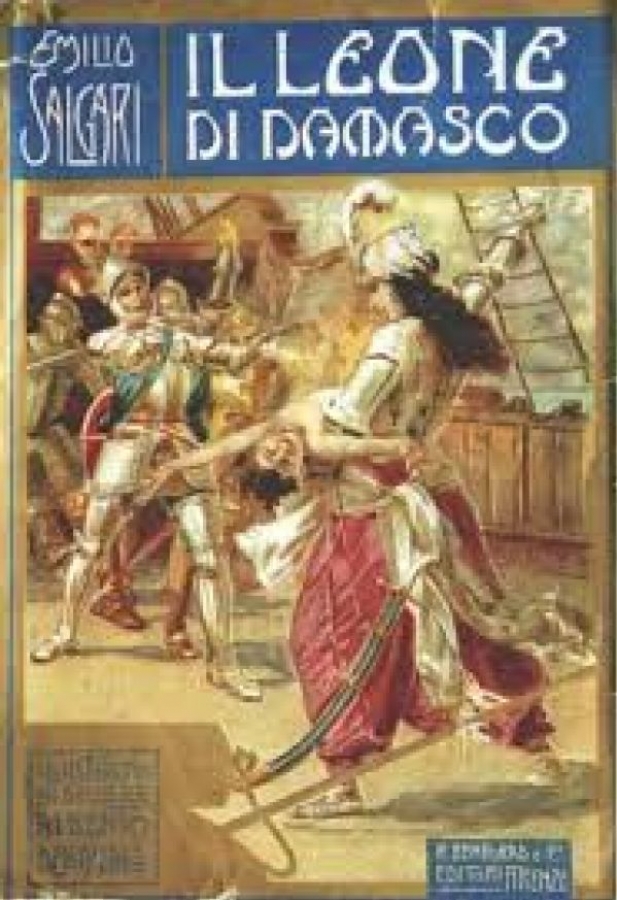
The Lion of Damascus
The novel is meant to be the sequel to *Capitan Tempesta*, a tale set in Famagusta in 1517 during the war between the Venetians and the Turks. The protagonist was a young noblewoman: a skilled swordswoman who, disguised as a man, had set out in search of her betrothed, abducted by the terrible Haradja. Salgari had succeeded in crafting a story full of allure, working upon gender ambiguity, vigorous female figures, and a final plot twist: the love between Capitan Tempesta and the Lion of Damascus—a passion that disregarded different allegiances, both national and religious. One would expect the same intriguing atmosphere and the very same freedom from convention. And the opening shows promise, even if certain signs make it clear from the outset that the story will take a different turn. It begins with the figure of Haradja: > a very beautiful young woman (...) pitch-black eyes, (...) very long, loose hair, of a hue that gleamed like raven wings... (...) the whole of her face had (...) something hard and forceful that instantly betrayed the Turkish woman, ever cruel at heart, as the bloodthirsty sultans of the fifteenth and sixteenth centuries had by then accustomed them to be . Haradja is no longer an unconventional woman: she is part of a cruel and bloodthirsty breed, that of the Turks, and foul black birds, "eaters of the dead," are the living symbol of thousands upon thousands of corpses, left in the sun to be stripped of their flesh. A grim and deathly atmosphere pervades the entire narrative and strips of narrative momentum the adventures that Salgari, despite everything, attempts to construct. Haradja seeks vengeance against Capitan Tempesta, who deceived her by posing as a man and with whom she had become infatuated; she also intends to punish the Lion of Damascus, formerly her betrothed, who had abandoned her for the Christian noblewoman. She therefore kidnaps the couple’s son and the father of the Lion of Damascus. She holds all the cards: overcome by hatred and above all by pride, she challenges Capitan Tempesta to a duel. > The two horses had collided with such impetuosity that they nearly threw their mistresses from the saddle; then came a clattering of weapons against armor. (...) Haradja continued to attack, trying to force down that sword which flashed with fiery gleams beneath the already scorching rays of the sun. (...) By the death of Allah!, cursed the Pasha's niece (Haradja), (...) You stand firm as a rock, do you?.. And yet I shall kill you! (...) A cry was heard, or rather, the howl of a wounded beast; then the great admiral's niece crashed to the ground with a great clash of steel. (...) Finish off the tigress of Hussiff! , shouted the Lion of Damascus; but numerous Turkish soldiers rushed in, preventing Capitan Tempesta from slaying her terrible rival. It is the finest moment of the novel; thereafter, the narrative loses its bite: Haradja and Capitan Tempesta vanish from the story, the Lion of Damascus is present but relegated to the background, faded and irrelevant, while minor characters emerge who, as often happens in Salgari, try to inject brio and establish a dynamic among the roles; meant to act as foils to the protagonist, they merely underscore his insubstantiality. Instead, a real historical figure comes to the fore: Sebastiano Veniero, the great commander of the Venetian fleet, to whom, according to Salgari, the victory of Lepanto against the Turks was owed. The narrative draws to a weary close. The book was published in 1910, a year before the Libyan War (1911–1912), which pitted Italy against the Ottoman Empire. It is possible that Salgari tapped into sentiments widespread among public opinion: the Turk as a cruel oppressor of peoples, bloodthirsty and treacherous. The novel abounds in massacres, tortures, flayings, quarterings, and other gruesome deeds: there is no mercy on the part of the Turks, nor any chivalrous respect for the vanquished. And the Christians know how to die with honor, whispering the *Miserere* "in the excruciating agony of the horrific torment"! Yet there is too much relentless ferocity here to believe that the novel's deathly atmosphere merely answers to an editorial demand or a nationalist resurgence on the author's part. Salgari took his own life the year following its publication, in 1911: the writer was by then living in a profound depression, plagued by frequent self-destructive crises and numerous suicide attempts; the novel mirrors Salgari's despair and his fascination with a gruesome end. At the same time, the narrative suffers from a weariness and an exhaustion of ideas, which the writer desperately tries to compensate for by resorting to prefabricated formulas, no longer embedded within a dynamic narrative framework: evidence of this lies in the repetitiveness of dialogues and scenes, the weakness of the characters, and the sparse descriptions of landscapes—the latter set against a peculiarity of the novel: historical digressions, generally rare in Salgari's oeuvre, a clear sign of a narrative vein that had grown fragile. Why not read it? It is a swan song, a bitter and sorrowful epilogue to a great writer.
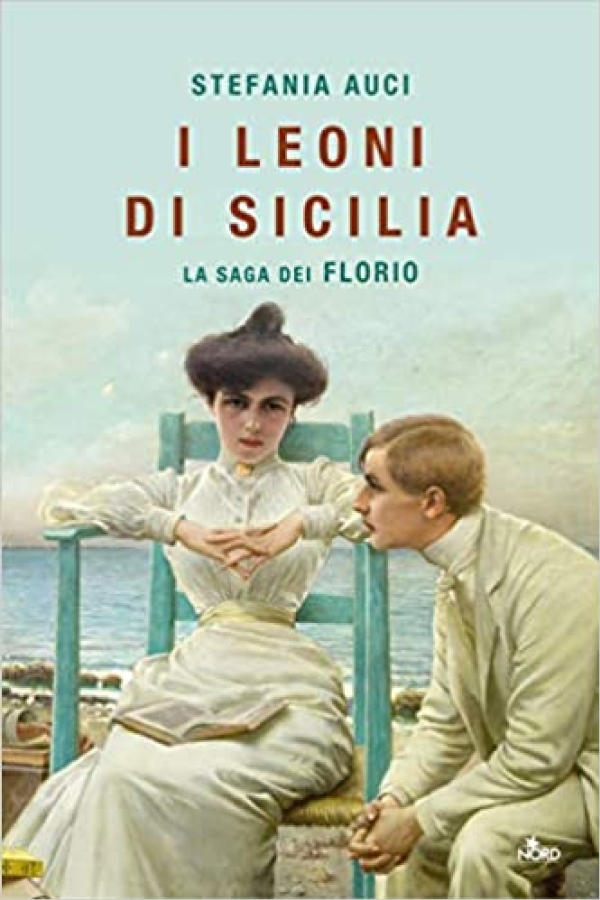
The Lions of Sicily
The novel traces the entrepreneurial and human history of the Florio family across a century, from 1799 to 1869, when economic and social success was fully achieved; and it does so by structuring the narrative around the commodities that laid the foundation for that success: Spices, Silk, Bark (from which quinine is derived), Sulfur, Lace, Tuna, and Sand. Historically speaking, perhaps it would have been appropriate to place greater emphasis on the other cornerstones of their rise: the fleet of steamships and thus technology, the concessions secured from the Bourbons and later from the new Kingdom, the usurious loans extended to the indebted Palermitan aristocracy, and their unscrupulous ties to political power. It is a grand family saga, boasting strong male figures while the female ones are relegated to supporting roles. If one were to seek a single interpretive key, it could be found in the John Milton quotation the author places at the opening: > The study of revenge, immortal hate, / And courage never to submit or yield . The Florios hail from a small Calabrian village, and Paolo's decision to open a spice shop in Palermo creates a rift within the family: a dispute that lies at the root of a ruthless resentment never to be overcome, which shapes the very relationship between mother and son. Another element that hangs heavy over the entire story is Palermo: > strange city, wretched, filthy, and regal all at once, (...) they cannot fathom how the stench of the sewer can coexist with the scent of orange blossoms and jasmine adorning the courtyards of aristocratic palazzi. (...) As much as he might love her and consider himself her son, Palermo treated him as an outsider. He had tried to win her acceptance, had wooed her with wealth, had provided work, had brought prosperity. Perhaps this was what could not be forgiven: the work. The power. The eyes opened wide to the world, while Palermo kept hers firmly shut . The Calabrian roots, as «bagnaroti», weigh on the Florios and lend them a hardness of character in business as well as in human relations. When Vincenzo, Paolo’s son, falls in love with Giulia, he makes her his mistress because the young woman does not belong to the Palermitan aristocracy; after two illegitimate daughters, he will marry her only when Giulia gives him a male heir and no noble daughter will have him as a husband, because he remains a «bagnaroto», wealthy though he may be. Thus Ignazio, Vincenzo’s son, chooses not to pursue the woman he loves, marrying a young aristocrat instead—at long last. In a suspended moment, stepping outside the role to which he is condemned, Ignazio looks at his mother. > And it is in that moment that he notices the dark circles under her eyes, the wrinkles around her lips, the lined forehead. How could she have aged so much? When did it happen? To answer these questions, it would be necessary to unveil the inner world, the domain of feelings between mother and son, between husband and wife. Instead, there is an > ancient rift, which business and the intimacy forged over long years of proximity had been unable to heal. Intimacy, indeed. Not that of feelings... The book could be defined as a fictionalized biography: a reconstruction of the historical context, an examination of the available documentation (how extensive remains unclear, not least because sources are not cited), and a narration of characters and events likely filtered through the author’s imagination. There was ample room to lend depth to the protagonists, especially the female ones. Take Giulia, for instance. She is introduced as a character rich in personality; raised within an entrepreneurial Milanese family, she is educated and well-versed in the dynamics of the business world. How is it possible that she succumbed so easily to the role of mistress and then to that of obedient wife, asserting her strength only in the bedroom? Why not "invent" a more complex, conflictual relationship between Vincenzo and Giulia? In the same vein, a slumberous, alluring Palermo lingers in the background; only rarely do the colors and sounds of a city undeniably known and loved by the author break through. Constrained by the family tree, the writer left no room for imagination, all too often reducing the narrative to a chronicle. For someone like me, who appreciates rich, adjective-laden, almost baroque prose, an initial sense of resistance prevails against a dry, fragmented narrative style, lexically impoverished and simplistic. Then, perhaps because the writer grows more confident in her voice, one begins to appreciate the prose: it becomes evident that the simplicity is deliberate. The aim is to reach the widest possible readership and focus on the story itself, without getting lost in Pindaric and rhetorical flights of syntax and vocabulary. There remains a lingering nostalgia for a more lush and captivating style. Why read it? It reads smoothly and is interesting, even if not gripping.
The Leopard
The author is billed as a master of the thriller, superior even to Stieg Larsson. In truth, he is merely a pale heir. Harry Hole is a Norwegian crime-squad detective specializing in serial killers. Following an investigation in which the perpetrator attempted to murder his wife and son, Harry quit the force and sank into despair in Hong Kong, amidst alcohol, drugs, and gambling. There, a detective named Kaja tracks him down to convince him to assist the police with another serial killer case. The thriller unfolds, relying primarily on dense dialogue, across several narrative threads: the hunt for the criminal (with multiple investigative leads), the turf war between different factions of the Norwegian police to spearhead the fight against crime, and Harry’s personal struggle in search of his own equilibrium. As one of the potential culprits puts it, > you cannot cheapen your feelings like that. You try to dodge the fact that you, like anyone else, are guided by concepts of right and wrong . And Harry is, deep down, a knight in search of truth, yet he continues to “wander in circles,” unable to find his roots. Throughout the story, he consistently makes the right choices, yet these do not lead him to find “the place to which he belongs.” And the novel closes with Harry, triumphant over crime, but returning to Hong Kong in search of himself. The book is interminable, in the sense that it seems to draw to a close only to reopen again and again, exhausting the reader. The problem is that it lacks suspense, and the protagonists—Harry and Kaja in particular—remain entirely on the surface, their motivations and personal developments never fully coming into focus. Why avoid it? It is a pointless book, fit only for the beach.


Letters of a Novice
The book is structured in epistolary form, a collection of letters exchanged among the various protagonists. The central figure is a young girl, Rita, who, on the verge of taking the veil, writes a letter to a priest confessing her lack of vocation. At first, her arguments appear rational and straightforward; gradually, the account given by the girl—and by the other protagonists—turns ambiguous, increasingly laying bare the complexity of the human soul. Rita is a young woman who genuinely wishes to aspire to goodness and clarity, yet is actually ruled by a languid passion, by far more material fantasies and longings. There is in her a sense of grievance against a fate that forced her to live in a convent from early childhood, contrary to her own sensuality and her yearning for life. The contradiction between appearance (the good, devout maiden) and her true being (the desire to seize the pleasures of life, beginning with love) drives her to cunning and deceit: her true personality emerges, however, over the course of the letters, when, confronted with the facts, she is forced into a gradual unveiling. The other protagonist is the mother. Hers is a clearer personality compared to her daughter's. She is evidently a frustrated, fragile woman who wishes to lean on her daughter, drawing her into her own romantic tribulations. When she realizes that her daughter rejects this role—and indeed deceives her—a deep hatred erupts, rooted in the nuisance of having had to look after a child and then an adolescent: hence also the decision to urge her to become a nun. Alongside the story of these two women are the priests and nuns: the ecclesiastical world acts with hypocrisy, seeking to conceal the scandal that gradually comes to light (Rita has killed a man, and the mother superior is aware of it) and, in some instances, allowing itself to be drawn by the girl into an intimacy that seems to suggest a romantic liaison (as in the case of Don Paolo). As the author states in his preface, > the characters in my book possess this inner diplomacy, but turned to an evil end and to the sole benefit of their indolence and selfishness , but, > the fanatical morality of inner clarity is of no use to art, since it combats and destroys the world of feelings, rendering them fictitious, framed as they are within rules foreign to the complexity of the human soul . The plot is very simple. From childhood, Rita is sent to boarding school. Leaving the country house is traumatic, as it separates her from her grandparents and from nature—the Venetian landscape she deeply loves. The girl experiences all this as an act of cruelty to which she must resign herself. On holiday at her mother's home, Rita believes she has rekindled an affectionate relationship with her, only to realize that the latter merely seeks support for her own fragility and romantic sorrows. In the meantime, she meets a young man with whom she falls in love and wishes to run away. When the young man tells her that he has no intention of fleeing with her, Rita, seized by rage, kills him. At this point, the mother, in agreement with the mother superior, decides to make her a nun in order to conceal the crime and the scandal. Yet Rita's refusal to accept this fate, relying on a series of letters—some anonymous—riddled with lies and half-truths, ultimately brings the crime to light. Now abandoned by all, deemed deranged, the poor girl ends up in prison, where she dies of pneumonia. The world's uncharitable judgment is encapsulated by the priest who delivers the news of her passing: > today I have reflected at length and ascertained that Rita was not good, though liked by all. And for this reason we say with special sorrow: May God have mercy on her! . The book may well be called perfect. The epistolary device, the gentle, lucid prose, the gradual thinning of the descriptions of Venetian landscapes—ever moments of serenity and sweetness—and the ability to bring forth little by little the complexity of the characters are all elements that make the reading enjoyable and richly suggestive.
The Vanished Reader
Vince, an eternally precarious literature teacher, has invented a new profession for himself: bibliotherapy—dispensing reading advice to help people resolve their existential and psychological issues. But do books truly possess this therapeutic power, which «wards off the pull of emptiness and black bile» as the ancient Greeks believed? Or does reading fiction merely and humbly lead us to daydream about another life, with a different ending? Hampered by a tenuous plot and flimsy characters, the novel attempts—perhaps—to answer these questions through two parallel narrative strands. In the first, we witness Vince’s sessions with his patients: women who come to recount their stories to a penniless, inexperienced therapist, sitting on the sofa bed of a squalid studio apartment. Some leave in indignation without paying; others accept his reading recommendations, though we will never know if they actually read the suggested titles. One might anticipate amusing or paradoxical scenes, but in truth, these consultations serve merely as a pretext for the author to flaunt his bookish erudition. Coupled with the French epigraphs opening each chapter, beyond the narrative void, one's mind turns not to Italo Calvino’s *Six Memos for the Next Millennium*, but rather to Matei Vișniec’s *Panic Syndrome in the City of Lights*, in which a chaotic succession of characters and authors overwhelms the reader in the absence of narrative unity (see the review on this site). Whence this compelling urge to foist a disguised bibliography upon us, much like in another tedious and futile book, that of Alba Donati (*The Bookshop on the Hill*, reviewed on this site)? The second strand concerns the disappearance of an elderly female neighbor, who left behind as her only trace a list of books borrowed from a local bookshop. What do all these authors have in common: from Paul Auster to Raymond Chandler and John Updike (several reviews of this author can be found on this site: *Rabbit Redux*, *Terrorist*, *Villages*) all the way to John Fante (on this site you can read reviews of *1933 Was a Bad Year*, *The Brotherhood of the Grape*, *Wait Until Spring, Bandini*), among still others? > Inevitably, I wondered about them too: what relational dilemmas might they illuminate, and to what paths of self-awareness and reconstruction of the personality did they lead? I was terrified by this. Would I ever again read solely for pure, childlike pleasure? It is difficult to find an interpretive key to the novel, beyond the flimsy investigative inquiry, tacked on merely to inject some semblance of pace into the storytelling. Certainly, the grand theme of the interplay between literature and life remains present, along with the yearning or hope of turning our dreams into reality. Perhaps meaning can be wrested from this deluge of cited books by returning to the author's locus: Rome. > Down below, Stassi notes, the city had once again become an anagram to be solved, a charade of streets heading in confusing directions. (...) Walking in Rome means moving toward something without any specific destination. At certain hours, this involuntary commuting becomes the space of a perfect solitude, one that brings neither pain nor sorrow. Lacking any distinct personality, the prose flows smoothly within a skillful syntactic construction, the sentences gliding along effortlessly, unhindered and without friction. What emerges is the impression of an artificial narrative, lifelessly engineered at the desk: «literary emotions», as the author himself admits. Why skip it? Pointless and prolix.

The Free Women of Magliano
Just like *Per le Antiche Scale*, the book is set in an asylum, and the protagonist, who is also the first-person narrator, is a psychiatrist. There is no plot; rather, it is a fragmented narrative composed of descriptions of individual figures—mostly women—within the institution: patients, nurses, nuns, and peasant women from the countryside surrounding the asylum. Some of them, such as Lella, play more than a fleeting role in the tale, yet generally they are all subsumed by madness, as though it were difficult to discern sanity from insanity. > With the mad who communicate their laws I easily settle in, we walk along the same track, and if a sudden onlooker were to judge on the spot which of the two is the sick one, he would find himself uncertain; and this exercise of mine, which on some days I repeat frequently, exhausts me and I return to my corridor in the mist of a vague anguish, almost a convalescent, as if those minutes I spent transferring into the mind of the madman, forsaking my own, were like going into hell, living in the circles, having crossed the cold waters of Hades, and returning to life with my soul still frozen by death . It is, therefore, a series of episodes which, despite their specificity and apparent disarray (almost diary-like), allow several narrative threads to be identified: the tenderness and wonder that emerge from the portraits. It is not the physician writing, nor is there any search for an ideological imprint; the individual characters are described with affection, at times with irony, but always with the acute awareness that there is no escape from madness. The theme of eroticism emerges, clearly revealing how loneliness often lies at the root of the path leading to madness; yet madness is also an inevitable fate, binding together both the poor and the rich. Emblematic is the figure of Lella, who seemed to have emerged from her illness, yet it takes merely another woman showing an interest in the object of her desire (a purely dreamed-of affection) to plunge her back into a depressive crisis and thus into madness once more. The balance is ever precarious. > The woman has a very beautiful face and, strangely, though she implores so, she seems on the verge of laughing, and at moments laughs as if in a blissful intoxication, as though touched in that instant by an amorous joy . Yet madness conceals itself. > Perhaps it was that woman, an ultra-flourishing blonde woman, exuberant and domineering; for several days she had been polite, sweetly accommodating in assisting with every service on the ward; indeed, like a sinless nun, she tended with all piety to another most petulant patient. And this morning I read a letter of hers addressed to her husband where the words declared her spirit lusting for violence and murder ; the serenity of the Tuscan landscape, almost in contrast to the violence and disorder of the asylum. > The plain of Lucca sparkles with harvests from the burst of spring until autumn; it rests in a deep ellipse surrounded by mountains silhouetted clearly against the sky. The Lucchese plain in summer is a shifting-swaying of laughing green, a witty conversation with every fruit and bud, and one’s sight varies and dances and is lost and is refreshed, and by no means do the mountains that distantly encircle it hinder that gladness ; the existential pain of the protagonist, whose anguish stems simultaneously from within himself and from the life of the asylum: the bond between his own existence and the fates of the mad seems the sole reason for overcoming an anguish that would otherwise prove unbearable. > My life is here, in the asylum of Lucca. Here my feelings unfold. Here I reveal myself honestly. Here I watch dawns and sunsets, and time passes beneath my watchful gaze. Inside a room of the asylum I study men and love them. Here I wait: glory and death. From here I depart for holidays. Here, until now, I have returned. And my desire is to make of every grain of this land a calm, orderly, universal speech . Yet there is hope, the love between creatures: all this allows the writer to say that there is, perhaps, a way out of madness and existential anguish. > And of little Lella I hope to say no more, for ample, if heaven has aided me, are the words I have spoken . The book, magnificent, is distinguished by an elegant style—imbued with a classical education—that admirably manages to evoke a dreamlike atmosphere, as though what is narrated were not real but rather the fruit of the author’s imagination and desire. The phrasing, the choice of adjectives, and the diction, often bearing a distinctly Tuscan stamp, make the reading pleasurable while highlighting the dramatic weight of the subject matter.
The Bookshop on the Hill
Alba Donati lives in Milan and works in the press office of a major publisher. How did she come up with the idea of moving to a remote village in Lunigiana to open a bookshop? The novel revolves around this question, and it does so in diary form, day by day. The author's immediate answer is that > things don't just come to mind; things smolder, ferment, clutter our imagination while we sleep, (...) and at a certain point they knock: here we are, we are your ideas, ready to be heard . Between the folds of the narrative, one can trace another, intimate and familial motive: returning to the house where she had grown up as a child—a house "half habitable and half sunk into nothingness," with two doors, one of which > led to the cellars, a place that added at least a couple of years to the analysis with Dr. Lucia , and the other led up to the attic via a new staircase built by her father, which then continued with a wooden one, because "paternal love had broken off." For anyone who has cherished the dream of opening a bookshop to live among these mysterious and fascinating objects, and at the same time wishes to understand why books sustain us in childhood just as in old age, Alba Donati's diary seems to promise unexplored worlds within the unconscious and the soothing function of literature. Instead, the editor who lived in the publishing world, among critics, publishers, and intellectuals, takes over: rather than a journey toward herself and her roots, the diary takes the shape of a survey of the books beloved by the author. There are numerous reading cues and interesting recommendations, but where is the story of the novice bookseller? Lunigiana dissolves; the daughter, the mother, and the father remain in the background, merely sketched; and even the flock of friends and benefactors remains voiceless. What is worse, however, is that the bookshop itself has no voice—that peculiar kind of shop so difficult to launch and manage today, in the face of such kaleidoscopic confusion. Beyond crowdfunding and "mail-order" sales, was it successful? How much toil did it take? What did she leverage? The diary form places the self at the center and is therefore a means to express anxieties, doubts, sensations, and feelings. Through a diary, one opens up slowly, one step at a time. In this account, the diary is merely a device that weighs down the narrative, rendering it repetitive, fragmented, and prolix. Why not read it? It is dull and banal; only the parade of recommendations holds any interest.
The Black Book
The novel revolves around two figures: Galip is a young lawyer who has been abandoned by his wife and sets out in search of her, following the clues left behind by the novel’s other character, Celal. The latter is a journalist who has written a column for many years, and is both Galip’s cousin and his wife’s half-brother. The book unfolds across two voices. A third-person voice recounts Galip’s wanderings through Istanbul on the trail of his wife and cousin. Celal, in the first person, draws upon reflections—paradoxical at times, yet always evocative—from his column to develop meditations on existence and Turkish society. It is a deeply dense, complex, and verbose book, with a very slow narrative pace that is, in many stretches, tedious. A primary theme is undoubtedly the context: Turkish society, poised between Europe and Asia, between modernity and Islamic tradition, perpetually on the verge of shedding nostalgia for past greatness, yet somehow pulled back by history. In an interview, the author stated that “Turkish is synonymous with confusion,” and this assertion emerges as the book’s dominant theme, particularly in its first part. From sociological and cultural contours, the focus shifts swiftly to an existential theme: nothing appears as it truly is. The wife’s ex-husband, a far-left militant, deliberately lives a bourgeois life with a wife and children. An old friend obsessively compiles documentation on leftist political movements, from the reading of which emerges a total confusion of names and facts, often fabricated. A former schoolmate married a man simply because he resembled Galip, believing that in this way she could live with him rather than with her husband. Objects themselves carry a double meaning: > what frightened him was the precise feeling that those objects had a different meaning... What is it used for?, he asked... it’s a table leg, replied the other, but some people slip them into the hem of curtains. It could also be made into a handle. What must one do to penetrate the arcane world of second meanings and uncover the mystery? . At this point, a philosophical theme opens up: there was once a felicitous era in which words (“letters”) fully represented the meaning of the object, and thus narrative and life corresponded. > In that Golden Age, the objects we placed in our homes coincided with the ones we dreamed of... everyone knew full well that words and what they described were so contiguous that, on foggy mornings, words and meanings blurred together. Upon waking, people could not distinguish dreams from reality, poetry from life, names from those who bore them. Stories and lives were so real that no one would have ever even conceived of asking where the former ended and the latter began. Dreams were lived, and lives were interpreted to their depths . The split between words and objects, between poetry and reality, between dream and life, leads to loneliness and to the incommunicability between people, as well as between people and objects: > the world he wanted to enter was not this one, but another realm that Celal had spent a lifetime creating. According to him, Celal, by calling things by their name and telling stories, had gradually walled off the world where he had sequestered himself, hiding the keys . Can one be oneself? Can narrative be reunited with life? Yes, but only in the stillness of mannequins, of cold objects that, even more than living beings, succeed in offering the exact representation of life. The key chapter of the book is that magnificent one depicting the visit to the underground workshop of a mannequin maker; in this place beneath represented life (“advertising mannequins”), this man had carried on the family tradition of crafting mannequins that genuinely represented the characters and figures of reality. Yet, if only mannequins allow narrative and life to reunite, is death not the sole moment in which the Golden Age is realized? The book appears in many respects intellectualistic and tedious, locked within philosophical and existential themes that cause the narrative and the characters themselves to lose their luster. Moreover, it feels fragmentary and redundant.
Limonov
In *Diary of a Failure* (2004), Eduard Limonov imagines that > they will all come. The delinquents and the shy (...). The drug dealers and the procurers for brothels. The onanists will come, the lovers of porn magazines and films. (...) The pensioners will come, those who queue at the supermarket in the express lane for customers buying fewer than five items. (...) They will all come, take up arms, occupy one city after another, destroy the banks, the factories, the offices, the publishing houses, and I, Eduard Limonov, will march at the head of the column, and everyone will recognize me and love me. This passage, quoted by Carrère, aptly captures who Limonov (1943–2020) was; this Russian D'Annunzio who moved through the second half of the twentieth century like a superman, seeking not to build anything (be it literature or a political party), but pursuing action solely for action's sake, outside of every framework, driven by an ideal of narcissistic aestheticism. For Carrère, Limonov is what he himself never dared to be (as the writer's sister described him as a boy: > my brother is very serious, he never does foolish things, he reads grown-up books all day long ), and so, to live a little like a superman, Carrère writes a “real” novel that suffers from the major flaw of drawing fundamentally from the character's own autobiographical accounts. And it is fortunate for us readers that the entire narrative is filtered through the halo of imagination. From the very beginning, when Carrère meets him in 2007—a sixty-five-year-old engaged alongside Kasparov in a liberal-democratic movement—Limonov appears an exceptional figure in the eyes of the French intellectual: > he is still lean: flat stomach, adolescent build, smooth and tanned Mongol skin, (...) something of the aging d'Artagnan of *Twenty Years After* (...). Or is he, the bandit, the rogue, amusing himself playing the role of the virtuous democrat...? (...) Deep down, does he relish playing the wolf in the sheepfold?.Carrère lightly retraces the entire life of our protagonist: the myth of the father, an officer in the glorious Soviet army, later shattered by the family's downward social mobility; the wild adolescent, always with a heavy knife in his pocket, yet a young poet nonetheless; the stay in Moscow during the height of the Brezhnev era among intellectuals passively chafing under the regime; and then New York and Paris, where he succeeds in publishing his American novels; and once again the return to Moscow, his association with Aleksandr Dugin, Putin's alleged ideologue, and together they found the National Bolshevik Party, which lands him in prison, from which he emerges triumphant. Bisexual, ever surrounded by gorgeous, sensual women, shifting between scenes of uninhibited sex and subtle intellectual conversations, not without his share of crimes and violence in the former Yugoslavia (after all, D'Annunzio too knew “regenerative” war), Limonov's life unfolds without remorse, like that of a true superman; or is it merely what the trickster Eduard wished to tell us, and the naive intellectual swallowed whole? Whatever Carrère’s intentions may have been, one must wonder why he did not devise an original story, the fruit of his own creativity, choosing instead to chronicle a real-life figure. This approach suffers from two principal shortcomings. First, one falls prey to the self-representation offered by Limonov himself, creating a sort of distorted lens that ultimately exalts such extreme figures—figures the media industry adores because they are simultaneously harmless and magnificent. Second, the narrative follows an uneven course: sharp and incisive when drawing upon Limonov's own novels (the years up to Paris and his imprisonment), only to flatten out into mere chronicle when forced to rely on other sources. It is no coincidence that the dialogues are concentrated where Limonov's autobiographies are used, and it is precisely in those sections that the narrative becomes most vivid. Assuming Carrère wished to depict the decline of Europe and the United States along with the root causes of the rise of Putin and sovereignist movements, why not do so through historical analysis grounded in established methodologies, or set himself a more ambitious goal: to be a new Hugo or Dostoevsky capable of true literature? In our minds, Limonov will forever remain trapped within his own era, never achieving the universality and eternity of Jean Valjean in *Les Misérables* or the characters of *The Brothers Karamazov*. The novel's merit lies in its narrative style—elegant and subtly ironic. Well-constructed, if overburdened with names, the reading flows pleasantly, particularly in the first part, which is undoubtedly the finest from a narrative standpoint. The tension begins to flag during the Parisian period, marred by a certain characteristically French complacency, before declining steadily to the point of inducing a distinct impatience. Why read it? Well-written, and an interesting depiction of the decline of Europe.

The Color Line
The novel is part of a trilogy that includes two other books: *Oltre Babilonia* from 2008 and *Adua* > from 2015 (reviews are available on this site). And indeed we find the same theme: the Black woman lives in a world of violence and abuse, because she is a woman and because she is Black. Taking up the narrative framework of *Adua* > the author pursues two parallel stories: that of Lafanu Brown, an African American painter who lived in the second half of the nineteenth century in papal Rome, a city soft, welcoming, and roguish, and that of Leila, an Italian of Somali origin who lives in today's Rome, alluring, decadent, and cruel. They are distant eras, yet with a common starting point: the Fountain of the Four Moors in Marino, featured in Rino Bianchi's photographic gallery in the book's appendix—a deeply evocative gallery, fundamental to interpreting the entire story. Thus writes Lafanu, those women, those ancestors of mine, because we descend from the suffering of slaves, want someone to give them a voice. Oh Lizzie dear, I see how they struggle to reach out toward us > . Leila is with a friend in Marino before the Fountain. The friend, an intelligent young woman, open to the world and a student of Arabic, says to her, laughing: did you see that? (...) Don't you find it beautiful? (...) She too, despite her breadth of knowledge, was blind to the pain of those four black-skinned prisoners. Perhaps she hadn't even noticed they were Black > . The two stories, Lafanu's and Leila's, unfold with different rhythms and a distinct narrative style: at the root, there is always violence. Lafanu was raped as a young girl in the abolitionist American town of Coberlin, in 1859. A model student, she attended a college that took pride in having students of color. One evening, Lafanu insisted on going to the theater, wearing an elegant dress rich in color. Every color was stripped from her. All she had left was a faint trace of mother-of-pearl in her frightened eyes and the black of her ebony skin. The black would not leave her. I will never leave you, it promised her > . Where to survive? In a place where color and surface meet. Lafanu becomes a painter; the pursuit of beauty as a lifeline brings her to Italy, to Rome. She painstakingly earns her place as an artist, enchanted by Italian Baroque and Classicism. Nightmares haunt her. She is fascinated by a painting by Lorenzo Lotto, *Santa Lucia davanti al giudice* > , where in a corner of the painting a young Black servant girl holds back an unruly child. Lafanu devotes sketch after sketch to this painting. She erases everything she considers superfluous. Everything disappears, even the child disappears; only the Black girl remains with her anxiety. A scene that Lafanu transforms into her obsession. Into the investigation of a terror > . As though beauty could free us from violence—it is an illusion! Leila, too, is Black and at the same time uprooted from Somalia: an exile from a land that ultimately was never mine > . If you are Black, it is hard to escape violence. Binti, Leila's cousin, in an attempt to reach Italy finds herself in the traffickers' infernal circle, who rape her, just as their white counterparts did to Black people during the terrible sea voyages to America. And now, Binti screams in silence. It is an agonizing sight: her mouth gapes wide, her eyes dilate, you expect a scream... but nothing comes from her lips." Perhaps salvation could be the meeting between color and surface. "I took a breath, steeled myself, and walked up to my cousin. (...) She stopped drawing. I was nearly struck dead with astonishment. There was a woman tied to a stake who was breaking her chains. She was weeping, and in her lap she held a passport. > Lafanu is a fictional character, a composite of two Black women who actually lived in Rome: the first a midwife and activist, the second a sculptor. The blending of reality and fiction gives the narrative a calm and evocative rhythm, like an escapist historical novel. While this diminishes the story's dramatic weight, it stimulates the reader's curiosity without generating anxiety: clearly there will be a happy ending, even if somewhat melancholy and bittersweet. Leila is the author, and the events unfold in the present day. There is of course imagination, but the raw reality of migration and human smuggling looms over the entire narrative: it slips into chronicle and indictment. The wounds inflicted upon our conscience—hypocritical and lazy though it is—are too deep for us to dally. As was already the case in *Adua*", it is truly demanding to sustain two narrative threads without making the story verbose and redundant. The sparse writing does not help create atmosphere and thus fails to support Leila's story, which often has a journalistic slant. Highly innovative, if not always entirely successful, is the blending of reality, fantasy, and the visual arts. Why read it? It is an innovative book that develops a dramatic story
The Silent Duchess
We are in eighteenth-century Sicily. Marianna belongs to a wealthy aristocratic family from Palermo. She is deaf and mute, but her impairment has not prevented her from becoming a resolute, cultured, courted, and ultimately independent woman, capable of disregarding the rules and customs of her contemporary society. Indeed, > her impairment has made her more attentive to herself and to others, so much so that she at times succeeds in gleaning the thoughts of those beside her . She would like to > shake her head to rid herself of those inopportune thoughts, sticky as carob juice... in the end she falls right into them, into people, drawn by a certain lively fluttering of their thoughts that promise who knows what surprises . Marianna’s life unfolds precisely within the cage wrought by her disability: on the one hand, she must force others to write to her in little notes to which she replies with slips of paper of her own—a filtered relationship, therefore, hindered by her interlocutors’ poor grasp of the written word (the aristocracy itself being largely semi-illiterate); on the other hand, Marianna possesses a sort of telepathic power, which is simultaneously lip-reading, sensory acuity, and the imagination of a melancholic and solitary soul. It is, nonetheless, an invasive form of communication, devoid of respect for personal privacy. Outwardly, Marianna’s life holds nothing exceptional for the era: married while still a child to an uncle, who becomes “the uncle-husband,” she bears many children, devotes herself to managing her vast estates, and prefers the reading of books to high society, in which she partakes merely out of duty. The marriage is consummated in a series of loveless couplings, yet she harbors no particular rancor toward the uncle-husband, even when she discovers that it was he who raped her when she was five years old. Yet it is to her father—loved and admired—that Marianna, now a widow and a mature woman, attributes her mutilation; for it is to him that she owes the silence surrounding what happened to her as a child, and a gruesome marriage to her own violator. > She understands with adamantine clarity that he, her father, is responsible for her mutilation... it is he who cut out her tongue and it is he who filled her ears with molten lead so that she would hear no sound and turn perpetually upon herself in the realms of silence and apprehension . And it is at the end of her long life, once she has discovered both sensual and literary love, that Marianna abandons Palermo, alone with a mad servant girl. Wandering through Italy, she travels with a troupe of actors, and at last Marianna > tasted freedom: the past was a tail she had curled up beneath her skirts... the future was a nebula inside of which one could glimpse the lights of a carousel. And there she stood, half fox and half siren, for once unburdened by mental weights, in the company of people who did not give a damn about her deafness and spoke to her merrily, contorting themselves into generous, irresistible grimaces . Enzo Siciliano, a prominent literary critic, places the book within the tradition of Verga, De Roberto, and Lampedusa. It is a misguided comparison. The historical backdrop, much like the family saga, serves merely as a pretext to recount something else: the woman’s solitude, exacerbated by deafness and muteness; the struggle to break free, to carve out a space of her own within a petty, coarse, and hypocritical society. It is an intimate, contemporary novel, not least in the role—both redemptive and insular—entrusted to fantasy. At one point, Marianna “reads with her chin resting on her hand” a sentence by David Hume in a notebook, perhaps left behind by a traveler in her library: > the intellect, says the English philosopher, entirely subverts itself... we are saved from this skepticism by means of that singular and seemingly vulgar property of the imagination (to penetrate) into the most recondite aspects of things . Imagination is the key to comprehending reality, and the novel can be interpreted—through its baroque style and precious, timeless descriptions—as a continuous escape from the harshness of everyday life, within which one would find oneself imprisoned were one to rely on reason alone. A philosophical novel, then, beneath the guise of a family chronicle and historical narrative? Such an interpretation is also prompted by the narrative structure, composed of sketches and episodes, and by the prose, which is at times bombastic, imagistic, and affected. And it is these very traits that make the narrative wordy, sluggish, and tedious. Why not read it? It is boring.