Finished reading on: June 28, 2026
Clown Bianco Edizioni
2015
222
Italiano
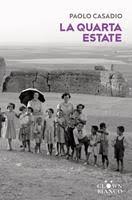
The Fourth Summer
Title of the original version reviewed: «La quarta estate»
AI Translation Notice: This review was translated from the original Italian using artificial intelligence. Book quotes and excerpts are translated interpretations and will not match the author's original English phrasing or official published translations.
Following an eventful journey and having lost her luggage, the young doctor Andrea Dalvina Zanardelli arrives in Ravenna to take up work at the Marina di Ravenna sanatorium, where "scrofulous" children from the orphanage are treated. The year is 1943. Dalvina comes from an affluent family on Lake Garda. Her very first encounter surprises her, when at the station she is asked whether she needs to go to Marina or to Abyssinia. Then there is this strange landscape, so distant from her idea of the sea:
a sort of swamp, a pool of rippled water that one sensed was barely deeper than a puddle,
and which are called "valli" (or piallasse), like those in her mountains. From the outset, she felt its charm, a
wild charm, (...) burdened by the toil of poor folk, (...) the camaraderie among the sailors, the respectful silence with which they greeted one another while puffing on clay pipes, and because of all this (...) she felt rather at home.
For her, the lovely girl with apricot-coloured hair, little was needed:
her character demanded frankness, authenticity, for she felt she belonged to simple stories.
And so she immediately took to the sanatorium,
the absolute radiance of the place, the ceaseless breaking of the waves, the briny taste clinging to the flesh, (... the orderly simplicity of the rooms and the quiet diligence of the nuns,
bearing peculiar names such as Leopola, Nolasca, Zoefe, Benespera, Galizia: a community of religious women devoted to Saint Dalmazia, yet always and above all women, with their secrets and their loves, not necessarily directed solely to Christ. Over the span of a few months, a "simple" story unfolds—a microhistory set against the grand history sweeping across Italy, from the Allied landing to Mussolini's downfall and the German invasion. Up until 8 September 1943, the author recounts these events through the madness of the sanatorium’s previous physician, who was removed and institutionalized because he believes himself to be Benito Mussolini: a deft metaphor for the folly that dragged our country into war. Then, at a certain point, it is no longer possible to hide behind the incurable rhetorical delusions of a poor madman:
the word "bombing" had just entered, with all its disruptive force, into the organized routine of the sanatorium. What had seemed stable and everlasting now wavered, was no more, and by any measure of logic no guarantee, no immunity could be foreseen.
For just a while longer, we readers hope to remain immune to the war, able to follow Dalvina as she discovers herself, her body yearning for love, and her maternal side, which binds her inextricably to a poor scrofulous boy—not out of pity, but because
she felt those whispers creep into her flesh, cross barriers and defenses, and reawaken an intimate, indecipherable unease that made her start, and certainly not because of the mysterious origin of the words.
Yet destiny looms over us all, its meaning difficult to discern because it pays no heed to Love and Hope:
bombs are hardly obedient, nor are they intelligent. They go wherever they please. (...) Yearning to dream. And so who knows, perhaps she had made up this whole fable of nuns, sea, and children. Her children.
These are Dalvina's final thoughts. And had everything remained a dream, might she have been saved?
Paolo Casadio possesses the ability to take small, real facts—the fruit of meticulous archival research—and build stories that invariably feature an enchanted "Setting", steeped in mystery and magic. In his debut novel, Il bambino del treno, it is a small station along the Faenza–Florence railway line that serves as the backdrop to a true event. In the subsequent Fiordicotone, the setting is Lugo di Romagna, although this narrative effort is less successful than the former because the author scatters his focus across too many themes and departs from his smooth, elegant prose—Casadio's quintessential virtue (see the reviews on this site). Here, by contrast, the Romagnol author is at his best: the reconstruction of Marina di Ravenna's atmosphere, so different from what it is today, evokes in the reader indecipherable, fairy-tale sensations, and it is easy to imagine how captivating it must have been for an educated girl from the North; the nuns' personalities are portrayed with affectionate irony, and we seem to see them right before our eyes, in their feminine passions and their nonetheless steadfast faith; and what of the "scrofulous" children, growing increasingly unruly and lively as their health improves (thanks also to the herbs of the pine woods); and then that gem of the delusional patient who believes himself to be Mussolini, amusing yet realistic. Perhaps the only shortcoming concerns the figure of Dalvina, drawn with insufficient psychological depth and constantly relying on hints of past wounds, which remain unresolved and prevent us from fully grasping her personality. And finally, we readers are left disappointed, having expected a happy ending.
Why read it? It is a wonderful novel, an enjoyable and compelling read.