Finished reading on: June 20, 2026
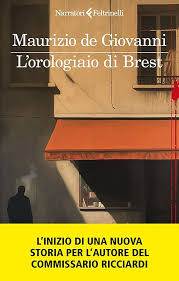
The Watchmaker of Brest
Title of the original version reviewed: «L'orologiaio di Brest»
AI Translation Notice: This review was translated from the original Italian using artificial intelligence. Book quotes and excerpts are translated interpretations and will not match the author's original English phrasing or official published translations.
In his splendid biography of Matteo Ricci (The Memory Palace of Matteo Ricci, published in Italy by Adelphi), Jonathan D. Spence recounts how the Jesuit missionary won over the Chinese mandarins with the gift of clocks brought from Europe. What astonished the Confucian elite was the exquisite mechanics of seventeenth-century Europe and the notion that time could be dissected into infinitely small increments, capable of deconstructing and even halting the flow of events. Perhaps this was what de Giovanni had in mind when entitling this novel: a "quasi-noir" that blends the discovery of one's past and identity with the machinations of a shadowy "Entity." There are two temporal dimensions: a washed-out professor of medieval history is prompted by a young journalist to uncover the truth behind the unsolved murder of a magistrate and his driver, only to discover that the killer was his own father—a terrorist from the 1960s and a skilled maker of mechanical devices, ranging from explosives to innocent clocks; on another timeline, set many years earlier, a naive young woman begins a relationship with a powerful cardinal whose assistant, acting on his superior’s instructions, arranges the girl's elimination with the help of a mysterious operative. How do these two storylines intertwine, and how do they culminate, perhaps, on the Atlantic coast—in Brest, no less? We will not reveal that, so as not to spoil the surprise for the reader.
Already in a 2022 novel, L'equazione del cuore (see the review on this site), the author had departed from classic, deeply atmospheric Italian-style noir to examine the conflict between rationality and emotion, drawing inspiration from the physicist Dirac's equation, according to which bonds of love do not evolve—they remain intertwined forever. Here too, in this narrative, de Giovanni relies on the metaphor of clockwork gears to show how the past incessantly resurfaces, binding two people—the professor and the young journalist—in an unsought yet indissoluble knot. Narratively speaking, the plot is excessively constrained by the criminal schemes of Power, embodied here by the influential Cardinal and his ambitious assistant. Why get bogged down in such an implausible plot, when it would have sufficed to explore the theme of an unaccepted memory—one nonetheless vital if one wishes to live an authentic existence? By attempting to cram together too many subplots and too many literary genres, the author has produced a bloated, redundant potboiler that only fitfully hits the stride of a noir. Further marring the narrative is the layering of temporal planes, which clear up only near the very end, failing to generate any real suspense. Finally, it is regrettable that de Giovanni has severed all ties with Naples, depriving the tale of a rooted setting, which consequently remains entirely evanescent.
Why not read it? It is boring.