
Land of Shadows
The novel is set in the second half of the nineteenth century in Sardinia, in Norbio, a small town surrounded by ancient woodlands. Angelo was orphaned as a child: > his entire life is a slow transition from the peasant condition to the bourgeois condition, or, as they used to say in Norbio, to the gentlemanly condition . This trajectory, which constitutes the central thread of the book, is not a betrayal of peasant roots, but rather the chronicle of a complex individual's destiny. The protagonist is conscious of the pastoral reality and instinctively integrates himself into bourgeois institutions to turn them to the community’s advantage. Angelo’s life is the pursuit of an uneasy equilibrium between the preservation of the commons (above all, the forest) and property rights. While still a boy, he inherits several holdings, which he manages prudently alongside his mother. As a young man, he earns the trust of a mining engineer and becomes the overseer of the forest logging carried out to produce charcoal. And it is precisely the profound unease provoked by the ruthless exploitation of the woodland that drives Angelo toward a perilous entrepreneurial venture: taking over the management of the timber cutting himself. In the meantime, he establishes his own family, marrying first a young peasant woman—the sole love of his life, who dies giving birth to a daughter—and later the heiress of one of the wealthiest and most prominent local dynasties. A wealthy landowner, esteemed by the entire town, he is appointed Mayor by the local notables. In this role, Angelo proves his caliber as an exceptional administrator and demonstrates his fidelity to the public good: defying the mindset of local proprietors, he accomplishes an extraordinary feat by arranging for the municipality to purchase a vast woodland offered for sale, thereby enabling all citizens to benefit from the riches of the pastoral economy. Paradoxically, Angelo, now elderly yet still Mayor, dies in the midst of his people while attempting to quell the excesses of a local festival—a final scene that encapsulates his lifelong struggle for the emancipation of his community. The narrative unfolds slowly, as though the events bore nothing extraordinary. In a disappointing, post-Risorgimento Italy dominated by misrule and the exploitation of the poor, “only the extras were authentic men.” It is therefore not great men or monumental events that shape history, but the “small” figures like Angelo who, through unrelenting toil, devotion to their land, and a desire to learn, build the hope of a better future. Moreover, human existence opens and closes within an environment (the forests, the countryside, the village houses) that resembles “an hourglass in which one could perceive the slow trickle of sand.” It is in the depiction of this setting, far more than in the character analysis (excessively stereotypical) or the predictable, generic social critique, that the prose achieves its finest results, effectively capturing the attentive listening to and perpetual rediscovery of the surrounding world, ever identical yet ever changing. > But the silence of the countryside was different from that of the day before. Listening closely—and every so often Angelo would pause, ears strained—one could distinguish many subtle sounds, like tiny air bubbles in a glass of clear water: the rumble of carts, distant blows of an axe or a hoe, the rhythmic back-and-forth of a saw, and a breath of human voices, invisible presences within the rustle of the rain. Then the scattered voices merged, and he had the impression of a crowd, of a procession approaching barefoot. Shortly after, around a bend, he came upon the slate-scaled roofs of Norbio.... now the voices sounded clear in the damp air; and one could also hear the dull, continuous thrum of the small stone millstones.... driven by blindfolded donkeys turning endlessly in circles . Why read it? It is read with pleasure primarily for its evocation of the Sardinian landscape. The plot disappoints, proving predictable especially in the concluding chapters, and the characters remain flat and indistinct. Even the figure of Angelo lacks sufficient exploration of his inner contradictions, poised as he is between a peasant vocation and his life choices.
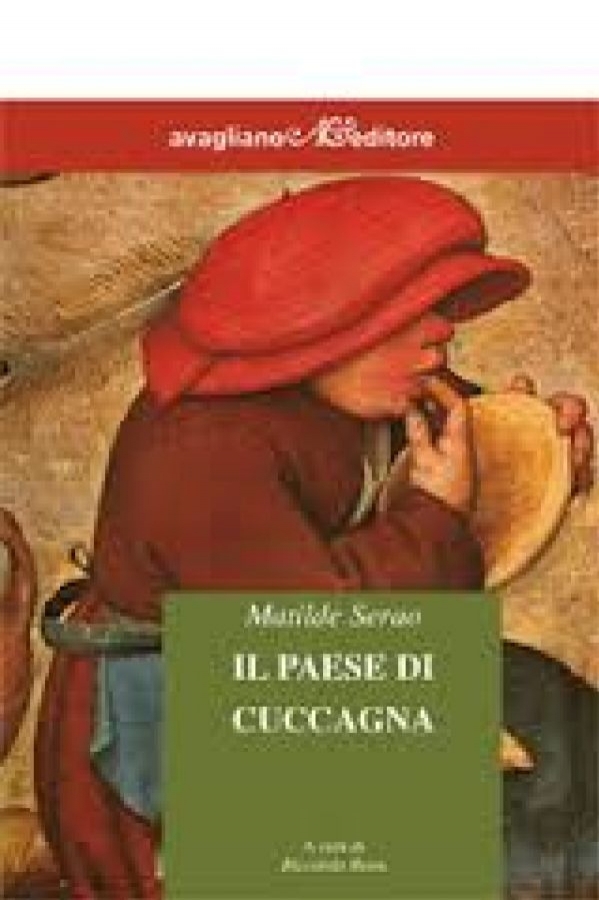
The Land of Cockaigne
A composite crowd, without distinction of sex, wealth, or social standing, gathers awaiting the lottery draw. That morning they feel > the need to eat, to drink, to smoke, feeding vividly on visions of Cockaigne in their imagination, dreaming (...) of a whole bellyful of rich, fatty feasts, devoured in imagination . While the Neapolitan populace, anxious, overexcited, deluded, follows the draw with increasingly wrathful voices up to "a final breath of anger," a young seamstress, delicate and tireless, continues to work; > she seemed so distant, so elusive, so absorbed, in a world utterly detached, different, that the imagination might suppose her more of an image than a reality, more an ideal figure than a living person . The novel intends to expose and deplore the devastating effects of the gambling habit on the material and spiritual conditions of Naples, despite the existence of forces and virtues capable of making this great city prosperous. How Matilde Serao would wish to be stern and realistic! Yet before the impetuous, joyous Neapolitan life, her indignation softens and dissolves into a vivid imagination, through which one can no longer distinguish between fantasy and reality. Take, for instance, the second chapter of the novel: "The Baptism of Agnesina Fragalà, Daddy's Lovely Daughter." Two young newlyweds, happy shopkeepers on Via Toledo, throw a party in honor of their baby girl: it is a kaleidoscope of seductive colors, a clattering of saucers, spoons, glasses, a > union of things pleasing to the eye, good to the palate, delightful to the sense of smell . One is carried away by the expert description of sugary Neapolitan pastries, when, with a dramatic turn of events, the "assisted one" of the spirits appears, > a pale convulsionary, who eats a great deal, who feigns having or has hallucinations, who speaks in riddles (from *Il Ventre di Napoli*). And immediately the guests, even the wealthy loan shark, crowd around this wretched figure, all convinced that some trivial phrase uttered by the charlatan points to a lucky number, to be played in the upcoming lottery draw. Throughout the first part of the novel, Matilde Serao crafts admirable vignettes of Neapolitan life, leading up to the narration of the most sacred moment in the "great imaginary land of Cockaigne": the miracle of San Gennaro. A word of advice may be useful: savor these pages to the fullest without expecting to stand before an Italian Émile Zola, or seeking to trace Verga’s *verismo*. > But just as at the bottom of all the cheerful things of the land of Cockaigne there is an ever-flowing vein of bitterness, this carnival that swept away into buffoonery and masquerades all the gravest matters and people of the city—this carnival was a pitiful thing . Matilde Serao, in her "Neapolitan heart," cannot take cynical pleasure in the nonetheless evocative scenes of the Neapolitan crèche she herself created. The pedagogical and moralizing intent takes over. The second part describes the grim fate met by the novel’s various characters—the culprits of the disaster as well as their victims, yet all "so weak, so wretched, so infinitely unhappy." Such is the despondency that, like the author, we are seized by the > frenzy to flee, to flee, so as to see no more, to hear no more, to endure no longer the spectacle of the bitterest disillusionment . The book is a grand social fresco, yet there are also plotlines and characters from which one can discern other underlying themes, beyond the prevailing depiction of the land of Cockaigne. First and foremost, the female characters are generally the positive figures, even if there is no lack of usurers and swindlers among them. The women are steadfast, grounded, detached from or not wholly consumed by the widespread madness for gambling. What ruins them is their loyalty, pushed beyond all limits, toward the male figure—fiancé, husband, or father. One discerns in Serao a critique of women, all too often incapable of rebelling, of taking full control of their own destiny. The male characters come off poorly, even when, as with Antonio Amati, they possess a strong, sound, rational personality. A doctor and a scientist, he could save poor Bianca Maria, the victim of a mad and cruel father, but he fails to do so. Faced with the daughter's stubborn devotion to paternal authority, he abandons her to her fate, offended and humiliated that the father is placed before him; filial obedience runs too deep in Bianca Maria. > All compassion had vanished from his heart; he felt all the implacable selfishness of immense suffering . Love was fragile, weaker than pride, born of pity rather than true affection. And in this, the woman was once again a victim. The first part of the novel is a masterpiece. In the scenes of Neapolitan life, Serao’s rich and elegant prose finds its ideal setting to express itself at its finest. Granted, the characters lack depth, the plot is not cohesive; they are like so many short stories that seem not to belong to a single narrative. In the second part, the author attempts to pick up the overarching thread, but fails, and the whole remains fragmented. Furthermore, melodramatic and moralistic tones prevail, undermining the tension and dramatic weight of the human tragedies, rendering them predictable and pathetic. Even the account of Bianca Maria’s death, which closes the novel, is so sluggish and tearful as to leave an impression of cloying pietism. Why read it? The first part is a masterpiece.
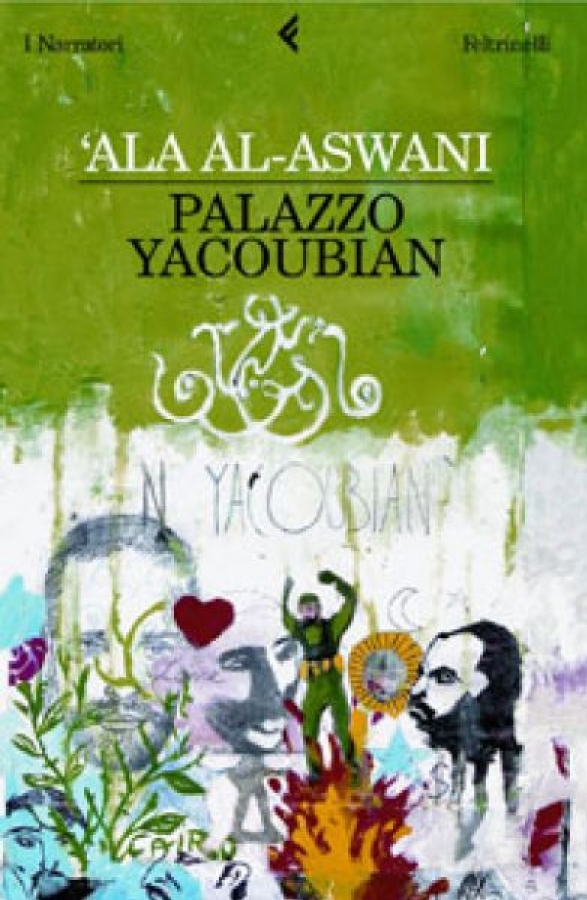
The Yacoubian Building
The Yacoubian Building is an emblematic space of contemporary Egypt, dominated by a corrupt, undemocratic regime where abuse of power, cunning, and deceit seem to be the defining traits. A young woman is forced to endure the advances of her employers, only to fall in love with an aging, depraved landowner on the verge of being driven out of his home by his sister. The girl’s former fiancé is rejected by the Police Academy for being the son of a doorman and, while at university, joins the Muslim Brotherhood. He is arrested, raped, and tortured by the police; once released, he goes to live in a training camp and marries the widow of another martyr. He is killed during the assassination of the police commissioner who had tortured him in prison. A wealthy homosexual falls in love with a young man, who murders him during an argument. A businessman marries in order to satisfy the sexual urges of his old age, but upon discovering that the woman is expecting a child, forces her to undergo an abortion and then repudiates her. In turn, the businessman is forced to pay a hefty bribe to powerful politicians. Beneath a seemingly light, ironic style and the narrative pacing of a "potboiler," the author in fact mounts a ferocious critique of both Egyptian society and the Muslim Brotherhood itself. In an oppressive world, individuals struggle to survive and forge their own path: for some, this leads to ruin (the former fiancé who is tortured and killed, the homosexual murdered by his lover, the woman who marries the businessman only to be cast aside); others are saved, finding affection despite the age gap (the young girl and the depraved old man). The novel unfolds with such lightness that it verges on the contrived, ultimately offering a false representation of Egyptian society. For much of the book, vigor is lacking; instead, the writer seems to capitalize on the most lurid aspects of the narrative. In the final part, the storytelling gains greater strength, allowing authentic, uncontrived feelings to finally emerge.
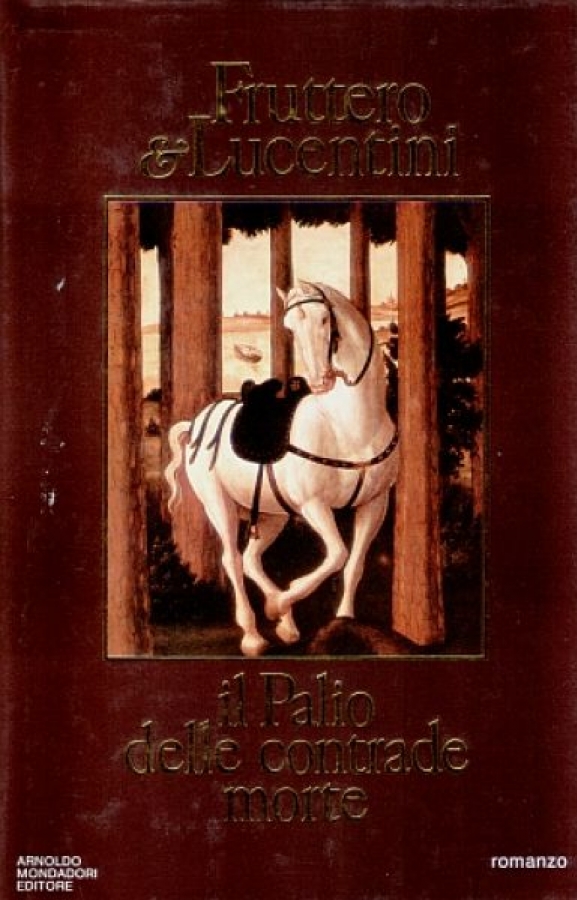
The Palio of the Dead Contrade
It is likely not one of the two authors’ best books. Beyond its brisk and lively style, the plot is utterly inconclusive: a husband and wife, their marriage frayed and dull, find themselves by chance in a patrician residence near Siena, where they witness a crime (the murder of a well-known Palio jockey), embark on affairs with the master of the house and his daughter, respectively, and take part in the Palio, in which the *contrade morte* (those excluded from the race) take revenge for their non-participation through the “ghost” of the slain jockey. A detective novel, a work of the fantastic, a reflection on the desolation of human relationships, or simply the pursuit of a paradoxical story: it is impossible to tell, and one is left, in truth, disappointed.
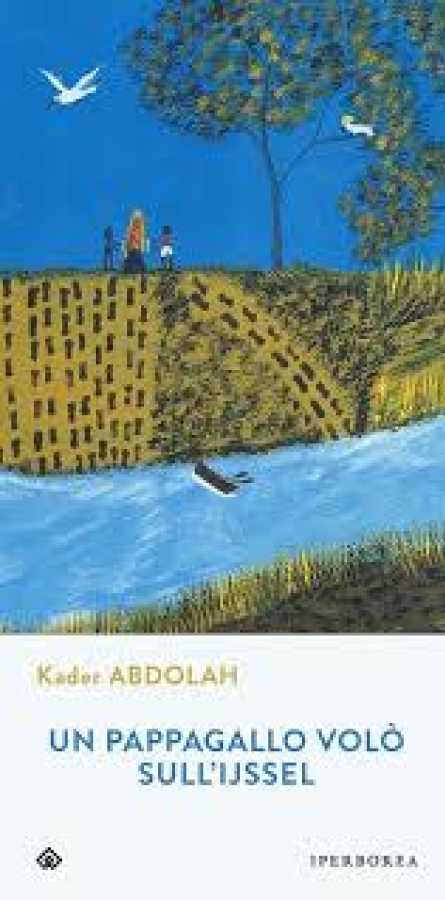
A parrot flew over the IJssel
In the first tale of *One Thousand and One Nights*, under the expressive title of *The Weaver of the Nights* (see review on this site), Scheherazade deceives the cruel sultan, bewitching him with wondrous and intriguing stories. It is the miracle of the word! Likewise, in this novel, Pari, an immigrant woman infatuated with the Dutch language, will save herself through writing. A Flemish healer entrusts her with the task of narrating the lives of immigrants. > Write the story of the people around you, the story of the foreigners arriving in the Netherlands. (...) Free yourself from your anguish by writing. (...) Perhaps this is your duty, now that destiny has led you to a foreign land. With the storytelling framework and the suffused lightness of the Arabic masterpiece, and in the country where > in every region the voice of the water is heard and feared with its eternal disasters , Pari is to narrate > the story of Mamed, of Catherina, of Lina, that of the colonel, of the colonel's wife, of Tala, of Mr. Rahimi, of the parrot, and your own story. They are all immigrants who could answer the question > what are you doing here? with a single word: > I live. Having placed Pari at the center should not suggest that she is the narrator or the sole protagonist: it is Abdolah who narrates from the vantage point of an invisible and neutral observer, just as the novel is crowded with numerous characters; my choice is justified by Pari's obstinacy in making the Dutch language her own, and by the fact that it is this woman's life, more than that of others, that bears witness to the precarious balance between integration and roots. Married while still a child, Pari followed her husband to the Netherlands. The man's long absences allow the woman to attend a school to learn Dutch. > She felt that something deep within her nature had been set in motion and wanted to destroy everything. (...) She realized that the words she looked up in the dictionary and the sentences she wrote in her new language were actually explosives she wanted to place under her family life, under her past, her present, and her entire existence. She begins publishing short stories in a local newspaper; she goes to live first with her Dutch teacher and then with a journalist: men who demand erotic-sexual games that are new to her yet offensive to her morals. *That is how it is done in Holland*, is the self-assured reply to her timid objections! Until one night her husband bursts in and stabs Pari, while the Dutchman flees without defending her. The past has violently returned. If in her husband's attempt to kill her the oppressive traits of an atavistic world re-emerge from her roots, it is Middle Eastern customs and liturgies that snatch her from death. > Twelve elders wrapped in long black coats, each with a rosary in hand , enter the hospital room where Pari lies in an irreversible coma. > Their sweet words danced like bees in the sunbeams, and the murmur of prayers enveloped Pari's head like a hum. (...) Suddenly the needle moved, tracing with a metallic sound a wavy line, a zigzag of life. As in the fabulous tales of *One Thousand and One Nights*, a parrot (an Angel?) flying over the IJssel saw > a young woman with long golden hair riding bareback on a bizarre white horse with a long mane, (...) a strange place populated by thousands of animals, great primordial elephants, giraffes, dinosaurs, camels, tigers, lions with aged manes, and also very small creatures: mallards, colorful parakeets, butterflies, golden insects. In Protestant, welcoming, and transgressive Holland, all the magic of the Orient had resurfaced to save Pari. The novel unfolds along two tracks: the difficulties of integration—cultural before political and institutional—and individual stories showing how each person faces assimilation differently. The Netherlands presents itself as a welcoming country, yet distrust, fears, and linguistic and cultural differences inexorably emerge. If at first it is intriguing to associate with a foreign man or woman—the former so passionate, the latter fascinating beneath the veil—later the Dutch woman withdraws in concern, and the man fails to show respect for traditions more reserved than those of Dutch society. Even within a framework of difficult assimilation, the individual stories, distinct and parallel, show how through this encounter everyone changes—both the Dutch and the immigrants—yet each in a different way. It is true that fate towers over us—may the will of the Almighty be done!—but each of us plays with destiny differently, carving out our own path; and therein lies the true change. For the parrot over the IJssel, for the Angel or the Almighty, there is nothing left to do but watch us. The novel is a collection of narrative modules that develop autonomously and then intertwine almost by chance; it is difficult to synthesize the various stories, except in a few pivotal passages: the grave of little Tala where everyone gathers to pray, the single public telephone used by the immigrants to call back home, the group of elders living as if they were still in the East, and the mysterious figure of the parrot, perhaps Frederick II's mythical "cockatoo," symbol of ancient Arabic culture. The writing is fairytale-like and realistic at once, never flattened into mere description or pointless political and sociological digressions, and for this reason rich in evocative power. Why read it? It is rambling, yet pleasant to read.
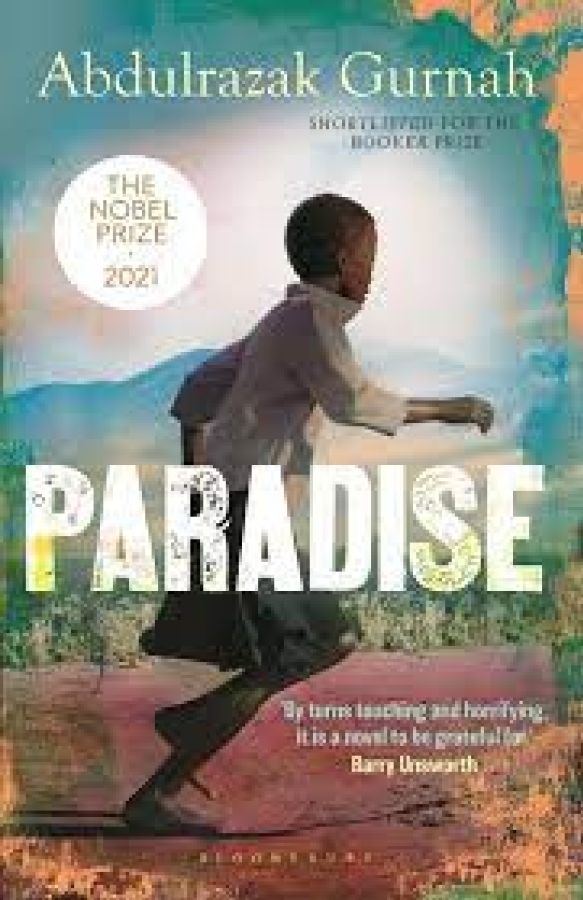
Paradise
The novel possesses two primary narrative threads. The first is a grand historical fresco of the Sultanate of Zanzibar shortly before the partition of East Africa at the 1885 Berlin Conference. As an Indian friend explains to the sixteen-year-old Yusuf, the Europeans > are not interested in trade, but in the land itself. And everything on it... us. (...) We will lose everything, including our way of life . It would have been easy for Gurnah to present the Arab-Swahili civilization—which had controlled the East African coast since the mid-eighteenth century—as an idyllic era prior to European conquest. The coexistence of different languages, sedimented over the centuries, the refined customs of the merchants, the splendor of palaces and gardens, the fragrances, garments, and jewelry of wealthy matrons, the observance of religious tenets: all are factors that might tempt us to extol the pre-colonial world in contrast to European—in this case, German—domination. Once again, Gurnah surprises us, doing so, moreover, in an unpredictable fashion by recounting the merchants' journeys into the African interior, toward the great lakes and mountains, in pursuit of ivory, gold, and slaves. With good reason, many commentators have compared the inland expeditions depicted in the novel to Joseph Conrad’s *Heart of Darkness*, in which the journey into the pestilential river forest is akin to a descent into a shadowy world where man’s primordial drives overpower civilization; in the same way, in *Paradise*, by taking part in these interior incursions, the young Yusuf will become “a wolf-man,” > he felt the thread of life slipping through his fingers, and he let it unravel without resistance. (...) There was nothing he could think of doing that would free him from the shackles of his condition. And here we arrive at the second narrative strand. Yusuf is still a child when he is taken from his family to settle a debt incurred by his father with a wealthy merchant. The uprooting is abrupt and definitive, sealed by the loss of the necklace given to him by his mother. He finds himself growing up in an opulent household, learning trade under the tutelage of a youth who was likewise handed over, along with his sister, to discharge unpaid financial obligations. In his new home, Yusuf is drawn to a magnificent garden concealed behind a high wall: a place so rich in scents and colors that Yusuf > dreamed that at night the fragrances dispersed into the air, disorienting him. In his intense sensation of pleasure, he imagined hearing music . Is it the Paradise described in the Quran? The garden conceals a secret: secluded from the outside world lives the merchant-master's mad wife; she has become infatuated with Yusuf's beauty, which she has observed through mirrors hung from the trees. And it is precisely to remove him from the woman's designs that the merchant enlists Yusuf in the expeditions into the interior, from which the youth will return a man, determined not to be thwarted: he seeks to unravel the garden's mystery to the very end. Thus he will come to understand that Hell and Paradise overlap—they are the selfsame prison: just as in Mozart's *Requiem*, where infernal tones alternate with heavenly ones, magnificence conceals despair. Beneath the veneer of a historical novel, Gurnah tackles a universal and enduring dilemma: that of freedom. The characters are dominated by the Mephistophelean figure of the merchant—ever composed, as quick to protect as he is to cast out, a true emblem of power that only a rival force can supplant. Let us not be deceived by appearances; the essence of power remains ever the same. Yusuf prefers the European's supremacy, harsher perhaps, but devoid of subterfuge. The German officer's face > was the face of a corpse, and Yusuf was appalled by its ugliness and cruel gaze. (...) The marching column was still visible when he heard a sound like a door closing behind him in the garden. He looked around quickly and then ran after the column, his eyes glistening. The prose is more restrained than that of *By the Sea*, reviewed elsewhere on this site; it is as if the author intended to write a chronicle, one in which fairy-tale motifs and digressions are curtailed in order to focus strictly on the essential elements of the tale. The reader does not lose themselves in the text, remaining constantly vigilant of unfolding events; hence, the narrative’s length begins to weigh, only to be cut short far too abruptly by the foreigner's arrival, as though the author felt compelled to wrap up the novel by any means necessary. Why read it? A splendid fresco of a civilization unfamiliar to us.
Johnny the Partisan
The events between 8 September 1943 and February 1945 form the historical backdrop of the novel. These are the years of the partisan war. An officer cadet in Rome, Johnny left the army, like so many others following the announcement of the armistice and the ensuing general chaos. He returned home, to Alba. A young intellectual passionate about English literature, he belongs to a lower-middle-class family. His parents would have him hide quietly, without exposing himself. But the young man decides to abandon > a fluid position, remediable from any fatal impact through pretense, subterfuge, or cunning , taking a stand instead > in the great dualism at the price of immediate, unquestionable execution . And then > he set out for the highest hills, the ancestral land that would aid him in its motionless possible, in the vortex of the black wind... in the name of the authentic people of Italy, to oppose fascism, to judge and execute, to decide militarily and civilly . He stumbles upon a Garibaldini brigade, tied to the communists. Like many of his comrades, political ideologies do not interest him; what matters is fighting fascism. He meets Tito, a shrewd young peasant, so far removed from him in culture and social origins, yet so close in partisan brotherhood. He was > happy and eager to mingle with the men, with all of them. They had fought with him, had been born and lived, each with their own origin... to find themselves together in that battle . He kills his first man: > the boy was dancing thirty meters away, blinded by his own courage... Johnny shot him without haste, without ferocity.... he propped himself up on his elbows in an ascensional suspension before his first dead man . The clash with the fascists breaks up the brigade, too poorly armed to resist. Johnny goes in search of another partisan formation and encounters the so-called *badogliani*, closer to his own political sensibilities. He finds a bourgeois environment more familiar to him, and it is with them, in the hill villages around Alba, that he spends the long stalemate of the winter of 1943–1944. Although better organized and equipped than the Garibaldini units, they are utterly unprepared to withstand the joint fascist and German offensive in the summer of 1944. The struggle is brutal and unequal. Johnny sees many of his comrades die and is reduced to a small core, including his friends Pierre and Ettore, with whom he takes refuge in a farmhouse. Yet Pierre flees to the city, where hiding is easier, while Ettore is captured along with the peasant woman who had sheltered and fed them. Desperate and alone, he faces the long, bitter winter of 1944–1945. He hides in the wildest reaches of the woods, in the ravines carved out by torrents, occasionally seeking food and shelter from the peasants, who are themselves exhausted and terrified. > His heart broke with longing for the ancient community, that factious, reproachable, at times repellent community, and for the old battlegrounds and the companionship of the living, the dead, the captured... He yearned to regroup, he would have given half his blood for it, Where is Nord (the partisan commander's nom de guerre)... January 31st is an absurd date to reunite. That morning you will rise and call out, but only the silence of the hills will answer you . By the end of the winter, very little remains of the naive, idealistic student. The loss of his dearest friends, the massacres he was forced to witness, the cold, the hunger, the squalor have turned him into a solitary fighter. When, in January 1945, the partisan ranks begin to reorganize and swell once more (with the Allies' final advance now drawing near), > Johnny was no longer at home there; that patch, far from fading, was widening. He could no longer endure fellowship or routine; he skirted collectivity, patrols, and sentry duty . The naive cry, “Long live us!, forever until the end of human history,” which he had voiced when feeling profoundly united with his comrades, has transformed into a sense of dissatisfaction, of disillusionment with others, driving him to disobey and seek a brave and solitary death. The novel is the ideal sequel to *Primavera di bellezza*, another of Fenoglio's masterpieces. While in that book the author chronicled the political maturation of a young man becoming aware of what fascism was and of the need to bear an individual witness of rebellion, in *Il partigiano Johnny* Fenoglio recounts a young man's partisan journey and how the events of the war and the harshness of the environment left an indelible, unpredictable imprint on his character. While remaining steadfast in his determination to “say no all the way,” never to surrender, by the war's end Johnny can no longer feel part of a broader community—the partisan army—desiring instead to fight the fascists alone, like a solitary hero. And as one reads on, both the language and the relationship between Johnny and his surroundings evolve. If at the beginning of the novel the prose is steeped in English words, as if to convey the protagonist's literary realm, the Anglo-Saxon terms gradually grow scarcer, until Johnny eventually betrays his beloved English tongue, rejecting the role of interpreter in favor of that of a combatant. Similarly, the hill country begins as a backdrop, only to take on an increasingly prominent role as protagonist as the story progresses, almost melding with Johnny's new persona. The woods, the ravines, the villages perched on the mountains, the fog and the frost, the peasant world with its livestock and its dogs, fierce or friendly, become the protagonist's new reality as, like a modern-day Robin Hood, he wages his solitary battle against the villains. In this respect, Fenoglio's book is a magnificent narrative of the Resistance—not the rhetorical one intended to exalt collective history and the emergence of a national consciousness. Paradoxically, the trajectory in the novel is reversed: from a civic and political vision, however naive and unrefined, the protagonist arrives at an individualistic and disenchanted conception of the idealized partisan war. Fenoglio's immense fascination lies in the expressive creativity of his language: > an ungrammaticalized language, ductile, capable of being dismantled and reassembled in its constituent elements with extraordinary fluidity... a magmatic language with which to collaborate creatively. The result is a prose incessantly yielding lexical, morphological, and syntactic neologisms (Dante Isella: *La lingua del partigiano Johnny*). It could have marked an intriguing direction of development for Italian literature. No one followed it, squandering the opportunity to inject fresh, original vitality into a language as stagnant as Italian had become. A weakness of the novel lies in its lack of compactness, leading to a narrative plot that is often sprawling. The relentless focus on the protagonist fails to provide dynamism and dialectic to the system of characters, who, in turn, lack sufficient depth and autonomy to counter the overbearing presence of Johnny's character. It is an epic and individualistic book *par excellence*. Why read it? It is a fascinating book, above all for its language.
The past is a foreign country
Perhaps it is not the author’s best book. A brilliant young student is dragged by a friend into a descent into hell: first gambling, then drugs, until he even risks becoming implicated in a rape. Faced with extreme violence, he reacts by saving the girl, and in some measure saves himself as well. The narrative premise could well be interesting, but it drags sluggishly along, offering neither plot twists nor any psychological probing of the motives behind behavior so vastly divergent from his past life. It almost seems as though the character were weak, someone who had always passively endured what was expected of him, only for his true personality to surface under his friend’s pressure. The style wavers between that typical of atmospheric crime fiction and that used in introspective narratives: the synthesis is sheer tedium in the reading.
Homeland
On a rainy evening, a small Basque entrepreneur is killed by an ETA commando, a terrorist organization that bloodied Spain from 1968 to 2011, causing over 800 deaths, including 240 civilians (source: Wikipedia). Txato, as the victim was named, had refused to pay protection money, and his assassination was preceded by a barrage of insults and increasing ostracism by the village where the businessman and his family had lived for years. Joxe Mari, the son of Txato’s best friend, is affiliated with ETA and operates underground; on one of the evenings prior to the attack, he was sent on reconnaissance near the victim's house, > no sooner had he started walking than he saw me. The Browning gripped in my pocket, and Txato, what does he do, what on earth does he do, he crosses the street and comes straight toward me. The scene wasn't in the script. “Hey, Joxe Mari. You back? I’m glad.” Those eyes, those huge ears, that friendly demeanor. His father’s friend, who used to buy him ice cream when he was a boy. (...) Don't do it. Don't kill him. They had stood mute facing each other. (...) I am a member of ETA and I've come to execute you. But he hadn't told him. It hadn't come out. High above, the bell had chimed a no. This scene, described on page 445, could have been a possible opening for the novel, lending unity, in my view, to the exploration of the consequences—not social and political, but psychological and existential—of a civil war that tore an entire community apart. Instead, Aramburu narrates the individual stories in a disordered fashion, shifting back and forth, trailing the trajectories of single characters as though they were mundane, predictable, run-of-the-mill tales, invigorated only by their connection to that single terrible event. Txato’s murder destroys long-standing bonds of friendship, dictates everyone's life—their emotional ties as well as the material conditions of their existence—and freezes them into roles defined by hatred and grief. Joxe Mari will end up serving a life sentence, condemned to being a hero of the Basque Country’s liberation. His mother, Miren, takes on the role of the fierce, unyielding protector of her persecuted son, > fanaticized by maternal instinct. Miren’s husband and Txato’s best friend retreats into himself; a coward, he conceals his grief over Txato’s death and his disapproval of Joxe Mari’s choices. The other children have fled that cursed land, just as Txato’s children have. They are all > satellites of a murdered man. Whether they wanted it or not, their respective lives had revolved for long years around that crime, around that ceaseless fire of—of what?—fuck, of sorrow, of grief, and this story must end and I no longer know how. Shattering the paralysis of suffering is Bittori, Txato’s widow, with her decision to return to the village and reopen the old house: > a strange atmosphere enveloped the ornaments, the walls, the furniture, a characteristic odor that, without being sickening, was anything but welcoming. And it was the same smell my mother's clothes give off when I hug her. We are past 2011; the civil war is over and everyone would like to forget. The parish priest stops Bittori on the street to urge her not to return to the village, > not to reopen old wounds. The woman’s reply is cutting: she is here > to draw out all the pus that is still inside. Otherwise, it will never heal. Resolute, Bittori will succeed in having Joxe Mari ask her for forgiveness, because only then can there be genuine reconciliation, rather than a craven, omertà-bound oblivion. Bittori’s determination will stir all the other protagonists of the story, who will emerge from their suffering to find themselves once again, finally processing their grief and coming to terms with their destiny. The core themes of the book are rupture and reconciliation: violence born of hatred and the will to rebuild fraternity. The author eschews rhetoric and moralism, delving instead deep into the characters' consciences. The figures constantly teeter between painful paralysis and the possibility of liberation from their fate; to achieve this, they need an external force, embodied by Bittori, who casts off the guise of the inconsolable widow to take on that of a tragic heroine—bearer, in spite of herself, of a universal and eternal task: to bring the perpetrator to acknowledge his guilt, to confess it, and in doing so free himself from remorse. Mention has already been made of the narrative's disordered nature. Generally pacing the novel three chapters at a time, the author explores its various characters without establishing a hierarchy of importance, as though there were no true protagonist. This approach grants the reader the freedom to choose the key figure of the tale (for me, Bittori), yet it blurs the focus and hinders the reconstruction of the storylines, which remain inconclusive. The alternation between first and third person as the narrative voice is intriguing at first, creating a disorienting effect. It is a stylistic dexterity that, over time, confounds the narrative: every sentence is interesting, but the whole becomes disjointed. Finally, the novel is very long, prolix, and repetitive. Why read it? The themes addressed are compelling.
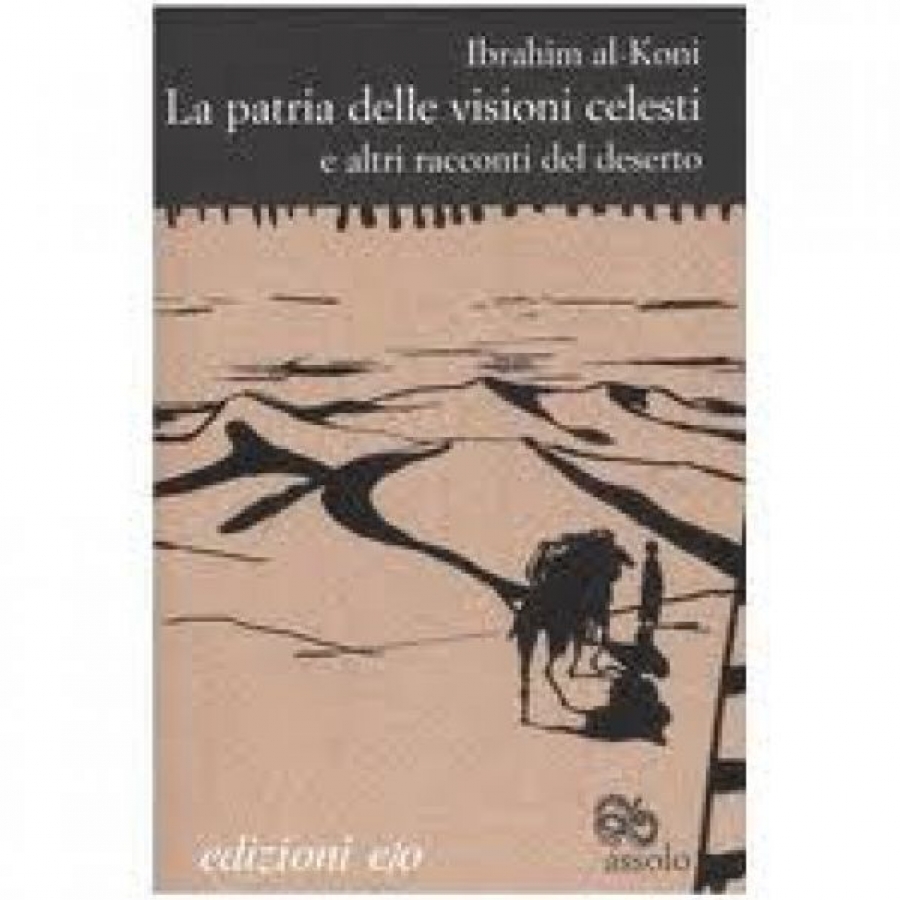
The Homeland of Celestial Visions
The book brings together 12 stories set in the Libyan desert: > in that desolate, impenetrable expanse, where spirits and mysterious enigmas hovered . The past tense is mandatory, for the primordial world of the desert has by now vanished, destroyed by the cruel colonialism of the Italians, by pervasive drought, and by war. The stories differ in content and style, yet a shared historical and human trajectory emerges—the demise of Bedouin civilization, and with it, an irreplaceable loss for humanity. The title story of the collection is undoubtedly the most captivating, as well as the most mysterious. Father and son advance through the desert: > since they had set out on their journey, the desert had continued to dilate and expand.... ultimately generating a ruthless horizon which, once yet another stretch had been traversed, gave rise to another... and in that limbo stretching between the expanse of sand and the horizon, a mirage shimmered . What was the purpose of a journey that seemed “eternal”? The father took his son, still a child, from the oasis. He did so because he wants the boy to be a “man of the desert,” because “whoever wields a hoe and wounds the earth is a slave,” whereas > the nomad has the star-strewn sky for a blanket, his pillow is the open space, he roams like gazelles and kneels before no place . The journey would seem to be the narrative of an initiation, yet the father is searching for something: his homeland, a return to the dwelling place of the desert nomads. Yet at the end of the story we discover, with surprise, that this homeland is the ultimate land of oblivion: death. > Do not regret the transitory journey you had to make, for remaining in the memory of the arcane is better than slipping into the desert of remembrance . It will be the subsequent stories that reveal the reasons behind such a drastic choice. Gradually, the author leads us toward the war, recounting the harrowing events—which we Italians have erased from memory—of the conquest of Libya by the Fascist army and the heroic, desperate resistance of the Libyans. There is no acrimony; it is a chronicle, yet one capable of conveying the profound sense of a people’s destruction. Where can the Bedouin go now? “A man who has grown accustomed to war can no longer do without it.” It would be inaccurate to say that the subject of the stories is the desert, even if the depiction of the environment, animals, fruits, and plants remains precise, almost naturalistic. In reality, the true theme is nostalgia. > All of us love the horizon and weep with nostalgia, yearning for what lies hidden beyond the desert . Thus the theme becomes universal, for “do you too, like me, feel nostalgia for the unknown?” The prose is remarkably rich and versatile, shifting from an elegiac, poetic register to one that is stark and detached. From this perspective, the most accomplished story is *The Virgin's Vow*. The life of young women in the desert is delineated with sociological precision. The two girls herding the flocks to pasture speak of loves and dreams, of betrothed grooms, like young women of any era and civilization. The sun, the arid dryness, and the heat are so unrelenting as to drive even the young goats mad, turning them unruly and aggressive. One of the two girls does not spend her days waiting for a desert horseman to take her as his bride: she dreams of water; water is her true lover. And when it suddenly arrives, she plunges into the surging torrent’s current and surrenders to its pull: > she began to undress... she knelt down and he held her in his arms. He threw himself upon her naked virgin body and gently submerged it. She drifted freely with the current.... fleeing toward the unknown together with his beautiful beloved . Why read it? One should not look for plot, narrative pace, or detailed social and psychological portraits. It is the chronicle of the end of a civilization, and, implicitly, an indictment.
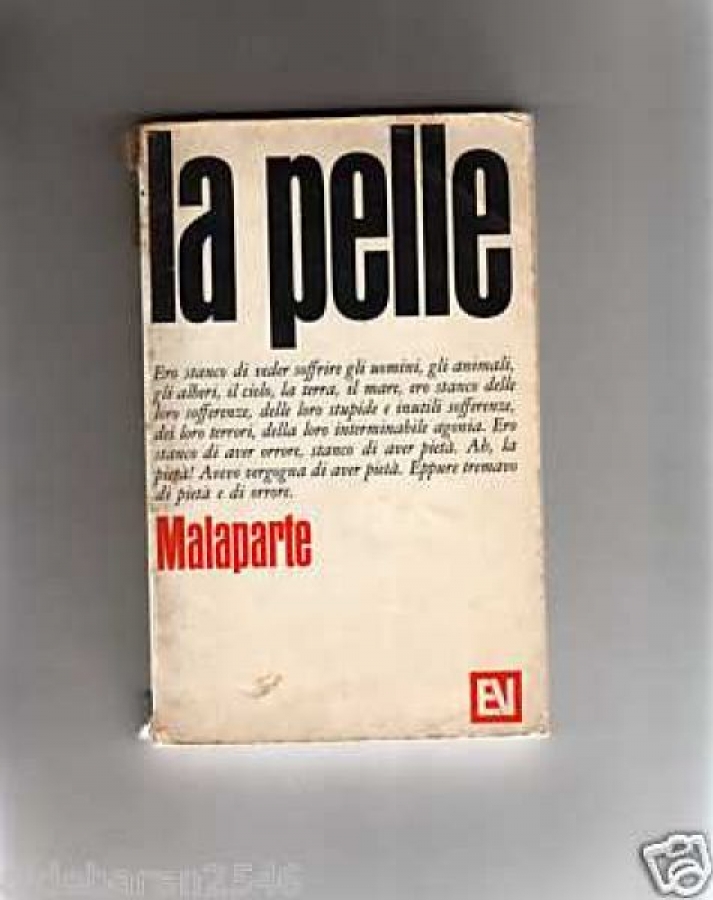
The Skin
The book is set during World War II, amid the American advance: in Naples and then, in the final chapters, in Rome and Florence. Malaparte serves as a liaison officer between the Americans and the Italians. And from this arises the contrast between a young and simple society (the American one) and one that is by now decadent and in ruins (the European one). Beyond the themes tied to the immediate aftermath of the armistice (the crumbling of Italian society, the civil war, selling oneself out by any means to the new conquerors, what Malaparte calls the new "plague"), the novel is in fact strikingly relevant today. A profound pessimism emerges regarding the future of Europeans, a sense of decay, rot, and death, through episodes that border on the implausible yet correspond to a society that no longer harbors any sense of the future, in which anything is possible. The "new" brought by the Americans unleashes something that lay hidden within European society, destroying its foundations and casting it into a grotesque, amoral, and unsettling dimension. One is left hoping for an extraordinary event (the eruption of Vesuvius) to wipe out this society. Does this novel not also reflect our present reality? It captures the deepest traits of European society: its decadence, its deference toward the powerful, the pursuit of personal gain even at the risk of compromising what is held most dear, the prevailing vulgarity and ignorance. The book is undoubtedly very timely, and its rich, imaginative style captures this sense of decadence and dissolution remarkably well. Its finest quality lies neither in the dialogues nor in the treatment of the characters (in reality, quite flat and conventional), but rather in the descriptions of situations and the passages that express the author's own sentiment: passages invariably characterized by lyrical rhythms and a pursuit of the marvelous, which seem to evoke sixteenth-century Italian literature (Ariosto, perhaps?). In this sense, the book's style stands in sharp contrast to the literature that followed, which would be heavily influenced by American writing and would pursue intimist (Moravia), neorealist (Pavese, Vittorini, etc. ), and fantastic themes (Calvino, Buzzati), all entirely alien to Malaparte. If we compare some recent novels from Anglophone literature itself, we realize that Malaparte’s book is remarkably modern.
Down the Ancient Staircase
The book is set in an asylum, and the narrator (and protagonist) is a psychiatrist. In the first part of the book, the character of a former hospital physician is delineated—a commanding figure and a man of science. The close examination of his persona reveals a whole series of idiosyncrasies (he never leaves the asylum, fears thunderstorms, never touches the doors leading to the various wards, and so on) that expose a mind riddled with fears, yet driven by a delusion of omnipotence. In the second part, the novel consists of a series of portraits of the mentally ill, which foreground both the ineluctability of illness and the profound humanity of these individuals, who are likewise capable of giving and receiving love, and with whom dialogue can be established if one manages to understand their language. The true protagonist, however, remains the asylum itself, which seems to hold sway over both the sane and the sick. Its enclosed structure establishes impassable boundaries that are psychological before they are physical—so much so that the doctors themselves are often led to live within its walls. Is the asylum not the paradigm of modern life, which, while ostensibly so free and open, is in truth trapped within preconceived molds and a series of constraints? And does not the mentally ill patient, in their delusions and mental wanderings, in fact embody true—and singular—freedom? The style is lean, devoid of any rhetoric, unfolding in a clear, serene manner, marked by a subtle irony and touches of tenderness.
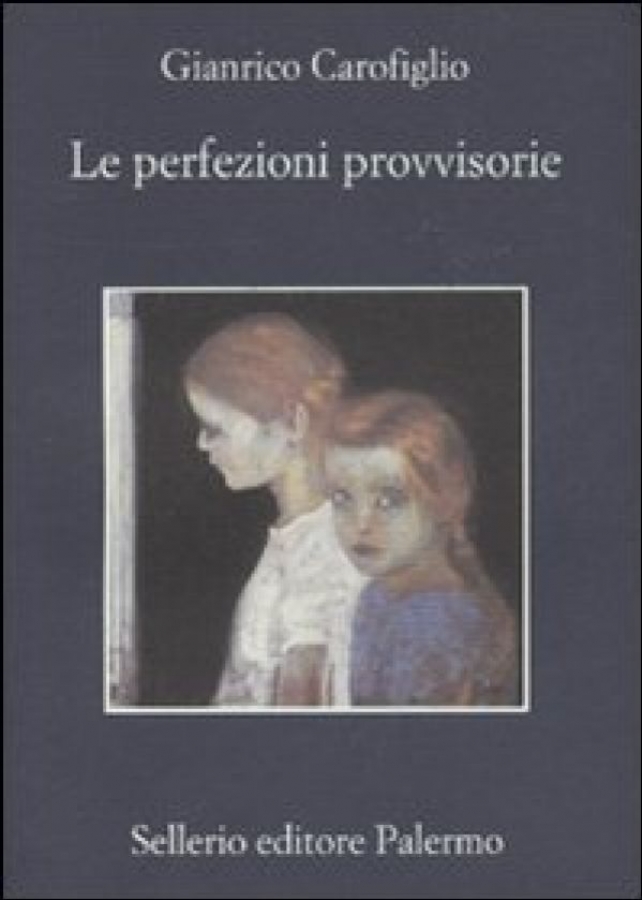
Temporary Perfections
Guido Guerrieri is a criminal defense lawyer asked by a colleague to look into whether an investigation regarding a young woman’s disappearance can be reopened. Albeit reluctantly, Guerrieri turns investigator and uncovers a narrative of drug consumption and dealing to which the girl fell victim. The mystery is well-crafted. The reader is skillfully guided toward the conclusion, which, while not a surprise, is far from predictable; one arrives there with the same curiosity and guilelessness displayed by the author. As in all of Carofiglio’s novels, the detective plot runs parallel to the lawyer’s personal tribulations: a mature man in his forties who lives somewhat “suspended” in the present, with a past fading into oblivion and a love life facing an uncertain future. Yet, deep down, the protagonist feels at home in this suspension, for “only what is provisional is perfect,” and even the past belongs to a “kind of extended, simultaneous, and welcoming present.” The novel’s primary virtues lie in its prose—light and elegant—and in the investigative thread, which is soundly constructed and clearly the product of real, firsthand experience in the field. Its weakness resides in the portrait of the protagonist, who appears somewhat evanescent, his personal affairs—in truth, rather unengaging—failing to interweave effectively with the investigative narrative. It is no coincidence that the character gains genuine depth only when the discussion turns to the law and legal practice. Why read it? The prose and the plot make the book an exceedingly pleasurable read.
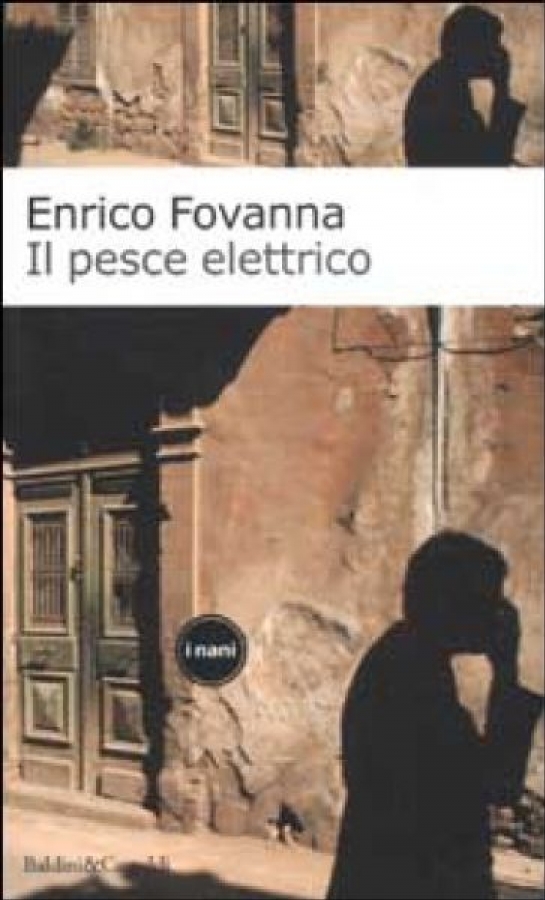
The Electric Fish
The book recounts the journey of three journalists to Turkey to meet a friend of theirs, imprisoned in an asylum by the authorities for being a friend of the Kurds, who is about to be released. It is unclear whether it is an introspective tale (a search for oneself), a portrait of Turkey, or a detective story. In truth, it is a dull book, poor in its descriptions and mediocre in its dialogue. I was unable to finish it.
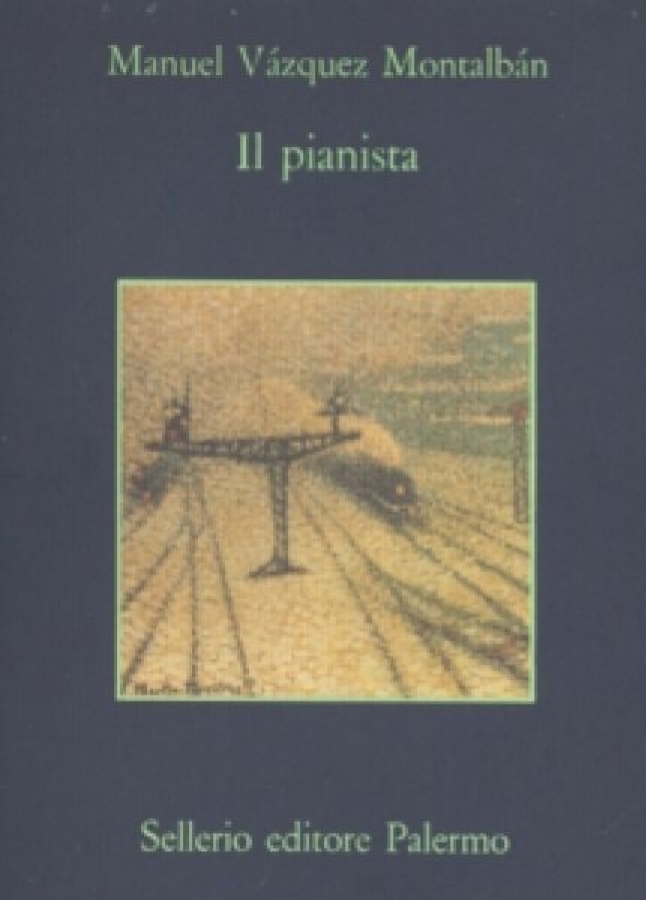
The Pianist
The book belongs to a period prior to the "detective-style" novels and deals with the years immediately following Franco’s death, marked by the initial disillusionment with the democratic system and the left’s inability to bring about genuine change. It is a tedious novel in both content and style, far removed from the detective fiction of the subsequent period, even in its setting and depiction of life in Barcelona. Dialogue predominates, often repetitive and sluggish, in which the protagonists seem to fulfill preordained roles as bearers of broad thematic meanings (by now bound to distant debates and events) rather than expressing personal stories.
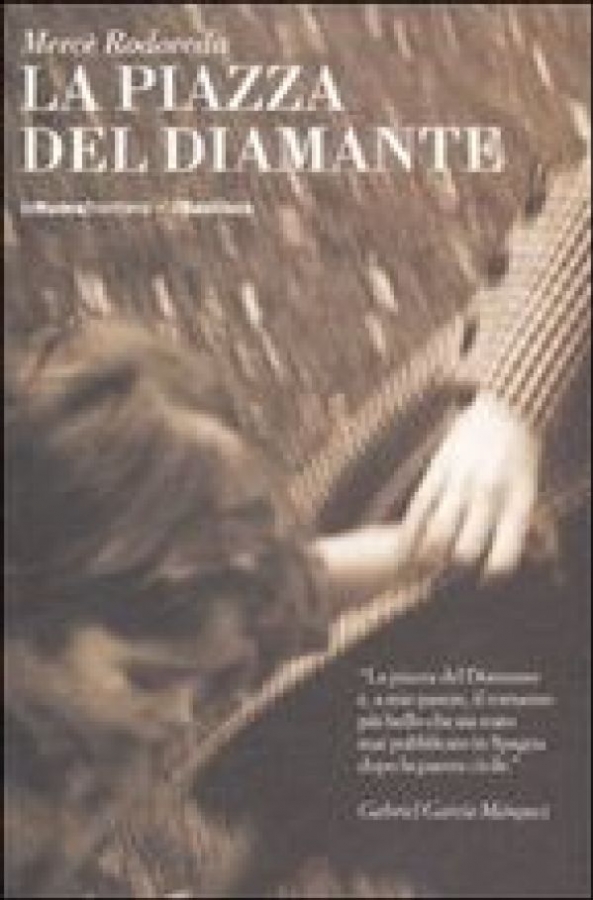
The Diamond Square
> I lived as a cat must live: up and down, tail lowered, tail held high, now it is time to eat, now it is time to sleep; with the difference that a cat does not have to work to live. At home we lived without words, and the things I carried inside frightened me because I did not know whether they were mine . The protagonist, Natalia, known as Colombetta, is the first-person narrator. She is a young woman working in a pastry shop. She marries Quinet, a selfish and restless yet charming young man, with whom she has two children. Quinet works as a restorer, but he begins breeding pigeons in the attic of their home. Soon the birds overrun the entire house, and Natalia finds herself enduring an increasingly burdensome and exhausting life, caught between caring for her children, working as a maid for an affluent family, and cleaning the house. Yet it is not the toil that frightens Colombetta; it is the growing sense of living a life that is not her own, but determined by others. This anguish drives her to commit the sole act of rebellion in her life: getting rid of the pigeons by preventing them from breeding. Meanwhile, the civil war breaks out. Quinet leaves to fight with the Republican army, Colombetta loses her job and sinks into deepening destitution, to the point where she can no longer feed her children and resolves to kill them and then herself. It is the darkest hour of her despair: she feels defeated not merely by the dramatic events of the civil war, but by the crushing weight of her own solitude. > I had to turn myself to cork to keep going, because if instead of being made of cork with a heart of ice I had been, as before, made of flesh, which hurts when pinched, I could never have crossed a bridge so high, so narrow, and so long. And I walked through the streets, dirty and desolate by day, dark and blue by night, dressed entirely in black and, perched on top, a sort of white smudge, my face growing tinier and tinier . She goes to a grocer’s shop to buy acid to kill her children and herself, and at that dramatic moment a turning point occurs in her life: the grocer, aware of Quinet’s death, proposes marriage. Once again, Natalia accepts as though the decision belonged to someone else. This new life of comfort for herself and her children does not free her from existential anguish. One day, in a state suspended between reality and dream, she returns to the old house she once shared with Quinet. She searches for a hole near the lock, which had been plugged with cork. > I began digging out little pieces of cork with the tip of the knife. And the cork crumbled and flaked away. I removed all the cork, and only then did I realize that I could not get in .Colombetta then goes to *Piazza del Diamante*, once full of life and now «an empty box made of old houses with the sky for a lid». And upon her shoulder > perched a satin-ruffed pigeon, unlike any I had ever seen, with lacquered feathers, and I felt a storm wind whirling inside the funnel now almost sealed, and with my arms over my face to shield myself from I knew not what, I let out a hellish scream. A scream I must have harbored inside for many years, and from my mouth came a tiny sliver of nothing, and that tiny sliver of nothing that had lived so long within me was my youth fleeing with a scream that I could not comprehend... detachment? . The novel unfolds through the perspective of the first-person narrator, Natalia. This literary device makes the protagonist's detachment—almost that of a bystander—from the events of her own life all the more striking. Natalia narrates in a painstaking and detailed manner (consider the description of the house where she works as a maid, or the splendid depiction, almost a painting!, of *Piazza del Diamante* teeming with life), yet it all reads like the field notes of a geographer, of an explorer. Alongside this seemingly realistic representation of life are Natalia's dreams, largely revolving around birds, pigeons, and the presence of the figures who have dominated her life. Existential anguish and the sense of emptiness do not manifest in the recounting of real events; rather, they find expression solely within the symbolic realm. From this vantage point, the episodes involving the pigeons constitute, perhaps, the bridge between realism and symbolism—virtually the physical embodiment of the protagonist's existential dread. It is a magnificent novel, seemingly simple in style, yet fundamentally built upon sentence structure. The author has no need for a surplus of words, an excess of adjectives, nor for imposing an intense pace on the narrative: syntax is the very instrument that imparts narrative power to the novel. Why read it? It is a captivating novel, intricate and demanding to interpret, yet one that confronts a universal theme: the difficulty of living life as protagonists rather than mere spectators.
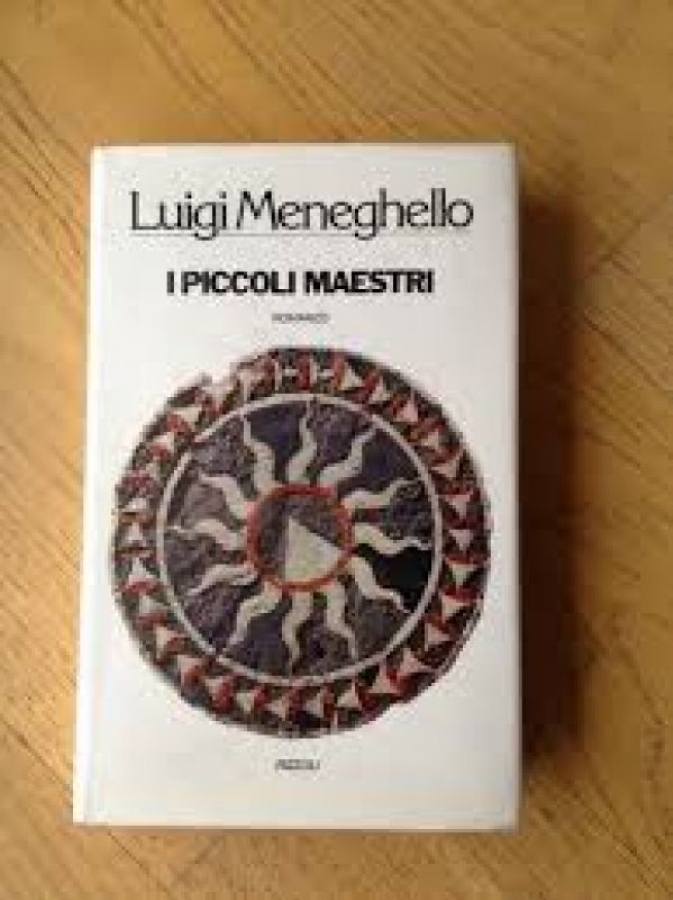
The Little Masters
Questo autobiographical account of the Resistance shares the same beginning as other novels that chronicle the years of partisan warfare between 1943 and 1945: as in Fenoglio’s *Primavera di bellezza* or Lajolo’s *A conquistare la rossa primavera*, the protagonist is a young officer, waiting for heaven knows what. > Perhaps we will flicker out like this; then, once we are extinguished, the war too will die down little by little . Instead, the armistice arrives, “like a scream,” and one returns home on foot, amidst columns of German troops. University friends in Vicenza are sought out once again, old discussions are resumed, and one partakes in an > intoxicating collective feeling (...); one sensed the overwhelming power of things rising from below, of spontaneous things; one felt the warmth, the security of being immersed in this surge of the general will . One joins the Resistance, moving through the city and the villages of the Venetian plain, but by October 1943 one is already forced to head up into the mountains, into the Belluno area and onto the Asiago Plateau, the settings where the book largely unfolds. Unlike what happens in Fenoglio and Lajolo, the protagonist does not become a lone wolf, like *Partigiano Johnny*, nor does he acquire a political consciousness that leads him to take a partisan stand, even after the Liberation. The author writes an intentionally anti-heroic narrative, yet does so with trepidation, because > every so often I had the sense of touching a more perilous point, almost a breach in a levee; and it seemed to me that if I stirred it, a flood of chaotic personal, civic, and literary affections would come pouring down and carry me away . And > in the end, the meanings of words vanished as well—adjectives, nouns, those cowards of verbs; (...) Finally, only the I and the non-I remained alone . The progression of the narrative follows the typical phases of partisan history: the emergence of the bands, disorganized and isolated; the roundups of autumn 1943; the long winter that followed; the movement’s growth in the spring of 1944; and then the new Nazi-Fascist offensive, which forces the partisans down into the plains. The protagonist moves through these events without dwelling on acts of war, which consistently remain in the background, focusing his attention instead on the men and the landscape. He meets old friends, makes new ones, loses them (to firing squads or deaths in battle), grazes past fleeting romances, and desperately tries to discuss literature and philosophy, to keep his humanist culture close. He too, like Partisan Johnny, finds himself alone in the long winter of 1944: on the run, starving, shoeless, barely surviving—yet it all feels like a dream. > I walked, with the landscape emerging in bits and pieces, giving the impression of moving. (...) Then the moon makes a long fish-like leap across the sky, its tangerine-colored light settles; I am on my feet and I stay on my feet, I walk down the road between the houses of Frizzòn, I knock on the first door. (...) There is no one in this house. They are all dead. Open up, at least you! I’m dead too. (...) I’m waiting for the coffin to come take me away . Though abandoned (he will be saved by Rosina, a young peasant woman), the protagonist lives as if on a long journey, both real and ideal, across the Venetian mountains, on the brink of the hills and the plains. And often he is overcome by a sense of wonder, as when he looks down from above upon > the torrents, the roads, the villages recognizable one by one in a kind of great lake; everything was enamel and gold, (...) and for a moment a kind of emotion came over me that I had not expected, as if a traveler in China were to look out over a remote valley, and there below Thiene should appear, the smoke of Schio, and the small hills beneath which lies his village, his home . The subdued, delicate atmosphere is the novel’s fundamental virtue: it is the fruit of a deliberately pursued narrative style and approach. As for the former aspect, the writing bears a humanistic, traditional, cultured, and elite imprint; yet the typically Italian rhetoric is stripped of its frills, rendered frugal and essential, thereby enhancing the fluidity of the sentence structure and the richness of vocabulary and idiom. The novel is a sort of remembrance, and thus the author rightly does not intend to provide a chronicle of events, but seeks instead to narrate them through the lens of memory, which shapes individual fragments, viewing them from the perspective of one who sees them now far off, as if in a mist. with a feeling of tenderness, but also of mild detachment. And it is this peculiar trait that makes the novel fascinating. This choice, which prioritizes sensations over events, at times makes the narrative tedious, as it comes at the expense of pacing and character depth. Why read it? It is wonderful to lose oneself in its atmosphere.
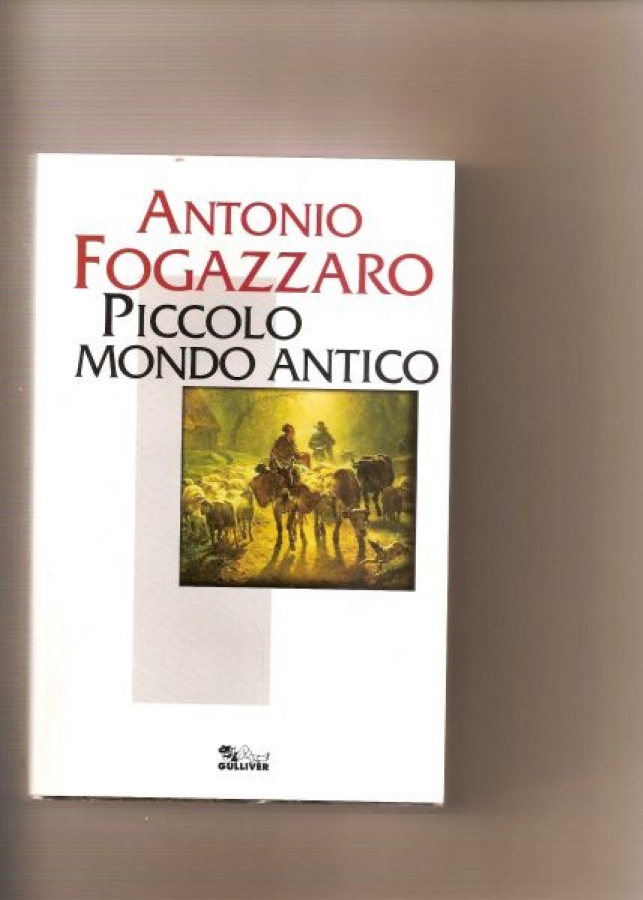
The Little World of the Past
The setting is Lake Lugano, and Valsolda in particular. We are between the two Wars of Independence. Franco is the grandson of a powerful marchioness and is in love with Luisa, a young woman from a respectable and honorable, yet modest, family. The conflict between the marchioness and Franco is not limited to the young man’s love for Luisa, but extends to their divergent political views: the woman is loyal to the Austrian dynasty, the man a staunch patriot. Franco marries Luisa without the marchioness’s knowledge, forcing the young couple to endure financial hardship, which is aggravated at a certain point by the dismissal of Luisa’s uncle—an honest, upright official of the Lombard-Venetian administration—engineered at the behest of the powerful marchioness. Life flows peacefully, revolving around the couple’s young daughter, little Maria. The only discord between husband and wife stems from their differing religious convictions: Franco is a devout and practicing Catholic; Luisa is practically indifferent, an atheist in her conscience. There are also their political ideals, shared by the couple and their small entourage, which, together with their economic struggles, prompt Franco to move to Turin. Finally, domestic harmony is disrupted and further tension is sparked between the spouses by the discovery of a document in which Franco’s grandfather, the marchioness’s late husband, reportedly bequeathed the estate to his grandson. Out of pride, Franco has no intention of enforcing the document concealed by the marchioness; this decision outrages Luisa, not so much for financial reasons as for the injustice endured. Upon the couple’s life—upon the «little world of the past»—tragedy intrudes with the death of Maria, who drowns in the lake. Luisa retreats into a tragic grief, consumed by guilt over the child’s death. Luisa feels barren and cold; a wall rises between husband and wife, threatening to destroy their relationship. The Second War of Independence breaks out; Franco, who has meanwhile returned to work in Turin, invites his wife to meet at Isola Bella prior to his departure for the front. Luisa hesitates deeply, but is persuaded by her uncle; en route to the island, aboard the boat, she observes a group of soldiers heading off to war and realizes that there are sufferings and heartaches far greater than her own. The reunion with Franco is initially cold, then gradually thaws, and the two find one another again, bringing forth a new child. As in all fine stories, love ultimately triumphs. It is, therefore, a romantic tale, one that caused a stir in its day on account of the religious ideas expressed within it. Through the character of Luisa, a sharp critique of religion was advanced—particularly against its official and sanctimonious forms—to the point where she declared that «God is cruel» or even that God does not exist. Viewed through modern eyes, what remains of genuine value in the novel is, instead, the tension between the intimacy of the domestic realm and participation in momentous historical events. At its core lies the depiction of the «little world of the past», which, as the author observes, > was even more secluded from the great world than at present, was more than at present a world of silence and peace, where the officials of Church and State, and, following their venerable example, several loyal subjects as well, dedicated many an hour to edifying contemplation . This world is Valsolda, whose landscape and community the author portrays alike. And it is precisely here that the novel proves weakest: nature is approached with a romantic sensibility, tending toward the «marvelous», evocative of a mere «tourist's» gaze, and ultimately rings hollow and detached; the characters, innumerable as they are, are depicted primarily through their mutual interactions, yet reduce to caricatures of small-town archetypes (the unfaithful maid, the curate, the schoolmaster, the informer, and so forth), without ever managing to achieve a truly ironic portrayal. Even the recourse to dialect fails to lend vibrancy or authenticity to the dialogues, ending up tedious and superfluous. The figure of Franco is flat, even implausible, considering that he endures a horrific tragedy which he seems to surmount with ease. The only character who emerges as contradictory and complex is Luisa: she is conscious of her husband’s frailty, of the vacuity of religion, yet she resigns herself to the social role of wife and mother. Only her daughter’s death shatters this precarious balance, driving her to the brink of madness. Yet, in the end, she redeems herself by reassuming the role assigned to her by society. *Piccolo Mondo Antico* is the novel of an affluent, cultured nineteenth-century Italian bourgeois, convinced that only by shouldering one’s social responsibilities can one attain salvation and mature as an individual. The pre-industrial tradition is thus something to be overcome, as is the inward retreat into personal grievances, petty interpersonal ties, and the pursuit of metaphysical and irrational solutions (religion, spiritualism). The theme of responsibility and the transcendence of the familial and parochial dimension remains remarkably timely in Italian society: perhaps the very superficiality with which it was treated in the novel is the reason why, as history has shown, familism and localism remain the enduring vulnerabilities of Italian society today.
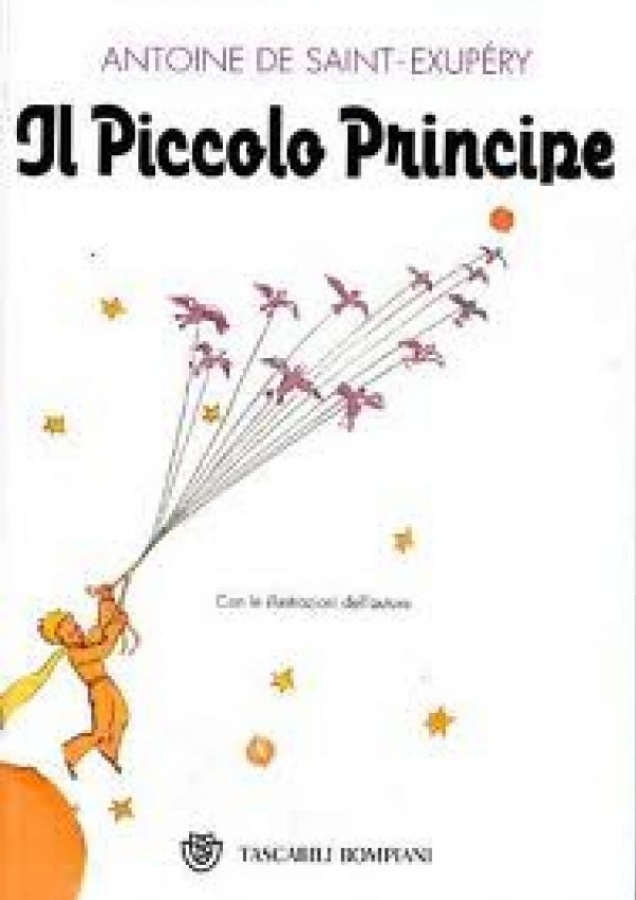
The Little Prince
*The Little Prince* is, perhaps, one of the most famous and widely read books in the world. The narrative opens with an episode from the narrator’s childhood, an aviator like Saint-Exupéry himself. At the age of six, he had drawn a "boa constrictor digesting an elephant," which to those who lack imagination—such as grown-ups—merely looked like a hat. Indeed, they > advised me to lay aside my drawings of boa constrictors, whether from the inside or the outside, and devote myself instead to geography, history, arithmetic, and grammar . From then on, the narrator spent "his life alone, with no one to truly talk to," until, having crashed with his plane in the desert (an actual event in Saint-Exupéry’s life), he encounters a "little fellow" (*the little prince*), who has arrived from outer space. The little prince lived on a minuscule world, so tiny that > you only had to move your chair a few steps to watch the twilight whenever you wished On this planet, the little prince tended to a flower, the only one in his world, "but he was too young to know how to love her." And, as so often happens to those who take no joy in what is close at hand, he sets off on a journey in search of something else. In his wanderings, he encounters six tiny worlds, each inhabited by a solitary soul: a king who "demanded from each what each could give"; a conceited man, who wished to be admired as the handsomest man on the planet, even though he was its sole inhabitant; a drunkard, who drank to forget that he was ashamed of drinking; a businessman, who endlessly counted; a fellow who constantly lit and extinguished a street lamp, because his planet spun so fast that day turned into night in an instant; and finally a geographer who had never explored the rivers, mountains, and seas he recorded on his map. Eventually, he lands on Earth, where the little prince makes several interesting discoveries, such as a fox who reminds him that "what is essential is invisible to the eye," and therefore his flower is unique not because other flowers do not exist (indeed, the little prince had already come across a field of roses), but because he had cared for that specific flower: > men have forgotten this truth. You become responsible, forever, for what you have tamed —that is to say, that to which you have bound yourself through an act of care. > Whether it be a house, the stars, or the desert, what makes them beautiful is invisible and it lies in loyalty to something, to an idea, to someone. And indeed, the little prince leaves Earth because he must return to tend to his little flower. Once he has departed, the narrator (Saint-Exupéry) realizes he forgot to add the leather strap to the muzzle drawn for the little prince's sheep. Will the sheep now eat the flower as well?! > Look up at the sky. Ask yourselves: has the sheep eaten the flower or not? And you will see how everything changes... One must ask oneself unpredictable, irrational questions aimed at probing the mysteries of the universe and the human soul: only the pursuit of the impossible can prevent life from lapsing into the prosaic nature of mere existence. The tale is autobiographical, recounting an exceptional and misunderstood life. The device of the fable allows the author, unburdened by the constraints of verisimilitude, to assert the necessity of holding onto a dream—which, in Saint-Exupéry's case, means flight, exploration, and adventure. Beneath the gentleness of the prose and the delicate lightness with which various existential themes are addressed (the allure of nature and mystery, friendship and loyalty, human flaws and the grandeur of the universe, imagination versus economic rationality), an enormous conceit actually emerges: the notion of being unique in the universe, the belief that the pursuit of one's dreams must know no bounds, and that when one realizes they are no longer attainable, death is preferable. The parade of little worlds serves as a vehicle to mock figures loathed by the author, yet it also mirrors an individualistic worldview, positing that only in isolation can our personality be fully realized. In the same vein, the desert setting encapsulates a longing for solitude, a state in which the author appears to indulge himself: it is far easier to converse with a child (the "little fellow") than with adults who fail to understand us. *The Little Prince*, despite all its sweetness and delicacy, stands as an allegory for a delusion of omnipotence—that of a man, and of a humanity, unwilling to accept limits: the swan song of the twentieth-century cultural superhero. Why not read it? It can certainly be read, as it is very brief, albeit pointless. A word of caution, however: do not give it to children to read, for it lacks any pedagogical value.
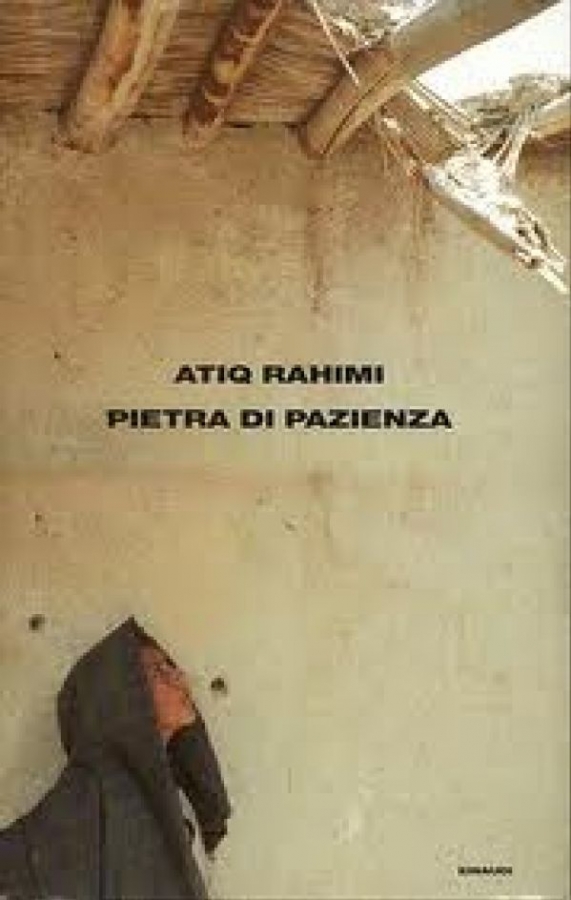
The Patience Stone
In Afghanistan, a woman finds herself beside the body of her husband, gravely wounded and seemingly in a coma. > Outside, a little shooting, a little praying, a little silence... the room is small. Rectangular. It is suffocating, despite the pale walls... the room is empty. Empty of all ornament . In a claustrophobic situation, isolated from the world and at the same time immersed in the whirlwind of war, the woman, hitherto silent and submissive, begins to speak, to confide her secrets to her husband. And she is able to do so > because you could answer me nothing, you could do nothing against me... I was at peace . A kind of exchange takes place. On the one hand, the woman cares for her husband and thereby takes possession of his body, now entirely dependent on her. On the other, the husband appropriates his wife's secrets > No one can believe it, no one! You don't eat, you don't drink, and you are still here! In fact, it is a miracle. A miracle for me, thanks to me, your breath is bound to the telling of my secrets. She stands up, weightless. Then she pauses in a gesture full of grace, as if to say: but do not worry, my secrets have no end . Outside, the world is shattered: a mad old woman wanders through the rubble, soldiers burst into the house and the woman pretends to be a prostitute to avoid being raped, but then (out of compassion?) gives herself repeatedly to a stuttering adolescent. Inside, within the suffocating enclosure of the room, we learn that the woman was forced to marry while still a child, without knowing her bridegroom, who was always away at war. We learn that she was menstruating when she had her first sexual encounter, and this was fortunate because it proved she had come to the consummation of the marriage a virgin. We discover that the woman, to avoid being repudiated, bore her daughters with another man, because her husband was sterile. > This voice erupting from my throat is the voice buried for thousands of years... if every religion is the story of a revelation, the revelation of a truth, then, my sang-e sabur (my patience stone, who listens), our story too is a religion A religion expressed in the body. We readers would wish that from this extraordinary encounter between a male body and the secrets of a female life, a communion between man and woman might be born, because > when it is hard to be a woman, it becomes hard to be a man as well! . Yet this is not the case. The husband awakens from his coma (or had he been conscious all along?) and hurls himself furiously upon the woman, killing her only to be killed in turn. The fragile unity has shattered into pieces. This tale is not an Afghan story—that is, one conceivable only within that specific social and cultural context. The author addresses a universal theme, in a situation possible, allowing for the necessary differences, across all latitudes: the distance between man and woman, their mutual incommunicability, is bridged only exceptionally, in a moment of profound suffering: beside the bed of a terminal patient, in solidarity over the loss of a child, in the midst of war or destruction. From this perspective, it is a quintessentially Western novel, drawing upon its existential dilemmas, narrative themes, and even literary devices: for instance, the opposition between inside and outside. And it is precisely this intellectualized imprint that disappoints and renders the entire narrative predictable. The narrative style effectively captures the opposition between inside and outside. External events are recounted in an objective, alienating manner, as though the woman were indifferent to them. The recounting of the secrets and of the woman's relationship to her husband's body is entrusted to a prose rich in evocative power, religious resonance, and poetic effect. The divergence in narrative styles reflects the acceptance of violence as a given and, at the same time, the woman's determination to liberate herself by confiding her secrets to her husband's inert body. Why read it? Brief and effective.
A Penguin in Trieste
The May 1953 issue of the *Giornale di Trieste* reported the news of the arrival in Trieste of the penguin "Marco". > Having arrived from the distant lands of the Cape of Good Hope, where a singular destiny had led him, (...) Marco was seduced by the affectionate attentions of an old sea dog, the boatswain of the motor vessel Europa Drawing inspiration from a real-life event, Carminati has written a coming-of-age novel that lends a touch of lightness to a troubled moment in Trieste’s history, between 1950 and the riots of November 1953, when a protest over the secret agreement between the United States and Yugoslavia—assigning the city to Italy and Istria to Yugoslavia—ended in deaths and injuries. Niccolò is still a child in 1950, > with few worries and plenty of freedom, when he flees Lošinj for Trieste, where he goes to live with an uncle. In a hidden box, he accidentally discovers a telegram reporting that his father was missing, presumed drowned, following the sinking of the steamship on which he was sailing. Why had his uncle never shown it to him? Perhaps > because he wanted me to remain a child for as long as possible, he wanted me to believe in the tooth mouse, Saint Nicholas bearing gifts, the Befana, shooting stars, my father alive somewhere in Africa. I looked out toward the open sea. The waves shuddered: (...) ten years earlier my father had died at sea, and for ten years he had lived only in my imagination. From a newspaper clipping (the January 1953 issue of *Il Tempo*), Niccolò learns that four sailors from the sunken steamship were saved in a lifeboat; what if his father were among them? What if he were still alive somewhere along the shores of the Indian Ocean, where the vessel had gone down? In an act blending hope, courage, and a spirit of adventure, Niccolò signs on as a deckhand on a steamship bound for Cape Town—still an adolescent and, to make matters worse, one who suffers from seasickness. Perhaps the search for his father is merely an occasion to come of age, much like Jim in *Treasure Island* (see the review of *Treasure Island* on this site). > I would return home, Niccolò admits, > with a new map: the one charted by my feet and my eyes. The novel is constructed with great skill and elegance, successfully weaving an adolescent’s feelings, curiosities, and discoveries into an engaging plot, complete with its share of surprises, albeit perhaps somewhat predictable ones. There are no villains! We are overtaken by a sort of hopeful cheer, accustomed as we are to despotic tales even in young adult fiction: consider *Borders no Borders* or the sprawling *Berlin* saga (see the reviews on this site). It is all rather excessive—too facile, one might say, and just as detached from the historical events of Trieste as it is from today’s reality. We must offer a positive perspective, yet we must do so while acknowledging current problems, lest we succumb to the lure of a "pretty fairy tale." The true merit of the novel lies in the writing: elegant, syntactically flawless, and lexically rich. Carminati recovers the very best of our language through a judicious use of punctuation, avoiding the stylistic traps so prevalent today: from the overuse of the full stop, which results in fragmented discourse, as in Nicola Lagioia’s acclaimed *La Ferocia*, to the rambling syntax where the flow of words relies not on punctuation but on mere sound, as in Federica Manzon’s overrated *Alma* (see the reviews on this site). Why read it? It is enjoyable, and it is a fine story. Assessment: medium-low.
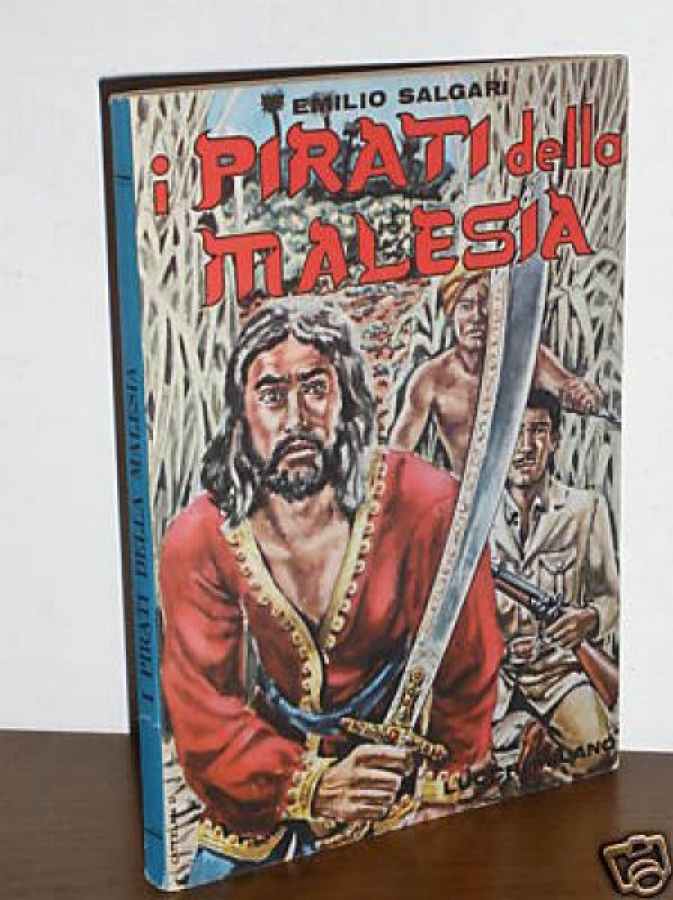
The Pirates of Malaysia
The pirates of Malaysia attack a ship aboard which Kammamuri is traveling with a young girl, mad. Kammamuri’s courage convinces Sandokan to spare his life and help free the girl’s fiancé, who is held prisoner by Rajah James Brooke. A series of intense adventures unfolds, leading to Sandokan’s victory over the Rajah, the liberation of the girl’s fiancé, Tremal-Naik, and the recovery of sanity by the girl herself. The book is characterized by fundamental narrative elements: the setting, the forests of Borneo and the maritime world, described with swift, evocative brushstrokes aimed at crafting an atmosphere that is both fascinating and somber. It is an engaging yet perilous context, far removed from the Western world, concealing not so much a taste for the exotic, but a desire for discovery and an awareness of nature as hostile to man; the heroes, in that all the characters, even the "mad" girl, seem to harbor no doubts and move without hesitation. Loyalty, courage, pride, dignity, and contempt for death are the sentiments that drive and define the novel's characters. In this sense, Salgari expresses a "will to power," a conception of the superman typical of his era. The characters have pre-defined roles: Sandokan, the fearless hero yet capable of weeping at the memory of his lost love; Yanes, the cunning and cold calculator; Kammamuri, the devoted and skilled servant, and so forth. There are no nuances or ambiguities in these figures; the narrative pace is relentless, characterized by rapid dialogues, concise descriptions, continuous moments of suspense, and sudden scene changes, even if it must be said that the final chapters appear rushed to the point that the Rajah's defeat seems scarcely consistent with the intelligence and strength displayed in other chapters by Sandokan's adversary. Magnificent is the chapter describing the revolt of the convicts up to their massacre by the savages. Salgari’s narrative pace anticipates the structure of cinematic screenplays and confirms the modernity of this author, beyond his style—at times elevated and rhetorical, typically nineteenth-century. The modernity and originality of Salgari’s narrative style emerge from two peculiarities: the artificial device of accumulation, whereby, for instance, within a few pages and in a single forest a multitude of fearsome or bizarre animals can converge, which answers > not only to the need to keep the reader in suspense, but also to offer within a limited space the world as spectacle and wonder (*Introduzione a Salgari*, Bruno Traversetti, p. 42); the method of the eternal return (a sort of search for lost time), whereby the heroes have always lost a state of stability (for example, Sandokan was a prince) and tend to return to that state, even distinguishing themselves from ordinary characters (for example, Sandokan is pleased that his wife’s uncle, an English lord, recognizes him as a nephew). The reference is always to a "conventional society" that has been destroyed by an extraordinary event. These devices are widespread in modern adventure cinema, and it is precisely the pursuit of this equilibrium, never fully recovered, that makes Salgari an extremely contemporary author, and from certain viewpoints, an unsettling one.
The Pirates of the Mountains
According to Daniel Pennac, the reader's second right is the right not to finish a book. “Does the book drop from your hands? Let it fall.” And he goes on to say that there are thousands of reasons to abandon a book, the principal one being: we never have time, and it is better to spend what little time we have reading what we like. In the past, I used to try to finish a novel or an essay even when I was not enjoying it. What torture! The eldest of my sons persists in this error; for example, he stubbornly insists on finishing *All the Pretty Horses*, despite finding it ponderous and tedious (see the review of Cormac McCarthy's novel on this site). A few years ago, I decided that I would let a book drop “from my hands” after eighty pages if I found its story uninteresting, its characters poorly drawn, and its prose unappealing, or simply if I preferred to read another book. I applied these superficial rules in this instance. We find ourselves in the midst of the Resistance. Among unidentified hills, but likely along the north-eastern border of Italy, a small contingent of partisans fights against the Nazi-Fascists: they are of various nationalities, united by the shared necessity of survival rather than by hatred toward the Germans and Fascists. There is also a nine-year-old boy: Giorgio, nicknamed the Cabin Boy because the partisans imagine themselves to be the fabled pirates of Tortuga and their band akin to Buccaneers sailing the Caribbean seas. A truly bizarre metaphor, given that they are in the mountains! Why not a group of mountaineers striving to conquer a peak, or the *Alpini* in the First World War? It is not clear why Giorgio left his home and parents; as we read, we learn that > it had begun, for him, with collaborationist fascists chasing after him. (...) With him running like a hare along the path that, past Capodistrada, climbs for another eight hundred paces—nine hundred if you are tired—before slipping through the brush and into the tangle of brambles, to emerge, already on all fours, at the barn and thus reach that hiding place. Here the boy was adopted by a group of men and women, already accustomed to war and death: loyal, brave, profoundly honest, and protective of Giorgio, as though they were the Tigers of Mompracem. Giorgio learns to live like a partisan, learning step by step to endure cold and hunger, to hide, to remain on alert for a sudden German attack, to forget his family, and finally to fight. > Giorgio, known as the Cabin Boy, narrowed his eyes and, trying to recover that sensation of invisibility, rolled himself up in the rough woolen blanket, waiting for the dawn when > the contours of things are more under the mind's control and those very things loom less large. The novel's opening pages promised an interesting story: an adolescent coming of age by confronting a harsh life and fighting for freedom. Unfortunately, the narrative quickly succumbed to the three golden rules. First of all, the storytelling is dull, devoid of plot twists or moments of tension—a predictable and repetitive succession of wartime events and partisan life. Secondly, the characters lack depth, especially Giorgio, whose personality accepts these new, dramatic experiences far too easily. Lastly, the writing is cluttered with pointless, banal dialogue at the expense of setting descriptions and the creation of an atmosphere that aspires to the imaginative, yet remains flatly prosaic. Consequently, I decided to let the book drop; I had another to read, and time is so scarce! Why not read it? It is boring.
La Più Grande
> She who would one day become The Greatest tripped over a stool left in the way. (...) Three bowls crashed to the floor, shattering instantly. The fourth, however, hovered a palm’s width from the ground: a young boy stretched out his leg and managed to catch it, in perfect balance, in the hollow between his foot and ankle. It was thus that Shi Yu saw Li Wei for the first time. In these few clear words are encapsulated the novel's fundamental narrative threads. Like *Oliver Twist* (see the review on this site), Yu is a young orphan girl who, while still a child, works as a servant in a squalid, filthy inn: a place to which she will return in dreams even after becoming a powerful and feared pirate, a longing for the nook where "the ferocious charity of memory" resides, as Giuseppe Ungaretti wrote (from *Ultimi cori per la terra promessa*). > It had been a long time since Yu had returned to the inn that stood deep within her soul. (...) She felt a great ache inside, but could not remember why. There, Yu was still innocent, exploited yet happy; later, she would have to learn to be a pirate commander, enjoying the freedom of the seas, the thrill of combat, yet forced to make difficult, harsh, and agonizing decisions, such as leaving her daughter to die in battle. *La Più Grande* is a coming-of-age novel, paced by the very structure of the narrative, which traces the phases of Yu’s life. Unlike Jim in Stevenson’s *Treasure Island* (see the review on this site), Yu does not need to grow up; she is already an adult at six years old. Instead, she must learn to navigate the stages that will forge her into a leader: fighting enemies and establishing her authority in a man's world, commanding men ( > you will have to learn to put the crew's interests before your own , her cook friend tells her), enduring imprisonment and torture, breaking free, and leading her fleet to victory against the imperial ships, against the Adversary, the powerful eunuch prince. > You must be proud of yourself, Yu, he murmured. (...) Why then did she sometimes feel like running away? (...) What was all this for? (...) I just want to sink. Into the blue. Into the cold heart of the sea. Into peace. As with the characters in *Treasure Island*, the sea, the pirate life, adventure, and the eternal struggle between good and evil compel her to carry on a life of struggle, with neither serenity nor quietude in sight. Li Wei's balancing act holds the third narrative thread: martial arts. The boy is the grandson of a powerful master of the so-called Air and Water style, through which one can leap as if flying and move weightlessly through water. Yu learns these techniques, also gaining access to a mysterious book, the repository of centuries of wisdom in this martial art. Had Morosinotto been writing for early twentieth-century adolescents, or indeed for us, the youth of the 1950s, he would likely have set the novel in fabulous India, among the pirates of Mompracem, or in Caribbean waters, among privateers. Since we are in the twenty-first century and Eastern fighting styles exert great allure, the story's settings are the China Seas, the cities of Shanghai, Macau, Canton, and Hong Kong, and the historical backdrop is the decadent Beijing empire prior to the imperialist aggression of Western powers. Everything is meticulously precise, but everything is also somewhat predictable, to the point that we are neither amazed when Yu skims across the water nor captivated by sequences of movements bearing evocative yet inexplicable names. To find the magic of Eastern martial techniques, we recommend reading Linda Lercari's *Kaijin l'ombra di cenere* (see the review on this site). And finally, there is the reunion with Li Wei, the Love Yu has pursued all her life. "The Greatest" knows she has always loved him, but Li Wei now appears to be an enemy in the service of the Adversary. And just as *The Black Corsair* (see the review on this site) weeps before his crew because he must abandon the woman he loves in a lifeboat, being the daughter of the enemy upon whom he has sworn vengeance, so Yu > wiped her tears with the sleeve of her shirt. A commander cannot break down before her men. > She knew that everyone on the ships was watching her, wondering what had happened. Morosinotto is a master craftsman of plots, as he admirably demonstrated in *Il grande colpo di Crimson City* (see the review on this site); here, however, the sheer length does not help impart rhythm to the narrative, which becomes diluted in repetitions, a multitude of names, and a ceaseless swirl of digressions. Yu and Li Wei remain mere sketches, their love never deepened or enriched by encounters that are not rushed, or by expressions of feeling, however tormented. Having finished the story, the reader cannot help but think how beneficial it would have been to prune some redundant passages and instead explore more deeply the two lovers, eternally bound since childhood, yet eternally kept apart by such divergent lives: Yu the pirate, Li Wei the imperial official. The prose is incisive, composed of short, clear sentences, with a style reminiscent of Emilio Salgari. The dialogue is effective, as are the descriptions of battles and combat. Certain scenes, such as the duel between Yu and the Adversary or the girl’s rides across the sea, are exceptionally evocative and leave the reader breathless. Why read it? Adventurous, albeit at times prolix.

A place called freedom
Ken Follett imagines finding a box buried in the garden of the house where he has just moved. Inside, engraved on a collar, he discovers this inscription: > this man is the property of Sir George Jamisson, year 1767.(...) if the steel collar could speak,(...) what story would it tell? From this opening, reminiscent of the discovery of buried treasure, begins a tale that aspires to be historical and social, in the vein of Émile Zola, but quickly degenerates into a potboiler. We are in mid-eighteenth-century England, though the exploitation of the iron and coal deposits of the "Black Country" in the English West Midlands had already begun by the mid-sixteenth century. Working conditions were brutal, owing to rudimentary mining techniques and the greed of the masters, to whom the miners were even bound by seven-year indentures. Men, women, and children descended into the depths of the earth; casualties were numerous and frequent, caused chiefly by explosions resulting from gas leaks. The miners were left with nothing but dreams of freedom in a life beyond this world. > Look no more with eyes of pity/see our victory/when we build that heavenly city/all men will be free . In these words lie both resignation and redemption, an unshakeable will toward freedom. And it is this very will that impels Mack, a young and charismatic miner, to place himself at the head of his people. Within the nascent bourgeoisie, too, stir impulses toward freedom, though viewed more as an impatience with rigid social codes than as an awareness of the brutish exploitation of the people. Lizzie belongs to a once-affluent, now-impoverished family: she could marry one of the young Jamissons because she is pretty and well-mannered—if overly independent—and, above all, because she owns land particularly rich in coal. This Lizzie is a peculiar character: she likes wearing men's clothes so she can move about more freely, rides astride like a man, and seeks to understand the life of the miners; moreover, she is drawn to Mack's magnetism, to the aura he exudes: > with pride he moved his powerful body, the confidence with which he tilted his head, the intense gaze in his gleaming green eyes. She felt drawn . Lizzie refuses to acknowledge her passion for Mack, even when she descends into the mines and sees the young man at work—untamed and strong, saving lives during a gas explosion; when she admires him for his courage in demanding better working conditions; and when, at last, she sees him emerge naked from the cold waters of the stream during his flight to London. It takes time for Lizzie to recognize her love for Mack, and with it, her own desire for freedom. She will marry one of the two young Jamissons—a mendacious, soft, and obtuse man—and travel with him to Virginia to a coffee plantation, where she will once again cross paths with Mack, transported as a slave from England; and it is with him that she will ultimately find freedom in the Wild West. One cannot help but wonder what Ken Follett truly means by freedom: the independent, transgressive ways of a young bourgeois woman—aspirations closer to our own era than to anything a young woman in sixteenth-century England could have conceived—or the emancipation of a people setting out on the path toward working-class rights and social justice? Considering that the author is a Labour Party sympathizer, the novel bears subtle witness to the devolution of socialist thought: from a working-class movement to left-wing liberalism. Where is freedom to be found? Only in the Wild West, far from the bourgeois constraints of society. Would it not have been better to delve deeper into the social and individual realities of an emerging working-class world within the mining and metallurgical industries, which were to play a decisive role in the Industrial Revolution and the birth of class consciousness? Written, as with all his fiction, in fine, elegant English enriched by period slang, and carried by an intricate, at times gripping plot (such as Lizzie's descent into the mines), the novel nevertheless displays Ken Follett's customary shortcomings: too many overlapping storylines (the exploitation of the miners, the struggle of the London dockers, slavery, and the American colonists' yearning for independence) and thinly developed characters, particularly Lizzie, who is meant to be the linchpin of the entire narrative. What longing one feels for Jane Austen's heroines! Why read it? It is an easy read, even if, ultimately, it proves flat and long-winded.
The Port of Crossed Dreams
According to Buddhism, suffering arises from opposing the flow of life and clinging to forms that are deceptively permanent, whether they be things, events, people, or ideas. And yet man is like the flight of a bird or the passage of a fish through water, leaving no trace behind; he is like sailing a boat, guided by the winds. And who better than a sailor personifies this condition of transience? We are in a pub in an Irish town, where four people meet; strangers to one another, yet all living in a port town and all having crossed paths with the captain of a cargo ship: Marcel. Rosa Moreno has the smile of Ingrid Bergman, and risks spending her entire life in the same bar in a small port on the Atlantic coast of Spain: and then > everything seemed black to her, as if life were not worth living . A night spent with Marcel gave her dreams of freedom, the possibility of a new life, but also a tangible legacy: a child. Madame Le Grand is a still-attractive widow who spends her life cataloging the stories of all the sailors passing through her port city, > to ensure that all the people she met left a trace behind, instead of vanishing into nothingness, as if they had never existed . She invites Marcel and his crew to dinner and is fascinated by a man who > did not care to know what comes next, (...) greatest desire: none, because it makes one unhappy . Peter Sympson is a jeweler to whom Marcel entrusts a highly valuable gemstone for sale, while revealing to him the profound meaning of his life: > your hobby is precious stones. Mine is fleeting acquaintances and their dreams of life. Jacob Nielsen is a computer scientist who lives in the world of the internet; at times restlessness takes hold of him, and then it takes only > a gust of wind from the sea to sweep away his longing for elsewhere . He meets Marcel and is captivated by the idea of a network of "intertwined ports," of which the captain he met by chance could be the unwitting fulcrum. > And what if in that way they managed to prove that the world is not an impenetrable chaos, a whirlpool of anonymous human beings drowning and lost in their very profusion and diversity? . Rosa Moreno, Madame Le Grand, Peter Sympson, and Jacob Nielsen are there, by chance in the very same pub, to see the man who pulled them out of their monotonous daily existence and propelled them into a hope-filled uncertainty. All four are deluding themselves. For Marcel > binding himself to other human beings would have been like running a mortal danger. Because who better than he could know that all bonds of that kind can be broken? To be alone and free to dance had become his destiny on this side of the grave . Marcel flees on his sailboat, even after learning that Rosa carries his child in her womb. > Strange is the heart of the sailor: he hopes, he fears, he ventures closer and veers off the coast, at last refits the torn sail, and turns his shattered bow toward the ocean, crestfallen, reversing course ( Robert Louis Stevenson, *Underwoods* from *Poesie*, Oscar Classici Mondadori 1997). Stevenson's beautiful quotation is inappropriate. The great English writer is referring to the sailor's life, his irrepressible longing for solitude. Larsson is not speaking of this: the distant, romantically depicted sea remains on the margins; nor is he truly writing about the characters. Even when we learn of Marcel's childhood, in which the captain suffered the loss of all his kin, we realize that it is not this terrible wound of the past that perpetually drives him to flee. The other characters have suffered too; nonetheless, they desperately seek something solid, certainties and relationships to which they can anchor themselves and for which they can live. The novel is a philosophical narrative. The real theme is the contradiction between permanence and transience: impermanence is not an unstable condition to be escaped; it is the very mode of reality, the sign that leaves no record, "emptiness" as an essential given of human being. What nostalgia for the writing of *The True Story of the Pirate Long John Silver*. Just as the narrative style in that splendid novel is vivid and evocative, here the delivery is flat, prosaic, cold. The events unfold without momentum, developed in a bureaucratic and repetitive manner. Why not read it? Trite, flat, and prosaic.
The Port of Love
I do not know whether anything exists in our literature quite like Thomas Mann’s novella *Death in Venice* (see the review on this site). Comisso's short piece recaptures much of the atmosphere of the great German writer's masterpiece. One senses the same oneiric anticipation of decay, voluptuous and melancholy. We are in Fiume, between 1919 and 1920: the city, sweet with the fragrance of jasmine, was illuminated > by the glint of the sea, and on the slopes orchards gleamed with blossoms, (...) on the sea, a few sails caught the sun. (...) The warmth of the sun matched the languor of the body restored by good food. I indulged in indefinite pleasures... How can one not recall the “balmy nights” of Piazza San Marco and the “soft, luxurious sweetness” that held sway over the aging writer who went to die in Venice? Comisso recounts his brief Fiume adventure with languid nostalgia through a series of portraits, steeped in an “immense boredom” and in the D'Annunzian notion that “everything in the world yearns for love.” It is a metaphorical journey along the paths of youth: betrayed hospitality, male friendship, passion for the Croatian woman (“come with me, Italy is in love,” Comisso tells her), the murky attraction to the decaying woman ( > withered skin, wrinkles, sullen eyes, hooked hands, a misshapen figure, a parched mouth, and blackened teeth ) right down to the hunchback, a grotesque pimp > who smiled at our frenzy and took pleasure in driving it to an exasperating pitch. (...) I trembled with impatience. The thought of the woods, the moon, and this peasant girl easily yielded to love in the night confirmed for me that the finest dreams of adolescence were achievable in life . And just as Thomas Mann surrenders to fantastical visions, where Venice is > half fairy-tale, half snare for strangers, in whose miasmas a voluptuous luxuriance flourished, (...) notes soothing and caressingly languid , so too does a Karst cave draw Comisso > into an agonizing dreamscape; I imagined an unleashed surge of water crashing over me, crushing and suffocating me against the walls. (...) How could such perfection last, and how could we ever find its equal? (...) The ground was strewn with countless dead bees, and that slaughter felt like an omen of my own end, the consequence of a summer lived too greedily . The Italian army put an end to the Fiume adventure, leaving Comisso with nothing but nausea. > Life weighed heavily on us, and we had grown old along with our clothes, threadbare and steeped in perfume, dust, and sweat . In Comisso’s youthful novella, much recalls the Crepuscular poets; reading it brings to mind the verses of Guido Gozzano: > heart that never bloomed, in vain do you hasten / toward pure mirages in less mournful gardens; / you feel it serves man nothing to linger, / scattering dispersed dreams for a new life (From *I colloqui*, “Le due strade”). Far from being a harbinger of Fascism, the Fiume enterprise was an experiment in free love through which a bourgeois youth, scarred by the violence of the First World War, sought desperately to live, refusing to return to an opaque petty-bourgeois existence while pursuing a kind of revolution of mores and consciences. Comisso recounts this shattered dream: nothing remained but Fascism as a final illusion of breaking free from the prosaic Italy of Giolitti. *Il porto dell'amore* is a youthful work, “teeming with impatience for grammar,” as Rolando Damiani observes in the preface to the collected works of the author; and it is precisely in these grammatical improprieties that the secret of Comisso's charm lies. The author employs a language that blends elevated, classicizing, and elegant forms with incursions of spoken idiom and dialect. The result is a singular, alluring, and mysterious reading experience; as Montale put it, “an exact, light sound of words,” which yields an indecipherable sense of grace. Why read it? Wonderfully languid.
The Meadow at the Bottom of the Sea
Stanislao is the great-nephew of Ippolito Nievo: writer, poet, and great patriot of the Risorgimento, who died at the age of 29. To Ippolito we owe one of the masterpieces of our nineteenth-century literature: *Le Confessioni di un italiano*, the review of which is available on this site. On March 4, 1861, the steamship Ercole, having departed from Palermo for Naples with Ippolito on board, vanished in the stretch of sea between Capri and the Sorrento Peninsula. Everyone perished: along with Nievo, the accounting records of Garibaldi's army were also lost, and with them the proof of the financial rectitude of the expedition, which had been the object of slander and accusations by the Piedmontese government. Was it a shipwreck caused by sea conditions, or was it a bomb that put an end to Ippolito’s life and buried documents of vital importance in the abyss? Stanislao reconstructs these events and investigates the mysteries surrounding the ship's disappearance. One must not expect a detective story: it is the search > for someone lost and shrouded in a strange light that sometimes obscured the truth . > Elegant, detached, soft face, brown, exceptionally mobile eyes, (...) romantic, rational in action , Ippolito is a myth; he and his death were never spoken of within the Nievo family, as though only silence could immortalize a figure who desired nothing but oblivion. Stanislao’s quest begins with a vision. Looking at a postage stamp dedicated to his uncle, suddenly > the sea expanded, became enormous, life-sized. The face widened and grew exceptionally clear, then dissolved, reappearing in natural color and receding into the sea that enveloped it. On the stamp, the man had a red mark on his chest. It was a military cap, red. The color remained, but the shape changed and began to throb. (...) Everything vanished into the sea, which had become an azure door . It is a hallucination; it sets the tone for the entire novel, ostensibly built around a rational plot, yet in truth punctuated by a series of portraits, some of them powerfully evocative. Consider the chapter “The Last Minute”—a chapter that alone is worth reading the book. With a realism both unsettling and mesmerizing, the author retraces the shipwreck, even imagining the thoughts of the final minute, when “there appeared to each the old age they would never live to see,” until > a few lights came on. They were deep-sea creatures with electric organs. No one else witnessed the Neapolitan vessel reaching the bottom. It settled with a silent caress, enclosing within its wretched cargo . One is reminded of one of Ippolito's poems (“The Fireflies,” quoted in the book): > my mind resembles a little meadow/Filled with tiny fireflies at the dusk hour/ Where the gleam on this side or that/ Tremulously flits without any rest . The vessel settling to the bottom evokes the final chapters, in which the author recounts the deep-sea dives undertaken to locate the boat, or at least some of its wreckage. It is a realistic, detailed description: amid numerous vessels lying on the seabed (how immense is the sea! and how much humanity lies buried in its depths!), Stanislao realizes how his inquiry was > a wave carrying me without direction and without lightness. Where? (...) Solitude slowly emptied itself of its images. Everything became alien, weightless. I felt like a tunnel where the wind shook the timbers. And it bore me far away, into nothingness. (...) I was cast into the memory of solitude of the shipwrecked man I was seeking. A week before disappearing, Ippolito wrote: “I shall die to die, and everything will be over.” The search is futile: Ippolito Nievo wishes to remain a myth, and his disappearance must remain a mystery. How does one recount the life and death of an uncle, a father, or a grandfather? How does one convey the meaning of devotion? Stanislao offers a disconcerting answer: one does so by searching for oneself, in a whirlwind of portraits and reflections, wherein the memory of the revered figure remains suspended there, in memory and imagination. How did Ippolito Nievo disappear? We will never know, but for a nephew, what does it matter? He does not have to write a biography, nor conduct a historical investigation: he must reconstruct in his mind, relying even on imagination, the essential character of the man. For Ippolito, that was solitude; after all, he used to say: > the fireflies glow in my brain at the dusk hour, scintillating among dense shadows . Like his uncle’s masterpiece, Stanislao’s novel is uneven: chapters of great narrative power and even hilarity (think of the section entitled “The Augean Stables,” recounting his wanderings through the state archives) are followed by muddled and redundant pages, such as encounters with palmists to seek enlightenment on where to find the steamship, or pointless digressions on the efficacy of pseudo-sciences. The prose sustains the novel, with short sentences, tight dialogue, and a sparing yet effective use of adjectives; yet the author cannot prevent the pacing from turning prolix and rambling. If Uncle Ippolito had the excuse of never being able to revise his masterpiece before it went to press, dear Stanislao! You have no excuse: some healthy pruning would have done the narrative a world of good. Why read it? For the chapter “The Last Minute,” and to rediscover *Le Confessioni di un italiano*.
Spring of Beauty
The novel is set in 1943, during the dramatic months that led to the fall of Mussolini—replaced by Badoglio—the Armistice of September 8, and the king's flight from Rome. In this brief span of time, Italians came to realize what the Fascist regime had truly been, and into what disaster it had plunged them. Like the novel's protagonist, the officer cadet Johnny, Italians were seized by an indignation that > loaded them like a shell into the mouth of a cannon: murderous swine, filthy bluffer! . The novel recounts, precisely, this tragic coming-of-age, narrating it from the perspective of young soldiers left to their own devices, as was the entire country. The novel opens in a barracks in Piedmont, where Johnny is attending an officer cadet course. The military environment is slipshod, marked more by hollow rituals than genuine training. In truth, no one, not even the highest-ranking officers, believes in Italy's victory or in the war's justification. Discouragement and pessimism prevail. A disconnect exists between reality and the repetitive, futile drills to which the young recruits are stubbornly held. > Exhausted by that excess of freedom and oblivion, he had to lean against the trunk of a poplar; he felt the soft, warm bark, and failed to hear the distant trumpet sound the cease-fire. This by the river was reality; the morbid dream was the Italian army . How unreal appear the slogans painted on the walls, «Vincere», when the Italian troops, «greasy, down-at-heel, gypsylike», are transferred to Rome: it seems the American army has landed in Sicily. The officer cadets' hope of seeing combat swiftly fades. They are stationed in a barracks in Montesacro, resuming their pointless drills. > It wasn't so bad after all, an entire, fairly close-knit squad idling in the delightful quiet of a nearly deserted barracks.... it felt like being in a clinic . The armistice catches them completely unprepared. Johnny, with a group of comrades, is guarding an ammunition depot in the Roman countryside when he sees droves of soldiers arriving, half in civilian clothes and half in uniform, fleeing Rome. The king, Badoglio, and the senior officers have abandoned the capital without leaving orders on how to act: > resist the Germans, do not resist, kill the Germans, do not open fire on the Germans, do not surrender your weapons, self-disarm.... hurry up and find yourselves some civilian rags, too . Resignation and flight prevail; after all, «it had to end somehow». «Full of misery, with no room left for fear», Johnny too resolves to return home to Piedmont. A journey begins aboard trains overflowing with fugitives, while at the stations Germans round up Italian soldiers to dispatch them to concentration camps in Germany. Often, some of the Italians are shot on the spot when attempting to escape. > The stench of that Italian multitude, bowed, attempting to do the smallest and most necessary things with an air of absolute harmlessness and submission. Often beneath the shed roofs a brutish German call rang out, and then those little soldiers, so trim and solid, cut irresistibly through the suspended Italian mass toward mysterious appointments and duties . These few lines render magnificently how Italians had been reduced by an improvident and cowardly ruling class: an abandonment mirrored by the aimless efficiency of Hitler's army. Two nations in disarray, albeit in markedly different ways. Johnny miraculously manages to reach Piedmont, just a few kilometers from home, when he encounters a detachment of soldiers who have resolved not to surrender and to fight the Germans. He decides to join the partisans, certainly not out of political conviction, but out of an emotional impulse, so as not to feel > too inferior to a spit... because it repels him to come out of it like that (like a fugitive) . Johnny's fate is sealed during an assault on a convoy: > the German was coming, a young face and an old uniform, and now lowered the already-aimed machinepistol. Johnny perceived an infinitesimal click . The splendor of this novel does not reside solely in Johnny's tragic and emblematic story. Its exceptional nature lies in the language used: rich, imaginative, and inventive. It is as if Fenoglio sought to transfigure history, refusing to reduce it to a dry and cold report. The Italian language is molded to forge a suspended, unreal atmosphere, as though everything that happened to Johnny had not truly occurred, but belonged to a nightmare—both personal and national. Reading this marvelous book, one feels overcome by an intense melancholy, for what Italy was, but also for what our language might have become, had it not withered into a hasty, impoverished, and sterile narrative style. Why read it? It is the account of a momentous juncture in our history, and a captivating read.
A fiery spring
In the conflict between Israelis and Palestinians, the events between 2000 and 2002 represent a fundamental watershed. Prior to September 2000, the onset of the so-called Second Intifada, there reigned in Palestine > an order imposed by an occupation that had lasted for years and generations, which had become a habit, or rather a routine, a way of life; yet the butterfly continued to struggle, it could catch fire, it could explode and make it falter . And when the visit of Ariel Sharon—then leader of Likud and later Prime Minister of Israel—provoked Palestinian religious sentiment as he prayed on the Esplanade of the Mosques in Jerusalem, a wave of violence erupted, leading to Israel’s military reaction, the siege of Arafat, and the subsequent occupation of the Palestinian territories by Israeli forces. The novel seeks to recount these dramatic events through the eyes of two brothers, Magid and Ahmad, and their friend, Su’ad. The narrative is divided into two parts. In the first—undoubtedly the most evocative and well-structured—the underlying theme revolves around dreams in wartime, anchored by a famous line from Mahmoud Darwish: “leave me alone, let me go where I want to go.” Magid is a splendid young man who dreams of becoming a famous singer. Ahmad is still a boy: shy, introverted, solitary, and sensitive. He strikes up a secret friendship with a young Israeli girl, communicating with her through few words and mostly gestures, across the barbed wire dividing the settlers’ territory from that of the Palestinians. Yet dreams are laden with deceptive hopes! Chance drags the two boys into the dramatic reality that grips their society. Magid is accused, despite his innocence, of the assassination of a high-ranking Palestinian government official, loathed as an alleged collaborator. Forced to flee, he joins the resistance. Ahmad’s story is paradoxical. In an attempt to retrieve his beloved cat, inadvertently taken by his little Israeli friend, he is caught inside the settlement and thrown into prison, suspected—mere child that he is—of being a terrorist. In the second part, the novel shifts perspective. On the one hand, the author pursues a political reflection on the role of the Palestinian Authority. There are more questions than answers. Faced with leaders who seem to favor careerism and visibility over the fulfillment of their people’s hopes, the author wonders whether > is the Cause not like a love story, starting sweet, strong, and overwhelming, and then, with time, withering, dying, and decaying? On the other hand, the female perspective emerges. Su’ad becomes the protagonist; she loves Magid, yet watches him transform into an elegant man dressed in a suit and tie. > With the artist and the revolutionary gone, nothing remains but the opportunist plotting his climb to power... Is this how power diminishes a promising young man?.... And what about us women? What do we know, what do we feel, what do we do? Not much; to them, we are mere background, nothing more . Women are thus left alone, yet within them all the struggles of a people at war are epitomized. > Inner sieges, outer sieges, the siege of society and that of Israel; men know only one. She, on the other hand, endured them all at once . And so only a woman can cry out: > Palestine, piece of the sky, your name upon my lips is a prayer.... a kind of azure prayer stretching as wide as the horizon . The tragedy of the Palestinian people unfolds hand in hand with the withering and dissolution of the passions of adolescence and youth. The book is an elegiac—at times epic—narrative of a homeland’s destruction, from which not even the inner world of intimate affections is spared. > Run, run. Barefoot, half-dressed, in slippers and sandals, with children, without children. The elderly, the aged, and the wounded clambering over rubble, stones, shattered glass, fires, garbage strewn everywhere. And corpses. And the wounded with injuries of every kind and severity—some in the hand, some in the foot, some blinded by the heat blasts, some struck mute and unable to utter a word. And screams. All that remains is the mortification of one’s tears and the humiliation of a life consumed by adverse fate. The novel’s true shortcoming lies in its narrative plot. In the first part, it manages to maintain an internal logic; this, however, splinters in the subsequent pages into a confused and disordered succession of events: the epic depiction of the assault on Arafat’s presidential compound and the Palestinians’ flight under military aggression; the musings and disillusionments of Su’ad, who occasionally steps in as narrator (further disorienting the reader); the author’s political reflections, often merely hinted at and thus impenetrable to those unfamiliar with the events; and the elegiac interludes on the pain and despair of the Palestinian people, at times rhetorical and repetitive. It is as though a surge of thoughts overwhelms the author, ultimately to the detriment of both characters and story. The frequent reliance on rhetorical questions further weighs down the prose, never fully concluding either argument or narrative. Why not read it? After an engaging start, the reading grows steadily more fragmented, often redundant and dull.

I have probably lost my way
The protagonist is a young woman: she lives in Tehran with a young child, is separated, is seeing a therapist, and has a friend: Gandom. The story unfolds over the span of a few hours. Waking up disoriented to the ringing of her ex-husband's call, she finds herself covered in bruises, with a black eye (was she beaten?); she barely remembers sending her child to kindergarten by taxi; immediately, she begins an imaginary dialogue with Gandom. > Why didn't I ever tell her that sometimes dreams accompanied by fears, anxieties, and worries are more beautiful than reality, and sometimes even more real than reality... They were childhood friends; they grew up in the same provincial town and left it together to study in Tehran; they fell in love with the same man, but then the protagonist married the one chosen by her family. She leaves the house; the traffic is heavy and noisy; the radio invades the car's interior with commercials, news items steeped in political propaganda, religious appeals: > Cick, Cick, Cick... the chocolate for young and old, (...) Economic troubles are a plot by the enemy, (...) Women and men are essentially different. If a woman strays from the path of purity, she brings dishonour upon her husband, but if a man..., (...) When a child is to be born, an angel comes from God (...). The angel ushers it into this world and watches over it for life... She keeps talking to Gandom, and so we learn that her father and brothers have died, and that she grew up in a family ruined by debt, with a cold, severe mother. > Since when, since when have I covered myself with this heavy, black chador? (...) Perhaps I left something behind somewhere, in the past. (...) Ah, if only it were possible, with a single deep breath, to swallow the past and gulp it down forever.... Gandom is altogether different: full of life, joyful, confident, with an affectionate father, a kind grandmother, and plenty of money to spend on shopping. They are inseparable, with the friend ever ready to assert her superiority, knowing her better than she knows herself. > Gandom always had to humiliate me, both when she threw my fears in my face and when she didn't. My entire life went to shit with this person, a person who seemed to know everything about me, as if she knew my hidden corners, as if she were closer to me than I was to myself... my entire life... it makes me laugh... . She hasn't seen her in many years; she must find her because she cannot live without her; she seeks her out through the man they both loved. > I am thirty-five years old. Tomorrow I will take Samiar to kindergarten, and when I walk out the front door, I will see a thirty-five-year-old woman standing there, watching me with a smile. This time, after all these years, I recognize her, with those bright black eyes, with that smooth, amber skin, with all that hair escaping here and there from her headscarf and framing her face... with that smile that brings two dimples to her cheeks... I go toward her and grasp her hands tightly in mine. She says: how warm they are. I would like to tell her that it is not my hands that are warm... I say nothing... I just hold them tight in mine and smile... after all these years, I know that when I smile, dimples appear on my face too . It is the story of a split personality. Oppressed by the nightmares of the past, from which she tried in vain to escape by moving to the big city—only to find herself even more isolated and desperate—the protagonist has slipped into schizophrenia. > I placed my hand on hers. Her perpetual presence was better than her absence. Her presence, with all the suffering it caused me, and perhaps with all the suffering I caused myself... (...) It is as if I had lost myself years ago, lost under that star-filled sky of Zahedan . To find herself again, she would have to return to childhood, deep into the past, and that is impossible. Will maternal love save her? > I weep... I weep out loud, (...) Samiar strokes my hair and I sink into his embrace... . The narrative is constructed on several levels: the real, insignificant plot; the rapid-fire dialogues with Gandom, which are obviously soliloquies; the visits to the therapist, brief and useless for understanding the protagonist; and contemporary Iran, caught between modernity and traditionalist Islam. What emerges is a fragmented, disjointed narrative, further marred by an exasperating overuse of ellipses—intended to convey a stream of consciousness, but in truth merely a trite literary device to avoid delving into the protagonist's existential drama. One is left perplexed and unsatisfied, with the impression of a superficial, contrived, overly intellectualized story, lacking the weight of genuine lived experience. Why skip it? Inconsequential and pointless.

The Scent of Lemon Leaves
Juliàn is a former inmate of a Nazi concentration camp, > obsessed with a past that no longer mattered to anyone, yet of which he could not forget a single day . On the threshold of old age, he travels to Spain after learning that a group of Nazi war criminals has taken refuge on the Costa Blanca. He is driven by a profound hatred for these "dying monsters," by the desire to instill the very fear and suffering he witnessed and endured in the camp: > I had been left behind, trapped in my own world, with my hatreds, my friends, and my enemies . His path crosses that of Sandra, a pregnant woman in her twenties, uncertain and confused about the direction her life should take. To the aged Juliàn, Sandra appears as the embodiment of the present and the future—realms he has never truly known, consumed as he was by a far stronger sentiment: hatred, and thus the past. > Her hair had various shades ranging from red to black, long on one side and shorter on the other. She also wore a small nose ring. Her eyes were somewhere between green and brown, and she had an aquiline nose. The sunlight striking her face gave her gaze a faintly ironic air . An encounter between two such disparate lives was made possible because Sandra had been taken in by an octogenarian Nazi couple, who, deep down, had been charmed by the girl in the very same way Juliàn was. With growing conviction, Sandra assists Juliàn in his investigation into this ring of criminals. In truth, it gradually becomes apparent that these former Nazis are themselves unhappy old men, locked in their own fantasies of power and youth, trapped in a web of relationships dominated by abuse and even deceit. The futility of hatred becomes increasingly evident to Juliàn, not least because he realizes that his obsession could place the young woman in grave danger. He finally understands that there are things far more important than constantly returning to the past. He at last makes peace with his concentration camp ordeal, to the point of choosing to stay in a retirement home where two elderly Nazis have also found shelter. For Sandra, on the other hand, the events in which she has become entangled propel her into adulthood, leading her to realize that her life’s purpose is to provide a peaceful existence for the child she carries. All she is left with is the memory of her love for a young, alleged Nazi who saved her life. There remains, in some way, an unresolved mystery—something unfinished that she may well carry within her, once again ushering in that fate of perpetual return to the past that had once been Juliàn's. The theme of Nazism, viewed from the perspectives of both tormentor and victim, serves as an opportunity to examine the relationship between past and present, as well as the communication breakdown between generations—a gulf that can only be bridged through "doing" (Juliàn and Sandra coming together in their investigation into the criminal ring) rather than "telling," that is, the narration of lived experience. Yet there is something more to this novel. There is a sense of contrast between the certainty of the old and the uncertainty of the young (Juliàn is as monotonous in his hatred as Sandra is fresh in her naivety), a conflict emblematic of an epochal transition, much like our own historical moment. In this sense, it is telling that Sandra's adulthood begins in a state of suspension that leaves the novel open-ended: what will become of Sandra and her life? The story is told through two alternating voices (Juliàn and Sandra), a literary device that renders the narrative redundant and repetitive. The plot, purporting to be that of a detective investigation, is devoid of incident and narrative twists. The setting is so sparse that it could easily be any generic tourist resort, just as the characters remain thinly sketched, despite confronting ethically and existentially complex themes. Why skip it? It is tedious and trite.
Proletkult
In 1906, Aleksandr Bogdanov, the pseudonym of Bolshevik revolutionary Aleksandr Malinovsky, wrote *Red Star*, a science-fiction novel in which real socialism had been fully realized on the planet Mars. With exceptional prophetic insight, he imagines that the new society modeled on Marxist utopia had not proved immune to imperialism, seeking to colonize Earth after exterminating its population. Leonid, the protagonist of *Red Star*, opposes the project and is banished to Earth as punishment, ending up in an asylum. The Wu Ming collective envisions a possible sequel. Denni, Leonid’s frail daughter, descends to Earth to search for her father and goes straight to Bogdanov, who, besides being a writer, is a philosopher and a scientist. The man finds himself facing a > strange girl who looks like a boy. Impeccably white, perfect teeth. Very small, well-shaped ears. Pale, perhaps overly so. The year is 1927, and Bogdanov has shut himself away in his clinic, wanting no further involvement in perilous affairs amid the first Stalinist purges. He takes refuge behind fiction: drawing on the hallucinations of poor Leonid, he invented a science-fiction story, setting it on Mars because it is the Red Planet. From here, the novel could take any number of directions: a nostalgically ideological work about an utopia—the communist one—that can only be built on another planet; Denni's search for her father across an Earth ravaged by wars, repression, and famine; Bogdanov's realization that Leonid was not mad and that his book mirrored an actual society. This last path would have been the most compelling, leading toward the unsettling visions of Philip K. Dick. Instead, Wu Ming wander between historical digressions and a tenuous plot, unsupported by narrative twists or vivid depictions of settings and characters. It is regrettable that in 2018 these talented writers remain entangled in the disappointments of an unrealized world revolution, spellbound by figures that have vanished after a century of history. The Wu Ming collective consists of five writers: often they succeed in blending their voices, producing a narrative that is cohesive from both a historical and literary standpoint (see the review of *L'Armata dei Sonnambuli* on this site). Here, the operation falls flat, perhaps because the events and characters are emotionally and politically too close to us compared to those depicted in *L'Armata dei Sonnambuli*, a tale set during the French Revolution. The novel's sole virtue is that it prompts us to read *Red Star*. Why not read it? Boring.

The Betrothed
*I Promessi Sposi* is set in the seventeenth century, in the Duchy of Milan, then a Spanish possession; it is not a historical novel, even if many events actually took place; rather, it speaks to the present, bearing a distinctly conservative message: we must entrust ourselves to Divine Providence, for we are part of a grand design, incomprehensible to us. Thus Cardinal Federigo Borromeo explains to Lucia, having just been freed by the Unnamed: > Poor young woman, God has allowed you to be put to a great trial; but He has also shown you that He had not taken His eyes off you, that He had not forgotten you. He has restored you to safety; and He has used you for a great work, to show great mercy to one man, and to comfort many at the same time . The plot, the characters, the prose possess no autonomy of their own; they are subservient to a “morality,” to a vision of society that demands the common people remain quiet, awaiting the salvific intervention of God and His Church. To each section of the book corresponds a slogan. The first block of chapters, from I to VIII, is set in a small village near Lecco, recounting the lives of the humble, unwittingly overwhelmed by misfortunes through no fault of their own. We meet the two protagonists, Renzo and Lucia: the young man a blend of peasant cunning and plebeian impetuousness; the girl a combination of superstitious devotion and apparent docility. Then there are the other characters: Agnese, Lucia’s mother, who embodies peasant common sense; Don Abbondio, the village curate, representative of the moral and character flaws of the lower clergy; Fra Cristoforo, a Capuchin friar with a troubled past, who in turn personifies the torment of a faith hard-won between the urge to rebel and obedience to the Lord; and finally the villain, Don Rodrigo, the symbol of abuse and caprice, of power wielded without justice. The story is the age-old tale, in the Italian countryside as in so many other lands. Lucia is the object of Don Rodrigo’s desire, and neither Agnese’s cunning nor Fra Cristoforo’s stratagems are of any avail: Renzo and Lucia must part ways and flee their native village. Just as the novel opens with the famous description of the mountains around Lecco, wild and pleasant at once, the opening chapters draw to a close with one of the most poignant passages in the entire book. > Farewell, mountains rising from the waters and elevated to the sky, familiar to whoever grew up among you, and impressed upon their mind no less than the features of their closest kin; (...) How sorrowful is the step of one who, raised among you, departs! (...) One who, torn simultaneously from their fondest habits and thwarted in their dearest hopes, leaves those mountains behind to set out in search of strangers whom they never wished to know, unable even in imagination to fix upon a time appointed for return! Were we to possess even a fraction of this affectionate compassion, perhaps we could face immigration with humanity, rather than letting ourselves be overcome by fear and hatred! The two subsequent chapters, IX and X, recount the story of the Nun of Monza: a young woman forced into a cloistered convent who refuses to accept her fate. Manzoni speaks to us of the Christian virtue of resignation: failing to entrust herself to faith—and therefore to God’s will—leads the wretched woman to impiety, to the point of betraying Lucia, who had been entrusted to her care, and handing her over to the Unnamed’s bravi. At times it seems Manzoni is on the verge of plumbing the undeniably conflicted feelings of this wretched woman; then, the writer retreats to a dry biography of the nun and vague psychological sketches, refusing to linger because it serves no purpose for his ends; real life does not interest him; what matters to him is delivering a universal moral lesson. In chapters XI to XVIII, the narrative turns to the great bread riot that convulsed Milan in 1628, and Renzo's role in it as he naively turns into a popular ringleader. It is a lengthy digression whose purpose is this: rebellion is futile and harmful, it achieves nothing, and above all, the common people, in their gullibility and fickleness, allow themselves to be duped and are effectively manipulated. As Renzo will say, > to conduct myself better in the future. I have learned not to get involved in riots: I have learned not to preach in the public square, I have learned to watch whom I speak to... We have arrived at what ought to be the novel’s centerpiece: the conversion of the Unnamed, a man so wicked and powerful that people dared not even utter his name, > it signified something irresistible, strange, fabulous... his life was the subject of popular tales . The chapters concerning him run from XIX to XXVII; the plot would have them be the turning point, the struggle between good and evil, with good triumphant: none of the sort. Federigo Borromeo’s dialogue with the Unnamed is nothing more than a long, cloying sermon by the former, with the latter listening, already defeated before even stepping into the room. Moreover, the crisis of the Unnamed is not ethical in origin (the consciousness of the evil he has wrought), nor does it stem from an act of love (toward wretched Lucia); at its foundation lie the terror of God and the dread of death. > To grow old! to die, and then? (...) now there rekindled from time to time in his soul the vague yet terrible idea of an individual judgment, of a reason independent of example, (...) the sense of a dreadful solitude. (...) That God of whom he had heard, but whom for a long time he had cared neither to deny nor acknowledge, (...) he seemed to hear Him shouting within him: I am, nonetheless . And this is the meaning of the lengthy chapters recounting the conversion of the Unnamed: to affirm that God exists. Mind you! Not Christ, who suffered upon the Cross, but the God of the Old Testament, implacable and elusive, before whom one can only bow. The abstract moralism underpinning the encounter between Federigo and the Unnamed becomes glaringly apparent when one contrasts this exchange with the drama and depth of the chapter "The Grand Inquisitor" in *The Brothers Karamazov*; there, faith is a torment poised between freedom of conscience and Church-enforced tutelage. Like the Grand Inquisitor, Manzoni believes that > it is not free decision (...) that matters, nor even love, but mystery, to which [men] must blindly bow, even against their conscience . Let us return to *I Promessi Sposi*. > Finally, new events, more sweeping, more potent, more extreme, reached even them, even the lowest among them according to the world’s scale: like a vast, driving, wandering whirlwind, tearing down and uprooting trees, stripping roofs... (...) searches out in the corners the withered, light leaves that a lesser wind had confined there, and carries them off whirled into its plunder . It is the plague (chapters XXVIII through XXXV). The pivotal chapter is the Thirty-Fourth, which deserves to be read and reread for its evocative power and raw realism. Manzoni prefaces it with an interesting historical digression, explaining the causes of the epidemic (famine, war, the indifference and incompetence of the authorities, superstition) and delving into the political, cultural, and individual mechanisms that overwhelmed a seemingly well-ordered society. They are > a confused hum of suppliant voices, (...) a vast, bewildered mass of public folly , in which only the Church is capable of ministering to the derelict, the sick, and the dying. And we arrive, finally, at the masterpiece: Renzo enters Milan in search of Lucia, whom he will find unharmed in the lazaretto; the description of his wandering through the Lombard city offers the occasion for a moving fresco of the plague and its victims. > Descending from the threshold of one of those doorways (...) was a woman whose appearance bespoke an advanced, though not bygone, youth, (...) Her gait was weary, yet not faltering; her eyes shed no tears, but bore the mark of having wept many; there was in that grief a certain quiet and profound quality that attested to a soul fully conscious and present in feeling it. (...) She carried in her arms a little girl of perhaps nine years, dead, yet neatly arranged, her hair parted on her forehead, in a dress of purest white, as though those hands had adorned her for a feast promised long ago and granted as a reward. (...) A foul monatto went to take the child from her arms, (...) "No," she said, "do not touch her for now; I must lay her upon the cart myself" . This passage, along with many others, bears witness to an empathy so profound as to shatter the frigid moralism; it leads us, without ideological filters, to the suffering of so many peoples, past and present: in Syria, in refugee camps scattered everywhere, to the millions fleeing cruelty and violence. Here, Manzoni truly rises to the universal, transcending time and space like a Platonic ideal that encapsulates the sorrow of all the wretched of the earth. After the plague, the subsequent chapters (the final ones, from XXXVI to XXXVIII) amount to very little indeed. Like a neat fairy tale, everything ends for the best: Renzo and Lucia marry and will live happily ever after. Troubles befall us, but > trust in God softens them and turns them to account for a better life . Is that truly so? Like many, I read *I Promessi Sposi* in school and did not like it. I blamed the obligation and the oral exams. Re-reading it many years later, I found my initial judgment confirmed: it is a truly dreadful novel. Its suffocating moralism saps the narrative pace, rendering it tedious and prolix; it fails to breathe life into the characters, who remain stereotypes and often lapse into caricature (such as Don Abbondio); and ultimately, it withers the prose. Manzoni’s celebrated Italian, held up as a benchmark by grammars, is an artificial tongue. I am referring not so much to the fact that peasants like Lucia and Renzo speak flawless Italian (fleeing dialect is, regrettably, a constant in our literature), but rather to the extreme use of punctuation, which chops up sentences, weighs down the syntax, and prevents the creation of atmosphere: the prose reduces discourse to mere reportage, accentuates haughtiness, and fails to evoke anything. To say nothing of the moralizing judgments with which the novel is saturated: let us be frank, Manzoni could have spared us them, for they are truly irritating. If it is such a dreadful novel, why did it become a pillar of literature? Why not place Fogazzaro, Ippolito Nievo, Federico Tozzi, Collodi, Matilde Serao, and the great Deledda at the center? It would be interesting to see critics answer these questions. I venture an explanation: *I Promessi Sposi* mirrors the worldview of the post-unification ruling class, a narrow elite that desired an absent and supine populace. Manzoni’s novel helped cement this vision, turning it into an undercurrent in our culture from which we have never managed to break free. Why not read it? Boring, dry, insufferable.
Prophet Song (the song of the prophet)
On television we constantly witness the devastation in Gaza and Ukraine: massacres, violence, death, shattered families, populations fleeing in search of any kind of salvation; far from the spotlight, other suffering peoples—Sudan, the Congo, Tigray, the Rohingya, and still others. Distant in space, we can be moved within our homes, as if > happiness lies in the lack of agitation, (...) is something that should not be seen, as though it were a musical note that cannot be heard until it sounds from the past , until we have lost our peace of mind and our certainties. Let us imagine that it all unfolds in a country close to us, Ireland, following the seizure of power by a totalitarian regime, determined to suppress freedoms and rights. It begins with a seemingly mundane occurrence: two police officers show up at Eilish's house asking for her husband, and > there is something in the way they look at her, (...) as though seeking to take possession of something inside her, (...) looking out into the darkness, (...) the cherry trees are old and will soon have to be cut down, they may have to come down in the spring. Rapidly, the situation spirals: her husband is arrested and disappears into prison, their eldest son goes off to fight with the rebels and is heard from no more; Eilish attempts to carry on a normal life, an increasingly arduous task as the city becomes a battlefield between government forces and the Resistance. If Eilish had read Serhiy Zhadan's *The Orphanage* (see the review on this site), she would not be surprised by what is happening, just as we might understand why the woman is slow to grasp what > the trees feel in the air and speak their terror through the ground, letting the other trees know the danger that has come, those sounds in the sky like an all-consuming fire chewing wood in its mouth. There is within her > a sense of death that never leaves her , a conflict between a protective instinct toward her children and the urge to let go: she cries out to her son > what is happening is making me sick, (...) I want my old life back. She is forced to realize that there is no returning to the past when her third child also disappears, and she discovers he was taken by the police, tortured, and then murdered. Nothing remains but flight with the two surviving children. > She closes her eyes to see herself carried forward into the darkness, to see herself becoming a passenger of her own life, (...) and sees her children born into a world of devotion and love and sees them damned to a world of terror. And it is not that she has forgotten her husband, and with him the past, > it is that when she thinks of him now so little of him remains, he has become a shadow, an absence where love used to be, or perhaps a little love still remains in a recess of the heart kept under such a heavy burden. The book is presented as a dystopian novel, a genre widespread and hugely successful today. It would, however, be reductive to read it merely through this lens. The author investigates the unraveling of a soul beneath the weight of an incomprehensible devastation. The narrative is like the song of a prophet, > who does not sing of the end of the world (...) but of what is being done to some and not to others, that the world is ending always again and again in one place and not another ; a biblical message of the end of the world, lyrically sung from the vantage point of a fragile human being. Eilish is not the matriarch of John Steinbeck’s *The Grapes of Wrath* (see the review of *The Grapes of Wrath* on this site), who, rock-solid, fights without ever yielding to protect and hold a family together against a cruel fate. Eilish is simply a woman overwhelmed by events larger than herself, who at first denies reality and then resigns herself, bending and struggling day by day. She is an ordinary woman, probably like so many women in Gaza and in all too many devastated lands. At first, the reader is captivated by the writing, by an English so musical that only Irish authors seem capable of writing, for reasons unknown. The words follow one another with singular evocative power; the syntax flows fluidly, elegantly, lyrically, dense with latent and not always transparent meanings, yet profoundly suggestive nonetheless. Then, moving deeper into the narrative, the fragility of the plot comes to the fore; there is no development, everything loops back upon itself; the result is a verbose, frequently repetitive tale, with a progressive flagging of tension—and of attention. Magnificent English, a disappointing story! Why read it? The language is gorgeous, but it must be read in English.