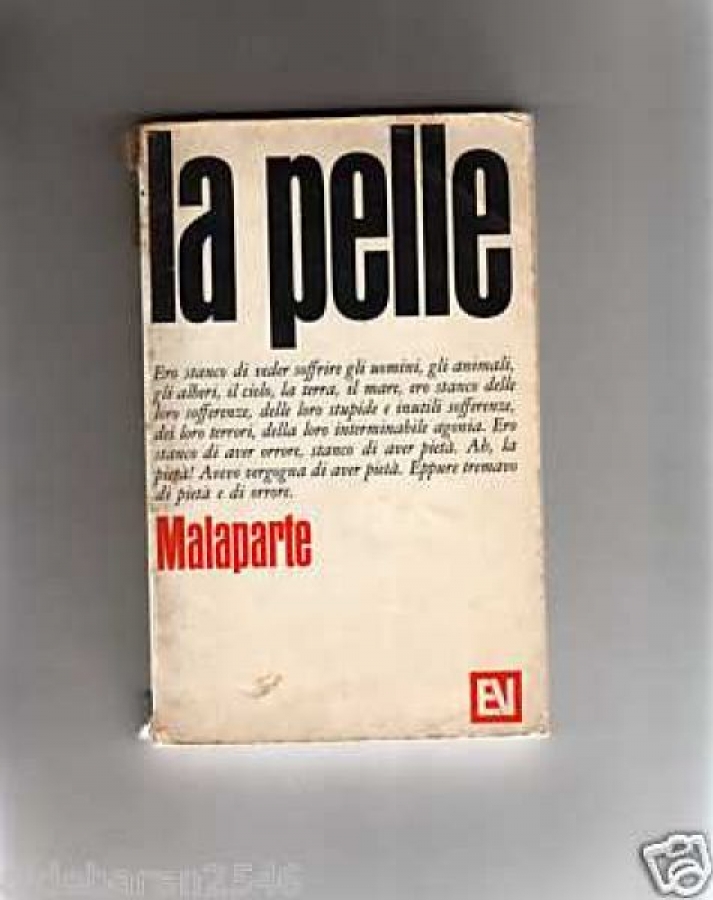
Finished reading on: December 24, 2008
The Skin
Title of the original version reviewed: «La pelle»
AI Translation Notice: This review was translated from the original Italian using artificial intelligence. Book quotes and excerpts are translated interpretations and will not match the author's original English phrasing or official published translations.
The book is set during World War II, amid the American advance: in Naples and then, in the final chapters, in Rome and Florence.
Malaparte serves as a liaison officer between the Americans and the Italians.
And from this arises the contrast between a young and simple society (the American one) and one that is by now decadent and in ruins (the European one).
Beyond the themes tied to the immediate aftermath of the armistice (the crumbling of Italian society, the civil war, selling oneself out by any means to the new conquerors, what Malaparte calls the new "plague"), the novel is in fact strikingly relevant today.
A profound pessimism emerges regarding the future of Europeans, a sense of decay, rot, and death, through episodes that border on the implausible yet correspond to a society that no longer harbors any sense of the future, in which anything is possible.
The "new" brought by the Americans unleashes something that lay hidden within European society, destroying its foundations and casting it into a grotesque, amoral, and unsettling dimension.
One is left hoping for an extraordinary event (the eruption of Vesuvius) to wipe out this society.
Does this novel not also reflect our present reality? It captures the deepest traits of European society: its decadence, its deference toward the powerful, the pursuit of personal gain even at the risk of compromising what is held most dear, the prevailing vulgarity and ignorance.
The book is undoubtedly very timely, and its rich, imaginative style captures this sense of decadence and dissolution remarkably well.
Its finest quality lies neither in the dialogues nor in the treatment of the characters (in reality, quite flat and conventional), but rather in the descriptions of situations and the passages that express the author's own sentiment: passages invariably characterized by lyrical rhythms and a pursuit of the marvelous, which seem to evoke sixteenth-century Italian literature (Ariosto, perhaps?).
In this sense, the book's style stands in sharp contrast to the literature that followed, which would be heavily influenced by American writing and would pursue intimist (Moravia), neorealist (Pavese, Vittorini, etc.
), and fantastic themes (Calvino, Buzzati), all entirely alien to Malaparte.
If we compare some recent novels from Anglophone literature itself, we realize that Malaparte’s book is remarkably modern.