Finished reading on: April 26, 2023
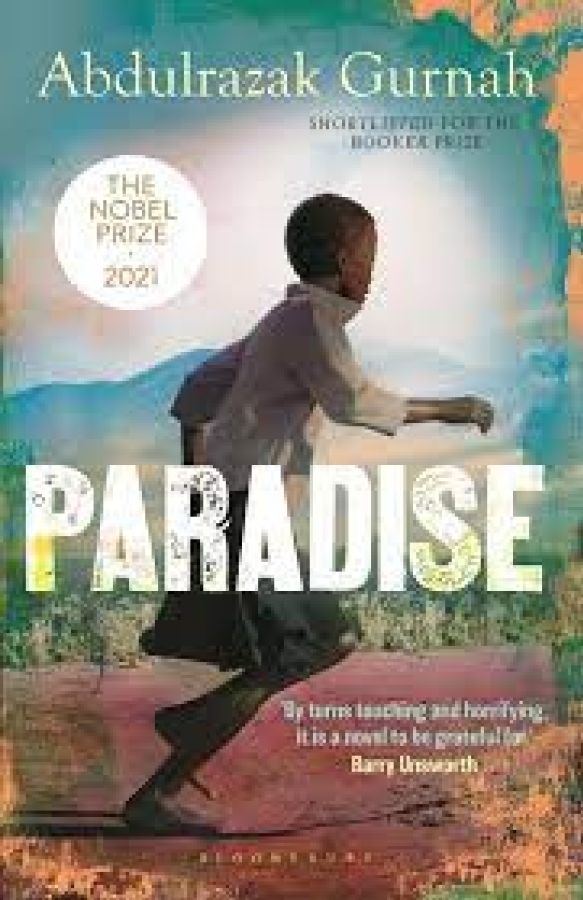
Paradise
AI Translation Notice: This review was translated from the original Italian using artificial intelligence. Book quotes and excerpts are translated interpretations and will not match the author's original English phrasing or official published translations.
The novel possesses two primary narrative threads. The first is a grand historical fresco of the Sultanate of Zanzibar shortly before the partition of East Africa at the 1885 Berlin Conference. As an Indian friend explains to the sixteen-year-old Yusuf, the Europeans
are not interested in trade, but in the land itself. And everything on it... us. (...) We will lose everything, including our way of life
. It would have been easy for Gurnah to present the Arab-Swahili civilization—which had controlled the East African coast since the mid-eighteenth century—as an idyllic era prior to European conquest. The coexistence of different languages, sedimented over the centuries, the refined customs of the merchants, the splendor of palaces and gardens, the fragrances, garments, and jewelry of wealthy matrons, the observance of religious tenets: all are factors that might tempt us to extol the pre-colonial world in contrast to European—in this case, German—domination. Once again, Gurnah surprises us, doing so, moreover, in an unpredictable fashion by recounting the merchants' journeys into the African interior, toward the great lakes and mountains, in pursuit of ivory, gold, and slaves. With good reason, many commentators have compared the inland expeditions depicted in the novel to Joseph Conrad’s Heart of Darkness, in which the journey into the pestilential river forest is akin to a descent into a shadowy world where man’s primordial drives overpower civilization; in the same way, in Paradise, by taking part in these interior incursions, the young Yusuf will become “a wolf-man,”
he felt the thread of life slipping through his fingers, and he let it unravel without resistance. (...) There was nothing he could think of doing that would free him from the shackles of his condition.
And here we arrive at the second narrative strand. Yusuf is still a child when he is taken from his family to settle a debt incurred by his father with a wealthy merchant. The uprooting is abrupt and definitive, sealed by the loss of the necklace given to him by his mother. He finds himself growing up in an opulent household, learning trade under the tutelage of a youth who was likewise handed over, along with his sister, to discharge unpaid financial obligations. In his new home, Yusuf is drawn to a magnificent garden concealed behind a high wall: a place so rich in scents and colors that Yusuf
dreamed that at night the fragrances dispersed into the air, disorienting him. In his intense sensation of pleasure, he imagined hearing music
. Is it the Paradise described in the Quran? The garden conceals a secret: secluded from the outside world lives the merchant-master's mad wife; she has become infatuated with Yusuf's beauty, which she has observed through mirrors hung from the trees. And it is precisely to remove him from the woman's designs that the merchant enlists Yusuf in the expeditions into the interior, from which the youth will return a man, determined not to be thwarted: he seeks to unravel the garden's mystery to the very end. Thus he will come to understand that Hell and Paradise overlap—they are the selfsame prison: just as in Mozart's Requiem, where infernal tones alternate with heavenly ones, magnificence conceals despair.
Beneath the veneer of a historical novel, Gurnah tackles a universal and enduring dilemma: that of freedom. The characters are dominated by the Mephistophelean figure of the merchant—ever composed, as quick to protect as he is to cast out, a true emblem of power that only a rival force can supplant. Let us not be deceived by appearances; the essence of power remains ever the same. Yusuf prefers the European's supremacy, harsher perhaps, but devoid of subterfuge. The German officer's face
was the face of a corpse, and Yusuf was appalled by its ugliness and cruel gaze. (...) The marching column was still visible when he heard a sound like a door closing behind him in the garden. He looked around quickly and then ran after the column, his eyes glistening.
The prose is more restrained than that of By the Sea, reviewed elsewhere on this site; it is as if the author intended to write a chronicle, one in which fairy-tale motifs and digressions are curtailed in order to focus strictly on the essential elements of the tale. The reader does not lose themselves in the text, remaining constantly vigilant of unfolding events; hence, the narrative’s length begins to weigh, only to be cut short far too abruptly by the foreigner's arrival, as though the author felt compelled to wrap up the novel by any means necessary.
Why read it? A splendid fresco of a civilization unfamiliar to us.