Finished reading on: January 06, 2012
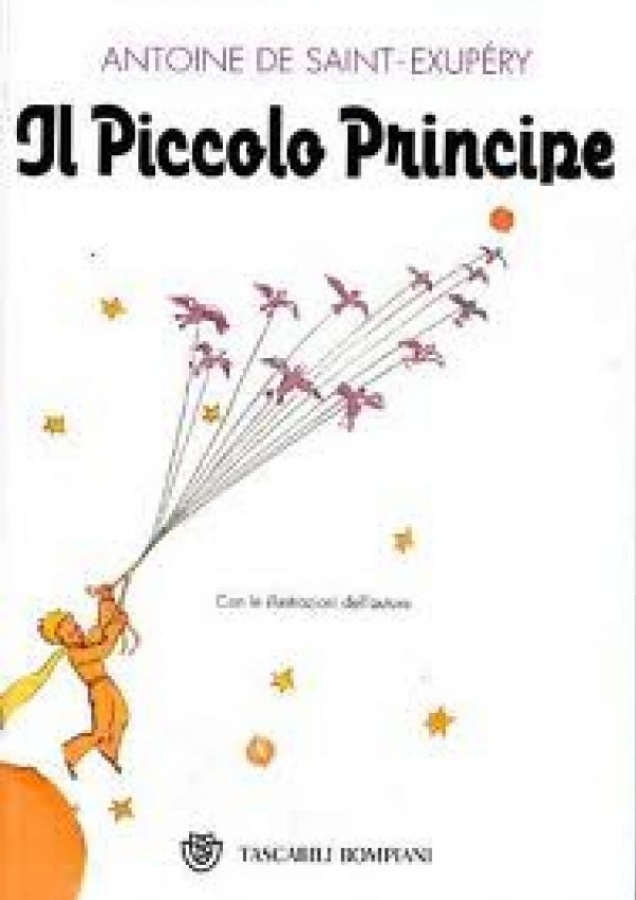
The Little Prince
Title of the original version reviewed: «Il piccolo principe»
AI Translation Notice: This review was translated from the original Italian using artificial intelligence. Book quotes and excerpts are translated interpretations and will not match the author's original English phrasing or official published translations.
The Little Prince is, perhaps, one of the most famous and widely read books in the world.
The narrative opens with an episode from the narrator’s childhood, an aviator like Saint-Exupéry himself.
At the age of six, he had drawn a "boa constrictor digesting an elephant," which to those who lack imagination—such as grown-ups—merely looked like a hat.
Indeed, they
advised me to lay aside my drawings of boa constrictors, whether from the inside or the outside, and devote myself instead to geography, history, arithmetic, and grammar
.
From then on, the narrator spent "his life alone, with no one to truly talk to," until, having crashed with his plane in the desert (an actual event in Saint-Exupéry’s life), he encounters a "little fellow" (the little prince), who has arrived from outer space.
The little prince lived on a minuscule world, so tiny that
you only had to move your chair a few steps to watch the twilight whenever you wished
On this planet, the little prince tended to a flower, the only one in his world, "but he was too young to know how to love her."
And, as so often happens to those who take no joy in what is close at hand, he sets off on a journey in search of something else.
In his wanderings, he encounters six tiny worlds, each inhabited by a solitary soul: a king who "demanded from each what each could give"; a conceited man, who wished to be admired as the handsomest man on the planet, even though he was its sole inhabitant; a drunkard, who drank to forget that he was ashamed of drinking; a businessman, who endlessly counted; a fellow who constantly lit and extinguished a street lamp, because his planet spun so fast that day turned into night in an instant; and finally a geographer who had never explored the rivers, mountains, and seas he recorded on his map.
Eventually, he lands on Earth, where the little prince makes several interesting discoveries, such as a fox who reminds him that "what is essential is invisible to the eye," and therefore his flower is unique not because other flowers do not exist (indeed, the little prince had already come across a field of roses), but because he had cared for that specific flower:
men have forgotten this truth.
You become responsible, forever, for what you have tamed
—that is to say, that to which you have bound yourself through an act of care.
Whether it be a house, the stars, or the desert, what makes them beautiful is invisible
and it lies in loyalty to something, to an idea, to someone. And indeed, the little prince leaves Earth because he must return to tend to his little flower.
Once he has departed, the narrator (Saint-Exupéry) realizes he forgot to add the leather strap to the muzzle drawn for the little prince's sheep.
Will the sheep now eat the flower as well?!
Look up at the sky. Ask yourselves: has the sheep eaten the flower or not? And you will see how everything changes...
One must ask oneself unpredictable, irrational questions aimed at probing the mysteries of the universe and the human soul: only the pursuit of the impossible can prevent life from lapsing into the prosaic nature of mere existence.
The tale is autobiographical, recounting an exceptional and misunderstood life.
The device of the fable allows the author, unburdened by the constraints of verisimilitude, to assert the necessity of holding onto a dream—which, in Saint-Exupéry's case, means flight, exploration, and adventure.
Beneath the gentleness of the prose and the delicate lightness with which various existential themes are addressed (the allure of nature and mystery, friendship and loyalty, human flaws and the grandeur of the universe, imagination versus economic rationality), an enormous conceit actually emerges: the notion of being unique in the universe, the belief that the pursuit of one's dreams must know no bounds, and that when one realizes they are no longer attainable, death is preferable.
The parade of little worlds serves as a vehicle to mock figures loathed by the author, yet it also mirrors an individualistic worldview, positing that only in isolation can our personality be fully realized.
In the same vein, the desert setting encapsulates a longing for solitude, a state in which the author appears to indulge himself: it is far easier to converse with a child (the "little fellow") than with adults who fail to understand us.
The Little Prince, despite all its sweetness and delicacy, stands as an allegory for a delusion of omnipotence—that of a man, and of a humanity, unwilling to accept limits: the swan song of the twentieth-century cultural superhero.
Why not read it? It can certainly be read, as it is very brief, albeit pointless.
A word of caution, however: do not give it to children to read, for it lacks any pedagogical value.