al-Aswani Ala
Books by this author (2)
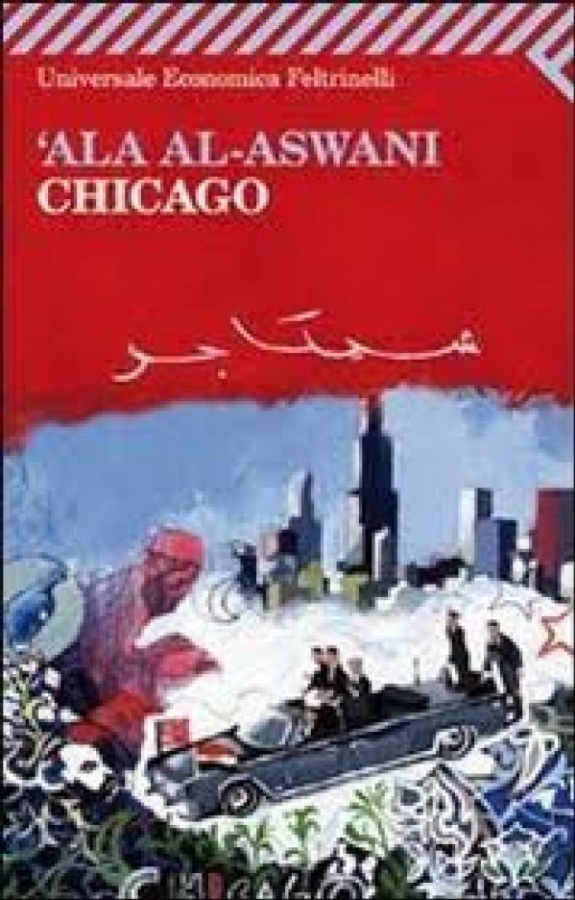
Chicago
The book is a collection of stories of Egyptians working and studying in Chicago, at the medical school. In some cases, they are individuals getting on in years, who have established themselves and seemingly integrated into American society. In others, they are young researchers who have received a scholarship from the Egyptian government and whose career success, therefore, depends upon the authorities of their homeland. They must strive relentlessly to achieve outstanding academic results, but they must also be exceedingly careful not to adopt critical or merely irreverent attitudes toward the Egyptian regime—at that time, Mubarak's. The stories unfold autonomously, interweaving only intermittently. Shaima is a deeply devout young woman who, > despite her exceptional scientific gifts, possessed an abysmal ignorance regarding the tools required to seduce a man . Already in her thirties, she meets an Egyptian colleague, falls in love with him, and discovers the pleasures of sex by his side. This affair seems headed toward a happy ending until Shaima finds herself pregnant and, confronted with the young man's terrified refusal (a child would disrupt his academic career), is forced to have an abortion, squarely against her religious convictions. Prior to moving to America, Marwa married a young man who appeared brilliant and respectable. In truth, her husband turns out to be a sordid individual: greedy, authoritarian, treacherous, with perverse and violent sexual inclinations, and, to top it all, an informant for the Egyptian secret service. Marwa wishes to divorce him but faces her parents' opposition; shrewdly, she engineers a situation whereby separation becomes inevitable: the husband is willing to surrender her to a powerful intelligence figure simply to secure an academic career compromised by his utter incompetence as a researcher. If the young are forced to navigate—some naively, others cunningly—the narrow confines granted by a repressive and hypocritical society, the adults themselves do not escape this fate. Saleh chose to flee Egypt, abandoning the woman he loved, whose harsh reproach still haunts him after so many years: "It is truly a pity that you are a coward!" the young woman exclaimed as she bid him farewell. Saleh married an American woman, but it was a marriage of convenience; so much so that his longing for the motherland eventually becomes uncontrollable, even taking on fetishistic dimensions, such as donning his old Egyptian clothes. He wishes to redeem himself by proving to his beloved that he is a brave man who takes risks for his people's suffering. He fails, because deep down he remains a coward, and so he takes his own life. Rafat, too, married an American woman, with whom he had a daughter. In a dramatic confrontation between father and daughter (in a last-ditch effort to save her from drug addiction), the girl violently unmasks the sham upon which Rafat has rested his entire life: > you are a fraud (she shouts at him), a failed actor playing a moronic role that convinces no one. What are you? Egyptian or American? Naghi is an idealist, receptive to the new experiences afforded him by American society, convinced of the need to fight for his country's freedom and democracy. He refuses to conform, often exposing himself to danger in the treacherous milieu of Egyptians abroad. He meets a Jewish girl and begins a romantic relationship marked by passion, affection, and mutual discovery. He is visited by an agent of the Egyptian intelligence services, who warns him to abandon his revolutionary pretenses and lets him know that they possess video footage of his fiery trysts with the young Jewish woman. Who could have planted a hidden camera in his apartment? Paradoxically, Naghi accuses his lover—so entrenched are the mistrust and the barriers dividing the two peoples. > However strong your love may be (the girl says), you will never forget that I am Jewish. I can be as honest with you as I like; your trust in me will always remain fragile . Naghi, too, an aspiring poet, cannot escape the fate of pretense and suspicion bred by a repressive society. All these stories develop in parallel, generating a kaleidoscope of lives, voices, and imagery so dense that discerning a unified narrative thread proves arduous. The vignettes of Egyptian culture, crafted with subtle irony, the deft sketches of characters and their circumstances, along with the detailed depiction of the erotic inclinations of individuals and couples, form a trap that entraps the reader within minutiae, obscuring the overarching import of the novel. There is unquestionably a critique of Egyptian society. Yet the book’s true significance likely resides in the unhappiness engendered by society’s repressive structures. There exists an indissoluble link between the social and institutional order (the absence of democracy) and individual destiny, reaching even into the realm of intimate, familial emotions. That this is not merely a feature of the Egyptian world becomes apparent in the only storyline whose characters do not hail from the North African country. Graham is a sixty-year-old professor, libertarian and eccentric. He meets Carol, a Black woman, with whom he shares a wonderful romance. Yet Carol, because she is Black, cannot find work, ends up modeling, and is coerced into yielding herself to a prominent corporate executive. They love each other, yet social segregation tears their relationship apart—for there is no escaping the devastating fallout of an unequal society, however formally democratic it may be. Aswani is a skillful writer, yet a narrative structure premised on multiple, parallel plotlines cannot be sustained indefinitely without weighing down the prose and dissipating it into too many tributaries. Moreover, there is no overarching plot to draw together the threads of the novel, leaving the narrative ultimately verbose and underwhelming. Why read it? It remains an assemblage of pleasant, intriguing vignettes.
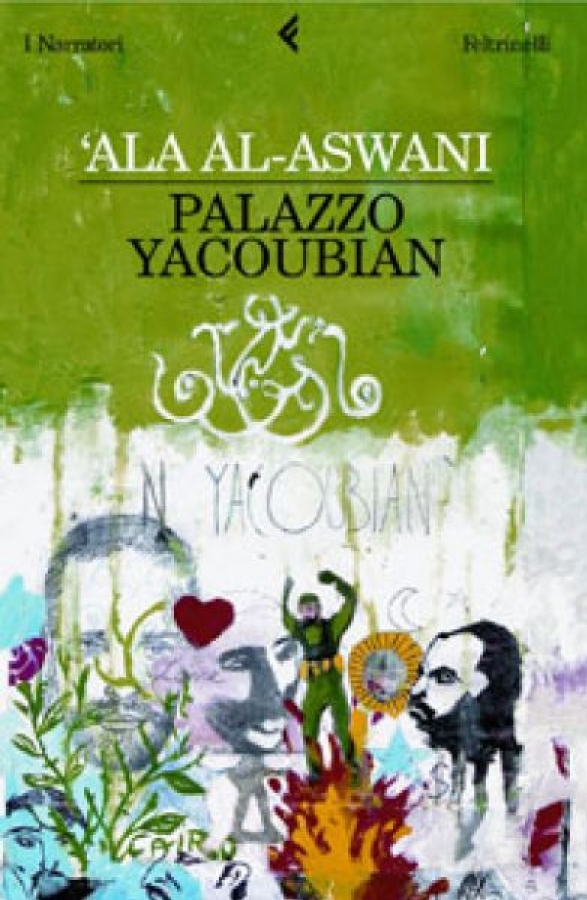
The Yacoubian Building
The Yacoubian Building is an emblematic space of contemporary Egypt, dominated by a corrupt, undemocratic regime where abuse of power, cunning, and deceit seem to be the defining traits. A young woman is forced to endure the advances of her employers, only to fall in love with an aging, depraved landowner on the verge of being driven out of his home by his sister. The girl’s former fiancé is rejected by the Police Academy for being the son of a doorman and, while at university, joins the Muslim Brotherhood. He is arrested, raped, and tortured by the police; once released, he goes to live in a training camp and marries the widow of another martyr. He is killed during the assassination of the police commissioner who had tortured him in prison. A wealthy homosexual falls in love with a young man, who murders him during an argument. A businessman marries in order to satisfy the sexual urges of his old age, but upon discovering that the woman is expecting a child, forces her to undergo an abortion and then repudiates her. In turn, the businessman is forced to pay a hefty bribe to powerful politicians. Beneath a seemingly light, ironic style and the narrative pacing of a "potboiler," the author in fact mounts a ferocious critique of both Egyptian society and the Muslim Brotherhood itself. In an oppressive world, individuals struggle to survive and forge their own path: for some, this leads to ruin (the former fiancé who is tortured and killed, the homosexual murdered by his lover, the woman who marries the businessman only to be cast aside); others are saved, finding affection despite the age gap (the young girl and the depraved old man). The novel unfolds with such lightness that it verges on the contrived, ultimately offering a false representation of Egyptian society. For much of the book, vigor is lacking; instead, the writer seems to capitalize on the most lurid aspects of the narrative. In the final part, the storytelling gains greater strength, allowing authentic, uncontrived feelings to finally emerge.