Finished reading on: April 01, 2024
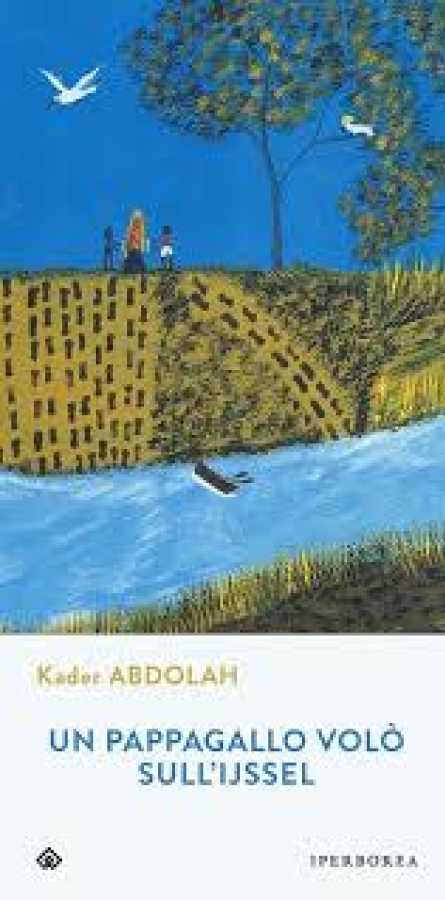
A parrot flew over the IJssel
Title of the original version reviewed: «Un pappagallo volò sull'IJssel»
AI Translation Notice: This review was translated from the original Italian using artificial intelligence. Book quotes and excerpts are translated interpretations and will not match the author's original English phrasing or official published translations.
In the first tale of One Thousand and One Nights, under the expressive title of The Weaver of the Nights (see review on this site), Scheherazade deceives the cruel sultan, bewitching him with wondrous and intriguing stories. It is the miracle of the word! Likewise, in this novel, Pari, an immigrant woman infatuated with the Dutch language, will save herself through writing. A Flemish healer entrusts her with the task of narrating the lives of immigrants.
Write the story of the people around you, the story of the foreigners arriving in the Netherlands. (...) Free yourself from your anguish by writing. (...) Perhaps this is your duty, now that destiny has led you to a foreign land. With the storytelling framework and the suffused lightness of the Arabic masterpiece, and in the country where
in every region the voice of the water is heard and feared with its eternal disasters
, Pari is to narrate
the story of Mamed, of Catherina, of Lina, that of the colonel, of the colonel's wife, of Tala, of Mr. Rahimi, of the parrot, and your own story. They are all immigrants who could answer the question
what are you doing here?
with a single word:
I live. Having placed Pari at the center should not suggest that she is the narrator or the sole protagonist: it is Abdolah who narrates from the vantage point of an invisible and neutral observer, just as the novel is crowded with numerous characters; my choice is justified by Pari's obstinacy in making the Dutch language her own, and by the fact that it is this woman's life, more than that of others, that bears witness to the precarious balance between integration and roots. Married while still a child, Pari followed her husband to the Netherlands. The man's long absences allow the woman to attend a school to learn Dutch.
She felt that something deep within her nature had been set in motion and wanted to destroy everything. (...) She realized that the words she looked up in the dictionary and the sentences she wrote in her new language were actually explosives she wanted to place under her family life, under her past, her present, and her entire existence. She begins publishing short stories in a local newspaper; she goes to live first with her Dutch teacher and then with a journalist: men who demand erotic-sexual games that are new to her yet offensive to her morals. That is how it is done in Holland, is the self-assured reply to her timid objections! Until one night her husband bursts in and stabs Pari, while the Dutchman flees without defending her. The past has violently returned. If in her husband's attempt to kill her the oppressive traits of an atavistic world re-emerge from her roots, it is Middle Eastern customs and liturgies that snatch her from death.
Twelve elders wrapped in long black coats, each with a rosary in hand
, enter the hospital room where Pari lies in an irreversible coma.
Their sweet words danced like bees in the sunbeams, and the murmur of prayers enveloped Pari's head like a hum. (...) Suddenly the needle moved, tracing with a metallic sound a wavy line, a zigzag of life. As in the fabulous tales of One Thousand and One Nights, a parrot (an Angel?) flying over the IJssel saw
a young woman with long golden hair riding bareback on a bizarre white horse with a long mane, (...) a strange place populated by thousands of animals, great primordial elephants, giraffes, dinosaurs, camels, tigers, lions with aged manes, and also very small creatures: mallards, colorful parakeets, butterflies, golden insects. In Protestant, welcoming, and transgressive Holland, all the magic of the Orient had resurfaced to save Pari.
The novel unfolds along two tracks: the difficulties of integration—cultural before political and institutional—and individual stories showing how each person faces assimilation differently. The Netherlands presents itself as a welcoming country, yet distrust, fears, and linguistic and cultural differences inexorably emerge. If at first it is intriguing to associate with a foreign man or woman—the former so passionate, the latter fascinating beneath the veil—later the Dutch woman withdraws in concern, and the man fails to show respect for traditions more reserved than those of Dutch society. Even within a framework of difficult assimilation, the individual stories, distinct and parallel, show how through this encounter everyone changes—both the Dutch and the immigrants—yet each in a different way. It is true that fate towers over us—may the will of the Almighty be done!—but each of us plays with destiny differently, carving out our own path; and therein lies the true change. For the parrot over the IJssel, for the Angel or the Almighty, there is nothing left to do but watch us.
The novel is a collection of narrative modules that develop autonomously and then intertwine almost by chance; it is difficult to synthesize the various stories, except in a few pivotal passages: the grave of little Tala where everyone gathers to pray, the single public telephone used by the immigrants to call back home, the group of elders living as if they were still in the East, and the mysterious figure of the parrot, perhaps Frederick II's mythical "cockatoo," symbol of ancient Arabic culture. The writing is fairytale-like and realistic at once, never flattened into mere description or pointless political and sociological digressions, and for this reason rich in evocative power.
Why read it? It is rambling, yet pleasant to read.