Finished reading on: June 15, 2025
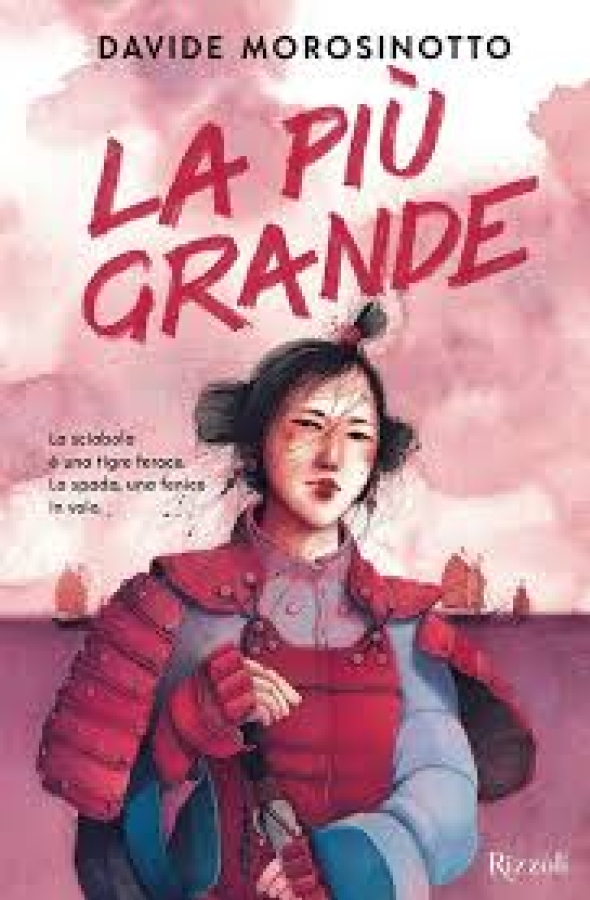
La Più Grande
AI Translation Notice: This review was translated from the original Italian using artificial intelligence. Book quotes and excerpts are translated interpretations and will not match the author's original English phrasing or official published translations.
She who would one day become The Greatest tripped over a stool left in the way. (...) Three bowls crashed to the floor, shattering instantly. The fourth, however, hovered a palm’s width from the ground: a young boy stretched out his leg and managed to catch it, in perfect balance, in the hollow between his foot and ankle. It was thus that Shi Yu saw Li Wei for the first time. In these few clear words are encapsulated the novel's fundamental narrative threads. Like Oliver Twist (see the review on this site), Yu is a young orphan girl who, while still a child, works as a servant in a squalid, filthy inn: a place to which she will return in dreams even after becoming a powerful and feared pirate, a longing for the nook where "the ferocious charity of memory" resides, as Giuseppe Ungaretti wrote (from Ultimi cori per la terra promessa).
It had been a long time since Yu had returned to the inn that stood deep within her soul. (...) She felt a great ache inside, but could not remember why. There, Yu was still innocent, exploited yet happy; later, she would have to learn to be a pirate commander, enjoying the freedom of the seas, the thrill of combat, yet forced to make difficult, harsh, and agonizing decisions, such as leaving her daughter to die in battle. La Più Grande is a coming-of-age novel, paced by the very structure of the narrative, which traces the phases of Yu’s life. Unlike Jim in Stevenson’s Treasure Island (see the review on this site), Yu does not need to grow up; she is already an adult at six years old. Instead, she must learn to navigate the stages that will forge her into a leader: fighting enemies and establishing her authority in a man's world, commanding men (
you will have to learn to put the crew's interests before your own
, her cook friend tells her), enduring imprisonment and torture, breaking free, and leading her fleet to victory against the imperial ships, against the Adversary, the powerful eunuch prince.
You must be proud of yourself, Yu, he murmured. (...) Why then did she sometimes feel like running away? (...) What was all this for? (...) I just want to sink. Into the blue. Into the cold heart of the sea. Into peace. As with the characters in Treasure Island, the sea, the pirate life, adventure, and the eternal struggle between good and evil compel her to carry on a life of struggle, with neither serenity nor quietude in sight. Li Wei's balancing act holds the third narrative thread: martial arts. The boy is the grandson of a powerful master of the so-called Air and Water style, through which one can leap as if flying and move weightlessly through water. Yu learns these techniques, also gaining access to a mysterious book, the repository of centuries of wisdom in this martial art. Had Morosinotto been writing for early twentieth-century adolescents, or indeed for us, the youth of the 1950s, he would likely have set the novel in fabulous India, among the pirates of Mompracem, or in Caribbean waters, among privateers. Since we are in the twenty-first century and Eastern fighting styles exert great allure, the story's settings are the China Seas, the cities of Shanghai, Macau, Canton, and Hong Kong, and the historical backdrop is the decadent Beijing empire prior to the imperialist aggression of Western powers. Everything is meticulously precise, but everything is also somewhat predictable, to the point that we are neither amazed when Yu skims across the water nor captivated by sequences of movements bearing evocative yet inexplicable names. To find the magic of Eastern martial techniques, we recommend reading Linda Lercari's Kaijin l'ombra di cenere (see the review on this site). And finally, there is the reunion with Li Wei, the Love Yu has pursued all her life. "The Greatest" knows she has always loved him, but Li Wei now appears to be an enemy in the service of the Adversary. And just as The Black Corsair (see the review on this site) weeps before his crew because he must abandon the woman he loves in a lifeboat, being the daughter of the enemy upon whom he has sworn vengeance, so Yu
wiped her tears with the sleeve of her shirt. A commander cannot break down before her men.
She knew that everyone on the ships was watching her, wondering what had happened.
Morosinotto is a master craftsman of plots, as he admirably demonstrated in Il grande colpo di Crimson City (see the review on this site); here, however, the sheer length does not help impart rhythm to the narrative, which becomes diluted in repetitions, a multitude of names, and a ceaseless swirl of digressions. Yu and Li Wei remain mere sketches, their love never deepened or enriched by encounters that are not rushed, or by expressions of feeling, however tormented. Having finished the story, the reader cannot help but think how beneficial it would have been to prune some redundant passages and instead explore more deeply the two lovers, eternally bound since childhood, yet eternally kept apart by such divergent lives: Yu the pirate, Li Wei the imperial official.
The prose is incisive, composed of short, clear sentences, with a style reminiscent of Emilio Salgari. The dialogue is effective, as are the descriptions of battles and combat. Certain scenes, such as the duel between Yu and the Adversary or the girl’s rides across the sea, are exceptionally evocative and leave the reader breathless.
Why read it? Adventurous, albeit at times prolix.