Finished reading on: January 31, 2009
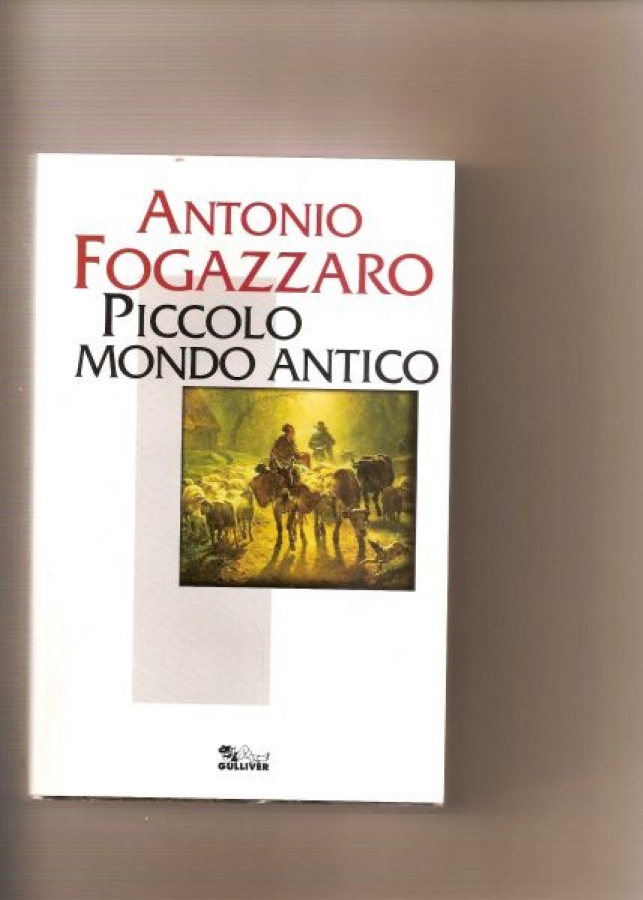
The Little World of the Past
Title of the original version reviewed: «Piccolo Mondo Antico»
AI Translation Notice: This review was translated from the original Italian using artificial intelligence. Book quotes and excerpts are translated interpretations and will not match the author's original English phrasing or official published translations.
The setting is Lake Lugano, and Valsolda in particular.
We are between the two Wars of Independence.
Franco is the grandson of a powerful marchioness and is in love with Luisa, a young woman from a respectable and honorable, yet modest, family.
The conflict between the marchioness and Franco is not limited to the young man’s love for Luisa, but extends to their divergent political views: the woman is loyal to the Austrian dynasty, the man a staunch patriot.
Franco marries Luisa without the marchioness’s knowledge, forcing the young couple to endure financial hardship, which is aggravated at a certain point by the dismissal of Luisa’s uncle—an honest, upright official of the Lombard-Venetian administration—engineered at the behest of the powerful marchioness.
Life flows peacefully, revolving around the couple’s young daughter, little Maria.
The only discord between husband and wife stems from their differing religious convictions: Franco is a devout and practicing Catholic; Luisa is practically indifferent, an atheist in her conscience.
There are also their political ideals, shared by the couple and their small entourage, which, together with their economic struggles, prompt Franco to move to Turin.
Finally, domestic harmony is disrupted and further tension is sparked between the spouses by the discovery of a document in which Franco’s grandfather, the marchioness’s late husband, reportedly bequeathed the estate to his grandson.
Out of pride, Franco has no intention of enforcing the document concealed by the marchioness; this decision outrages Luisa, not so much for financial reasons as for the injustice endured.
Upon the couple’s life—upon the «little world of the past»—tragedy intrudes with the death of Maria, who drowns in the lake.
Luisa retreats into a tragic grief, consumed by guilt over the child’s death.
Luisa feels barren and cold; a wall rises between husband and wife, threatening to destroy their relationship.
The Second War of Independence breaks out; Franco, who has meanwhile returned to work in Turin, invites his wife to meet at Isola Bella prior to his departure for the front.
Luisa hesitates deeply, but is persuaded by her uncle; en route to the island, aboard the boat, she observes a group of soldiers heading off to war and realizes that there are sufferings and heartaches far greater than her own.
The reunion with Franco is initially cold, then gradually thaws, and the two find one another again, bringing forth a new child.
As in all fine stories, love ultimately triumphs.
It is, therefore, a romantic tale, one that caused a stir in its day on account of the religious ideas expressed within it.
Through the character of Luisa, a sharp critique of religion was advanced—particularly against its official and sanctimonious forms—to the point where she declared that «God is cruel» or even that God does not exist.
Viewed through modern eyes, what remains of genuine value in the novel is, instead, the tension between the intimacy of the domestic realm and participation in momentous historical events.
At its core lies the depiction of the «little world of the past», which, as the author observes,
was even more secluded from the great world than at present, was more than at present a world of silence and peace, where the officials of Church and State, and, following their venerable example, several loyal subjects as well, dedicated many an hour to edifying contemplation
.
This world is Valsolda, whose landscape and community the author portrays alike.
And it is precisely here that the novel proves weakest: nature is approached with a romantic sensibility, tending toward the «marvelous», evocative of a mere «tourist's» gaze, and ultimately rings hollow and detached; the characters, innumerable as they are, are depicted primarily through their mutual interactions, yet reduce to caricatures of small-town archetypes (the unfaithful maid, the curate, the schoolmaster, the informer, and so forth), without ever managing to achieve a truly ironic portrayal.
Even the recourse to dialect fails to lend vibrancy or authenticity to the dialogues, ending up tedious and superfluous.
The figure of Franco is flat, even implausible, considering that he endures a horrific tragedy which he seems to surmount with ease.
The only character who emerges as contradictory and complex is Luisa: she is conscious of her husband’s frailty, of the vacuity of religion, yet she resigns herself to the social role of wife and mother.
Only her daughter’s death shatters this precarious balance, driving her to the brink of madness.
Yet, in the end, she redeems herself by reassuming the role assigned to her by society.
Piccolo Mondo Antico is the novel of an affluent, cultured nineteenth-century Italian bourgeois, convinced that only by shouldering one’s social responsibilities can one attain salvation and mature as an individual.
The pre-industrial tradition is thus something to be overcome, as is the inward retreat into personal grievances, petty interpersonal ties, and the pursuit of metaphysical and irrational solutions (religion, spiritualism).
The theme of responsibility and the transcendence of the familial and parochial dimension remains remarkably timely in Italian society: perhaps the very superficiality with which it was treated in the novel is the reason why, as history has shown, familism and localism remain the enduring vulnerabilities of Italian society today.