
American Pastoral
The book is divided into three chapters, each possessing its own distinct identity. In the first, bearing the evocative title *Paradise Remembered*, the narrator is the writer himself. The idol of his youth is Seymour Levov, “the Swede”: handsome, blond, athletic, a formidable sportsman. The memory of his feats epitomizes a golden era where harmony triumphs. Now in his sixties, the writer is invited to lunch by Seymour under a pretext. The meeting turns out to be mundane and pointless; later, however, at a reunion of old classmates, the writer learns that Seymour was suffering from cancer and had been shattered by the actions of his daughter, who had bombed a general store, killing a bystander. > The gentle man with his delicate ways of dealing with conflict and contradiction, the confident former athlete, responsive and resourceful in any fair-minded struggle with fair-minded foes, is up against a foe who is not fair-minded, a devil rising out of the human feelings, and he is overwhelmed. He learns to live behind a mask . The writer decides to write a book about Seymour, even as he wonders—with a deeply autobiographical undertone—whether the man inside the man is ultimately knowable, whether he is a “jar you cannot open.” Yet does the story he writes conform to reality, or is it merely the author's invention? In the two subsequent chapters, the writer shifts to a third-person narrative. In the second chapter, titled *The Fall*, the dramatic story of Merry is recounted: Seymour’s stuttering daughter who, at sixteen, vanishes after committing a heinous crime, sinking ever deeper into hiding and self-destruction. At the root of the daughter’s conduct lies a hatred for her parents, their orderly home, their life built on bourgeois values—and, by extension, for American society itself. Yet how could > his daughter be so blind as to want to destroy the very system that had granted her family so many opportunities for success? To destroy her capitalist parents as though their wealth were anything other than the product of the steadfast labor of three generations? . Is Merry, then, an inexplicable anomaly? In truth, in the final chapter, *Paradise Lost*—which largely details a dinner party among the Levovs and their friends (a dinner that concludes tragically with the stabbing of Seymour’s father)—it becomes evident that the “moral disease” afflicts not merely the girl, but an entire society in which > what was supposed to exist did not exist. Deviance prevailed. You cannot stop it. Undeniably, what was not supposed to happen had happened, and what was supposed to happen had not. The old system that created order no longer works. All it has left behind is fear and dismay, now concealed by nothing . The themes of this undoubtedly formidable book are essentially two: generational relations and, above all, the agony of a parent who views himself as blameless, who wishes to protect his family and cannot fathom why a daughter so cherished grew up so estranged from his world; and the unraveling of a society built by immigrants who toiled tirelessly to integrate and be embraced as successful citizens, only to watch the foundational values of social cohesion disintegrate. Seymour’s ordeal is that of a father, but it is also the tragedy of the American pastoral. Roth’s narrative structure is exceptionally rich and intricate. It relies neither on a lavish surplus of adjectives, as with Updike, nor on the expansive periodization of Bellow (all chroniclers of the crisis of American society). It is precisely this syntactic framework that constitutes Roth’s strength, yet also proves to be his weakness: the sentences are often overly convoluted, making for an exhausting read and fostering a redundancy of phrasing and, above all, of syntactic constructions. A greater frugality would certainly have served the book’s otherwise compelling themes far better. Why pass on it? It is deeply demanding, particularly the third chapter. It should be taken in small doses.

Butcher's Crossing
The year is 1873 and Butcherʼs Crossing is a Kansas town, in reality a small settlement of buffalo hunters. Andrews is a twenty-year-old youth; he has abandoned Boston for a vague notion of freedom. > Sometimes, after listening to the hushed voices in church and school, he would pass beyond the borders of Cambridge into the lands and woods lying to the southwest. There, in some solitary place, standing motionless upon bare ground, he felt his mind fill with the clear air and plunged into infinite space: the emptiness and constraint he felt were dissolved in the wild nature that surrounded him . The young man meets a hunter and allows himself to be drawn into a venture: to go beyond the Great Plains, into the mountains, where thousands of buffalo still graze. > He realized that the hunt was merely a stratagem, a deception practiced upon himself. (...) No business impelled him... he was going there for freedom . An odd team is assembled: Miller the leader, a paranoid hunter who kills buffalo for the sheer pleasure of it, and not merely out of greed; Schneider, a pragmatic and cynical man, tasked with skinning the beasts with Andrewsʼs help; and with them an old alcoholic madman, Charley Hoge. With this group, Andrews ventures into the Wild West—at once an adventure and a physical and spiritual transformation. They represent another vastness and another horizon, yet the young manʼs mind remains “full of the wonders he had known as a child.” Francine, a prostitute, tells him affectionately, smiling gently: > you will come back; but you wonʼt be the same. You wonʼt be so young; you will become like the others. Andrews looked at her, confused, and in his confusion cried out: I will only become myself . The stages of his transformation, from youth to adulthood, are marked by the different phases of the journey. First, they travel for many days across the Great Plains, and Andrews must accustom himself to the long hours on horseback in a flat and monotonous landscape: > he felt like the earth, identityless and formless (...), he sensed his body slowly becoming lean and strong: he thought at times that he was entering into a new body, or a real body, previously concealed by an unnatural softness, whiteness, and delicacy . The second phase consists of the buffalo hunt: the merciless slaughter, the beast skinned and butchered. > To Andrews, the entire business seemed like a dance, a dark minuet ; the endless slaughter like > a mechanism, an automation, (...) like a cold, senseless response to life. (...) He realized he was turning away not out of some womanish nausea at the blood, (...) but from the shock of seeing the buffalo, moments before proud and noble and full of dignity, now stripped and helpless, an inert piece of flesh. (...) Its being had been killed, and in that killing he felt the destruction of something within himself, and he was unable to face it . And finally, there is the long winter: the group finds itself trapped by snow until spring, freezing and completely isolated. > He came to accept the silence in which he lived, and no longer sought any meaning in it. (...) He vaguely recalled the comforts of his home in Boston; but that seemed unreal and distant, and of those thoughts there remained only faint ghosts of remembrance : a sort of alienation, a loss of consciousness and identity. The wilderness, inscrutable and indifferent, gets the better of the young manʼs dreams: it creates a hard man, incapable of affection, solitary and individualistic. And when the party finally returns to Butcherʼs Crossing, having lost their entire cargo of hides while crossing a swollen river, and when Miller and his men discover that the price of hides has collapsed, that their toil was for nothing, Andrews wonders what the meaning of it all was. Where had he been, and why? Nothing remains but to leave, to take to the road again, alone. > Even now, in the light of dawn, the town was like a small ruin; the light struck the edges of the buildings and made all the more evident a emptiness that was already there. (...) He did not know where he was going; but he knew that (the direction) would come to him later in the day. He rode on unhurriedly, and felt behind him the sun rising slowly and warming the air . One must not be deceived by the story, by the meticulous descriptions of the landscapes and the buffalo hunt: the subject of the narrative is not the Wild West. Nor are we dealing with a *Bildungsroman*, because Andrews has not truly become an adult—borne out by the fact that he abandons the woman, Francine, who welcomed him with love upon his return from the long journey. The subject of the novel is estrangement from the world: the sense of not belonging to anything, a solitary man in an incomprehensible world, devoid of friendships and values. If the great conquest of the West, the American myth, had been this, what would become of the values of community and freedom that nevertheless underpin American society? The novel does not speak of this, though it might seem to; the narrative unfolds within the authorʼs own consciousness, addressing the failed search for a balance between individuality and sociality. The story is very well written. The style is elegant, the sentences flow smoothly and pleasantly, and the documentary element is well integrated with the plot and characters. One senses, however, a pronounced intellectualized quality, something contrived—the product of research rather than a lived world, at least in its ideals. It speaks of wilderness, of men struggling against a hostile environment, but if one compares the novel to the works of Jack London, and in particular to that masterpiece *White Fang*, it becomes quite clear how John Williams is merely yet another intellectual, writing about himself and—why not?—about men and environments he knows only from books, because he has studied them. Why read it? Fine prose, superb descriptions of setting, admirably etched characters.
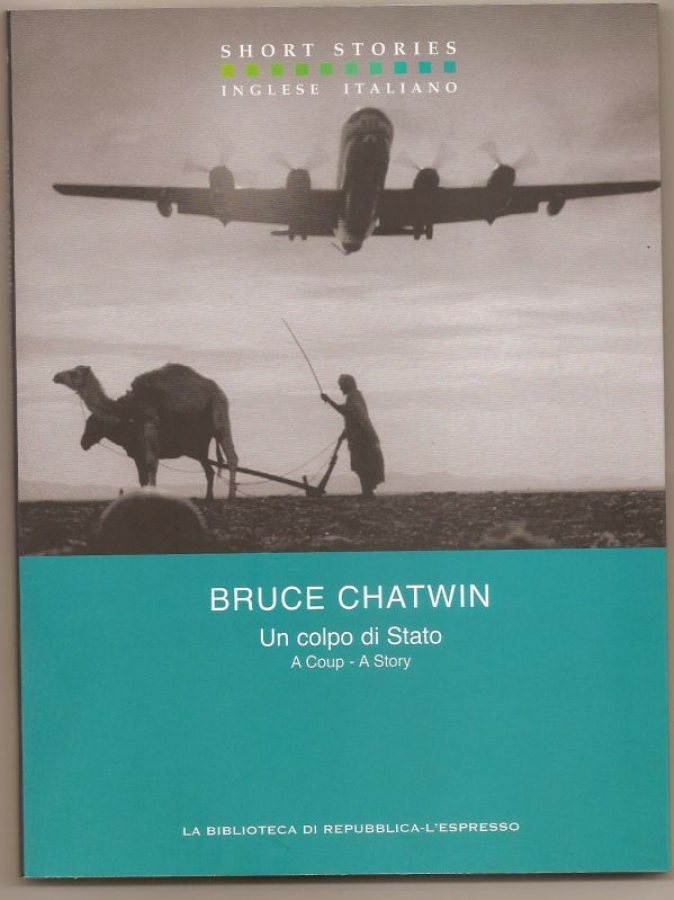
A coup d'état
This is a short story, set in Benin, describing several episodes of a coup d'état. The author finds himself in the African country and is captured, along with a Frenchman, by military forces whose allegiance—whether to the regular army or the putschists—remains unclear. Throughout the narrated events, a general confusion prevails regarding the origins of the coup, the roles played by the military forces, and the very figures encountered. A sense of frustration predominates in the author: he is interrogated, held in captivity without food or drink, struck, and then released with profuse apologies for the misunderstanding. It seems an unreal affair, as if fabricated, and precisely for this reason emblematic of a collective madness. It is Africa unraveling, and the author is its stunned, incredulous spectator. Why not read it? It is a story too slight to prove interesting and engaging.
The Enchantress of Florence
We are in the East, in the magical empire of Akbar the Great. > If the war-torn world was a hard truth, then Sikri (the capital of the empire) was a splendid lie . It is a magical world where the mystery of the great sovereign "enchants all the earth, and the future, and all of eternity." Into this wondrous land arrives a traveler hailing from the West, who calls himself Mogor dellʼAmore. He enchants the sovereign and the entire court with tales of an incredible city, Florence: > for him knowledge was of no use, except to remind him of what should never be forgotten: that sorcery requires no potions, familiar spirits, or magic wands. Language made of silver words is enough for enchantment . Mogor dellʼAmore tells of three young Florentines: one of them leaves his native city in search of adventure and becomes a great general in the Ottoman army. In a war against the Persians, he meets a princess who becomes his bride. With this woman he returns to Florence to become the captain of its army. This princess is "the enchantress of Florence," who uses her magical powers to bewitch the entire city. Yet the boundary between sorcery and enchantment is exceedingly tenuous, and soon superstition is unleashed against the woman. What a contrast between the magical world of Sikri and the paltriness of Florence! The princess flees to the New World, but > her magic was no longer strong enough to help withstand temporal forces, just as it was not powerful enough to alter the geography of the earth. No middle passage was found, and she found herself trapped in the new world until she chose to die . Yet even the magical world of Sikri must vanish to yield to the force of reality. > I have returned home after all (said the princess to the great emperor), you allowed me to return, and so here I am, at the end of my journey. End until you are not, said the great regulator of the universe, my love, until you do not exist . Everything can exist within the imagination, even beyond time; nothing can survive in reality. With an imagistic and baroque style, the author narrates an incredible, entirely fictional tale that nonetheless, beneath the tone of a fairy tale, develops three arguments: a) the East is superior to the West, insofar as the East gives expression to the wealth of the imagination; b) fantasy is an enchanted realm that allows one to achieve perfection; c) the movement of history from East to West (from Sikri to Florence, and ultimately to the New World) corresponds to a slow, inexorable decline of civilization. The individual words and the phrasing captivate the reader, yet the events are too implausible and, at the same time, excessively real to enthrall and convince. The digressions—which appear to stem more from a brand of literary narcissism than from the requirements of the plot—encumber the novel, rendering it prolix. Why not read it? Certain pages are delightful, the premise of the book is intriguing, yet it is too fragmented and long-winded to make the overall reading experience genuinely compelling.

Freedom
Among the possible meanings of the word *Freedom*, one defines it as > being able or having the opportunity to do what one wants without being restricted by something or someone (Collins Dictionary). The characters in this novel have always lived poised between the “set of possibilities” and events (what used to be called destiny), which push inexorably toward a specific direction in life. There are no externally imposed constraints; rather, it is the very nature of things that leads down one path rather than another. And life is made up of the complexity of interpersonal structures, of conformism, and of the pursuit of realizing ideas that are often theoretical and generic. The story unfolds between the Reagan and Obama presidencies, set within an increasingly frightened American middle class, riddled with divisions, moral and political dilemmas, and a burgeoning awareness of the nation’s decline. As in all good bourgeois stories, it begins with a triangle: Walter, an earnest young man brimming with environmentalist ideals, loves Patty, a star basketball player who feels rejected, on account of this passion, by her politically prominent, establishment family. Patty, in turn, is drawn to Richard, a musician and Walter’s close friend. Patty and Richard take a car trip together to join Walter, and for Patty it becomes a missed opportunity: Richard, a consummate womanizer, refuses to sleep with his best friend’s fiancée. The bond between Patty and Richard feeds on regret. > in all these years, (Patty) had treasured the memory of their little trip, had kept it locked in a deep interior space, letting it age like wine, so that, symbolically, what might have happened between them remained alive and grew older with the two of them . Within Richard there grew “envy of his friend for his unwitting possession of his wife.” Walter and Patty’s marriage drags on wearily (“they could not live together, but could not imagine living apart”), until a vacation by Patty and Richard in Walter’s beloved old lake house, set in a stunning natural landscape, precipitates events: the two sleep together. Walter cannot accept being betrayed by his best friend: the couple separates, doing so just as Walter finally realizes he cannot pursue abstract environmental ideals with the money of American capitalism. And it is precisely from the breakdown of false interpersonal relationships and the undoing of vague ideals that Patty and Richard find each other again and can rebuild the family. In truth, the book is not confined to these three characters; it also involves the younger (Walter and Patty’s children) and older generations, chronicling the histories of their families of origin. There are also numerous forays into the political and social issues that have characterized America in recent decades; the author is particularly invested in environmental themes, which are also framed as an emblem of the hypocrisy and vacuity of much of the bourgeoisie. The message seems invariably the same: it is impossible to change the world; we must learn to live with ourselves and our problems. Emblematic in this regard is the final chapter. Walter has retreated into nature, finding his life’s mission in the defense of migratory birds, particularly against a domestic cat prone to murderous rampages. This stance puts him in conflict with the small middle-class community bordering the nature reserve. The tensions are resolved when Patty returns; she nurtures social ties with the neighbors (the conformism of the American bourgeoisie) and eventually brings Walter back to New York, back to the family. At that point, the organization managing the reserve erects a dividing wall between the natural habitat where the migratory birds nest and the small community. Is the world, then, composed of countless walls, within which each person seeks their own freedom? And does true freedom perhaps lie in that other possible meaning of the word *Freedom*: “the condition of being able to move around,” even within separate worlds? The book’s greatest strength undoubtedly lies in its style—marked by tight, highly effective dialogue—and in the depth of its psychological and existential exploration of the characters and their mutual relationships. The narrative pacing is slow, and the story unfolds sluggishly. Overall, it is dominated by that intellectualized, erudite, yet often evanescent approach typical of many contemporary American writers. Why read it? It is interesting, but recommended only to a very patient reader.
The Golden Notebook
It is the mid-1950s in England. Anna is a writer living off the royalties of her successful novel, set in Africa during the Second World War. Divorced after a brief, loveless marriage, she is the mother of a young daughter and a friend to Molly, who is likewise divorced from an immensely wealthy man and the mother of a twenty-year-old son. "Free women," independent, shouldering the burden of raising their children, yet destined for loneliness and relationships with men incapable of meeting women's needs: > women's emotions are still geared to a kind of society that no longer exists. My deep emotions, the truest ones, are about my relationships with men. One man. But I don't live that kind of life, and I know few women who do. I ought to be like a man, care more for work than for people; I ought to put my work before everything, and take men as they come, or find an ordinary but well-off man for financial support, but I won't do it, I can't be like that . Anna can no longer write and turns to a psychoanalyst, who advises her to keep a diary. *The Golden Notebook* consists of four notebooks: the black one, concerning Anna the writer; the red, for politics (Anna is a member of the British Communist Party); the yellow, for stories outside of real experience; and the blue, which attempts to be a genuine diary. A spiral unfolds in which reality blurs with imagination, a sort of descent into the depths of consciousness. It all unfolds unexpectedly, because > the things that are important in life advance furtively, by surprise; one doesn't expect them, they take no shape in the mind. They are recognized when they appear, that is how it is . The book becomes a sort of box which, when opened, > instead of beautiful things, there is a mass of fragments and pieces. Not a whole thing, broken into fragments, but little pieces from everywhere, from all over the world.... seeing the mass of horrible fragments was so painful that I could not look, and I closed the box . But what is so terrible within consciousness? The dissolution of human bonds, the pain that inexorably marks relationships between individuals, the chaos of a world hurtling toward destruction, and hence loneliness within chaos, from which the only possible remedy seems to be the aridification of emotion—erecting a defense against the destruction of human relationships, against their reduction purely to the forces "of property, money, and power." Anna’s is an existential and cosmic suffering that cannot but lead to madness. Yet at the end of the journey, Anna realizes that salvation is anchored in the deepest bonds: those of affection and care. At the climax of a deeply fraught passage, a simple sentence offers the alternative to death: "I can hear Janet (Anna’s daughter) coming up the stairs." It is a highly complex novel, philosophically as well, open to many readings: the exhaustion of hope for the future, of the grand ideologies; the culmination of a political and literary trajectory asserting female independence—one that began with Jane Austen's heroines and ends in Anna's profound solitude, where, in a passage unquestionably shocking for the era in which the book was written, she declares that she prefers masturbation to sex with men incapable of love; the theme of psychoanalysis and thus the discovery of one's unconscious; literature as imagination, but also as a search for self, as memory and nostalgia. What makes the book timely is its reflection on the repercussions of a world in destruction upon individual consciousness, the author’s ability to grasp how the absence of a broader hope has a devastating impact on human relationships themselves: one cannot be saved by retreating into the domestic sphere, nor, however, can one rely on outworn ideologies. The narrative is sustained by an elegant prose style, pleasurable to read. The multi-layered structure of the tale would have required a tremendous ability to maintain a compact narrative architecture, which instead fragmented and dissolved. That very intellectual richness, while often offering compelling food for thought, does not favor the frugality and concision of the narrative. Why not read it? A few pages hold up well, but the overall reading proves ponderous and prolix.
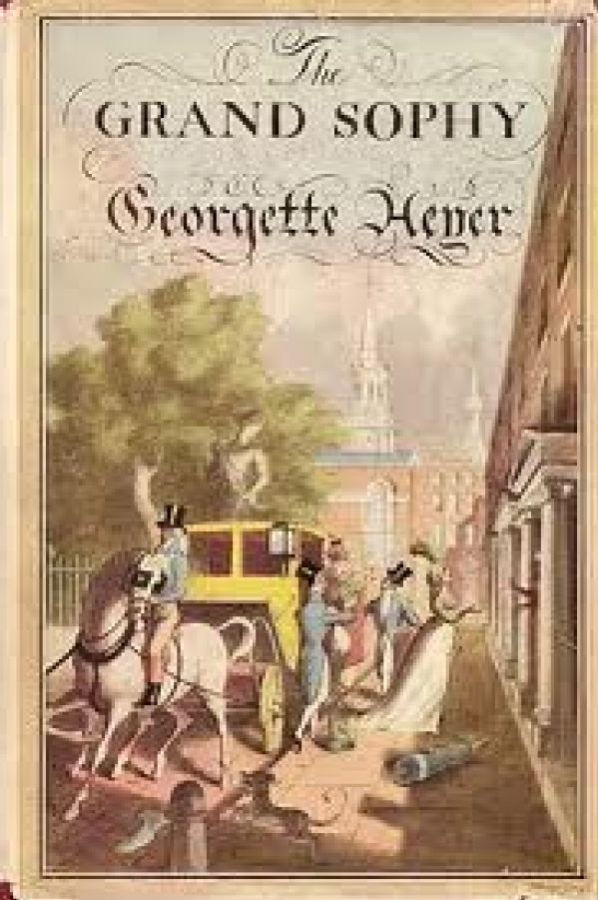
The Grand Sophy
Georgette Heyer was one of the most popular twentieth-century English writers. *The Grand Sophy*, recently translated into Italian, chronicles the intrusion of an independent, daring, and willful young woman into a traditional family of the English upper nobility at the beginning of the nineteenth century. The novel opens with Sir Horace’s unexpected request to his sister, the mild-mannered Lady Ombersley, to host his seventeen-year-old daughter, Sophy, for several months. The reader is immediately introduced to the cast of characters and to the circumstances from which the narrative unfolds: the two eldest children, the authoritarian and short-tempered Charles and the “so typically English” Cecilia, a female figure straight out of Jane Austen; the family’s financial ruin following Lord Ombersley’s gambling debts; and the providential inheritance bequeathed to Charles, which has cast him in the role of head of the family, fostering an atmosphere of subservience and reverent dread among his brothers and numerous sisters. Then there are the impending marriages. Charles has engaged himself to Miss Wraxton, unquestionably of high breeding and moral standing, yet detested by the Ombersleys for her patent intention to impose order on a household management she considers far too lax and permissive. Cecilia has accepted Lord Charlbury’s suit, yet has become infatuated with a handsome, penniless young poet. Lady Ombersley’s anxieties are thus manifold; she initially attempts to resist her brother’s insistent pleas, but ultimately agrees to take Sophy in, expecting a timid adolescent eager to be welcomed into the warmth of a home, having been orphaned of her mother as a young child and raised by a father, Sir Horace, who was perpetually on the road. She is consequently left stunned and somewhat alarmed when, accompanied by a mountain of luggage, a greyhound, a small monkey, and a splendid black horse, there appears an imposing girl—not pretty, but > built on generous lines, tall, with a fine bosom, an intensely lively countenance, and a wealth of rich brown hair under one of the most dashing hats her cousins (the numerous young Ombersleys) had ever seen . Her appearance reveals the girl’s character: impatient of rules, stubborn, capricious, and generous all at once, but above all > Sophy could not see anyone in trouble without instantly wishing to discover the cause, and, if possible, to set it right . This attitude cannot fail to bring her into conflict with Charles, by now accustomed to commanding. The girl causes a scandal (driving unchaperoned through London in a racing carriage!), flouts his directives, and openly challenges his betrothed, a sanctimonious busybody. Above all, however, Sophy schemes to make people happy, brushing aside the dictates and conventions of polite society. Yet, as so often happens, strong personalities relish encountering minds capable of defying them, and gradually Charles falls in love with Sophy. Could it be that the girl had been maneuvering from the very outset to conquer her sullen and difficult cousin? The plot is the novel’s greatest strength: unexpected twists, brisk dialogue, and Sophy’s subtle machinations coming to fruition in the teeth of adversity, malicious gossip, and the opposition of Miss Wraxton—virtually the only character who makes a pitiful attempt to thwart her. One senses that quintessential self-critical complacency of English culture, which views itself as rigid and conventional in contrast to Continental culture, imagined conversely as nonconformist and free. It is a trope reflected in the overly schematic portrait of Sophy—monotonously self-consistent, far too assured and mature for her years—and in the profiling of the other characters, so formal and predictable. Cecilia and Charles are the exceptions. The former asserts her complete independence—unprompted, in this instance, by her exuberant cousin—the moment she declares that she does not love Charlbury, but intends to marry the dreamy, handsome poet. Yet it will ultimately be Sophy who plays precisely upon the girl’s ingrained English values—her regard for propriety and respectability—to lead her back to desiring her original betrothed. Charles, on the other hand, represents the synthesis. While it is true that he is mindful of society’s rules and conventions, there resides within him that Elizabethan vigor that underpinned the British Empire. He is, after all, the hero, and one is left to wonder whether it will be he who changes Sophy, molding her into the noblewoman her rank naturally calls her to be. The scene in which Charles and Sophy declare their love is so thoroughly dominated by him that it raises the apprehension that Sophy’s future may simply be to yield to the conformism that surrounds her. Why read it? The plot is full of twists—somewhat predictable, perhaps, but thoroughly entertaining.

The house of sleep
The theme of sleep purports to be the book’s unifying thread, to the point that the novel is divided into parts corresponding to the various stages of sleep. In reality, it is a device—perhaps overly intellectual—to tell the story of the love between Robert and Sarah. We find ourselves in a university hall of residence. Sarah suffers from a sleep disorder that leads her to confuse dreams with reality. At their first meeting, Robert tells her he has just lost a cat to which he was deeply attached. Sarah dreams that Robert has lost a twin sister, Cleo, who does not actually exist. And it is upon this misunderstanding, originating in Sarah’s secret—her sleep disorder—that their relationship takes root: > as she left, they looked directly into each other's eyes for the first time; and something happened then, some connection was made, just for a moment . Their relationship is built on confidences, which > ranged freely over feelings, friendship, families and gender, shared intimacies and self-revelations which became deeper and more frequent as the objects themselves grew larger and more complex . The relationship between Robert and Sarah cannot, however, develop into a true romantic affair, partly because Sarah is a lesbian and partly due to Robert’s inability to translate his feelings into romantic advances. Their story remains in limbo until Sarah’s and Robert’s paths diverge: their university years come to an end, and when Sarah terminates a relationship with a woman, Robert realizes he is incapable of seizing this opportunity to translate his affection for his friend into a sexual relationship. At this point, the plot (in truth, the narrative constantly jumps between past and present, complicating the reading experience) shifts into the future, when the university residence has been converted into a sleep clinic—as it turns out, run by Sarah’s first lover, a paranoid man convinced that his mission in life is to find a way not to sleep. This is the least convincing section of the book, which seems to slide into a thriller, peppered with superficial musings on psychological science and references to analogies between dreams, fantasy, and cinema. The finest pages are those chronicling the life of Sarah, now a schoolteacher, in some way haunted by her sleep disorder—with which she has come to terms—and ever waiting for Robert, the only person with whom she knows she is truly in tune. Only towards the end of the novel is it revealed that Robert has undergone gender reassignment (because he understood his true nature, or out of love for Sarah?), becoming Cleo, a physician specializing in sleep disorders. And, like any thriller, everything is resolved, and Cleo can finally reveal herself to Sarah. The book’s primary virtue is the prose: pleasant, brilliant, and fluid. Its chief flaw is the inconclusiveness of the events and the characters: everything remains superficial, creating a palpable disconnect between the narrative structure of a thriller and the unmistakable ambition to deliver something more. What, exactly? It is impossible to say. Why read it? The individual pages read exceptionally well; the story as a whole disappoints.
The love of a good woman
This is a series of short stories exploring the lives of women. The narratives unfold delicately, pivoting entirely on emotion, the depiction of context, and interpersonal relationships. The stories have no definitive conclusion, imparting a sense of how life, seen through the eyes of women, is somehow more attuned to the “process” than to the results. The prose contributes admirably to creating this sense of suspension: it is delicate, elegant, rich both in its vocabulary and syntactic construction, yet without excess—hitting precisely the right note. It would be interesting to read a novel by the author.
Nostromo
The novel opens with the description of the setting in which the story will unfold. Sulaco, a natural harbor on the western coast of Costarica, is an > enormous semicircular and unroofed temple, open to the ocean, with its walls of lofty mountains adorned with mourning draperies of clouds . In this natural amphitheater there is a > sanctuary inviolable by the temptations of world trade in the solemn hush of the deep Golfo Placido : It is a peninsula, which > lies out on the sea like a rough head of stone, and extends from a green-clad coast at the end of a slender spit of sand overgrown with patches of thorny scrub . Waterless, arid, > the poor man, mingling with an obscure instinct of consolation the ideas of the devil and of wealth, will tell you that it is lifeless because of its hidden treasures . It is in this coastal wasteland that legend has it three men vanished in search of gold. The opening of the novel encapsulates the narrative style and the meaning of this sprawling book. The moral and idealistic degradation of men swept away by an unstoppable fate—that of triumphant capitalism—is narrated by Conrad in a rich, lush, evocative prose, at times bombastic and redundant. The heart of the novel is Sulaco, perhaps the true protagonist: a small town cut off from Costarica by high mountains, an easy haven for ships and favored by nature with an inexhaustible silver mine, its fortune but also its damnation. In the background lies the quintessential South American country, burdened by the > lawlessness of a people of every color and race, by barbarism, by an irremediable tyranny . As Bolívar, the great liberator, used to say: > America is ungovernable. Whoever works for its independence has drained the sea . In this context there is no room for feelings, for delicate, fragile souls, fraught with uncertainty: everyone must be a "hero > , men of action and not of thought, driven by grand ideals or ignoble designs. Sulaco hosts numerous strong-willed characters: the Garibaldian who took refuge in the New World because he refused to bow after the betrayal of Aspromonte; the haughty young Costarican woman devoted to a dream of moral and political rebirth for her country; her fiancé, seemingly disillusioned, yet whose love for her leads him to the idea of separating Sulaco from the volatile Costarica to forge a solid, democratic, Western state. Among these, and many others, stands the figure of Nostromo: a man with the weight of countless generations behind him and with no ties to account for..... like the People > . Nostromo is strong, courageous, driven by the desire for renown: he is a quintessential man of the people, with an obscure sense of greatness, with his boundless devotion to something desperate, just as his passions are desperate (...) Splendid, robust, and agile, he threw back his head, spread his arms, and stretched out with a slow twist of the torso and a deep breath, calm and menacing, natural and free from evil at the moment of awakening, like a magnificent, unconscious wild beast. Then, with a suddenly rigid stare fixed upon nothingness from beneath a pensive expression, the man appeared > . An exaltation of the primordial authenticity of male physicality that could almost be Pasolini’s! What disrupts this world of pure heroes, possessing a virtue equal to that of untamed nature, is the arrival of an Englishman, Gould, determined to exploit the silver mine. Mind you, it is not a lust for money that drives him, but a vision—one might say today, a strategic one: silver is the symbol of a rebirth, of a new world. Yet, as his wife well understands (the only sensitive soul, filled with doubts and dismayed by the moral and social implications of what is unfolding), the mine has turned into a fetishism, and now the fetishism had grown into a monstrous destructive force > . To save the silver, threatened by yet another Costarican revolution, Nostromo is entrusted with the task of transporting a shipment by sea to a vessel waiting offshore in the ocean. A series of unfortunate circumstances shipwrecks the boat upon the very arid and mysterious peninsula described at the beginning of the novel. Here, Nostromo abandons his traveling companion to certain death—the very young idealist in love, who vanished without a trace, swallowed up in the immense indifference of things > : an obvious metaphor for how ideals are valued. In that same grim spot, he conceals the precious cargo. From that moment on, he becomes a rich man, but at the cost of a vile betrayal. On the other hand, old or young, everyone likes money, and they will speak well of the man who gives it to them > . The novel ends tragically. Nostromo is killed by mistake by a friend, who mistakes him for his daughter's suitor, when in fact the man was going to retrieve some silver from his hidden hoard. One might say on the surface that greed is stronger than grand ideals. In reality, the theme of the novel is something else, encapsulated in this sentence by Gould: Saleco is no longer a paradise of snakes. We have brought humanity and we cannot turn our backs to leave and start a new life > . Capitalism brings civilization, but all this comes at a cost: the loss of heroes > . In short, Conrad is a bard of imperialism, with the difference compared to other Western authors (such as Kipling) that in him lives the myth of the noble savage. The novel is very long, extremely uneven, and devoid of narrative rhythm. Alongside very fine pages, generally those dedicated to the description of the environment, there follow monotonous and repetitive dialogues, abrupt scene shifts—often temporal and disconcerting—while the historical and political descriptions disrupt the narrative without adding anything of interest. The characters are stereotypes, devoid of psychological and existential depth; the web of relationships is superficial, poorly developed. The writing is linguistically fascinating, with occasionally poetic flourishes, evocative of an imaginative world; on the other hand, all this is life, it must be life, even though it is so like a dream". The author allows himself, however, to be carried away by the sheer indulgence of writing, by the redundancy of words, by the pleasure of the baroque and the marvelous. Consequently, the narrative style also becomes ponderous and at times suffocating. Why not read it? It is long and prolix.
Open City
When walking the streets of a city > every decision, where to turn, how long to linger lost in thought before an abandoned building, was of no consequence, and for this reason was a sign of freedom. I traversed the city’s neighborhoods as though I had to measure them with my stride, and the subway stations served as recurring motifs of my unending wandering . The protagonist and narrator of this novel is a young psychiatrist of Nigerian descent, the child of a mixed couple: an African father and a European mother. He spends much of his free time wandering the streets of New York. > The walks fulfilled a need: they were an escape from the strictly regimented mental environment of work, and once I discovered them as therapy, they became normal, and I forgot what life had been like before I began walking . Wandering the city on foot is a grand metaphor. It is a toponymic itinerary, a geographical discovery, and as such “a regime of competence and perfection.” At the same time, it is a journey into the labyrinth of the mind. Like the urban plan of a city, the human mind is a network of logical intersections, a rational model within which, however, we move in leaps. An image, a snatch of conversation, a chance encounter is enough to carry us “far away,” to other images, to memories, to the depths of the unconscious toward an "I" > never fully explored and unlocked. The novel can be read on three levels. First and foremost, it is an account of the protagonist’s urban wanderings. Moving aimlessly, he encounters places meticulously described in their history and urban function; they are also, and above all, watersheds between neighborhoods and unpredictable turning points in his journey on foot. Walking allows one to upend the rational model, since one is not constrained to follow traffic arteries, inadvertently leading to unexpected quarters of the city—historically significant, yet long forgotten in the consciousness of its inhabitants. The improvisation and slowness of walking also allow for encounters with others. Many are casual encounters, while others involve habitual acquaintances, yet always met by chance. In any case, they offer the opportunity to hear others’ lives narrated: their memories, their aspirations, and the ideas that animate their existence. Our protagonist does not like to speak; he prefers to listen, yet he does so without curiosity, almost as if fulfilling his psychiatric vocation even outside of work. The city then yields unexpected discoveries that bring us to the novel’s second level of interpretation: the genocides perpetrated by Western man. It is incredible, but in Manhattan itself, at the very center of global capitalism, there are sites that recall the slaughter of indigenous peoples, just as entire neighborhoods of skyscrapers and apartment buildings were erected over a burial ground where slaves were interred—those who died during the crossings from Africa or perished just after arriving in America. For all its pomposity, the West does not even respect the veneration of the dead! The city thus expresses a cosmic wound, a universal sorrow, latent and concealed within the consciousness of contemporary man. Aimless roaming also stirs remembrances, ushering us to the narrative’s third level: childhood, with the brief and intense bond with his maternal grandmother, his father’s funeral, the military academy where the young protagonist completed his education before moving to the United States. It is Nigeria resurfacing, with its spiritualism so distant from Western culture. Yet above all, it is the unresolved relationship with his mother, who carries a deep wound: she is the product of a rape, for which she blames her own mother, the maternal grandmother, and her native land, Belgium. Pursuing the labyrinth of the mind, the protagonist has thus arrived at a dark juncture: his mother’s existential grief, which prevented her from truly loving her son. Have we reached the conclusion of this journey into the unconscious? Is there something else the protagonist refuses to acknowledge and accept? In his peregrinations along the city streets, the protagonist happens to meet the sister of a childhood friend. It is she who recognizes him and speaks to him. They exchange the customary pleasantries of people who have not seen each other in a long time, between individuals whose relationship was superficial and slight. The friend invites the protagonist to a party at her boyfriend’s home. While looking out from the terrace at the countless lights of Manhattan, the friend pulls the protagonist aside and reminds him that, when she was fifteen years old and I was a year younger..... I had forced myself into her... afterward, she said, in the weeks that followed, in the months and years that followed, I had acted as if I knew nothing, I had even forgotten her to the point of not recognizing her when we met again, and never tried to acknowledge what I had done... but it was not so for her, she said, the pleasure of denial had not been possible for her". > Each of us must, at some level, take oneself as the yardstick of normality, must assume that the mansion of one's own mind is not, cannot be, entirely opaque to him To myself, I am always the hero > and so, what does it mean when, in someone else's version, I am the villain? The novel concludes with a highly evocative metaphor. The Statue of Liberty is what all immigrants see upon arriving in New York. Yet against this great statue hundreds of birds crash, driven by the currents and the wind. A precise system of statistics records each death: species, number, date, and weather conditions. With scientific precision, an attempt is made to bring rationality to a cosmic and existential phenomenon that encapsulates the destiny of each of us: as an emigrant people and as an individual in search of himself. We are faced with a complex book, difficult in its content, intellectually rich yet lacking in vigor, in some ways cryptic and prolix. What sustains a nonexistent narrative plot and an equally fragile system of characters is the prose: an English that is elegant, delicate, sophisticated, and simple all at once. It is read with pleasure, yet one gets lost in the narrative dispersion and in the obsessive effort to give voice to too many topics and reflections. Why not read it? Too long and verbose. One loses oneself.
A thousand splendid suns
Female friendship lies at the core of this novel. The author chronicles the condition of women in Afghanistan across an extensive span of time, from the 1960s to the present day—from the monarchy to the invasion by Western forces, spanning the “Soviet” period, the civil war, and the Taliban regime. He portrays the harsh reality of women's lives through the trajectories of two female figures: Mariam and Laila. Mariam is fifteen years old in 1974 when her father gives her in marriage to a much older man: Rasheed. The marriage is intended to remedy a scandalous situation. Mariam is an illegitimate child and thus, following her mother's suicide, cannot be taken into her father's household. For the young girl, this marks the end of a relatively happy adolescence, nourished by the myth of her father and the dream of being recognized as a daughter in her own right, of no longer being a bastard. Yet, though betrayed by her father—a weakling and a coward—Mariam bravely confronts her new life in the metropolis of Kabul. Yet Rasheed proves to be a despotic and violent man, particularly after Mariam fails to bear him a son, miscarrying the baby girl she was carrying instead. The monarchy is supplanted by the communist regime, and the status of women improves, at least in official rhetoric and for a narrow stratum of the population. Yet for Mariam, nothing changes: she lives cloistered at home, subjected to her husband’s brutal dominion. The narrative then turns to the adolescence of Laila: a lively, restless, educated girl, in love since childhood with a playmate: Tariq. War among tribal factions fosters a mounting climate of violence, killings, abductions, and rapes, driving many families—including Tariq's—to flee to Pakistan. A bomb destroys Laila's house, killing her parents. The girl is rescued and taken in by Rasheed and Mariam. In truth, the man aims to marry her and succeeds, partly through deception (with the false news of Tariq's death) and partly because Laila is pregnant with Tariq's child and sees marriage as a solution for herself and, above all, for her unborn baby. At first, Mariam treats Laila with hostility, viewing her as an interloper who has usurped her role as sole wife; yet Rasheed’s sheer cruelty, the birth of two children, and the harshness of life under the Taliban regime gradually forge a growing solidarity between the two women that blossoms into a profound friendship. It is a distinctly feminine bond, arising from the care of the children and the resolve to resist—with steadfastness and stubborn determination—the unprecedented violence inflicted upon them by Rasheed. And it is Mariam herself—the meek, submissive Mariam—who strikes down her husband with an axe as he attempts to murder Laila. Mariam thereby enables Laila’s escape while condemning herself to death at the hands of the Taliban: an ultimate sacrifice for the future happiness of her friend and her children. The finest sections of the novel are those devoted to depicting the childhood and adolescence of Mariam and Laila: the representation of the rural world—Mariam's—contrasted with the Kabul setting where Laila grew up; the innocence and dreams of the two girls, so disparate yet so akin, typical of youth; their affection for their fathers—mythologized for Mariam, tangible for Laila; the emotional detachment of the mothers, and the deeply rooted bond between Laila and Tariq, unquestionably the redeeming facet of an otherwise grim and somber novel. When the narrative moves on to depict the vicissitudes of the two marriages, however, one senses an air of abstraction and contrivance. The author relies in vain on the literary device of alternating perspectives between the two women: both personalities remain relegated to the background, flattened by scenes of violence and Afghan life that are themselves repetitive and precisely as we in the West imagine them to be. In particular, the friendship between the two women is never explored in depth; instead, it surfaces superficially, its underlying motivations and contradictions left unexamined. Mariam’s extreme decision to kill her husband and liberate Laila feels abrupt, devoid of any perceptible maturation, with the result that Mariam herself is reduced to a secondary figure compared to Laila, when in fact she bears all the hallmarks of a heroine of Greek tragedy. Why not read it? It is overly long and at times redundant.
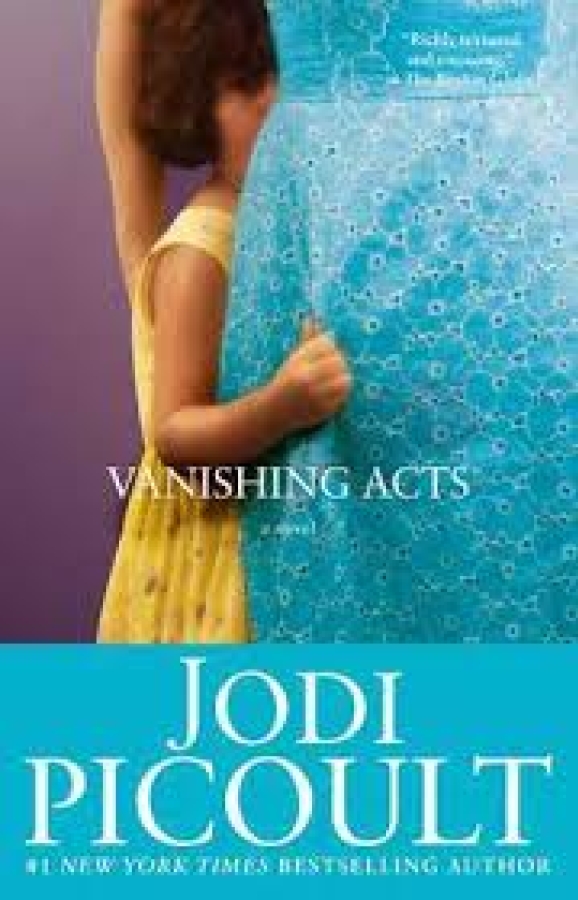
Vanishing Acts
Delia’s father had always told her that her mother was dead, so much so that she has become a memory continually resurfacing in her mind. > I used to imagine how my mother would come back. (...) In all of these daydreams, death was not as absolute as it was supposed to be, and we always found each other by accident. In all of these daydreams, my mother and I recognized each other without a single word. Delia's life has unfolded peacefully, with a loving father and two friends: Fritz and Eric, the latter of whom Delia falls in love with as a girl and with whom she has a daughter. Her only torments are that ever-present feeling of having lost something and the fact that Eric is an alcoholic. Until, suddenly, the police show up at the house to arrest her father, Andrew, accused of having kidnapped his daughter twenty-five years earlier. The novel tackles many themes—perhaps too many: Andrew's deceit, having concealed the existence of her mother, Elise, from Delia; Eric's alcoholism, resurfacing under stress and upon discovering that Elise had also struggled with alcohol addiction; the dynamics between the three friends, Delia, Eric, and Fritz, the latter having always been in love with her (serving in the novel as a kind of guardian angel); the new surroundings where Delia moves with her daughter to attend the trial and where she meets Rutham, a blend of Native medicine woman and hippie grandmother; the harshness and brutality of the prison where Andrew is incarcerated; potential childhood sexual abuse, repressed by Delia but brought back to light by her father's accusations against Elise during the trial (perhaps yet another lie); and finally the trial itself, recounted with the standard American police-procedural approach. To impose order on such a sprawling narrative, a review must select a single thread, even at the risk of stripping away the plot's richness. One might begin with a curious question the Native medicine woman poses to Delia: > What if the whole kidnapping experience wasn't Delia's story? What happens if disappearing wasn't the most catastrophic event in your life? What else would it be? (asks Delia). Ruthman raises her face to the sun. "Coming back," she says. And indeed, Delia is not happy when she meets her mother; Elise, tears in her eyes, realizes this and tells Delia that she has lost her once again, and forever. Too vast is the divide between fantasy and reality! > My mythical, imaginary mother was a god and a superhero and a comfort to me. (...) It took me twenty-five years to be able to admit that I'm glad I didn't know my mother until now. Not because, as my father suspected, she might have ruined my life, but because this way, I didn't have to witness her ruining her own. As the author states, through Delia's voice, > What matters is not what you have accumulated over the years, but those few things you can carry with you. It is a pity that such a compelling theme—the confrontation between memory and reality—is compromised by a plot overcrowded with narrative threads, superfluous characters, and redundant episodes. Why depict prison life only to traffic in clichés, and why become entangled in the interpersonal dynamics of childhood friends transitioning into adulthood? It would have been far better to examine in psychological depth Delia’s discovery of her mother as well as the mother's own emotions, which remain perpetually relegated to the background until fading away entirely. Further accentuating its melodramatic potboiler quality is the now ubiquitous technique of multi-voiced narration: each chapter recounts the story from the perspective of a different character, generating a redundancy of the "I" (is one not enough?) that renders the whole enterprise long-winded, repetitive, and tedious. The novel's merit lies in its prose: a syntactic structure that is straightforward yet far from trivial, and an elegant vocabulary enriched by idioms, adjectives, and verbs drawn from colloquial speech, marked by a distinctly American cadence. Distant from New York intellectualism and the overwrought virtuosity of certain contemporary American authors (one need only think of the much-celebrated Cormac McCarthy; see the review of *The Road* on this site), Picoult returns us to a style accessible to the general reader. Why read it? The prose is engaging; the premise, potentially intriguing.
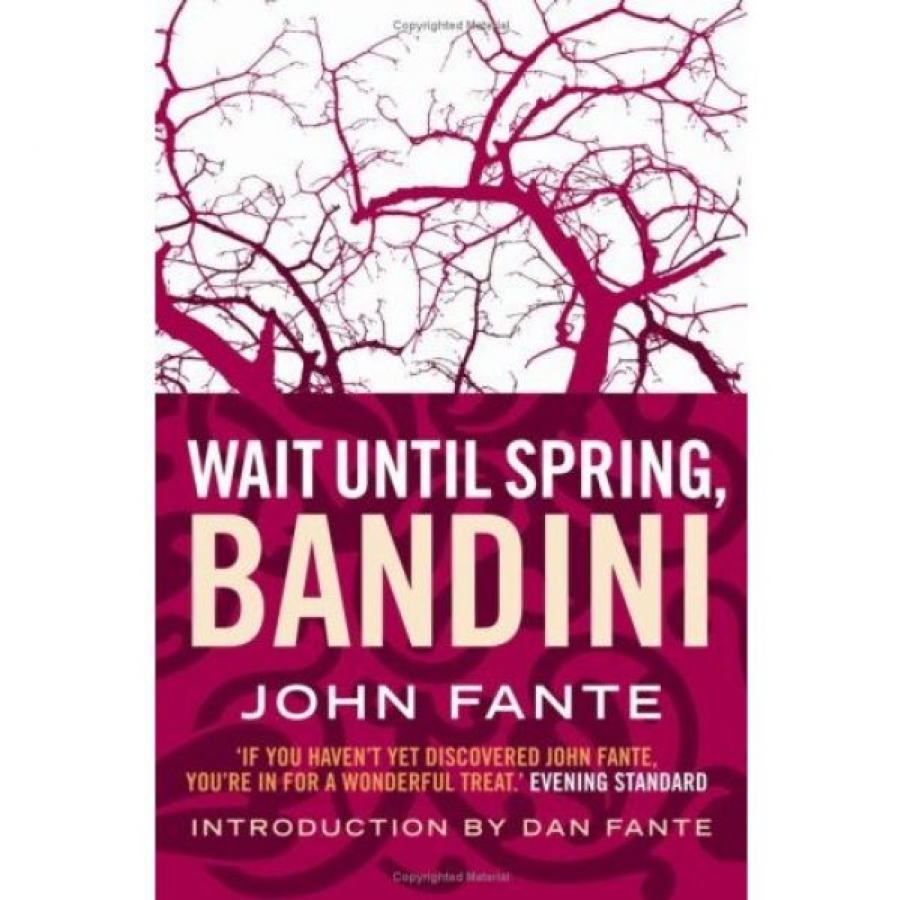
Wait until spring, Bandini
The story belongs to *The Bandini Quartet* saga, chronicling the fortunes of the Italian-American Bandini family, and of Arturo Bandini in particular. The setting is the family: a bricklayer father who is consequently unemployed during the long Colorado winters, a mother striving to maintain a sense of decency and a bare minimum of subsistence, and three sons, the eldest of whom, Arturo, must also shoulder the burden of his father’s frequent, drunken disappearances. In this already fraught domestic sphere, the father’s infidelity with a wealthy local woman triggers the mother’s breakdown; she sinks into prolonged bouts of depression and refuses to let her husband back into the home. It falls to Arturo to seek out his father and bring him back. The themes are those familiar to the author: family dynamics, the bond between son and parents, Catholic culture, and so forth. The narrative unfolds sluggishly, at times becoming tedious and verbose. The musical cadences that characterized the previous novel are absent here. Predictable tropes tied to Italian heritage and Catholicism often seem to dominate (for instance, guilt, recourse to confession, and rituals). The mother’s revolt—her defiance in the face of wounded dignity—emerges as a high point in the narrative and constitutes its finest pages. Another theme is Arturo’s coming-of-age, a journey inevitably accelerated by his mother’s fragility and his father’s absence.

The way home
Chris grew up in a respectable middle-class family. His father runs an installation business: hardworking, reserved, yet attentive to the family’s needs; like all parents, he is full of expectations regarding his son’s future. The mother is protective, affectionate, ready to indulge anything from her boy, so loved and desired. It is a peaceful and well-off household, yet how is it possible that Chris deals drugs, gets involved in petty theft and brawls? > He was not trying to hurt his parents, really. But in his mind there was this thought: they have unreasonable expectations of me. They do not understand who I am... I don't want to be their good boy and I don't want the things they want for me. If they do not understand, it is their problem, not mine . Charged with drug dealing, assault, and causing accidents while attempting to flee the police, Chris receives a severe sentence. He is committed to a juvenile correctional facility, predominantly populated by Black youths. Proving to possess greater resilience than anticipated, the young man manages to survive in an environment that should be hostile to him. Indeed, he establishes a series of friendships that endure beyond prison walls. His only friction is with an older, violent, and aggressive youth named Lawrence. The author does not, however, delve deeply into the prison environment, which resembles a boarding school more than a prison, even a juvenile one. Attention is entirely focused on depicting the relationship between Chris and his father: a cold, detached dynamic marked by mutual distrust. For the father, the disappointment was too profound to offer solidarity and affection to his son. The boy senses his parent's low esteem and withdraws into himself, bolstered by his new experience, which he regards as an achievement. Parent-child relations are fraught to such an extent that one is astonished when, in the novel’s second half, Chris is found working for his father. During an installation job in an apartment, Chris and Ben, a former fellow inmate, discover a bag of money under a floor. They do not steal the cash; they leave it where they found it, promising each other to keep quiet. Ben, however, mentions it to Lawrence over drinks one evening. Lawrence steals the money, unaware that it belongs to two dangerous criminals who stashed it away to retrieve upon their release from prison. The two thugs murder Ben in an effort to discover who has the cash. Chris reveals nothing to his father or the police, contacting Lawrence instead to seek mutual vengeance for their friend’s death. Such is the prison code of honor. To his girlfriend, who urges him against it, Chris replies that > there are two personalities in me, there is the person you know, and the one that is still inside me. The boy who did bad things and was locked up in prison. The one you have never met . It seems Chris is lost for good, yet it is Lawrence who saves him, ensuring Chris does not carry out the revenge, which falls solely upon himself, the bad seed. Indeed, destiny is sealed at birth: Chris was "born in a good suburb, raised in a loving home," while Lawrence > had never found that place ( where) they speak to you with kindness and patience instead of sarcasm and cruelty . The novel pursues several narrative threads: intergenerational conflict, the passage from adolescence to adulthood—which often finds positive resolution through sheer luck alone—and parents coming to terms with the fact that their children harbor their own aspirations and desires. The happy ending should not lead us into facile optimism regarding social change. Everything is already determined from birth: those who are white can be saved, even if they occasionally lose their way; those who are Black can only be dragged down, back into the world from which they desperately strive to rise. Compelling social and psychological themes are diluted by a sluggish narrative pace, devoid of action and at times mundane. Particularly in the depiction of prison life, the author seems eager to present a placid, reassuring vision of the so-called rehabilitation of juvenile offenders. The leap between the first part—the bad Chris—and the second—the good Chris—is so pronounced and thinly explored that it strains the credibility of the entire narrative. Finally, reviews often tout Pelecanos as a writer of noir, albeit with a social bent. From this vantage point, one is left disappointed by the dearth of action and suspense. Why read it? It makes for a pleasant read, but nothing more.