Finished reading on: August 31, 2013
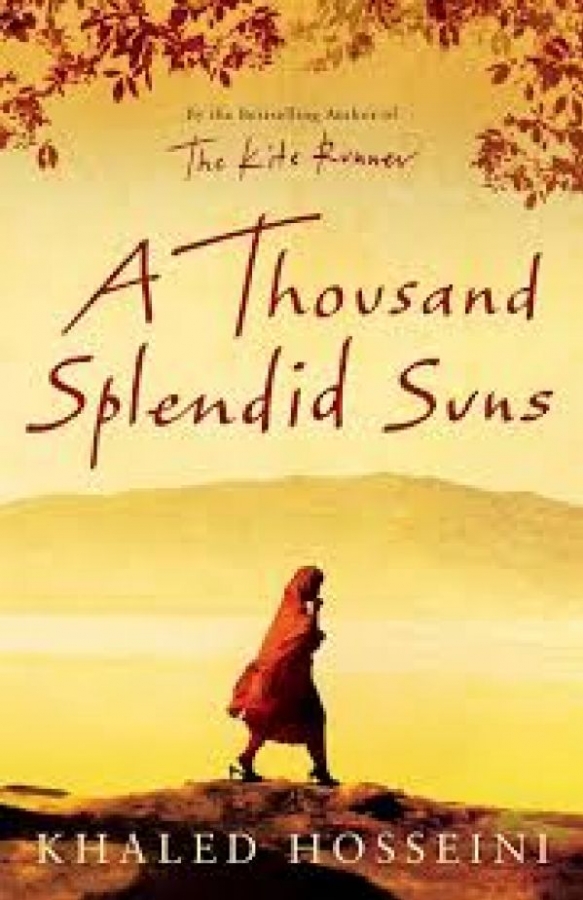
A thousand splendid suns
AI Translation Notice: This review was translated from the original Italian using artificial intelligence. Book quotes and excerpts are translated interpretations and will not match the author's original English phrasing or official published translations.
Female friendship lies at the core of this novel. The author chronicles the condition of women in Afghanistan across an extensive span of time, from the 1960s to the present day—from the monarchy to the invasion by Western forces, spanning the “Soviet” period, the civil war, and the Taliban regime.
He portrays the harsh reality of women's lives through the trajectories of two female figures: Mariam and Laila.
Mariam is fifteen years old in 1974 when her father gives her in marriage to a much older man: Rasheed.
The marriage is intended to remedy a scandalous situation.
Mariam is an illegitimate child and thus, following her mother's suicide, cannot be taken into her father's household. For the young girl, this marks the end of a relatively happy adolescence, nourished by the myth of her father and the dream of being recognized as a daughter in her own right, of no longer being a bastard.
Yet, though betrayed by her father—a weakling and a coward—Mariam bravely confronts her new life in the metropolis of Kabul.
Yet Rasheed proves to be a despotic and violent man, particularly after Mariam fails to bear him a son, miscarrying the baby girl she was carrying instead.
The monarchy is supplanted by the communist regime, and the status of women improves, at least in official rhetoric and for a narrow stratum of the population.
Yet for Mariam, nothing changes: she lives cloistered at home, subjected to her husband’s brutal dominion.
The narrative then turns to the adolescence of Laila: a lively, restless, educated girl, in love since childhood with a playmate: Tariq.
War among tribal factions fosters a mounting climate of violence, killings, abductions, and rapes, driving many families—including Tariq's—to flee to Pakistan.
A bomb destroys Laila's house, killing her parents.
The girl is rescued and taken in by Rasheed and Mariam.
In truth, the man aims to marry her and succeeds, partly through deception (with the false news of Tariq's death) and partly because Laila is pregnant with Tariq's child and sees marriage as a solution for herself and, above all, for her unborn baby.
At first, Mariam treats Laila with hostility, viewing her as an interloper who has usurped her role as sole wife; yet Rasheed’s sheer cruelty, the birth of two children, and the harshness of life under the Taliban regime gradually forge a growing solidarity between the two women that blossoms into a profound friendship.
It is a distinctly feminine bond, arising from the care of the children and the resolve to resist—with steadfastness and stubborn determination—the unprecedented violence inflicted upon them by Rasheed.
And it is Mariam herself—the meek, submissive Mariam—who strikes down her husband with an axe as he attempts to murder Laila.
Mariam thereby enables Laila’s escape while condemning herself to death at the hands of the Taliban: an ultimate sacrifice for the future happiness of her friend and her children.
The finest sections of the novel are those devoted to depicting the childhood and adolescence of Mariam and Laila: the representation of the rural world—Mariam's—contrasted with the Kabul setting where Laila grew up; the innocence and dreams of the two girls, so disparate yet so akin, typical of youth; their affection for their fathers—mythologized for Mariam, tangible for Laila; the emotional detachment of the mothers, and the deeply rooted bond between Laila and Tariq, unquestionably the redeeming facet of an otherwise grim and somber novel.
When the narrative moves on to depict the vicissitudes of the two marriages, however, one senses an air of abstraction and contrivance.
The author relies in vain on the literary device of alternating perspectives between the two women: both personalities remain relegated to the background, flattened by scenes of violence and Afghan life that are themselves repetitive and precisely as we in the West imagine them to be.
In particular, the friendship between the two women is never explored in depth; instead, it surfaces superficially, its underlying motivations and contradictions left unexamined.
Mariam’s extreme decision to kill her husband and liberate Laila feels abrupt, devoid of any perceptible maturation, with the result that Mariam herself is reduced to a secondary figure compared to Laila, when in fact she bears all the hallmarks of a heroine of Greek tragedy.
Why not read it? It is overly long and at times redundant.