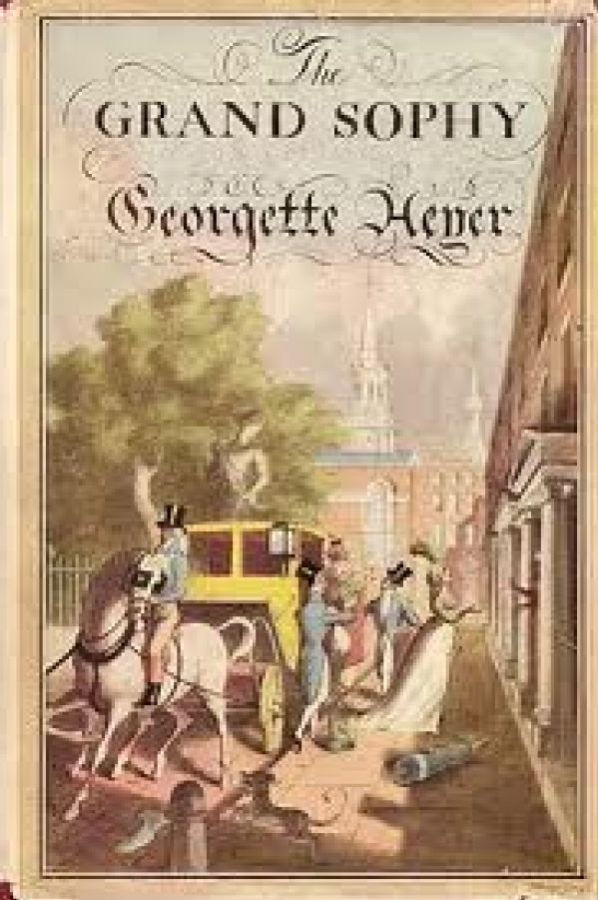
Finished reading on: August 01, 2013
The Grand Sophy
AI Translation Notice: This review was translated from the original Italian using artificial intelligence. Book quotes and excerpts are translated interpretations and will not match the author's original English phrasing or official published translations.
Georgette Heyer was one of the most popular twentieth-century English writers.
The Grand Sophy, recently translated into Italian, chronicles the intrusion of an independent, daring, and willful young woman into a traditional family of the English upper nobility at the beginning of the nineteenth century.
The novel opens with Sir Horace’s unexpected request to his sister, the mild-mannered Lady Ombersley, to host his seventeen-year-old daughter, Sophy, for several months.
The reader is immediately introduced to the cast of characters and to the circumstances from which the narrative unfolds: the two eldest children, the authoritarian and short-tempered Charles and the “so typically English” Cecilia, a female figure straight out of Jane Austen; the family’s financial ruin following Lord Ombersley’s gambling debts; and the providential inheritance bequeathed to Charles, which has cast him in the role of head of the family, fostering an atmosphere of subservience and reverent dread among his brothers and numerous sisters.
Then there are the impending marriages.
Charles has engaged himself to Miss Wraxton, unquestionably of high breeding and moral standing, yet detested by the Ombersleys for her patent intention to impose order on a household management she considers far too lax and permissive.
Cecilia has accepted Lord Charlbury’s suit, yet has become infatuated with a handsome, penniless young poet.
Lady Ombersley’s anxieties are thus manifold; she initially attempts to resist her brother’s insistent pleas, but ultimately agrees to take Sophy in, expecting a timid adolescent eager to be welcomed into the warmth of a home, having been orphaned of her mother as a young child and raised by a father, Sir Horace, who was perpetually on the road.
She is consequently left stunned and somewhat alarmed when, accompanied by a mountain of luggage, a greyhound, a small monkey, and a splendid black horse, there appears an imposing girl—not pretty, but
built on generous lines, tall, with a fine bosom, an intensely lively countenance, and a wealth of rich brown hair under one of the most dashing hats her cousins (the numerous young Ombersleys) had ever seen
.
Her appearance reveals the girl’s character: impatient of rules, stubborn, capricious, and generous all at once, but above all
Sophy could not see anyone in trouble without instantly wishing to discover the cause, and, if possible, to set it right
.
This attitude cannot fail to bring her into conflict with Charles, by now accustomed to commanding.
The girl causes a scandal (driving unchaperoned through London in a racing carriage!), flouts his directives, and openly challenges his betrothed, a sanctimonious busybody.
Above all, however, Sophy schemes to make people happy, brushing aside the dictates and conventions of polite society.
Yet, as so often happens, strong personalities relish encountering minds capable of defying them, and gradually Charles falls in love with Sophy.
Could it be that the girl had been maneuvering from the very outset to conquer her sullen and difficult cousin?
The plot is the novel’s greatest strength: unexpected twists, brisk dialogue, and Sophy’s subtle machinations coming to fruition in the teeth of adversity, malicious gossip, and the opposition of Miss Wraxton—virtually the only character who makes a pitiful attempt to thwart her.
One senses that quintessential self-critical complacency of English culture, which views itself as rigid and conventional in contrast to Continental culture, imagined conversely as nonconformist and free.
It is a trope reflected in the overly schematic portrait of Sophy—monotonously self-consistent, far too assured and mature for her years—and in the profiling of the other characters, so formal and predictable.
Cecilia and Charles are the exceptions.
The former asserts her complete independence—unprompted, in this instance, by her exuberant cousin—the moment she declares that she does not love Charlbury, but intends to marry the dreamy, handsome poet.
Yet it will ultimately be Sophy who plays precisely upon the girl’s ingrained English values—her regard for propriety and respectability—to lead her back to desiring her original betrothed. Charles, on the other hand, represents the synthesis.
While it is true that he is mindful of society’s rules and conventions, there resides within him that Elizabethan vigor that underpinned the British Empire.
He is, after all, the hero, and one is left to wonder whether it will be he who changes Sophy, molding her into the noblewoman her rank naturally calls her to be.
The scene in which Charles and Sophy declare their love is so thoroughly dominated by him that it raises the apprehension that Sophy’s future may simply be to yield to the conformism that surrounds her.
Why read it? The plot is full of twists—somewhat predictable, perhaps, but thoroughly entertaining.