Jodi Picoult
Books by this author (1)
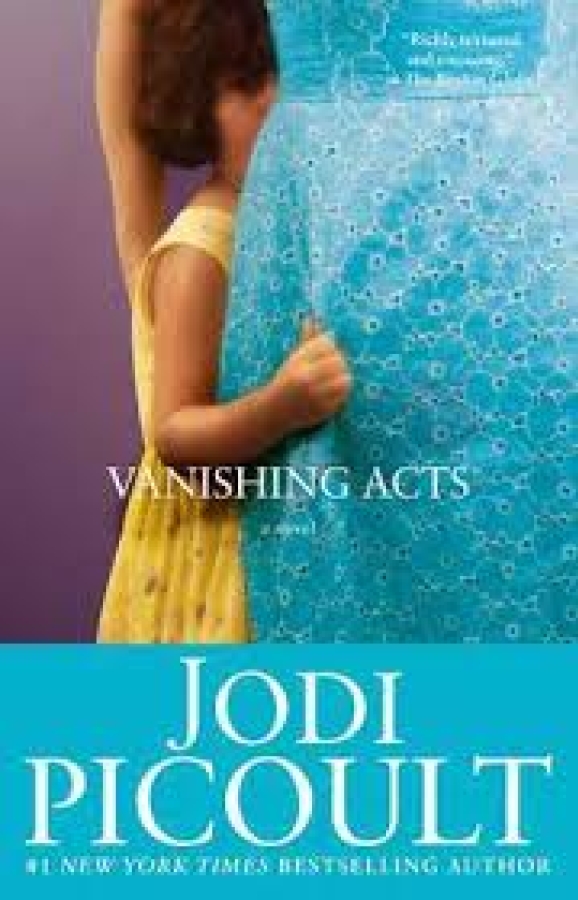
Vanishing Acts
Delia’s father had always told her that her mother was dead, so much so that she has become a memory continually resurfacing in her mind. > I used to imagine how my mother would come back. (...) In all of these daydreams, death was not as absolute as it was supposed to be, and we always found each other by accident. In all of these daydreams, my mother and I recognized each other without a single word. Delia's life has unfolded peacefully, with a loving father and two friends: Fritz and Eric, the latter of whom Delia falls in love with as a girl and with whom she has a daughter. Her only torments are that ever-present feeling of having lost something and the fact that Eric is an alcoholic. Until, suddenly, the police show up at the house to arrest her father, Andrew, accused of having kidnapped his daughter twenty-five years earlier. The novel tackles many themes—perhaps too many: Andrew's deceit, having concealed the existence of her mother, Elise, from Delia; Eric's alcoholism, resurfacing under stress and upon discovering that Elise had also struggled with alcohol addiction; the dynamics between the three friends, Delia, Eric, and Fritz, the latter having always been in love with her (serving in the novel as a kind of guardian angel); the new surroundings where Delia moves with her daughter to attend the trial and where she meets Rutham, a blend of Native medicine woman and hippie grandmother; the harshness and brutality of the prison where Andrew is incarcerated; potential childhood sexual abuse, repressed by Delia but brought back to light by her father's accusations against Elise during the trial (perhaps yet another lie); and finally the trial itself, recounted with the standard American police-procedural approach. To impose order on such a sprawling narrative, a review must select a single thread, even at the risk of stripping away the plot's richness. One might begin with a curious question the Native medicine woman poses to Delia: > What if the whole kidnapping experience wasn't Delia's story? What happens if disappearing wasn't the most catastrophic event in your life? What else would it be? (asks Delia). Ruthman raises her face to the sun. "Coming back," she says. And indeed, Delia is not happy when she meets her mother; Elise, tears in her eyes, realizes this and tells Delia that she has lost her once again, and forever. Too vast is the divide between fantasy and reality! > My mythical, imaginary mother was a god and a superhero and a comfort to me. (...) It took me twenty-five years to be able to admit that I'm glad I didn't know my mother until now. Not because, as my father suspected, she might have ruined my life, but because this way, I didn't have to witness her ruining her own. As the author states, through Delia's voice, > What matters is not what you have accumulated over the years, but those few things you can carry with you. It is a pity that such a compelling theme—the confrontation between memory and reality—is compromised by a plot overcrowded with narrative threads, superfluous characters, and redundant episodes. Why depict prison life only to traffic in clichés, and why become entangled in the interpersonal dynamics of childhood friends transitioning into adulthood? It would have been far better to examine in psychological depth Delia’s discovery of her mother as well as the mother's own emotions, which remain perpetually relegated to the background until fading away entirely. Further accentuating its melodramatic potboiler quality is the now ubiquitous technique of multi-voiced narration: each chapter recounts the story from the perspective of a different character, generating a redundancy of the "I" (is one not enough?) that renders the whole enterprise long-winded, repetitive, and tedious. The novel's merit lies in its prose: a syntactic structure that is straightforward yet far from trivial, and an elegant vocabulary enriched by idioms, adjectives, and verbs drawn from colloquial speech, marked by a distinctly American cadence. Distant from New York intellectualism and the overwrought virtuosity of certain contemporary American authors (one need only think of the much-celebrated Cormac McCarthy; see the review of *The Road* on this site), Picoult returns us to a style accessible to the general reader. Why read it? The prose is engaging; the premise, potentially intriguing.