Finished reading on: March 22, 2015
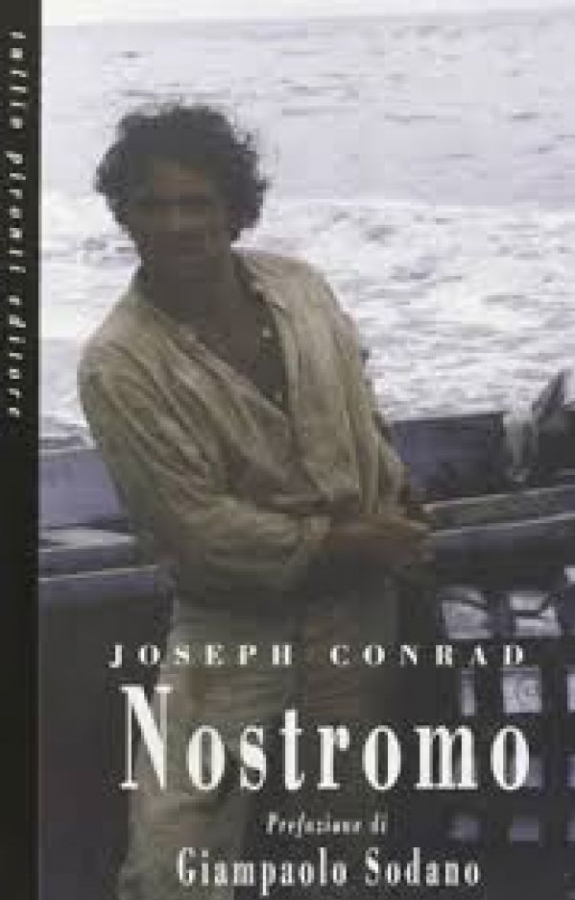
Nostromo
AI Translation Notice: This review was translated from the original Italian using artificial intelligence. Book quotes and excerpts are translated interpretations and will not match the author's original English phrasing or official published translations.
The novel opens with the description of the setting in which the story will unfold.
Sulaco, a natural harbor on the western coast of Costarica, is an
enormous semicircular and unroofed temple, open to the ocean, with its walls of lofty mountains adorned with mourning draperies of clouds
.
In this natural amphitheater there is a
sanctuary inviolable by the temptations of world trade in the solemn hush of the deep Golfo Placido
: It is a peninsula, which
lies out on the sea like a rough head of stone, and extends from a green-clad coast at the end of a slender spit of sand overgrown with patches of thorny scrub
.
Waterless, arid,
the poor man, mingling with an obscure instinct of consolation the ideas of the devil and of wealth, will tell you that it is lifeless because of its hidden treasures
.
It is in this coastal wasteland that legend has it three men vanished in search of gold.
The opening of the novel encapsulates the narrative style and the meaning of this sprawling book.
The moral and idealistic degradation of men swept away by an unstoppable fate—that of triumphant capitalism—is narrated by Conrad in a rich, lush, evocative prose, at times bombastic and redundant.
The heart of the novel is Sulaco, perhaps the true protagonist: a small town cut off from Costarica by high mountains, an easy haven for ships and favored by nature with an inexhaustible silver mine, its fortune but also its damnation.
In the background lies the quintessential South American country, burdened by the
lawlessness of a people of every color and race, by barbarism, by an irremediable tyranny
.
As Bolívar, the great liberator, used to say:
America is ungovernable.
Whoever works for its independence has drained the sea
.
In this context there is no room for feelings, for delicate, fragile souls, fraught with uncertainty: everyone must be a "hero
, men of action and not of thought, driven by grand ideals or ignoble designs.
Sulaco hosts numerous strong-willed characters: the Garibaldian who took refuge in the New World because he refused to bow after the betrayal of Aspromonte; the haughty young Costarican woman devoted to a dream of moral and political rebirth for her country; her fiancé, seemingly disillusioned, yet whose love for her leads him to the idea of separating Sulaco from the volatile Costarica to forge a solid, democratic, Western state.
Among these, and many others, stands the figure of Nostromo:
a man with the weight of countless generations behind him and with no ties to account for.....
like the People
.
Nostromo is strong, courageous, driven by the desire for renown: he is a quintessential man of the people, with an obscure sense of greatness,
with his boundless devotion to something desperate, just as his passions are desperate (...) Splendid, robust, and agile, he threw back his head, spread his arms, and stretched out with a slow twist of the torso and a deep breath, calm and menacing, natural and free from evil at the moment of awakening, like a magnificent, unconscious wild beast.
Then, with a suddenly rigid stare fixed upon nothingness from beneath a pensive expression, the man appeared
.
An exaltation of the primordial authenticity of male physicality that could almost be Pasolini’s! What disrupts this world of pure heroes, possessing a virtue equal to that of untamed nature, is the arrival of an Englishman, Gould, determined to exploit the silver mine.
Mind you, it is not a lust for money that drives him, but a vision—one might say today, a strategic one: silver is the symbol of a rebirth, of a new world.
Yet, as his wife well understands (the only sensitive soul, filled with doubts and dismayed by the moral and social implications of what is unfolding), the mine has turned into
a fetishism, and now the fetishism had grown into a monstrous destructive force
.
To save the silver, threatened by yet another Costarican revolution, Nostromo is entrusted with the task of transporting a shipment by sea to a vessel waiting offshore in the ocean.
A series of unfortunate circumstances shipwrecks the boat upon the very arid and mysterious peninsula described at the beginning of the novel.
Here, Nostromo abandons his traveling companion to certain death—the very young idealist in love, who
vanished without a trace, swallowed up in the immense indifference of things
: an obvious metaphor for how ideals are valued.
In that same grim spot, he conceals the precious cargo.
From that moment on, he becomes a rich man, but at the cost of a vile betrayal.
On the other hand,
old or young, everyone likes money, and they will speak well of the man who gives it to them
.
The novel ends tragically.
Nostromo is killed by mistake by a friend, who mistakes him for his daughter's suitor, when in fact the man was going to retrieve some silver from his hidden hoard.
One might say on the surface that greed is stronger than grand ideals.
In reality, the theme of the novel is something else, encapsulated in this sentence by Gould: Saleco
is no longer a paradise of snakes.
We have brought humanity and we cannot turn our backs to leave and start a new life
.
Capitalism brings civilization, but all this comes at a cost: the loss of
heroes
.
In short, Conrad is a bard of imperialism, with the difference compared to other Western authors (such as Kipling) that in him lives the myth of the
noble savage.
The novel is very long, extremely uneven, and devoid of narrative rhythm.
Alongside very fine pages, generally those dedicated to the description of the environment, there follow monotonous and repetitive dialogues, abrupt scene shifts—often temporal and disconcerting—while the historical and political descriptions disrupt the narrative without adding anything of interest.
The characters are stereotypes, devoid of psychological and existential depth; the web of relationships is superficial, poorly developed.
The writing is linguistically fascinating, with occasionally poetic flourishes, evocative of an imaginative world; on the other hand,
all this is life, it must be life, even though it is so like a dream".
The author allows himself, however, to be carried away by the sheer indulgence of writing, by the redundancy of words, by the pleasure of the baroque and the marvelous.
Consequently, the narrative style also becomes ponderous and at times suffocating.
Why not read it? It is long and prolix.