
Dirty water
> In Italy, Neela had a job, a daughter, a home—in that order, but without any of the three truly belonging to her. (...) She had applied herself with unflagging constancy to fashion a new shell; certain things are not learned through the eyes, but with the gut. Behind that thick layer of greasepaint, Neela felt inhabited by a monstrous underworld pressing to surface, which she relentlessly forced back down. After many years in Italy, after a lifetime of toil, she had some money, which in Ceylon, her native land, afforded her a solid financial standing. She decides, then, to return home. This choice appears incomprehensible to her relatives in Ceylon—a country devastated by civil war, military repression, mounting poverty, and the fallout of climate change: a country vastly different from the one Neela had left behind, now transformed by Western patterns of consumption and by new beliefs and customs. The author is not interested in Neela's future, whose life seems dictated by the immutable fate of the emigrant. The novel's central theme is the impact of this departure on Ayesha, Neela's daughter, the "dirty water"—so called because she has become Italianized, while remaining in search of a link to the past, both her own and that of her family. These two existential dimensions are not approached through a predictable sociological lens revolving around the question of identity. With great narrative dexterity, the writer unfolds the chronicle of Neela’s family and that of Ayesha in parallel; unlike her mother, Ayesha cannot return; unlike her aunts and cousins, she cannot place her trust in ancient remedies, in the wisdom of a magical world still populated by spirits and Buddhist rituals, nor lean on anti-colonial and revolutionary ideologies. Where are the roots of a "dirty water" to be found, obliged to survive within a post-capitalist society? Fond of metaphors, the author turns to the image of tropical trees that grow from seeds > that burrow into the cracks in the bark of other trees, choking the host with their own roots. (...) The relationship I wove with my life elsewhere was like this: an existence growing atop another like a parasite. While one sought to take over, dragging along its roots, exposed like raw flesh, the other, underneath, continued to survive on the verge of rot. I felt like a Persephone dividing her time between two worlds. She had sold herself for six pomegranate seeds; what had I sold myself for? The suspicion often arises as to whether Uyangoda is actually speaking of Italy, using Ceylon just as Montesquieu wrote of France by imagining a Persia that existed only in his *Persian Letters*. One derives the same impression when reading Igiaba Scego, particularly the latest book reviewed on this site: *Cassandra a Mogadiscio*. While it is true that the most captivating section of the novel consists of the chapters devoted to Ceylon, the author invariably brings us back, with unsparing starkness, to the existential and psychological drama of Ayesha: a woman so close to us, yet so distant because she is "dirty water." And it is precisely in this "coming and going," between an idealized island and our own daily alienation, that the substantive weight of the novel resides. The narrative structure is well crafted, relying on the first person when dealing with Ayesha, while shifting to the third person to chronicle the family histories: this approach generates a peculiar alternation between the subjectivism characteristic of the contemporary novel and the objectivism that arises from an urge to address the world and "universal" existences. The prose is fluid yet dense; one senses a philosophical undercurrent, especially in certain passages rich in meditation and abstraction. All of this enhances the allure of the reading experience. The plot cannot help but be fragile, given that everything has already been laid bare from the opening sentences of the book. Why read it? A demanding, yet fascinating novel.
The namesake (the nickname)
> Transform yourself into words: (...) if running around a single name it is always you and me at stake and always the same the potent weapons of mourning and affliction that even in dreams chase my smoothness to ruin (Cosimo Ortesta, from *Il progetto di un freddo perenne*, 1988). Reading this novel brought this line of Ortesta’s to mind: names follow us throughout our existence, speaking of ourselves, of the bond we share with others, and of all the feelings, even painful ones, we carry with us; as Lahiri writes, “names die over time, they perish with people.” Gogol is the son of a Bengali couple who moved to the United States; the name was bestowed upon him at birth while awaiting the “true > name that was supposed to arrive from India, but never did: a pet name, then, chosen by his father out of his passion for Russian writers. Gogol hates even signing his name at the bottom of his drawings in art class. He hates that it is at once absurd and obscure, that it has nothing to do with who he is—that is, neither Indian nor American, but above all not Russian > . Being named Gogol is the mark of his ambiguity, of an identity suspended between two worlds, two different cultures, histories, and traditions. And Gogol attempts to break free from this indeterminacy, to escape the name, stubbornly pursuing separation from his parents and from the large, noisy, crowded Bengali community, with its clothing, cuisine, customs, and language—strenuously defended precisely because they live far from their homeland. He is weary of returning to Calcutta to visit relatives, a journey so eagerly anticipated by his parents. And above all, he no longer wants to be called Gogol. He goes to study far from home, earns a degree in architecture, finds work in another city, changes his name to Nikhil. The protagonist's attitude does not shift even when he learns the true reasons that led his father to give him that pet name. One evening, the train bringing Nikhil home is severely delayed. His father waits for him at the station in a state of great anxiety: he reveals to him that he named him Gogol because, as a young man, he was one of the few survivors of a catastrophic train accident; the book by the great Russian writer had saved him. Is this what you think of when you think of me, Gogol asks him, Do I remind you of that night? Not at all, his father says at last, with a hand on the boy’s hip, an accustomed gesture that had embarrassed Gogol up until that moment. You remind me of everything that followed > , that is, of family, work, and hard-won prosperity; and the name bestowed upon his son holds many meanings, not least what Dostoevsky said: we all came out of Gogol’s Overcoat > . The enigmatic phrase cannot yet be understood by young Nikhil, who resumes his flight from his roots. He meets Maxine, a classic daughter of the upper-middle-class liberal > , with beautiful homes, beautiful objects, solid points of reference. A guest at the house where Maxine’s parents—so cultivated and accommodating—spend their holidays, by the shores of a splendid lake amid woods and green meadows, Gogol understands that this is a place that will always be here for her. It makes it easy to imagine Maxine's past, her future, to picture in his mind her growing old. (...) Through the windows, he sees that dawn is slowly emerging in the sky, only a few stars are still visible, the silhouettes of the surrounding trees and buildings gradually become distinguishable. A bird begins to sing. And then he remembers that his parents cannot reach him: he hasn't given them the phone number. (...) And here beside Maxine, in this welcoming wilderness, he feels free. > The flight is cut short when his father suddenly dies. The rush to the morgue, the identification, gathering the few possessions his father had with him, the return home to his now-solitary mother, the Indian funeral rites surrounded by the entire Bengali community, brutally pull Gogol back to his condition of being neither Indian nor American, nor even Russian. Maxine invites him on a vacation together (because it might do you good (...) to get away from all this”); Nikhil replies to her: “I don’t want to get away > . And just like that, he is Gogol once more; he lets his mother guide him into a marriage with a Bengali girl, in a lavish and crowded ceremony he would have scornfully refused only a short time before. Reclaiming one's identity is not so simple. We cannot delve deeply into the story of the girl Gogol marries—a tale within the tale. We can only outline a few fundamental traits: she has a name unpronounceable in American and is therefore called by a pet name; she too fled her family, went to Paris where she acquired a third language (neither American nor Bengali), returned to the United States to teach French literature at university, surrounds herself with refined intellectuals (so removed from Gogol’s straightforward technical background), has had many men, betrays Nikhil, returns to Paris. Gogol is a romantic, and as such engages in a love affair—intense at least for him—genuinely believing he has found solid roots in a modern Anglo-Bengali family. The betrayal and separation abruptly throw him back into a state of limbo. He wonders how his parents managed, leaving behind their respective families, seeing them so rarely, without a place to reunite, in a perennial state of waiting, of nostalgia. (...) Gogol knows that his parents lived their lives in America despite what they lacked, with a strength he fears he does not possess.” What's in a name? Shakespeare wonders in *Romeo and Juliet*: “that which we call a rose by any other name would smell as sweet > . The novel does not tell us whether Juliet is right. In the old house his mother is vacating to move to Calcutta, Gogol finds the stories of the great Russian writer once again: a book his father had given him as a teenager, which he had abandoned on the shelf with a mixture of indifference and annoyance. And he finds a dedication: the man who gave you his name, from the man who gave you your name.” Here is Dostoevsky’s enigma: “the name he had so detested was hidden and preserved here. (...) Those who had given and preserved the name of Gogol were far from him now. One dead, the other, a widow, on the verge of a different kind of departure, to live filled with nostalgia, like his father, in a world apart. (...) Once or twice a week he will hear the name Gogol over the telephone wires, or written on a screen. (...) Without people in the world to call him Gogol, no matter how long he lives, Gogol Ganguli, once and for all, will vanish from the lips of those who love him, and so, cease to exist. It is an intense and complex novel: fluid, elegant prose, a spasmodic attention to detail. Places, objects, food, clothing are meticulously described, unlike the characters, who are not treated superficially, but rather deliberately kept always waiting” for something else, or yearning with nostalgia for something else. The author seems to be saying: everything is vacuous except places, naturalistically rendered yet rich in myth, suggestion, transmitters of values and worlds. At times one loses the thread of the plot, but what does it matter? The allure resides in the writing, and it is up to the reader to reassemble and interpret the whole. Why read it? A masterpiece, fascinating and dense with meaning and resonance.
Nineteenth-Century Southern Fiction Writers
As the editors, Alda and Elena Croce, have noted, Southern Italian literature is strongly influenced by the great French authors, such as Zola, Flaubert, and Maupassant: heedful, therefore, of social conditions, yet marked by a peculiar accent—a blend of ironic, fairy-tale fabulation and melodramatic tones. The survey is limited to 10 writers, some of them well known, such as Capuana, Serao, and De Roberto; how representative it is remains unclear, but within it one can single out two singular pieces. Salvatore Di Giacomo is a prolific Neapolitan writer, journalist, poet, and scholar. He favors tragic spectacles, mixtures of ferocity and goodness; his characters are harlots, *camorristi*, and beggars; his settings are filthy, picturesque alleyways. The short story *La Taglia* offers an effective portrait of a dramatic and forgotten chapter of our history: the great brigandage between 1860 and 1870. We find ourselves in a "disconsolate little village" over which weighed "a silence of death": today the sacking of the mayor's house, yesterday a severed ear to extort a ransom, then a herdsman roasted over firewood like a ram; a horror to which the soldiers react, > without the stir of a trial, without lawyers or courts. Down there, behind the little church, they shot them on the dirt ground . Mariangela is seized by labor pains, surrounded only by her children because her husband has gone off to capture a ruthless bandit on whose head a bounty has been placed; it is a poor wretch's desperate bid to escape destitution. > The toddler had crawled up to the doorstep. (...) The other, the red-haired one, grabbed him from behind and pulled him onto his chest. The naked infant shrieked, growing restless, with his little hands trying to fend him off.(..) The July sun burst inside with a blaze that scorched the flesh and took away one's breath;(...) the broody hen pecked among the scattered grains, (...) a little dog braced its paws on the rim of the pitcher and stretched its dirty snout into it, (...) outside, a heavy silence... The woman is in labor; the eldest boy, the red-haired one, runs off terrified to look for his father. As he makes his way into the brush, he finds a lizard, which he slips into his pocket. He calls desperately for his father, then catches sight of him: > the murdered man's face was barely visible, (...) flies swarmed all over him, (...) a hand stuck out, all bruised and bloody, open. (...) Tata! Tata!, called the little boy, Tata, mama is crying and wants you!... Oi, tata! He grew restless. He lay flat on his belly on the low wall, brought out the lizard, tied a string to the bloody stump of its tail and made it walk, jerking it back with sudden tugs, yelling after it: Ah, Ah!... Isce!... > Vittorio Imbriani, also a Neapolitan, was a university professor, patriot, and combatant, but also an imaginative writer attentive to popular literature. Bearing witness to this is the tale *Le tre Maruzze* > , a true rarity, having been published in an edition of only twenty-eight copies in 1875. In Neapolitan maruzza > means snail; in the story, these little creatures are the guardians of three precious gardens: a rose garden, a wondrous field of maize, and an orange grove. Don Peppino, a young peasant, rescues three filthy beasts (the grass snake, the lizard, and the sewer rat), in truth three fairies, who, as Parini sings, make lovers blissful and in the blink of an eye mingle earth and sea at their whim > . And indeed the good man becomes the King’s gardener, held in high esteem because Don Peppino is sincere and faithful. One day, the Queen and the other Royal Highnesses, piqued and envious at hearing repeatedly that Don Peppino was the only one who never lied, proposed a wager to the King: to tempt the gardener by every means, and if Peppino were to blurt out > a lie, the King’s head would fall; otherwise, those of the Royal Highnesses. Don Peppino resists the princes' overtures, but when the Queen offers herself in exchange for a rose, as Girolamo Fontanella sings, the mawkish versifier, > upon the happy lover she falls and joins breast to breast, mouth to mouth, and heart to heart . And what is to be done now? Telling a lie means incurring the Sovereign's wrath; telling the truth will mean the King loses his head. What weighs most heavily on Don Peppino is the grief of the three fairies (now in the form of a spade, hoe, and shovel), because the man could not resist and “tomorrow will tell the little lie.” But to the Sovereign’s question: “How fare my little snails?” Don Peppino replies: > Mouth of Truth no Lie shall tell, your wife came asking for them; she offered what I might ask, and three she obtained. As price for the first, I kissed her; (...) Spade, hoe, and shovel, that know all, as I have told you shall bear witness to the truth . What moral is to be drawn from this fairy tale? While the powerful amuse themselves with pointless games and foolish wagers, the poor man acts wisely, even if he too has allowed himself to be deceived. Could it be true? "...Cuccurucù...". I have chosen only two stories, because the others add little to literature or even to the narrative of our *Mezzogiorno*. Journalism, the fantastic, and melodrama mingle together, giving us a languid and pessimistic vision of the South. The only story of great power is Federico De Roberto’s (*La Paura*), set in a World War I trench and dealing with foretold death; several soldiers must advance to an outpost, fully aware that they will surely die. It is death, > crouching, watchful, poised to spring and seize; if one must go out to meet it, staring into its eyes, the eyes grow dim, the legs give way, the veins run dry, every fiber trembles, all of life ebbs away. It is a tragic and intensely timely page; yet we are in 1927, a world away from the weary and repetitive tales of the late nineteenth century. Why not read it? Nothing evocative or stimulating.
The Birth of Rome
The book chronicles the events surrounding the birth of Rome through the story of two brothers, Servio and Plistino. Enslaved, they flee to find freedom in Rome, which was then coalescing around the figure of Romulus. The two brothers make their fortune, but Servio is unable to have children, and Plistino’s descendants perish in a plague. Servio and his wife resolve to adopt one of the brothers of Plistino’s wife so as to perpetuate the family name. The novel features all the most celebrated episodes of the founding of Rome, yet the style and storytelling elevate when dealing with domestic themes: the love between spouses and the bond with children, death and grief, a religion centered on the veneration of ancestors, adoption as the expression of a love that transcends ties of blood, and the values of justice and freedom. The pedagogical intent is less pronounced here than in *Storia delle Storie del mondo*, yet the prose retains that affectionate, gentle, and at times lyrical tone distinctive of the author. The narrative structure is often fragmented, lacking the momentum required to keep the reading from growing tedious at times (particularly in the middle section).
Born Twice
The book, autobiographical in nature, recounts the relationship between the writer and his disabled son. The chief merit of the narrative, structured into self-contained chapters and thus devoid of an overarching plot, lies in its spare style, which eschews easy sentimentality and false solidarity. The disabled boy functions almost as a mirror to the author, the embodiment of a personal history fraught with friction—evident, for instance, in his relations with his wife and with the school, the writer’s own workplace. In reality, it is a tedious book, at times reduced to aphorisms and assertions that are ends in themselves, detached from any narrative framework. Even the portrait of the son falls flat, devoid of nuance and consequently bent on projecting a positive view, despite the grave misfortune.
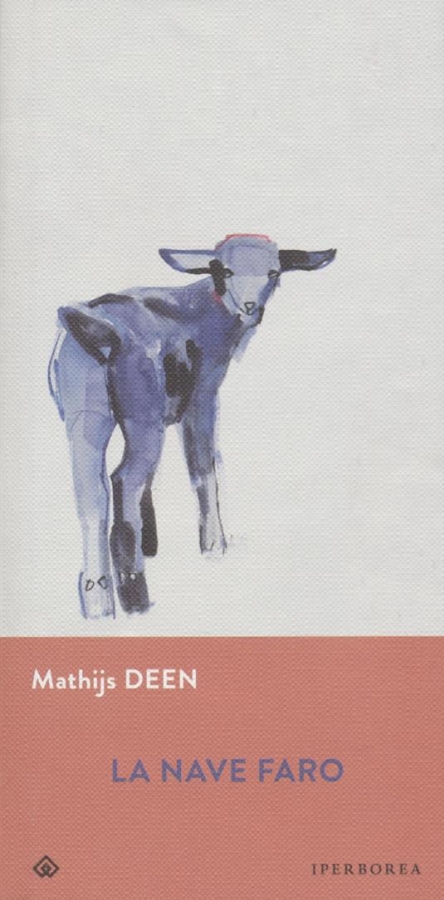
The Lightship
> A lightship has no propeller, no engine; on the bridge there is no helm: it can do nothing but sway, somewhat forlorn, an animal tugging in vain at a chain On this ship that will never sail and will never see distant lands, the crew members vanish > into the dark labyrinth where all the days of their working lives were digested into an almost inextricable mass of memories . Into this sort of prison, into a fragile balance of lives and memories, bursts a young goat. The cook brings it aboard, intending to slaughter it to make a savory dish. > Such an animal on a ship (the peasant woman shouted at him), watch out, because it'll want to escape. (...) A goat always wants to get away , but on this ship we are all prisoners, says the cook. It is only natural to wonder why the cook wanted to bring the young goat on board; its meat is certainly exquisite, but culinary motives are irrelevant; in the man’s childhood lies an image that resurfaces ceaselessly. While still a child, a household servant induced him to slit a chicken's throat. > Blood spurted from the neck, the chicken flapped its wings violently. (...) he ran inside looking for his mother. (...) He put his thumb in his mouth and rested his head against her chest. The finger had the sweet taste of the chicken's blood. (...) He closed his eyes . The cook does not have much butchering experience, let alone with goats, but no matter: in his subconscious, he seeks to repeat the childhood ritual through which he conquered fear and reclaimed his mother. The cook does not realize that he is not the only one subject to the dark fascination of the young goat. Days of dense fog set in, which > deadened the wind, dissipated sounds, petrified the motion of the waves, encircled the lightship. (...) Now it was a defenseless animal, chained, surrounded, (...) invisible to passing vessels . The danger of a collision is palpable, the tension among the crew is at its peak; there is nothing to do but wait, peering into the gloom of the fog. To anyone who has not been hardened by years of waiting and is unable to repress fear, the young goat—a frisking, restless creature—might seem like the devil, who has brought disorder to a life as regimented as that of the lightship. There is a sailor who > sometimes heard things that weren't there and struggled to shake off the thoughts that plagued him . His duty on board is to take readings for the Meteorological Service, but the meticulous, detailed records have become "a shadow bookkeeping of his anxiety and unease." He convinces himself that the young goat is the root of the evils afflicting the crew, of that dark fog enveloping the vessel: a condition that prevents him from filling in his daily log. He decides to put the goat to death in a ritual to exorcise the evil. But if the animal is the devil, how can a mere sailor be expected to save the small community? Whether due to the author's limited grasp of maritime life or the translator's difficulty in rendering nautical terminology into Italian, the lightship remains in the background of the narrative; it can only be brought to light as a metaphor for evil and the fragility of the human soul. At a certain point, the cook contracts malaria and plunges into a fever-induced suspension of consciousness. A respite for memory at last, says the author! What is this obsession with memories, never real but always imagined? Would it not be better to dissolve into the void of the present, without past or future? Saint Augustine maintained that nothing exists except the present, since the past is memory in the present and the future is merely today's anticipation of what is to come. Giving the tale a philosophical reading, one might conclude that the young goat is the lockpick used to drag the past into the present—everything dark within the human soul that originates in memory. The writing is stark: short sentences with frequent full stops resulting in a fragmented narrative, sketched and somehow suspended characters, a simple, even banal plot. It reads like a cold, journalistic report of an affair that is not meant to have an explanation, unless one settles for a few psychological traits, which are, moreover, underdeveloped. The allure of the maritime world is entirely absent, both in language and situations, save for the descriptions of the dark, terrifying fog. Why not read it? It is fragile from a narrative standpoint, useless when it comes to content.
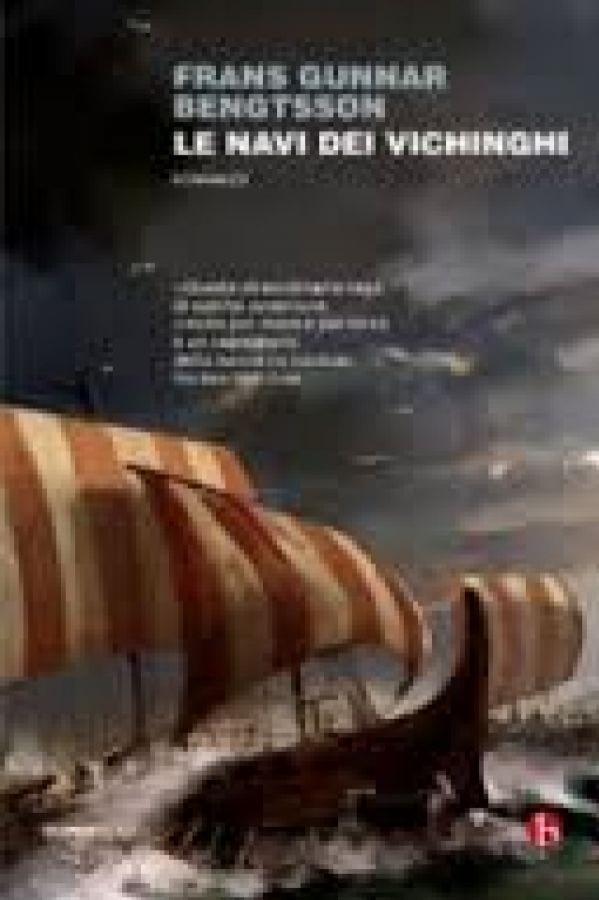
The Viking Ships
The year is 900 AD. The Vikings, a people native to Scandinavia, lived off crops, herring fishing, and, for the more restless among them, sea raids—chiefly toward England and Ireland, where they found fortune by the sword, and where many eventually settled. They were beginning to be touched by the preaching of priests, “shaven-headed men,” who sought to convert them to the Christian faith and to soften their customs, still crude and violent. The novel recounts the deeds of Red Orm: the youngest son of a wealthy farmer, who, as soon as > spring arrived and the smell of tar began to permeate the air , would turn his gaze toward the sea and, out of the sheer joy of setting out, “would even compose a verse or two.” Orm was his mother’s darling, and she did not want him sailing off with his father on perilous voyages, fraught with storms and enemies. Circumstances dictated otherwise. In an attempt to defend his flock, he was captured by a ship of Vikings sailing “southward,” toward the Frankish realm and wealthy Andalusia. Thus begins the first part of the book, recounting Orm’s long voyage. It was an expedition into worlds still unknown yet already dreamed of: rich lands ripe for plunder. The Vikings had no fixed destination, and thus the book is not a Nordic version of the *Argonautica*, as Michael Chabon suggests in his introduction. Events carried the voyagers along, and they displayed courage, vigor, a knack for seizing opportunity, and a thirst to discover new places and customs. The account of this long journey is also the story of Orm’s coming of age: from a spoiled, impulsive boy, he grew into a seasoned man and a leader of men. And so, upon returning home, Orm was fully an adult, claiming mastery over his own fate. The account of his homecoming opens with one of the most compelling chapters: the Christmas feast at the king’s court. The clash between tradition and Christianity, between ancestral values and new ideals, emerges with brutal clarity. The long banquet in honor of Christmas culminated in a series of bloody duels, in which Orm himself was embroiled, defending the necklace bestowed upon him by the Caliph of Cordova. And it was precisely during his prolonged convalescence that love blossomed between Orm and the king’s daughter—a love that spurred the now-mature youth toward further spiritual growth. To win the woman he loved, Orm chose to surrender the necklace and convert to Christianity. It was a momentous choice, for it forced him to take refuge near the great forests, > where kings never come. It is there that I shall build my church . Many interpretations can be ascribed to the novel: a hybrid of fantastical narrative and social chronicle; a chronicle of the transformation of Vikings into Normans, conquerors of England and key players in the late Middle Ages; the spread of Christendom and its attendant ethical and cultural dilemmas; nostalgia for Viking society, crude yet authentic; the wandering of young men in search of their destiny and the pursuit of the new; the portrayal of a man’s long and turbulent life. Yet the novel’s truest essence is adventure, seasoned with a healthy, dry irony—a detachment that keeps us from taking the heroic figures, incredible exploits, and wondrous discoveries too seriously. As Michael Chabon writes in the conclusion to his introduction, > adventure is a dish best consumed in the comfort of one’s own home . Why read it? The narrative is at times episodic, yet it remains a captivating, epic, and popular tale.

In Pressel's Summerhouse: A Tale of Old Tübingen
> To you, islands, to you may my guardian god/Lead me! Yet from this faithful heart/Even then the Neckar shall not fade,/Nor the sweet meadows and the willows of its banks. (*“Ode on the Neckar Valley”*, 1801). Thus Friedrich Hölderlin (1770–1843), one of the founders of German Romanticism, sings of Tübingen and its river, the Neckar—to him a cherished realm, an emblem of peace and serenity. Yet Tübingen is also the city where Hölderlin spent the long years of his madness, from 1807 until his death. Hermann Hesse (1877–1962) returns to the great poet in this short story, imagining two young men paying a visit to Hölderlin in 1823. One is the young student Eduard Mörike, residing in Tübingen to study theology and become a Protestant pastor. > To the young man in his twenties, beloved by his friends for the inexhaustible vivacity of his genius, it happened not infrequently, in certain serene moments of happiness, that the entire landscape would suddenly take on the contours of an enchanted painting, upon which he gazed with rapt eyes, sensing the world’s enigmatic beauty as a warning and almost as a subtle, concealed torment. The other is his friend and contemporary Wilhelm Waiblinger: he, too, officially a student of theology, brazenly declares his wish to > flee far from you, predestined race of obese petty priests, (…) rushing into a tavern to drown my soul in beer and wine. (…) What a clown I am, what a mangy egoist and dissolute drunkard! The former embodies purity, diaphanous and cowardly; the latter, dissolution, corrupting yet vital. Mörike (1804–1875) would end up a country vicar, trapped in an intractable conflict between sexuality and spirituality; Waiblinger (1804–1830) would die young in Rome, author of poetry and prose marked by an intense visionary world. The two young men, still oblivious to their own future, go to fetch Hölderlin to guide him to a cloister from which the now-demented poet can contemplate the placid flow of the Neckar. Poetry does not save man, the figure of Hölderlin seems to say to the two youths: > there, now, sat the man with the divine brow and a gaze ever filled with touching purity, the ghost of himself, plunged back into an empty, helpless childhood. And when > the tall, solemn man, led by the hand by his nurse, walks away to return home, the two young men part ways as well, and it will be forever: Mörike, a *slender adolescent* who still believes in poetry, and Waiblinger, determined to gamble his fate. Looming over them is what is perhaps the demented Hölderlin’s last poem: > The pleasant things of this world I have enjoyed. /The time of youthful hours, how long, /oh, how long since lost!/ April and May and July a distant season/withered away./I am no longer anything, no longer do I love life. (Probably written in 1811). The story is Hesse’s tribute to poets who likely contributed to his intellectual formation; as if Montale were to imagine D’Annunzio and Pascoli paying a visit to Carducci. There is also a reflection on Poetry, when Hesse wonders > why were they sitting here so unhappy and cheated, those poets of exaltation, the old man and the young (Hölderlin and Waiblinger), and why did he himself (Mörike), (…) sit beside them so sorrowful and discontented? (…) Was it truly the fate of poets that no sun could shine in their eyes without them having to amass its shadow in their souls? Why read it? Fluent, and a fine introduction to Hesse.
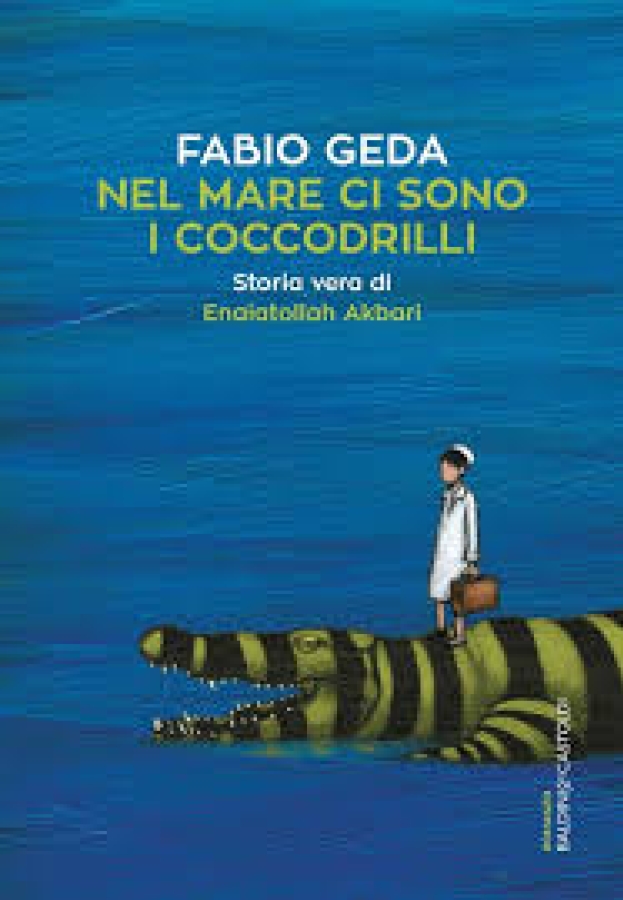
In the Sea There Are Crocodiles
The novel bears the subtitle *The True Story of Enaiatollah Akbari*. It is, in fact, Akbari who recounts his journey from Afghanistan to Italy to Geda. Whether this is a literary device or an actual interview matters little; the journalistic reportage format lends the requisite credibility to the boy's tribulations, to his dream of freedom and peace. Akbari lives in northern Afghanistan, near the border with Pakistan: he belongs to a Shia ethnic minority persecuted by the Taliban. Still a child, he is forced to witness the execution by firing squad of his schoolteacher, who stubbornly insisted on keeping the school open. To escape Taliban repression, Akbari's mother takes him to Kandahar and entrusts him to an acquaintance who gets him across to Quetta, Pakistan. In this city, Akbari must find a way to survive, taking on even foul jobs such as unclogging sewers, submerged in waste. Quetta serves as a sort of crucible of formation, where Akbari learns to navigate adversity, picks up new trades—such as petty street theft—and meets other boys with whom to play soccer and dream of a better future. He has heard of > a lot of kids going to Iran. (...) I would hear these voices in the air, as if broadcast from a loudspeaker in place of the muezzin’s prayer; I sensed them in the flight of birds, and I believed them, because I was little, and when you are little what can you know of the world? Listening and believing were one and the same. I believed everything they told me. And above all, when one is still a child, one believes friendship gives such strength that any hardship can be overcome. Unfortunately, one later discovers that *in the sea there are crocodiles*. Akbari will realize this upon traveling to Iran and then to Turkey, always thinking he has found the right place to live. While the pages devoted to Quetta are still imbued with a sense of adventure—the places, people, and events portrayed as if in a dream of reality from which one might escape by returning home—later, in Iran, Turkey, and Greece, everything turns raw and vicious, and Akbari himself becomes harder, disillusioned, and ready to save himself even by abandoning his friends. Consider the sea crossing by dinghy to reach the Greek coast, when, amid the waves, they lost a friend:. > we kept rowing and shouting Liaqat's name. And rowing. And shouting. (...) Nothing. The darkness had swallowed Liaqat. At that point—I don’t really know how it happened: it must have been the exhaustion, it must have been the despair, it must have been that we felt too small, yes, infinitely too small not to succumb to it all—at that point, it just happened that we fell asleep. Now alone, Akbari manages to reach Italy, a wonderful, still welcoming Italy, where an unaccompanied minor received care and foster placement—and that was only fifteen years ago! In *Anime scalze* (see the review on this site), Geda writes that > life is a billiard ball: every collision makes it change direction; and if you are strong and lucky enough, you can go anywhere. Beyond the account of the journey—in which the most compelling aspect is Iran's role as a hinge and immigration country—Akbari's story is a coming-of-age novel that transcends its specific events. One reaches adulthood by facing and overcoming hardships, by learning from circumstance, not without a certain measure of opportunism and pragmatism. It is the happy ending that trivializes the narrative, imparting a cloying tone and thereby compromising the sheer drama of child migration. The novel maps out migrant itineraries, yet everything comes across as too easy, devoid of suffering other than the physical. Separation from family, parting from friends left to their fate, the abandonment of one's roots—all appear effortless, easy to overcome. Why not read it? In the end, it is banal.
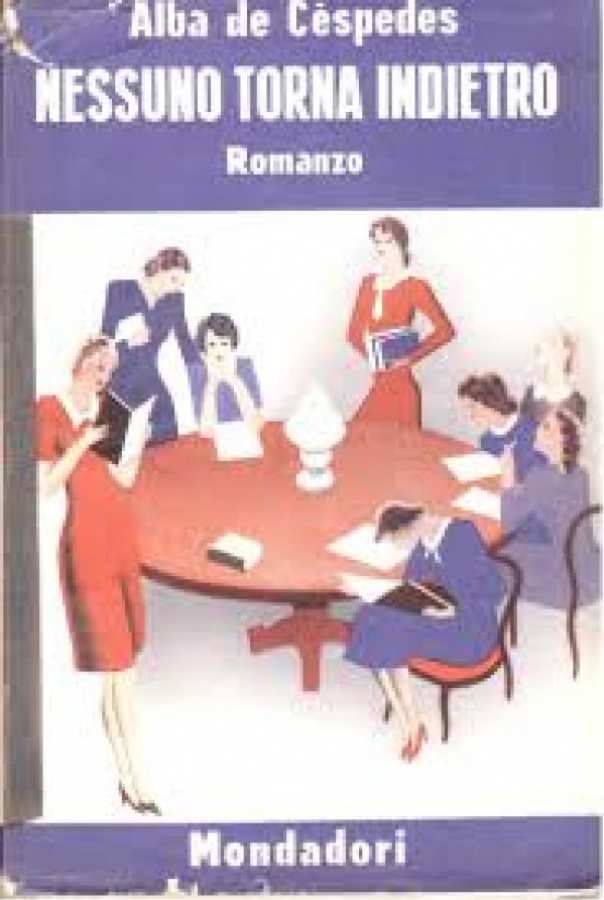
No one turns back
We find ourselves shortly before the Spanish Civil War (1936–1939); a group of young women comes together in a nunsʼ boarding house in Rome. An intimate and intense friendship develops among these young women, despite their different social classes and diverse personal experiences. It is as if the external social structure were momentarily suspended, allowing them all to live with a freedom and sincerity unthinkable out in society. > They went on confiding in one another: at first they seemed to feel a certain shyness about their aspirations, then, little by little, they laid themselves bare, even moving closer, touching each other to communicate better, until Silvia observed: ---still, it is wonderful to talk like this among ourselves, all women: if a man were here, we would never have dared speak (...). We women are sincere only among women. There is a singular solidarity among us. It is a feminine world, conscious of its exceptional condition and nonetheless waiting for what comes next, when they leave the boarding house. > Here we chose one another from among so many, one might say, out of genuine affinity. Yet it is only the continuous, daily familiarity that binds us; as soon as that falls away, an unbridgeable distance opens between us . And yet something will remain. > Who can forget having been mistress of herself? (...) Those who stayed behind, who passed from their motherʼs hands into their husbandʼs hands, do not forgive us for having seen new things, new faces, for having had the key to our room, coming and going at whatever hour we pleased. And men do not forgive us for knowing as much as they do . Disrupting a state so rich in reciprocal humanity (as Confucius would say) is the arrival of Emanuela. > I donʼt understand what she is doing here--Silvia remarked from the bed--she doesnʼt study, did you notice? and one comes here to study . Emanuela is at the boarding house in Rome to be close to her daughter, born of an extramarital affair. The young woman does not intend to reveal her peculiar situation to her friends; she pretends to be like them because she wishes she were—unencumbered, still with all of lifeʼs possibilities before her. > I belong to your group. An oath sworn upon the common table, like the musketeers. Eight for one, one for eight. And now I know everything about them, who with others are so secretive and elusive. And what do they know about me? All lies. The flawless harmony among the young women falters, as if an alien presence, that of Emanuela, were setting fire to the dormant embers of individual destiny. The first to leave is Xenia: she flees the boarding house after failing her degree examination, disappears without a trace, and goes to live in Milan, becoming a cynical woman who uses men for her own gain. > To her, of all pleasures this alone seemed an ineffable delight: to enjoy herself, her own company, her own image . Then Milly dies, gravely ill: «Her companions were right to wonder whether she had ever truly existed». Next comes Anna, the daughter of wealthy landowners, who, as soon as she graduates, marries a peer from her own social class, shelving her studies, friendships, and freedom simply to live on her family estates. > I think, she continued earnestly, that it is a mistake to wish to leave oneʼs own social class and force oneʼs way into another . Vinca also leaves the boarding house—a Spanish woman who fled home to avoid living with her stepmother; she stays with compatriots awaiting news of her fiancé, who went off to fight for Franco in the civil war; her beloved, however, has married another woman there in Córdoba, and Vinca has no choice but to remain in Rome, living modestly by giving Spanish lessons. Then there is Silvia, plain but intelligent, who graduates with honors. > And now, Silvia? Now? Nothing had changed except that 'Dr.' she could place before her name. She would have to do everything on her own . Augusta and Valentina remain, destined for spinsterhood and for this reason bound by a peculiar friendship, shielded by the walls of the boarding house. And it is they, custodians of an utopia of female communion, who finally drive Emanuela out. > Her torso bent forward, her face next to hers, breathless, Augusta spoke to her in a muffled, murky voice: Thief! (...) Not even the other day, when you were in bed, did you speak. (...) Yourself, always before anything else. (...) You must leave now. (...) Tonight, before all of them, I wanted to tell you: Get out! But then I thought that it isnʼt your fault: there are beings who, like you, are born flawed, indifferent . We are in the presence of a great female novel, perhaps the first in Italian literature. The protagonists are women in all their complexity: their feelings, erotic reveries, and aspirations. Men are entirely absent, and when they do appear (one need only think of Xeniaʼs trajectory), they serve merely as instruments for achieving goals conceived by the protagonist in solitude, without the contribution of the opposite sex. The setting is the 1930s, and one can well imagine the revolutionary impact of such a narrative, even within an apparently traditional framework. The young womenʼs paths, once they leave the boarding house, diverge into different yet entirely plausible stories: in some way, they also reflect the diverse facets of the female psyche—a coexistence of ideas, emotions, and desires that the author likely felt within her own consciousness as a young woman with so many potential destinies still ahead of her. None of the protagonists will achieve complete fulfillment; all will, in one way or another, betray the fullness and multiplicity of female nature, resigning themselves to a single path—traditional, transgressive, or vacuous, yet always a single path, necessarily reductive of the complexity of the human soul. Yet how many of us, men or women, abandon the multifaceted richness of youth? Perhaps because, as Silvia remarks, «living events is much easier than imagining them». Regarding the narrative style, there is little to say: the writing is flawless, the diction elegant, the entire literary construction refined. It is a splendid contribution to the Italian language, a demonstration of how one can write in a manner both erudite and lucidly simple. Why read it? A great book of womenʼs literature.
The Makioka Sisters
The setting is Japan across a chronological span that stretches from the years immediately preceding the Second World War up to the outbreak of the conflict. Against a backdrop of unease and mounting economic hardship, a family drama unfolds: the story of four sisters. An ancient family, now in decline, has split into a main branch—which moves to Tokyo and retains the authority over fundamental family decisions—and a secondary branch, residing in Osaka and centered around the protagonist, one of the sisters: Sachiko. This woman assumes responsibility for her two younger sisters: one unable to find a husband due to her shyness and aloofness, and the other, more modern and emancipated, who works as an artist and weaves a web of romantic affairs, including with men of a lower social standing than the family. The novel is an assemblage of small episodes, featuring a narrative arc that appears fragmented, yet builds precisely upon the portrayal of the intimacy of a Japanese household, and the clash between the tradition of customs and values on the one hand and Western modernity on the other. The women wear kimonos, but also Western dress; they attend the theater to watch ancient Japanese performances, yet devour Western books and films. Even the most rebellious girl, one of the younger sisters, who dreams of going to France to study dressmaking, attends a traditional dance school and gains renown by crafting traditional Japanese dolls. The strictures of tradition fail to confine or ossify familial affections. Sachiko’s repeated matchmaking efforts on behalf of one of the younger sisters fall through because she cannot bring herself to thwart her sister’s will and temperament. The scandals provoked by the other sister ultimately meet with Sachiko’s forgiveness and benevolence. The love among the sisters and within the family proves stronger than any rule or imposition. One might assume the context is defined by the war, and that conflict must eventually burst into the novel (much like a sort of *War and Peace*). This is not the case: the war remains perpetually in the background, scarcely mentioned, and what matters above all are the private tribulations, the protagonists' search for serenity and balance. Only the letters from Western friends who have left Japan evoke the approaching military conflict, of which, however, there is not yet full awareness. Perhaps the author wishes to reassure the reader (it should be remembered that it was serialized during the war), or perhaps he offers a subtle critique of familism, of that excessive fixation on individual feelings and personal friendships, which delays an awakening to the reality of unfolding events. It would have been compelling had there been a sequel to the novel, to observe the characters’ conduct during the final phase of the conflict, beneath the bombings. The true fabric of the novel is woven from the customs and values of Japanese society, captured across myriad moments yet epitomized by nature—such as the family’s excursions to view the cherry blossoms. The peace, order, and serenity emanating from the natural world stand in stark contrast both to the complexity of the emotions and events, and to the creeping emergence of the war. The novel unfolds slowly, marked by a pronounced scarcity of plot-driven action, as everything hinges on minute particulars. Ultimately, it feels long-winded, though never dull, and at times repetitive.
All Quiet on the Western Front
The novel, made famous by a film, is a war diary. Set during the First World War, it recounts the story of a group of German twenty-year-olds: “the iron youth,” as their schoolmasters called them. Everything is confused; memories of their previous lives are > mute visions, (...) an immense, disconsolate melancholy. (..) As long as we were in the barracks they awakened in us a wild and rebellious longing. (...) But here in the trenches that world is lost. The memory rises no more; we are dead, and it appears far away on the horizon like a ghost, like an enigmatic reflection that torments us and that we fear and that we love without hope. (...) And even if it were restored to us, this landscape of our youth, we would no longer really know what to do with it . What Paul, the first-person narrator, recounts is a descent into hell; and he does so without rhetoric, victimhood, or self-indulgence. > Our thoughts are like soft clay molded by the shifting fortunes of the days; they are good when we are at peace, dead when we find ourselves under fire. Churned-up ground, within us and without us . The book retraces the various facets of military life amid the great slaughter that was the First World War: the agony of a comrade-in-arms ( > This is Franz Kemmerich, nineteen and a half years old; he does not want to die, Do not let him die! ), whose fine boots are appropriated while he is on his deathbed; the harsh and oppressive discipline of the barracks, the infantryman's petty revenges against the obtuse and malicious non-commissioned officer; the vital importance of rations, the scrounging and stealing to supplement meager food; visits to young prostitutes while dreaming that they are the girls from the propaganda posters; the atmosphere of the field hospital, where limbs are amputated amid the wretches' shrieks, and men can hardly wait for a dying comrade to vacate a bed; leave back home, made grating by having to endure the warmongering speeches of the “bourgeoisie”; friendship, a bond strong enough to make the harshness of a soldier’s life bearable, yet so fragile because companions die so easily; and, finally, the trenches. Anyone expecting an epic tone, a sort of *Iliad*, will be disappointed. The fighting is, in truth, pure butchery: bodies riddled with bullets and pulverized by shells, the death rattles of the wounded with disemboweled bellies, blood and corpses everywhere, even the screams of dying horses; all that matters to the infantryman is survival. > We have become dangerous beasts, we no longer fight, we defend ourselves against annihilation. (...) We rave with rage, we are no longer bound helplessly to the scaffold, we can destroy, kill in our turn, to save ourselves, to save ourselves and to avenge ourselves . The book is an indictment of war, not only because it is absurd and cruel, but because it transforms men, stripping them of their humanity: > this life has reduced us to barely thinking animals, (...) it has kneaded us with insensibility, to make us withstand the horror that would crush us; (...) it has given us the indifference of savages so that we may endure, despite everything, every moment of reality. (...) Thus we lead a closed, hard existence, entirely on the surface . There is no plot in the strict sense; the characters act like people living “empirically,” day by day, devoid of apparent feelings, which would in any case be useless to show. The narrative is sustained by an essential, stripped-down prose made of short, almost frantic sentences capable of driving the story forward at a relentless pace. At times, moments of calm supervene, such as life in the barracks or leave at home (and here the author's stylistic weakness emerges); yet this is momentary: the images of the great slaughter return, evocative of that cruel death which is war; despair overwhelms us, and we realize that life is a wretched semblance. There are only stumps of life: > red poppies on the meadows around our billets, glossy insects on blades of grass, warm evenings in the cool, half-dark rooms, black and mysterious trees in the twilight, stars and the flowing of waters, dreams and long sleep . Why read it? It reminds us of what war truly is.
Nothing is true except the eyes
With this novel as well, Faletti confirms his standing as a fine author of American-style thrillers. An excellent style and a brisk narrative pace that nonetheless leaves room for evocations of the mysteries surrounding life and human relationships. The only flaw lies in the fact that the protagonist sees the scenes through the eyes of one of the murder victims—eyes that were transplanted into her. It is an implausible conceit that introduces a jarring note, one that is, moreover, superfluous to the unfolding of the plot.
Plebeian Nymph
> I have a daughter, fair and coquettish,/an unwed maiden, fresh as a rose;/ever close, since she was a tot,/I’ve held her fast by my skirt. . Thus Nunziata would sing of her little girl, Miluzza, while picking lice from her head. And Miluzza was truly beautiful, and all the men in town > studied the slender ankles of a racehorse, the breasts budding like a posy of flowers, the dark charm of her fourteen-year-old head . What they wanted, Miluzza knew “by prenatal memory,” and also because she had been born and raised in a destitute family of the *bassi*: a crippled, impotent, and cuckolded father; a mother notorious for giving herself to every passing soldier, doing so with joy and passion like Fabrizio De André's *Bocca di Rosa*. Daughter of the neighborhood whore, Miluzza becomes acquainted with sex while still a child: whether with her playmate or the old shopkeeper, or instead the parish priest and the austere schoolmaster. It is not true carnal intercourse, but lascivious explorations of her young vagina; on the other hand, “one doesn’t walk around with such bare legs and without knickers.” It is possible that Miluzza would have met the same fate as her mother Nunziata, a whore tolerated by the small provincial town, had not the death of her parents (and the consequent collapse of the modest tailor's shop on which they lived) and her employment as a factory hand in a local cardboard manufacturer radically altered Miluzza's life. The factory owner becomes infatuated with the girl and shamelessly makes her his mistress. Hoping to conceal the affair and to dazzle Miluzza, he whisks her away to Naples, lodging her in grand hotels and taking her to the finest restaurants. Yet it is precisely the elegant life in the big city that leads Miluzza to realize her condition as a kept woman, as “Sisina, elegant Sisina, (...) and for a lira she does the zuchetuzù,” as an insolent vaudeville performer recites. Listening to him amid the general laughter, > Miluzza gave a cold laugh. (... The Neapolitan world, so unbuttoned, was the opposite of her mood . For her, sex is a natural, melancholy, understated, and delicate affair to be consummated in a discreet setting, among the neighborhood folk, without offending anyone. Indeed, Miluzza risks being engulfed by scandal, forced to shutter herself at home amid general reprobation, or compelled to leave the small town where she has always lived. To save her comes the war, and, like the angel of the Resurrection, a deserting soldier arrives. The happy ending clashes with the overall tone of the tale—precious and effervescent, yet ever steeped in a disconsolate pessimism. The life of the poor is and always will be thus: carving out spaces for survival and simple diversion amidst daily misery and toil. But is such a life truly so sorrowful, or does one instead forge ahead, serene and confident, as part of an exuberant and festive humanity? It is no coincidence that it takes the big city to lay bare the squalor, which previously went unnoticed within one’s own milieu. The writing is the story’s primary merit. Rea forges a new idiom, a blend of Italian and Neapolitan; in doing so, he lends brio and evocative power to the entire narrative, demonstrating as well how one can employ the “language of the speakers” without turning it into a coquettish gimmick or, worse still, a protected species. Why read it? Spirited and captivating.
A noble madness
Igino Ugo Tarchetti lived between 1839 and 1869. He is, therefore, a Risorgimento writer who was sidelined because he advanced a fierce critique of war and a clear recognition of the value of desertion and conscientious objection. The novel, partly autobiographical, relates the trials of Vincenzo D.: > one of those minds that cannot choose between prosperity and conscience, and are ever wretched creatures . The narrative is structured into three parts. The first part concerns the protagonist's childhood and adolescence. Abandoned, he grows up in an orphanage, where he meets Margherita, the great love of his life. It is a bombastic and rhetorical section, dominated by a romantic and spiritualistic view of life and the world. It is an unmitigated exaltation of love and nature, taken as an idyllic realm. A typical dialogue runs as follows: Margherita asks: > Where are we going? To love each other. And what are those fireflies doing? They love each other. And all those stars? They love each other. God, how beautiful the night is! It is love that adorns it . By page 71, the temptation to abandon the book is strong. The second part recounts the military life of Vincenzo D. Just as the two lovers resolve to marry, Vincenzo is called to arms. In pages of great efficacy, the narrative chronicles the individual and social transformation of a person forced to endure military discipline. Anyone who has completed military service cannot fail to recognize themselves in the author's words: > the drills, the march, the measured and mechanical motion, the deafening cadence of the drum, the novelty of the uniform, the harshness of command, and the discipline daze his mind, divert it from serious and sustained reflection, create new needs, new ideas, new semblances. The good have become bad, the bad worse, the worse wicked . Vincenzo's military life takes a turn when he is summoned to fight in the Crimean War. The very casus belli invoked by the author is of such futility that it constitutes in itself a critique of the absurdity of armed conflict: a Russian prince refuses to pay a visit to the Turkish minister and strolls through the streets of Constantinople with "whip in hand." This section of the book features the description of the Battle of the Chernaya: it feels like watching a modern special-effects film and, at once, a battle from the *Iliad*. Mangled bodies, severed heads, blood, and devastation are depicted with such chromatic force that one visualizes them as if in a painting. The narrative reaches its peak impact when nature itself (here no longer benign, but man's adversary) takes part in the battle: > the sea casts back upon the shore the masts, the rigging, the corpses. A gigantic wave, which seems to reabsorb into itself all the other waves of the ocean, draws near slow and majestic to the shore. A long line of shipwrecked men appears atop it, thrashing their chests and arms: they feel the ground beneath their feet, but the wave pressing behind them surges forward, breaks over them, sweeps them away, and drags them back onto the high surface of the sea . Yet Vincenzo manages to survive, having not yet killed anyone, buried as he was beneath a heap of corpses. Upon regaining consciousness, he faces an enemy soldier and, much like in Fabrizio De André's *Canzone di Piero*, he is forced to kill him, only to rush to beg his forgiveness and realize that the slain soldier > was handsome, with a beauty at once virile and gentle; he had blond, ringleted hair, a broad and serene brow . On the verge of death, the soldier asks Vincenzo, "Why did you kill me?" At that point, the protagonist resolves to desert and claim his freedom: > I had thrown down the gauntlet to humanity; I had nothing with me but my conscience: how was I to sustain that struggle? The third part is the descent into madness, rooted in the homicide. By now, the narrative devolves into philosophy and a collection of aphorisms, in some instances nonsensical. A trenchant declaration against war and, above all, against military life clearly emerges, while a pantheistic worldview now prevails. The whole degenerates into a confused political manifesto. The author relies on a narrative framing device (Vincenzo D. recounts to the writer, who in turn recounts to a friend), which, rather than enlivening the reading, contributes to weighing it down, as the tale unfolds entirely in the first person in the form of a narration: a narration that often serves as an occasion for tedious philosophical digressions that drag down the narrative pace. The bombastic, emphatic style, heavily laden with adjectives, frequently makes for a turgid read. Why not read it? It is sufficient to visit a public library and confine oneself to the pages depicting military life and the great Battle of the Chernaya (forty pages in all).
Knot in the gut
The plot of the novel is surreal. Paul, a small-time crook, falls in love with an unusual girl, Jeanne, who introduces him to the high-stakes world of armed robbery, only to betray him with another man. Following the betrayal, Paul begins living in a hallucinatory state, constantly dreaming of a little man with a mustache. During a bank heist, he believes he sees this figure in one of the clerks and, to free himself from the nightmare, kills him. A police pursuit ensues, during which Paul begins a "descent" into the underworld: both physically and spiritually. Paul loses control of his life and lapses into a paranoid state. In this condition, he murders a woman who had taken him into her home and shielded him from the police. The book chronicles the decline of an individual and his transition from a precarious equilibrium to a neurotic and self-destructive condition. In this sense, it stands as the representation of a broader situation, one that could happen to anyone; yet the author develops it in a paradoxical and inexplicable manner, leaving the reader bewildered and disappointed by the superficiality of the narrative.

I had understood nothing
An unsuccessful, penniless lawyer takes part, almost as an onlooker and without realizing it, in a series of events—both romantic and professional—that deeply embroil him. He continues his relationship with his ex-wife; becomes the object of love for a brilliant and beautiful female lawyer; learns, without reacting, that his son falls into «bad company» and is inclined toward homosexuality; becomes the defense counsel for a notorious Camorra criminal; secures a series of courtroom victories, unexpected for him, as a point of contact for the Camorra; and ultimately discovers that he had failed to understand he was merely an instrument in the hands of the judiciary to ensnare his client. The narrator is the lawyer himself, whose surname, Malinconico, aptly encapsulates his personality: an underlying sadness, accompanied nonetheless by a keen self-irony and a philosophy of life that allows him to accept the world as it is. In a conversation with his mistress, the latter reproaches him for not knowing why he does things: > which is absolutely true, even if I don’t find anything strange about it. Since I lack the courage to say so, however, and at the same time have no original ideas at the moment, I fish among the most recent information. No, it’s that I don’t see myself while I’m doing them. How’s that? That I only understand things once I’ve done them . For the author, life is a tumbling sequence of events upon which one cannot intervene, and everyone moves as though being captured by a camera, behaving in a false, inauthentic manner. The Camorra itself is a reality to be accepted for what it is, and of which certain aspects of its code of conduct can even be appreciated: what would be desirable is «a sustainable Camorra». The novel is best appreciated for the author’s digressions—often felicitous and incisive—on contemporary life. As the author himself puts it: > the fact is that I am an incoherent narrator. I am far too interested in the incidental chatter that takes you somewhere else. When I tell a story, I’m like someone searching for a bill in the receipt drawer. First I grope around a bit, just to get a feel for the organic material, then I fish at random, hoping to hit the mark . Yet the plot is flimsy, devoid of any genuine narrative momentum, reliant as it is more on sketches—invariably incomplete—than on any minimally cohesive storytelling structure. The pervasive fragmentation, the narcissistic vacuity of the situations, and the implausibility of both behaviors and settings (for instance, the premises where the lawyer maintains his office, or the curious benevolence shown toward him by the Camorra) are not sufficiently redeemed by the style, undeniably elegant and nimble, nor by the ironic lightness of the prose. In the end, the novel proves tedious, insubstantial, and grating in its excessively superficial and resigned treatment of the Camorra. It is a novel that mirrors our Italy: resigned, withdrawn into the private sphere of friendships and family, ready to seize opportunities just as they come along.
Don't Call It Night
"Over everything lies a feeble, faded, sorrowful smile." This line by Ezra Zussman "in a poem about autumn evenings" encapsulates the meaning of this book: dense, gray, and seemingly mundane. Theo and Noa share an ordinary coexistence, made of small habits, silences, and fleeting moments of love. Both have led solitary, difficult lives. Having met by chance, they took refuge, in search of a fragile serenity, in a small town in the Israeli desert, where it seemed that > the pale boulders, the slope, the heights to the east, even the harsh glint of the stars, everything was waiting for a change. Imminent, in just a moment, when everything will be clear . Shattering their dreary everyday existence comes the overdose death of one of Noa's students, and the boy's father's wish to entrust her with establishing a drug rehabilitation center. Noa throws herself into the project with enthusiasm: she finally finds a purpose in life and, above all, asserts her independence from Theo, who is older and more experienced than she is. She is also driven by remorse for having failed to grasp the pleas for help the boy had somehow sent her. The town is suspicious and hostile toward the project. Theo would like to warn her, but he realizes that > the only way to help her is not to try to help her... Am I lying in wait, motionless, staring at her in the dark with petrified eyes, waiting for her to collapse from exhaustion? Then I will be able to bend down and take care of her as in the beginning. From the very beginning. There is a protective, almost paternal feeling in Theo, which nonetheless encloses Noa in a sort of chrysalis from which she cannot escape: she is too fragile, too strong is the need to feel protected and to run and nestle > into the dark cave of the chest hair (of Theo) as though he had been pregnant with me . And, > like water slowly flowing across the inside of eyelids shut from exhaustion , the project dissolves into nothingness. Noa herself grows weary of pursuing it, and everything slips back into prosaic daily life, into > a quiet, blissful dream, far from ourselves, far from pain and suffering, intent on listening to the gusts of the south wind that blows and stops and once again stirs the branches of the crippled pines in the garden of the ruin, and from there sweeps onward engulfing the entire town, reaching to feel from the outside the shutters we have closed.... in two and a half weeks the summer holidays will end . It is not the plot that stands at the heart of the narrative, which plays out entirely around the existential world of the characters. The author, however, has no psychological intent; rather, the emotions remain merely sketched, lightly rendered, and therefore mysterious. Even the literary device of dual narration (Theo and Noa are the narrators of the same events) does not lead to an interpretation of the story from two distinct points of view. Far from it: each chapter seems an end in itself, so much so that the reader scarcely realizes they are reading the same story seen from different angles. The true theme is existential, cosmic, and philosophical. The true protagonist is the desert, always identical to itself and always changing, swept by a fierce wind and characterized by an arid environment where vegetation barely manages to take root. The town itself consists of vast empty spaces, like "strips of desert," a botched concept of a garden city > flecked with scrap metal and a few shrubs that have crossed the boundary line between plant and mineral . The distinctive feature of the novel lies in its attention to the urbanistic dimension of human existence. We often forget that the streets, the architecture of buildings, the monuments, the green spaces, and the environment beyond the urban perimeter (where the forces of nature reclaim dominion) shape our existence, imparting to us the character of who we are. Thus, the sudden arrival of change (a drug rehabilitation center, turning into the periphery of a major city, and so on) not only dissolves a fragile urban fabric, but also overpowers and distorts our very essence. And it is not by locking ourselves within the "quiet normalcy" of the home that we can defend against social decay and existential atomization, which also stem from the collapse of meaning in the context in which we live. The core merit of the novel is its writing: both spare and poetic at once. Short sentences paired with expansive periods, punctuation that is at times redundant and at others non-existent, and a sparing, deliberate use of adjectives all contribute crucially to forging a dense narrative climate—exacting yet captivating—where gray and muted tones prevail: an atmosphere of sweet melancholy. Why read it? Though set in Israel, it is a novel that mirrors remarkably well the state of mind of Italians at this moment.
Don't Move
The book’s plot appears intriguing: prompted by his daughter’s accident, the protagonist recounts (to whom?) his extramarital affair with a woman. She is someone entirely outside his social milieu, not beautiful, yet a woman with whom he has fallen in love for reasons he himself cannot fathom. Yet the struggle to abandon his own world and the birth of his daughter ultimately lead the protagonist to desert this woman, who is expecting a child. Feeling betrayed, the woman undergoes a clandestine abortion and dies. The central thread rests on the transition from an attraction that is fundamentally sensual and transgressive to a deeper affection (yet is it sincere?) that manifests only in a desperate attempt to save her. Indeed, at the outset the protagonist wonders whether “the body can love what the mind despises,” yet fails to arrive at an answer: this failure lies at the very root of the tragedy. Thus, while the premise is compelling, it is undermined by a verbose, inessential style and an overt striving for effect; furthermore, several episodes prove overlong, redundant, and tedious.

Norwegian Wood
Eighteen years have passed. The writer recalls a great love—his love for Naoko. The novel is both a search for her memory and a journey of liberation from someone who dominated his life. Naoko’s figure has vanished from memory, but gradually her features resurface: > her cold little hands, that lovely straight hair so light to the touch, the soft, rounded earlobes with a small mole beneath... the voice that would sometimes tremble for some reason (it was as if she were speaking on a hill swept by a powerful wind) . This is the opening of the novel, and right from the outset the delicacy of the style is apparent—impalpable and endowed with remarkable symbolic resonance: a narrative approach that mirrors closely the fragility and sensitivity of the protagonist: Watanabe. Watanabe, Naoko, and her boyfriend, Kizuki, are three close friends. Yet Kizuki takes his own life, and the relationship is momentarily severed. Watanabe moves to Tokyo to study and lives in a dormitory, leading a solitary existence with few friends and a deep passion for literature. One day, he encounters Naoko once more and love is rekindled: the two embark on long walks, in silence, Naoko ahead and Watanabe behind, > looking at her back and her straight, black hair, held back by a large brown clip so that whenever she turned to one side, it offered a glimpse of her small white ear . Meanwhile, Watanabe meets Midori, a girl vibrant with life yet also burdened by death, having lost her mother and now tending to her dying father. With Midori, too, Watanabe develops a relationship founded primarily on his availability and willingness to listen: a bond perpetually poised between friendship, sexual attraction, and love. Naoko disappears, only for him to learn that she has been admitted to a sanatorium for psychiatric care. Watanabe spends several days at this mountain retreat, where he reconnects with Naoko and feels a profound love for her take root. Watanabe lives “in a swamp,” caught between his deep friendship for Midori and his idealized love for Naoko: the young man exists as if in a no-man's-land, always available to others but never capable of living his own life to the full. Naoko’s suicide plunges him into despair, from which he emerges only when he realizes he must also live for himself. The pivotal scene marking this passage from availability to self-awareness, from adolescence to adulthood, is his encounter with a fisherman who, in an effort to comfort him, recounts the death of his own mother: > what is he even talking about? I thought. And suddenly I was seized by a senseless rage, wanting to wrap my hands around his neck and strangle him. I have lost Naoko! That marvelous body of hers no longer exists, and you come telling me about your mother! The novel can be read as a coming-of-age story: a young man becomes an adult through suffering. In truth, there are two other crucial dimensions: the theme of death, which, as the author observes, is an integral part of life yet can only be overcome through grieving; and the themes of literature and music as companions along life’s way. Death—Kizuki's suicide—hangs heavy over the narrative, a shadow from which the protagonists cannot break free: it is a painful past that can only be navigated through suffering. It is hardly a coincidence that in the first part of the novel Watanabe reads, and rereads, *The Great Gatsby*, drawn to a heroic and solitary figure, whereas in the second part, when Watanabe must grapple with death and suffering, his reading of choice is *The Magic Mountain*—the tale of a man awaiting death as a fateful destiny. Why read it? The delicacy of the style, the beauty of the characters—most notably the protagonist—and the existential themes explored are all compelling reasons to read it. It is a book to be read with immense pleasure.

The Night of the Comet
In the *Tuttolibri* supplement of *La Stampa* of January 18, 2021, Donatella Di Cesare reviews Giorgio Agamben's book *La Follia di Hölderlin*: a volume recounting the events that led the great poet to shut himself away in an asylum, from 1802 to 1846. Was it true madness or, as Schelling suspected, had his friend "assumed the outward manners of one who is mad"? Hölderlin was > torn, in an existential condition that seemed to push him outside and beyond his era . Sebastiano Vassalli seeks to answer the same question, retracing the life of Dino Campana through a biography that is both documented and fictionalized, as the writer himself describes it; in doing so, he dismantles the cliché that Campana's poetry stemmed from madness. Just as it is difficult to believe that Hölderlin, out of his mind, could have translated Sophocles into German, so we wonder whether a madman could have created an absolute masterpiece like *Genova* (from *Canti Orfici*): > Since the cloud came to rest in the skies/Far over the silent infinite/Seashore enclosed in distant veils,/And the departed soul returned/For all around it was arcane-/ly illuminated the garden's green/dream in the superhuman apparition/Of its flashing proud statues: Let us stop here, because one would be tempted to speak only of this poem, rather than of Campana's mournful life. Born in 1885 in Marradi. > Stocky, blondish, of medium height, (...) He had copper-blond hair, thick and curly, framing a face glowing with health: two small moustaches that stopped at the corners of his lips, and a thrifty goatee that did not stray too far from his chin Thus a friend describes him in 1912, when the young Campana, already deemed mad by his family and by the whole of Marradi, had been cast out several times: first by locking him up in the asylum of Imola, then shipped off to Argentina with a one-way ticket, later, upon his return, sent to the Florence asylum, and subsequently led to live in modest boarding houses across the Tuscan-Romagnolo Apennines. In 1914, Campana published *Canti Orfici* at his own expense, which brought him his first taste of renown and opened the arms of Sibilla Aleramo, with whom he would have a stormy love affair. Finally, in 1918, diagnosed with syphilitic dementia, he was committed to an asylum, where he died in 1932. Vassalli retraces Campana's human ordeal with the same passion and documentary commitment found in one of his masterpieces, *La Chimera*. The protagonist, a young woman exposed to village gossip because she was free and beautiful, was guilty of making love to a "wayfarer," at night under an old oak tree believed to be the devil's abode: for this, she was burned at the stake as a witch (see the review on this site). In *3012* > , also reviewed on this site, a young slacker from Fellinia wants to bring war back into a terrifying world where peace is imposed through repression: he preaches chivalric war and is killed by the guardians of peace, becoming the Prophet. Both were persecuted because they were "out of step," free yet fragile spirits. Thus was Dino Campana. The author writes: "I was looking for madmen: I found madmen. (...) Each madman told me his story. (...) Most of them were people who caused trouble. (...) People who had to be gotten rid of by sending them to America or Australia, or by interning them in an asylum. (...) By day, I lived among the mad; by night, in the hotel, I kept dreaming their stories." For them, "the asylum is a great sounding board/and delirium becomes an echo/anonymity a measure,/the asylum is Mount Sinai,/accursed, upon which you receive/the tablets of a law/unknown to men." (Alda Merini from *La Terra Santa*). And so, nothing remains for the alleged madmen but to sing with Campana: "I know not if among rocks your pale/Face appeared to me, or smile/Of unknown distances/(...) And still through tender distant skies clear running shadows/And still I call you I call you Chimera." (*La Chimera* from *Canti Orfici*). *La notte della cometa* dates from 1984; at the time it sparked controversy: some accused the author of inaccuracies if not outright falsehoods, accusations that stemmed from the disinformation generated by Campana's first biographer (suffice it to recall that as late as 1993, Alberto Asor Rosa, in his preface to *Canti Orfici*, still repeated the far-fetched tale of the poet landing in Odessa on his return from America and then walking to Antwerp, where he had in fact disembarked from the ship *Odessa*); others, such as Edoardo Sanguineti, read Vassalli's reconstruction superciliously, especially where the author sheds light on the relationship between Campana and Soffici (Sanguineti, in his anthology of twentieth-century Italian poetry, groups Campana among the "Vociani," even though Dino despised the journal *La Voce*); still others took offense and sued the writer, such as the municipality of Marradi, because Vassalli had exposed the rancor and malice of the Marradesi toward their great fellow citizen. These are all dated controversies, which flatten Dino Campana's unique and marvelous poetics down to his wretched life. The real question to ask today is another: where does Campana's poetry originate, who were his masters, how did he arrive, while still so young, at compositions so unusual and extraordinary for our literature? Perhaps Asor Rosa is right that > there is nothing left today but to reread him as an isolated and somewhat mysterious fruit of our deepest Italian viscera (Alberto Asor Rosa, preface to *Canti Orfici*, ed. L'Unità 1993); that is, somewhat like Grazia Deledda's *Canne al vento* (see review on this site). Is this sufficient, or is it time to investigate Dino Campana's poetry more deeply? With all due admiration for Sebastiano Vassalli, one must acknowledge the shortcomings of this fictionalized biography: fragmentary and at times muddled, repetitive and verbose, it strives for literary effect at the expense of the overall vision, and it neglects the poet's literary and intellectual formation by reducing it to a sort of solitary quest, thereby paradoxically endorsing the cliché of the "eccentric" poet: not mad, but odd. Why read it? It is a book that sheds light on Campana's life, and also on what the asylum truly was.
The Novellas
The book collects the short stories of Giovanni Verga, written between 1874 and 1894. The author feels the need for retreat from the intense social life of Milan, longing to “see again” his Sicily, > the immense hearth of the Pino farmstead, on the slopes of Mount Etna . From the urge to return to his roots stems the first story, which encompasses all the major themes of Verga’s fiction. Nedda, “la varanisa,” is a wretched girl; her fate is already sealed from birth: > the liveliest imagination could never have conceived that those hands, bound to the harsh toil of every single day, scraping through the frost, or the scorching earth, or the brambles and crevices, that those feet, accustomed to walking barefoot in the snow and upon sun-baked rocks, tearing against thorns or hardening upon stones, could ever have been beautiful; (...) poverty had crushed her from childhood with all the hardships that deform and harden body, soul, and intellect—so it had been for her mother, so for her grandmother, so it would be for her daughter . How distant from this immutable, cruel reality is the gaze of the privileged, who “carelessly” contemplates the enchanting Sicilian landscape and listens > with singular interest to the talk of those folk placed so far below at the foot of his towers .( *Le storie del Castello di Trezza* in the collection *Primavera ed altri racconti*). From this contradiction between the world of the humble and that of the privileged, between the romantic vision of nature and the harsh severity of the environment, originates Verga’s project, articulated clearly at the opening of the collection entitled *Vita dei Campi*: > I tried to decipher the modest, obscure drama that must have overwhelmed the plebeian actors we met together. A drama (...) whose crux must lie in this—that whenever one of those little folk, either weaker, or more reckless, or more selfish than the others, sought to detach himself from the group out of a vague longing for the unknown, or a craving for something better, or curiosity to see the world, the world, voracious fish that it is, swallowed him up, and his kith and kin along with him . It is striking that the author titled this sort of manifesto *Fantasticheria*, almost as if to imply that he himself did not believe in it completely. And indeed, as we venture into the many stories, we realize how they lose their narrative power whenever they move away from Sicily. The author is aware of this as well. In the closing story of *Novelle Rusticane*, under the emblematic title “Di là dal mare,” Verga recounts the departure of two lovers from the island and, > when the sweet sorrow of those memories assailed him, he would look back upon the humble actors of those humble dramas with a vague, unwitting longing for peace and oblivion . It is a watershed: on this side lie the collections *Vita dei Campi* and *Novelle Rusticane*, which radiate a pessimism that is undeniably deep yet transformed into social protest by the author’s profound involvement with his stories and characters; on the other lies a series of collections (*Per le Vie*, *Vagabondaggio*, *I ricordi del capitano dʼArce*, *Don Candeloro e C*), in which the depiction of the humble loses its vitality, deteriorating into pietism, commiseration, resignation, and defeat. The finest stories are those of *Vita dei Campi*. The characters are exceptional, deviating from the norm: Jeli, Turdiddu, Gramigna, La Lupa, Rosso Malpelo, place themselves > among so many madmen who had their brains in their heels, and did the exact opposite of what a Christian usually does when he wants to eat his bread in holy peace . (Verga in the first draft, later discarded, of *Pentolaccia*, quoted in the introduction by Carla Riccardi, p. XIII). Take the story of Jeli. It opens with the recollection of the childhood friendship between the naive horse herder and Alfonso, the master’s son. Between the two boys there are no differences of class or culture: together they revel in the wonders of a primordial nature. Yet, as he grows up, Jeli suffers the collision with reality, consistently tragic in a swift crescendo, culminating in the betrayal of the highest value: friendship. For it is Alfonso who takes his wife as a mistress. > His wife leaves him to rot outside the door, the neighbors said, while the thrush is in the house! But Jeli knew nothing, cuckold that he was. When, however, he sees that Alfonso, > with his fine curly beard, velvet jacket, and the gold chain across his waistcoat, took Mara (his wife) by the hand to dance, only then, as he saw him touch her, did he leap at him, and slit his throat in a single stroke, just like a kid goat . The blind, sudden violence of the humble man who has endured too much is often the denouement of these stories. It is so as well in the renowned story “La Lupa.” > She was tall, thin; she had only the firm, vigorous bosom of a brunette, though she was no longer young; she was pale as if she had malaria perpetually upon her, and against that pallor two eyes as big as this, and lips fresh and red, that devoured you . She is not a woman who submits; will and sensuality make her a master. To possess the man she loves, she gives him her daughter in marriage, in order to bed him under the same roof, defying all propriety. Then the man, to rid himself of her, > ceased hoeing the vineyard, and went to unhook the axe from the elm. La Lupa saw him coming, pale and wild-eyed, the axe gleaming in the sun, and she did not retreat a single step, did not cast down her eyes, but kept walking toward him, her hands full of bunches of red poppies, devouring him with her black eyes . It is an extraordinary, striking image that leaves the narrative unresolved: did the man kill her, or did he throw himself once more into the arms of the Wolf? In *Novelle Rusticane*, the storytelling hardens. The characters of *Il Reverendo*, *Cosʼè il Re*, *Don Lucciu Papa*, *Malaria*, *Libertà*, are nothing other than the embodiment of the laws governing Sicilian society. Ultimately, life is like that of Saint Joseph’s donkey in the eponymous story: rebellion is futile, and animals are not necessarily worse off than many human beings. The inescapable destiny of all the humble: > I’m only buying the firewood, because this is all the donkey is worth! And he kicked the carcass, which sounded like a burst drum . The stylistic and narrative quality of the stories is uneven, since > the trajectory of Verga the short-story writer can be defined as a series of stages leading toward the novels (Riccardi’s Introduction, p. XXIV). In the short stories, Verga hides less behind verismo, behind the apparent detachment from characters and situations: the novellas are a kind of workshop in which the author works > in multiple directions and simultaneously across several fronts, including theater (Riccardi’s introduction, p. XXV), yet he reaches his finest expression precisely where his engagement is most evident—his bond with his land and the implicit protest against the inhumane conditions of the Southern people. From this perspective, the stories, particularly those of *Vita nei Campi*, have an independent life compared to the novels and are often masterpieces. Why read it? *Nedda*, *Vita dei Campi*, and *Novelle Rusticane* are magnificent stories that offer a realistic, compelling vision of our South.

The New Life
The novel’s protagonist is the book: a book, but also all books. > The culprit is not only that book, the book that deceived my son, but all books pouring from the printing presses; they are all enemies of our time, of our lives . Thus spoke Mehmet’s father menacingly—Mehmet being one of the novel’s central figures, the first to read the book and flee. The other two protagonists are Osman, a young student who falls in love with Canan, Mehmet’s girlfriend. It is she who leads Osman to read the book, and the two youths embark on a dizzying journey across Turkey, ostensibly in search of Mehmet, though they are in fact driven by a restlessness, an existential malaise ignited by the reading of the book: > passengers of night buses, wretched brothers, I know that you too seek that weightless moment. You want to be neither there nor here, to become other and wander in the pleasant garden that lies between the two worlds . Yet what are these two worlds? Current life and the new life, or the quest for the angel: death. The novel unfolds as a succession of bus journeys, fatal crashes, blaring television sets, travelers, and surreal landscapes. The search for Mehmet ends with Osman killing him, hoping to rid himself of his romantic rival; yet at this juncture the quest remains unfinished, for Osman has failed to attain any inner equilibrium. He resumes his travels, fully aware that the true threshold into a new life is death. > The angel appears at that magical moment of departure, and only then do we perceive the true meaning of the confusion we call life. Only then can we return home . And Osman indeed dies in a traffic accident, just like those he had witnessed during his bus journeys. What is the true meaning of this novel? First and foremost, reading a book represents a rupture in human equilibrium: > a good book is a piece of writing in which things that do not exist are explained, a kind of absence, a kind of death. Yet it is futile to search outside the book for the country that lies beyond words . Thus the book constitutes an alternative reality to actual existence: other worlds nourished by text and imagination. Their impact, however, is disruptive to human existence, exposing and laying bare the one-dimensionality of life. Another central theme is travel, perpetual motion, which serves as the sole point of stability for both the novel and its protagonist. When Osman realizes that Mehmet, too, had set out from the book and > after searches, journeys, and adventures in which he had encountered death, love, and misfortune, had attained what I had failed to attain: inner peace , he decides to kill him, seized by envy and resentment. The third theme is undoubtedly death, the much-sought angel: the journey, like life itself, inevitably culminates in death, with > my eyes dazzled and filled with dread, just as I had once gazed upon the incredible light spurting from the book, I would pass immediately into a new life . The new life, so desperately sought, is death. It is a cryptic novel, whose true meaning remains elusive. Each reader can draw their own interpretation: one tied to the social context suspended between modernity and tradition, an unhappy love story, or the notion of conspiracy as the engine of history. I prefer to believe that the book speaks of life’s multiple dimensions, of that relentless quest for a new life that perpetually animates humanity. The author also evokes Dante’s *Vita Nuova*, rebirth, the revelation of a more authentic spirituality.
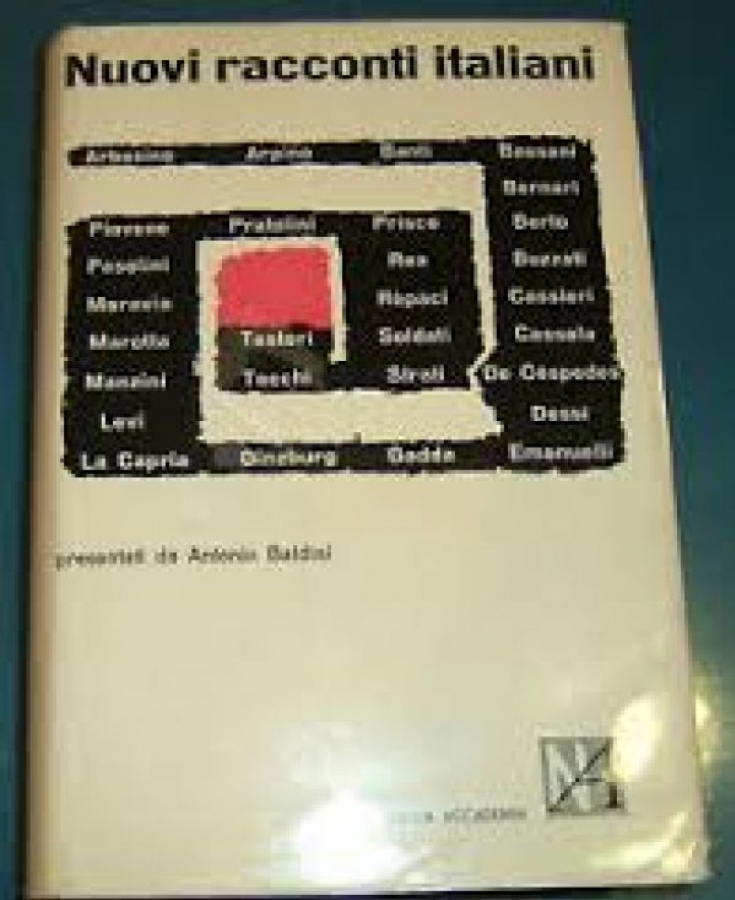
New Italian Short Stories
The book brings together 29 short stories, an anthology that includes famous writers such as Bassani, Buzzati, Gadda, Moravia, Pasolini, Pratolini, Cassola, and others; but also lesser-known authors, nonetheless representative of our country's literature. It is impossible to account for every story—many, in fact, not particularly successful—so I shall dwell only on a few. They share a common trait: they speak of the material living conditions of 1950s Italy, through an approach poised between truth and poetry, between social design and personal histories. Carlo Bernari is a forgotten writer today, yet in 1929 he penned a novel (*Tre operai*) that offered a realistic portrait of the working-class condition under Fascism, and which for this reason circulated semi-clandestinely. In his long story, *Il crumiro*, Bernari tells us of Peppino, a resourceful Neapolitan: in post-war Bari, he manages to find work as a factory handyman, build himself a house—unauthorized, naturally—hook into the electricity and water supplies, on the sly as always, and raise a family. > The Neapolitan way, his workmates would tease him, when in the morning they discovered the mended tap, the new steam intake, a stool fashioned from an old packing crate (...). Not exactly by the book, but haphazardly—yes, the Neapolitan way—yet it was done all the same . And if it is true that everything (the house, the job, and the numerous brood) comes with its drawbacks ( > but really, inside they hear us, outside they see us, will you tell me what kind of love this is? ) Peppino feels he has achieved many milestones, modest to today's eyes, yet significant in the Italy of that era. When, following a rain that had been pouring down for days, > the drains blocked, a muddy, greenish water surged back up from underground (...) reaching the furthest courtyard, where Peppino lived: and there it stagnated and destroyed the house of Peppino and his family, annihilating his dreams. Alongside Rea, Prisco, Ortese, and others, Raffaele La Capria belongs to that Neapolitan narrative vein tracing back to Matilde Serao. In this short story (*Ninì prende il largo*), La Capria speaks of freedom, and does so through the Posillipo sea. Ninì is a «scugnizzo». His bony, sun-blackened back, flecked with salt, one with the rock, was already beginning to scorch under the sun (...) But Ninì's attention was fixed on the transparent little hollow, among those four stones on the bottom, which if you picked them up and brought them to the surface were stones like any other, (...) yet when you saw them under half a meter of water so clear, they were full of adventures«. He is fishing for rock goby (a rockfish that »even the cat turns its nose up at > ), when a friend shouts for him to get into the boat. And there he is, rowing towards the tip of Posillipo, calling out to the girls to come to the balconies, playing the swaggerer to those on the rocks: and he wiggled his little backside on the prow of the boat, drumming with his heels against the sides, as if to spur it on. (...) Now, as the boat pressed forward, the horizon line shifted further and further away, behind the Cape of Posillipo, and the promontory receded further into the coast, and before Ninì's eyes the perfect circle of the gulf opened up, revealing glimpses of other distances. (...) Thinking back on it now, the transparent hollow beneath the rocks of Palazzo Donn'Anna seemed to Ninì no larger than a washtub > . Bonaventura Tecchi won the Premio Bancarella in 1960 with the novel *Gli egoisti*«. In *La ragazza della filanda*, the protagonist is a mill worker »big and bony, almost like a man > , (...) retaining beneath that masculine frame a curious innocence, partly timid and partly simple-minded . She has not yet known sex, and laughs when her workmates tell her that love > is a taste, pretty much like the one you get from eating delicious treats . > It seemed that her very body, so square and strong, was a suit of armor, inside which love could never have entered through malice, perhaps only through violence . And so it happens: a man, simply because he «had her close at hand», courts her, convinces her to let him take her home, and when he realizes that > she truly had never been touched by love, he felt almost a sense of resentment, (...) and when the swift, violent pleasure arrived, and the immense satisfaction, his male pride, even then there remained (...) the desire to humiliate her . And she, dumped after a few days, walks > away alone down the lane, those bony shoulders shuddering under the little shawl, yet without crying. Giovanni Testori is known as a playwright, but he wrote numerous short stories and novels. The short story *Guardati intorno ed impara* is enigmatic, so much so that its overall meaning remains unclear until the very end. A young woman flees from a house, stumbles, leans against a wall, attempts to reconnect with life: she realizes > that she has nothing left to do but hide herself, not only from people but from things as well . This is the opening of a story: as it slowly unfolds, we understand that the young woman has killed a man, not because she truly wanted to, but because of a familial mechanism. Sister, brother, and mother are bound to one another by a knot that > in its elemental nature was almost tragic: bonds withheld from any sentimental expression, yet manifesting in all their force whenever the family's life passed through some difficult situation. Then a word, a question, or a mere reference was enough for the three to find themselves constrained and almost damned to a single destiny. (...) It would have been necessary to destroy, by dint of being all-powerful, every human remnant. The stories of Peppino, Ninì, the mill worker, and the young woman are paradigmatic of a society and an existential condition. Hustling, often in vain; yearning for freedom, even for a fleeting moment; settling for any kind of love; letting oneself be ensnared by familial mechanisms—these are the defining traits of an Italy on the verge of change, yet where resignation still prevails. Despite the prevailing pessimism, the four stories exhibit narrative power and innovation: the authors construct elegant and compelling plots, significant and substantial characters; they have something to say, and they do so in a prose that is cultured, yet already contemporary. Spoken language is making its way into the written word and will later do so with overwhelming force; for now, it serves to prevent the stories from cutting "the tedious and wretched figure of the antiquated (Antonio Baldini in the introduction). Why not read it? They are four fine stories, but they are not worth the chore of reading more than five hundred pages..