Giovanni Verga
Books by this author (3)
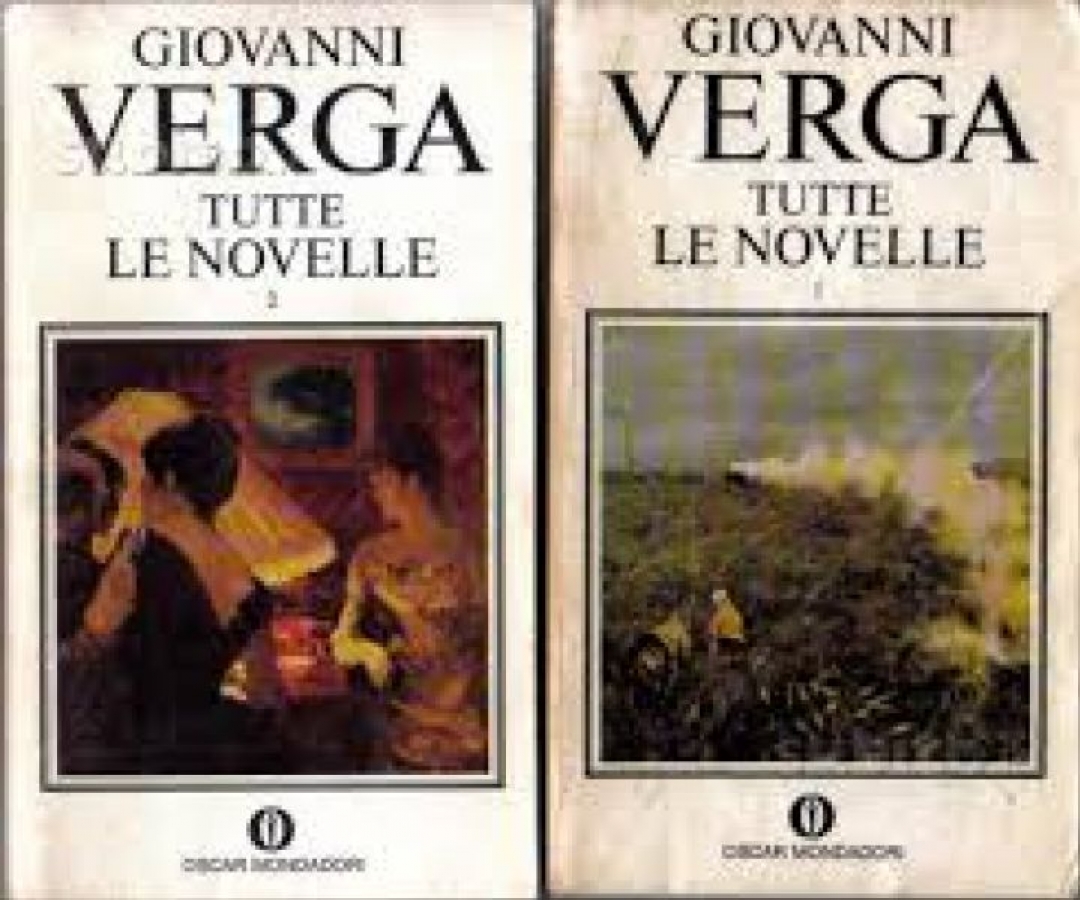
The Novellas
The book collects the short stories of Giovanni Verga, written between 1874 and 1894. The author feels the need for retreat from the intense social life of Milan, longing to “see again” his Sicily, > the immense hearth of the Pino farmstead, on the slopes of Mount Etna . From the urge to return to his roots stems the first story, which encompasses all the major themes of Verga’s fiction. Nedda, “la varanisa,” is a wretched girl; her fate is already sealed from birth: > the liveliest imagination could never have conceived that those hands, bound to the harsh toil of every single day, scraping through the frost, or the scorching earth, or the brambles and crevices, that those feet, accustomed to walking barefoot in the snow and upon sun-baked rocks, tearing against thorns or hardening upon stones, could ever have been beautiful; (...) poverty had crushed her from childhood with all the hardships that deform and harden body, soul, and intellect—so it had been for her mother, so for her grandmother, so it would be for her daughter . How distant from this immutable, cruel reality is the gaze of the privileged, who “carelessly” contemplates the enchanting Sicilian landscape and listens > with singular interest to the talk of those folk placed so far below at the foot of his towers .( *Le storie del Castello di Trezza* in the collection *Primavera ed altri racconti*). From this contradiction between the world of the humble and that of the privileged, between the romantic vision of nature and the harsh severity of the environment, originates Verga’s project, articulated clearly at the opening of the collection entitled *Vita dei Campi*: > I tried to decipher the modest, obscure drama that must have overwhelmed the plebeian actors we met together. A drama (...) whose crux must lie in this—that whenever one of those little folk, either weaker, or more reckless, or more selfish than the others, sought to detach himself from the group out of a vague longing for the unknown, or a craving for something better, or curiosity to see the world, the world, voracious fish that it is, swallowed him up, and his kith and kin along with him . It is striking that the author titled this sort of manifesto *Fantasticheria*, almost as if to imply that he himself did not believe in it completely. And indeed, as we venture into the many stories, we realize how they lose their narrative power whenever they move away from Sicily. The author is aware of this as well. In the closing story of *Novelle Rusticane*, under the emblematic title “Di là dal mare,” Verga recounts the departure of two lovers from the island and, > when the sweet sorrow of those memories assailed him, he would look back upon the humble actors of those humble dramas with a vague, unwitting longing for peace and oblivion . It is a watershed: on this side lie the collections *Vita dei Campi* and *Novelle Rusticane*, which radiate a pessimism that is undeniably deep yet transformed into social protest by the author’s profound involvement with his stories and characters; on the other lies a series of collections (*Per le Vie*, *Vagabondaggio*, *I ricordi del capitano dʼArce*, *Don Candeloro e C*), in which the depiction of the humble loses its vitality, deteriorating into pietism, commiseration, resignation, and defeat. The finest stories are those of *Vita dei Campi*. The characters are exceptional, deviating from the norm: Jeli, Turdiddu, Gramigna, La Lupa, Rosso Malpelo, place themselves > among so many madmen who had their brains in their heels, and did the exact opposite of what a Christian usually does when he wants to eat his bread in holy peace . (Verga in the first draft, later discarded, of *Pentolaccia*, quoted in the introduction by Carla Riccardi, p. XIII). Take the story of Jeli. It opens with the recollection of the childhood friendship between the naive horse herder and Alfonso, the master’s son. Between the two boys there are no differences of class or culture: together they revel in the wonders of a primordial nature. Yet, as he grows up, Jeli suffers the collision with reality, consistently tragic in a swift crescendo, culminating in the betrayal of the highest value: friendship. For it is Alfonso who takes his wife as a mistress. > His wife leaves him to rot outside the door, the neighbors said, while the thrush is in the house! But Jeli knew nothing, cuckold that he was. When, however, he sees that Alfonso, > with his fine curly beard, velvet jacket, and the gold chain across his waistcoat, took Mara (his wife) by the hand to dance, only then, as he saw him touch her, did he leap at him, and slit his throat in a single stroke, just like a kid goat . The blind, sudden violence of the humble man who has endured too much is often the denouement of these stories. It is so as well in the renowned story “La Lupa.” > She was tall, thin; she had only the firm, vigorous bosom of a brunette, though she was no longer young; she was pale as if she had malaria perpetually upon her, and against that pallor two eyes as big as this, and lips fresh and red, that devoured you . She is not a woman who submits; will and sensuality make her a master. To possess the man she loves, she gives him her daughter in marriage, in order to bed him under the same roof, defying all propriety. Then the man, to rid himself of her, > ceased hoeing the vineyard, and went to unhook the axe from the elm. La Lupa saw him coming, pale and wild-eyed, the axe gleaming in the sun, and she did not retreat a single step, did not cast down her eyes, but kept walking toward him, her hands full of bunches of red poppies, devouring him with her black eyes . It is an extraordinary, striking image that leaves the narrative unresolved: did the man kill her, or did he throw himself once more into the arms of the Wolf? In *Novelle Rusticane*, the storytelling hardens. The characters of *Il Reverendo*, *Cosʼè il Re*, *Don Lucciu Papa*, *Malaria*, *Libertà*, are nothing other than the embodiment of the laws governing Sicilian society. Ultimately, life is like that of Saint Joseph’s donkey in the eponymous story: rebellion is futile, and animals are not necessarily worse off than many human beings. The inescapable destiny of all the humble: > I’m only buying the firewood, because this is all the donkey is worth! And he kicked the carcass, which sounded like a burst drum . The stylistic and narrative quality of the stories is uneven, since > the trajectory of Verga the short-story writer can be defined as a series of stages leading toward the novels (Riccardi’s Introduction, p. XXIV). In the short stories, Verga hides less behind verismo, behind the apparent detachment from characters and situations: the novellas are a kind of workshop in which the author works > in multiple directions and simultaneously across several fronts, including theater (Riccardi’s introduction, p. XXV), yet he reaches his finest expression precisely where his engagement is most evident—his bond with his land and the implicit protest against the inhumane conditions of the Southern people. From this perspective, the stories, particularly those of *Vita nei Campi*, have an independent life compared to the novels and are often masterpieces. Why read it? *Nedda*, *Vita dei Campi*, and *Novelle Rusticane* are magnificent stories that offer a realistic, compelling vision of our South.
Mastro Don Gesualdo
The novel is set in Sicily in the first half of the nineteenth century: an ancestral, arid land, > a sun-scorched expanse, hills upon hills, tumbling over one another, bare, parched, stony, scattered with rare and stunted olive trees, with dusty prickly pears . Ever since his youth, Mastro Don Gesualdo has toiled relentlessly to amass wealth and > defend his property against everyone, to pursue his own interest, with not a single person in the town who was not his enemy, or a dangerous and dreaded ally . Moreover, as a commoner outside the circle of local landowners, he must therefore > always conceal the fever of profit, the blow of bad news, the surge of joy; and always keep a closed face, a watchful eye, a grave mouth! He has the opportunity to escape the marginalization to which his peasant origins condemn him: he can marry Bianca, a member of the ancient yet decadent aristocratic Trao lineage. At a reception hosted by an exponent of the local nobility, Don Gesualdo ( > freshly shaven, dressed in fine cloth, with a brand-new hat between hands eaten away by lime ) makes his entrance among the town's notables, only to realize that marriage will not allow him to lower his guard. And it is precisely to take revenge for the icy, contemptuous reception of his marriage by his wife’s relatives that Mastro Don Gesualdo flouts all local traditions by taking on the lease of the communal lands entirely alone, and at an exorbitant rent. The description of the auction is one of the finest passages in the novel, depicting the landowners as they attempt to repel Don Gesualdo’s assault, then seek to invalidate the auction, and finally try to broker a deal—exerting pressure on Bianca as well, and thus appealing to the very kinship ties they had previously repudiated. Yet our protagonist presses onward along his path, steadfast in his position > with his foolish little smirk, the only one who did not lose his head in that bedlam . Don Gesualdo’s victory—first and foremost a social one—concludes the first part of the novel, undoubtedly the most accomplished, owing to the detachment with which Verga narrates, through brisk and rapid dialogue, the dynamics of money and relationships within the local petty aristocracy. The characters seem like puppets trapped within their social roles: there is no psychological introspection; instead, the cold facts speak for themselves. Subsequently, an ideological and stylistic shift takes place: the novel descends into a sugary sentimentalism, taking on the characteristics of a serialized feuilleton. Bianca proves to be an obedient yet distant wife, who shows neither affection nor intimacy toward Don Gesualdo, thereby reaffirming the disparity of their social origins. Their only daughter, Isabella—perhaps the product of an earlier liaison of Bianca's—grows up spoiled and contemptuous toward her father, whom she too regards as a coarse peasant, failing to grasp his sacrifices and toil. Don Gesualdo, now aged and ill, sees the estate he accumulated with such hardship squandered by his daughter and son-in-law, and dies amidst indifference and solitude. And yet, even on his deathbed, he commends to his daughter > his property, to protect it, to defend it.... He explained what his estates had cost him... he reviewed them all lovingly.... he described them minutely, clod by clod, his voice trembling, his hands trembling, the blood still flushing his face, tears welling in his eyes . Only out of a pang of conscience does he implore his daughter to give something (“you will consider it a gratuity”) to the illegitimate children he had by a servant woman—the only person who ever truly loved him. Numerous critics consider the novel to be the > demystification of the social climber.... implicitly aimed at striking at the core values of bourgeois society itself (Romano Luperini 1968) and the chronicling > of the rifts induced in the fabric of an archaic economy and a peasant society by a capitalist-bourgeois economy and society, governed by a brutal, exclusive economic code, by the alienating logic of wealth and possession (Vitilio Masiello 1972). This interpretive approach is superficial and reductive when set against the complexity of Verga’s pessimism. While it is true that the author has his character state that “everyone in the world pursues their own interest, and goes their own way,” it is equally true that the accumulation of property is perceived by Don Gesualdo as a calling—one about which he can only lament, but from which he cannot escape. Likewise, the other characters are all trapped in a social destiny that forces them to live in existential—and at times physical—misery. One need only consider the figure of Bianca herself—among several others in the novel—who is forced to marry a man she does not love and spends her entire life frail and ill. And so, perhaps, the true interpretive key to the novel lies in the impact wrought upon the human personality by an immobile, static social structure that permits neither ascent nor escape. One of the earliest commentators on the novel observed that Verga never reveals > his characters through the internal workings of their soul: he makes them act, he does not show them in the act of thinking (Guido Mazzoni 1890). This authorial approach lapses into superficiality and obscurity in the second half of the novel, where the narrative pace becomes relaxed, fluid, yet conventional. In the first part, up to the magnificent auction scene for the lease of the communal lands, the predominance of dialogue over narration and the reliance on brief character sketches are remarkably original literary devices designed to distance the author and capture the protagonists, highlighting their total surrender to their social roles and effacing the inner stirrings of thought: they are not conscious subjects, but societal marionettes. Why read it? It can at times make for demanding reading, but the novel’s first part is well worth the effort.
The House by the Medlar Tree
The setting is a fishing village in late nineteenth-century Sicily. The Malavoglia are a family of fishermen, owners of a boat (the *Provvidenza*) and a home with a small plot of land (the house by the medlar tree). Life unfolds serenely and with dignity within a community that respects the Malavoglia because they are economically self-sufficient. In short order, a succession of misfortunes plunges the family into poverty and grief: the *Provvidenza* is shipwrecked, claiming the life of Bastianazzo, the son of Padron ’Ntoni, and a cargo of lupins is lost. The family is forced into debt to repair the boat and repay the loan contracted to purchase the lupins. Then one of the sons, Luca, dies as a soldier, and a second shipwreck forces the sale of the house by the medlar tree as well. ’Ntoni, Padron ’Ntoni’s other grandson, turns to smuggling; surprised by the police, he severely wounds an officer in the ensuing scuffle. To spare him a life sentence, the defense lawyer invokes the officer’s pursuit of one of the Malavoglia daughters, who, consumed by disgrace, flees the village. Following this series of catastrophes, the novel appears to conclude on a positive note: Alessi, Padron ’Ntoni’s other grandson, manages to repurchase the house by the medlar tree. In reality, this positive note bears witness to the cyclical nature of history, the perpetual struggle for survival composed of positive moments and negative ones—the latter far more frequent. Alongside the Malavoglia family, the book’s other primary subject is the community itself, embodied by a gallery of characters, their mutual entanglements, and their utilitarian logic, but also by a continuous intertwining of economic concerns with gossip, the hunt for husbands, moral hypocrisy, and, ultimately, indifference toward misfortune. No one aids the Malavoglia, save for fellow unfortunates, while the propertied families—or those who perceive themselves as such—abandon them, as misfortune is, at bottom, regarded as evidence of guilt. It is a complex work, layered with manifold themes. In the background lies an absolute fatalism, reflecting a destiny already sealed by social hierarchy and economic utilitarianism: > What ails you? he would ask him. Nothing ails me, only that I am a poor devil. And what can you do if you are a poor devil? We have to live as we were born . "When a man cannot catch good fortune, he is a fool, as everyone knows." It would be reductive, however, to limit the novel to a mere mirror held up to society, or to subsume it under a kind of philosophy of history. In truth, the vitality of the various characters, the narrative tempo, and above all the language—highly idiosyncratic in that it is non-dialectal yet profoundly representative of its milieu—are all elements that elevate the narrative into a realm that is non-realistic, imaginative, and expressive of universal sentiments. If one compares Verga’s work with those of Émile Zola, particularly *La Terre*, a profound difference clearly emerges. Verga’s novel seeks neither to sensationalize nor to incite revolt or desolation; instead, it operates on the terrain of "lightness," steeped in irony toward a society locked within its own rigid codes and incapable of comprehending the heroic spirit that animates the Malavoglia. The clash between individual (and familial) heroism and the narrow-minded conservatism of society constitutes an inherently Italian theme, and is thus emblematic of a culture and a country.