Finished reading on: February 12, 2015
The Novellas
Title of the original version reviewed: «Le Novelle»
AI Translation Notice: This review was translated from the original Italian using artificial intelligence. Book quotes and excerpts are translated interpretations and will not match the author's original English phrasing or official published translations.
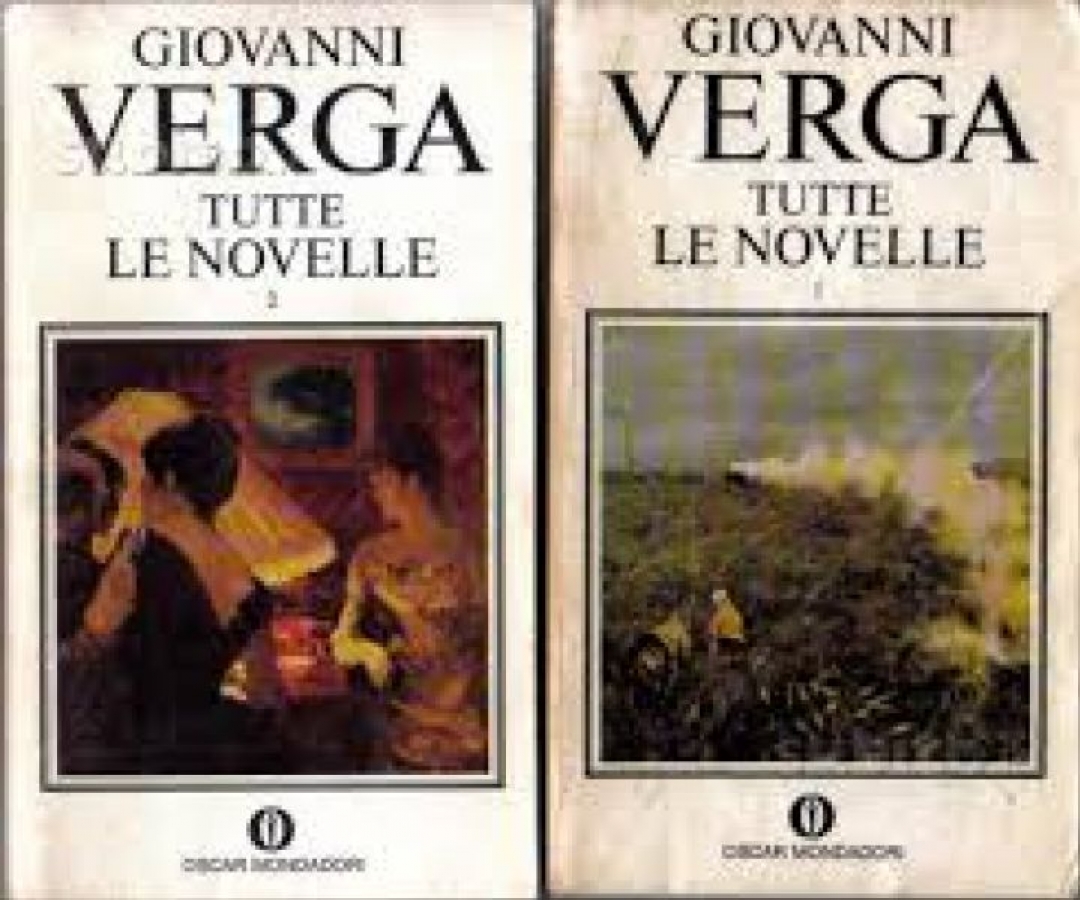
The book collects the short stories of Giovanni Verga, written between 1874 and 1894.
The author feels the need for retreat from the intense social life of Milan, longing to “see again” his Sicily,
the immense hearth of the Pino farmstead, on the slopes of Mount Etna
.
From the urge to return to his roots stems the first story, which encompasses all the major themes of Verga’s fiction.
Nedda, “la varanisa,” is a wretched girl; her fate is already sealed from birth:
the liveliest imagination could never have conceived that those hands, bound to the harsh toil of every single day, scraping through the frost, or the scorching earth, or the brambles and crevices, that those feet, accustomed to walking barefoot in the snow and upon sun-baked rocks, tearing against thorns or hardening upon stones, could ever have been beautiful; (...) poverty had crushed her from childhood with all the hardships that deform and harden body, soul, and intellect—so it had been for her mother, so for her grandmother, so it would be for her daughter
.
How distant from this immutable, cruel reality is the gaze of the privileged, who “carelessly” contemplates the enchanting Sicilian landscape and listens
with singular interest to the talk of those folk placed so far below at the foot of his towers
.( Le storie del Castello di Trezza in the collection Primavera ed altri racconti).
From this contradiction between the world of the humble and that of the privileged, between the romantic vision of nature and the harsh severity of the environment, originates Verga’s project, articulated clearly at the opening of the collection entitled Vita dei Campi:
I tried to decipher the modest, obscure drama that must have overwhelmed the plebeian actors we met together.
A drama (...) whose crux must lie in this—that whenever one of those little folk, either weaker, or more reckless, or more selfish than the others, sought to detach himself from the group out of a vague longing for the unknown, or a craving for something better, or curiosity to see the world, the world, voracious fish that it is, swallowed him up, and his kith and kin along with him
.
It is striking that the author titled this sort of manifesto Fantasticheria, almost as if to imply that he himself did not believe in it completely.
And indeed, as we venture into the many stories, we realize how they lose their narrative power whenever they move away from Sicily.
The author is aware of this as well.
In the closing story of Novelle Rusticane, under the emblematic title “Di là dal mare,” Verga recounts the departure of two lovers from the island and,
when the sweet sorrow of those memories assailed him, he would look back upon the humble actors of those humble dramas with a vague, unwitting longing for peace and oblivion
.
It is a watershed: on this side lie the collections Vita dei Campi and Novelle Rusticane, which radiate a pessimism that is undeniably deep yet transformed into social protest by the author’s profound involvement with his stories and characters; on the other lies a series of collections (Per le Vie, Vagabondaggio, I ricordi del capitano dʼArce, Don Candeloro e C), in which the depiction of the humble loses its vitality, deteriorating into pietism, commiseration, resignation, and defeat.
The finest stories are those of Vita dei Campi.
The characters are exceptional, deviating from the norm: Jeli, Turdiddu, Gramigna, La Lupa, Rosso Malpelo, place themselves
among so many madmen who had their brains in their heels, and did the exact opposite of what a Christian usually does when he wants to eat his bread in holy peace
.
(Verga in the first draft, later discarded, of Pentolaccia, quoted in the introduction by Carla Riccardi, p.
XIII).
Take the story of Jeli.
It opens with the recollection of the childhood friendship between the naive horse herder and Alfonso, the master’s son.
Between the two boys there are no differences of class or culture: together they revel in the wonders of a primordial nature.
Yet, as he grows up, Jeli suffers the collision with reality, consistently tragic in a swift crescendo, culminating in the betrayal of the highest value: friendship.
For it is Alfonso who takes his wife as a mistress.
His wife leaves him to rot outside the door, the neighbors said, while the thrush is in the house! But Jeli knew nothing, cuckold that he was.
When, however, he sees that Alfonso,
with his fine curly beard, velvet jacket, and the gold chain across his waistcoat, took Mara (his wife) by the hand to dance, only then, as he saw him touch her, did he leap at him, and slit his throat in a single stroke, just like a kid goat
.
The blind, sudden violence of the humble man who has endured too much is often the denouement of these stories.
It is so as well in the renowned story “La Lupa.”
She was tall, thin; she had only the firm, vigorous bosom of a brunette, though she was no longer young; she was pale as if she had malaria perpetually upon her, and against that pallor two eyes as big as this, and lips fresh and red, that devoured you
.
She is not a woman who submits; will and sensuality make her a master.
To possess the man she loves, she gives him her daughter in marriage, in order to bed him under the same roof, defying all propriety.
Then the man, to rid himself of her,
ceased hoeing the vineyard, and went to unhook the axe from the elm.
La Lupa saw him coming, pale and wild-eyed, the axe gleaming in the sun, and she did not retreat a single step, did not cast down her eyes, but kept walking toward him, her hands full of bunches of red poppies, devouring him with her black eyes
.
It is an extraordinary, striking image that leaves the narrative unresolved: did the man kill her, or did he throw himself once more into the arms of the Wolf? In Novelle Rusticane, the storytelling hardens.
The characters of Il Reverendo, Cosʼè il Re, Don Lucciu Papa, Malaria, Libertà, are nothing other than the embodiment of the laws governing Sicilian society.
Ultimately, life is like that of Saint Joseph’s donkey in the eponymous story: rebellion is futile, and animals are not necessarily worse off than many human beings.
The inescapable destiny of all the humble:
I’m only buying the firewood, because this is all the donkey is worth! And he kicked the carcass, which sounded like a burst drum
.
The stylistic and narrative quality of the stories is uneven, since
the trajectory of Verga the short-story writer can be defined as a series of stages leading toward the novels
(Riccardi’s Introduction, p.
XXIV).
In the short stories, Verga hides less behind verismo, behind the apparent detachment from characters and situations: the novellas are a kind of workshop in which the author works
in multiple directions and simultaneously across several fronts, including theater
(Riccardi’s introduction, p.
XXV), yet he reaches his finest expression precisely where his engagement is most evident—his bond with his land and the implicit protest against the inhumane conditions of the Southern people.
From this perspective, the stories, particularly those of Vita nei Campi, have an independent life compared to the novels and are often masterpieces.
Why read it? Nedda, Vita dei Campi, and Novelle Rusticane are magnificent stories that offer a realistic, compelling vision of our South.