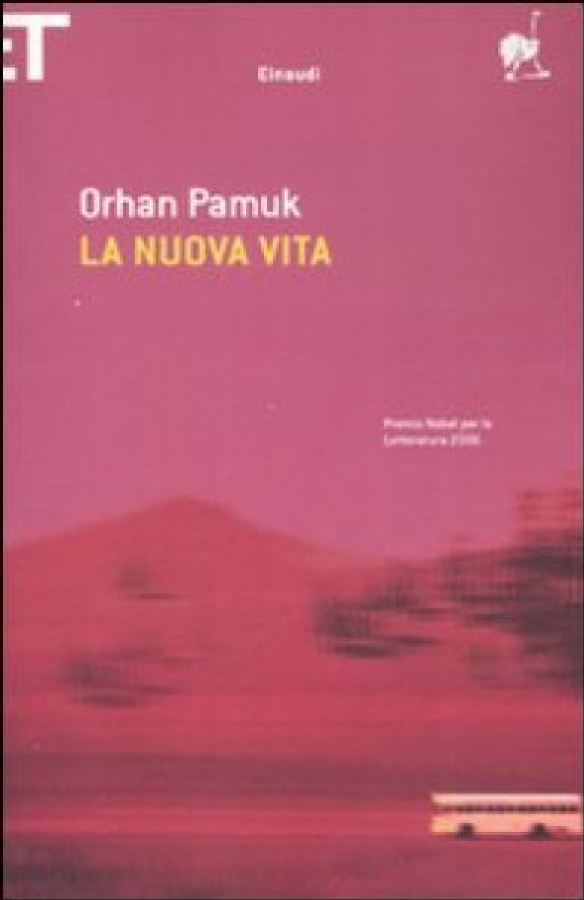
Finished reading on: November 16, 2008
The New Life
Title of the original version reviewed: «La nuova vita»
AI Translation Notice: This review was translated from the original Italian using artificial intelligence. Book quotes and excerpts are translated interpretations and will not match the author's original English phrasing or official published translations.
The novel’s protagonist is the book: a book, but also all books.
The culprit is not only that book, the book that deceived my son, but all books pouring from the printing presses; they are all enemies of our time, of our lives
.
Thus spoke Mehmet’s father menacingly—Mehmet being one of the novel’s central figures, the first to read the book and flee.
The other two protagonists are Osman, a young student who falls in love with Canan, Mehmet’s girlfriend.
It is she who leads Osman to read the book, and the two youths embark on a dizzying journey across Turkey, ostensibly in search of Mehmet, though they are in fact driven by a restlessness, an existential malaise ignited by the reading of the book:
passengers of night buses, wretched brothers, I know that you too seek that weightless moment.
You want to be neither there nor here, to become other and wander in the pleasant garden that lies between the two worlds
.
Yet what are these two worlds? Current life and the new life, or the quest for the angel: death.
The novel unfolds as a succession of bus journeys, fatal crashes, blaring television sets, travelers, and surreal landscapes.
The search for Mehmet ends with Osman killing him, hoping to rid himself of his romantic rival; yet at this juncture the quest remains unfinished, for Osman has failed to attain any inner equilibrium.
He resumes his travels, fully aware that the true threshold into a new life is death.
The angel appears at that magical moment of departure, and only then do we perceive the true meaning of the confusion we call life.
Only then can we return home
.
And Osman indeed dies in a traffic accident, just like those he had witnessed during his bus journeys.
What is the true meaning of this novel? First and foremost, reading a book represents a rupture in human equilibrium:
a good book is a piece of writing in which things that do not exist are explained, a kind of absence, a kind of death.
Yet it is futile to search outside the book for the country that lies beyond words
.
Thus the book constitutes an alternative reality to actual existence: other worlds nourished by text and imagination.
Their impact, however, is disruptive to human existence, exposing and laying bare the one-dimensionality of life.
Another central theme is travel, perpetual motion, which serves as the sole point of stability for both the novel and its protagonist.
When Osman realizes that Mehmet, too, had set out from the book and
after searches, journeys, and adventures in which he had encountered death, love, and misfortune, had attained what I had failed to attain: inner peace
,
he decides to kill him, seized by envy and resentment.
The third theme is undoubtedly death, the much-sought angel: the journey, like life itself, inevitably culminates in death, with
my eyes dazzled and filled with dread, just as I had once gazed upon the incredible light spurting from the book, I would pass immediately into a new life
.
The new life, so desperately sought, is death.
It is a cryptic novel, whose true meaning remains elusive.
Each reader can draw their own interpretation: one tied to the social context suspended between modernity and tradition, an unhappy love story, or the notion of conspiracy as the engine of history.
I prefer to believe that the book speaks of life’s multiple dimensions, of that relentless quest for a new life that perpetually animates humanity.
The author also evokes Dante’s Vita Nuova, rebirth, the revelation of a more authentic spirituality.