Finished reading on: April 13, 2019
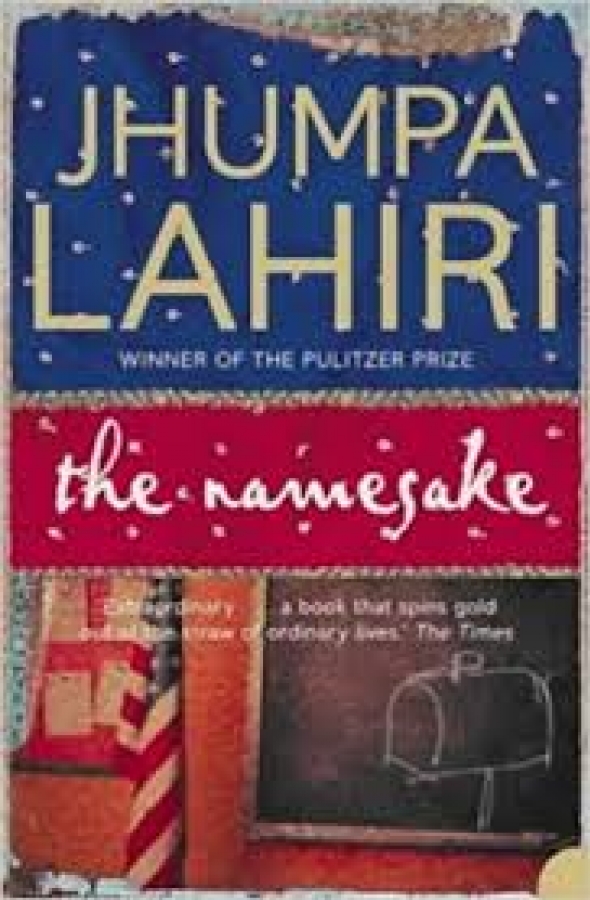
The namesake (the nickname)
Title of the original version reviewed: «The namesake (il nomignolo)»
AI Translation Notice: This review was translated from the original Italian using artificial intelligence. Book quotes and excerpts are translated interpretations and will not match the author's original English phrasing or official published translations.
Transform yourself into words: (...) if running around a single name it is always you and me at stake and always the same the potent weapons of mourning and affliction that even in dreams chase my smoothness to ruin
(Cosimo Ortesta, from Il progetto di un freddo perenne, 1988). Reading this novel brought this line of Ortesta’s to mind: names follow us throughout our existence, speaking of ourselves, of the bond we share with others, and of all the feelings, even painful ones, we carry with us; as Lahiri writes, “names die over time, they perish with people.” Gogol is the son of a Bengali couple who moved to the United States; the name was bestowed upon him at birth while awaiting the “true
name that was supposed to arrive from India, but never did: a pet name, then, chosen by his father out of his passion for Russian writers. Gogol
hates even signing his name at the bottom of his drawings in art class. He hates that it is at once absurd and obscure, that it has nothing to do with who he is—that is, neither Indian nor American, but above all not Russian
. Being named Gogol is the mark of his ambiguity, of an identity suspended between two worlds, two different cultures, histories, and traditions. And Gogol attempts to break free from this indeterminacy, to escape the name, stubbornly pursuing separation from his parents and from the large, noisy, crowded Bengali community, with its clothing, cuisine, customs, and language—strenuously defended precisely because they live far from their homeland. He is weary of returning to Calcutta to visit relatives, a journey so eagerly anticipated by his parents. And above all, he no longer wants to be called Gogol. He goes to study far from home, earns a degree in architecture, finds work in another city, changes his name to Nikhil. The protagonist's attitude does not shift even when he learns the true reasons that led his father to give him that pet name. One evening, the train bringing Nikhil home is severely delayed. His father waits for him at the station in a state of great anxiety: he reveals to him that he named him Gogol because, as a young man, he was one of the few survivors of a catastrophic train accident; the book by the great Russian writer had saved him.
Is this what you think of when you think of me, Gogol asks him, Do I remind you of that night? Not at all, his father says at last, with a hand on the boy’s hip, an accustomed gesture that had embarrassed Gogol up until that moment. You remind me of everything that followed
, that is, of family, work, and hard-won prosperity; and the name bestowed upon his son holds many meanings, not least what Dostoevsky said:
we all came out of Gogol’s Overcoat
. The enigmatic phrase cannot yet be understood by young Nikhil, who resumes his flight from his roots. He meets Maxine, a classic daughter of the upper-middle-class
liberal
, with beautiful homes, beautiful objects, solid points of reference. A guest at the house where Maxine’s parents—so cultivated and accommodating—spend their holidays, by the shores of a splendid lake amid woods and green meadows, Gogol
understands that this is a place that will always be here for her. It makes it easy to imagine Maxine's past, her future, to picture in his mind her growing old. (...) Through the windows, he sees that dawn is slowly emerging in the sky, only a few stars are still visible, the silhouettes of the surrounding trees and buildings gradually become distinguishable. A bird begins to sing. And then he remembers that his parents cannot reach him: he hasn't given them the phone number. (...) And here beside Maxine, in this welcoming wilderness, he feels free.
The flight is cut short when his father suddenly dies. The rush to the morgue, the identification, gathering the few possessions his father had with him, the return home to his now-solitary mother, the Indian funeral rites surrounded by the entire Bengali community, brutally pull Gogol back to his condition of being neither Indian nor American, nor even Russian. Maxine invites him on a vacation together (because
it might do you good (...) to get away from all this”); Nikhil replies to her: “I don’t want to get away
. And just like that, he is Gogol once more; he lets his mother guide him into a marriage with a Bengali girl, in a lavish and crowded ceremony he would have scornfully refused only a short time before. Reclaiming one's identity is not so simple. We cannot delve deeply into the story of the girl Gogol marries—a tale within the tale. We can only outline a few fundamental traits: she has a name unpronounceable in American and is therefore called by a pet name; she too fled her family, went to Paris where she acquired a third language (neither American nor Bengali), returned to the United States to teach French literature at university, surrounds herself with refined intellectuals (so removed from Gogol’s straightforward technical background), has had many men, betrays Nikhil, returns to Paris. Gogol is a romantic, and as such engages in a love affair—intense at least for him—genuinely believing he has found solid roots in a modern Anglo-Bengali family. The betrayal and separation abruptly throw him back into a state of limbo.
He wonders how his parents managed, leaving behind their respective families, seeing them so rarely, without a place to reunite, in a perennial state of waiting, of nostalgia. (...) Gogol knows that his parents lived their lives in America despite what they lacked, with a strength he fears he does not possess.”
What's in a name? Shakespeare wonders in Romeo and Juliet: “that which we call a rose by any other name would smell as sweet
. The novel does not tell us whether Juliet is right. In the old house his mother is vacating to move to Calcutta, Gogol finds the stories of the great Russian writer once again: a book his father had given him as a teenager, which he had abandoned on the shelf with a mixture of indifference and annoyance. And he finds a dedication:
the man who gave you his name, from the man who gave you your name.” Here is Dostoevsky’s enigma: “the name he had so detested was hidden and preserved here. (...) Those who had given and preserved the name of Gogol were far from him now. One dead, the other, a widow, on the verge of a different kind of departure, to live filled with nostalgia, like his father, in a world apart. (...) Once or twice a week he will hear the name Gogol over the telephone wires, or written on a screen. (...) Without people in the world to call him Gogol, no matter how long he lives, Gogol Ganguli, once and for all, will vanish from the lips of those who love him, and so, cease to exist.
It is an intense and complex novel: fluid, elegant prose, a spasmodic attention to detail. Places, objects, food, clothing are meticulously described, unlike the characters, who are not treated superficially, but rather deliberately kept always
waiting” for something else, or yearning with nostalgia for something else. The author seems to be saying: everything is vacuous except places, naturalistically rendered yet rich in myth, suggestion, transmitters of values and worlds. At times one loses the thread of the plot, but what does it matter? The allure resides in the writing, and it is up to the reader to reassemble and interpret the whole.
Why read it? A masterpiece, fascinating and dense with meaning and resonance.