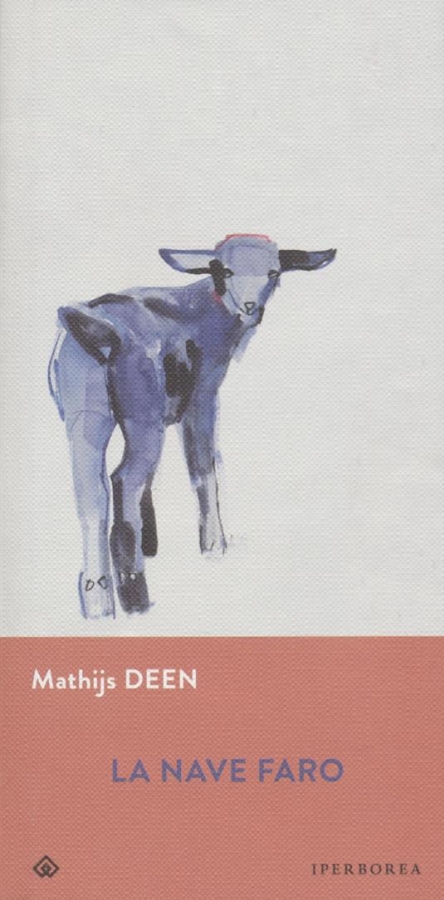
Finished reading on: June 02, 2022
The Lightship
Title of the original version reviewed: «La nave faro»
AI Translation Notice: This review was translated from the original Italian using artificial intelligence. Book quotes and excerpts are translated interpretations and will not match the author's original English phrasing or official published translations.
A lightship has no propeller, no engine; on the bridge there is no helm: it can do nothing but sway, somewhat forlorn, an animal tugging in vain at a chain
On this ship that will never sail and will never see distant lands, the crew members vanish
into the dark labyrinth where all the days of their working lives were digested into an almost inextricable mass of memories
. Into this sort of prison, into a fragile balance of lives and memories, bursts a young goat. The cook brings it aboard, intending to slaughter it to make a savory dish.
Such an animal on a ship (the peasant woman shouted at him), watch out, because it'll want to escape. (...) A goat always wants to get away
, but on this ship we are all prisoners, says the cook. It is only natural to wonder why the cook wanted to bring the young goat on board; its meat is certainly exquisite, but culinary motives are irrelevant; in the man’s childhood lies an image that resurfaces ceaselessly. While still a child, a household servant induced him to slit a chicken's throat.
Blood spurted from the neck, the chicken flapped its wings violently. (...) he ran inside looking for his mother. (...) He put his thumb in his mouth and rested his head against her chest. The finger had the sweet taste of the chicken's blood. (...) He closed his eyes
. The cook does not have much butchering experience, let alone with goats, but no matter: in his subconscious, he seeks to repeat the childhood ritual through which he conquered fear and reclaimed his mother. The cook does not realize that he is not the only one subject to the dark fascination of the young goat. Days of dense fog set in, which
deadened the wind, dissipated sounds, petrified the motion of the waves, encircled the lightship. (...) Now it was a defenseless animal, chained, surrounded, (...) invisible to passing vessels
. The danger of a collision is palpable, the tension among the crew is at its peak; there is nothing to do but wait, peering into the gloom of the fog. To anyone who has not been hardened by years of waiting and is unable to repress fear, the young goat—a frisking, restless creature—might seem like the devil, who has brought disorder to a life as regimented as that of the lightship. There is a sailor who
sometimes heard things that weren't there and struggled to shake off the thoughts that plagued him
. His duty on board is to take readings for the Meteorological Service, but the meticulous, detailed records have become "a shadow bookkeeping of his anxiety and unease." He convinces himself that the young goat is the root of the evils afflicting the crew, of that dark fog enveloping the vessel: a condition that prevents him from filling in his daily log. He decides to put the goat to death in a ritual to exorcise the evil. But if the animal is the devil, how can a mere sailor be expected to save the small community?
Whether due to the author's limited grasp of maritime life or the translator's difficulty in rendering nautical terminology into Italian, the lightship remains in the background of the narrative; it can only be brought to light as a metaphor for evil and the fragility of the human soul. At a certain point, the cook contracts malaria and plunges into a fever-induced suspension of consciousness. A respite for memory at last, says the author! What is this obsession with memories, never real but always imagined? Would it not be better to dissolve into the void of the present, without past or future? Saint Augustine maintained that nothing exists except the present, since the past is memory in the present and the future is merely today's anticipation of what is to come. Giving the tale a philosophical reading, one might conclude that the young goat is the lockpick used to drag the past into the present—everything dark within the human soul that originates in memory.
The writing is stark: short sentences with frequent full stops resulting in a fragmented narrative, sketched and somehow suspended characters, a simple, even banal plot. It reads like a cold, journalistic report of an affair that is not meant to have an explanation, unless one settles for a few psychological traits, which are, moreover, underdeveloped. The allure of the maritime world is entirely absent, both in language and situations, save for the descriptions of the dark, terrifying fog.
Why not read it? It is fragile from a narrative standpoint, useless when it comes to content.