Finished reading on: January 17, 2021
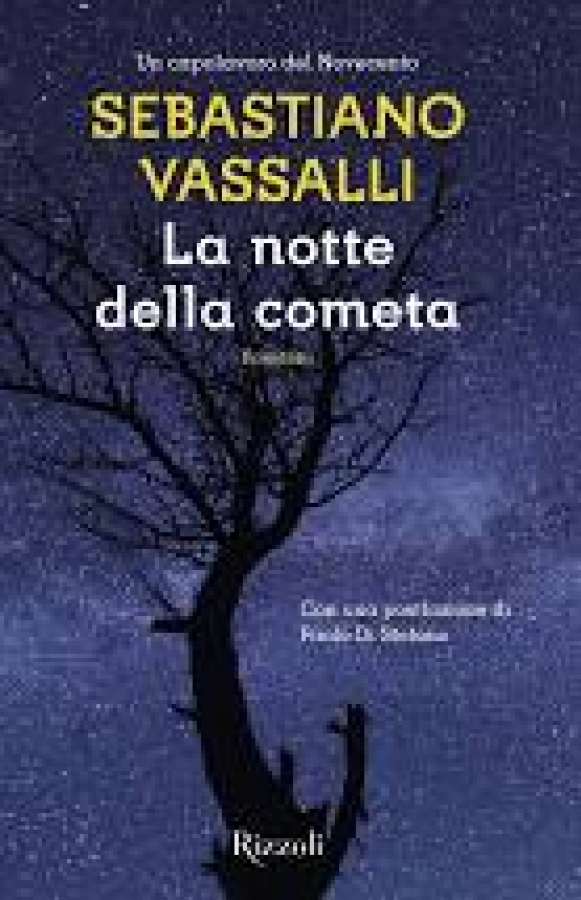
The Night of the Comet
Title of the original version reviewed: «La notte della cometa»
AI Translation Notice: This review was translated from the original Italian using artificial intelligence. Book quotes and excerpts are translated interpretations and will not match the author's original English phrasing or official published translations.
In the Tuttolibri supplement of La Stampa of January 18, 2021, Donatella Di Cesare reviews Giorgio Agamben's book La Follia di Hölderlin: a volume recounting the events that led the great poet to shut himself away in an asylum, from 1802 to 1846. Was it true madness or, as Schelling suspected, had his friend "assumed the outward manners of one who is mad"? Hölderlin was
torn, in an existential condition that seemed to push him outside and beyond his era
. Sebastiano Vassalli seeks to answer the same question, retracing the life of Dino Campana through a biography that is both documented and fictionalized, as the writer himself describes it; in doing so, he dismantles the cliché that Campana's poetry stemmed from madness. Just as it is difficult to believe that Hölderlin, out of his mind, could have translated Sophocles into German, so we wonder whether a madman could have created an absolute masterpiece like Genova (from Canti Orfici):
Since the cloud came to rest in the skies/Far over the silent infinite/Seashore enclosed in distant veils,/And the departed soul returned/For all around it was arcane-/ly illuminated the garden's green/dream in the superhuman apparition/Of its flashing proud statues:
Let us stop here, because one would be tempted to speak only of this poem, rather than of Campana's mournful life. Born in 1885 in Marradi.
Stocky, blondish, of medium height, (...) He had copper-blond hair, thick and curly, framing a face glowing with health: two small moustaches that stopped at the corners of his lips, and a thrifty goatee that did not stray too far from his chin
Thus a friend describes him in 1912, when the young Campana, already deemed mad by his family and by the whole of Marradi, had been cast out several times: first by locking him up in the asylum of Imola, then shipped off to Argentina with a one-way ticket, later, upon his return, sent to the Florence asylum, and subsequently led to live in modest boarding houses across the Tuscan-Romagnolo Apennines. In 1914, Campana published Canti Orfici at his own expense, which brought him his first taste of renown and opened the arms of Sibilla Aleramo, with whom he would have a stormy love affair. Finally, in 1918, diagnosed with syphilitic dementia, he was committed to an asylum, where he died in 1932. Vassalli retraces Campana's human ordeal with the same passion and documentary commitment found in one of his masterpieces, La Chimera. The protagonist, a young woman exposed to village gossip because she was free and beautiful, was guilty of making love to a "wayfarer," at night under an old oak tree believed to be the devil's abode: for this, she was burned at the stake as a witch (see the review on this site). In 3012
, also reviewed on this site, a young slacker from Fellinia wants to bring war back into a terrifying world where peace is imposed through repression: he preaches chivalric war and is killed by the guardians of peace, becoming the Prophet. Both were persecuted because they were
"out of step," free yet fragile spirits. Thus was Dino Campana. The author writes: "I was looking for madmen: I found madmen. (...) Each madman told me his story. (...) Most of them were people who caused trouble. (...) People who had to be gotten rid of by sending them to America or Australia, or by interning them in an asylum. (...) By day, I lived among the mad; by night, in the hotel, I kept dreaming their stories." For them, "the asylum is a great sounding board/and delirium becomes an echo/anonymity a measure,/the asylum is Mount Sinai,/accursed, upon which you receive/the tablets of a law/unknown to men." (Alda Merini from La Terra Santa). And so, nothing remains for the alleged madmen but to sing with Campana: "I know not if among rocks your pale/Face appeared to me, or smile/Of unknown distances/(...) And still through tender distant skies clear running shadows/And still I call you I call you Chimera." (La Chimera from Canti Orfici).
La notte della cometa dates from 1984; at the time it sparked controversy: some accused the author of inaccuracies if not outright falsehoods, accusations that stemmed from the disinformation generated by Campana's first biographer (suffice it to recall that as late as 1993, Alberto Asor Rosa, in his preface to Canti Orfici, still repeated the far-fetched tale of the poet landing in Odessa on his return from America and then walking to Antwerp, where he had in fact disembarked from the ship Odessa); others, such as Edoardo Sanguineti, read Vassalli's reconstruction superciliously, especially where the author sheds light on the relationship between Campana and Soffici (Sanguineti, in his anthology of twentieth-century Italian poetry, groups Campana among the "Vociani," even though Dino despised the journal La Voce); still others took offense and sued the writer, such as the municipality of Marradi, because Vassalli had exposed the rancor and malice of the Marradesi toward their great fellow citizen. These are all dated controversies, which flatten Dino Campana's unique and marvelous poetics down to his wretched life. The real question to ask today is another: where does Campana's poetry originate, who were his masters, how did he arrive, while still so young, at compositions so unusual and extraordinary for our literature? Perhaps Asor Rosa is right that
there is nothing left today but to reread him as an isolated and somewhat mysterious fruit of our deepest Italian viscera
(Alberto Asor Rosa, preface to Canti Orfici, ed. L'Unità 1993); that is, somewhat like Grazia Deledda's Canne al vento (see review on this site). Is this sufficient, or is it time to investigate Dino Campana's poetry more deeply?
With all due admiration for Sebastiano Vassalli, one must acknowledge the shortcomings of this fictionalized biography: fragmentary and at times muddled, repetitive and verbose, it strives for literary effect at the expense of the overall vision, and it neglects the poet's literary and intellectual formation by reducing it to a sort of solitary quest, thereby paradoxically endorsing the cliché of the "eccentric" poet: not mad, but odd.
Why read it? It is a book that sheds light on Campana's life, and also on what the asylum truly was.