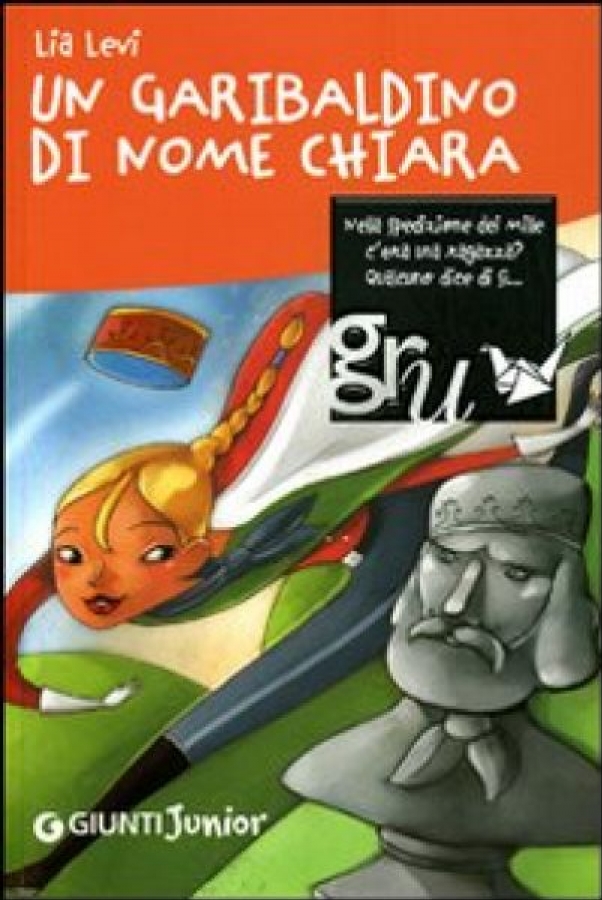
A Garibaldian Named Chiara
The year is 1860. Chiara is the daughter of a well-known patriot, a friend of Garibaldi. Disguised as a boy, the girl manages to join the Expedition of the Thousand and thus meets Simone, with whom—predictably—she falls in love. The story is pleasant, but handled far too superficially, both from the standpoint of Chiara’s personal affairs (her desire that her father not marry a Turinese lady, her yearning for adventure, the blossoming of her love for Simone) and with regard to the historical context. The latter emerges in a fragmentary fashion, without illustrating the environmental conditions and political premises of the expedition.
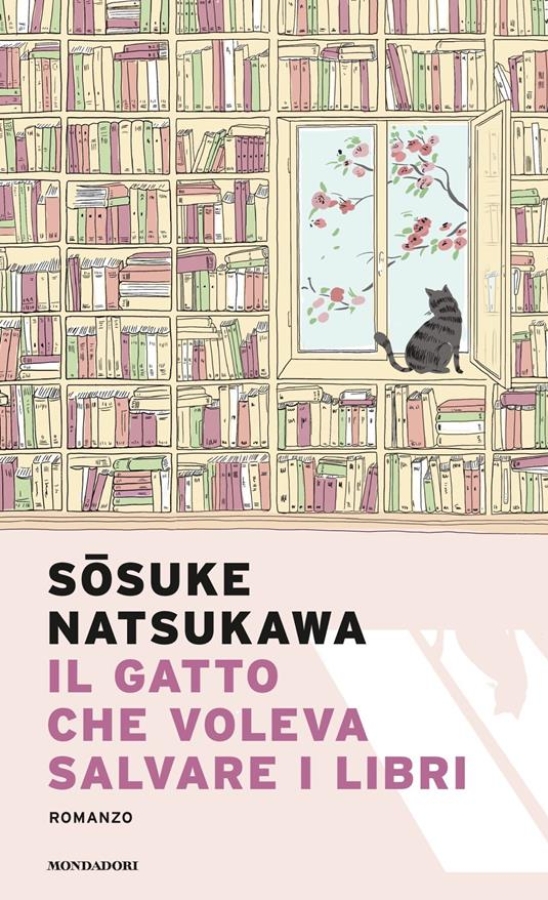
The Cat Who Saved Books
What is the fascination of books? Why do so many of us spend so much time reading novels and poetry? The author attempts to answer these questions through a coming-of-age story, a cross between *Harry Potter* and *Treasure Island* (see the reviews on this site). Natsuki Rintaro is the typical *hikikomori*, a term synonymous with an antisocial, apathetic, and misanthropic adolescent. To be sure, he possesses a passion for reading, born of living in his grandfather’s crowded, dusty bookshop. It is a small secondhand bookshop with a peculiar layout. > When entering the bookshop through the brightly lit front door, the room seemed in perspective far deeper than it actually was, and for a moment it felt as though that book-lined corridor stretched out endlessly into the darkness . There is a power in books, the grandfather used to tell his grandson as he quietly opened a volume. Upon his grandfather’s death, the boy is supposed to go live with an aunt—a fate he accepts passively, almost indifferently. Suddenly, out of nowhere, a cat appears; with gentle yet firm manners, it invites him on a quest: to save books. Together with the cat, the boy ventures down the corridor beyond the back wall of the bookshop; the two find themselves in palaces, veritable labyrinths, from which the boy will only be able to escape if he frees the books. Each labyrinth corresponds to a specific way of understanding our relationship with this “collection of sheets of paper covered in printed characters”: the obsessive urge to hoard, the pursuit of digests that allow one to consume the greatest number of writings in the shortest possible time, and the conception of the book as a consumer good—a business in which everything that does not sell must be destroyed. It is a taxonomy all too familiar to us book lovers, yet one forgets that > reading a book is rather like climbing a mountain. (...) Every now and then you have to examine line by line, re-read the same sentence backwards several times, and proceed slowly, striving to understand. As a result of such arduous effort, suddenly your mind opens up . These are the grandfather’s words resurfacing in the boy’s mind, dense and vigorous words. Through the climbing metaphor, the grandfather means that one can only endure the grueling ascent if one loves the mountain. And it is this very argument that disarms his interlocutors and saves the books: how can one hold them prisoner, chop them up, and treat them as mere commodities, if one truly loves them? The journey of personal growth is not yet complete. To paraphrase Karl Marx in *The Poverty of Philosophy*, we are still in the realm of ideas, bound in an erudite and narcissistic attachment to reading. Only the final trial will bring the adolescent’s maturation to fruition: as Confucius held, the humanities, literature, and poetry allow us to understand “the sense of reciprocal humanity”—that is, the empathy that binds all human beings together. The author attempts to give narrative momentum to the story while simultaneously conjuring a magical atmosphere. To this end, he resorts to the literary device of the cat, a frequent trope in Japanese literature—one need only think of Natsume Soseki’s *I Am a Cat* (see the review on this site). Yet while in Soseki’s work the cat is an ironic, wise figure, an alter ego to the dull and narrow-minded schoolmaster, here the small feline is a plodding censor of the protagonist, akin to the Owl in *Pinocchio*. The long corridor that opens mysteriously into the labyrinths calls to mind the far more original railway platform from which the magical adventure of *Harry Potter* begins; moreover, the description of the palaces is so meticulous as to become predictable and verbose. Having started off well, the novel lapses into a pedantic meditation on the book, containing reflections that would be agreeable and worthwhile were this a work of non-fiction. What elevates the novel’s quality is the prose: plain, pleasant, and fluid, even if occasionally repetitive; the brushstrokes portraying the bookshop and sketching the boy and his friends are spot-on. What a pity the author did not develop the characters more thoroughly! Why read it? It speaks of our love for books.
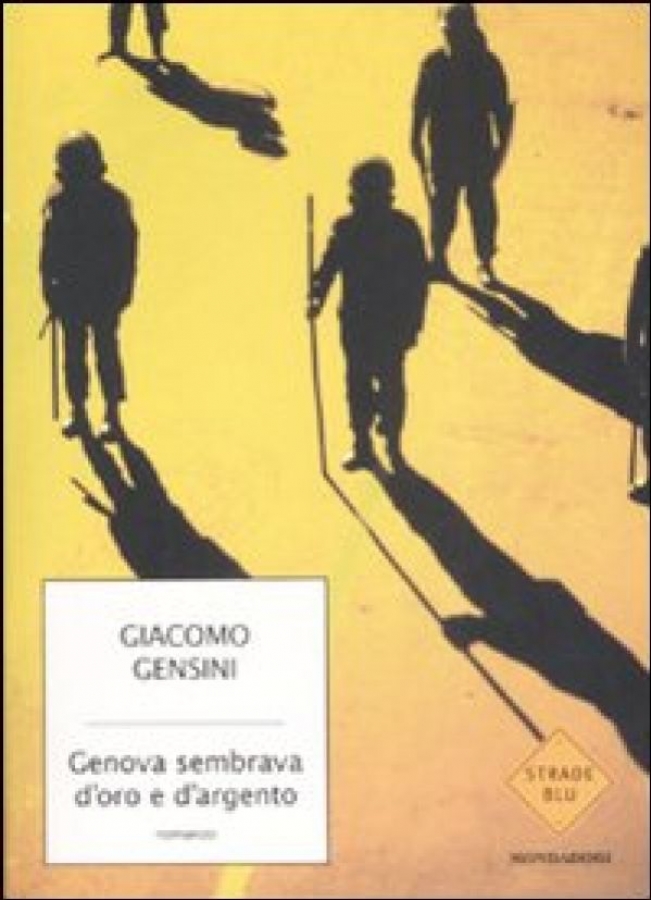
Genoa seemed made of gold and silver
The book is not about Genoa, despite its title. The city is merely a setting, devoid of imagery and depth, in which to recount the life of a police officer. The protagonist is a young man without hope, who believes that life is > merely a scheme of the system, one of many, but men do not control it, not even those gathered at Palazzo Ducale. The system is a headless machine, an autonomous machine . What matters is the group, belonging through courageous and violent actions. This young officer’s entire life is a succession of drills, off-duty leaves, overtime, and interventions against hooligans and protesters. He is assigned to a special squad trained for the G8 summit in Genoa. The drills, grueling and geared toward counter-insurgency tactics, reinforce esprit de corps. In Genoa, the young man’s convictions are put to the test, not so much by what happens, but by his love for a girl who might just convince him that destiny is in our hands, that it is not true that «human beings are what they are». Then everything spirals out of control: the officer takes part in the raid on Via Diaz and discovers that the mysterious girl, met in Genoa, is there among the beaten, bleeding youths. Once again, it was destiny that decided: > I was fucked, I always had been, I cried because Sara was right, I had had my chance to choose, I cried for myself, because I understood that now it really was over . The novel’s overarching theme is cynicism as the consequence of a hopeless life. The story, however, unfolds monotonous and slow, devoid of narrative pace and without the author managing to grant psychological depth to the characters, starting with the protagonist. The greatest disappointment comes from Genoa, which is simply not there (has the author ever set foot in the streets where the G8 clashes took place?), with the result that the whole affair feels cold and artificial. Why not read it? It is boring and pointless.

Jerusalem Delivered
*Gerusalemme Liberata* recounts the climax of the First Crusade, when Godfrey of Bouillon conquered Jerusalem in 1099. It can be interpreted as an epic poem (a sort of Christian *Iliad*), but in truth its interpretive keys are far more intricate than those of Homer's work. First and foremost, the poem is the narrative of a purification, both collective and individual: > thus singing, the devout host unfolds and spreads in wide circles, directing its slow procession toward Olivet ( Canto XI, verse 10). This holy advance collides, in bloody combat, with the Saracens and with the forces of evil: a struggle between supernatural powers of the underworld and the heavens. The clashes between armies and knights form one of the poem's central threads, allowing Tasso to display a consummate mastery and knowledge of the art of war and dueling, imbued with a taste for the macabre that anticipates modern adventure cinema: > and between neck and nape he strikes the blow; severed the sinews and slit the throat, the spinning head fell down and stained its face with foul dust before the trunk could fall; the trunk remains (a wretched monster) seated in the saddle, but freed of the rein, wheeling and kicking wildly, the steed shakes it off . ( Canto IX, verse 70). Yet what a contrast between dreams of military glory and the harsh, cruel reality! In memorable verses, Tasso sings of the absurdity of war. At the battle's end > there is no silence, nor any distinct cry, but a hoarse and muffled sound is heard: shudders of fury, murmurs of rage, groans of those who languish and those who breathe their last. The weapons, once so joyous to behold, now made a grim and mournful show; the iron had lost its gleam, the gold its rays, and no beauty remained in their once-fair hues . ( Canto XX, verses 51 and 52). Alongside the epic component lies the elegiac and lyric dimension, made up of extended landscape and sentimental interludes. It is the most luminous facet of the poem, pivoting upon woman—a figure who, for Tasso, is complex, richly nuanced, a mystery to be unveiled. Erminia, a delicate Saracen maiden in love with Tancredi, a Christian knight, longs to become a warrior to remain near her hero: > ah, why did Nature and Heaven not make my limbs and breast as strong, that I too might exchange skirt and veil for cuirass and helmet ( Canto VI, verse 83). Yet Erminia realizes that war belongs to men, and that she can only be a gentle wife: > unhappy Erminia flees, and her swift steed gallops across the earth ( Canto VI, verse 111). And Armida, the true protagonist of the poem, is a sorceress, an enchantress, and a conqueror of men; yet when she beholds her Rinaldo—himself a Christian knight—her hatred turns to love: > but when she fixed her gaze upon him and saw how placidly he breathed.... from an enemy, she became a lover . ( Canto XIV, verses 66 and 67). It is precisely the portrayal of the poem's women and their star-crossed love for Christian knights that reveals the complexity of Tasso's universe. He aspires to be the poet of the Counter-Reformation, of steadfast faith unclouded by doubt; yet one senses how deeply the poet loves the feminine realm, probing its torments and sentiments, just as he harbors a predilection for the vanquished and the infidels. In contrast to the rigid, impersonal Christian knights (Goffredo, Tancredi, and Rinaldo), stand complex characters endowed with profound humanity: the tender Erminia, the ill-fated Armida, the valiant Saladin, and the fierce Argante. These are living figures, fraught with doubt, affection, and memory. This is Tasso's spiritual world, mirroring his own anguish: > I shall live amidst my torments and my cares, my rightful Furies, frantic and wandering; I shall dread the dark, solitary shadows that bring my first transgression before me, and of the sun that unveiled my misfortunes, I shall abhor and loathe the sight. I shall fear myself; and ever fleeing from myself, shall have myself forever near .( Canto XII, verse 77). Here is the modern, pre-Romantic, and existential Tasso, with his passion for nocturnal scenes: > meanwhile night rises, and beneath its wings the sky shrouded the boundless plains; and sleep, the soul's repose, oblivion of woes, with flattering touch lulled cares and senses into rest yet there is no peace, “for the cruel fury appears before him in dreadful phantoms, striking him with terror” ( Canto VIII, verses 57 and 59). Why read it? It is a long poem, at times tedious, written in demanding verse that is dense and convoluted. Yet when Tasso breaks free from religion, from faith, from what must be said, and gives rein to his inspiration, a musical and profound lyricism captivates the reader.
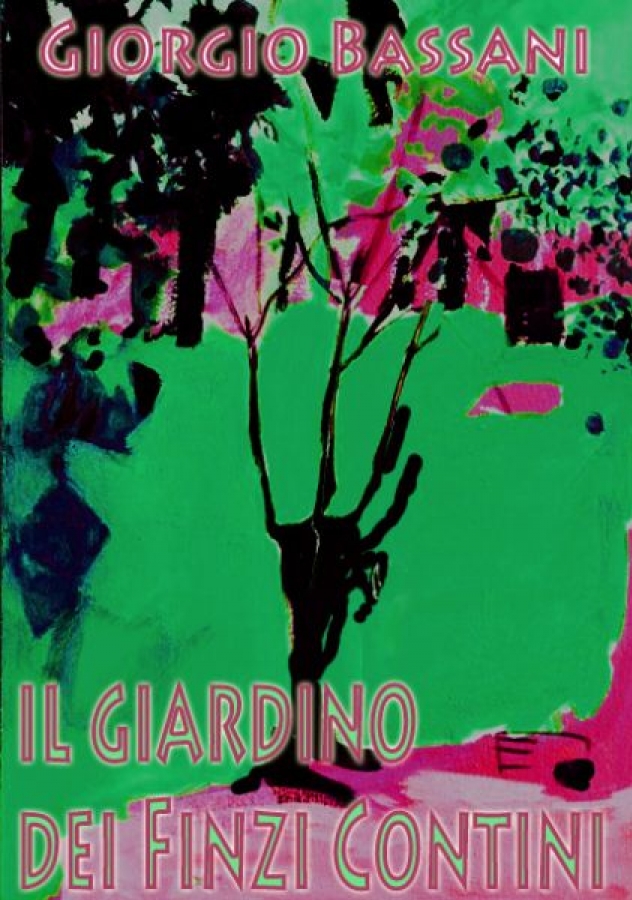
The Garden of the Finzi-Continis
The narrative recounts the love story between the author and Micòl within the milieu of a prominent Jewish family of Ferrara: the Finzi-Continis. Two fundamental themes emerge: nostalgia for a serene, peaceful Ferrara and, above all, an intimate tale tied to personal relationships that unfolds as if suspended over an abyss: the protagonists attempt to live as though nothing were happening, but in truth the racial laws, marginalization, war, and deportation, as well as illness, loom over and increasingly engulf their lives. It is reductive to read the novel as the story of Ferrara or a tale of unrequited love; it is the story of the Jews, but also of anyone who, in the face of danger and the dissolution of a world, «pretended not to see, let things slide...». The style is characterized by a pronounced musicality, as well as a richness of adjectives and narrative threads, which nonetheless does not come at the expense of incisiveness and concision. The characters are not «excavated» but remain on the surface, almost indecipherable and contradictory in their sentiments and behavior.
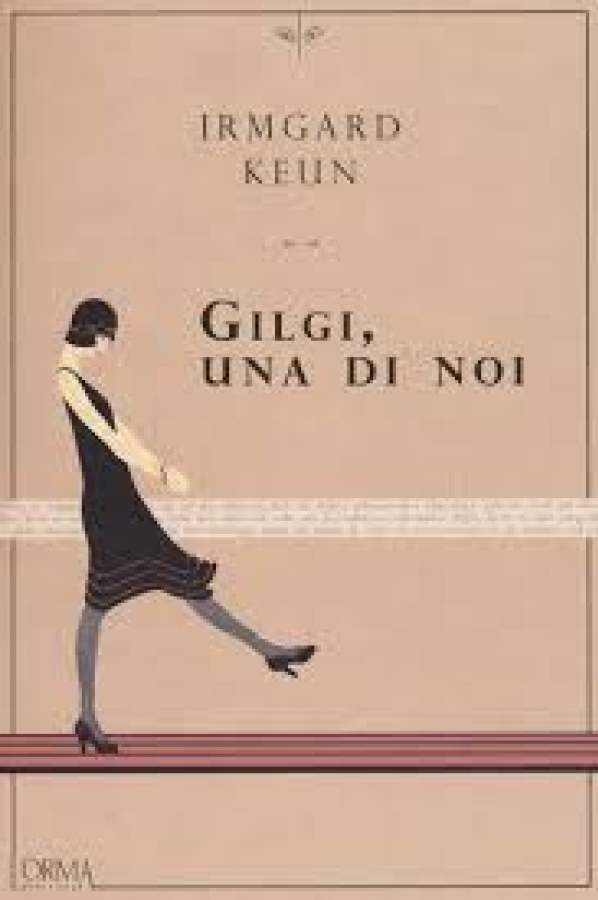
Gilgi, una di noi
Who knows whether Alba de Cèspedes had read this novel before writing *Nessuno torna indietro* and *Dalla parte di lei*, published respectively in 1938 and 1948, just a few years after the 1934 Italian release of Irmgard Keun’s novel, heavily censored to excise its most transgressive passages (see the reviews of de Cèspedes’s books on this site). Even allowing for a completely different style (elegant and baroque in the case of the Italian-Cuban writer; cinematic and remarkably modern in that of the German author), there are numerous affinities. The young boarding-school girls of *Nessuno torna indietro* seek their own path beyond the stereotypes of the “pretty wife and mistress,” just as Gilgi forcefully asserts her independence from Martin, the man she loves—fatuous and manipulative. > All tenderness vanishes from Gilgi’s face, her voice hard and clear: I settle my own affairs myself, (...) I will not tolerate anyone feeling responsible for me, it is the greatest insult one could pay me, I... Even greater similarities seem to emerge with *Dalla parte di lei*. Like Gilgi, abandoned by her birth mother, Alessandra is haunted by her mother’s suicide, which upends her life and drives her to seek a man with whom she can find total harmony. And if Alessandra kills her husband when she realizes she cannot be loved completely (“Francesco,” I cried out in despair, “help me, Francesco”), so Gilgi leaves Martin when she recognizes the vast gulf between the external world into which he has dragged her (living day-to-day in superficial lightheartedness) and her inner world as a young woman determined to remain a cog in the whole. Confronted with the destitution that drove a family to suicide, Gilgi understands that > lightheartedness has become an illusion, (...) that one cannot hide within the collective, that one is alone. This is what must be learned: one must learn to be a person, one must learn that a single laugh costs a thousand tears, must know that an hour of happiness must be paid for with a thousand hours of pain... And so it is impossible to continue living with a man to whom > everything else becomes utterly, deeply indifferent. One must leave, reclaim one's own life. > She belongs to the universal structure, she is not made to stay outside... now she believes once again, deeply, in the duty of young, healthy hands... Set in 1930s Germany, Gilgi’s story carried clear political and scandalous undertones, which prompted the Nazis to burn the book and the Fascists to censor substantial portions of it. Through contemporary eyes, Gilgi appears as a typical, conscientious office clerk, a sort of Carla from Elio Pagliarani’s eponymous poem. The charming Miss Gilgi loves an orderly life: she wakes up early in the morning, takes a cold shower to invigorate herself, does gymnastics, hurries to the office (she is a model employee), then studies foreign languages. > The fact that my demands (Gilgi tells a friend) are never beyond my reach makes me free... Shattering this industrious life arrives Martin, a carefree, selfish globetrotter. > Gilgi’s imagination had always been a well-behaved child. (...) Now the well-behaved child is straying a little too far; Martin tells his tales, and Gilgi sees oceans, deserts, landscapes—what she sees is not reality. Love overwhelms her and seems to consume her entirely. After an occasionally wry depiction of Gilgi’s life, such as the small ploys to ward off her boss’s advances, the narrative dwells at length on Gilgi’s infatuation, an incessant oscillation, a pendulum swinging between the bourgeois values with which the girl is steeped and the transgressive existence that awaits her with Martin. The prospect of an unwanted child, the encounter with an old friend who has lost his job and been reduced to penury by children that came unbidden, Martin’s glaring superficiality—attentive only to himself and heedless of what is happening in a Germany ravaged by poverty—are all factors that drive her toward a fateful choice in a feverish, dreamlike delirium: first she contemplates suicide, then she flees to Berlin, opening herself to a new life. The novel's virtue lies in its writing, which one might describe as cinematic: the dialogues evoke a film script where the actors must be given room, the descriptions are replete with vivid imagery that imprints itself on the reader’s imagination, and even Gilgi’s long deliriums, while at times discursive, remain visionary and profoundly striking. Consider Gilgi’s encounter with her biological mother, from whom she intends to ask for money. In Gilgi’s eyes, the rediscovered mother is merely a “white patch.” > There is no sound in the room, only a heavy, silent gloom and a small white patch: the face of the woman from the magazine. (...) They are all dead... I am completely alone, alone on the planet... And what of the image of her departure for Berlin, when Gilgi sees, or imagines seeing, > a small orange rolled down from the platform, lying amid the smooth, straight, ingenious tracks, awkwardly simple and inadequate: an oneiric conclusion to a stylistically singular novel. Why read it? The prose is captivating, though at times the narrative becomes redundant.
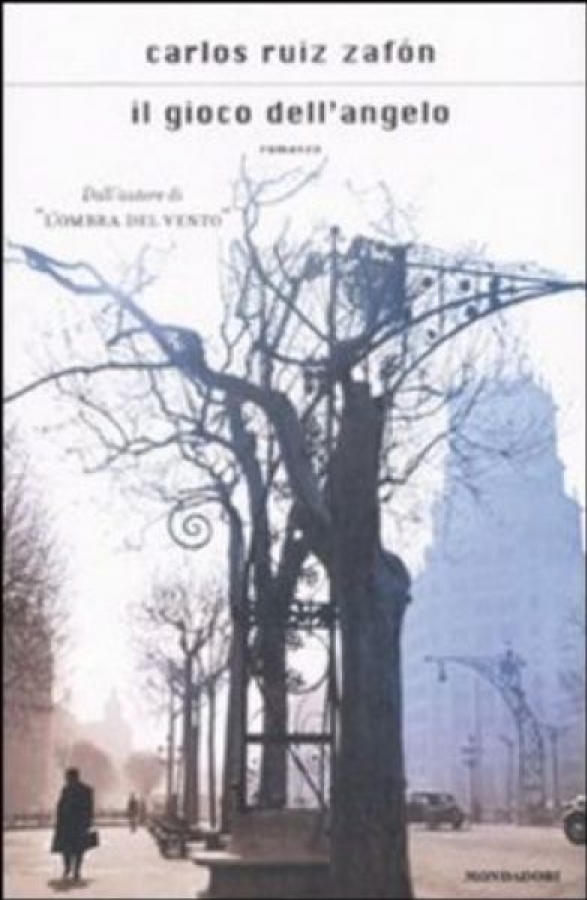
The Angel's Game
David Martin is a young journalist, who begins writing serialized stories for his newspaper. These stories meet with considerable success, and he is consequently put on salary by a publisher to write a series of novels belonging to a cycle entitled *The City of the Damned*. With the money he earns, he rents a mysterious house, abandoned for many years and previously owned by a strange character, Diego Malasca. Meanwhile, several plotlines intertwine: David is in love with Cristina, who convinces him to secretly write a book for a wealthy friend who wishes to become a famous author. He is contacted by a French publisher—who will later turn out to be the devil, or the personification of evil—who persuades him, for a handsome fee, to devise a new religion. At the request of a bookseller friend, he hires a young girl (Isabella) as his assistant, who aspires to become a writer. David, while continuing to write the commissioned book, launches an investigation to discover who the French publisher is and why he wants to formulate a new religion. At this point, a series of gruesome murders ensues, and David becomes embroiled in surreal and implausible events, all steeped, however, in mystery. In vain does Isabella try to bring him back to reality; David desperately pursues the mystery, and with it, his ill-fated love for Cristina. Everyone close to him, friend and foe alike, dies in a horrific and mysterious manner: Cristina, for example, having lost her mind, drowns in a frozen lake before the eyes of her friend. After a succession of grim events and terrible deaths, David manages to flee to a distant foreign land, only to meet the devil one day, many years later, who entrusts to him Cristina as a child, thereby opening up the prospect of a future. The scene faithfully mirrors a photograph David had found many years earlier, depicting the devil walking hand in hand with Cristina as a young girl. Mystery reigns unchallenged. What is the meaning of this book? There are, undoubtedly, numerous interpretative hypotheses: the construction of a religion of death that is nevertheless overcome by love, an unhappy love story, a "noir > inexplicable, a labyrinth of ideas and situations whose guiding thread remains elusive. I like to think that the common motif is the book itself. Books are the true protagonists of the novel, and with them, fantasy and imagination. At the beginning of the novel, when the author speaks of his childhood, David recalls that where my friends saw traces of ink on incomprehensible pages, I saw light, streets, people. Words and the mystery of their occult science fascinated me, and they seemed a key with which to unlock an infinite world > . At another point in the novel, Samperi, his bookseller friend, predicts that David will become a new Edgar Poe. And this writer indeed seems to be the guiding inspiration of the novel. Are the events narrated real, or the product of imagination and fantasy? Is it not always the *Cities of the Damned* dominating the scene? Could David have invented everything in a fit of delirium within the cursed house, or might he himself be the perpetrator of so many crimes? From this perspective, the character of Isabella gains meaning, embodying reality, concreteness, and pedantry in a situation where unchecked fantasy has run rampant. As the devil remarks, Everything is story, narrative, a sequence of events and characters that convey an emotional content". A complex book that nevertheless proves verbose and constantly in search of sensational effect, failing, however, to generate either genuine suspense or real action. Events unfold predictably, and in certain instances the overt borrowing of literary imagery is glaringly evident. In my view, the novel lacks life; it is formal and merely literary.
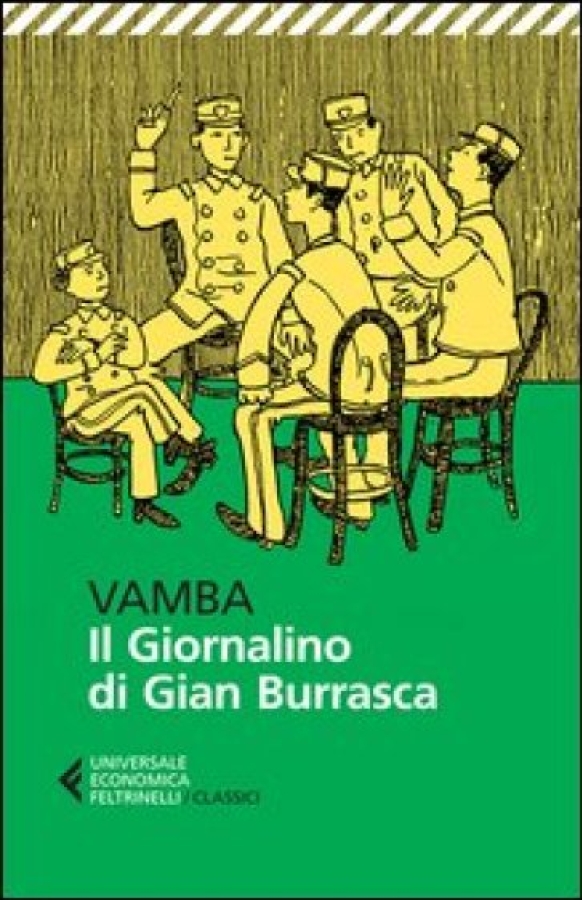
The Diary of Gian Burrasca
Vamba, the pseudonym of Luigi Bertelli, imagines having discovered *Il giornalino di Gian Burrasca* “from a portress, wife of a court usher, while she was reading it to her children”; indeed, Giannino Stoppani’s diary had long remained “forgotten among the files of the Judicial Chancellery, which will certainly come as no surprise to anyone who knows how everything concerning Italian Justice is protracted and oblivious, (...) wearisome and costly... > *Il giornalino di Gian Burrasca* begins on September 20 (the day of the capture of Porta Pia) and concludes on March 2 of the following year; the years are not specified, but they are likely 1907 and 1908, when the story was published in installments in *Il Giornalino della Domenica*. The setting is the typical bourgeois family of the early twentieth century, of modest means, constantly awaiting an inheritance and anxious to find a good husband for their three grown daughters. Giannino is the youngest, and we may assume he is around ten years old: mischievous, rebellious, always ready for new pranks, the consequences of which he fails to grasp, whether out of naivety or excessive shrewdness. After the lawyer Maralli, future husband of his sister Ada, nearly loses an eye due to Gian Burrasca’s latest stunt, to his mother who tearfully tells him: “do you see, my Giannino, how much sorrow, how many misfortunes because of you!...” Giannino replies “to comfort her, (...) but if they are misfortunes, excuse me, how is it my fault?” > The diary is divided into two parts. In the first, roughly 200 pages long, Giannino's antics unfold in succession—some hilarious, others frankly exaggerated, often repetitive in their narrative structure. Vamba harbors no pedagogical intent, as is the case with De Amicis’s *Cuore* and Collodi’s *Pinocchio* (for the latter, see the review on this site). A penchant for pranks prevails over everything. In the second part, Giannino is sent to a boarding school, where the boy discovers solidarity among peers and the meaning of revolt as a challenge to authority. Highly effective are the figures of the Headmaster and the Headmistress: he “so very thin and so very tall”, she “so very short and so very fat” and who calls her husband “idiot” > . She, after all, is the owner of the boarding school, founded by her uncle. And here unfolds one of the funniest episodes of the entire story. The boys realize that the pair are fond of séances in which they summon the spirit of the founder; by means of a ruse, Giannino and his friends fake responses from beyond the grave, but they cannot contain their laughter and end up being discovered. The diary ends on a bitter note. Humiliated by the Headmaster and the Headmistress because he is a poor boarder unable to pay his tuition, feeling unworthy in front of his peers, his friend Barozzo flees the boarding school: “he turned to me and threw his arms around me, holding me tight, so very tight; he kissed me and our tears mingled upon our faces, (...) and when I came to my senses I was alone, leaning against the main gate of the institute, which was shut.” The diary could have ended with this feeling of grief and shock over a friendship lost to wounded pride; yet instead, stubbornly, Vamba chooses to add yet another of Giannino’s stunts, thereby pinning the entire diary to its caricatured aspects. Through modern eyes, the atmosphere and episodes of *Il giornalino di Gian Burrasca* seem to belong to another society, distant from our own. For us adults, the diary can serve as an intriguing portrayal of the early-twentieth-century bourgeoisie, that which Guido Gozzano depicted with irony; a social structure that endured throughout Fascism and into the early postwar decades, until it was swept away by consumerism and the sexual revolution. To teenagers, I suspect Giannino may seem an incomprehensible boy, though they might appreciate his spirit of revolt against adults, who are perceived as a hostile, rigid, and downright hypocritical counterpart. Unintentionally, Vamba chronicled the generational conflict, albeit in a paradoxical and therefore implausible manner. The Tuscan cadence of the language makes Giannino’s diary a testament to a living, popular, and authentic Italian. And this is precisely why *Il giornalino di Gian Burrasca* remains an enjoyable read. Why read it? It offers a cross-section of an Italy that is no more.
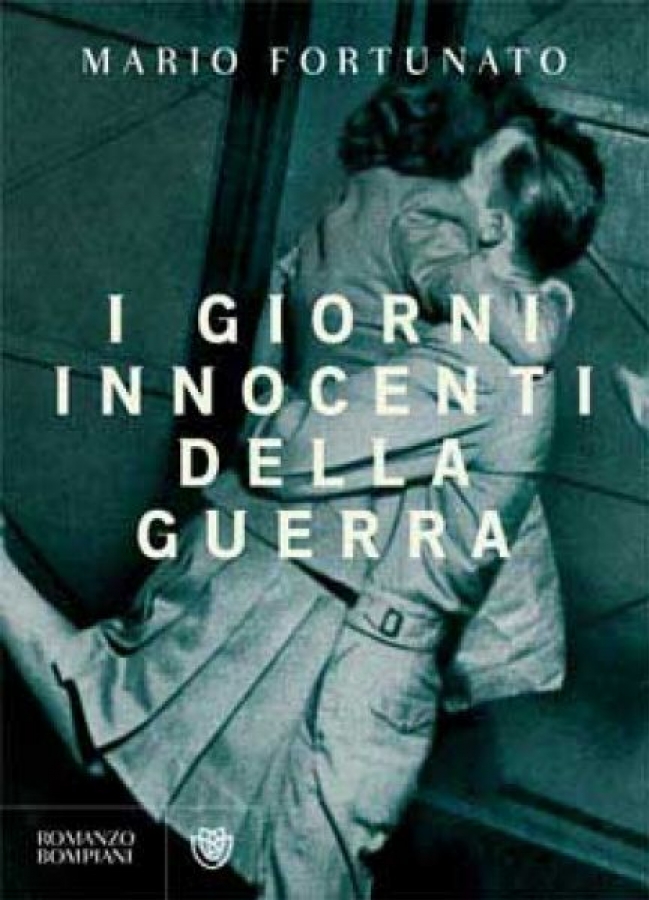
The innocent days of the war
During the Second World War, a series of personal storylines unfold across a small provincial town near Rome and in the great city of London. Stefano, a legal enthusiast employed at the courthouse, marries Nina as his second wife—a restless young woman who accepts a much older husband to please her family, but is in truth in love with Sergio. At the same time, Ally is an English pilot, homosexual, who is bound by a deep friendship to Edna, an eccentric English girl. Stefano and Sergio take part in the partisan resistance, to which Nina also makes a significant contribution as a courier. The young woman carries on a clandestine affair with Sergio, unbeknownst to Stefano, who is moreover having a liaison with a prostitute. The situation comes to a head when Ally’s plane crashes and he is hidden by Sergio: the two young men are caught showing affection to one another by Nina and Stefano, who realizes from the young woman's reaction that Sergio was her lover. Stefano returns home and sets it on fire, killing himself in the blaze. Nina realizes, too late, that she loves Stefano, while Edna comes to understand her deep bond with Ally, despite his homosexuality. The war is merely a backdrop that clarifies interpersonal relationships, which nonetheless remain grounded in the complexity and ambiguity of human emotions. As the author states: > life is nothing other than a great confusion. A disorder and a turmoil of things and feelings, which ultimately, however, is all that binds us to others and makes us love them .
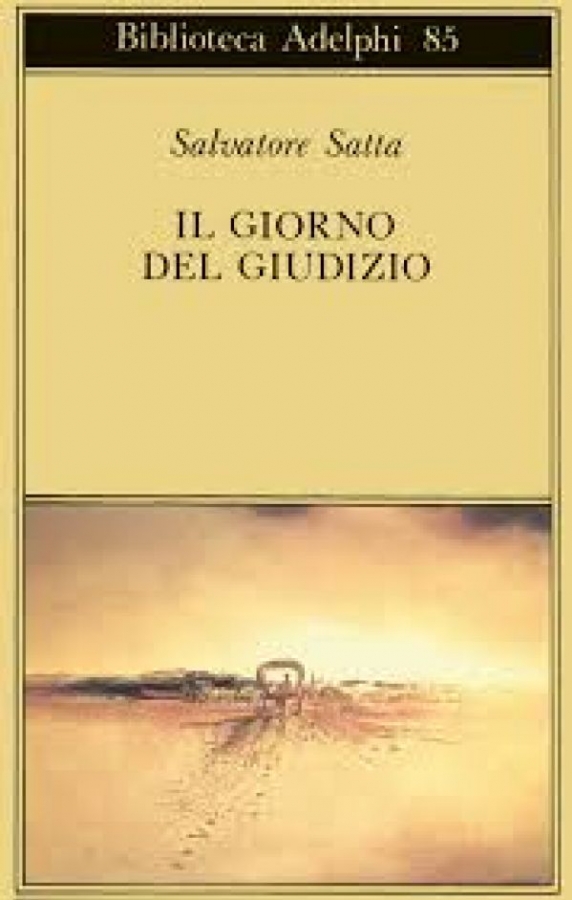
The Day of Judgment
A few years before his death, an illustrious jurist retraces his childhood in a timeless Nuoro; and > as in a developing negative, distant faces reappear, (...) and perhaps, as I think of their life, because I write their life, they sense me as a ridiculous god, who has summoned them on the day of judgment, to free them forever from their memory . It could easily be a mundane autobiography, interesting merely for its depiction of a Sardinia (between the nineteenth and twentieth centuries) where there still existed > a magical sense of things, whereby every act was a ritual, every word the echo of another word, every occurrence a mystery , and the only hope was «to create ghosts to cling to». Were it only this, the book could rest forever on dusty shelves, alongside all too many family chronicles and nostalgic, often folkloric descriptions of a society that no longer exists and can never return. The novel endures, however, beyond its context, because it speaks of another matter altogether: death as the dissolution of memory. Since > each of us, even if we merely look within ourselves, sees ourselves in the fixity of a portrait, not in the succession of existence , the novel is likewise composed of characters and episodes that appear, at first glance, isolated and repetitive; the reader derives from it a sense of fragmentation and incompleteness, of a confused and superficial narration. One longs for more, especially when the author addresses the core of the narrative: the patriarch father, authoritarian and absent; the mother, seemingly marginal yet pivotal in the care of hearth and children; the numerous siblings; the manifold books gathered with love, through which > fantasy entered the austere house (...) and operated silently, touching men and things with its magic wand . We would like to know more of young Sebastiano (behind whom the author conceals himself), of his bond—both joyous and unhappy—with his brother Peppino, of their shared passion for bookbinding, of «a childish industry», meaningless perhaps, yet an expression of the «imagination of the gratuitous». Instead, we are left disappointed, for the myriad stories and characters must converge upon a single objective, both narrative and existential: the day of judgment, the extinction of memory, and with it, of existence itself. Sebastiano is on the verge of leaving Nuoro to study in Sassari. The author treats this episode fleetingly, almost as if he wished to forget it. Donna Vincenza, the mother of many children, > prepared his provisions with good breaded cutlets and sugar-dusted fritters. Sebastiano left it all behind, ashamed of his mother, (...) and departed in the dark of night, like someone eager to belong to others . And what of Pietro Catte, who had gone to the mainland to make his fortune, and who one day stepped off the coach, «amid sneers and taunts», and «like an automaton joined the procession», following the summons of the driver, > the devil himself, with horns and a pointed beard and a twisted tail , who led him to hang himself from a great oak tree. And Gonaria, who spoke with God and was betrayed because God let her brother, the canon, die; whereupon the poor woman locked her brother’s room forever, only to open it twenty-five years later and discover it had become a nest of mice, woodworms had devoured the furniture, and clusters of cobwebs hung from the ceiling. > If one does not die, one lives. And this truth, which seems obvious, is on the contrary fraught with consequences, because life transforms everything; nothing withstands its implacable truth. (...) To know oneself, one must play out one’s life to the very end, to the moment one is lowered into the grave. And even then, there must be someone to gather you up, resurrect you, recount you to yourself and to others, as in a final judgment . It is not an easy book: numerous characters and stories follow one another without any apparent order. Often one must pick up the thread of the narrative again; if instead one surrenders to it, the mind turns to oneself, to one's own life, to the memory of those who shared it with us, and to how this memory has dissolved over time, because «if one does not die, one lives». And then one realizes that it is not so important to keep a «chronicle» of existence as it is to wander in remembrance, because, as the author says, it is not a matter of another’s destiny, but of our own; and there comes a moment when we too face our final judgment. Aiding the reading is a refined, simple, and elegant prose: traces of juridical language can be glimpsed; far from being a flaw, this lends slowness and deliberation to the narrative; it is what one expects, and it keeps the portraits, their characters, and their stories from being trivialized. One must allow oneself to be ensnared by the tale, just as our memory, clouded by time, runs along the course of our life. Why truly remember the past, when it is better to be guided by the imagination? Only myth opens our hearts to mystery. Why read it? Pleasurable and profound.
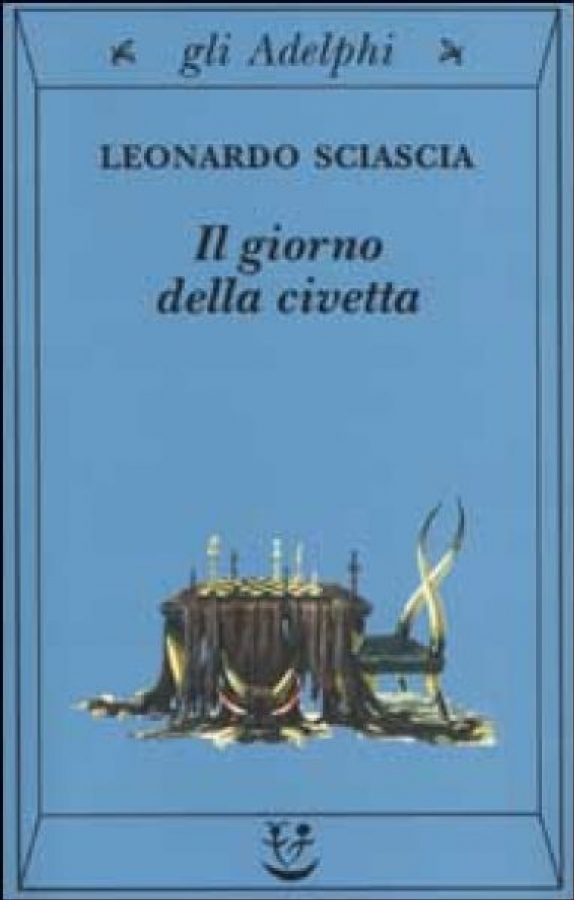
The Day of the Owl
The setting is once again Sicily, and the subject is mafia murder. A Carabinieri lieutenant from Parma, stationed on the island, finds himself investigating the murder of a small building contractor, soon followed by the killings of a peasant—a pruner by trade—who had recognized the assassin, and of a police informant who had named the instigators. Dismissing the crime-of-passion angle (the pruner’s wife had a lover), the lieutenant skillfully manages to extract a confession from the hitman and the man who commissioned him, tracing the trail back to a powerful mafia figure and risking the exposure of connivance with the political sphere. A member of parliament and a government minister may be implicated, both intervening repeatedly to halt the investigation. In the end, it is the mafia that will provide the three suspects with «illustrious alibis». While on leave in Parma, the lieutenant learns that the killer and the instigators have been acquitted, and that the crime-of-passion lead has been reopened. After dinner with friends, the lieutenant «felt like a convalescent: intensely sensitive, tender, hungry». «To hell with Sicily, to hell with everything»....He walked back home around midnight, crossing the entire city on foot....but before reaching home he knew, with lucid certainty, that he loved Sicily and that he would return. «I’ll break my head against it,» he said aloud. With subtle irony, the author constructs a plot suspended between the detective story—fraught with suspense at times—and the political novel, focusing on the ambiguity of power (magnificent, in this respect, are the exchanges between the member of parliament and other institutional figures whom the reader is deliberately not allowed to identify) and the perhaps natural collusion among the various tiers into which power itself is structured. Precisely because power is the fundamental theme, one of the book’s most famous scenes appears genuinely out of place: the passage in which the mafia boss expounds his vision of society to the lieutenant (men, half-men, pigmies, arse-takers, and *quaquaraquà*), introducing folkloric elements and a trite sociology that diminish the intellectual weight of a work that is not merely about Sicily and the mafia, but seizes upon the mafia crime as an opportunity to reflect on power as an obscure, invulnerable force. It is for this reason that the novel achieves universality, transcending its historical and social context. The style is brisk and brilliant, driven by a narrative momentum that suffers rare lapses in tension (most notably in the aforementioned soliloquies of the mafia boss). The syntactic structure and language are lean yet incisive, entrusting their expressive force to narrative cadence, the careful deployment of adjectives, and the seamless transition between clauses. Sciascia remains an essential reference point for the Italian language.
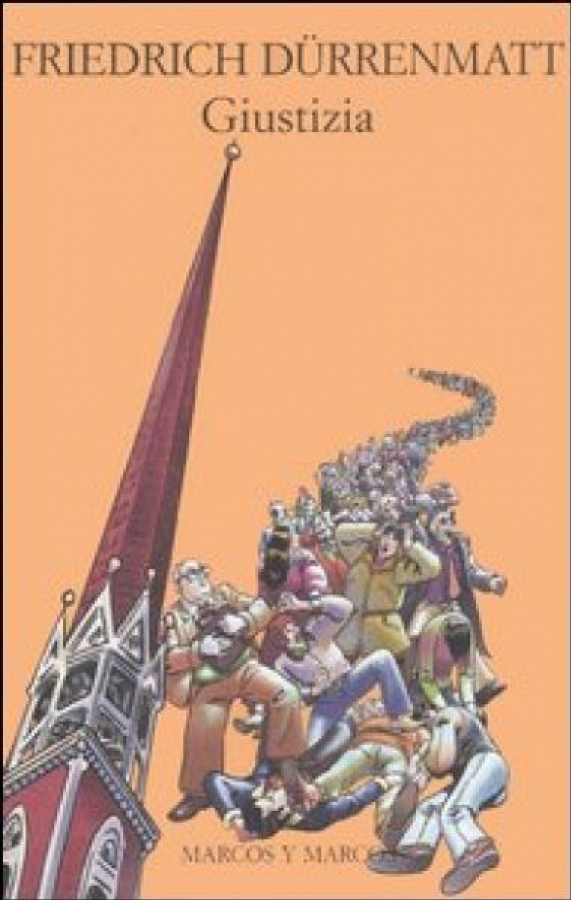
Justice
The novel recounts a paradoxical story. A cantonal councillor murders a friend in a restaurant before a crowd of witnesses. Once in prison, he hires an attorney (the author of the manuscript) to identify a different killer. The attorney gathers a body of information that leads to the cantonal councillor’s acquittal before the court of assizes. Convinced he was merely a pawn of the councillor (who is, in truth, the real murderer), the attorney attempts to kill him, but misses his mark. The novel concludes many years later, when the writer (Dürrenmatt himself) comes to learn the underlying motives of the murder and the actual sequence of events that led to the crime. The dominant theme of the novel is the incomprehensibility of reality and its potential inversion into absurd situations, devoid of logic and of any social or historical meaning. As the author writes, > is the story that became real only in my imagination and that now, written down, recedes from me, perhaps more absurd than the history of the world, less solid than the ground upon which we build our cities? . This philosophical theme is translated into a relentless narrative pace which, moving from a traditional structure (reminiscent of a nineteenth-century novel), evolves into a succession of characters and events that overlap and intertwine across different temporal planes. The style likewise turns convulsive, composed of short, truncated sentences so as to manifest the author’s agitation and the absurdity or inherent lack of logic in the events and situations described. It is, however, a novel entirely folded in upon itself: there is effectively no plot to generate a shred of suspense or compel the reader onward; the characters seem devoid of genuine depth and individual character, almost marionettes in the hands of fate; the descriptions of settings are repetitive. It is, in fact, a tedious, intellectualistic novel that fails to give artistic form to the philosophical theme at its foundation. Confirmation of this lies in the fact that its most engaging and readable sections are precisely those that assume the character of an essay.
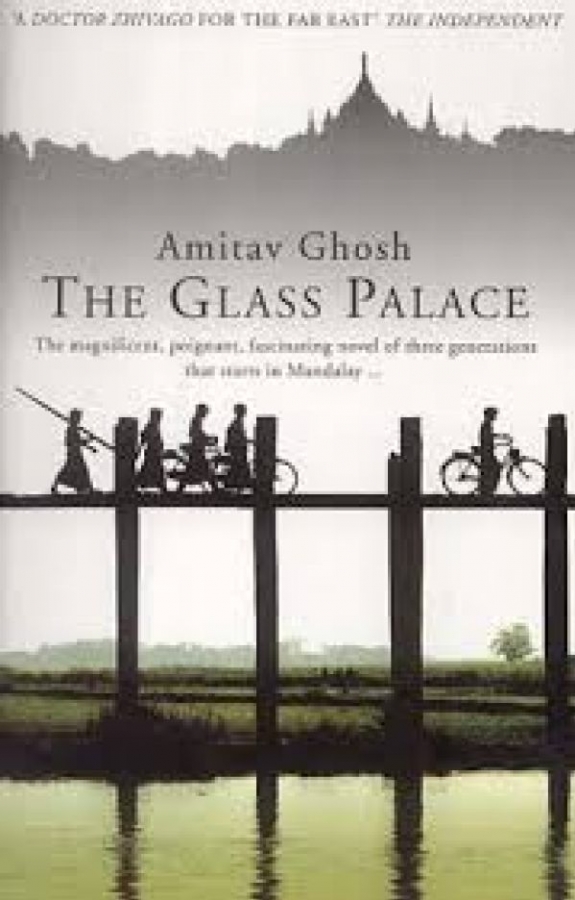
The Glass Palace
It is an insignificant book. It is set in Burma after 1886, when Britain transformed this vast kingdom into a province of British India, exiling its last sovereign. *The Glass Palace*, the novel’s title, is a metaphor for a world overtaken by imperialism and capitalism—forces to which one must adapt on pain of extinction or, at best, oblivion. The protagonist, Rajkumar, is a young boy, > a ragged Indian... with a sort of watchful determination.. there was no simplicity in his face, no innocence: his eyes were full of practicality, curiosity, appetite. He was as he was meant to be . Tradition, cultural roots, and ideal values can find no home when everything is upended and one must survive, and if possible, grow rich. Yet even in Rajkumar, already an adult when still a boy, there is room for bonds of affection and loyalty that are not > related to himself and his immediate needs, which was almost incomprehensible . It is precisely during the looting of the royal palace that the protagonist meets Dolly, the twelve-year-old handmaiden to the little princesses, daughters of the defeated and humiliated monarchs. A love is ignited that will never leave Rajkumar. The story unfolds along parallel tracks, allowing us to follow the protagonist’s social ascent alongside the life of the royal family, isolated and closely watched by the British. Amid the ruin of the ruling dynasty, Dolly matures into a reserved woman, seemingly timid, yet self-assured, cultivated, and independent. She marries Rajkumar, who has in the meantime become a wealthy businessman, young yet already portly. Yet does she do so for love, or simply because she wishes to escape a sort of gilded cloister? I cannot answer the question of whether the marriage of Rajkumar and Dolly is the fruit of true love, or merely the desire of both to trade the old for the new, tradition for the culture of dominant British imperialism. When I realized that after hours of tedious reading I was still only at 40% of the novel, I put the book aside, defeated by the flimsiness of the plot, the shallowness of the characters, and the pedestrian quality of the writing. Reading Ghosh’s book makes one want to reread Kipling’s *Kim*: a sinister bard of British imperialism, to be sure, but a writer of an entirely different caliber! Why not read it? It is tedious, pointless, banal.

The Glassmaker (the master glassmaker)
In this novel, Tracy Chevalier, author of the bestseller *Girl with a Pearl Earring* (see the review on this site), measures herself against Venice, the “City of Water,” and one of its immortal treasures: Murano, the “Glass Island.” In the preface, Chevalier wonders > whether the artisans of the City of Water and the Glass Island seem to age more slowly than those in the outside world. (...) Painters, writers, carvers, knitters, weavers, and—why not?—glassmakers: creators often live in a suspended state that psychologists call flow, where hours pass without them noticing. An admiration for art led the author to devise a narrative that purports to trace Murano's history across the centuries, from a primal state of perfection and isolation to present-day reality, steeped in consumerism and craftsmanship alike. It is a grand historical fresco that prompts Chevalier to resort to a bold device: the story of Orsola and her family recurs through the centuries, with the same characters, passions, and vicissitudes, in an ever-shifting context. We begin in 1486, in a Venice still powerful and wealthy, moving to the early eighteenth century, when the decline of the Serenissima has become undeniable, and then on to the handover to Austria in 1797, when Venice lost its independence, up to the First World War and years closer to our own. A bold device, I said, because Orsola does not age at the pace of History, but much more slowly; and while this may symbolize Venice’s immobility, this literary expedient renders the narrative implausible. It is better, therefore, not to follow the author across the entire novel, but to linger on the first part, “Goblets, Beads, and Dolphins”: set in 1486, it encapsulates the essence of the book. Orsola is a girl, later a young woman, born into a family of Murano glassmakers. She yearns ardently to learn the craft. > Orsola’s life revolved around an endless pile of laundry, tending the vegetable garden, and cleaning chores, but whenever she could, she found ways to slip into the workshop under the pretext of delivering messages or bringing biscuits to the workmen. (...) Then she would have lingered to watch them fashioning vases or tumblers and decorating goblets. Secretly, she visits a rival family, seeking out a woman who is a renowned artisan and merchant. This woman teaches her how to make glass beads and advises her to work on them in the kitchen, away from the workshop. It seems like a minor subterfuge, but these beads will ultimately save the family financially upon the sudden death of Orsola’s father, taking with him much of the workshop’s masterly skill. Chevalier is adept at painting the setting and familial dynamics, explaining glassmaking techniques, and depicting the Venetian merchants who enrich themselves off the isolation to which Murano was condemned by the Republic’s regulations. The incompetence of the eldest brother, who has assumed the role of head of the family and fails to grasp the importance of commercial ties, forces Orsola to venture into Venice—to discover the “City of Water” with its canals and gondoliers, taverns and brothels, the magnificence of its palazzi, and its disreputable quarters. > It seemed as though every gondolier on the canal was cheerfully hurling insults, almost singing: > Buzaròn, Mona!, Magnamerda!, Visdecasso!, Cover your ears, Giacomo shouted, and she laughed at the vulgarities Together with the city and its merchants, Orsola also meets the handsome fisherman, with whom she falls in love, breaking once again the rigid rules of Muranese society, which dictated marrying within the same families to preserve the secrets of the trade and the island's isolation. Maliciously, perhaps, the handsome fisherman > gets hired as an apprentice in the workshop, learns the art of glassmaking, and then flees abroad, taking with him the closely guarded knowledge and skills. Was it love, then, that ended a monopoly ensuring wealth and prestige to Murano and Venice? We may well believe it; yet the fact remains that Orsola is left waiting for a longed-for love, whose sole token will be a glass dolphin > , sent to her across the centuries. We must admit that Chevalier is no Ken Follett, if we wish to frame her within the realm of historical thrillers: she lacks the ability to pace the narrative, to create surprises and plot twists (on this site, one can read reviews of Ken Follett’s *A Place Called Freedom* and *World Without End*). As with the English author, the characters lack psychological depth: for instance, the figure of Orsola, a tenacious yet unhappy heroine (what is this woman's mystery?), is not analyzed in her human and sociological dimensions. Yet how could she be, when the author traverses centuries as though a fifteenth-century artisan shared the exact same inner life as a woman of the eighteenth or twentieth century! Chevalier possesses an elegant style of writing, an enjoyable English with linear, limpid syntax; an extensive yet accessible vocabulary makes for effortless reading without diminishing its quality. Her attention to the Venetian vernacular, the precise environmental descriptions (such as the actual routes between the island and the city), and the explanations of glassmaking techniques and commercial mechanics all demonstrate how deeply the author immersed herself in the history, and above all in the “City of Water” itself. Ravaged by tourism and the abandonment of its inhabitants, Venice still retains an incredible allure, captivating and commanding love, even as we strive to destroy it. Why not read it? In the end, it is prolix and implausible.

God help the child (Children first)
For many of us, childhood was a source of suffering. > And each will rewrite this story forever, knowing the sorrow, imagining the plot, inventing its meaning, and forgetting its origin . Then one day we discover that > you accepted like a beast of burden the weight of an incomprehensible curse and the unjustified threat that binds you to wounds and leaves you with a fate; and you spend your life denying, even though that hateful word is only a fragile line drawn on a rock, quickly dissolved at any moment by the force of the sea . But what is this force? The author seems to suggest it may be love, attested by the birth of a child. Two young people meet by chance, each bearing a secret. Bride was born with skin of a “terrible color”: black. She repulsed her mother to such an extent that she never touched her, even though it was hardly the child’s fault, but rather the twenty percent Negro blood in her family. Still a young girl, in an effort to gain acceptance Bride commits a terrible act: through her testimony, she sends a woman to prison by accusing her of sexual molestation, knowing full well she is innocent. Booker is a brilliant young man and a talented musician; his life was shattered by the death of his brother, raped and tortured by a sexual predator. He wishes to live in memory and has run away from home, confronted by his family’s refusal to persist in perpetual commiseration. They spend six intense months together, marked by overwhelming passion and a profound communion of purpose and feelings; yet both keep their painful secrets hidden from one another. And then, one day, Booker walks out, simply saying: “you’re not the woman.” Did he do it, perhaps, because she is Black, despite being glamorous and wealthy? Can neither beauty nor success overcome racism? Is it still the ancient sin of being born with that skin color? Bride wants to know; she sets out in search of Booker, eventually finding him at an elderly aunt’s home. While searching for him, a strange phenomenon befalls her: she reverts to being a child, as though life were starting over from the beginning: > a child. New life, immune to evil or disease, protected from kidnapping, violence, rape, racism, insult, hurt, self-loathing, abandonment, Error-free, All goodness. Angerless. Or so they believe . Through this inexplicable transformation, Bride frees herself from guilt and is ready to confess the terrible truth, as well as to embrace Booker’s suffering: she realizes he left her because he loves her, > so as not to overwhelm her with a grief so deep it would have broken her heart : > Now she is pregnant. Good luck. (...) Listen to me, You are about to find out what it takes, what the world is like, how it works and how it shifts when you are a parent. Good luck and God help the child . It is difficult to grasp the narrative line of this novel; too many themes overlap: violence against children, racism, liberation from suffering, and perhaps others besides. The plot is muddled, and the constant shifting of narrator (the mother, Bride, the friend, the third-person narrative) certainly does not help; on the contrary, it disorients the reader by forcing them to piece the overarching thread back together, without adding anything to the understanding of the story or the characters. What redeems the novel is the prose: even if weary when compared to the author’s other works, it still manages to enthrall with its elegant, muted syntactic construction, with words so evocative as to create expectations of meaning that nevertheless slip away and remain suspended. In short, one is left somewhat disappointed. Why read it? It is intense.

A Golden Age: Days of Love and War
The novel is set in Bangladesh during the brief yet bloody war of liberation from Pakistan, from March to December 1971. The author traces the events from the perspective of Rehana: a woman who wishes merely to be a wife and mother: > she had married a man she did not expect to love; she lived a life of composure, a life with few surprises. She had asked her father to find her a husband with few ambitions. Someone whose wealth would not suddenly dissolve . And yet the woman finds herself widowed, without an income. Fragile and defenseless, she lacks the strength to prevent her brother-in-law from taking away her two children, Sohail and Maya. The desperate longing to have them back leads her to commit an act inconceivable for her, a religious woman observant of traditional norms: she steals jewels from a blind man and manages to reclaim her children by proving she has sufficient income to raise them. Having allowed her children to be taken from her, even if only briefly, leaves a deep wound; it fosters a sense of guilt in Rehana that shapes her relationship with them. She is a widow; she has left the children fatherless, having chosen not to give them a new parent. When the people in revolt declare the independence of Bangladesh, Rehana > felt certain that everything would resolve itself: (...) the country would become her home, and the children would continue to be her babies. Suddenly the world would be righteous on its own, and they would go on living ordinary, unexceptional lives . Yet, > a war had come to find them. Whatever was going to happen had already happened; now they would have to live in its shadow. We might wish to live in peace, leading an existence made up of small things (cooking, tidying the house, tending the garden, raising children, delighting in their love), but war arrives, and nothing is ever the same again. The novel does not grapple with the grand theme of war and peace; rather, it chronicles the inner journey that leads a slight, thirty-five-year-old woman to take an active role in her people's struggle for freedom, against a cruel and ruthless repression. At first, Rehana does so for her son, who has joined the Resistance; later, she acts out of a commitment to fight for the independence of Bangladesh. Rehana allows the partisans to hide ammunition and dynamite in her garden, shelters an officer of the liberation army critically wounded in an attack, and finally, courageously frees a prisoner by showing up alone at the prison and bribing the guards. Why does she risk her life? > I want to do my part. Maybe it isn't for my son, maybe it is something else. You don't think I can love anything other than my children? I can, I can love other things. Along this journey there are two pivotal moments in which a sort of stripping away of her innermost essence takes place. At her daughter's request, she decides to use her most precious fabrics to make blankets for the partisans: > the saris lay before Rehana like images in a photo album, evocative, a little accusatory Yet why not do it, if Maya dressed in white (the color of widowhood) to signify her contempt for luxury, and perhaps also an everlasting mourning for her father? > We are at war, (...) To prove that I belong here. That is why I am doing something . She severs ancestral ties as well. At the war's end, she visits her brother-in-law in prison—he who had fought and tortured partisans, and who now appeals to family ties in asking her to secure his release. > She is about to utter the obvious, expected words—“out of respect for my husband”—but then the sight of all of them, Joy and Aref and Mrs Sengupta, appeared before her. Yet even so, she might have forgiven him, but then she remembered the look on Maya's face when she learned of Sharmeen (her daughter's best friend, raped and slaughtered), and those first days of the war when she realized she would not emerge from it with her entire world intact And she said: > I cannot forgive you, brother. For my daughter's sake, I cannot forgive you. It is an intense book, in certain passages rich in action, which lends pace and suspense to the narrative. The author skillfully navigates two planes: family relationships and grand History, which, as is often the case, is compressed into a few months. The pivot around which the tale revolves is the mother-daughter relationship. For Rehana, it is taken for granted that Sohail will commit to the struggle, even if she is overwhelmed by fear for his life. She does not accept Maya's behavior. Toward her daughter, social prejudices and difficulties in communication and mutual understanding converge. When Maya leaves her mother to cross the border, intending to fight from there for the revolutionary cause, Rehana expresses her anguish and urges her to be careful. Yet her daughter tells her that it is she who is always worried about her mother. > Rehana was surprised to hear these words, but she understood that it had to be true, (...) a small window into her daughter's sealed heart. It was not that she was distrustful; she was burdened. Burdened by her beloved father, by the one who was gone, by her own widowed mother . It is a pity that this splendid book falters in its ending, which is muddled, rushed, and in certain respects implausible. The book is sustained by an elegant style, simple and effective syntax, and vocabulary that is refined in English while simultaneously enriched by words and idioms native to Bengali. Here we encounter that long-awaited blending of English with the local tongue, rare among writers of the Indian subcontinent. Why read it? A magnificent read, which transcends the specific history of Bangladesh to become a tale of all wars of liberation.

Gomorrah
*Gomorrah* is a book about the Camorra—that is, about what is known as the "System." Yet in reality, it does not merely recount criminal affairs; it investigates the deep entanglement between economy and crime, and the awakening of a consciousness toward a corrupt world against which one must rebel, first and foremost through information and denunciation. The book opens and concludes with this nexus between economics and criminality. The apparel industry, waste collection and disposal, and the building trade are all "legitimate" sectors in which major corporate groups exploit the Camorra to turn a profit and circumvent market regulations and the law. A large portion of the book is then devoted to the unprecedented, ruthless violence of the gangs and Camorra families: an unbridled war that strikes enemies and innocents alike. Now and then, isolated voices courageously emerge: a priest, a young schoolteacher, a magistrate, and so forth. The book can be read as a journey of mounting awareness regarding the state of abandonment in which Campania has been left—a condition of which all its inhabitants seem to be victims, from ordinary citizens to the criminal foot soldiers, up to the bosses themselves, whose fate appears sealed: either to be murdered or to end up behind bars, condemned to life imprisonment. Yet why does all this happen? Why has this region been turned into the cesspool for all the country’s toxic waste with the acquiescence of local elites? To these questions, Saviano seems to offer a definitive answer: > a looted wealth, painstakingly seized by someone and dragged into their own hole . This sentence encapsulates Neapolitan society, yet it holds a broader truth that concerns the entire country. The total absence of any sense of community, save for that of the clan; the cultural dependence on stereotypes (Camorra bosses imitate cinema, not the other way around); and the myth of violence are all cultural premises of a society that readily allows itself to be subjugated by dominant economic interests. In this sense, the Camorra bosses are destined to pay the price for those pulling the strings in the shadows: > the bosses who decide not to repent live off a metaphysical, almost imaginary power but > bosses always pay, they cannot not pay. They kill, they command military squads, they are the first link in the extraction of illegal capital, and this will always render their crimes identifiable, never diaphanous like the economic crimes of their white-collar counterparts . Against this state of affairs, Saviano, and a rare few others, rebel. Standing before Pasolini’s grave, the author feels he is "less alone." > And there I began to mutter my rage, fists clenched so tight that my nails dug into the flesh of my palms. I began to articulate my *I know*. The *I know* of my time... I know where the pages of economics textbooks vanish, mutating their fractals into matter, things, iron, time, and contracts. I know . And thus rises the cry of revolt: > let us not permit, men, that our lands become places of the Camorra, that they become one great Gomorrah to be destroyed . Yet can such a cry find an answer in an Italy as hidebound and stagnant as that of today?
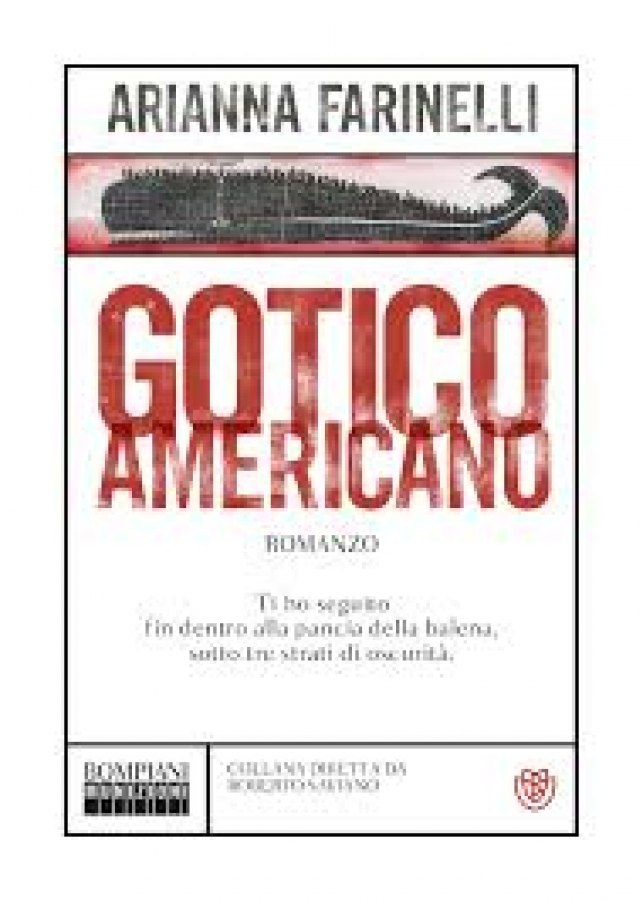
American Gothic
The novel is set in New York and chronicles the life of Bruna, an Italian political science professor who relocated to the United States to follow her husband Tom, an Italian-American physician. The mother of two children, Minerva and Mario, she falls in love with one of her African-American students, Yunus, who will later go on to fight for ISIS and die in the defense of Mosul. This alone would offer plenty of themes, yet the author piles on far more: the decline of America, racial and social rifts, the integration of diverse cultures, terrorism, and Islamophobia. In the notes at the end of the book, Farinelli attempts to provide a unifying interpretive thread, locating it in identity and its multifaceted aspects: religious, political, class-based, sexual orientation, and generational conflict. > I believe that beyond national borders and the ethnic, cultural, and religious differences that define and often divide us, we are first and foremost citizens of the world, and I hope that one day we will also be citizens of the same cosmopolitan democracy . Bravo, Professor! But where is Bruna? In spite of everything, the novel is not a political treatise; it is the tale of the protagonist's life. So let us start with Bruna. The narrative opens at the end: Bruna has just learned that her student lover is an ISIS fighter; it is the day of Trump's victory; to put little Mario to sleep, Bruna has recited an episode from the Quran, the moment Yunus was cast into the belly of the whale and saved by God because he was a righteous man. Why does God not save every man, as the Black American slaves once sang? She ought to answer her son, but > the words choke in her throat. (...) With her fist, she keeps clutching the scrap of black silk as if trying to crush that darkness. Mario then takes her face in his hands and softly strokes her cheeks, right where tears have begun to fall, carving pale rivulets through the heavy makeup...(...) I lied to everyone . Her life is in shambles; convinced she could make it on her own, she clashed with Tom's Italian-American family, fighting their prejudices and their meddling—she could have been more conciliatory and submissive; she tried to make Tom into a strong, self-reliant man, refusing to accept his nature as an eternal child; she lacked ambition and a competitive edge, abandoning her academic career; and then Yunus arrived and left; she could have told him she was pregnant, but > silence had swallowed all words, perhaps because nothing they might have wished to say had the power to change the course of their lives. (...) We can smooth the surface, soften the roughness, fill in a few cracks, but change—no, not even for love . And yet, there is an anchor in this desolate resignation. Minerva > slips her cold hands under her mother's nightgown. She rests them on her warm belly, as if to feel. (...) Don't worry about anything, I'll help you . And the fragile Mario, who had become Maria, > had embraced her and then laid her head on her lap, her face pressed against her womb . Dear cosmopolitan professor, in the end it is our very own Italian familism that saves us! The novel is a missed opportunity. The great theme of love remains in the background. We catch a glimpse of how difficult it is to love when so many idealisms engulf us and we remain suspended, unfulfilled, incapable of bringing clarity to the relationships with the people in our lives. Swept away by events and sudden shifts, Bruna could have delved into the reasons behind her presumed failures, perhaps discovering that she had gained a deeper understanding of herself, of what she was and what she had wished to be. Driven by lofty political aims, the author failed to explore what truly mattered in the story, what would have made it compelling. And so Bruna's life slips away like pebbles down a slope; as the poet wrote, > nothing changed within your life / the years that slip so easily into shade / when a single torch suffices in the dusk / and the descent is almost an ascent . (Marino Moretti, “La Madonna del Sassoferrato” from *Poesie Scritte col lapis*, 1919). The narrative is further compromised by the writing and style. The prose unfolds hesitantly; initially marked by short sentences and heavy punctuation, it later grows more expansive, yet remains stubbornly banal, lackluster, and pedestrian. The narrative pace is sluggish, burdened with lengthy ideological lectures and the frequent repetition of a handful of actions, hardly enough to inject dynamism and suspense into the novel. The characterization is flimsy: the characters undergo no evolution over the course of the book; everything feels predictable, thoroughly worn out. Why not read it? Prolix and pointless.
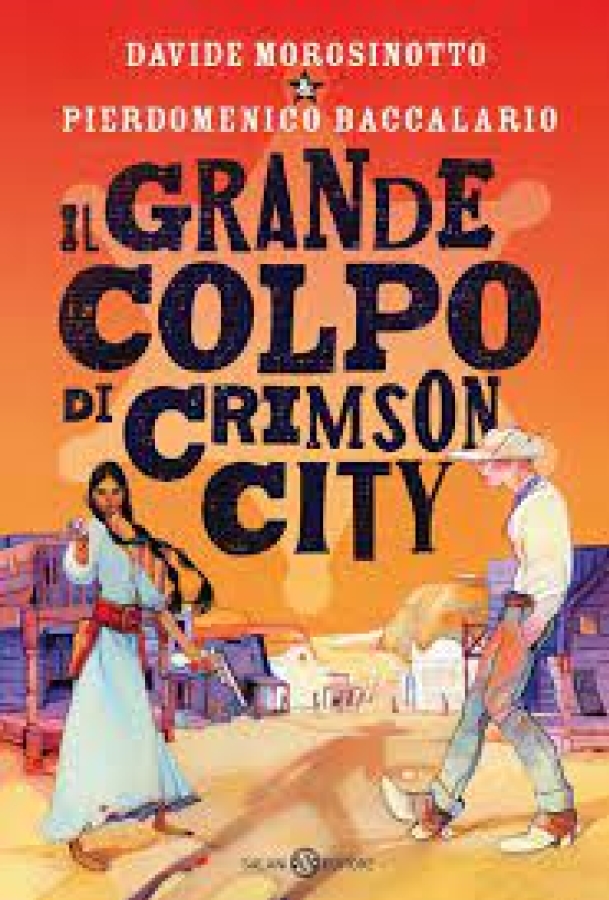
The Great Heist of Crimson City
Crimson City > had only a single dusty street that branched off at one point into a single dusty crossroads. A church, a laundry, a post office, a general store, a bank, a hotel, a saloon. Everything had a rundown, filthy appearance, bleached by the sun, as if the surrounding desert were trying to swallow the town one bite at a time, (...) as if into the space of twenty houses and three streets they had crammed an assortment of wreckage and remnants of a real city, one with a plan, an intention, a future. Roy had arrived a few years ago. > He's a good kid, the sheriff said hastily. > Just think: he stepped off the train all by himself eight years ago, and he’s been here ever since. (...) He works hard, never a complaint. He’s become one of our own. One day, two people arrived from the desert: a man, whom everyone took to be the famous Sheriff Pickett, and a half-breed girl, who introduced herself as his sister. Piper > was so swaggering, tough, sleek, with two pistols strapped to her thighs, slender bones, spring-loaded muscles, and a devilish glint shining in her eyes. They had received a letter from the sole survivor of the Gordon brothers' outlaw gang—men cut down by Sheriff Pickett, evidently all except one, who was now seeking vengeance in a duel, right in this miniature town. While the townsfolk, trembling yet thrilled, awaited the killer's arrival, love blossomed between Roy and Piper: the boy seemed timid and apprehensive before the brazen, weapon-savvy gunslinger; Piper began to be drawn to Roy’s gentleness and naivety, apparently fragile and defenseless. Are we facing the classic tale of a romantic boy who falls for a mysterious, strange, and stunning girl waiting to be rescued by a knight? Will Roy realize that passion alone is not enough to save his beloved? Much like what occurs in Fabio Geda and Marco Mugnone’s *Il lato oscuro della Luna* (see the review of the novel on this site). Then, suddenly, we discover that Roy is far different from who we believed him to be. The boy is the sole survivor of the Gordon brothers, and he has come to Crimson City to slaughter those who destroyed his family: Sheriff Pickett and his daughter. Will love prove stronger than vengeance, or will Roy press on toward his goal, seeking Piper’s life as well? I leave it to the readers to choose their preference. For my part, I would have welcomed an ending akin to *Il Corsaro Nero*, who fell in love with his enemy's daughter yet pursued his revenge, abandoning his beloved in a boat adrift at sea. > Amid the moans of the wind and the roar of the waves, muffled sobs could be heard at intervals... Look up there! The Black Corsair is weeping! (you can read the review of Emilio Salgari’s novel on this site). Are we certain Roy came to Crimson City merely for revenge, or did he harbor other motives? The plot is well-constructed. In the first part, the premise of a miniature town cut off from everything—where the sole link to the civilized world is a train passing every two weeks—is compelling: an insular community governed by its own dynamics, waiting for unlikely change. Still, the narrative proves somewhat tedious and flat. Then comes an unexpected twist, and the novella turns into a suspense-laden thriller. Perhaps the resolution should have been less cloying; instead, it lapses into a Hollywood-style "happily ever after." The prose is very simple, perhaps overly so, even for a novel aimed at young adults; the narrative framework relies predominantly on dialogue and action, to the detriment of vivid descriptions and nuanced psychological depth, leaving the characters' choices and motives rather thinly drawn. Why read it? It becomes genuinely gripping after a sluggish start.
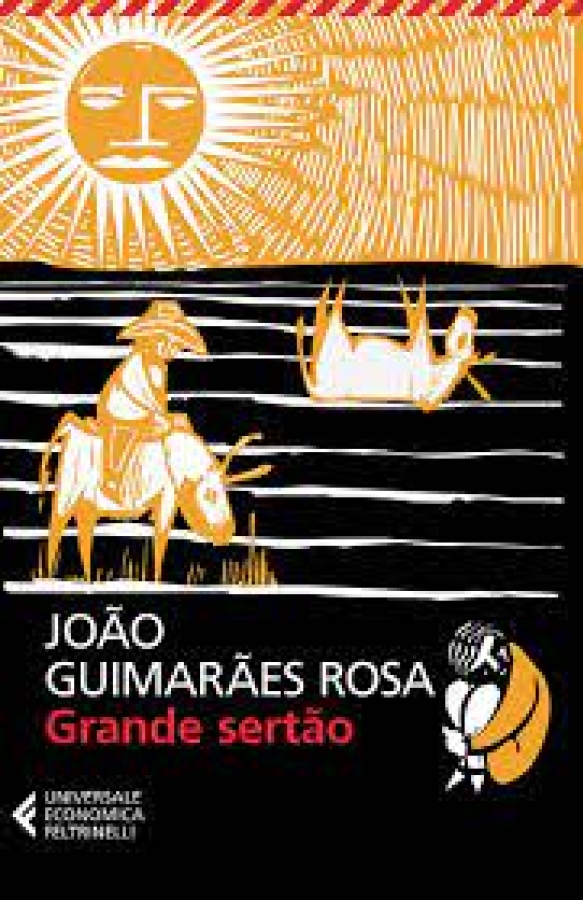
Grande Sertão
The Sertão is a vast region in northeastern Brazil: an expanse of low plateaus characterized by brief, intense rains that give rise to alternating periods of drought and flood, ruining crops and bringing famine to an impoverished population historically exploited by large landowners. At the end of the nineteenth century, widespread banditry developed, blending rebellion, brigandage, and confused social demands. In this setting, where "the criminal lives as he pleases," Guimarães Rosa composed an epic poem, a kind of *Iliad*, with its heroes and its battles (see the review of the *Iliad* on this site). Furthermore, the author recounted an unhappy and enchanting love story, a seemingly impossible, extraordinary passion reminiscent of that for the Pisana in Ippolito Nievo's *Confessions of an Italian* (see review on this site). Riobaldo is the son of a wealthy landowner; he could live in comfort and marry a wealthy, beautiful woman of his own social class, yet he chose instead to go fight alongside the rebels: > the Sertão produced me, then swallowed me, then spat me out from the heat of its mouth . Among the rebels, he met a splendid, delicate youth with whom he fell in love. > I felt the need to place my fingers, light, very light, upon those tender eyes of his. (...) My treasure, if only it were broad daylight, and I could see the color of your eyes...; so I said, lost in oblivion, as if I were only thinking aloud, almost reciting a line of verse. Diadorim stepped back, frightened. (...) And he laughed wickedly. We are not in ancient Greece, where homosexual relations were customary and Achilles could love Patroclus; here, in the Sertão, Riobaldo and Diadorim can only be friends, and Riobaldo’s advances a mere "mocking jest." Diadorim is the son of the most prominent gang leader, who is murdered by a cruel, bloodthirsty rival, "the man without a face"—perhaps the Devil himself. The vendetta begins. Several bands under Riobaldo’s command pursue their enemies in ceaseless clashes amidst great rivers, swamps, and scrublands, magnificent wild beasts, impoverished peasants, and wealthy landowners—stealing, raping women, looting, and dying of disease and in battle. The Great Sertão profoundly transforms Riobaldo: from a reflective, insecure youth he becomes a ruthless leader, shrewd and resolute. With his feminine sensitivity, Diadorim gently reproaches him: "what is changing within you is the task of the soul, not the duty of command." Did Riobaldo make a pact with the Devil? To be sure, he sought a pact on a stormy night, but the Devil never appeared. At last, we arrive at the final, decisive battle. Diadorim slays "the man without a face," avenging his father, but dies fighting. And when the pious women wash the corpse, as was the custom in the *Iliad*, they discover that Diadorim is a girl! > She was, such that she thus disenchanted herself, in so terrible an enchantment. (...) I howled. (...) Diadorim was a woman, she was a woman as the sun does not kindle the water of the river Urucuia, as I sobbed out my despair . The novel is not merely a love story. There are at least two other narrative strands. First and foremost, Guimarães Rosa tells of the vanished world of the "jagunços" and their natural and social environment: hardened men whose fate is sealed from birth and who know they will be defeated, yet continue to live in the Great Sertão, singing their songs: > life is a most perilous lot/in the duty of loyalty:/every night a river downstream, /every day is darkness... Another theme is the metaphysical one: does the Devil exist, and where is God? If by the end of the novel we cannot find an answer to the first question, we nevertheless understand quite clearly that God, if He exists, is like the Great Sertão—pervasive yet exceedingly distant, indifferent to the plight of human beings. As the translator notes, Guimarães Rosa’s narrative and lyrical world > blends regional terminology, structures, and inflections with the boldest innovations and the distinctiveness of the natural and human world from which it springs. Much is perhaps lost in translation, yet the magical sense of the narrative remains, sweeping the reader into a dreamlike and fascinating tale. Riobaldo, at the end of his life, narrates his Sertão to an unidentified person, addressed only as Vossignoria"; in this way Guimarães Rosa gives momentum to the novel, alternating brief colloquial phrases with detailed, intense descriptions, melding reality and imagination. It is a pity that Feltrinelli ruined this masterpiece by using a tiny typeface that is exhausting to read: perhaps to save paper and ink! Why read it? Arduous, but magnificent.
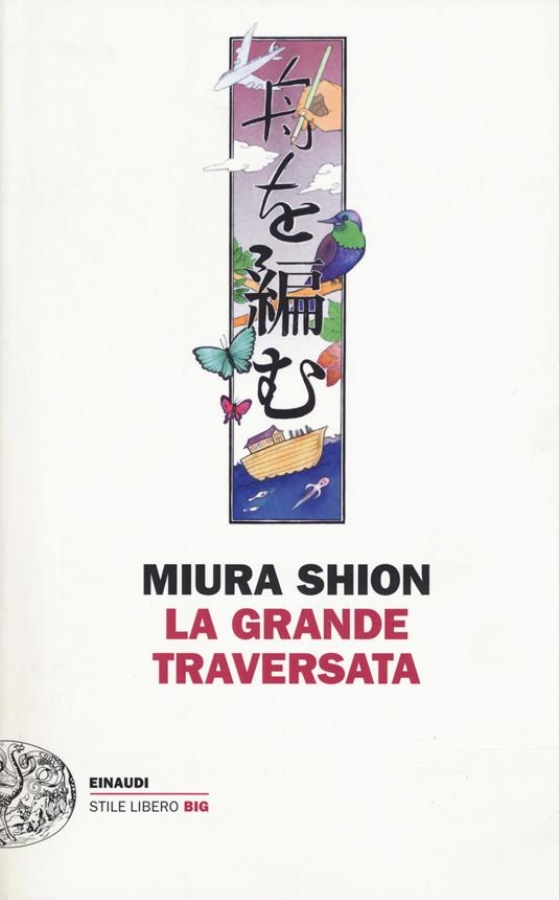
The Great Crossing
We find ourselves inside a major publishing house, in the department tasked with compiling dictionaries. Despite being a profitable business, the staff is remarkably small, not least because preparing a new dictionary is an exceptional endeavor—a difficult, complex undertaking that does not happen every year; between an old dictionary and a new one lies a process of continuous revision, which nevertheless does not overhaul the entire structure of the work. We learn how a dictionary must be exhaustive, up-to-date yet concise, especially since it is compressed into pages where each headword (as the individual entries are called) must occupy a space calibrated so as not to disrupt the balance with the other entries. For example, how does one describe a great poet from around the year 1000 (samurai, monk, and poet), whom tradition named Saigyō—a term laden with meanings, from “immortal” to “wandering pilgrim,” and even “freshwater snail”? Should some of the poet's verses be quoted? Is it right to state that every Japanese person “cannot help but be moved” by Saigyō's poetry? A dictionary ought to be precise and objective, eschewing value judgments. Another challenge is the paper: it must be extraordinarily thin, yet prevent ink from bleeding through to the reverse side. It is hardly surprising that such peculiar work requires individuals so engrossed in the secrets of words as to think of nothing else. Compulsively, > they studied and analyzed them with extreme detachment, almost as if vivisecting them. There was something vindictive about their obsession, as though they were hunting down a hated enemy, gathering information to catch it red-handed and make it pay . Our story begins when the department head retires and seeks someone to replace him. In the office, there is a seasoned colleague, but he suffers from a fatal flaw: he lacks the meticulous obsession required for lexicographical work. Over in sales works a young man, a fellow with “madman's hair who never sheds those hideous black sleeve protectors.” His very name intrigues the department head: Majime is an unusual word, apparently meaning “horse supplier.” When, over lunch, the young man describes his favorite pastime (watching people ride the escalator), the department head knows he has found his man. Just as people queue two by two in a harmony that is “fabulous, elusive,” an enthusiastic Majime exclaims, so too an astonishing tide of words arriving from all quarters can be classified, arranged into columns, and set in immaculate order across the pages of a dictionary: it is within this order that the lexicographer's pleasure resides. Majime gradually settles into his new responsibilities, falls in love, and marries a brilliant young chef. They seem an improbable match, yet they are bound by the same meticulousness and quest for order: Majime in his obsessive exploration of words, and she in the impeccable preparation of traditional Japanese dishes. The publisher decides to embark on a major new dictionary, titled *The Great Passage*. Time is of the essence; they must outpace the competition, which is also working on a new lexicon. The staff needs reinforcing, and an employee from the Marketing Department arrives. Incredulous and intimidated by Majime's “ardent, almost devilish expression,” Kishibe feels she lacks both the competence and the passion; she stands before “a steep, jagged wall impossible to scale.” Yet she gradually comes to realize that this new dictionary—to be published as quickly as possible, concise and precise as any good lexicon must be—is for her a true passage. > She had carried on with her life and career without ever pausing to reflect. (...) Becoming aware of the power of words—the power not to harm others, but to respect them, to communicate, and to forge healthy interpersonal relationships—had taught her to know herself better and to understand the thoughts and feelings of others . All of us, avid readers that we are, believe that words have the power to change people, or at least to offer a deeper understanding of oneself and others. To develop such a compelling and poignant thesis, however, the characters needed greater psychological depth. Instead, Majime is a monolith, fated from the outset to harbor a morbid obsession with minutiae; Kishibe is more complex as a personality, yet she attains self-knowledge through sheer grit and determined labor, without our ever understanding where she comes from or where she truly wishes to go. At times, the author seems eager to inject a suspenseful, quasi-thriller tone into the narrative: will our heroes manage to complete the dictionary against a thousand obstacles and setbacks, despite the skepticism of corporate executives? Yet the plot is sluggish and devoid of surprises, lapsing at times into melodrama and superfluous detail. Why read it? It is pleasantly written and opens a window onto the world of dictionaries.
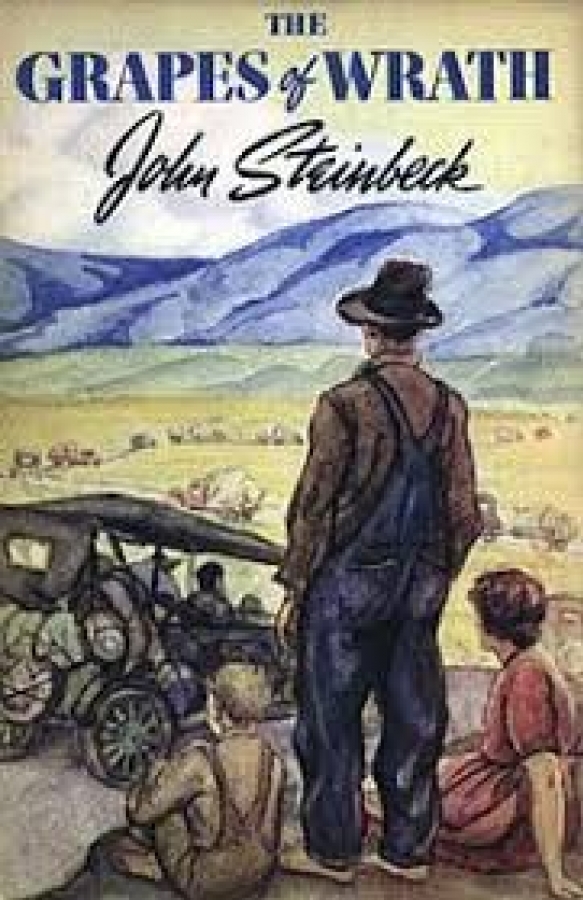
The Grapes of Wrath (Furore)
> In the dust there were little craters where the rain had fallen, and there were clean spots on the corn, and that was all. (...) The dust-filled air hung over everything with a softer sound than fog had. (...) The men were silent and did not move often. And the women came out of the houses to stand beside their men—to see whether this time the men would break. Faced with the destruction of the harvest, the farmers and their families stand struck dumb and resigned: an inexorable fate against which, nonetheless, one must fight. The evocative, intense opening foreshadows the novel's two levels: a political manifesto calling workers to unity, organization, and struggle; and a family engulfed by economic crisis yet determined to pursue a dream, setting out toward the promised land, California. > The stars disappeared, little by little, toward the west. And still the family lingered like dreaming wanderers, their eyes cast upon the whole, not seeing the details, but the entire dawn, the entire earth, the complete weave of the countryside, in a single glance. In this review, I will follow the exodus of this family, for this is the very heart of the novel. We can divide the plot into four movements: the abandonment, the journey, the camps and the work, and the final catastrophe. The first, from chapter one to chapter ten, serves as a sort of preamble: with great power, it depicts the despair, the looming and violent eviction with bulldozers crushing the home, the hurried decision to leave, the frantic sale of their few possessions, the slaughter of the pig and chickens to secure the necessary provisions for the trip, and finally the waiting before departure, amid mingled feelings of dread and hope. “The abandonment” allows the author to introduce the characters: the elderly, stubborn and frail all at once; the head of the family, already struggling to fully assume his role; the uncle, constantly on the verge of collapse from guilt (he let his wife die); the numerous offspring (four sons and two daughters, one of whom is pregnant); and a strange preacher who has decided to pray no longer because it serves no purpose (“all this holiness, everything I didn't understand”). Then there is Ma: a tragic, towering heroine. > She was heavy, but not fat. (...) Her strong, sun-browned arms were bare to the elbow, and her hands were round and delicate, like those of a plump child. Her full face was not soft; it was controlled, with kindness. Her hazel eyes seemed to have lived through every possible tragedy and to have borne them with pain and suffering as passages toward an infinite serenity and a superhuman understanding. She seemed to know, accept, and gladly assume her role: the citadel of the family, an impregnable stronghold. And it is she who will emerge as a pillar during the “journey,” the great exodus (chapters 11 to 18). > The people in motion, searching, were migrants now. These families who had lived on a little piece of land, who had lived and died on forty acres, who had eaten or starved to death on forty acres, had now the whole West to traverse. On the road, an anthropological transformation takes place: not everyone is able to confront the change; one son flees, the pregnant daughter’s husband abandons her, the old folks die and are buried far from their land, wretchedly like all the poor who no longer have a homeland; the eldest sons, Tom and Al, react differently, the former yearning for rebellion and the latter chasing girls, as if nothing were happening. It becomes increasingly difficult for Ma to hold the family together, yet she fights on, indomitable and indestructible, even as she is often submerged by memories. > I go back to the sad things—that night Granpa died and we buried him. I was all set on the road, and struggling and moving, and it wasn’t so bad. But now I’m here. And Granma—and Noah walking off like that! (...) I can remember how the mountains looked, sharp like old teeth beside the creek where Noah went. I can remember how the weeds looked where Granpa lies. I can remember the chopping block by the front door with the feather stuck in it, all scarred with cuts, and black with chicken blood. At last, the family reaches California. “The camps and the work” (chapters 19 to 29) are far removed from what the migrants expected: the camps where wagons are parked are squalid, putrid, unlivable; work is scarce, wages are starvation-level, and all attempts by the workers to organize are crushed. People literally starve to death; Ma fights desperately to support the family and keep it together, driven by a deep conviction: > woman carries all of life in her arms. (...) Woman is all one flow, like a river, a few rocks, a few waterfalls, but the river keeps on going in the right direction. Woman looks at it that way. We aren’t going to disappear. The people keep on going—changing a little, maybe, but keeping right on in the right direction. The determination and endurance of the proletariat are personified in Ma, who reflects through her own strength that of all women. And finally, we arrive at the catastrophe (chapter 30). It is no longer man who oppresses, but nature, unleashing all its fury upon the most vulnerable, upon those living in camps exposed to the rising waters. A torrential downpour, an outright flood, engulfs the camp where the destitute migrants have settled. An attempt is made to build a dyke, only for it to be swept away by timber carried in the torrent. It is the end for the family; in despair, they scramble for safety along the road and seek shelter. They enter a barn, but as they step into the dark, an emaciated boy steps forward, crying out that his father is starving to death. And then the daughter, who had just lost the child she was carrying, approaches the dying man. > Then slowly she lay down beside him. (...) She bared her breast. (...) She moved closer and pulled his head toward her. “There,” she said, “there.” Her hand moved behind the man’s head to support it. Her fingers gently stroked his hair. She looked up and across the barn, and her lips came together in a mysterious smile. Medea, Antigone, Cornelia: all the great women of tragedy come to mind while reading this intense novel. Certainly, the social theme is central; we are presented with a fresco of 1930s America, of the proletariat and migration, analyzing with great clarity the mechanisms of class exploitation: the concentration of wealth, mechanization and the displacement of labor, the creation of a desperate reserve army to drive down wages and impose harsh working and living conditions, police brutality, racism. Many viewpoints are possible; I offer my own particular interpretation: the family’s tragic story reflects an underlying, dark pessimism, redeemed only because the woman stands fast like a “rock,” fighting without ever yielding. The ending—so magical and mysterious, in which the daughter, whiny throughout the narrative, takes charge of a dying man—reveals the novel as “a hymn to the female heroine.” Is this an overly naive and simplistic reading? Perhaps; for me, this is precisely where the novel’s power lies. Steinbeck adopts “the language of the speakers,” to borrow a phrase from Pasolini. This makes translation difficult, as one must immerse oneself in an idiom undeniably far removed from classical English. On the other hand, the author’s very aim was to give voice to rural America, in contrast to the language of the upper bourgeoisie. It is a revolutionary novel in its prose as well: a pity, then, that it is weighed down by an essayistic vein that is in many respects declamatory and redundant. Some critics have suggested that the novel’s structure resembles that of *Moby-Dick*, in which long digressions on whaling complement the story of Ishmael and Ahab. I disagree: in *The Grapes of Wrath*, the essayistic strand is superfluous, whereas the novel would have been far more powerful had it remained confined to the family’s saga, making it compact and less sprawling. Why read it? Intense, magical, and realistic all at once—an innovative feat of writing.
The Grass Harp
*The Grass Harp* is a coming-of-age novel, but it must be read as an assonance of wondrous images and extraordinary sounds, “a harp of voices telling a story.” And all that is left for us is to listen. As was already seen in Salvatore Satta's *The Day of Judgment*, remembrance is not a succession of events, a sequence of situations and characters; it is instead like closing one's eyes > to fix their image, (...) a series of ripples, rings that do not evolve with the freedom of a spiral: for me, passing from one to the next was a leap, not a gradual change . In this case, the one remembering is an adolescent: Collin. Orphaned of both parents, he is taken in at his aunts' house in a small country town. Verena, the younger of the two sisters, is an authoritarian woman, shrewd in business, always ready to impose rules and restrictions. Dolly, the other sister, is eccentric, with the eyes of > a person endowed with a natural talent, gentle, transparent eyes, of a luminous green color, like crème de menthe . And then there is Dolly's only friend, Catherine. > They were always together, and everything they had to say they said to each other: resting my ear against a beam, I could listen to the fascinating tremor of their voices flowing like a hum between the old wooden partitions. (...) I know: Dolly, they said, was Verena's cross. (...) Perhaps it was so. But those were happy years. (...) If some sprite wanted to give me a gift, he would have to give me a bottle filled with the voices of that kitchen, the ha-ha-has and the whispers of the stove, a bottle brimming with the smells of baking, of butter and sweets, even if Catherine smelled like a sow in heat . Verena, ever greedy for profit, wants her sister to agree to commercialize her natural herbal recipes, for which Dolly is famous, but also justifiably protective. For the first time, the two sisters clash, and Dolly, so fragile and docile, reveals all her stubbornness: she decides to leave, taking Collin and Catherine with her, and chooses a tree as their dwelling: > spacious, sturdy, (...) it was like a raft floating on a sea of branches, (...) Dolly knew, and made sure I knew, that it was a ship, that being in it was sailing along the cloudy shores of every dream, (...) we belonged to it, just as the sunlit branches belonged to it, a nest for night birds. It is a scandal, clearly a revolt—against Verena and against the whole town. And indeed, several times the sheriff, the reverend, and the townsfolk gather beneath the tree to convince Dolly to come down. The situation becomes even more awkward when an old retired judge joins the “revolutionaries,” who in turn allow a strange and large family of wanderers to camp near the tree. The orderly life of the town is disrupted. Things escalate to physical confrontation, to forceful action; Catherine is arrested. In the end, Dolly will be the one to decide: her wisdom, and her affection for her sister, for Collin, and for Catherine, convince her to come down, not least because Verena has realized she was in the wrong. The story concludes with Dolly’s prolonged illness and her death. It is time for Collin to leave. What does the tree symbolize? Many things: freedom, dreams, nature, and especially a bond so powerful as to outlast death: that between Collin and Dolly. > I would have invented someone, a story to find her again, because she seemed to be moving forward into the future, while I was unable to follow her in my monotonous stillness . Yet as I went on writing > we flowed together again like a stream of water that an island had divided for an instant . As had already been seen in *The Great Gatsby*, the eye of the young narrator—an adolescent—illuminates through imagination the figure of a modest provincial woman and an ordinary treehouse built by other boys at play. Imagination is the most powerful means (the only one?) to transfigure reality and make us happy. The first chapter is splendid; after that, the narrative proceeds slowly, devoid of rhythm, bogged down by too many digressions and the entrance of an excessive, redundant cast of characters. In short, the writer drags things out, failing to develop the ingenious premise of the treehouse as a refuge and a realm of dreams and freedom. Perhaps it was detrimental to insist on constructing a plot rather than surrendering to the mysterious atmosphere of the woods: too much prose, too little poetry! Why read it? It is worth reading for the first chapter alone.
The Silent Cry
> I wake in the darkness before dawn, flailing among the agonized shreds of dreams that still linger in my consciousness, searching for a burning sense of anticipation. (...) In every part of my body, I perceive separately the distinct weights of flesh and bone, sensations that coalesce into a dull ache within my consciousness, reluctant to resurface into the light. (...) I have slept with my arms and legs curled to the side, in the posture of one unwilling to recall his own nature or the circumstances in which he finds himself. This is the novel’s opening; it encapsulates the essential traits of a narrative that is oneiric yet deeply rooted in reality: the refuge of dreams to flee suffering—the latter manifested through bodies often described in grotesque terms; memory as a prison enclosing a human destiny already doomed; the ambiguity of familial and social ties, thickened by resigned silences and unspeakable memories. We find ourselves before a stream of consciousness set against a backdrop portrayed both naturalistically and like a dark fable. Mitsui, the first-person narrator, is shattered by the tragicomic suicide of a friend. His life is already scarred by his son’s monstrous disability and his wife’s alcoholism; furthermore, tragic family events weigh upon him, their recollection repressed yet ever-present in his consciousness. Perhaps to effect a turning point in his life, he accepts the invitation of his brother Taka to return to the village at the edge of the “mighty” forest, where the family home stood and where they grew up as children. It is a return to the past: for Mitsui, a desperate hope for change that translates into the definitive awareness of his estrangement from the world; for Taka, a desire for self-punishment enacted by retracing dramatic events that engulfed their family. In 1860, upon the fall of the Shogunate, their great-grandfather’s brother led a peasant uprising, later bloodily suppressed; at the end of the Second World War, in the very same village, a brother died in a clash between Japanese and Koreans, the latter prisoners of war. Seeking to retrace the deeds of his uncle and brother, Taka decides to lead the villagers in pillaging the local supermarket, owned by a Korean known as “The Emperor” (perhaps to confer upon him a sacred aura, Korean as he is!). Mitsui remains aloof from the events, curling further into his stupor, while Taka emerges as a vigorous and cunning leader; yet it is all a charade through which Taka seeks to punish himself for a grave sin: as a youth, he raped his disabled sister, driving her to suicide. Taka confesses to a murder he did not commit and then, disbelieved by Mitsui, kills himself. > He looked like a life-size plaster dummy, entirely red and dressed only in trousers. shouts the wife to Mitsui, who tries to justify himself. > You reject people and let them die, and the only thing you can do to make amends is cry out in your sleep: “I have abandoned you!” (...) In the deep gloom of the cellar, stirred by swirling eddies of wind, I saw the eyes of a dying cat. (...) As I contemplated them in the darkness, the eyes of my cat, a companion of many years, became the eyes of Taka, the eyes of the great-grandfather’s brother I had never known, and the eyes of my wife, red as plums; and they all merged into a luminous circle that was rapidly asserting itself as an undeniable part of my being. (...) And I would survive in an agony of shame, beneath the light of those stars, peering with my single eye and the timidity of a mouse into a vague, dark outside world... The setting is similar to that of *The Water Forest* (see the review on this site), and certain historical references are analogous, such as the peasant uprisings of 1860, but the narrative structure is profoundly different. Unlike in *The Water Forest*, here the first-person narrator is redundant, just as the familial relationships are intricate, unfolding along two axes: the bond between Mitsui and Taka, a mixture of affection and revulsion, and the former's relationship with his wife, which seemingly remains in the background. > Remaining silent for a moment and then staring at me with eyes full of desperate hostility, this time red from tears rather than whisky, my wife said to me: > When the time comes when, as you say, we must acknowledge that there is no turning back, perhaps then we will be a little kinder to each other! . Despite the complex interplay of themes and narrative layers, perhaps the unifying meaning of the novel lies in the acceptance of the disabled child—the sole possibility for rebuilding a relationship torn apart by merciless fate. The narrative unfolds slowly, with numerous references and digressions, as if the author were wary of uncovering the depths of consciousness too quickly. One is captivated by the spell of the words, rich in psychological and social resonance; yet an oppressive sense of claustrophobia looms over everything, offering no glimpse of development or resolution, so that reading becomes burdensome and one reaches the novel's end with difficulty. Why read it? Splendid prose, and the haunting allure of pain and death.
The War of the End of the World
> How was it possible that there, at the end of the world.... something different ordered things, men, time, death, something that it would be unjust to call madness and too broad to call faith and superstition . Such are the reflections of one of the protagonists of an incredible, and in some respects indecipherable, book. Vargas Llosa recounts an actual event that took place in Brazil in 1889, during the transition from empire to republic. A multitude of the disinherited had gathered around a holy man and, in a kind of messianic and religious fervor, had founded a utopian place, free from exploitation. The government of the young republic dispatched a mighty army against them, which, after a bloody battle, carried out a chilling and ruthless massacre. The episode had been recounted many times before, yet Vargas Llosa crafts a complex narrative from it, weaving social and political themes with spiritual and psychological ones. The novel can be divided into three parts. In the first, the author relates the background to the uprising: a strange figure wanders through the *sertão*, followed by a handful of disciples, to rebuild abandoned churches and thus bring a religious sign to a people forsaken by everyone, even their own priests. Then, an ever-growing crowd gathers around him, as the holy man manages to convert the most disparate figures: gang leaders, bloodthirsty killers, merchants, fallen women, hunchbacks, and the wretched. All are drawn by a quest for redemption and peace. In the second part, the utopian enclave of Canudos is created out of nothing; its renown draws yet more people, but it also attracts the attention of monarchist landowners, who hope to exploit the revolt for anti-republican ends, and the interest of socialists and revolutionaries, who interpret through European lenses events that defy the frameworks of Marxist and anarchist ideologies. The first expeditions sent to quell the uprising fail miserably: Canudos's survival is a threat, not because the poor intend to stage a revolution, but because it bears witness to a utopian society. A distinctly Brazilian alternative to exploitation exists, and this is unacceptable to monarchists and republicans alike: the two political factions join forces, and a massive army is dispatched. And here begins the third part, the most extraordinary in the entire book. With exceptional narrative skill, Vargas Llosa describes the siege of Canudos across two hundred pages: a continuous alternation of martial descriptions with the personal chronicles of the various characters. There are four central figures whose stories unify a narrative that would otherwise have been fragmentary. First, a trio composed of a dwarf, a peasant woman, and a journalist who is virtually blind because he has lost his glasses. His blurred eyes take in the terrible scenes through an out-of-focus perspective, lending an air of unreality to the entire narrative (an exceptional literary device). Far from the battlefield, in the aftermath of events, there unfolds a dialogue between this same journalist and one of the monarchist leaders, a baron whose wife was driven mad by the sight of her home torched by the rebels. Reason, the great organizer of the world, has dissolved in the face of the horrific events of Canudos: the rules no longer make sense; the world is turned upside down. > Love, pleasure, thought the baron, bewildered. It seemed to him a sacrilege that those beautiful, forgotten words should appear on the lips of that ridiculous creature, huddled like a heron in the armchair. Was it not comical, grotesque that a mongrel bitch from the sertão should make a man who was, despite everything, cultivated, speak of love and pleasure? But in the world, truth and happiness may be found in the most improbable things, such as in a bond of love and affection between a journalist, a peasant woman, and a dwarf, or in the lesbian love of the baron's wife for her maid, in which the baron himself might have taken part had he realized earlier that it would have pleased his wife. And so it might be that the baron could see that > the people in the boats were not fishing but throwing flowers into the sea, scattering petals, corollas, bouquets upon the water, and crossing themselves, and, though he could not hear it, his chest pounded hard, he was certain that those people were also praying and perhaps singing . It is extraordinarily difficult to give a single interpretation to the book. It can certainly be read in many ways: an indictment of a ruling class ruthless in defending its own interests, a critique of a left wing often vainglorious and far from understanding the specific reality, a cruel depiction of the violence of war as well as the ignorance of the masses. I believe, rather, that the unifying thread is confusion—a crowding of voices and images, a firework display that lasts only a few minutes but illuminates the sky in points of light, without any discernible meaning. Why read it? The narrative style is splendid and sustains a book that is undoubtedly long and fragmentary.

War and Peace
The book deals with the Napoleonic Wars, and in particular the French invasion of Russia, the sacking of Moscow, and the defeat of Napoleon. In the early parts of the novel, war is something distant, a matter for the powerful and their diplomatic games, whereas > life, the real life of men, with its fundamental necessities concerning health, illness, work, rest... , proceeded, as always, independently and outside political friendship and hostility toward Napoleon Bonaparte, and beyond all possible reforms . There exist, therefore, several narrative planes: the great political and military events, the battles and political rivalries, through the narration of which Tolstoy articulates from the outset one of the book’s fundamental themes. His philosophy of history is that everything is accomplished in accordance with an end that man is not granted to understand, being the work of Divine Providence. This philosophical conception contrasts, then, with the stark depiction of war as destruction, suffering, and death—a catastrophe that spares neither the vanquished nor the victors; the vacuous life of the court and the aristocrats, enclosed in their web of relations, their petty worldly pleasures, and their intrigues: behaviors that persist even during the sacking of Moscow itself, heedless of the danger looming over the country; the search for a meaning to existence, embodied by Pierre (Freemasonry and the ideals of French democracy), by the inner torments of Prince Andrei (who perceives the absurdity of war from the start and recoils in horror), and by Princess Marya’s steadfast religious faith; the domestic life of the Rostovs, woven of small, genuine occurrences, Natasha’s awakening to love, Sonya’s unrequited devotion to Nikolai, first infatuations, balls, and receptions. This structure of the novel shatters with the French invasion, when war intrudes into civil life. As Prince Andrei observes, > my father, too, was building at Lysye Gory and thought that was his place, his land, his air, his peasants; but Napoleon came and, without even knowing of his existence, struck him aside, casting him like a splinter out of the road, and Lysye Gory and his entire life collapsed . War reshuffles the novel’s distinct narrative planes and upends the lives of the protagonists, opening paths that once seemed impossible, yet are made viable by suffering, necessity, and the authenticity demanded by extraordinary events. Marya is rescued by Nikolai and falls in love with him; Pierre, in captivity, through close contact with privation, death, and simple souls, comes to understand the true roots of serenity and happiness; Natasha discovers love while nursing Andrei, grasping the genuine, deeper dimensions of romantic devotion, thereby preparing herself to embrace Pierre’s affection. Everything culminates in the discovery of fundamental values (family, marriage, the pleasures of country life and good stewardship, religion) in a “hosanna” to tradition and the good. The heavy religious and philosophical imprint comes at the expense of the depth and complexity of the characters and the events narrated. The protagonists are stereotypes of social and familial roles, devoid of genuine torment, substantive evolution, or change. The pace of the narrative is brisk, if one sets aside the philosophical digressions, but this is due to a sequence of episodes that, in certain instances, degenerate into impromptu snapshots, paradoxically mirroring the structure of a modern television drama. A few pages are redeemed: Nikolai’s visit to the military hospital with the vision of the sick in appalling hygienic conditions, the Battle of Borodino, the mingling of Russian soldiers and French prisoners reduced to a single shared destiny, Andrei’s death, and the grief of Marya and Natasha. From this standpoint, one cannot share the opinion expressed in the *Enciclopedia Treccani*, which casts in a positive light what is, in truth, the work’s most profound limitation. > What struck and continues to strike the reader most in this epic of recurring yet ever-new motifs is the total absence of any artistic arbitrariness, the seamless fusion of art with life. Sustained by a prose of pure substance, without a shadow of embellishment, the diverse threads of the narrative knot and unravel with absolute spontaneity. Life and death are celebrated within it with the same devotion, both humble and solemn. From the protagonists to the minor extras, all possess an unmistakable individuality, and all, in turn, are as if absorbed by a humanity that resides within them and above them. Only toward the end of the novel does one sense the presence of an author who has a thesis to defend and to preach. And this presence would indeed be grating, were it not to bring us back to the very essence of the work: man creates nothing, commands nothing; he merely follows the inevitable march of events unfolding before his eyes . The contemporary relevance of the novel lies in its agonizing portrayal of war, in its devastating repercussions on soldiers and civil society alike. In this sense, the dichotomous theme of war as a cluster of remote occurrences that do not touch individual conscience, versus war as a violent intrusion into daily existence, offers a line of reflection equally valid for today’s political landscape. Tolstoy does not condemn war in itself (his appreciation of partisan warfare and his romantic conception of war as an emancipator of authentic values are readily apparent); rather, he seems above all to condemn war as a diplomatic and political “game” that disregards the toll of suffering and grief inflicted upon the people.
William and the Gold Coin
It is a book for children aged 9–10. Guglielmo is a young boy who finds a gold coin and discovers that people, even good ones, turn false and wicked out of greed. The only bonds left to him are those with his dog and a vagrant, a former soldier. In the end, Guglielmo realizes that, if > a man is free, has friends, has honest work, cares for people, well, perhaps he has something more than one gold coin, or a hundred. Therefore he is rich . The book is pleasant, but it strikes me as somewhat dated, overly simple, and lacking that touch of suspense needed to keep the reading from being entirely predictable.