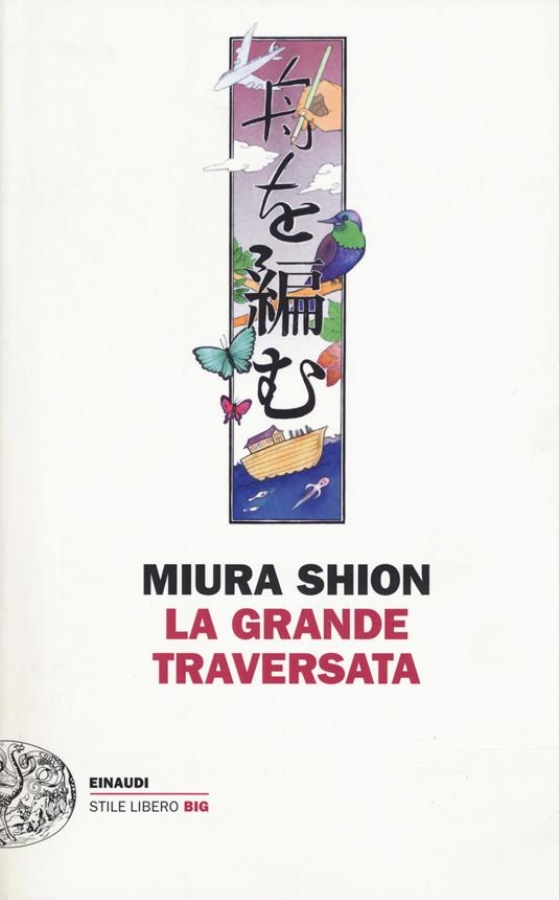
Finished reading on: January 24, 2022
The Great Crossing
Title of the original version reviewed: «La grande traversata»
AI Translation Notice: This review was translated from the original Italian using artificial intelligence. Book quotes and excerpts are translated interpretations and will not match the author's original English phrasing or official published translations.
We find ourselves inside a major publishing house, in the department tasked with compiling dictionaries. Despite being a profitable business, the staff is remarkably small, not least because preparing a new dictionary is an exceptional endeavor—a difficult, complex undertaking that does not happen every year; between an old dictionary and a new one lies a process of continuous revision, which nevertheless does not overhaul the entire structure of the work. We learn how a dictionary must be exhaustive, up-to-date yet concise, especially since it is compressed into pages where each headword (as the individual entries are called) must occupy a space calibrated so as not to disrupt the balance with the other entries. For example, how does one describe a great poet from around the year 1000 (samurai, monk, and poet), whom tradition named Saigyō—a term laden with meanings, from “immortal” to “wandering pilgrim,” and even “freshwater snail”? Should some of the poet's verses be quoted? Is it right to state that every Japanese person “cannot help but be moved” by Saigyō's poetry? A dictionary ought to be precise and objective, eschewing value judgments. Another challenge is the paper: it must be extraordinarily thin, yet prevent ink from bleeding through to the reverse side. It is hardly surprising that such peculiar work requires individuals so engrossed in the secrets of words as to think of nothing else. Compulsively,
they studied and analyzed them with extreme detachment, almost as if vivisecting them. There was something vindictive about their obsession, as though they were hunting down a hated enemy, gathering information to catch it red-handed and make it pay
. Our story begins when the department head retires and seeks someone to replace him. In the office, there is a seasoned colleague, but he suffers from a fatal flaw: he lacks the meticulous obsession required for lexicographical work. Over in sales works a young man, a fellow with “madman's hair who never sheds those hideous black sleeve protectors.” His very name intrigues the department head: Majime is an unusual word, apparently meaning “horse supplier.” When, over lunch, the young man describes his favorite pastime (watching people ride the escalator), the department head knows he has found his man. Just as people queue two by two in a harmony that is “fabulous, elusive,” an enthusiastic Majime exclaims, so too an astonishing tide of words arriving from all quarters can be classified, arranged into columns, and set in immaculate order across the pages of a dictionary: it is within this order that the lexicographer's pleasure resides. Majime gradually settles into his new responsibilities, falls in love, and marries a brilliant young chef. They seem an improbable match, yet they are bound by the same meticulousness and quest for order: Majime in his obsessive exploration of words, and she in the impeccable preparation of traditional Japanese dishes. The publisher decides to embark on a major new dictionary, titled The Great Passage. Time is of the essence; they must outpace the competition, which is also working on a new lexicon. The staff needs reinforcing, and an employee from the Marketing Department arrives. Incredulous and intimidated by Majime's “ardent, almost devilish expression,” Kishibe feels she lacks both the competence and the passion; she stands before “a steep, jagged wall impossible to scale.” Yet she gradually comes to realize that this new dictionary—to be published as quickly as possible, concise and precise as any good lexicon must be—is for her a true passage.
She had carried on with her life and career without ever pausing to reflect. (...) Becoming aware of the power of words—the power not to harm others, but to respect them, to communicate, and to forge healthy interpersonal relationships—had taught her to know herself better and to understand the thoughts and feelings of others
.
All of us, avid readers that we are, believe that words have the power to change people, or at least to offer a deeper understanding of oneself and others. To develop such a compelling and poignant thesis, however, the characters needed greater psychological depth. Instead, Majime is a monolith, fated from the outset to harbor a morbid obsession with minutiae; Kishibe is more complex as a personality, yet she attains self-knowledge through sheer grit and determined labor, without our ever understanding where she comes from or where she truly wishes to go. At times, the author seems eager to inject a suspenseful, quasi-thriller tone into the narrative: will our heroes manage to complete the dictionary against a thousand obstacles and setbacks, despite the skepticism of corporate executives? Yet the plot is sluggish and devoid of surprises, lapsing at times into melodrama and superfluous detail.
Why read it? It is pleasantly written and opens a window onto the world of dictionaries.