Finished reading on: January 02, 2025
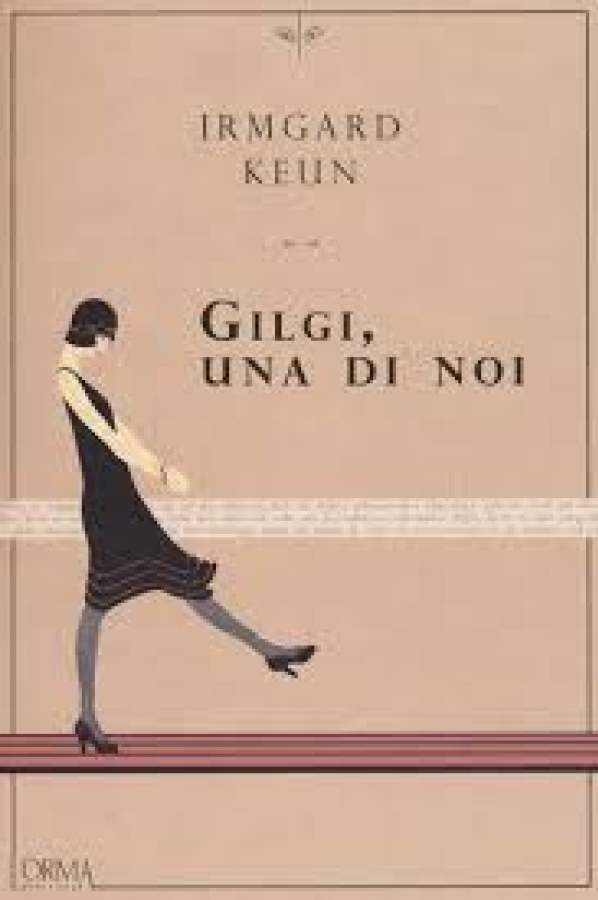
Gilgi, una di noi
AI Translation Notice: This review was translated from the original Italian using artificial intelligence. Book quotes and excerpts are translated interpretations and will not match the author's original English phrasing or official published translations.
Who knows whether Alba de Cèspedes had read this novel before writing Nessuno torna indietro and Dalla parte di lei, published respectively in 1938 and 1948, just a few years after the 1934 Italian release of Irmgard Keun’s novel, heavily censored to excise its most transgressive passages (see the reviews of de Cèspedes’s books on this site). Even allowing for a completely different style (elegant and baroque in the case of the Italian-Cuban writer; cinematic and remarkably modern in that of the German author), there are numerous affinities. The young boarding-school girls of Nessuno torna indietro seek their own path beyond the stereotypes of the “pretty wife and mistress,” just as Gilgi forcefully asserts her independence from Martin, the man she loves—fatuous and manipulative.
All tenderness vanishes from Gilgi’s face, her voice hard and clear: I settle my own affairs myself, (...) I will not tolerate anyone feeling responsible for me, it is the greatest insult one could pay me, I... Even greater similarities seem to emerge with Dalla parte di lei. Like Gilgi, abandoned by her birth mother, Alessandra is haunted by her mother’s suicide, which upends her life and drives her to seek a man with whom she can find total harmony. And if Alessandra kills her husband when she realizes she cannot be loved completely (“Francesco,” I cried out in despair, “help me, Francesco”), so Gilgi leaves Martin when she recognizes the vast gulf between the external world into which he has dragged her (living day-to-day in superficial lightheartedness) and her inner world as a young woman determined to remain a cog in the whole. Confronted with the destitution that drove a family to suicide, Gilgi understands that
lightheartedness has become an illusion, (...) that one cannot hide within the collective, that one is alone. This is what must be learned: one must learn to be a person, one must learn that a single laugh costs a thousand tears, must know that an hour of happiness must be paid for with a thousand hours of pain... And so it is impossible to continue living with a man to whom
everything else becomes utterly, deeply indifferent. One must leave, reclaim one's own life.
She belongs to the universal structure, she is not made to stay outside... now she believes once again, deeply, in the duty of young, healthy hands...
Set in 1930s Germany, Gilgi’s story carried clear political and scandalous undertones, which prompted the Nazis to burn the book and the Fascists to censor substantial portions of it. Through contemporary eyes, Gilgi appears as a typical, conscientious office clerk, a sort of Carla from Elio Pagliarani’s eponymous poem. The charming Miss Gilgi loves an orderly life: she wakes up early in the morning, takes a cold shower to invigorate herself, does gymnastics, hurries to the office (she is a model employee), then studies foreign languages.
The fact that my demands (Gilgi tells a friend) are never beyond my reach makes me free... Shattering this industrious life arrives Martin, a carefree, selfish globetrotter.
Gilgi’s imagination had always been a well-behaved child. (...) Now the well-behaved child is straying a little too far; Martin tells his tales, and Gilgi sees oceans, deserts, landscapes—what she sees is not reality. Love overwhelms her and seems to consume her entirely. After an occasionally wry depiction of Gilgi’s life, such as the small ploys to ward off her boss’s advances, the narrative dwells at length on Gilgi’s infatuation, an incessant oscillation, a pendulum swinging between the bourgeois values with which the girl is steeped and the transgressive existence that awaits her with Martin. The prospect of an unwanted child, the encounter with an old friend who has lost his job and been reduced to penury by children that came unbidden, Martin’s glaring superficiality—attentive only to himself and heedless of what is happening in a Germany ravaged by poverty—are all factors that drive her toward a fateful choice in a feverish, dreamlike delirium: first she contemplates suicide, then she flees to Berlin, opening herself to a new life.
The novel's virtue lies in its writing, which one might describe as cinematic: the dialogues evoke a film script where the actors must be given room, the descriptions are replete with vivid imagery that imprints itself on the reader’s imagination, and even Gilgi’s long deliriums, while at times discursive, remain visionary and profoundly striking. Consider Gilgi’s encounter with her biological mother, from whom she intends to ask for money. In Gilgi’s eyes, the rediscovered mother is merely a “white patch.”
There is no sound in the room, only a heavy, silent gloom and a small white patch: the face of the woman from the magazine. (...) They are all dead... I am completely alone, alone on the planet... And what of the image of her departure for Berlin, when Gilgi sees, or imagines seeing,
a small orange rolled down from the platform, lying amid the smooth, straight, ingenious tracks, awkwardly simple and inadequate: an oneiric conclusion to a stylistically singular novel.
Why read it? The prose is captivating, though at times the narrative becomes redundant.