Finished reading on: January 13, 2019
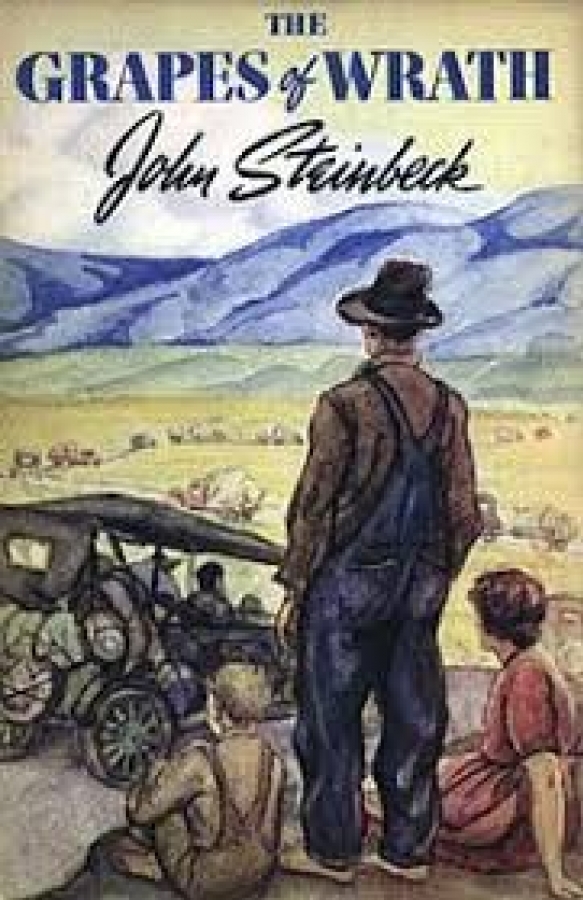
The Grapes of Wrath (Furore)
AI Translation Notice: This review was translated from the original Italian using artificial intelligence. Book quotes and excerpts are translated interpretations and will not match the author's original English phrasing or official published translations.
In the dust there were little craters where the rain had fallen, and there were clean spots on the corn, and that was all. (...) The dust-filled air hung over everything with a softer sound than fog had. (...) The men were silent and did not move often. And the women came out of the houses to stand beside their men—to see whether this time the men would break.
Faced with the destruction of the harvest, the farmers and their families stand struck dumb and resigned: an inexorable fate against which, nonetheless, one must fight. The evocative, intense opening foreshadows the novel's two levels: a political manifesto calling workers to unity, organization, and struggle; and a family engulfed by economic crisis yet determined to pursue a dream, setting out toward the promised land, California.
The stars disappeared, little by little, toward the west. And still the family lingered like dreaming wanderers, their eyes cast upon the whole, not seeing the details, but the entire dawn, the entire earth, the complete weave of the countryside, in a single glance.
In this review, I will follow the exodus of this family, for this is the very heart of the novel. We can divide the plot into four movements: the abandonment, the journey, the camps and the work, and the final catastrophe. The first, from chapter one to chapter ten, serves as a sort of preamble: with great power, it depicts the despair, the looming and violent eviction with bulldozers crushing the home, the hurried decision to leave, the frantic sale of their few possessions, the slaughter of the pig and chickens to secure the necessary provisions for the trip, and finally the waiting before departure, amid mingled feelings of dread and hope. “The abandonment” allows the author to introduce the characters: the elderly, stubborn and frail all at once; the head of the family, already struggling to fully assume his role; the uncle, constantly on the verge of collapse from guilt (he let his wife die); the numerous offspring (four sons and two daughters, one of whom is pregnant); and a strange preacher who has decided to pray no longer because it serves no purpose (“all this holiness, everything I didn't understand”). Then there is Ma: a tragic, towering heroine.
She was heavy, but not fat. (...) Her strong, sun-browned arms were bare to the elbow, and her hands were round and delicate, like those of a plump child. Her full face was not soft; it was controlled, with kindness. Her hazel eyes seemed to have lived through every possible tragedy and to have borne them with pain and suffering as passages toward an infinite serenity and a superhuman understanding. She seemed to know, accept, and gladly assume her role: the citadel of the family, an impregnable stronghold.
And it is she who will emerge as a pillar during the “journey,” the great exodus (chapters 11 to 18).
The people in motion, searching, were migrants now. These families who had lived on a little piece of land, who had lived and died on forty acres, who had eaten or starved to death on forty acres, had now the whole West to traverse.
On the road, an anthropological transformation takes place: not everyone is able to confront the change; one son flees, the pregnant daughter’s husband abandons her, the old folks die and are buried far from their land, wretchedly like all the poor who no longer have a homeland; the eldest sons, Tom and Al, react differently, the former yearning for rebellion and the latter chasing girls, as if nothing were happening. It becomes increasingly difficult for Ma to hold the family together, yet she fights on, indomitable and indestructible, even as she is often submerged by memories.
I go back to the sad things—that night Granpa died and we buried him. I was all set on the road, and struggling and moving, and it wasn’t so bad. But now I’m here. And Granma—and Noah walking off like that! (...) I can remember how the mountains looked, sharp like old teeth beside the creek where Noah went. I can remember how the weeds looked where Granpa lies. I can remember the chopping block by the front door with the feather stuck in it, all scarred with cuts, and black with chicken blood.
At last, the family reaches California. “The camps and the work” (chapters 19 to 29) are far removed from what the migrants expected: the camps where wagons are parked are squalid, putrid, unlivable; work is scarce, wages are starvation-level, and all attempts by the workers to organize are crushed. People literally starve to death; Ma fights desperately to support the family and keep it together, driven by a deep conviction:
woman carries all of life in her arms. (...) Woman is all one flow, like a river, a few rocks, a few waterfalls, but the river keeps on going in the right direction. Woman looks at it that way. We aren’t going to disappear. The people keep on going—changing a little, maybe, but keeping right on in the right direction.
The determination and endurance of the proletariat are personified in Ma, who reflects through her own strength that of all women. And finally, we arrive at the catastrophe (chapter 30). It is no longer man who oppresses, but nature, unleashing all its fury upon the most vulnerable, upon those living in camps exposed to the rising waters. A torrential downpour, an outright flood, engulfs the camp where the destitute migrants have settled. An attempt is made to build a dyke, only for it to be swept away by timber carried in the torrent. It is the end for the family; in despair, they scramble for safety along the road and seek shelter. They enter a barn, but as they step into the dark, an emaciated boy steps forward, crying out that his father is starving to death. And then the daughter, who had just lost the child she was carrying, approaches the dying man.
Then slowly she lay down beside him. (...) She bared her breast. (...) She moved closer and pulled his head toward her. “There,” she said, “there.” Her hand moved behind the man’s head to support it. Her fingers gently stroked his hair. She looked up and across the barn, and her lips came together in a mysterious smile.
Medea, Antigone, Cornelia: all the great women of tragedy come to mind while reading this intense novel. Certainly, the social theme is central; we are presented with a fresco of 1930s America, of the proletariat and migration, analyzing with great clarity the mechanisms of class exploitation: the concentration of wealth, mechanization and the displacement of labor, the creation of a desperate reserve army to drive down wages and impose harsh working and living conditions, police brutality, racism. Many viewpoints are possible; I offer my own particular interpretation: the family’s tragic story reflects an underlying, dark pessimism, redeemed only because the woman stands fast like a “rock,” fighting without ever yielding. The ending—so magical and mysterious, in which the daughter, whiny throughout the narrative, takes charge of a dying man—reveals the novel as “a hymn to the female heroine.” Is this an overly naive and simplistic reading? Perhaps; for me, this is precisely where the novel’s power lies.
Steinbeck adopts “the language of the speakers,” to borrow a phrase from Pasolini. This makes translation difficult, as one must immerse oneself in an idiom undeniably far removed from classical English. On the other hand, the author’s very aim was to give voice to rural America, in contrast to the language of the upper bourgeoisie. It is a revolutionary novel in its prose as well: a pity, then, that it is weighed down by an essayistic vein that is in many respects declamatory and redundant. Some critics have suggested that the novel’s structure resembles that of Moby-Dick, in which long digressions on whaling complement the story of Ishmael and Ahab. I disagree: in The Grapes of Wrath, the essayistic strand is superfluous, whereas the novel would have been far more powerful had it remained confined to the family’s saga, making it compact and less sprawling.
Why read it? Intense, magical, and realistic all at once—an innovative feat of writing.