Friedrich Durrenmatt
Books by this author (1)
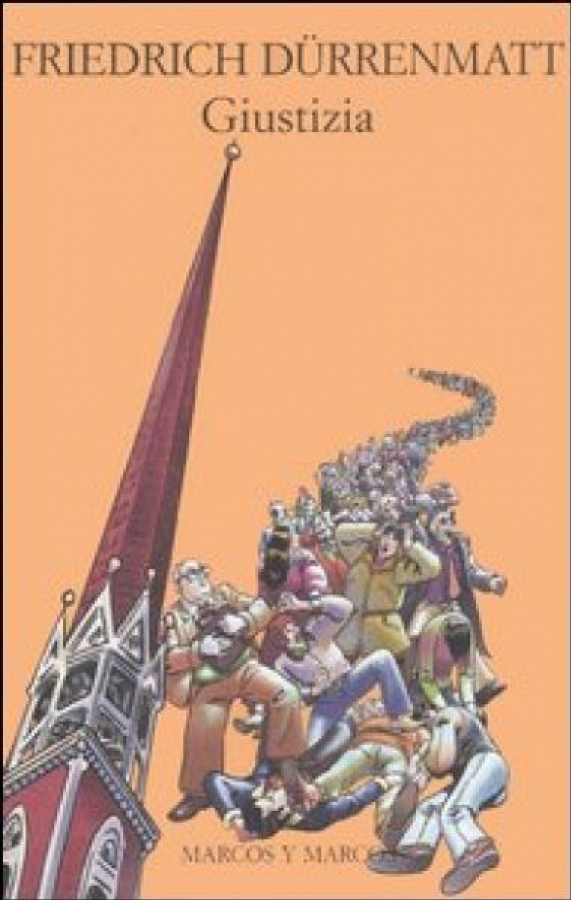
Justice
The novel recounts a paradoxical story. A cantonal councillor murders a friend in a restaurant before a crowd of witnesses. Once in prison, he hires an attorney (the author of the manuscript) to identify a different killer. The attorney gathers a body of information that leads to the cantonal councillor’s acquittal before the court of assizes. Convinced he was merely a pawn of the councillor (who is, in truth, the real murderer), the attorney attempts to kill him, but misses his mark. The novel concludes many years later, when the writer (Dürrenmatt himself) comes to learn the underlying motives of the murder and the actual sequence of events that led to the crime. The dominant theme of the novel is the incomprehensibility of reality and its potential inversion into absurd situations, devoid of logic and of any social or historical meaning. As the author writes, > is the story that became real only in my imagination and that now, written down, recedes from me, perhaps more absurd than the history of the world, less solid than the ground upon which we build our cities? . This philosophical theme is translated into a relentless narrative pace which, moving from a traditional structure (reminiscent of a nineteenth-century novel), evolves into a succession of characters and events that overlap and intertwine across different temporal planes. The style likewise turns convulsive, composed of short, truncated sentences so as to manifest the author’s agitation and the absurdity or inherent lack of logic in the events and situations described. It is, however, a novel entirely folded in upon itself: there is effectively no plot to generate a shred of suspense or compel the reader onward; the characters seem devoid of genuine depth and individual character, almost marionettes in the hands of fate; the descriptions of settings are repetitive. It is, in fact, a tedious, intellectualistic novel that fails to give artistic form to the philosophical theme at its foundation. Confirmation of this lies in the fact that its most engaging and readable sections are precisely those that assume the character of an essay.