Finished reading on: January 04, 2023
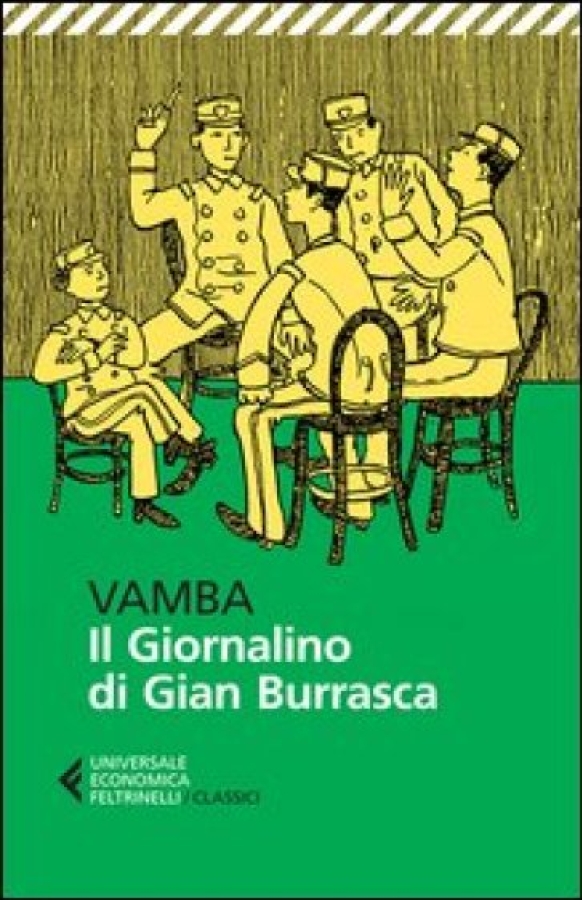
The Diary of Gian Burrasca
Title of the original version reviewed: «Il giornalino di Gian Burrasca»
AI Translation Notice: This review was translated from the original Italian using artificial intelligence. Book quotes and excerpts are translated interpretations and will not match the author's original English phrasing or official published translations.
Vamba, the pseudonym of Luigi Bertelli, imagines having discovered Il giornalino di Gian Burrasca “from a portress, wife of a court usher, while she was reading it to her children”; indeed, Giannino Stoppani’s diary had long remained “forgotten among the files of the Judicial Chancellery, which will certainly come as no surprise to anyone who knows how everything concerning Italian Justice is protracted and oblivious, (...) wearisome and costly...
Il giornalino di Gian Burrasca begins on September 20 (the day of the capture of Porta Pia) and concludes on March 2 of the following year; the years are not specified, but they are likely 1907 and 1908, when the story was published in installments in Il Giornalino della Domenica. The setting is the typical bourgeois family of the early twentieth century, of modest means, constantly awaiting an inheritance and anxious to find a good husband for their three grown daughters. Giannino is the youngest, and we may assume he is around ten years old: mischievous, rebellious, always ready for new pranks, the consequences of which he fails to grasp, whether out of naivety or excessive shrewdness. After the lawyer Maralli, future husband of his sister Ada, nearly loses an eye due to Gian Burrasca’s latest stunt, to his mother who tearfully tells him:
“do you see, my Giannino, how much sorrow, how many misfortunes because of you!...” Giannino replies “to comfort her, (...) but if they are misfortunes, excuse me, how is it my fault?”
The diary is divided into two parts. In the first, roughly 200 pages long, Giannino's antics unfold in succession—some hilarious, others frankly exaggerated, often repetitive in their narrative structure. Vamba harbors no pedagogical intent, as is the case with De Amicis’s Cuore and Collodi’s Pinocchio (for the latter, see the review on this site). A penchant for pranks prevails over everything. In the second part, Giannino is sent to a boarding school, where the boy discovers solidarity among peers and the meaning of revolt as a challenge to authority. Highly effective are the figures of the Headmaster and the Headmistress: he
“so very thin and so very tall”, she “so very short and so very fat” and who calls her husband “idiot”
. She, after all, is the owner of the boarding school, founded by her uncle. And here unfolds one of the funniest episodes of the entire story. The boys realize that the pair are fond of séances in which they summon the spirit of the founder; by means of a ruse, Giannino and his friends fake responses from beyond the grave, but they cannot contain their laughter and end up being discovered. The diary ends on a bitter note. Humiliated by the Headmaster and the Headmistress because he is a poor boarder unable to pay his tuition, feeling unworthy in front of his peers, his friend Barozzo flees the boarding school:
“he turned to me and threw his arms around me, holding me tight, so very tight; he kissed me and our tears mingled upon our faces, (...) and when I came to my senses I was alone, leaning against the main gate of the institute, which was shut.” The diary could have ended with this feeling of grief and shock over a friendship lost to wounded pride; yet instead, stubbornly, Vamba chooses to add yet another of Giannino’s stunts, thereby pinning the entire diary to its caricatured aspects.
Through modern eyes, the atmosphere and episodes of Il giornalino di Gian Burrasca seem to belong to another society, distant from our own. For us adults, the diary can serve as an intriguing portrayal of the early-twentieth-century bourgeoisie, that which Guido Gozzano depicted with irony; a social structure that endured throughout Fascism and into the early postwar decades, until it was swept away by consumerism and the sexual revolution. To teenagers, I suspect Giannino may seem an incomprehensible boy, though they might appreciate his spirit of revolt against adults, who are perceived as a hostile, rigid, and downright hypocritical counterpart. Unintentionally, Vamba chronicled the generational conflict, albeit in a paradoxical and therefore implausible manner.
The Tuscan cadence of the language makes Giannino’s diary a testament to a living, popular, and authentic Italian. And this is precisely why Il giornalino di Gian Burrasca remains an enjoyable read.
Why read it? It offers a cross-section of an Italy that is no more.