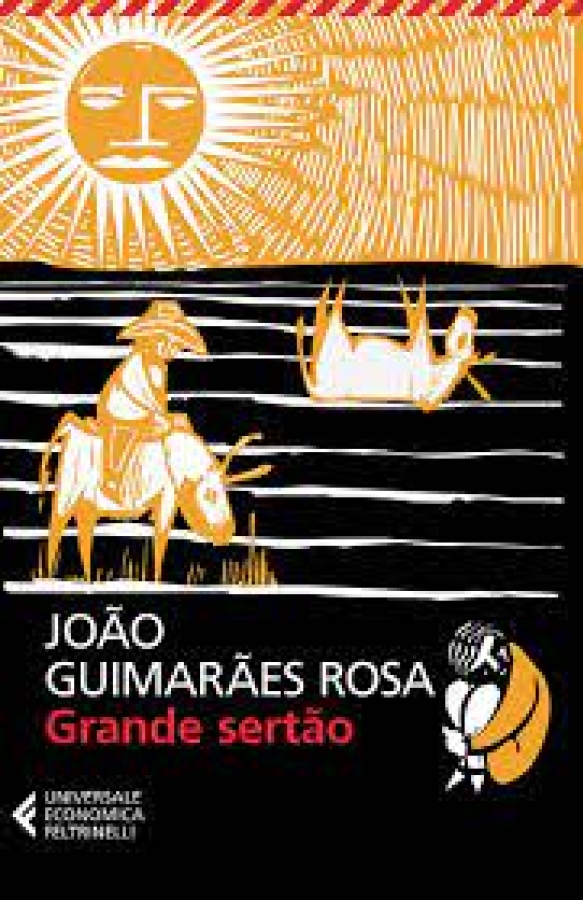
Finished reading on: June 10, 2023
Grande Sertão
Title of the original version reviewed: «Grande Sertao»
AI Translation Notice: This review was translated from the original Italian using artificial intelligence. Book quotes and excerpts are translated interpretations and will not match the author's original English phrasing or official published translations.
The Sertão is a vast region in northeastern Brazil: an expanse of low plateaus characterized by brief, intense rains that give rise to alternating periods of drought and flood, ruining crops and bringing famine to an impoverished population historically exploited by large landowners. At the end of the nineteenth century, widespread banditry developed, blending rebellion, brigandage, and confused social demands. In this setting, where "the criminal lives as he pleases," Guimarães Rosa composed an epic poem, a kind of Iliad, with its heroes and its battles (see the review of the Iliad on this site). Furthermore, the author recounted an unhappy and enchanting love story, a seemingly impossible, extraordinary passion reminiscent of that for the Pisana in Ippolito Nievo's Confessions of an Italian (see review on this site). Riobaldo is the son of a wealthy landowner; he could live in comfort and marry a wealthy, beautiful woman of his own social class, yet he chose instead to go fight alongside the rebels:
the Sertão produced me, then swallowed me, then spat me out from the heat of its mouth
. Among the rebels, he met a splendid, delicate youth with whom he fell in love.
I felt the need to place my fingers, light, very light, upon those tender eyes of his. (...) My treasure, if only it were broad daylight, and I could see the color of your eyes...; so I said, lost in oblivion, as if I were only thinking aloud, almost reciting a line of verse. Diadorim stepped back, frightened. (...) And he laughed wickedly.
We are not in ancient Greece, where homosexual relations were customary and Achilles could love Patroclus; here, in the Sertão, Riobaldo and Diadorim can only be friends, and Riobaldo’s advances a mere "mocking jest." Diadorim is the son of the most prominent gang leader, who is murdered by a cruel, bloodthirsty rival, "the man without a face"—perhaps the Devil himself. The vendetta begins. Several bands under Riobaldo’s command pursue their enemies in ceaseless clashes amidst great rivers, swamps, and scrublands, magnificent wild beasts, impoverished peasants, and wealthy landowners—stealing, raping women, looting, and dying of disease and in battle. The Great Sertão profoundly transforms Riobaldo: from a reflective, insecure youth he becomes a ruthless leader, shrewd and resolute. With his feminine sensitivity, Diadorim gently reproaches him: "what is changing within you is the task of the soul, not the duty of command." Did Riobaldo make a pact with the Devil? To be sure, he sought a pact on a stormy night, but the Devil never appeared. At last, we arrive at the final, decisive battle. Diadorim slays "the man without a face," avenging his father, but dies fighting. And when the pious women wash the corpse, as was the custom in the Iliad, they discover that Diadorim is a girl!
She was, such that she thus disenchanted herself, in so terrible an enchantment. (...) I howled. (...) Diadorim was a woman, she was a woman as the sun does not kindle the water of the river Urucuia, as I sobbed out my despair
.
The novel is not merely a love story. There are at least two other narrative strands. First and foremost, Guimarães Rosa tells of the vanished world of the "jagunços" and their natural and social environment: hardened men whose fate is sealed from birth and who know they will be defeated, yet continue to live in the Great Sertão, singing their songs:
life is a most perilous lot/in the duty of loyalty:/every night a river downstream, /every day is darkness...
Another theme is the metaphysical one: does the Devil exist, and where is God? If by the end of the novel we cannot find an answer to the first question, we nevertheless understand quite clearly that God, if He exists, is like the Great Sertão—pervasive yet exceedingly distant, indifferent to the plight of human beings.
As the translator notes, Guimarães Rosa’s narrative and lyrical world
blends regional terminology, structures, and inflections with the boldest innovations and the distinctiveness of the natural and human world from which it springs. Much is perhaps lost in translation, yet the magical sense of the narrative remains, sweeping the reader into a dreamlike and fascinating tale. Riobaldo, at the end of his life, narrates his Sertão to an unidentified person, addressed only as
Vossignoria"; in this way Guimarães Rosa gives momentum to the novel, alternating brief colloquial phrases with detailed, intense descriptions, melding reality and imagination. It is a pity that Feltrinelli ruined this masterpiece by using a tiny typeface that is exhausting to read: perhaps to save paper and ink!
Why read it? Arduous, but magnificent.