Finished reading on: July 31, 2021
The Cat Who Saved Books
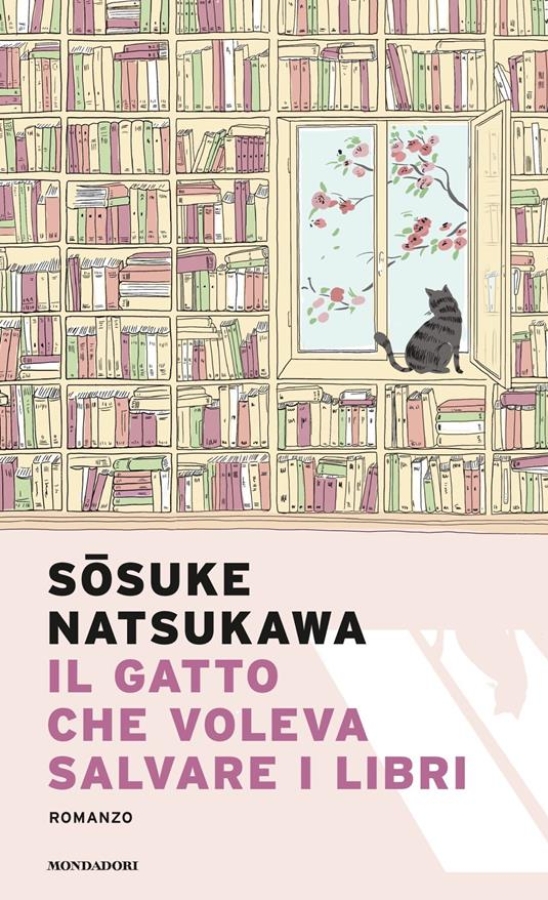
Title of the original version reviewed: «Il gatto che voleva salvare i libri»
AI Translation Notice: This review was translated from the original Italian using artificial intelligence. Book quotes and excerpts are translated interpretations and will not match the author's original English phrasing or official published translations.
What is the fascination of books? Why do so many of us spend so much time reading novels and poetry? The author attempts to answer these questions through a coming-of-age story, a cross between Harry Potter and Treasure Island (see the reviews on this site). Natsuki Rintaro is the typical hikikomori, a term synonymous with an antisocial, apathetic, and misanthropic adolescent. To be sure, he possesses a passion for reading, born of living in his grandfather’s crowded, dusty bookshop. It is a small secondhand bookshop with a peculiar layout.
When entering the bookshop through the brightly lit front door, the room seemed in perspective far deeper than it actually was, and for a moment it felt as though that book-lined corridor stretched out endlessly into the darkness
. There is a power in books, the grandfather used to tell his grandson as he quietly opened a volume. Upon his grandfather’s death, the boy is supposed to go live with an aunt—a fate he accepts passively, almost indifferently. Suddenly, out of nowhere, a cat appears; with gentle yet firm manners, it invites him on a quest: to save books. Together with the cat, the boy ventures down the corridor beyond the back wall of the bookshop; the two find themselves in palaces, veritable labyrinths, from which the boy will only be able to escape if he frees the books. Each labyrinth corresponds to a specific way of understanding our relationship with this “collection of sheets of paper covered in printed characters”: the obsessive urge to hoard, the pursuit of digests that allow one to consume the greatest number of writings in the shortest possible time, and the conception of the book as a consumer good—a business in which everything that does not sell must be destroyed. It is a taxonomy all too familiar to us book lovers, yet one forgets that
reading a book is rather like climbing a mountain. (...) Every now and then you have to examine line by line, re-read the same sentence backwards several times, and proceed slowly, striving to understand. As a result of such arduous effort, suddenly your mind opens up
. These are the grandfather’s words resurfacing in the boy’s mind, dense and vigorous words. Through the climbing metaphor, the grandfather means that one can only endure the grueling ascent if one loves the mountain. And it is this very argument that disarms his interlocutors and saves the books: how can one hold them prisoner, chop them up, and treat them as mere commodities, if one truly loves them? The journey of personal growth is not yet complete. To paraphrase Karl Marx in The Poverty of Philosophy, we are still in the realm of ideas, bound in an erudite and narcissistic attachment to reading. Only the final trial will bring the adolescent’s maturation to fruition: as Confucius held, the humanities, literature, and poetry allow us to understand “the sense of reciprocal humanity”—that is, the empathy that binds all human beings together.
The author attempts to give narrative momentum to the story while simultaneously conjuring a magical atmosphere. To this end, he resorts to the literary device of the cat, a frequent trope in Japanese literature—one need only think of Natsume Soseki’s I Am a Cat (see the review on this site). Yet while in Soseki’s work the cat is an ironic, wise figure, an alter ego to the dull and narrow-minded schoolmaster, here the small feline is a plodding censor of the protagonist, akin to the Owl in Pinocchio. The long corridor that opens mysteriously into the labyrinths calls to mind the far more original railway platform from which the magical adventure of Harry Potter begins; moreover, the description of the palaces is so meticulous as to become predictable and verbose. Having started off well, the novel lapses into a pedantic meditation on the book, containing reflections that would be agreeable and worthwhile were this a work of non-fiction.
What elevates the novel’s quality is the prose: plain, pleasant, and fluid, even if occasionally repetitive; the brushstrokes portraying the bookshop and sketching the boy and his friends are spot-on. What a pity the author did not develop the characters more thoroughly!
Why read it? It speaks of our love for books.