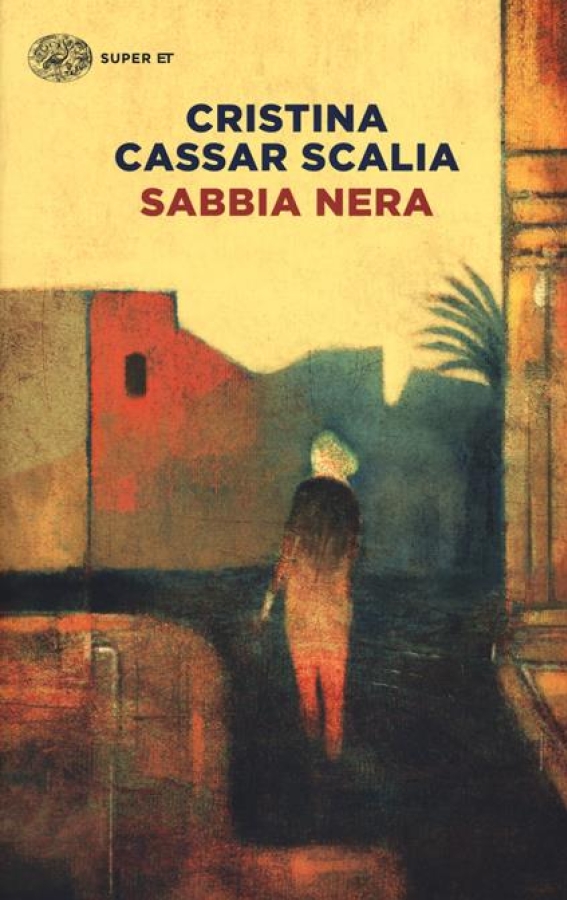
Black sand
> *La Muntagna* had awakened that morning. A dense black cloud of ash loomed over the city, enveloping it. (...) The volcanic sand fell relentlessly, forming a crunching carpet on the ground and sliding off open umbrellas... E as the sky is darkened by the ashes of Mount Etna, so Vice Questore Guarrasi must unravel the mystery of an unknown woman found mummified in a dumbwaiter of a villa on the slopes of the volcano. Transferred from Palermo's anti-mafia squad to Catania's homicide division, Guarrasi possesses that "Palermitan shell," and even as she attempts to assimilate the customs and idiom of the Etnean city, she remains at heart a Palermitana: > and a native of Palermo in Catania is convinced they could never feel at home, even if in truth that is not so . The Vice Questore is a legend within the police force, having saved a magistrate from a mafia hit by killing the hitmen; she is resolute, intelligent, and intuitive, with a penchant for complex, obscure cases that defy easy resolution. The mummified corpse is in many respects an enigma. First and foremost, her identity must be established and the time of death determined. Tracing back the threads of the affair, Guarrasi discovers a link between this body and the murder of Gaetano Burrano, which occurred some twenty years earlier and had been attributed to the mafia—supposedly in retaliation against a man who refused to yield to the syndicate's demands. But "Gaetano Burrano had been described" as someone who *arriminava* (stirred the pot), *macari* in dirty water at times > . Could there have been something more? And why did the widow, wealthy and powerful, abandon the villa following her husband's death, obstructing the investigation at every turn? *Incutto*, one might say in Sicilian of an irritating person like the widow Burrano, "one of the dialect terms that Vice Questore Guarrasi strove to learn, jotting it down in a dedicated note on her iPhone entitled 'Catanesate'." Guarrasi discovers that Gaetano financed a brothel run by the deceased woman, who was also his mistress and by whom he had fathered a daughter whose trail has long gone cold. The scandalous affair had *«i na fatta morta»* (utterly crushed) the widow: could she be the murderer? And > what if the south wind that had cleared the city of the volcanic rain had also begun to dispel the dark haze shrouding that investigation ? The impression is strong that the author intended to emulate Camilleri through Vice Questore Guarrasi, offering a female counterpart set in Sicily akin to Inspector Montalbano. Yet the flaws lie precisely in the setting and in the protagonist's characterization. Catania is sketched superficially: the motif of the ash cloud feels trite, just as the fleeting glimpses of chaotic city traffic remain inconsequential; far more engaging is the recourse to Sicilian dialect, evocative and inscrutable to unaccustomed ears. In delineating her character, the author perhaps had Alicia Giménez Bartlett’s Petra Delicado in mind (see the site's reviews of *Il silenzio dei chiostri* and *Serpenti nel Paradiso: Riti di Morte*); despite the attempt to lend depth to Guarrasi through allusions to her murdered father and her love for the magistrate whose life she saved, and notwithstanding the depiction of a solitary, disordered existence tempered by the care of a neighbor, the Vice Questore’s personality fails to enrich the narrative, lingering in the background and frequently verging on the stereotypical. The plot alone carries the story, and that is simply not enough. Why not read it? It is banal.

Sardinia Blues
Three young men—Davide, the protagonist, Licheri, and Corda—drag out their existence in a Sardinia far removed from the one known to tourists: the sun and the sea are there, but above all, there is boredom and a yearning to escape the provinces to experience the wider world. All three have spent considerable time abroad falling in love with extraordinary women, dancers, but have returned disillusioned to their homeland, whiling away their days between nightclubs and petty thefts. The protagonist, Davide, is thalassemic and therefore bound to constant blood transfusions. Yet his illness is not the root of his *mal de vivre*: what weighs on him most heavily is his mother’s death and the unraveling of his family, marked by his father’s remarriage and the emotional—even spiritual—estrangement of his sister. For the most part, the novel drifts between depictions of the three youths' nightlife, Davide’s memories of his adolescence and his life in London, fleeting love affairs, and episodes of petty delinquency: everything unfolds with lightness and resignation, devoid of anger, almost in acceptance of life’s futility. Then events spiral: Davide sleeps with Daniela, one of the most beautiful girls at the club, and the two are caught by her boyfriend, who murders them. The fundamental theme of the novel is what it means to be Sardinian: > often my friends and I would have dinner and smoke, holding forth on love and art, on being Sardinian and the meaning—or lack thereof—of this fortuitous element of our existence, on our desire to travel and understand the world, on our phobias and our aimlessness . And it is precisely this need to transcend parochialism, “the identitarian and anti-identitarian paranoias,” that constitutes the book’s most compelling trait: in an Italy increasingly diminished and provincialized by the rhetoric of territory, this novel serves as an anthem—perhaps unintended by the author—to globalization, to an openness toward the world, to “accepting that we are like everyone else.” It is no coincidence that Davide consistently refers to foreigners when speaking of other thalassemics: illness unites rather than divides. Sorigo’s prose is highly idiosyncratic and innovative: the narrative unfolds without punctuation (or with faulty punctuation), as though the words tumble forth unchecked, staking everything on musicality and verbal juxtapositions. The touchstone is poetry rather than prose. This stylistic approach is occasionally effective, yet it renders the reading experience fragmented, eroding the novel’s overarching coherence and leaving it, in the end, as an assemblage of episodes and impressions.
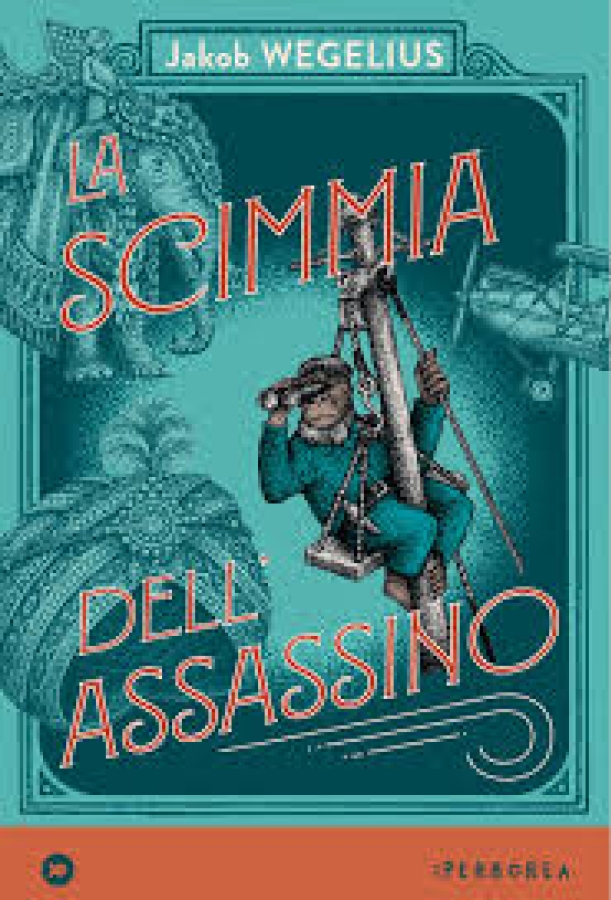
The Murderer's Ape
> For those who do not know me, it is best to state first of all that I am not a human being. I am an anthropoid ape. (...) How I ended up among humans I do not know, and in all likelihood I never will. Sally Jones, the simian narrator of this novel, is intelligent; she lacks only the gift of speech, but understands human language, knows how to write (which is how she communicates), and is exceptionally skilled at repairing mechanical objects, from ship engines to musical instruments and an old typewriter, with which she presumably penned "her memoirs." Her gifts (technical prowess, dedication to work, a deep sense of friendship) have made her the indispensable companion of a solitary seaman, owner of an old boat. Finding themselves in Lisbon, waiting for cargo to haul, Sally Jones and her Chief cross paths with Alphonse Morro, ( > he had a thin, deathly pale face and a tormented look), who charters the ship to pick up cargo—officially tiles, in reality crates filled with weapons. In a series of unpredictable events (the sinking of the boat, the unexpected encounter with Alphonse Morro ( > his eyes seemed to be bulging from their sockets in terror ) and the latter's disappearance at sea, the captain is accused of having murdered Morro, whose body is nowhere to be found. While the man is taken to prison, Sally Jones flees into a hostile, shadowy Lisbon. Trembling and hungry, she takes shelter in an attic, when there reaches her, as if in a dream, a song, > a sad and beautiful voice, (...) and suddenly, without understanding why, I felt a sense of warmth wash over me. (...) The woman was sitting before the open window of a dormer. As she sang, she worked on something in her lap. She wore a shawl, and her dark hair was gathered in an untidy bun. From this point on, the narrative unfolds into a series of adventures that lead Sally Jones from Lisbon on the run to distant India, only to return to the Portuguese city, ever determined to prove her captain's innocence. It would be tedious to retrace every episode, continually marked as they are by dramatic twists, new characters, and a suffused atmosphere of melancholic hope. Whence comes the gentle strength of Sally Jones, this strange ape? It springs from Love, expressed through the profound bond linking the ape to the people she encounters—those who help her and whom she helps in turn: the sorrowful Anna, a poor factory worker and wondrous Fado singer; Fidardo, the surly musical instrument repairer; the cemetery keeper where Sally Jones discovers the grave of Morro’s fiancée and her tragic love story; the eccentric maharajah, to whom Sally Jones is no courtier, but a true friend; and finally Alphonse Morro himself, in truth a suffering victim racked with remorse. There are villains too, manifestly stronger than the poor ape; how often does Sally Jones curl up on the bed, feeling tears well up, overwhelmed by fear and longing! Stubborn, seemingly fragile yet steadfast in her values, Sally Jones is a harbinger of hope at a time when we—adolescents and adults alike—stand in great need of it. The novel is divided into three parts: the first and third set in Lisbon, the second in India. One must wonder why the author devoted so many pages to Sally Jones's sojourn with the maharajah, dissipating Lisbon's enchanting atmosphere in trite descriptions. Reading the pages set in the Portuguese city, one feels imbued with that melancholic sense of existence so distinctive of Lisbon; and the author has proven exceedingly deft at lending contrasting palettes to the streets and the sky—somber in the first part, radiant in the last, when Sally Jones returns to her friends and familiar haunts. And what can be said of the song, the Fado, which threads through the entire narrative, managing to convey even to the maharajah the sweet sorrow of Portuguese music, capable of transforming a self-absorbed man into a generous and benevolent soul, at least once in his life. The plot alone would not have sufficed to give depth to the story. It is the prose that defines the entire narrative: fluid, deceptively simple, alternating between dialogue, the ape's inner reflections and states of mind, and deft atmospheric descriptions; the style captivates the reader, even in passages that are frankly prolix and redundant. Why read it? Sally Jones seems to personify Kant’s categorical imperatives: liberty, equality, and fraternity.
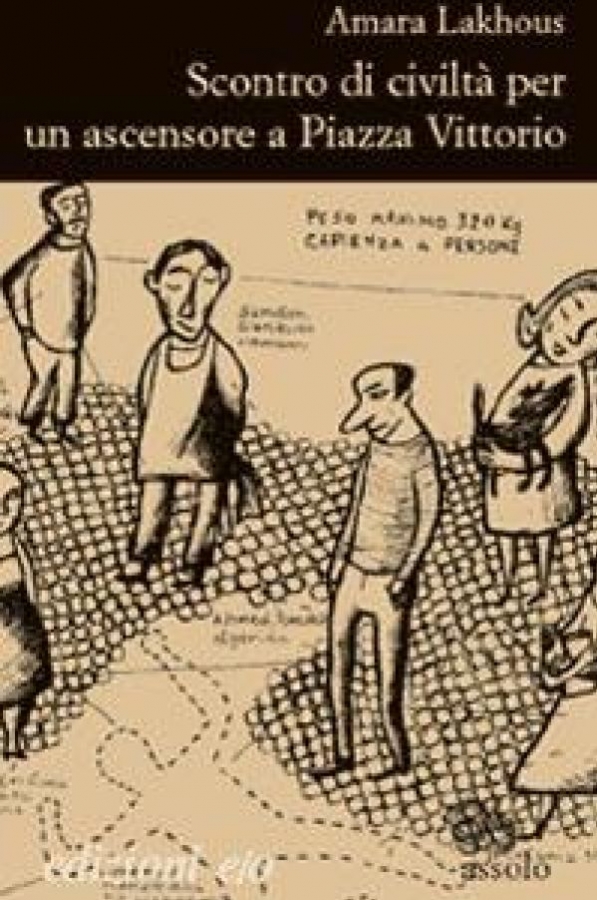
Clash of Civilizations Over an Elevator in Piazza Vittorio
The Italian edition is a revision, also undertaken by the author, of the original Arabic publication of 2003, which bore another title: “how to be suckled by the she-wolf without her biting you.” The two titles, in Italian and in Arabic, constitute two possible interpretive keys to the book. The setting is Piazza Vittorio in Rome, the multicultural venue par excellence, and specifically an apartment building inhabited by a diverse cast of characters: from the Neapolitan concierge to a melancholy university professor from Milan, to a young Dutchman passionate about Italian Neorealism. Revolving around the building is a multiform humanity that, despite mutual misunderstandings and cultural and linguistic differences, shares a single conviction: their esteem and trust in Amedeo. He appears, and strikes us, as the Italian we would all wish to be in a multicultural society: cultured, kind, polite, tolerant, and ready to help regardless of skin color, religion, or country of origin. These are the reasons why everyone rejects the idea that Amedeo could have committed a murder—and what is more, in the building’s elevator, which he avoided using out of respect for the concierge. > He looked at me with a smile and said: I’ve changed my mind, I’ll take the stairs. I couldn’t believe my ears and asked myself: are there still men who respect women in this country? . Yet what is even more incredible is that everyone, Italians and foreigners alike, is astounded that Amedeo is not Italian. After all, foreigners are all ill-mannered and ignorant. But who is Amedeo? And this is the second interpretive key. Amedeo, with his flawless Italian and his vast knowledge of Rome, is in reality Ahmed, an Algerian who fled his homeland after his fiancée was brutally murdered. His is a flight from the horrors of the past, from a world he wishes to leave behind, in mind as well as in body. In Rome he found Stefania—naive, idealistic, and curious—and fell in love with Piazza Vittorio, with its clash of civilizations. > Rome has Termini Station. Termini means the journey is over. There is something strange about this city. It is very difficult to leave. Perhaps the water from its fountains has been mixed with some peculiar substance of sorcerous origin . Yet Rome can also wound you, with its bureaucratic red tape, with the coldness and violence of a society in decline, bereft of human solidarity. Ahmed, deep down, wants to be neither Italian nor Algerian: he would like to simply be Ahmed. Moreover, the memory of the past belongs to him alone, its wounds to be tended in solitude. > Oh my open wound that will never heal! I have no solace except in howling . The book’s fundamental merit lies in its writing. To begin with, an inspired choice is the alternation between the unfolding of events as related by the various characters—thereby foregrounding their differing points of view—and the autobiographical, diary-like notes of Amedeo/Ahmed. These are introspective, reading almost as the narrative of a personal journey of liberation from the past and discovery of the future. Furthermore, the affectionately ironic style does much to prevent the narrative from lapsing into moralizing or pseudo-sociological analysis when depicting the latent racism among Italians (structured along the classic hierarchy: North – Southern Italy – Global South), the despair and nostalgia of the foreigners, and the coldness and harshness of Italian life. The characters are sketched with such close attention to the individuality of each, whether Italian or foreign, that a multitude of lights and shadows emerges, rather than that binarism (Italian – foreigner, good – evil) that so much of the media seeks to impose upon an Italian society that, though resistant, is subjected to it. Why read it? Light, entertaining, yet profound.
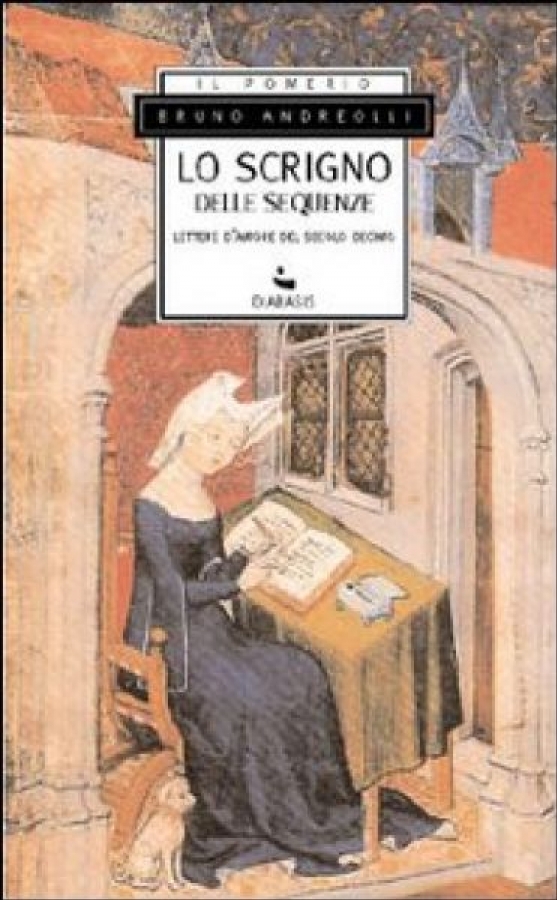
The Casket of Sequences
The book is set in the year 900 and recounts the story of a young man raised by a countess. Unwittingly, the young man kills his father and, at the countess’s bedside, reads letters that shed light on his life. The book is thoroughly enjoyable; the harsh medieval milieu is depicted with great skill, complemented by scenes of family life and domestic settings.
The Second Circle
The book brings together four short stories by young Russian writers who were children when the Soviet Union collapsed and are therefore utterly detached from the themes inherited from the fall of the empire. The stories exhibit entirely different styles and subjects, yet share a common motif: “the search for something we lack,” as concluded by Vladim, the protagonist of Savelyev’s short story, the most accomplished of the four. Alisa Ganieva’s *Salam Dalgat* is set in a city in the Caucasus. Dalgat, a young student “thin as a stick,” is searching for a relative, a quest that leads him across the city: through the bazaar, into squalid outskirts, to a wedding. Everywhere he encounters desolation, gratuitous violence, and the enduring clash between tradition and modernity. How far removed all this is from the official rhetoric that seeks to project a radiant, virtuous image of the lands and people of the Caucasus! In his wanderings, Dalgat meets a man who wants him to read a book about how the Caucasian nation was destroyed, along with its languages, songs, and secular poetry. Yet when the young man asks what the book is about, the man replies with a smile: “nothing special, nonsense.” While Ganieva’s style remains profoundly Russian, that of Igor Savelyev is minimalist, spare. His *Pale City* explores the world of hitchhiking. The protagonists are youths roaming across vast Russia with no real aim other than fleeing their parents and escaping bourgeois existence. Vladim, in his wanderings, finds lodging for the night in Ufa, one of the many cities bordering the Urals, staying with a chronically delayed university student. Here he meets a girl, Nastya, also a hitchhiker. A brief romance begins, which the young man wishes to pursue, but Nastya > grew heated.... I don’t care where I go (she says), as long as it’s far from home... I need new places to stay for just a short while.... casual acquaintances, people who appear and vanish . And so nothing remains but to hit the road again, in search of that “acute sense of loneliness that cannot be found in normal life.” Anna Lavrinenko’s *The Lost Child* is a delicate, sentimental, even psychological story, yet behind its apparent narrative normalcy lies a paradox: the protagonist, a call-center operator, is convinced he was abandoned by his mother at the age of five. This thought—was he truly abandoned?—has haunted him for thirty years, yet perhaps an event of such magnitude is not required to give meaning to life. > Perhaps it is enough simply to forget one’s keys, to sit down in a deserted stairwell . Finally, Aleksei Lukyanov’s *High Pressure* returns us, in a surreal manner, to the squalor of contemporary political life. A few laborers work wearily in a railway depot when they realize, day by day, that phones, the internet, and all means of communication have ceased to function. The government attempts to remedy this with an absurd scheme: steam-powered radio broadcasting. Yet this does not halt the decay; even important (“sacramental”) words begin to go missing. Everyone wants to escape to the West, but the trains are overcrowded. The future might well be one of desolation, poverty, and loneliness, were it not for the continuing cycle of the seasons. > The green had returned and some retail chains had liquidated themselves in great haste.... and so famine did not arrive . At one point, the government announces via steam radio broadcasting that it has grown weary of its citizens, who are far too ignorant to comprehend it, and has decided to abandon them to their fate. The steam broadcasting explodes, but words return, and freedom is finally attained. Yet are we in Italy or in Russia? The stories are finely written and address overarching themes typical of contemporary society: the disorientation of youth, but also the resolve to forge one’s own future independently and by one’s own means. The stories do not reach closure; they remain suspended and uncertain—yet this is precisely what lies before us: there are no longer any certainties. Why read it? It makes for an enjoyable read, with compelling and intriguing themes.
The Secret of the Old Woods
At the beginning of the story, Dino Buzzati imagines that a nineteenth-century abbot, «with concise and very clear accounts», speaks of «a wondrous vision» upon beholding the old wood; in a footnote, the author observes how some men grasp the secrets of the woods, perceiving them by «nature», while others will never possess this sensitivity, > and will pass impassive (...) alongside the tenebrous forests, without even suspecting what goes on inside . Communion with the trees, the capacity to grasp their magic, belongs to children; as Bernardo explains—the tree-genie who took upon himself the burdensome task of conversing with adults— > at a certain age all of you, men, change. Nothing remains of what you were as children. You become unrecognizable . Adulthood causes one to lose the quality of feeling part of the whole, of playing in the woods alongside the animals, of understanding the birdsong, of perceiving and distinguishing the grand, multicolored orchestra of the forest’s sounds. Since adults will never love nature, the genie Bernardo became friends with the old owner, persuading him to leave the old wood untouched. What an ordeal to spend evenings in long games of cards, in tedious conversations, while > through the window, along with the scent of most precious resins, drifted the deep voice of his brothers, singing carefree ! The situation changes when the old owner dies and the new master arrives. Procolo, a retired colonel, is a rigid, somber, solitary man, impervious to any communion with the woods, which he views merely as an opportunity for exploitation. It is not that he is greedy; he is simply a petty soul, and how can one who lacks generosity ever find pleasure in the rustlings and scents of the woods? He allies himself with the wind Matteo to bend the tree-genies and force them to work for him in exploiting the forest; he kills the magpie that stands sentinel over the house, only to plunge into the silence of the night, locked within his nightmares. Wretched and wicked, he seeks to rid himself of young Benvenuto, the heir to the wood and his ward; with the aid of the wind Matteo, he does not hesitate to abandon the boy in wild tracts of the forest, where Benvenuto surely would have died. He fails, believing that no one knows of his murderous intent. But when he ventures into the depths of the forest, > the birdsong fades, the squirrels and dormice flee, silence settles upon the boughs, and at times ominous storm clouds even appear in the sky. (...) Evidently he struck a discordant note in that joyful corner of the woods; evidently trees and birds could not endure him . Even his shadow abandons him, so disgusted is it by the barrenness of its lifelong companion. Procolo is alone. And yet, little by little, reluctant and surprised, during a sleepless night Procolo recognized the sounds of the forest. He counted fifteen of them, meticulously noting down each one. > But two or three times, that night, there was also true silence, the solemn silence of ancient woods, incomparable to any other in the world, which very few men have ever heard . And the goodness that dwells in all human beings is finally liberated from the performance of self, from that «false self» that had accompanied him throughout his life. Procolo dies, yet he is saved. Buzzati’s tale can be interpreted as a fascinating metaphor for the human soul, where the woods are not Dante’s «dark wood» but a kind of Shinto paradise in which trees are benevolent genies and the winds are hostile, dark forces: a depiction, in short, of the intricate tangle of consciousness. I prefer to interpret *The Secret of the Old Woods* literally, as a great fable of the forest, devoid of ulterior meanings. Raised by parents who loved the mountains and made me spend long summers amidst the greenery of the Alps, walking among the trees was always part of my life, without my understanding why. Reading Buzzati’s tale made me understand my passion. And it is precisely for this reason that I juxtapose it with Petrarch, fully aware of how daring such a connection is. When Francesco Petrarch recounts his walks in Provence and Tuscany, I recognize the feeling that stirs within me as I, too, make my way through the forest: the longing for detachment from the frenzy of the world, finding oneself again, solitary, silent, immersed in physical activity, permeated by the vitality of the trees, conscious of the bond connecting all living beings. Often, wandering freely and aimlessly amidst the lights and sounds of the forest, the lines of Canto XXXV of the *Canzoniere* come to mind: > alone and pensively the most deserted fields/I pace and measure out with slow and tardy steps,/and keep my watchful eyes alert to flee/wherever human imprint marks the sand .

The Secret of the Old Woods
At the beginning of the tale, Dino Buzzati imagines a nineteenth-century abbot who, "with succinct and very clear accounts," speaks of "a wondrous vision" upon beholding the old forest; in a footnote, the author observes how some men grasp the secrets of the woods, perceiving them by "nature," while others will never possess this sensitivity, > and will pass impassively (...) along the shadowy forests, without even suspecting what goes on in there . Communion with the trees, the capacity to perceive their magic, belongs to children; as Bernardo explains—the tree-genie who has taken upon himself the burdensome task of conversing with adults— > at a certain age all of you, men, change. Nothing remains of what you were as children. You become unrecognizable . Adulthood causes one to lose the quality of feeling part of the whole, of playing in the woods alongside the animals, of understanding the birdsong, of perceiving and distinguishing the vibrant and grandiose orchestra of forest sounds. Because adults will never love nature, the genie Bernardo befriended the old owner, persuading him to leave the old forest untouched. What an ordeal it was to spend evenings in long games of cards, in tedious conversations while > through the window, with the fragrance of precious resins, entered the deep voice of his brothers, singing carefree ! The situation changes when the old owner dies and the new master arrives. Procolo, a retired colonel, is a rigid, somber man, solitary and impervious to any communion with the woods, which he sees merely as an opportunity for exploitation. It is not that he is greedy; he is simply a petty soul, and how can one who lacks generosity find pleasure in the rustlings and scents of the woods? He allies himself with the wind Matteo to bend the tree-genies and force them to work for him in exploiting the forest; he kills the magpie that stands sentinel over the house, only to plummet into the silence of the night, trapped inside his nightmares. Wretched and wicked, he seeks to rid himself of young Benvenuto, heir to the forest, of whom he is the guardian; with the aid of the wind Matteo, he does not hesitate to abandon the child in wild reaches of the woods, where Benvenuto would surely have perished. He fails, yet believes no one knows of his murderous intent. But when he ventures into the thick of the forest, > behold, the birdsong wanes, squirrels and dormice flee, silence settles upon the boughs, and at times ominous clouds even appear in the sky. (...) Clearly he struck a false note in that blissful corner of the woods; clearly the trees and birds could not bear him . Even his shadow abandons him, so disgusted is it by the barrenness of its lifelong companion. Procolo is alone. And yet, little by little, reluctant and astonished, on a sleepless night Procolo recognized the sounds of the forest. He counted fifteen of them, meticulously noted one by one. > But two or three times, that night, there was also true silence, the solemn silence of ancient woods, comparable to none other in the world, which very few men have ever heard . And the goodness that resides in all human beings is finally liberated from the representation of self, from that "false self" that had accompanied him throughout his life. Procolo dies, but is saved. Buzzati’s tale can be interpreted as a fascinating metaphor for the human soul, where the woods are not Dante’s *selva oscura*, but rather a kind of Shinto paradise in which trees are benevolent genies and winds are hostile, dark forces: a depiction, in short, of the intricate tangle of consciousness. I prefer to interpret *The Secret of the Old Forest* literally, as a great woodland fairy tale, devoid of ulterior meanings. Raised by parents who loved the mountains and made me spend long summers amidst the greenery of the Alps, walking among the trees has always been part of my life, without my ever understanding why. Reading Buzzati’s tale helped me comprehend my passion. And it is precisely for this reason that I associate it with Petrarch, fully aware of how bold such a connection is. When Francesco Petrarch recounts his walks in Provence and Tuscany, I recognize the feeling that stirs within me whenever I, too, make my way through the forest: the desire for detachment from the world’s frenzy, a reunion with oneself—solitary, silent, absorbed in physical exertion, steeped in the vitality of the trees, conscious of the bond connecting all living beings. Often, as I wander free and aimless amid the light and sounds of the forest, the lines of Canto XXXV of the *Canzoniere* come to mind: > alone and lost in thought the most deserted fields / I go measuring with steps slow and halting, / and keep my eyes alert to flee / wherever human trace marks the sand .
Six Four
Mikami works in the police department of a provincial city, designated generically by the author as D. After many years spent in criminal investigation, Mikami has been transferred to administrative management, put in charge of the press office. Alongside his new post, two events occur that form the cornerstones of the entire story. A visit from Tokyo by the police chief is scheduled to commemorate the murder of a young girl kidnapped fourteen years earlier, whose perpetrators were never found. It was a humiliating setback for D, and officially the police chief intends to reaffirm the determination to catch the killers. It falls to Mikami to organize the press conference and persuade the girl's father to attend: two grueling tasks, given the strained relations with the media and a family aggrieved by the police's failure. Like a true cop who has not lost his appetite for investigation, Mikami discovers that a dense shroud of mystery surrounds the *Six Four* case, as it is known in D's jargon; the detective division covered up a grave blunder by the investigators: having failed to identify the kidnapper's voice due to a mundane technical glitch. Then, Mikami learns that the police chief's visit is merely an opportunity to place D's detective division under administrative supervision, bringing it under Tokyo's direct control. Power struggles, investigative missteps, omertà, a lack of transparency, and fraught relations with the news media are the main threads of a crime novel set in Japan, but one that could easily take place in Italy. Mikami faces a dilemma: is he still a policeman, and therefore part of the detective division, or is he now an administrative official who must dutifully orchestrate the trap meant to ensnare his former unit? Mikami resolves the dilemma in the only way he knows: he reverts to being a detective to uncover what lies behind the blunder of years past and identify the kidnapper who killed the child. Alongside his new assignment, Mikami's only daughter has run away from home and has yet to be found. The author offers us glimpses of a household where the father is perpetually dedicated to his work and the wife fully discharges her duties as mother and spouse; a pity they failed to notice—or chose not to see—their daughter's burgeoning distress. > "Perhaps it was us who were not right," >. Words that every parent should etch into their mind and heart! And then, quietly, beneath a veil of the unspoken, we discover that Mikami has an exceptionally ugly face, so much so that people often laugh behind his back when looking at him, and that his daughter resembles her father, suffering from that very same ugliness. > She refused to go out with her father. (...) she made sure her parents could not see her face. (...) With her head turned away (...) she said: (...) I want to change everything, anything at all. (...) It had felt to him as though she were saying: I am ceasing to be your daughter. There is a mystery here as well, prompting Mikami to wonder why his wife, universally considered very beautiful, ever chose to marry him. To this question the novel offers no answer, for the human soul is far more indecipherable than any detective mystery. The family drama is swallowed up by the narrative of a grand intrigue, where the most compelling element lies in the relations between the police and the news media. The author meticulously describes the fraught management of the press office, caught between the demands of journalists and directives of little to no transparency. A penchant for detail and introspective analysis defines the entire narrative, offering sparse plot twists and lingering in the protagonist's often tortuous ratiocinations. One emerges from it like someone buried beneath a heap of dirt, only occasionally catching sight of a pretty little flower. Metaphor aside, the novel is long-winded and tedious. Why not read it? The story is intriguing, but the narrative is dull.

Senso and Other Stories
Camillo Boito, elder brother of the more renowned Arrigo, was an art expert who engaged only marginally in literature. Yet his short stories are strikingly modern in the cold detachment and amorality with which the author confronts the ambiguous, unspeakable egoism lurking within the human soul. In his most famous story, *Senso*, Livia is a harsh, shallow, and conceited woman who entrusts a terrible secret to a “sheaf of papers.” And she does so with the joy of > confiding solely in oneself, free from scruples, from hypocrisies, from reticence, honoring the truth in memory even regarding that which stupid social affectations make hardest to proclaim: one's own vileness! Still very young, yet already wed to a wealthy, elderly aristocrat, she takes an Austrian officer as her lover. Even while acknowledging him to be a dissolute, cynical man of virtually no moral principles, Livia is swept away by physical passion. The description of the beginning of their affair is a masterclass in literary craft. With few words, light and veiled, the author captures the profound sensuality of the bond between Livia and her lover. The woman is in a bath, naked, reclining supine in complacent admiration of her own beauty, of the “rosy beauty of her skin,” when, through the wide apertures connecting the pool to the men's quarters, her lover bursts in. > I did not cry out, I was not afraid. He seemed carved from marble, so fair and beautiful was he; yet his broad chest heaved with deep breaths.... standing erect, half-veiled by the water, still trembling, he raised his soft, muscular arms: he seemed to thank the gods, as if to say: At last! But the man soon reveals himself to be a rogue, constantly extorting money from the wealthy countess, even to the point of stripping her of her jewels to bribe doctors and evade the war. Livia lives in Trento; the man must remain in Verona, where his military regiment is stationed. The distance allows the man to deceive his mistress further, professing his fidelity while carousing with other women on the countess’s dime. Yet blind love can transform into cruel hatred. Livia discovers the betrayal and, out of revenge, denounces her lover, who is executed by firing squad. Will this infamy weigh forever on Livia’s conscience, or was it merely the wretched conclusion of a whim? The author offers no answer to this question; he is not interested in passing moral judgment, much less in conducting a sociological analysis. Ultimately, the author is like a painter whose sole task is to depict—with all its chiaroscuro—a landscape, a state of mind, an ensemble of characters: nothing more. The narrative plot is Boito’s fundamental virtue. It is linear, simple, yet brimming with suspense. Another compelling aspect of the author’s style lies in his depictions of landscapes, especially the subalpine foothills, an environment that must have been particularly dear to him. There is a meticulous attention to detail, almost Verist, accompanied by a transfiguration that hinges on imagery and colors. Consider, for instance, this excerpt from a minor tale, *Il demonio muto*. > Between those two barren slopes of a dark, reddish hue, one sees, almost horizontally, the pale blue ridge of a distant mountain. The clouds had parted, and, across the wide blue field, from that lower corner, a white cloud rose and rose, illuminated by the sun. At first it seemed a silver crown set upon the peak of the far-off mountain; then it expanded, engulfing a vast portion of the sky. It took the shape of an immense bull, advancing with its horned head... Then, in a minute, the bull altered its appearance: its massive head lengthened, turning into the snout of a pig, and the figure, once majestic, became grotesque . Why read it? It is enjoyable—entertainment of no trivial sort.

The Path to the Spiders' Nests
It is Calvino’s first novel. The protagonist is a young boy, Pin, who undergoes an experience that makes him grow up rapidly. The setting is the Ligurian Riviera during the partisan war. Pin lives with his sister, who works as a prostitute and collaborates with the Germans. The boy frequents the tavern and keeps company with the adults, who talk about women and drink wine. The men at the tavern convince Pin to steal a pistol from a German who frequents his sister. The boy hides the pistol near the burrows that he imagines spiders build. He is imprisoned, escapes, and joins the partisans, where he continually witnesses the affairs of adults: violence, betrayal, love, lies. He flees the partisans and encounters one of them, Cousin, who once took him by the hand when Pin was alone and abandoned. He trusts him and reveals where his sister lives. In reality, Cousin wants to know so he can go and kill her. Pin is betrayed once again and finds himself alone, abandoned by all. Despite its apparent realism, it is a “fantastic” novel. The real story is that of childhood and its encounter with the adult world. Pin talks like a grown-up, but he is still a child, searching for affection and friendship. Yet in truth, he finds it only in the landscape, in the spiders’ nests, in a fantastic world.

Separate Flights and Other Stories
*Separate Flights* is part of a short-story collection centered on a single theme: the disintegration of marital relationships within the nuclear family, now typical of the middle class. One need only dwell on the short story that lends its title to the entire volume to grasp the author’s literary traits and flee, as quickly as possible, from the tedious repetitiveness of the situations, characters, and dialogue. Beth cannot sleep and refuses to take sleeping pills: she wants to know why she cannot do something as simple as sleeping. > So night after night she went to bed to lie awake. (...) she was not equipped to solve a problem of this sort, (...) what she needed was to look into herself, and that was a painful, unsuccessful task. For when she looked into herself she found, oh God, she found nothing. There was nothing left to do but fix a gin. Lee, her husband, has to attend a corporate event; as they often do, the two take separate flights to avoid both perishing in a potential plane crash (it’s the portfolio theory of finance: spread the risk!). Beth meets a man with whom she has a casual affair. And it is precisely this fleeting and intense encounter that brings to light the root causes of her malaise: she no longer loved her husband. For a long time > you suspected that something had died in your house, so you looked around and saw it was long dead in everyone else's house too; then you could come back and look under your own bed and find, truly, a corpse. She accepted this death. It was as natural and predictable as a wrinkled face . And indeed, there is no outlet for the marital crisis, for the loss of love, because it is something that "just happens and there is nothing we can do about it." In a society in which everything disintegrates, even love, all that remains is turning to alcohol: loneliness is an existential dimension that cannot be escaped because it is grounded in the stasis of human relations, in our inability to truly love or to overturn our lives. The author’s deep pessimism leaves the stories hanging, deliberately arresting the narrative’s development to create a static plot; the characters are cold, soulless, imprisoned in a flat, lackluster existence. And Beth’s daughter is right to react violently to her mother’s warnings ( > oh my baby, save yourself. (...) it's a farce, love, marriage, fidelity..), and scream: oh why did you come in tonight! Why! Why! Why didn't you stay upstairs and mind your own dirty business!" There is no hope, perhaps that is true; but one would have wished for a better story, with intense dialogue, a few plot twists, and, above all, deeper insight into the characters and situations. Instead, one is confronted with a tedious and oppressive narrative pace; a pity, because the writing is of a very high standard. Why not read it? Oppressive and tedious.
Serpents in Paradise; Rites of Death
Set in Barcelona, the novels center on Inspector Petra Delicado, who tackles a series of police investigations alongside her partner, Deputy Inspector Fermín Garzón. The two officers display little investigative prowess, chasing multiple leads and frequently overlooking crucial clues. In reality, personal affairs always take precedence. In *Death Rites*, an investigation is finally entrusted to Petra Delicado, who, still under the strain of two failed marriages, projects onto the inquiry such aggression that it frequently compromises her interrogations, while often operating with a distinct lack of lucidity. In *Serpents in Paradise*, it is instead a longing for a different life (defined by an orderly domestic ménage, a beautiful home, and above all, children) that leads Petra Delicado to become ensnared by the culprit, to the extent of abandoning any line of inquiry and missing an important clue. Ultimately, the detective plot is merely an occasion to portray events and situations invariably marked by profound solitude and a fundamental falseness in personal relationships. These are, after all, two facets of an existential dilemma that appear mutually contradictory: to experience sincere and honest relationships, one must live in solitude. Barcelona remains merely in the background, almost nonexistent. The author relies on dialogue and brief descriptions of the settings in which the characters move, but lacks all those sociological references and digressions so characteristic of Montalbán’s books. Certain settings, the narrative pace, and the depiction of the characters recall the American detective novel, particularly that of Raymond Chandler.
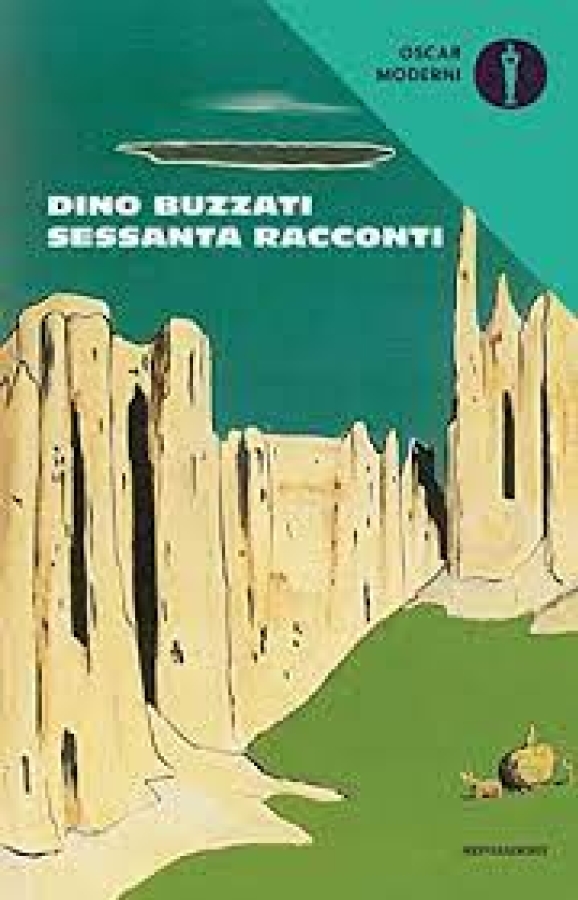
The Sixty Stories
Dino Buzzati is one of the most fascinating Italian writers of the second half of the twentieth century: suspended between the fantastical and realism, he captured the existential anguish of contemporary man, the absence of hope alongside the intense desire to escape into a better world, beyond reality; he is the Kafka and the Philip Dick of our literature, so often prosaic and lyrical. A great writer to be read in small doses, it is a pity that this vast 1958 collection of short stories was republished, for it also reveals the limits of Buzzati's poetic and spiritual world. Let us start with a short story, *A Drop*. In an apartment building, a strange event occurs: > a drop of water is climbing the steps of the stairs. Can you hear it? Lying in bed in the dark, I listen to its arcane journey. How does it do it? Does it hop? Tick, tick, tick, it is heard intermittently. (...) But what is this drop, after all, (...) could it perchance be an allegory? (...) Or is it more subtly intended to depict dreams and chimeras? Or places further away still, at the edge of the world, which we will never reach. No, it is merely a drop. In its banality and strangeness, a hopping drop of water encapsulates the narrative vein of Buzzati's entire work: the bizarre nature of reality, which is not what it should be; the spasmodic need of the human being to take root in something concrete, alongside the anticipation of something else—the whole, however, enclosed in a claustrophobic world from which one cannot escape. Consider another story, an ironic and gentle sketch of the Milanese upper bourgeoisie. In *Fear at La Scala*, we are at an opera premiere; Milan's most elegant and affluent society has gathered in the great theater. A rumor spreads that revolution is about to break out; and so the spectators remain inside La Scala as though it were a diplomatic mission. > Among so many familiar faces, in an environment alien to politics, (...) they felt protected . With keen psychology, Buzzati describes the dynamics of this "joyful, noble, and civilized" world, yet frightened and incapable of reacting. > In the square, a stooped little man appeared, pushing a handcart. With extreme calm (...) the little man began to sweep. Bravo! A few strokes of the broom were enough. (...) Nothing had happened . And what should happen? Recalling a beautiful poem by Caproni (*Farewell of the Ceremonious Traveler*), in *Something Had Happened* the travelers, arriving at the station, found it empty, > until the voice of a woman, piercing and violent as a gunshot, gave us a shudder. Help! Help! she screamed, and the cry reverberated beneath the glassy vaults with the hollow sonority of places forever abandoned . There is nothing waiting for us beyond our dreary existence. The theme of a claustrophobic world from which one escapes, even by resorting to fantasy, runs through the entire collection of short stories. Each of them captivates the reader, despite variations in stylistic and narrative quality; yet the whole becomes monotonous and looming in its existential pessimism. The book should be taken as a breviary, to be read once in a while, a short story here and there, whenever one feels the need to turn to fantasy and the paradoxical, but without any pretense of uplifting the spirit in the face of the world's ugliness. Or perhaps, as in *Seven Floors*, a splendid narration of a hospital stay (who among us has not lived through the fears and loneliness of the sick person at the mercy of doctors?), nothing remains but the mysterious fascination of the landscape. > He looked at the green of the trees through the window, with the impression of having entered an unreal world, made of absurd walls and sterilized tiles, of icy, mortuary entrance halls, of white human figures void of soul. It even occurred to him that the trees he seemed to glimpse through the window were not real either; in fact, he ended up convinced of it, noticing that the leaves did not move at all. To appreciate the stories, one must make generous use of quotations. Indeed, it is not the narrative structure that grips—it is, in fact, repetitive; Buzzati's strength lies in his writing. One is left to wonder how this author manages to blend the fantastical and surreal, even science-fictional style, with a descriptive prose attentive to detail, psychological insight, and context, just as a fine nineteenth-century novel would demand; a narrative that is invariably elegant, fluid, and lexically rich. Why read it? Keep it on the nightstand like a breviary, of fantasy and elegance.
Bet's Outburst
The novel is set in Turin, during these years of economic crisis and social malaise. Elisabetta, who wants to be called Bet, is the first-person narrator of a neorealist story with a happy ending. > We were a family like any other, neither too loud nor too quiet, neither rich nor poor, a working-class family like those in our building and those in the buildings next door : a normal family, until the death of her little sister shatters their precarious domestic equilibrium: the father abandons the family, the mother finds a new partner, and Bet finds herself angry at the world without any clear reason: > I think that I am a girl of my time, and that I am not. That I live in the world, and I do not like the world, and I do not feel suited to it . The first part of the novel, undoubtedly the most accomplished for its freshness, chronicles Bet’s anger: the loneliness, the tedium of the school environment, the conflict with her mother—upon whom she heaps all the blame—the idealization of her father, by whom she is bound to be disappointed, and the unexpected encounter with a young pregnant woman, with whom she strikes up a friendship. Disrupting the gentle, light-footed realism of the narrative, however, comes an unfortunate magical overtone: in the evening, before falling asleep, Bet—if she is at peace and has behaved well (sic!)—sees tiny luminous spheres emerge from her hands and rise toward the sky (the guardian angel? the soul of her deceased little sister?). This alone is a worrying sign that the publishing house’s marketing team has tampered with the story. And indeed, the second part of the novel is replete with mawkish and far-fetched contrivances: Bet rebuilds solidarity with her mother by taking part alongside her in an ill-fated union action (a dash of class struggle is always in fashion); in a fit of rage, she chains herself to the radiator in the principal’s office and becomes famous enough to be invited on television; and, in the story's climax, she finds herself trapped in an elevator with her friend who is about to give birth. The power goes out, yet despite these absurd predicaments, Bet manages to deliver the baby, aided by the little luminous spheres. If one were to stop at the first part of the novel, one might speak of neorealism, as several critics have done. One could appreciate the narrative style—simple yet effective, wry at times—which deftly conveys what sustains today’s youth when confronted with a paternalistic and indifferent society: > the only thing that can keep me alive, present, and alert in the rush of days unfolding before me is not hope, but the curiosity to see how it will end, whether I will pull through and in what way, without trampling on the few principles I have cultivated up to this point . Was it really necessary to spoil everything with a concoction of the supernatural and soap opera? Why not read it? Because we are weary of sentimentality and would prefer a dose of sound, genuine realism.
The Shadow King (The Shadow King)
The novel is set in Ethiopia during the Italian occupation (1935–1941). The first part, entitled "Invasion", deals with the war between October 1935 and May 1936 that led to the capture of Addis Ababa by Italian forces and the flight of Haile Selassie; the other two parts, "Resistance" and "Return", recount the bloody partisan war that deeply undermined Italy’s colonial ambitions in Ethiopia. Finally, a brief epilogue takes place in 1975, when Mengistu deposed and imprisoned Haile Selassie. In addition to historical research, notably that of Angelo Del Boca (*Gli italiani in Africa orientale*, Volumes I and II), the author drew upon photographic documentation, also from Italian sources. And it is precisely from the "photograph as memory" that the narrative takes its cue, right from the introduction of the protagonist: the servant Hirut. In 1935, a French photographer visits the home of an Ethiopian feudal lord and is asked for a portrait of the servants. > This is Hirut. This is her broad, friendly face with a curious gaze. Eyes full of light are suspicious but calm, (...) a pretty girl with a slender, attractive neck and slightly rounded shoulders. (...) She looks away from the lens, trying not to squint, her face turned toward the blinding sun. (...) No other way to remember the untainted body she once carried with the lightness of a child. The depiction of Ethiopian feudal society and the condition of women is ruthless: brutal exploitation of the peasantry, total subjugation of women—even those belonging to the feudal caste—violence, and sexual abuse. Hirut is a proud young woman; she keeps the sword left by her father, out of affection and to assert the rank to which she believes she belongs; the weapon is stripped from her by her master, as women are not permitted to fight. Hirut’s persistent disobedience is punished by rape, and the other women, rather than showing solidarity, condemn her to ostracism. Her fate is not so different from that of her mistress: the aristocratic Aster, who is likewise forced to acknowledge her husband’s superiority, humbling herself. When Aster asks to fight, she is met with a flat refusal. > Get back here with your women. (...) She looks at him for a long time, long enough for the resentment to vanish from her face. She lets it fall between them like a curtain dropping onto a stage. Then she nods and walks away. The condition of women changes radically when, following defeat, the resistance begins, and the role of women becomes pivotal to a struggle that requires the involvement of the entire population. We know from Angelo Del Boca that there were numerous and famous female partisans; these are historical figures who truly lived, even if transfigured by the imagination. Haile Selassie's exile dismays the Ethiopian people in their struggle against the Italians; a stratagem is devised: the resemblance between a beggar and the Negus is exploited to spread the rumor that the sovereign has returned. The man must show himself among the villages; escorting him is a magnificent Amazon: Hirut. From a humiliated and subjugated servant, the young woman becomes a fighter, essential to lending credence to the deception, but she is herself a heroine through her acts of valor and courage. At this point, a new character bursts into the narrative: Ettore, an Italian photographer of Jewish descent, who, out of fear of denunciation and sheer pusillanimity, complies in photographing the most horrific crimes committed by the Italians. These are dramatic pages of high narrative caliber. The author draws on the photographs of this forgotten soldier to document the savagery of our compatriots. Continuous roundups are carried out, and the captives—mostly the elderly, women, and children—are hurled into a ravine; as they plunge into the void, they scream their names, asserting that they had lived, that they were human beings. > This cannot be annihilated: let him repeat his name until that final fall, (...) and the echo of his voice is the world's dirge, the earth cursing this cruelty. (...) He had found a way not to hear their prayers and curses when they moved, with the elegance of a dance, along the crest of the precipice for that final photograph. (...) Every photograph had become a broken vow to himself, a breach in the defenses he had erected to ignore what he truly is: the archivist of obscenities, the collector of terror, a testament to everything that penetrates us and dissolves our self-esteem, leaving human beings dead. The sprawling novel reaches its climax, dramatically epic; then, exhausted by so many horrific and inhuman images, it folds back in on itself in an implausible bond between the virile, determined Hirut and the fragile, hypocritical Ettore. Let us dispel a possible misunderstanding: the novel is not an indictment of our country. The author charts a destiny common to women: independence and prestige are granted to them only when they contribute to the liberation struggle, in this case against the Italian invader. Hirut carves out a role for herself by fighting and risking torture, rape, and death; in doing so, she redeems herself from the violation she suffered, almost as if it had been her own fault. There is a strength in her that captivates us, particularly because it contrasts with Ettore's weakness of character and values. At the same time, the author seeks to recount the tragedy of Ethiopia: assaulted, defeated because poisoned by the criminal use of nerve gas (with tens of thousands, perhaps hundreds of thousands, of dead among the civilian population), and subsequently subjected to a repression that spared no one. Unfortunately, Maaza Mengiste is no Chimamanda Ngozi Adichie (see *Half of a Yellow Sun* on this site): she fails to build outward from her characters to tell the story of a people; the protagonists remain stereotypes onto which, nevertheless, the author unloads far too many existential themes (witness the relationship between Ettore and his father); the tragedy of Ethiopia is treated as an epic poem, burdened further by certain devices—such as the chorus and the reflective pauses on Haile Selassie—that are frankly redundant. The two levels remain separate; it is evident that the author feels far more at home when adopting lyrical and dramatic registers. From the standpoint of writing, the novel gets off to a somewhat halting start; subsequently, the writer gains confidence and growing stylistic mastery, displaying a rich vocabulary and increasingly expressive syntactic forms. The excessive length does not help the overall effectiveness of the narrative, and it becomes an effort to reach the end. Why read it? For us Italians, coming to terms with colonialism is indispensable.

Shanghai Baby
Anyone expecting the China routinely churned out by the mass media—whether to disparage or exalt it—will be disappointed. This novel is set in Shanghai ( > an epicurean metropolis that produced euphoric froth, a new generation of human beings, and was steeped, throughout its streets and alleys, in a frivolous, mournful, and mysterious atmosphere ), but the story could just as easily unfold in New York, London, or any other metropolis. The protagonist, Ni Ke, “though my friends call me Coco,” is a twenty-four-year-old girl who belongs to > a group of wealthy, decadent youths who resort to increasingly hyperbolic and unhinged words to procure unbridled pleasure... we are a swarm of disoriented caterpillars, with fanciful wings more virtual than real, sentimental and dependent on one another; a swarm of larvae clinging to the skeleton of our city, sensual and brimming with a sweet dynamism . When it was published in 1999, the book was banned by the Chinese authorities because it depicted and glorified the lifestyle of “Mian Mian,” the Chinese Beat Generation, branded as “garbage to be swept away,” outlawed, and eradicated. From this perspective, the novel is undeniably dated, as headlong development has standardized > the attire, hairstyle, way of speaking, and manner of lovemaking of Coco, rendering her indistinguishable from affluent, educated young women anywhere in the world. There is, however, one theme that keeps it compelling: can love exist without sex? > Was I supposed to maintain a certain distance between man and woman, with no intimate physical contact? Or were they meant to end up in bed, becoming two inseparable lovers? Coco has just published a collection of short stories that made her famous ( > I received many love letters from male readers, almost all accompanied by pornographic photographs ); she works as a waitress in a bar, where she meets Tiantian, a young man of an > indescribable beauty, which betrayed a weariness of life and a longing for love. We were two diametrically opposed individuals: I was ambitious, brimming with vitality, ready to bite into the world as if it were ripe fruit; while he was taciturn, mournful, depressed, regarding life as a cake dusted with arsenic powder . A love affair begins—a deep bond that would satisfy Coco completely, were it not for the fact that Tiantian is impotent, unable to engage in full sexual intercourse. Coco is “like a caterpillar determined to bore into a big apple”; she wants to live intensely, without missing out on a thing. She meets Mark, a handsome, blond German, with whom she openly cheats on Tiantian. The encounters between Coco and Mark are consistently tumultuous, unbridled, visceral, and violent, counterbalanced by the tender, lascivious intimacies the girl continues to share, to her great satisfaction, with Tiantian. In the background, parties, celebrations, and a cast of characters—all transgressive and over-the-top—chaotically pursue one another across a cosmopolitan, youth-obsessed Shanghai. Everything seems natural: discussing art and literature, having sex—both heterosexual and homosexual—smoking joints, getting drunk, and visiting parents, who are always ready to welcome them into the safety of the traditional family, joyfully and without too many questions, yet laden with anxieties, much like parents the world over. In such an environment, there is no room for guilt in Coco, even when Tiantian lets himself die of an overdose, crushed by his inadequacy as a lover and incapable of shaking off the nightmares that have gripped him since childhood. Behind Tiantian’s persona lies an existential tragedy born of the conviction that his mother, an ambitious Chinese businesswoman, murdered his father. Coco does nothing to save her friend, far too absorbed in living Shanghai’s frantic scene to the full. On her way to deliver the manuscript of her new novel—which recounts precisely her story with Mark and Tiantian—Coco feels thoroughly exhausted. > The taxi sped wildly along the ring road, with me and a friend inside, yawning incessantly . And boredom is indeed the prevailing impression left upon the reader. The narrative unfolds at a sluggish, verbose, somewhat predictable pace. Shanghai feels too distant for the reader to be truly seduced by this great metropolis, just as Coco’s musings and digressions often ring banal, literary, and generic. A profound superficiality reigns supreme. Why skip it? The underlying premise is intriguing, but the novel is dull.
Signoria
We are in Spain in 1799. Don Rafel is the powerful chancellor of the Royal Tribunal of Barcelona. The author succinctly describes him as a man > whose life was marked by an unrelenting craving and the restlessness of dissatisfaction, which drove him to dream without being a poet, to fall in love without being a Don Juan, to climb ever higher above others, hoping to attain happiness. Yet, because he was intelligent, he knew how to hold the ground he had won, even at the cost of the hatred and envy of others . His skill and unscrupulousness had allowed him to climb the social ladder to an unimaginable standing—non-aristocrat that he was—and to amass considerable wealth. Powerful and feared, he seemed unassailable and insisted on being addressed as His Lordship, the prelude to a barony. A seemingly marginal incident—the murder of a singer—drags him into the abyss. The woman was murdered after a romantic liaison with a young poet, Andreu, who is accused of the crime. At the young man’s home, a document is found revealing that Don Rafel murdered his own mistress. The powerful chancellor ensures that the youth, though innocent, is swiftly convicted and sent to his execution. Yet the situation rapidly unravels: others are aware of Don Rafel’s crime, and they either blackmail him or seek revenge for the young man’s death. Don Rafel feels no remorse, but he dreads scandal and “wondered when they would begin to pounce on him to strip him of everything.” Overcome with despair, he goes to confession, only to reveal the full extent of his cynicism before the priest: when urged to surrender to the authorities, he candidly declares that > the law is a collection of arbitrariness gathered into a Code, and justice is by definition unjust . Not even God can welcome him, and at that point nothing is left for him but suicide. The society portrayed in the book is decadent: a lust for money and power, abuses and violence against the weak, a life built on appearances and sordid sexual affairs. It sounds just like modern-day Italy!! Even authentic relationships are destroyed in a corrupt society, helping to create predestined victims: Teresa’s love for Andreu led her to give him the medallion that will serve as the evidence for his conviction; the letters from Nando—naive and full of affection for Andreu, written far from Barcelona and oblivious to his friend’s fate—become cruel and insipid in light of the condemned youth's plight. The prose is pleasant, but the story unfolds slowly, circling around the figure of Don Rafel without ever investigating him deeply enough—so much so that the drama of the conclusion feels both predictable and abrupt, as if rushing to wrap up an overly protracted tale. Why not read it? It has the length of a thriller without being one.

The silence of the cloisters
Petra Delicado, the protagonist of Bartlett’s novels, has married an architect who has no fewer than four children. Petra thus finds herself juggling her duties as a police detective, a marital venture she desperately wants to succeed, and relations with stepchildren backed by her husband’s irascible ex-wives. Into this fraught domestic arrangement intrudes a complex and mysterious case: inside a convent, a friar is murdered and the body of a blessed man, venerated as a relic, is spirited away. Unable to make sense of the crime, Petra pursues numerous leads, assisted—or more accurately, steered—by one of the convent’s nuns, who conceals a terrible secret. The novel moves along sluggishly, somewhat limp, alternating the police investigation with protracted conversations between Petra and the Mother Superior, depictions of life at the precinct, and domestic tensions that gradually give way to a cheerful, serene environment. In the end, the mystery is solved purely by chance, leaving the reader weary and disappointed rather than surprised. As in all her novels, Bartlett tackles themes far beyond the boundaries of the detective genre: in this case, the arcana of conventual life and of the Catholic Church more generally, as well as the tribulations of living together in a complex, blended family. As for her anticlericalism, the author makes her stance immediately clear, defining Catholics as > those who haven’t recovered from the traumas of a Catholic education, those who live perpetually imprisoned by guilt. In a word: poor wretches . As for cohabitation, the struggles of a couple’s relationship are summed up as follows: > Marcos and I were there, united before the law but separated by the incommensurable divide between the worlds in which we moved . Why not read it? As a detective story, it is weak and dull; as an account of social milieus and human emotions, its contents are far too superficial to hold the reader’s interest. Its sole merit is a pleasant prose style, even if it leans too heavily on dialogue—especially between Petra and her colleague Garzón; but then, why don’t the two of them just get married?
The Silence of the Wave
Roberto and Emma come from two different backgrounds: Roberto is a former carabiniere who spent years working undercover within criminal organizations; Emma is an ex-actress, a single mother to a twelve-year-old boy. Their paths cross because they are seeing the same psychiatrist; both need to free themselves > from thoughts or memories. When they arrive, one must observe them with detachment and let them slip away . The narrative centers on the figure of Roberto. Born in the United States, he returned to Italy with his mother following the suicide of his father (a corrupt police officer). The absence of his father is not the only wound waiting to heal. He enlists in the Carabinieri and is soon successfully deployed in undercover operations. > My job was to be someone else. And it isn’t bad at all to be someone else, from time to time: it makes you feel free.(...) The problem arises when you have to be someone else just to feel like yourself . Deception leads one to tolerate violence, even against young girls, and to betray the trust of the woman one loves, simply because she is the daughter of a crime boss. > I am a coward and a bastard. (...) I was so good at working with criminals because I am just like them : it is a torment that drives Roberto to the brink of suicide. By comparison, Emma’s story is prosaic; after yet another marital row sparked by her infidelities, her husband walks out for several weeks, cutting off all contact and refusing to see their son. The man’s death in a car crash leaves her burdened with profound guilt, as she feels responsible for having denied her son one final meeting with his father. Roberto and Emma approach their relationship with great caution, even if both feel that, at long last, everything around them is beginning to shift. What accelerates their romance and steers it toward a happy ending is Emma’s son, who confides his suspicion that a female classmate has become entangled in a child prostitution ring. Roberto’s intervention is, predictably, decisive in dismantling the criminal racket and rescuing the teenager. Carofiglio is a successful author, blessed with a simple and elegant prose style. One is left wondering why he chose to write a story so vacuous and superficial: there is no real action, the characters are poorly delineated, and the plot is thoroughly predictable. Compounding the already fragile narrative structure is the frequent reliance on dreams—premonitory and revelatory of truths hidden in the unconscious: a “New Age” cliché, far too ubiquitous today in contemporary fiction and countless American TV series. Why skip it? Pointless, hollow, inconclusive.
Panic Syndrome in the City of Light
The novel opens with a paradoxical and amusing scene: an eccentric publisher summons his authors to a Parisian café for a "live reading" of their manuscripts. He read them while "expressing himself": > he was capable of biting his tongue, gnashing his teeth, whistling... (...) his lips were in perpetual motion, in a continuous slaughter, (...) even his nose played a role during these readings, (...) he managed to impart a sort of vibration to his nostrils, and even increase the size of his nose as if blowing into a balloon . With such an astonishing beginning, one would have expected a continuation of equal effervescence, an ironic and biting account of the tribulations of an unpublished poet: a Romanian writer who fled to Paris after penning a single successful poem, fiercely caustic toward the communist regime of the time. One would anticipate hilarious scenes of authors vying to see their books published; instead, our poet is engulfed by a chaotic succession of characters and episodes lacking any apparent narrative purpose. At the center, a weaver of invisible threads, stands the visionary and overbearing publisher: he wants to abolish the narcissistic "I" through the mandatory use of the third person (one can only agree with him!), he wants to create a collective book assembled from fragments of each of his authors' work, he roams Paris in search of improbable figures who might be writers, retracing the haunts of famous authors who still inhabit his mind, while their books now languish on dusty library shelves. Books are "dead": all that can be done is to rush to open them and read a few pages to bring them alive, if only for an instant; words overlap in cosmic disarray, and the line between reality and fiction blurs to the point where inanimate objects come alive in a kind of artistic metamorphosis. Perhaps the novel aspires to be a metaphor for a fragmented world, where an epistemological—and consequently narrative—unity can no longer be found; nothing remains but nostalgia for the great nineteenth-century novel. Browsing the reviews on this site, one can find numerous novels in which the book itself is the protagonist. Sosuke Natsukawa's *The Cat Who Saved Books* recounts the journey of a young hero who must overcome various trials to secure a future for books. In Satoshi Yagisawa’s *Days at the Morisaki Bookshop*, a young woman regains serenity among books, only to realize that life is something else entirely. In a devastated and violent Russia, Mikhail Elizarov’s *The Librarian* tells of a group of survivors defending their books as an intangible heritage to be preserved. These are all novels with a positive view of the book and of literature. By contrast, Natsume Sōseki’s *I Am a Cat* casts culture in a negative light, where a stray cat kills itself to escape the idle chatter of humans, literati, and scientists. The novel's theme is therefore hardly original, and it might have been compelling had it been framed within a cohesive narrative plot, highlighting Paris and the splendors of a city that was once the cultural capital of the world. Instead, disorder and arbitrariness predominate, rendering the story incomprehensible, taxing to follow, prolix, and overly intellectual. Why not read it? Intellectualistic and tedious.

The Emerald
In New York, the author meets a strange character, a gemstone expert or perhaps a magician, who convinces him to go to a French village, where he will find an emerald that will reveal his future. The author is persuaded, partly intrigued by what this strange character tells him, partly because he hopes to track down an old flame, Mariolina, and present himself with a jewel of great value. Arriving in the French village, he takes lodging in an old hotel, where he falls asleep and seems to enter a strange dream. He sees the village where he lives, Tellaro, near La Spezia, vastly different from what he remembers, and he no longer recognizes the people: > it is as if they were all new: others. And it is as if I myself were someone else . In the dream he is actually a painter named Andrea Tellarini, living in an isolated house with a dog. A visitor brings him word that in a French village (the very one where he is actually staying), he has received an inheritance and must therefore go there. He becomes increasingly aware that he lives in an uncanny world, where, following the Third World War, the globe is divided into two confederations: that of the North, dominated by the Russians, technological and technocratic, and that of the South, dominated by the Arabs and the Chinese, Levantine and agrarian. Both confederations are dictatorships, two police states dominated by military forces and the secret services. Between the two confederations runs a Line, roughly traversing Southern Tuscany and Rome, which cannot be crossed because it is contaminated and therefore lethal. The painter lives in the North within a dictatorial state, where everyone is on the state payroll, travel is forbidden, and cinema no longer exists. He obtains permission to go to the French village, where he inherits a large emerald, which he resolves to use in order to search for Mariolina. She, however, lives in the South, and so he must cross the Line. He sets out on the journey together with his son (in the dream, he discovered he had a son). The Line is no longer contaminated, and in Rome he encounters some gypsies who salvage treasures from the abandoned city and sell them to a truck driver (in reality, a spy), who transports them South, to Naples. The painter manages to reach Naples with the truck driver, with whom he is enticed into a homosexual encounter. In Naples, he meets Mariolina again, but also discovers that the emerald is fake. His scheme of growing rich and winning back Mariolina has failed; instead, he is dragged into a power struggle between Mariolina's allies and her enemies, for whom the truck driver is a spy. Mariolina herself proves to be an avaricious woman, thirsting for power. Captured by Mariolina's enemies, he is brought to Rome and gets caught in a firefight with the gypsies: the dream breaks off abruptly as his wife, summoned by the innkeeper, wakes him. In fact, he had allegedly not been sleeping and dreaming, but had been writing the dream down for fifteen days without sleep and without food. It is a fantastic novel, built entirely around the device of the dream as an occasion for an unleashing of nightmares, desires, and fears regarding the future. > I was constructing this dream, complicating it, entangling it, splitting it: a captious, adventurous, fantastic, faerie dream: I was dreaming this dream solely to touch a fragment of my petty reality, of my little self. Who knows, perhaps it was not even a dream: but a delirium fraught with insurmountable and agonizing contradictions . The dream was, in any case, the discovery of a boiling life. > In my dream of discovery I did not wish to go any further. Better to stop here, I told myself. Better to wake in time and sleep again, afterwards, dreamless or with bland dreams that are forgotten and not worth remembering . Several themes run through the novel: a cruel future, dominated by military or bandit dictatorships: technology has ultimately led to the destruction of the Western political system and its collapse into states lacking the rule of law. This upheaval may herald the beginning of a new renaissance, precisely because it has destroyed a culture that was already decaying. In this regard, the reflections on cinema are illuminating. > All that layering of techniques, that paste, that elaborate concoction of acting, dance, drama, scenography, lights, colors, moans: that colossal manneristic, advertising, vulgarly scientific swindle has revealed itself today as a typical—indeed emblematic and exclusive—product of the defunct industrial and consumerist society . > If there is any hope of peace and brotherhood with the South, that hope lies in our reborn and unwitting sense of art ; the recovery of a primitive and simple world, namely that of the gypsies. It is no coincidence that they inhabit a Rome that is ghostly yet alive. > I stopped on the edge and looked all around, near and far, at other valleys and other hills; I contemplated, frightened and fascinated, those horrible alps with their riddled walls, that strange nature, and that matter... They were shells of old mollusks, empty eye-sockets of skulls from which the softness, mobility, and intelligence of life had withdrawn forever. And suddenly I understood. They were the hollows where the desire for life entered and from which life itself emerged: dead, however, now, dead; material images of a final sarcasm . In a D'Annunzian style, the author reflects upon the transformation of life, finding in nature's destruction of the city, in its abandonment, the starting points for rebirth. Yet it is not society that will revive it, but that of simple men, of a people—the gypsies—who have rejected industrial and consumerist society; the diverse dimensions of life. In reality, the author is inhabiting another dimension—not so much what he would have wished to be, but the reality and the persona he could have been. Does the possibility of another life exist? Are there other worlds within us, where nightmares but also aspirations might be realized? The author's dream is the construction of that other world, of the other life the author could have lived. The dream broke off precisely > so as to see no more, so as not to know what lay at the bottom of my whole story . For Paolo Pasolini, Soldati's writing > is devoid of all viscosity, which is to say, of clinging to the reader, of possessing him, of exerting an unacknowledged authority over him . Pasolini speaks of lightness and a relentless reference to something else, to an alternative. The dream device allows the author to play without explaining: for example, what did the emerald signify? What purpose did the entire affair serve in relation to the opening of the tale? As his friend Enzo Giachino wrote in a letter to Soldati, > I am convinced that a more cultured and subtle reader would be able to unravel the hidden meaning of so many episodes, which eludes me .
Dreams at dawn of the urban cyclist
The novel opens in its initial chapters with two seemingly parallel storylines. On the one hand, it recounts the most pivotal episodes in the life of an adolescent, his circle of friends, and his neighborhood in Porto Alegre. The boy perpetually courts risk, yet fails to display genuine courage: thus, he does not come to the aid of a friend who is murdered by a rival gang. There emerges in the boy a propensity to pursue adventure and a superhero’s existence within the realm of fantasy, to the point of inflicting wounds on himself and causing self-harm merely to prove that he is capable of enduring pain and that he has lived through extraordinary trials. On the other hand, there is a successful plastic surgeon about to set off to conquer an unclimbed peak with a mountaineering friend. On his way to pick up his friend, he returns to his old neighborhood, and we come to realize that the surgeon is none other than that same adolescent grown into adulthood. Adolescent memories then resurface: he gets involved in a street fight to save a boy, encounters once again a female friend with whom he had shared his childhood fantasies, and realizes that “living, on the other hand, had nothing heroic about it.” He had lived > in a permanent limbo between innocence and heroism, inhabited by phantasmagoric projections of himself, slightly distorted by what he would have liked to have been in the past or become in the future . He has finally become an adult. The novel tackles several themes. The first of these is the pursuit of life’s authenticity—that is, of a life genuinely lived—solely through extraordinary feats meant to highlight one's courage and virility. One does not truly live unless one is a superhero. > They are boys living at the pinnacle of the human illusion of invincibility, seduced by the opportunity to put their physical vigor to the test and avenge the cosmic injustice of being born . The blatant falsity of this worldview surfaces only when the protagonist lacks the courage to help his friend, thus failing to demonstrate the true capacity to be a man. The dominant theme of the book, however, is the relationship with one’s own body and the process of alienation through which, from being protagonists, we become spectators of ourselves, as if at the cinema. The protagonist perceives the reality of his own feelings only if they translate into a physical alteration of the body. This initiation begins in childhood when, standing before the bathroom mirror at home, he uses felt-tip pens to simulate blood and wounds on his body; it unfolds through genuine accidents, sought out precisely to hurt himself, and culminates in his professional calling: becoming a plastic surgeon. Just as at the moment of initiation, the protagonist sees himself as a spectator watching a film. > C’è sangue sul suo volto, una ferita terribile all’occhio, un’altra al braccio, e lui che si trascina fuori dal veicolo sulla sabbia bollente, la sabbia che si incolla al suo sangue, gli spettatori correvano a prestare soccorso all’eroe del film. Il suo film. La scena rasentava la perfezione. Il trucco non avrebbe potuto essere più realistico. Che bella cosa il sangue, pensò prima di svenire . > Lui iniziò a vedere la cosa dall’esterno, come una telecamera piazzata sul soffitto. La maledetta telecamera che era la sua unica amante. A volte la telecamera spuntava fuori negli istanti cruciali della sua esistenza: era come se lui stesso, si staccasse dal corpo per diventare l’osservatore. C’era lui dietro alla telecamera, che usciva di scena, attraversava la membrana tra realtà e fantasia e sceglieva una sedia nella platea vuota di un cinema buio . The novel is thoroughly engaging. The prose ranges from a neo-modernist style (long, winding periods, bordering on soliloquies) to succinct, remarkably effective dialogue. The depiction of the settings and characters proves equally incisive.
The Dream of the Celt
Roger Casement was born in 1864, in the century of the West’s conquest of the world—of that which styled itself as civilization. And the young Roger believes firmly in this civilizing and adventurous spirit, to the point of deciding to go to the Congo, then a land of Belgian conquest. Yet there, reality confronts him in a profoundly different way: > those poor people whipped, mutilated, those children with hands and feet severed, dying of hunger and disease. Those beings squeezed to the point of extinction and murdered on top of that. Thousands, tens, hundreds of thousands. By men who had received a Christian upbringing. I saw them go to Mass, pray, take communion, both before and after committing those crimes. Perhaps in those years I lost my mind. And everything that happened to me afterwards was the work of someone who, even if he did not realize it, was mad . Yet Roger still believes in Western civilization and thus devotes his life to denouncing the crimes perpetrated against these peoples. First in the Congo and then in Brazil, he carries out an investigation on behalf of the British government into the conditions of exploitation and the atrocities being committed. His name becomes famous in Britain and the United States, to the point that he is conferred the title of baronet. Yet it is easy to stand on the side of justice when it concerns distant lands, subject to the dominion of other powers—in this case, Belgium and Peru. It is far harder to confront what lies close at hand, such as Ireland. Roger is Irish, and he decides to dedicate the final years of his life to the struggle for his country's independence, going so far as to pursue the mad scheme of seeking assistance from Germany during the First World War. He is arrested in 1916 and sentenced to death. The life of Roger Casement is recounted in the form of a novel, but here Vargas fails, or refuses, to transfigure history. The result is a well-written chronicle, yet one that neither offers a documented inquiry shedding light on the facts and motives of such a singular and momentous figure, nor manages to impart to the reader the sense of suffering and disillusionment that must somehow have dominated the protagonist. It is, without question, an indictment of colonialism, yet it remains merely that, without ever truly stirring the conscience. Why read it? The sole reason is to discover a truly singular and remarkable figure.
Arturo's Island
> One of my earliest boasts had been my name. I had soon learned (it was he, I think, who first informed me of it) that Arturo is a star: the swiftest and most radiant in the figure of Boötes, in the northern sky!. Thus begins Arturo Gerace’s long quest for Love: > an indecipherable dilemma, without the solace of hope, or of revenge ; a quest that, to unfold, required an enchanted place like Procida: > a land of adventure, a blessed garden! , but also > a bewitched and voluptuous mansion. The novel encompasses three distinct natures, profoundly intertwined: the narrative, the fantastic, and the oneiric. Orphaned at birth, Arturo was nursed on goat’s milk by the foster-nurse Silvestro. He grows up alone in a ruined Castle. His father is perpetually traveling, and the boy roams across the island and along the shores. Arturo lives freely yet melancholically, fulfilled only when his father is at home. > My childhood is like a happy land, of which he is the absolute ruler! (...He who strode resolutely forward, like a sail in the wind, with his blond, foreign head, swollen lips, and hard eyes, looking no one in the face. And I followed behind him, proudly casting my dark eyes to the right and to the left, as if to say: “Men of Procida, my father is passing!”. This adoration is unmarred by the brusque and severe manner the father displays toward Arturo, nor is it broken by the arrival of the stepmother, a girl barely older than Arturo (who was then fourteen), perhaps married on a whim. The boy’s relationship with his stepmother wavers between jealousy and attraction, typical of an adolescent undergoing his first stirrings of love and perpetually searching for a maternal figure. One day, the father returns to Procida accompanied by a convict, who is locked up in the island's penitentiary. The man grows taciturn, no longer wanting to walk or sail with his son; instead, he frequently vanishes to sing a love serenade beneath the convict's cell. Arturo's infatuation with his father dissolves painfully, especially when he overhears him being dubbed a “Parody” by the malicious convict: a pitiful imitation of a man of the world, of a great traveler, when > it will be a stretch if he even made it as far as Benevento, or Rome-Viterbo!. Arturo enters adulthood because he sees his father in his true nature, selfish and petty: he must also leave the marvelous island, overly steeped in joyful roaming and anxious anticipation. Adolescence has ended; Arturo sets out to discover the world and resolves to go to war. Thus far, we are faced with a coming-of-age novel, at times verbose and banal. What renders it original and compelling are the narrative’s fantastic and oneiric dimensions. Consider the ascent toward the Penitentiary, trailing behind the father: the alleyways of the ancient village, the narrow, climbing streets, the walls plunging sheer over the island's high cliffs made the Penal Colony look like the > Castle of the Knights of Syria; fairy-tale adventurers (...) crowded that walled palace , and Arturo became > a funereal Knight Errant, (...) and the voices of the village not far off (...) seemed to me the voices of a childish race. A central episode of the novel takes on fairy-tale suggestions, evocative of distant, fabulous worlds and spoken tales. Consider, on the other hand, the image of the seashell, a dreamy naturalism applied to a celestial phenomenon. > Outside the midnight window, (...) a tiny cloud could be seen which, drifting across the turquoise of the sky, within moments took first the shape of a seashell, then of a small hot-air balloon, then of an ice cream cone, then of an old man's beard, then of a ballerina. Reality, fantasy, and dream hybridize, and the narrative tones blur; the novel bears less and less resemblance to a coming-of-age tale (a sort of Neapolitan *Treasure Island*, see the review of *Treasure Island* on this site) and increasingly assumes the imagery and cadence of *The Thousand and One Nights* (see the review on this site). Morante makes no attempt to impart a traditional stamp to the novel, as she had attempted in *Menzogna e Sortilegio* in 1948 (see review on this site); imagination soars from the opening pages, from that singularly starlit incipit. Even within a meticulous and ostensibly naturalistic style, the narration is so oneiric and fairy-tale-like that it suggests a journey deep into consciousness. An early clue lies in the choice of Arturo as narrator, and hence the first-person perspective; then, the disordered, invasive succession of images, bordering on dreams and visions; finally, the characters, who resemble archetypes of different facets of the psyche: the stepmother, an animalistic figure obstinately faithful; the father, stubbornly selfish and hostile; the foster-nurse Silvestro, embodying the Mother figure and returning to rescue him; the wicked malice of the convict, destroyer of Absolute Love. It is as though the protagonist (Morante herself?) hung in the balance, poised before divergent paths, ultimately choosing detachment: a separation also from the yearned-for place where one was born and raised. The narrative proceeds at a leisurely pace, intent as it is on plumbing the depths of the narrator-protagonist’s soul when faced with the diverse situations that unfold before him. It is a continual excavation, marked by detailed descriptions that would border on tedious were they not sustained by grammatically exquisite prose, an airy and elegant lexicon, and a pervading atmosphere of pleasure. Why read it? Fascinating, even if at times verbose.
Soldiers of Salamis
> In 1989, my first novel had been published; (...) the book was met with utter indifference. What followed was a prolonged depression and the breakdown of my marriage, until, coming to the rescue of the failed writer, arrived the sensual Conchi and the miraculous story of Rafael Sánchez Mazas. The former was a fortune-teller, > who was crazy about dating a journalist (an intellectual, she called him) and who danced singing > Land glorious to my heart,/blessed land of scents and passion,/(...) Alas, what sorrow,/as I part from you, Spain,/for they tear me away from your rose garden. The episode, both famous and incredible, is set in 1939 at the end of the Civil War. The Republican army, retreating toward France, took with it a group of Falangist leaders to execute them by firing squad. Sánchez, founder of the Falangist movement and later a Francoist minister, managed to escape and survive, fashioning around this ordeal his aura of an immortal hero. Cercas imagines that our failed writer comes into possession of a notebook in which Sánchez had jotted down what had happened: the name of the peasant family that took him in and a reference to unspecified "friends of the forest." Fragmentary accounts, contradictions between differing versions, and the very condition of the notebook, which appeared forged, led the aspiring writer to assume that everything was false: > a colossal fabrication meticulously concocted by Sánchez Mazas's imagination, (...) to redeem himself from his reputation as a coward, to conceal some dishonorable incident from his strange wartime vicissitudes. The investigation of archival documents and in the field leads to validating the entire affair: the execution and the escape truly occurred, and the "friends of the forest" are three draft dodgers who had been hiding in the undergrowth and helped Sánchez; a presence expunged by the Falangist leader so as not to admit that he had been aided by brave young men who were not fascists—he, the great poet of the Fatherland. There remains an episode which, who knows why, the aspiring writer does not explore further. In a narrative that seems drawn from *Una nobile follia* by Ugo Igino Turchetti, which likely inspired Fabrizio De André's *Canzone di Piero* (see the review on this site), our aspiring writer describes the event thus. > The soldier is looking at him; Sánchez Mazas stares back at him, but his tired, myopic eyes cannot interpret what they see; beneath the locks of wet hair and the broad forehead and dripping eyebrows, the soldier's gaze expresses neither compassion nor hatred, nor even contempt, but a kind of secret or fathomless joy, (...) and at a certain point he shouts into the wind without ceasing to stare at him: "There's no one here!". To truly become a writer, our protagonist must discover who this soldier was: the narrative leaves mere chronicle behind, gains momentum and mystery, and reveals a truly discreet hero in the service of Freedom and Spain, an account of real events, with real people. It is pointless to object that every novel is real to the reader and that one might as well invent characters about whom nothing is known. Unlike Carrère, who, to write about Limonov, draws heavily upon the biographies of the Russian writer and politician himself (see the review on this site), Cercas conducts an investigation like a good journalist. Too bad that when he writes a factual account, however brilliant, the narrative flattens, becomes tedious, and the reader wonders why bother when we already have historians. On the contrary, on all the pages where the writer relies on imagination and mystery (think of the figure of Conchi and the discovery of the soldier-hero), the story changes tenor, becoming intriguing and engaging. In the end, one senses the passion when the writer comes out into the open and extols the soldier-hero. We ought to find a boundary between fiction, chronicle, and historiography; we live in the present and process the past through the facts of the present, yet the representation of the past conditions our vision of reality and must therefore be handled with care, pursuing the "truth" on the basis of historical research methodologies. The prose flows smoothly and with slight mischief. The author creates an almost unreal atmosphere, so that the events, even the dramatic ones, and the characters dance to the tune of the celebrated song. Its merit lies precisely in a narrative style far removed from the journalistic, capable of making us dream. Its main defect is the plot, confused and repetitive. Why read it? The story is interesting, and some pages are truly beautiful.
The Solitaries of the Ocean
Salgari wrote over eighty novels, and not all of them possess the same literary quality. In this case, two hallmarks of the author’s pen are absent: the pulse of adventure and the exotic, yet often captivating, depiction of the setting. The opening is promising. In the mid-nineteenth century, the slave trade is replaced by the recruitment of Chinese laborers, who supply South America with cheap labor. The transport conditions endured by these poor souls, deluded into believing they would find dignified work, are even more harrowing than the African slave trade. Indeed, since they are not regarded as chattel, the Chinese possess no asset value, and exorbitant profits lead shipowners to accept an appalling mortality rate. The opening chapters could easily be set today, amid the plight of migrants crossing the Mediterranean. Salgari’s indignation is profound at the perfidy, deceit, and senseless cruelty of those who exploit (recruiters, shipowners, sea captains, and large landowners) the misery and aspirations of the world’s dispossessed—in this case, the Chinese. We find ourselves aboard the *Alcione*, a vessel sailing from China to Peru with a cargo of over four hundred Chinese, crammed into the hold, poorly fed, and forced to survive without access to fresh air. Plague breaks out, and Salgari portrays, with grim power, the corpses of the Chinese, snagged with a hook, hoisted from the hold without being touched by the crew, and cast to the ravenous sharks. It is a harbinger of the book's core theme: the cannibals and their craving for white flesh. A mutiny erupts, and the captain, unable to quell it, abandons ship along with his crew, though not before poisoning the provisions. All the Chinese perish, save for their leader, Sao-King, two Peruvians, and an Argentine officer who had opposed the captain’s cruelty. The four men must navigate the *Alcione* alone through fierce storms, seeking refuge on islands inhabited by cannibal populations, only to be captured at last by pirates, who seize the sailing ship. The adventures revolve around two protagonists: Sao-King and Ioao, the younger of the two Peruvians. The two, evidently formidable swimmers, manage to escape the ship while underway and find safety aboard a naval schooner. With the warship’s aid, and through further heroic feats, they vanquish the pirates and rescue their companions. Salgari repeats a literary formula common to all his books: a hero, Sao-King, accompanied by a less experienced and vigorous sidekick, here Ioao. Displaying great courage and remarkable prowess, the two confront numerous, incredible ordeals. These episodes, however, are not woven into a cohesive narrative structure and unfold sluggishly. It is evident that Salgari is weary, drained, incapable of breathing vigor into the scenes, and perfunctory in his depiction of the setting and characters. Moreover, a true antagonist is missing, as the adversaries to be overcome shift constantly: the cruel captain, whose vengeance one would expect to be a guiding thread, disappears for most of the narrative, only to resurface reduced to a skeleton in the launch with which he fled the ship; the anthropophagi (hideous and treacherous) are too primitive to be considered genuine foes; and the pirate chief, who will end his own life, is ruthless yet benign enough to spare our four friends. The theme of cannibalism—already present in other novels, though never so repetitively—casts a lugubrious pall that spoils any relish of the adventure. Yet perhaps this very motif mirrors Salgari’s psychological decline: moving from the depiction of grand heroes, even if tormented like *Il Corsaro Nero* or ambiguous like *Capitan Tempesta*, to a tragic worldview where, confronted with sheer ruthlessness, one can only defend oneself or succumb. Why avoid it? It simply isn’t worth it.

The Kreutzer Sonata
During a long train journey, the passengers begin a discussion on the institution of marriage. Can there be spiritual affinity in married life, or is it nothing more than > a horrifying hell, on account of which one ends up an alcoholic, shoots oneself, or commits murder ? The conversation is abruptly interrupted when a traveler declares that he is “the one who, fancy that, killed his wife.” And he begins to recount his story. Like most men, he had led a licentious life for many years, frequenting brothels and despising women, from whom he sought only sexual pleasure. Then, like everyone of his social standing, he married, because that was simply what one must do. Already during the honeymoon, > the infatuation had run dry with the satisfaction of the senses, and we found ourselves facing one another in the true reality of our relations: that of two egoists, utter strangers to one another, wishing for nothing more than to extract from the other as much pleasure as possible . For many pages, the narrative serves as an occasion to discuss marriage and, more broadly, the relations between men and women: reflections to which Tolstoy would return more explicitly in his postscript. We must live an authentic life, the great Russian writer asserts, in the service of a higher ideal: love of God and of one’s neighbor. Along this path, marriage—a mere compliance with external rules—is a disruptive impediment, because > one ends up dedicating the finest period of one’s existence—men, respectively, to eyeing, seeking out, and possessing the finest objects of love in the form of love affairs and marriage, and women and girls to luring and drawing men into an affair or into marriage . And to those who counter that marriage legitimizes sexual relations without which there would be no procreation, and thus the human species would become extinct, Tolstoy responds drastically: > a Christian would be conscious of not sinning or not falling, in marrying, only if the necessities of life were guaranteed for all the children in the world . Is the novella, then, a moral essay? In large measure, yes, and that is how his contemporaries interpreted it. At a certain point, however, comes an unexpected turning point. The protagonist, the murderous narrator, attends his wife’s concert, in which she plays, alongside her lover, a piece by Beethoven: the first presto of the *Kreutzer Sonata*. Many authors have written about music, more often than not associating listening with an elevation of the human soul. Tolstoy astounds us once again. > They say that music elevates the soul: nonsense, it isn’t true! (...) Music compels me to forget myself, my true state of mind; it transports me into a different, alien situation; under the spell of music, I seem to feel what I do not actually feel, to understand what I do not understand, to be capable of what I am incapable of. (...) Upon me, at least, this piece had a terrible effect; feelings were revealed to me that seemed completely new, new possibilities I had never known before. Not as I had previously thought and lived, but as though a new voice were speaking within my soul . And an irrepressible force rises within the protagonist’s consciousness, one the reader has already encountered in the final pages of *Anna Karenina*, immediately before the suicide: > some demon, entirely outside my will, devised and suggested the most bloodcurdling hypotheses . From this moment on, the narrative, previously slow and somewhat tedious, becomes relentless and overwhelming, driving toward a dramatic scene. Returning home unexpectedly, he catches his wife and her alleged lover in the drawing room; first he attacks the man, who flees—unpursued, at that (“it was ridiculous to run in stockinged feet”—even during a murder, bourgeois propriety prevails!); then he violently turns upon his wife, stabbing her to death. He even has the impudence to beg her forgiveness. “Forgive you? That is nonsense. If only I didn't have to die!” the woman replies. The novella hinges entirely on its final forty pages, both from a literary standpoint and in terms of thematic substance. The narration of the murder, as the final act of a lucid and frenzied hatred, possesses an astonishing expressive power: even while foreseeing the inevitable conclusion, the reader hopes until the very end that something might happen (a pang of conscience, someone’s intervention), before ultimately surrendering to a sentence terrible in its cold matter-of-factness. > I felt and remember the momentary resistance offered by the corset, and beneath it something else, then the knife sinking into the softness . Tolstoy’s condemnation of the man is clear and unequivocal: the victim is the woman, the culprit is the husband, who is fully conscious of what he is doing. The judges will decide otherwise, acquitting the murderer on the grounds of the alleged adultery. Conscience will not acquit him, and the novella closes with a desperate plea for forgiveness. Why read it? If one pushes past the first eighty pages, one discovers a story of femicide, recounted by a great writer.

The Sovereign of the Golden Field
This novel belongs to the Western cycle. Influenced by the figure of Buffalo Bill, Salgari developed a series of stories set against the historical backdrop of the mythical conquest of the West, amidst heroic figures, savage Indians (Apaches and Navajos), and American villains. A young woman (the Sovereign of the Golden Field), whose father has been abducted by bandits demanding a hefty ransom, decides to put herself “up for auction” to raise the sum required to free him. The winner of the auction will take her as his bride. Participating in the auction are a young engineer and a wealthy black man who oversees the crab fishing and trade, controlled by the Chinese; for this reason, he is known as the King of the Crabs. The young engineer lacks the funds to rival the wealthy merchant, yet, with the help of a young clerk, manages to outwit the King of the Crabs, win the auction, and flee into the West with the young woman to rescue her father. Naturally, the villainous merchant sets off in pursuit. Everyone travels by train, the revolutionary conveyance that collapses distances and stands as emblematic of American technological superiority. A sequence of adventures unfolds aboard the train; we witness the passage of an enormous herd of bison; and finally the three youths—the girl, the young engineer, and the clerk—set out on foot through Apache territory to reach the hideout where the father is held captive. Accompanying them are Buffalo Bill and a handful of valiant men. Further adventures ensue, as the wealthy merchant, joined by a band of ruthless Mexicans, remains in hot pursuit. While fleeing the villain, the three youths are captured by the Apaches. We witness a sort of trial convened by the Indian chiefs, in which white society is indicted (this is the novel’s political juncture, where Salgari’s anti-colonialist vision reemerges). The three youths are condemned, but the young engineer and the clerk manage to escape (via a subterranean stream), while the young woman remains a prisoner. The narrative reaches its pivotal moment: a duel between the young American woman and an Indian warrior woman, from which the former emerges victorious. From that point on, the novel slides toward a happy conclusion: Buffalo Bill arrives, the kidnapper's hideout is uncovered—the villain having meanwhile joined forces with the wicked merchant—and ultimately the father is freed and the villains vanquished. The plot is highly intricate, but unlike the novels of the Malaysian cycle and the Caribbean cycle, it lacks narrative tension. First and foremost, the author fails to create that suspense, that sense of anticipation characteristic of the works in the other two cycles: one senses something artificial and contrived, which the plot’s intricacy futilely attempts to replace. Secondly, at the center of the novel stands the figure of a heroine, hardly a novelty for Salgari if one recalls *Jolanda, la figlia del corsaro nero* and *La regina dei Caraibi*. In this instance, however, the heroine is a cold character who remains impassive even in the face of death, betraying no affection toward the enamored young engineer. She is all strength and all courage—perhaps how Salgari imagined the American woman. What constrains the entire novel, perhaps, is an admiration for American society that feels too conventional to lend emotional depth to the characters and their setting. Only the plot remains.

Spaccanapoli
The book is a collection of short stories written between 1943 and 1947, expressing the author’s effort to reckon with reality, with the lush, carnal, amoral, and shrewd humanity of that “Babel of history” that is Naples: hence, in all likelihood, the title *Spaccanapoli*, the thoroughfare around which the city’s life has always gravitated. Let it be said at once that this reckoning with reality was not entirely successful; indeed, the narrative is steeped in a dreamy, melancholic hope. In the first story (*“La figlia di Casimiro Clarus”*), set in a small town in northern Italy “where men are courteous and live on few words,” the now elderly narrator believes he catches a glimpse of the woman he loved in his youth and calls out to her: in his imagination he longs for her once more, but she is not there; he was mistaken. “She always wore a broad-brimmed yellow hat, with violets in the ribbon.” Immediately I would say, Katy, are you here? No, I am not, she replied. Then I would chase after that butterfly > . If one could still afford to write of lukewarm loves before the war, afterward Rea felt the need to use a linguistic system closer to the new reality > . The subsequent stories are sketches of Neapolitan society, where a cynical instinct for survival prevails, allowing the characters to get by. Take *L'Americano* > . A poor baker’s boy takes advantage of the attentions of his master’s wife, wins the infatuation of the young duchess, and finally, getting ahead of himself, brings a prostitute from Taranto with whom he stirs up both scandal and envy. Having killed the young duchess’s fiancé, he flees to America where he becomes a *ganghesterro*, impregnates a wretched prostitute, makes his fortune, and returns to Italy, abandoning the girl to her fate. Having landed, I went to the Madonna of Pompeii. (...) May I become an old man who looks like a boy, for I have harmed no one, I tell you as a son. (...) I will buy you the diamond-studded slippers. (...) I am a good man. (...) 'Go,' the Madonna gestured with her finger > . It reads like a novella by Boccaccio. The influence of the great fourteenth-century writer is glimpsed in another story, *L'interregno*”. The opening of the narrative bears the stamp of the plague described by Boccaccio. “In our mild country, the war had arrived by report.” The return of peace was feared, because “it was also that of commercial legality and taxes on war profits. (...) Many idlers owed the flourishing of their clandestine trades to the dark. (...) The middle class fretted over it. But they were few in number and likewise strictly bound to propriety and restraint, sacrificing proud appearances > . But then war bursts in, the poor rush into cellars for shelter, while the rich, the quickest to notice in the mirror that their consciences were tarnished, promptly took them out through secret doorways to be aired in the countryside > . The life of the refugees is rendered with bold, incisive strokes, without neglecting the personal fortunes of the protagonist—a decent man with a shrewd knack for seizing whatever opportunities present themselves, be they of love or money. The distinctive hallmark of the stories is the writing: at times linear, but more often poised between prose and poetry, with stylistic inflections typical of Boccaccio. Take as an example this passage from another story, *I capricci della febbre* > . The protagonist has been hospitalized for smallpox, and there he encounters a nurse. The muscles of my thighs quivered at a fresh draft of air. But she took it as a call of love: (...) and, with arms raised as if surrendering, she fell to her knees with a loud clatter before my shame, which she stared at in astonishment. (...) I am a poor girl. I'm afraid to go out in the middle of the street to sin. With you, I was doing it out of pure love. (...) I could no longer keep my memory still: another Nina, the one summoned in delirium, blurred into this living one: incredible before my eyes.” And it is precisely the analysis of this fleeting amorous encounter that pinpoints the difference between Rea and Boccaccio: in the former, the narrative unfolds in a state of yearned-for reality (the rediscovered woman, the cynical self-justification, the fantastical life under the bombs); in Boccaccio, the narrative possesses the same voluptuousness of language, but is developed from the perspective of an urchin who jests and refuses to become embroiled in the events and characters. Why read it? Evocative, even if often difficult to decipher

A Spiral of Mist
Life is > a kind of deception, one trains oneself for, this lying to oneself about oneself , fleeing (...) “the unknown, murky fear of revelation.” As in Teju Cole's *Open City* (see the review on this site), where the protagonist even forgot having raped a girl because “for myself, I am always the hero” (yet “the pleasure of denial was not available to her”), this novel also investigates > that mysterious, secret depth made of unexpressed emotions, of truths concealed from everyone's eyes . The investigation takes on the outward guise of a detective novel. Valeria, the Milanese wife of Fabrizio Sangermano—a powerful Campanian family—is killed during a hunting trip with her husband: an accident or a murder? There is a police commissioner, there are numerous characters supposed to help unravel the plot, but that is not what interests the author: Valeria's death should be that traumatic event capable of finally dissolving the fog of human feelings. A series of portraits unfolds. We witness the family gathering, bewildered and worried as they debate Fabrizio’s possible involvement, which would drag the Sangermano clan into scandal; the discussion comes to an abrupt halt when the grandfather, the grand old man, > waved his hand and then said: I am glad to have foreseen the conclusion of this meeting of ours , (...) silence fell once more in the study, aunts, uncles, and cousins assumed the contrite expression they had learned to master to perfection after so many years of training and acquiescence: attentive, indifferent, expressionless faces of people suddenly emptied of their most intimate personality > . Maria Teresa, a Sangermano who risked remaining an old maid, married a prominent Curia lawyer at the family's behest: an esteemed and influential man. The marriage was never consummated because he is impotent, and when she finds out (having been deceived by his lies), even knowing she should not give a damn about the scandal, even repeating to herself that she must not yield, she said, as in a dream, without realizing it “that it was fine this way,” speak no more of it, do not be afraid > . And what does the illustrious Curia lawyer do? He impregnates the housemaid to prove he is not impotent and can file for the dissolution of the marriage on the grounds of his wife’s fault; and the wife retreats into silence as a final act of dignity. There are other tales of deception, of hypocrisy, of unsaid things, in certain cases merely the result of that monotonous, mechanical course “of everyday life, which leads” irreparably away from the essence of life, from discovering what life truly is, as happens to so many millions of individuals who grow up and live short or long lives, yet consecrated, one might say, by constitution or incapacity or who knows what else, to a kind of perpetual renunciation of life > . It is a mortiferous approach, which could only culminate in an unsettling portrait of Valeria's funeral, she, as a corpse, finally part of the Sangermano family that had rejected her in life. The grandfather stood between the altar and a kneeler in a sedate posture “: was he truly moved or feigning? And the Sangermanos are all around, although” no one weeps, no one was moved: but was it really necessary to be moved? (...) And now the fog was returning, (...) perhaps it rose right from the earth with no other purpose than to smooth over every contour and confuse, annul, at least for the duration of its presence, even them: not their physical bodies, but the resentments and passions and hopes and sorrows and fears, in short, the dense, inextricable knot of feelings. > The novel feels suspended: there is no resolution, and above all, the narrative does not evolve; it remains tangled in the psychological introspection of characters excavated to their core, dissected in their feelings yet without empathy. On the other hand, there is no dynamism in the human drama; everything is enclosed within the superficiality of social relations, in the resignation to an individual destiny already sealed by society. It recalls the existential cages of Andre Dubus, whose stories do not progress because the protagonists are prisoners of interpersonal relationships and their own lies (see on this site *Separate Flights and Other Stories* and *Dirty Love*). Outside the human drama looms a gray backdrop—not stormy, but rainy and foggy: > rather than rain, it was a dust of water, falling softly and soundlessly as though the fog itself were dissolving into a light, moist silver down . It is a novel from the 1960s, yet the stylistic distance from today is abyssal. The “fine Italian” of the classical high school permeates the deft articulation of sentences, its rich punctuation, the well-chosen and well-placed adjectives, words brimming with expressive potential. At times one is captivated, but ultimately one realizes the author is relishing his own skill with a narcissism that seems to declare: look how good I am! And we feel an intense nostalgia for Cesare Pavese, for his sober prose, devoid of virtuosity. Perhaps we can no longer write like Prisco, or like Moravia, but it is better this way: our language has gained in terms of readability and accessibility. Why read it? One must savor the writing; it remains, nonetheless, beautiful prose.
A Spiral of Mist
La vita è > una specie d'inganno, cui ci si addestra, questo mentire a se stessi su se stessi , sfuggendo (...) «la sconosciuta e torbida paura della rivelazione». Come in *Open City* di Teju Cole (vedi la recensione in questo sito), nel quale il protagonista dimenticò persino di aver violentato una ragazza perché «per me sono sempre l'eroe» (ma «il piacere della negazione non è stato possibile per lei»), pure questo romanzo indaga > quella profondità misteriosa e segreta fatta d'emozioni inespresse, di verità celate agli occhi di tutti . L'indagine assume la forma apparente del giallo. Valeria, la moglie milanese di Fabrizio Sangermano, una potente famiglia campana, è rimasta uccisa durante una battuta di caccia col marito: un incidente o un omicidio? C'è un commissario, ci sono numerosi personaggi che dovrebbero aiutare a dipanare la vicenda, ma non è questo che interessa all'autore: la morte di Valeria dovrebbe essere quel fatto traumatico che potrebbe finalmente dissolvere la nebbia dei sentimenti umani. Si sviluppano una serie di ritratti. Assistiamo alla riunione di famiglia, che discute sconcertata e preoccupata il possibile coinvolgimento di Fabrizio che trascinerebbe nello scandalo il clan Sangermano; la discussione termina a un istante quando il nonno, il gran vecchio, > fece un cenno con la mano e poi disse: sono contento d'aver previsto la conclusione di questo nostro incontro , (...) nello studio si rifece il silenzio, zii e cugini assunsero l'espressione compunta che avevano imparato ad assumere alla perfezione dopo tanti anni di allenamento e di acquiescenza: facce attente indifferenti inespressive di persone a un tratto svuotate della loro più intima personalità > . Maria Teresa, una Sangermano che rischiava di restare zitella, ha sposato per volontà della famiglia un noto avvocato della Curia: un uomo stimato e influente. Il matrimonio non è stato mai consumato perché lui è impotente e quando lei ne viene a conoscenza (è stata ingannata dalle sue bugie), pur sapendo che deve infischiarsene dello scandalo, pur ripetendosi che non deve cedere, disse, come in sogno senza rendersene conto«che andava bene così,»non se ne parli più, non avere paura > . E che fa l'illustre avvocato della Curia? Fa mettere incinta la domestica per dimostrare che lui non è impotente e può chiedere lo scioglimento del matrimonio per colpa della moglie; e la moglie si chiude nel silenzio come estremo atto di dignità. Ci sono altre storie di inganno, di ipocrisia, di cose non dette, in certi casi semplicemente frutto di quel monotono meccanico corso«della quotidianità, il quale allontana»irreparabilmente dall'essenza della vita, dallo scoprire che cosa veramente la vita sia, come succede a tanti milioni d'individui che crescono e vivono vite brevi o lunghe ma consacrati, si direbbe, per costituzione o incapacità o chissà che altro, a una specie di perpetua rinunzia alla vita > . E' un approccio mortifero, che non poteva che non concludersi con un ritratto inquietante del funerale di Valeria, lei come morta finalmente parte della famiglia Sangermano, che l'aveva respinta in vita. Il nonno si trovava in piedi fra l'altare e un inginocchiatoio in un atteggiamento compassato«: era veramente commosso o fingeva? E i Sangermano sono tutti intorno, malgrado»nessuno piange, nessuno s'è commosso: ma era proprio necessario commuoversi? (...) E adesso ritornava la nebbia, (...) forse saliva proprio dalla terra senza alcun altro compito che questo di smussare ogni rilievo e confondere annullare almeno per il tempo della sua presenza anche loro: non loro persone fisiche, ma i risentimenti e le passioni e le speranze e le pene e le paure e insomma il nodo fitto inestricabile dei sentimenti. > Il romanzo è come sospeso: non c'è un finale e soprattutto la narrazione non si evolve, resta impigliata nell'introspezione psicologica dei personaggi, scavati fino in fondo, sezionati nei loro sentimenti ma senza empatia; d'altra parte non c'è dinamismo nella vicenda umana, tutto è rinchiuso nella superficialità delle relazioni sociali, nella rassegnazione di un destino individuale già segnato dalla società. Ricorda le gabbie esistenziali di Andre Dubus, i cui racconti non si sviluppano perché i protagonisti sono prigionieri dei rapporti interpersonali e delle loro menzogne ( si veda in questo sito *Separate Flights and other stories* e *Dirty Love*). Al di fuori delle vicende umane incombe un contesto grigio, non tempestoso, ma piovoso e nebbioso: > più che pioggia era una polvere d'acqua e cadeva adagio senza rumore come se fosse la nebbia a sciogliersi in una leggera e umida peluria d'argento . E' un romanzo degli anni '60 ma la distanza stilistica rispetto ad oggi è abissale. Il «bell' italiano» del Liceo Classico invade l'articolazione sapiente delle frasi, la sua ricca punteggiatura, gli aggettivi ben scelti e ben collocati, le parole ricche di potenzialità espressive. Talvolta si è avvinti ma alla fine si capisce che l'autore pregusta la sua abilità con un narcisismo che pare dire: vedete come sono bravo! E noi sentiamo una intensa nostalgia per Cesare Pavese, per la sua scrittura sobria, scevra di virtuosismi. Forse non riusciamo più a scrivere come Prisco, e come Moravia, però è meglio cosi: la nostra lingua ne ha guadagnato in termini di leggibilità e fruibilità. Perché leggerlo? Bisogna godersi la scrittura, è comunque una bella lingua.

The Kimono Room
Asako works for a company specializing in wedding ceremonies. Her father's illness forces her to leave a well-paying job to devote herself to the family kimono shop. > She had been intimately familiar with kimonos since childhood, but nowadays almost no one wears them, except for the most important ceremonies. An anachronistic folklore, destined in any case for decline, a luxury permitted only to wealthy, idle women; an instrument for putting on airs: that was what they seemed to her . The grandmother shows her granddaughter the collection of antique kimonos, until then hidden away in numerous chests of drawers. Driven by her entrepreneurial spirit, Asako decides to open another shop, specializing in antique kimonos, veritable rarities. The novel shows promise; until, with no apparent connection to the title, the narrative slips into a tale of romantic entanglements, the classic infidelities of weary, monotonous couples. Asako meets the handsome Masataka, a successful real estate agent who puts her in touch with families ready to part with their old kimono collections. The respective spouses also enter the scene: Asako's husband, apathetic and long indifferent to sex, and Masataka's wife, who still suffers from the abuse inflicted upon her in childhood by an uncle. The four weave reciprocal “love affairs,” unbeknownst to their respective partners: relationships that unleash hitherto repressed sadomasochistic fantasies. The kimonos are lost along the way, supplanted by scenes verging on pornography and long, pointless dialogues. The protagonists attain sexual satisfaction; the reader slips into boredom, deciding to abandon the book. The question is as follows: what do kimonos have to do with sex scenes and a banal story of infidelity and weary marriages? One might assume the author intended to suggest that rigid, formal traditions have never truly shaped Japanese society; beneath the ostensible devotion to rules and detail, erotic drives are unleashed, all the more irrepressible for being repressed. *The Kimono Room* is a useless, cruel prison, a cage easily shattered at the first opportunity, from which one can never fully break free; one can only come to better understand oneself and those around them (see the epilogue). This dreadful novel is weighed down by reliance on a literary device all too often overused by writers. Each chapter describes the events and feelings from the point of view of each of the protagonists. As so often happens, the narrative is repetitive and prolix, forfeiting its overall cohesion. Why not read it? Insipid.
The Bishop's Bedroom
> In the late afternoon of a summer day in 1946, at the helm of a large sailboat, I arrived at the port of Oggebbio on Lake Maggiore . In a few words, the author captures the atmosphere of the entire novel: the immediate post-war period with its yearning to reclaim one's prime years, lost to the war or in prison camps; the freedom of sailing without ever returning home, like modern-day Odysseuses; and the unreal atmosphere of the lake, with its charming coastal villages, light breezes and sudden gales, mist and towering mountains, and «the fragrant olea in gardens of bitterness» (Vittorio Sereni, quoted at the opening of the book). In this suspended realm, within consciences even before the landscape, the first-person narrator and his casual friend, Doctor Orimbelli, attempt to > invent a second youth for themselves, a reclamation, capitalizing on their still-fresh age and a certain bodily vigor . Nor is there any lack of Penelopes: Orimbelli’s wife and sister-in-law—the former having waited for him for ten years, by now disillusioned with her husband; the latter awaiting her spouse, presumed lost in the war. Ithaca is there as well: Villa Cleofe, a sumptuous and decadent estate. Cruising this way and that in the boat, the narrative frays amidst pretty girls and hotel rooms. The author attempts to invigorate the plot by devising a mysterious crime and a surprise ending; it is a futile attempt, for everything dissolves into the languid, cynical climate of an amoral society, such as that of post-war Italy would become. There is something reminiscent of Giorgio Scerbanenco’s *L'isola degli idealisti* (see the review on this site). Just as in Scerbanenco’s novel, Villa Cleofe is a place of suspension, offering safety to men weary of too many harrowing events; except that in Piero Chiara, the resolution does not reside in an idealism that, however naive, remains charged with hope. Rather, serenity is to be found in living day to day, in refusing to see oneself as the hypocrite and scoundrel one fundamentally is. It is no coincidence that the first-person narrator considers himself morally superior to Doctor Orimbelli—a liar and a cad—yet continues to play along, lending himself to his friend's petty and grand villainies, as if ensnared by a voluptuous torpor. Only flight seems capable of saving him: as soon as the boat > began running before the wind, I turned toward the coast and picked out the villas one after the other, interspersed with their grounds, (...) while the wind shifted a quarter and, between Canneto and the mouth of the Tresa, the waters of home opened before me, to be furrowed for the last time. The primary virtue of the book is the writing: everything flows seamlessly; the pen glides light and assured across the blank page. The plot is lacking, and it is at times long-winded, but the reader is captivated by the exquisite prose, capable of concealing the narrative void. Why read it? Beautiful Italian.
The Star of Araucanía
The star of Araucania is the young Mariquita, “of marvelous beauty,” who, between the two cousins, Piotre and Alonzo, chose the latter—more gentle and elegant than his coarse, brusque counterpart. Fate dictates that Alonzo is shipwrecked in the wild lands of Tierra del Fuego, and only Piotre’s ship can brave the sea during the terrible winter of the Strait of Magellan. In a dramatic encounter, taking place no less during a condor hunt, Mariquita is forced into a painful bargain: to promise to marry Piotre if he provides his ship and his skill as a captain to go and rescue Alonzo. The expedition originates in an act of blackmail, Piotre’s coercion of the young woman, who lives in deep anguish because Alonzo’s salvation will compel her into an unwanted marriage. Her feelings change radically once Mariquita discovers Piotre’s courage and rectitude: first while navigating stormy seas and colossal icebergs, then during the furious clash with the cannibals who inhabit Tierra del Fuego. As in all of Salgari’s books, plot twists follow in rapid succession, but this tale also features an intriguing inversion of personality, emblematic of how distance from civilization unveils man’s true character. Alonzo has become the chieftain of the cannibal tribe and condones the slaughter and consumption of Piotre’s sailors by the savages. Indeed, he would even be willing to offer up his own cousin as food, so as to rid himself of his rival. > “I no longer recognize the Alonzo of old,” said Mariquita,... “one would say that constant contact with these wretched savages has hardened his heart!... Alonzo, you frighten me!” . Evidently, Mariquita’s choice to break the engagement and marry Piotre is now justified as well by Alonzo’s villainy, whose fate can only culminate in death during a dramatic duel with his cousin in the frigid Antarctic waters. In truth, Mariquita remains perpetually in the background, swept along by events and by the shifting of passions. The novel’s true protagonist is Piotre, whom Salgari introduces in such a way as to accentuate this man’s inner conflict: > steel-colored eyes that held a certain wild flash and betrayed an indefinable roughness, but also sadness . Pride would urge him to reject Mariquita, yet love compels him to accept marrying her even without being loved in return. And it is the perils they must face together (in which Mariquita too proves herself a bold and vigorous woman) and their increasingly frequent physical proximity that soften Piotre’s spirit, laying the groundwork for a love no longer bred of pride and resentment. During the flight from the cannibals, Salgari pens lines reminiscent of D’Annunzio’s sensuality: > and he pressed Mariquita ever tighter to his chest, with a kind of frenzy, running desperately... when the hair of the young Araucanian woman, undone in that mad dash, whipped against his face or coiled around his neck, he lifted his eyes and looked at her, smiling, overjoyed to hold against his breast the woman he had loved so dearly . On the other hand, > Mariquita, resting against the whaler’s broad chest, her hands clasped around his powerful neck, looked at him with admiration . The narrative of this falling in love, rooted in Piotre’s valor and rebirth, would be trite and mawkish were it not set against Tierra del Fuego. In this novel, the environment does not simply serve as a backdrop to the adventures; it forcefully bursts forth, becoming a protagonist in its own right. It offers more than just the occasion for thrilling pages—among the finest being the passage of Piotre’s ship between two gigantic icebergs converging with destructive force upon the vessel. The depiction of Tierra del Fuego gives rise to a fantastical, incredible, compelling chronicle of a world teeming with a multitude of birds, grassy plains, “mostly covered with moss,” vast forests, and rugged, inaccessible coasts. Even the inhabitants are extraordinary—either towering giants or stunted dwarfs, but invariably grotesque. Why read it? I am not entirely sure why it is considered one of Salgari’s minor novels. In reality, it is a breathless read that introduces startling lands and characters.

A star crowned with darkness
On May 28, 1974, in Piazza della Loggia in Brescia, a bomb killed eight people and wounded one hundred and two. > Eye to eye, she waves to him. Just then, the bomb explodes. A roar. Then smoke (light grey, white, pale blue, pages upon pages of witness testimonies, poignant, grueling...)... Livia must have felt practically nothing. The image she took with her is the smiling blue eyes of her husband coming toward her . The book opens with the dramatic and poignant description of the massacre, to conclude conceptually with the scene—equally turbulent and gripping—of the reading of the verdict by which the Court of Assizes acquitted all defendants on November 16, 2010. Moreover, the judicial saga has not yet concluded: on February 12, 2014, the Court of Cassation overturned the acquittal of two of the six defendants. Forty years have passed, and light has still not been shed on one of the gravest events of the 1970s, confirming what Gianfranco Fini declared on a television broadcast: “the massacres are a mystery.” Yet this is precisely what Benedetta Tobagi cannot accept, and alongside her Manlio Milani, president of the association of victims of the Brescia massacres: not out of a quest for vengeful justice, but “to pass on the memory of what happened” and > to truly understand a period of such mad loves and hatred... and look upon one’s past in a secular light . This undertaking, at once an act of bearing witness and of comprehension, is carried out by the author on two levels. The first, undoubtedly the most effective from a literary standpoint, retraces the lives of four of the eight victims: Livia, Manlio’s wife, the couple Clem and Alberto, and Giulietta. They are four teachers, engaged in education, politics, and social activism. > We have the things that truly matter, (Livia) wrote to Manlio when they were engaged : it was the faith “in being able to reshape the world in one’s own image.” With terrorism, not only were lives lost; the hope of a generation dissolved. A wound was inflicted on the national consciousness that has not yet healed, for the instigators, the facts, and the motives have remained obscure. The book's second level concerns precisely the author’s attempt to unravel, or at least comprehend, the social and cultural world underlying the massacres of the 1970s. Drawing on extensive documentation and resorting also to interviews with key figures, Tobagi probes, perhaps in excessive detail, the history of the subversive right, from *Ordine Nuovo* down to the role played by the *Movimento Sociale*. The reader emerges even more bewildered than before, finding themselves inundated with events and figures, without being guided toward a synthesis. Yet perhaps this is not what the author seeks; she holds neither dogmas nor certainties, but is interested in > breaking the cycle of mutual recriminations and making pity possible, opening a space for genuine human understanding even for the victims of the opposing side, who were trapped in the conflict as scapegoats . This book pursues too many objectives: the chronicle of the victims, of their lives, and of how they unwittingly met their death; the relationship with Manlio Milani and thus the account—regrettably merely sketched—of the bond between two individuals so far apart in age yet both caught up in a bereavement made devastating because it was born of violence: Benedetta, daughter of the journalist Tobagi, murdered by the Red Brigades, and Manlio, Livia’s husband; the impassioned, meticulous reconstruction of the young people who aligned themselves with the subversive right out of an “impulse toward an existential fascism,” through the “cult of physical strength, fascination with weapons,” and pernicious mentors. In this medley of genres and purposes, the journalistic investigation takes over, creating an overlapping clutter of information and considerations that makes for tedious reading. In short, not everyone is Roberto Saviano. Why not read it? In the end, it is tedious and does not help in understanding what took place.
Red Star: A Utopian Novel
In an unspecified year (though let us assume it is 1908), a Martian presents himself to the revolutionary and scientist Aleksandr Bogdanov, inviting him to come to Mars to study its society and disseminate superior Martian values on Earth. The Red Planet possesses a flawless organization that makes it possible, for instance, to assign to each individual the work most useful to the community while simultaneously most congenial to the person, realizing Marx's utopian dictum: "from each according to his ability, to each according to his needs." It is the ideal communist society—one that will not be easy for the revolutionary Bogdanov to accept, vexed as he is by the Martians' attentiveness toward him, which he presumes to be a form of surveillance, whereas instead > the solicitude they showed toward me was the very same—perhaps less frequent—that they displayed when helping one another. (...) I, who came from an individualistic world, involuntarily set myself apart from others and morbidly perceived their kindness and friendly assistance, which I, child of a materialistic world, could not afford to repay. And so, > one had to make haste, one had to summon all one's strength and energy, for the responsibility was colossal! What an immense benefit for our old and suffering humanity, what titanic progress and prosperity would the energetic, vigorous influence of that superior, powerful, and harmonious culture bring! But are we truly certain that Martians and Earthlings are so different? Are we convinced that socialist society dissolves individualistic impulses into a higher sphere where only rationality and solidarity prevail? And what if love were to burst into this exquisitely harmonious society? Netti, a slender and gentle Martian woman, falls in love with the fragile, bewildered Earthling. > I love you not merely as a wife; I love you as a mother accompanying her child into a new, alien existence, fraught with hardships and perils. This love is stronger and deeper than any other capable of binding two beings together. Thus Netti writes to Bogdanov when the latter discovers that she is also married to Stenni—a cold, heartless scientist capable of dissecting everything, yet incapable of understanding people's thoughts and feelings. And there is unquestionably jealousy and antipathy, sentiments so un-socialist, at the root of Bogdanov's murder of Stenni. And there is also homesickness for Earth: > a swarm of familiar faces and past events flickered in my mind (...) earthly landscapes, theatrical scenes, images from children's fairy tales were silently reflected in my soul; as in a mirror, they dissolved and interchanged without any sense of turmoil, but only with a mild curiosity accompanied by a faint sensation of pleasure. In an agitated and confused state, where jealousy and earthly allegiance overlap, Bogdanov cannot help but kill Stenni upon reading the minutes of a secret meeting in which the "cold scientist" urges the invasion of Earth, the extermination of its population, and the plundering of its resources, which Mars desperately needs. Is this a premonition of what was to come, when genocides of entire peoples would be perpetrated behind the veneer of class and racial utopias? What will become of Bogdanov and his beloved Netti? The author envisions Bogdanov being sent back to Earth: using him as a potential "bridge" between the two worlds has proved a failure. Netti journeys to Earth to join him, and then? All that remains > on the parlor table, before a huge, wide-open window, (...) a note. A few words were inscribed there in a trembling hand: "greetings to the comrades, Farewell". Wu Ming imagined a continuation of Bogdanov and Netti's story (see the review of *Proletkult* on this site); yet, as in their preface to *Red Star*, the Bologna-based collective offers a historical-ideological reading, informed naturally by hindsight. What is lost is that crucible of sentiments and relationships that forms the pivot of the plot and keeps the novel so captivating. Why read it? Though at times tedious, the story of Bogdanov and Netti is beautiful.
The Cold Stars
This is a highly complex book, in certain respects difficult to interpret, with pronounced philosophical undertones. The protagonist, an advertising executive, decides to abandon his job and the city to change his life, returning to the countryside where he owns a house. At the moment of making this decision, his attending physician introduces him to a young girl—entirely normal and very bright—who is nevertheless convinced that “she moves, but everyone else stands still.” When the protagonist asks whether he is alive or dead, given that in the girl’s eyes he does not move, the answer is unequivocal: “dead.” This encounter sets the plot of the novel in motion, charting a path toward the pulverization of the boundary between life and death: only the world is motionless, while living beings drift in a kind of limbo, in a state of perpetual transience. Upon arriving at the country house, the protagonist sees once more a cherry tree, which > radiated a great, almost boundless energy, transmitting an invisible vibration like ethereal waves reaching the stars; it was the energy of gods, of animals, and of the dead . As long as the cherry tree was alive, a certainty emanated from it, an “immense vocabulary”; but when the cherry tree is uprooted, the boundary between life and death collapses, making possible > the intrusion of another world into our habitual one, and our slipping into it from one moment to the next . A trajectory begins: first, the protagonist attempts to detach himself from the world; then, Dostoevsky’s return from the realm of the dead, channeled through the uprooted roots of the cherry tree, makes him realize that the only certainty is the world itself, cataloging and photographing everything, while living beings are nothing but illusion and transition: > I looked at the photographs of the cherry tree, and I understood that I too was a photograph, preserved in some archive. I was like a planet tracing an orbit with all its inhabitants, its cities, and its landscapes. The memory of the world had recorded everything and remembered everything . In this immutable world > nothing and no one exists that does not fall into it: person, thing, sound, smell, thought . The Self is lost in the immensity of the universe, in an enormous tree whose entire vocabulary is impossible to decipher, yet “the tangle of its branches permeates everything with its whiteness.” The descriptions of the landscape are magnificent, as are the dialogues, whereas the narrative frequently loses itself in philosophical digressions, at times redundant and prolix.

Stoner
The novel chronicles the obscure career of a professor of English literature. William is the only son of a modest farming family. At the cost of great sacrifices, his parents sent him to study agriculture, in the hope that he would one day return with what he had learned to improve the management of the land. At university, the young Stoner falls in love with literature, and with books. Above all, he chooses the shelter of the university’s secure walls. As a friend once told him: > in the world you would have always been on the brink of success, but you would have been destroyed by your failures. So you chose, you were chosen; providence.... snatched you from the clutches of the world and placed you safe here, among your brothers... Who are you?. A simple son of the soil, what do you expect of yourself? These words prove prophetic of what will be a mundane life: a gradual retreat into mediocrity, shrinking into a corner, accepting defeat before even fighting, demanding little from existence. He marries only to discover immediately that he is not loved, yet he does not rebel; he takes on an exorbitant debt for his modest salary, simply to buy the house his wife desires; and it is she, once again, who decides to get pregnant, giving him a daughter whom William, however, cannot love as he would like and who soon becomes a stranger to him. Our protagonist accepts everything for the sake of an easy life, for a sluggish peace of mind. He falls in love with a young teacher, who reciprocates his love. But when the dean of the faculty urges him to bring the affair to a resolution, what does our “courageous” William do? > He leaned back in his chair and looked up at the low, dark ceiling that had been the sky of their world. He said calmly: if I threw it all away, if I quit and went away, you’d come with me, wouldn’t you? Yes, but you know I won’t do it, don’t you? Yes, I know.... Because then, Stoner explained to himself,... we would both become something else, something other than ourselves. We would be nothing . And like all those who bury “their heads in the sand,” William is quite glad that his young lover left without telling him and that > she left him no farewell note to say things that could not be said . It is better to live within the walls of the University of Columbia, where William had entered as a student, had become a professor, and would retire, as late as possible. No matter if, in the meantime, epochal events unfold in real life, overwhelming the lives of millions of individuals: the First World War, the Great Depression of the 1930s, the Second World War, and the harsh postwar years. As happens with many intellectuals, it is enough to contemplate them, not to live them. It comes as no surprise, then, that he touches a book on his deathbed. Books gave him that security he sought all his life, and for which he renounced truly living. In his introduction, John McGahern states that Stoner is “a real hero” because > he bore witness to values that are important... The important thing in the novel for me is Stoner’s sense of a mission. Teaching for him is a mission.... his mission gave him a particular kind of identity and made him what he was . For teaching, Stoner renounced everything. But are we sure one can be a good teacher by refraining from fighting for the people one loves, from defending one's country, from staying close to the land of one's parents—in other words, educating others without living oneself? And did not William think so as well? At the end of his life, he indeed acknowledges that > he had wanted to be a teacher, and he had become one; yet he knew, he had always known, that for most of his life he had been an indifferent man... Dispassionately, rationally, he contemplated the failure that his life must appear to have been... What did you expect? he asked himself. The academic setting must not mislead us. The real story of the novel is the timeless tale of someone who prefers a mediocre life to an intense existence, habitual and quiet relationships to turbulent yet profound emotional bonds. In short, someone who chooses indifference and withdrawal into oneself (an escape into books?) rather than allowing themselves to be swept away by events and affections. The novel is deemed a masterpiece today, fifty years after its publication. Could the copyright have expired? For it is difficult to fathom what reasons there might be to consider it a masterpiece. To be sure, the writing is exceedingly elegant and grammatically flawless, worthy of a fine professor of English. Yet it is banal, just as the plot proves tedious. This petty academic world is particularly irritating. It is not a slice of the world. It is like reading about the serene life of a medieval monastery while the barbarians rage outside: a useless microcosm. Granted, we live in the era of anti-heroes, but for God’s sake—give us some real stories and characters rich in personality! Why read it? It reads well, but leaves little behind.
History
> There is no word, in any human language, capable of consoling the guinea pigs who do not know the reason for their death (a Hiroshima survivor). Elsa Morante places this quotation as an epigraph to the novel, indicating that her aim is to recount the victims during a dramatic and painful period of our recent history: the years between 1941 and 1947. It would nonetheless be mistaken to think oneself before a modern version of Riccardo Bacchelli's novel (*Il Mulino del Po*, reviewed on this site), with which the great Bolognese writer intended to narrate post-unification history from the perspective of the humble. And how could that be, when the author is the very same behind *Menzogna e Sortilegio* (see review on this site)? How could we imagine ourselves before a historical, combative, trenchant, ideological novel, when Elsa Morante's narrative universe is oneiric and introspective? Ida, widow Mancuso, lives in Rome: a schoolteacher by profession, thirty-seven years of age, with a restless, engaging son named Nino; she has an > undernourished body, and formless in its structure, with a withered chest and an awkwardly swollen lower half, the face of a worn, delicate little girl. (...) In her large, dark, almond-shaped eyes there was a passive sweetness, of a deep and incurable barbarism, resembling a precognition. (...) The strangeness of those eyes recalled the mysterious idiocy of animals, who know the past and future of their destiny not with the mind, but through a sense of their vulnerable bodies. We shall call that sense (...) the sense of the sacred (...) the universal power that can devour and annihilate them, for the guilt of having been born . While returning home, she is raped by a German soldier, who impregnates her; Giuseppe, known as Useppe, is born. Nino is always out roaming; alone with little Useppe, Ida endures the bombings and the destruction of her house, the evacuation to Pietralata into a vast communal room devoid of intimacy, the harsh German occupation, the deportation of the Jews, and, indirectly through Nino, the partisan resistance; then she somehow retreats into a small rented room, still alone with Useppe, sharing quarters with a family waiting in vain for their son missing in Russia. Finally, she achieves a respectable security that seems to set her on course for a peaceful life. All these tragic events pass through the lives of Ida and Useppe like a fairy tale, wherein the child resembles a cheerful yet wise gnome: > one would have said, indeed, from his laughter, from the constant brightening of his little face, that he did not see things confined within their usual appearances; but as multiple images of other things, infinitely varying . It is as if the song of two woodland birds, whose words were crystal clear to Useppe's ears, expressed in their repetitive refrain the indecipherable meaning of what was taking place: "it's a joke, a joke, all a joke!". Were it not for the fact that Anna Maria Ortese's novel *Il Cardillo addolorato* dates from 1993, and Elsa Morante could thus not have drawn inspiration from the mysterious little song ( > and fly, fly, fly, cardillo...., see the review on this site), there nonetheless emerges the same subterranean world, the magma seething beneath ordering rationality. Ida, Nino, and Useppe seem to survive just like their two dogs, Blitz and Bella, unwitting victims; dreams, on the contrary, reveal from the very beginning the anxieties stemming from the unconscious, submerged in fear and pain, to which one can neither assign meaning nor simply bear witness to such cruelty. Ida walks with her father, who shelters her beneath his coat; when suddenly the coat flies away as if on its own, without her father. And she finds herself a little girl alone along certain mountain paths, trickles of blood escaping her vagina. (...) Instead of running away, she has stopped on the path to play with a young goat.... But she does not notice that the goat is crying out, in labor, about to give birth! And meanwhile, right there, already waiting, is a quartermaster from the electric slaughterhouses....(...) In the dream, Useppe was not on the shore, but in the water of the river-lake. And this water, though enclosed in a circle by the hills, appeared infinitely vast. (...) Useppe swam in this water naturally, like a little fish; and around him throughout the warm lake emerged countless little heads of other swimmers, companions of his. (...) But the most extraordinary thing about this joyful lake was that the circle of hills, battered by the bleak tempest, was mirrored within it, instead, intact and blissful, in the serene fullness of an early summer > . How to attain peace, how to break free from pain? Nothing remains but death or madness. The reader departs from the book with a deeply evocative image. Useppe has fallen ill, suffered an epileptic seizure, Bella rushes toward home to summon Ida, and she awakens from a dream ( and then the kid and she, joyful, board the ship together"), is seized by an "incoherent panic" and rushes to save her son. "The three of them walked, huddled close together: Useppe perched on Bella as on a hobbyhorse, his head resting against Ida's side, who encircled him with her arm to support him > . What muted, melancholy tenderness! Clustered together, in the only solidarity they know, the three hope to save themselves! Elsa Morante stated in a 1959 interview, the novelist (...) presents, in his work, a complete system of the world and of human relations of his own. Only, instead of expounding his system in terms of reasoning, he is driven, by his nature, to configure it in a poetic fiction, by means of narrative symbols" (quoted by Cesare Garboli in the introduction). With the aim of speaking of the victims, the writer seeks to abide by this canon; she gives her novel a nineteenth-century imprint, with a meticulous description of stories, places, and details, in an effort to legitimize the imaginary and grant it coherence. She slips into a lengthy, redundant scene in the manner of Dostoevsky, almost a replica of the Grand Inquisitor chapter from *The Brothers Karamazov* (see review on this site). However, the oneiric world is irrepressible; the unconscious bursts forth and dismantles the novel's overarching order: what emerges is a *zibaldone*, a miscellany where History merges with individual stories in an exaggerated and prolix mixture; Useppe lends a chivalric momentum to the narrative that might have redeemed us, but it is not enough. Why read it? Certainly a great novel, but surely not on par with *Menzogna e Sortilegio*.
The Story of the Golden Yoke
The novel is set in Shanghai between 1911, the fall of the Chinese empire, and the late 1930s, just prior to the Japanese occupation. Traditional China is unraveling; the centuries-old certainties underpinning the families at the apex of the social hierarchy—the imperial bureaucracy and the vast landed estates—are collapsing. It is a prolonged transitional period, in many respects akin to the one we are experiencing today. Against this backdrop, the author tackles a universal theme: the madness spawned by familial rules and relationships, the devastating effect of the "redundancy of artificial appearances." Cao Qiqiao comes from a family of shopkeepers and has married the "second elder brother" of a high-ranking, albeit declining, house. In doing so, she has made a social leap, becoming the "Second Sister-in-law," but she has entered a > great clan, where the older generations use their prestige to oppress others, and the younger ones are like wolves and tigers . Qiqiao is well aware of being despised for her inferior background; she must tend to a husband disabled since birth, with whom she has shared sporadic moments of intimacy; she hates her own brother, who traded her away in exchange for a handsome dowry and relentlessly pesters her for money. She is alone, feels like a captive, akin to > a butterfly specimen inside a glass case, dazzling and desolate . She harbors a profound resentment, which vents itself in malice and gossip meant to harm her sisters-in-law, "young ladies from honored and respectable families." She anxiously awaits the moment she can come into her inheritance and become wealthy. Yet she is shortchanged by the "Old Master," the head of the family, who favors male heirs over females and factors her humble social origins into the division of the estate. Qiqiao retreats into her home, guarding the assets she inherited and raising her children. Her self-hatred—born of a bitter fate and the failure to seize the few opportunities that came her way—translates into a burgeoning madness. > It seemed to her that before her eyes was a veil of frozen pearls, which a gust of hot wind pressed against her face; then the wind passed, sweeping the veil away with it, and before she could catch her breath, the wind blew once more, enveloping her entirely—head and face—one gust cold, one hot . Growing ever more vicious and violent, she seeks solace and oblivion in opium. Her lucid madness is destructive, both to herself and to those around her: her daughter, whose prospects of marriage she destroys and whom she turns into an opium addict; her son, weak and corrupted, subjugated to his mother's despotic will; her daughter-in-law, despised, abused, alienated from her husband, and forced to retrace Qiqiao's own wretched existence; even the son's concubine, though elevated to the status of wife, cannot endure the familial atmosphere and kills herself. > Qiqiao lies dozing on the opium couch. For more than thirty years she has worn this golden yoke around her neck; she has used its heavy corners to strike down several people, and those who did not die now live only half-lives. (...) Feeling the jade bracelet on her wrist, she pushes it up her bony arm, now thin as a matchstick, until it reaches her armpit, and then slides it back down again. She can hardly believe she had plump, rounded arms in her youth. (...) They are all ghosts—ghosts from decades ago, ghosts that were never born... What is truth? What is a lie? The theme of madness within enclosed domestic walls is a well-trodden subject in literature. Were it not for the Chinese context, the story would not be particularly innovative. The depiction of the rigid and ruthless hierarchy of the great Chinese clans evolves rapidly: the characters move with greater freedom and could make their own choices, as tradition has by now grown frail. And herein lies the drama. Qiqiao, her children, and the other minor figures could forge lives of their own, but they do not—out of indolence, resignation, and a self-destructive urge. It is as though the author were critiquing her own social milieu, the upper-middle class of Shanghai, offering a characteristically Western novel that allows no sheltering behind the constraints of custom. Yet Zhang Ailing is not so severe; she favors "nuanced contrast," achieving it through description: the use of color, the interplay of moonlight and shadow, and interiors cluttered with now-useless objects evoke an existential desolation, a sense of an irrevocable and therefore universal destiny. It is not merely Chinese society, but the human condition at large. > Bluish shadows on the floor, and bluish shadows on the canopy ceiling, and even her feet are steeped in that deadly shadow. (...) Outside the window hung that bizarre, hair-raising moon, a glittering little white sun set against a black lacquer sky. (...) Such an expansive room, crammed with chests and trunks, mattresses, bedding, among which she would surely find a sheet to hang herself from. (...) She was afraid of this moon, yet lacked the courage to turn on the light . Why read it? A brief tale, captivating in its narrative style.

The Story of a New Name
Elena continues the story of her friendship with Lila. The first book, *My Brilliant Friend*, had ended with Lila’s marriage to Stefano, the wealthy grocer. > I wanted to sink back into the neighborhood, to be as I had been. I wanted to throw away studying, the notebooks crammed with exercises. (...) What I could become outside Lila’s shadow counted for nothing. What was I compared to her in her wedding dress, to her in the convertible, the blue pillbox hat and the pastel suit? This reflection of Elena’s does not halt a trajectory that leads the two young women to drift apart and continually seek each other out. What is life without Lila for Elena? > Time settles down and the salient facts slip along the thread of the years like suitcases on an airport conveyor belt; you take them, you put them on the page, and it’s done. (...) With her I didn't want to have real relations, just hello, generic phrases. (...) On the one hand I said enough, on the other I grew depressed at the thought of not being part of her life, of her way of inventing it . Elena continues her studies, passes her classical high school exit exams with flying colors, attends the Scuola Normale in Pisa, graduates, writes a novel, becomes an author. All this culture is nothing more than a mask: > I learned to control my voice and gestures. (...) I brought my Neapolitan accent under control as much as possible. (...) At school I had learned to make people believe that I knew a great deal . And above all, Elena found herself “sterilized by study,” bringing under control her feelings, anxieties, and her very boldness. In search of the “best disguise,” upon reading some of Lila’s notebooks she realizes that > the mask worn so well (...) was almost face. Suddenly I became aware of that almost . (...) Behind the almost I seemed to see how things stood. I was afraid > . Beneath the apparent conquest of freedom lies hidden, for Elena, the loss of an authentic life. For Lila, however, her unhappy marital and romantic tribulations lead to a life full of diverse and reckless adventures > , to an effective conquest of her autonomy as an individual and a woman. Lila realizes immediately that the marriage was a mistake: Stefano turns out to be an insensitive, vulgar, and even violent man. The young woman tries desperately to rebel and then to accept married life, even though it is so false and devoid of love. During a summer vacation she encounters Nino, the young intellectual with whom Elena is also infatuated. If for the latter her love for the young man is still an adolescent crush, for Lila it is an overwhelming affair in which physical attraction is intertwined with the desire for cultural elevation. She gets pregnant, is abandoned by Nino, and commits what is madness in the eyes of the neighborhood: running away, living on her own with her child, and working—she, once wealthy and pampered—as a laborer in a sausage factory. Elena visits her friend at the factory, sees the sordid work environment, and is disgusted by the stench of fat that (her friend) carried on her > . She would like to tell her about her own success; instead, she discovers that in the evening, after putting the child to sleep, Lila studies programming languages: they did exercises with flowcharts, they trained to strip the world of the superfluous, they schematized everyday actions according to only two values: zero and one. Obscure words in the squalid room, whispered so as not to wake Rinuccio. I understood that I had arrived there full of pride (...) but she (...) was reacting by effectively explaining to me that I had won nothing, that in the world there was nothing to win, (...) and that time simply slipped away meaningless, and it was good only to see each other from time to time to hear the mad sound of one's brain echoing inside the mad sound of the other's brain". Elena’s cultural ascent, her cultivated and artificial Italian that suppresses the dishonorable dialect of childhood, her educated and sophisticated friends act as a sort of solvent that distills the narrative; the Neapolitan milieu, the vitality of the neighborhood, the authenticity of life disappear gradually yet decisively. It is a net loss for the narrative, all the more so because the author lingers for about 100 pages in a meticulous and long-winded account of the two girls’ summer vacation and the story of falling in love with Nino. It is an adolescent regression, unredeemed by the final part of the book: Elena’s integration into university life in Pisa and, more broadly, into the upper-middle class; Lila’s struggle to live her love for Nino fully; Lila’s resignation and subsequent escape; and, finally, the intense closing pages. The writing—elegant, fluid, flawless—sustains the entire narrative, which is all too often verbose and redundant. Substance and originality are lent by the implied yet potent critique of formal education as a site of normalization and masking. Why read it? The two protagonists captivate; the narrative style redeems a plot that is slow and at times sluggish.
The Story of the Lost Child
The story of the friendship between Elena and Lila continues, its conclusion offering us the meaning of this long narrative: in vain do we attempt to bring clarity to the disorderly flow of events and feelings. In the previous book, we left Elena fleeing with Nino, abandoning a prosaic bourgeois life. For many pages—too many, even—Elena remains at the center: a separated mother and, above all, a mistress. To be close to Nino, Elena returns to Naples, dragging her two daughters along with her. She moves into a sunlit apartment on Via Tasso, far from the neighborhood, which she nonetheless frequents often. She fails to > recapture Lila immediately along with all the complications she brings with her or, worse, I allow myself to be caught up in the events of my own life because I dash them off with greater ease . Nino proves to be an evanescent man; with barefaced brazenness he refuses to leave his wife for Elena; he is selfish, vain, wildly ambitious, a natural-born betrayer. Can an intelligent, educated woman accept being the concubine of a scoundrel? > The more I traveled toward Milan, the more I discovered that, once Lila was set aside, I did not know how to give myself solidity except by modeling myself on Nino. I was incapable of being my own model. Without him, I no longer had a core from which to expand beyond the neighborhood and into the world; I was a heap of debris . The spell breaks; Elena catches Nino in a sordid embrace with the maid—the most bourgeois of betrayals. And she discovers that Nino is “nothing alien, then, but rather much that is foul.” She leaves the man and the bright home behind to go live in the neighborhood, right above Lila’s apartment. The narrative develops the friendship between the two women within an unusual context, that of family: both of their careers (Elena’s often taking her far away), five children, two of whom—Tina and Imma—are young girls of the same age, the former Lila’s daughter, the latter Elena’s, fathered by Nino. The story proceeds slowly, steeped in neighborhood affairs, petty domestic conflicts, and the conflicting emotions of the two friends, until suddenly a dramatic turn occurs: Tina vanishes. The “lost child” brings us back to *My Brilliant Friend*: Lila is once again at the center, and with her, Naples. It is not as one might expect. Lila’s grief remains ever in the background. It is true > Tina had become encysted inside her. (...) A way had to be found to set the child’s story flowing again . Yet Lila does so in her own way, setting out to discover Naples: putrefaction and splendor all at once. In what other city has a church (San Giovanni a Carbonara) been built over a ditch known as the Carbonara because the rotting corpses and severed limbs of men and beasts were dumped there? > I often had the impression that Lila used the past to normalize the present (...). In the Neapolitan things she recounted, there was always something ugly at the origin, something fractured, which later assumed the shape of a handsome building, a street, a monument, only to lose its memory and meaning, worsening, improving, worsening again, according to a flow inherently unpredictable, composed entirely of swells, dead calms, sudden downpours, waterfalls . Is life not, after all, a perpetual “dissolving of margins,” > a melting down of heterogeneous matter, a blurring and reshuffling ? Why, then, be surprised by Lila’s vanishing, by her decision to depart leaving behind no trace of herself, save for two fifty-year-old dolls sent to Elena one day? To be sure, Elena is left with the impression of having been deceived, of having been dragged wherever Lila wished. > All her life she had narrated a story of redemption, using my living body and my existence. (...) I have been writing for too long and I am weary; it grows ever harder to keep the thread of the narrative taut amid the chaos of the years, of events great and small, of moods. (...) Unlike in stories, real life, once past, leans out not toward clarity, but toward darkness. Once again, the author lingers far too long over a trite tale of betrayals, domestic trivialities, and social relationships. She seeks to delve into Elena’s soul to probe the reasons behind her submissiveness toward an overtly unfaithful lover, yet the narrative ends up bland, superficial, and dull. There is the life of the neighborhood; dramatic events unfold in succession, such as the earthquake, yet it all feels pasted on, devoid of any sociological analysis. There are Elena’s daughters, astonishingly adaptive to new environments and life changes, yet it defies belief that they could pass through childhood and adolescence entirely impervious to the domestic turmoil, to a mother perpetually occupied elsewhere, and to the neighborhood's endemic violence. The novel takes flight only when Naples enters the scene. It feels then as though one were reading Matilde Serao or Anna Maria Ortese—the great Neapolitan women writers. The credit belongs to Lila, a character capable of taking on a life of her own whenever she is not eclipsed by the excessively bourgeois and predictable Elena. Why read it? It is somewhat tedious, but it is worth reading to see how the grand saga ends.

Those Who Leave and Those Who Stay
> To become. It was a verb that had always obsessed me (...). I wanted to become, even though I hadn't known what. And I had become, that was certain, but without an object, without a true passion, without a determined ambition. I had wanted to become something, that was the point, only because I feared that Lila would become who knows who and I would be left behind. My becoming was a becoming in her wake. I had to start becoming again, but for myself, as an adult, outside of her . This long quotation captures the essence of this third volume in the story of a friendship, that between Elena and Lila. The former has reached > a land of good reasons, governed by rules (...) that gave meaning to everything : already a successful writer, married to a young, brilliant professor, > always guided by a higher order that, while having a familial rather than divine origin, nonetheless gave him the certainty of being on the side of truth and justice. Yet beneath a veneer of bourgeois—albeit left-wing—achievements, a deep and intimate dissatisfaction lurks within Elena. Her visits to the neighborhood are always greeted with deference and admiration, even if tinged with an envious acrimony toward someone who has abandoned her roots; but how to explain the cost of this extraordinary social climb, that > since the age of six I have been a slave to letters and numbers, that my mood depends on the success of their combinations, that this joy of having done well is rare, unstable, lasting an hour, an afternoon, a night? For much of its length, the novel follows a predictable path, with Elena as the judicious, self-assured woman and Lila in her role as the tormented, unfortunate friend. The lengthy account of the misadventures of the “brilliant friend” (Lila), her illness—undoubtedly psychosomatic in origin—and Elena's decisive intervention seem to confirm the predictable roles between the two friends. And the reader expects new literary triumphs for Elena, an intense life from an intellectual and political standpoint, the pursuit of social advancement: none of this comes to pass. Slowly, but inexorably, Elena retreats into an opaque bourgeois life. A mother of two young girls, it seemed to her that daily chores bore witness to her maturity as a woman, > that becoming like the mothers of the neighborhood was not a threat, but the natural order of things. It’s fine like this. I told myself . That a subtle malaise lies beneath this quiet family life is shown not so much by the arid marital relations, accepted with resignation, as by the loss of that authenticity which had sustained Elena as a young writer. And it once again falls to Lila to tell her the truth, as has always been the case. After reading her friend's second book, Lila hurls her rage in her face: > don't make me read anything anymore, (...) the disgusting face of things was not enough to write a novel: without imagination it didn't look like a real face, but a mask . And it is precisely this judgment, inexorable and cruel, through which Lila asserts her “unrivaled power,” that drives Elena to a disruptive act. She meets Nino, the man yearned for in her adolescence and stolen away by her friend; she begins an extramarital affair with him that culminates in fleeing her family. At the news, Lila > began to scream. (...) Why did you study so much? What the fuck was the point of imagining that you would enjoy a wonderful life for me, too? I was wrong, you're an idiot . Yet wasn't Nino the very man who had brought Lila close to self-annihilation? But then, Elena wonders after an intense day of lovemaking with her lover, “we weren't doing, but redoing.” One might hastily say that Lila's verdict on Elena's book applies to this third volume as well. The narrative has lost its vigor; it lingers pointlessly on the clichés of the 1960s, on facile observations regarding the female condition, and on fragile, predictable psychological insights. Lila's figure recedes into the background and, consequently, the novel loses its originality; Elena comes across as a bored, inconclusive, petty-bourgeois woman; the other characters are vacuous figures, beginning with Nino—a capricious and irresponsible lover, for whom the love affair with Elena is a “repetition,” as Elena herself acknowledges. The only truly compelling scene in the book is the one set in a drawing room in Posillipo: the Solaras, neighborhood bosses who have grown rich, celebrate their mother's sixtieth birthday in their luxurious apartment. *Napoletanità* returns to breathe life into the narration, drawing all the characters back into the life of the neighborhood. Ultimately, this lack of energy is reflected in the writing—still fluid, but tired and prosaic. Why read it? To see how it ends.
Stories of the History of the World
It is a book for young readers written in the early twentieth century. It recounts the Trojan War, blending episodes from the *Iliad* with others drawn from Greek tragedies. Though aimed at young readers, it is written in a clear language, yet remains rich in terms of both syntax and constraints. The intent is also moralistic, conveying a society grounded in simple, common-sense values: friendship, loyalty, but also the understanding of error and a disdain for war. The book is very fine.

The Donbas Road
Questo romanzo fa parte di una trilogia, che include *Mesopotamia* e *The Orphanage* (*Il Convitto*), quest'ultimo recensito in questo sito. L'ambiente è sempre il Donbas, una terra dove > tutto scompare -- le città, la popolazione, le infrastrutture. (...) Si stendeva e si levava un vuoto leggero e profondo, dipanandosi direttamente sotto i nostri piedi verso oriente e verso meridione. E' una terra di transito dove si possono incontrare carovane di zingari e pastori con le greggi, abbandonati villaggi di minatori e aeroporti in dissesto dell'era sovietica, sconosciute comunità religiose, camion e treni carichi di merci di contrabbando, bande criminali bramose di denaro e potere; pianure popolate da animali notturni: > i serpenti uscivano strisciando lungo i binari lucidi, (...) i ragni correvano per la sabbia, spingendosi in alto, dall'altra parte della luce della luna. E le fulve volpi, con un ghigno minaccioso, si avvicinavano alla ferrovia cercando di saltare l'ultimo confine che le divideva da terre sconosciute. Il Donbas è una distopia, riecheggiando il mondo perduto di Cormac McCarthy (si veda la recensione di *The Road* in questo sito), o è un luogo di purificazione, verso cui > il popolo devoto con larghi giri si dispiega e stende, e drizza a l'Oliveto il lento moto ? (si veda il Canto XI verso 10 della *Gerusalemme Liberata*, di cui si può leggere la recensione in questo sito). Di certo non lo sa Herman quando riceve da un amico d'infanzia una telefonata, che lo informa che il fratello è scomparso, lasciandogli sulle spalle un distributore di benzina, che con leggerezza Herman aveva accettato di intestarsi. Non sappiamo se Herman fosse già stanco della propria vita; tant'è si convince presto a restare nel Donbas, a cercare di salvare l'attività del fratello, pur tra attentati intimidatori di bande locali che vogliono impossessarsi del distributore. > Mi trovavo fra persone che conoscevo da anni e altre che non conoscevo affatto, che mi guardavano con attenzione, che volevano qualcosa da me, si aspettavano da me un gesto speciale. Alcuni erano amici e amiche della giovinezza, della stessa scuola, degli stessi campi di calcio e delle medesime bevute; altri erano nuovi personaggi e nuovi amori. A Tamara chiede se non volesse andar via dal Donbas ed ella gli risponde che c'è sempre qualcosa che ci trattiene ed è > la certezza di ieri. A volte basta questa a trattenerci. O forse, come succede spesso, sono i luoghi che ci fanno rimanere: > la valle laggiù si immergeva nel buio. A oriente il cielo si copriva di una foschia torbida, mentre da occidente, proprio sopra le nostre teste, fuochi rossi si spargevano per tutta la valle annunciando che sarebbe rapidamente arrivata la notte. (...) Se si sceglie bene il posto, a volte si può sentire tutto questo insieme: per esempio, come s'intrecciano le radici, come scorrono i fiumi, come si riempie l'oceano, come volano i pianeti per il cielo, come i vivi si muovono sulla terra e come i morti si muovono nell'aldilà. Sarebbe un errore interpretare il romanzo alla luce degli avvenimenti successivi, che hanno fatto del Donbas un tragico campo di battaglia. Il tema è la peregrinazione tra gente amica e luoghi amati, un ritorno senza speranza, un girare insofferente nella propria terra. E' un viaggio onirico dentro la propria coscienza, come se si scorresse un vecchio album di foto, dove > uomini e donne, vecchi e giovani, studenti, militari, operai, diplomande in grembiule bianco, morti nelle bare con le monete sugli occhi, bambini con i giocattoli preferiti -- tutti in attesa che qualcuno guardasse di nuovo le loro pupille a colori o in bianco e nero, per cercare di capire cosa li tenesse insieme, cosa li unisce, di cosa erano vissuti e perché erano morti. Il pregio fondamentale del romanzo è la scrittura, che alterna descrizioni di grande efficacia espressiva a dialoghi serrati che riconducono ai personaggi e alle storie. In questo oscillare tra divagazioni oniriche e approccio tradizionale la narrazione si frammenta, diviene prolissa, spesso confusa, tanto che il romanzo non si conclude con un finale definito, perdendosi via via nei puntini. A tratti si percepisce una poesia prosa; aspetto che, se delizia il lettore ( riecheggiando i *Canti Orfici* di Dino Campana), risulta dispersivo e rende difficile ricomporre l'intera storia. I personaggi emergono dal nulla senza approfondimenti, scompaiono e ricompaiono senza se ne capisca veramente il ruolo e la psicologia. Perché leggerlo? Vale la pena ma si fa fatica.
Provincial Road Three
The premise of the book is very interesting. Vera, an apparently happy wife, abandons husband, family, and job. She begins walking down a provincial road: > she started by walking, then picked up speed, her strides growing longer, quicker, tighter. One after the other . > The road is a wide road cutting across a ruined countryside. A precise, geometric destruction . > Beneath her eyes, the road. The cracked, rough asphalt. Pitted with holes, craters, fissures, cigarette butts, condoms, dried dog shit, flattened cats, bird feathers, crumpled cans, fragments of blown-out tires, nails, bolts, scraps of rusted iron, unrecognizable animal carcasses. It is the world seen from below . «You are free, I think. I am free. And I am running. There is no memory». In these opening sentences lies the essence and the finest part of the narrative, which then unfolds repetitively and without any real development. Vera encounters various characters (an old man, a young immigrant) and suffers the violence of the road. Through this rush down the road, Vera actually discovers a world she previously did not know: the poor, the abandoned, the derelict, the violent. Yet this is not a novel with a social theme. In truth, it is an intimist story: a continuous oscillation between memory and imagination. All the characters recall their lives and the dreams they realized. Vera thought she could live on nothing, alone with her drawings, and then dreamed of having twins, two identical children. In reality, Vera wants to escape a nightmare, a dream to which she continually returns: the grief of an abortion, of a child never had. And she begins running again, knowing she will remain forever still, because there is no possibility of escape. > Perhaps she could stay right here, rooted like a tree, watching the seasons pass and return, watching the trucks, the cars, all these passing people who care nothing about her, not a soul wondering who that woman is, standing motionless by the road, and why she is there. Just an insignificant detail of a landscape glimpsed at speed from a car window, out of the corner of an eye. A bush, a tree, a wall, a stone embedded in the asphalt, a fence hidden by the grass . The novel is paced like a series of poems: metaphors and meditations expressed effectively, yet lost in the repetitiveness, in the lack of rhythm and action that characterizes the narrative. There is no narrative development, but rather a constant return to the initial theme, to the representation of an existential and environmental anguish. The conjunction between individual lives (each person’s «story») and a bleak setting, stripped of its identity, constitutes a theme of major significance. The way it is conveyed by the author seems more suited to poetic form than to that of a narrative. And ultimately, it proves heavy and in many respects hermetic.

The Philippine Massacres
With exceptional timing, in 1897 Salgari published a novel "of adventure and love" that recounts the Philippine Revolution between 1896 and 1898: a conflict between the Philippine independence movement and Spain, which would ultimately lead the latter to lose its colony. As had already occurred with Cuba during the Spanish-American War of 1898, recounted by Salgari in another novel (see the review of *La capitana del Yucatan* on this site), the ambiguous American support for the Filipino patriots would culminate in the annexation of the Philippines by the United States. While in the novel set in Cuba Salgari squarely sides with Spain against the perfidious American imperialists, here the author's stance is ambiguous; he is bound to be anti-colonialist, and thus against Spain, yet a growing vein of racism shines through: the insurgents are heroic yet bloodthirsty and cruel, devoid of genuine military competence when matched against the valiant and skilled Spanish officers. Consider the description of the insurgent camp: > it was a chaos of haphazardly pitched tents, improvised huts, hovels of every shape and size, simple lean-tos, absolutely primitive shelters. And what of the > diverse races of the Far East: from the mestizos, a cross between European blood and Asian peoples, and therefore > of lively character, exceptionally quick-witted, who formed the backbone of the insurrection , to the Chinese, > with their faces the color of ripe lemons , down to the Malays ( > with wide mouths armed with sharp teeth like those of wild beasts ), to the Tagalogs, > with almost rhomboidal, bony but pleasant faces. It reads like a treatise by Cesare Lombroso; on the other hand, in 1885 we occupied Eritrea, Italy's colonial venture had begun, and Salgari captures the spirit of the times—nationalistic, imperialist, and racist. The historical and ideological framing risks diminishing the novel: beyond the traditional adventures and plot twists typical of Salgari's tales, here we are faced with an anguished love story that recalls *Il Corsaro Nero* (see the review on this site). The novel opens with a shocking scene in which a mob of opium-intoxicated men, drugged by treacherous Mohammedan priests to take revenge on the infidels, wreak havoc among the population of Manila and are about to butcher Teresita, a seventeen-year-old girl ( > two eyes of a deep black (...) two lips as red as coral ), when two valiant men intervene to save her: the mestizo Romero Ruiz and the Chinese Hang Tu. Romero is in love with the girl, the daughter of one of the chief commanders of the Spanish army. How can one love an enemy's daughter? Making the dilemma even more intriguing, Than Kiù, a heroine of the revolution and Hang Tu's sister, is also in love with Romero. We are faced with a web of sentiments, from Hang Tu's friendship for Romero to the young Chinese woman's passion for the mestizo. Beloved to excess, the mestizo fails to grasp the suffering, even when Hang Tu saves the life of Teresita's father—doing so for Romero's sake—and when Hang Tu nurses the gravely wounded mestizo with devotion. For Romero, only the beautiful Spanish girl exists; besides, how could he fall in love with a Chinese woman, he who is nearly European? Than Kiù and Hang Tù, sister and brother, march toward the same fatal destiny. > Look instead, says Than Kiù to Romero, at my star following that of the white woman. Its pale light constantly flickers as though it might go out from one moment to the next. When it has arrived above my country it will die, and on that day the daughter of the land of the sun will die as well. (...) Hang Tu, ever motionless, watched the black mass vanish into the darkness. When the lanterns disappeared behind the lighthouse, he bowed his head upon his chest and sat beside Than Kiù, murmuring: - I loved you so much, Romero, but you did not love my sister. - A dark, romantically sorrowful thread runs through the entire narrative. We find ourselves before the familiar Salgari, with a plot constructed around desperate clashes, flights through the jungle, and moments of intense suspense. The setting is exotic, almost dreamlike, inhabited by evil spirits: > high above circled legions of those hideous and enormous bats, (...) with bodies roughly forty centimeters long, and membranous wings over a meter wide, (...) in the fruit-bearing trees quite a few of those small quadrumana could be seen stirring (...) with their rich, soft, brownish fur , and then macaques, snakes, crocodiles, quicksand. It is a fantastically grim world, reflecting, perhaps, the torments and nightmares of Salgari the man. Ostensibly an adventure story, the novel is disquieting, a harbinger of the author's horrific suicide. Salgari's limitations also emerge: the characters are stereotypes; the writer fails to delve into the protagonists' inner depths; the adventures feel repetitive to anyone who has read the author's other works, carrying a sense of the predictable, of the déjà vu. Why read it? It is among Salgari's most complex novels, from both a historical and personal perspective.

The Stranger
Beatrice, known as Bea, is a young woman from Turin, raised in a typical middle-class family, a lover of mountains, climbing crags, and ascents of great peaks—of that view of mountaineering as a performance, a competition with oneself and with others. We know little about her, because the author does not probe Bea's history prior to her choice: going to work in a mountain refuge. We catch a glimpse of a solitary, restless soul seeking an authentic life, one she can no longer find in the city, nor on the high peaks. When she is already working at the refuge and has begun a tenuous romance with Elbio, “the handsome shepherd,” Bea recounts to the boy—awestruck and in love—her encounter with a Sherpa, whom she asked what it felt like to stand on Everest. The man simply replied that it is beautiful. > I was expecting a revelation about life, I don't know. I was disappointed, but he was probably more disappointed, because I was yet another person who understood nothing about the mountains. (...) In reality, there is nothing. Only ice, rock, and so much sky. The novel, instead, speaks of larch forests, refuges at the foot of peaks, high pastures and mountain dairies—places often visited, but for us merely incidental to sublime vistas. Aidala recounts life in these settings with meticulous care: there is the Barba, the refuge warden, gruff and stubborn as a man living in the high mountains must be; there are her co-workers, all male, who welcome Bea among them as though she were one of the boys, with just a hint of affectionate chivalry; there are the hikers, numerous on weekends, clamorous, demanding, and often ill-mannered, as tourists all too often are. And there are also the men and women of the high pastures, where livestock are driven to graze during the summer. Bea's eyes still light up at the sight of high summits, but she is already drawn to the prosaic, harsh reality of mountain life. > The refuge was situated at the threshold of a plateau that opened onto an amphitheatre of peaks, the highest in the entire valley. (...) The Becca (a 3,000-metre peak in the spurs of Monte Rosa) loomed before me with its severed pinnacles, upon which the white grip of the ice had loosened its talons. From the refuge terrace, they seemed to wrap me in an embrace that, on that day of dark clouds, had turned into a vice. (...) Through the fog, the approach of the cows could be sensed from the clanging of cowbells, the herders' calls, the barking of dogs. The very orchestra that had arrived up here in early June was now moving elsewhere: the cold was swooping down like a hawk, the pastures future horizons of barren earth. Suspended between so many worlds (nostalgia for the din of the city, the still-vivid allure of the peaks, the subtle pull of the mountain's nature and its true inhabitants), Bea seems to have found an equilibrium in the arduous work of the refuge, in friendship, in the stern, paternal figure of the Barba. So deep is her conviction that she has found her true element that Bea stays with the Barba even through the long winter, when the refuge sees few visitors or is entirely cut off by snow. Until an incident bursts in to shatter this certainty. Left alone at the refuge, she loses her composure the moment Alpine Rescue asks her to alert the Barba and hold the post regardless: two mountaineers are lost on the Becca. > That people die up there is something you have to accept, like an apple falling from a tree. (...) For me, those were days of confusion. The refuge felt distant; I drifted aimlessly. I had believed I had managed to carve out a space for myself amid elbows and shoves, sleepless nights, grueling shifts. (...) Everything was familiar to me, and yet nothing belonged to me anymore. For the first time, I felt truly «strangera»—an outsider, without a homeland, without a home to return to. Bea resolves to leave the refuge and seek a new life, in mountains far from the great peaks, from those summits: splendid and mysterious, cruel and murderous. If the central theme of the novel is the relationship with the mountain—one so dominant as to overshadow the analysis of Bea's personality and her tenuous loves—there is another subject running throughout the narrative: the relationship between the girl and the Barba. He initially appears as a hardened man, with his precise orders, with those sharp words that seemed to carry > a different gait, a suspicious cadence. (...) The Barba had (...) a stern face, uncouth movements, an angular tenderness. Had he been a tree, he would have sprouted as a walnut. Normally, the walnut tree does not grow at high altitude; it is not found deep in the woods, and stands always solitary. His exchanges with Bea—this clueless city girl!—are summed up in one scornful phrase: > You don't understand anything about this place. Little by little, beneath this crust of a gruff mountaineer, a patient and trusting old man emerges, granting the girl room: small changes to the refuge routine, two cats Bea wanted to keep the mice away, Elbio's presence with the lovers' displays of affection, Bea's requests that the boy be allowed to stay the night—requests all the more disconcerting to the Barba because the poor lad is invariably sent home. Besides, only Bea can decide whether to make love or not! Slowly, we come to learn the Barba's story, his solitude: a desire to live secluded that he shares with Bea, as though he were the girl's mirroring self. During the long winter at the refuge, Bea is no longer the city girl oblivious to mountain life; to the Barba, she has become a kind of daughter—the embodiment of everything he never had, or never wanted out of a scornful rejection of others. And so, when Bea reveals her decision to return to the city, perhaps for a few days, perhaps forever, the impostor Barba deceives her, asking her to wait a few days even though he knows snow is on the way, making it impossible to leave the refuge. It is the frailty of a lonely old man; for Bea, it is a betrayal that definitively severs her bond with the Barba. > Had the mountain been alive, she and I would have been kindred spirits at that moment. I felt stripped bare, like a slope from which an avalanche has just broken away. The few passages cited here give a sense of Aidala’s style; one might define it as a lyrical approach, charting the protagonist’s inner states through descriptions of landscapes, situations, and events. In an ambiguous, suspended play of elegant, fluid prose, Bea never truly reveals herself to the reader; she remains concealed behind the mountain's light and shadows. Everything seems ethereal and distant; this impression stems also from the tenuousness of the plot and the evanescence of the characters: faded figures that would have demanded a writer more willing to delve into their psychology, to inhabit the viewpoint of others as well, and not just her own. Why read it? It places at its center a mountain rarely chronicled.
Suite Française
Following the defeat of the French army in 1940, the Germans occupied France until 1944—directly in the North and via the collaborationist Vichy regime in the South. Despite dire circumstances (Némirovsky and her husband being Jewish), the author embarked upon a grand fresco of a defeated France, not so much to discern its causes or analyze its events, but to address a single question: did the war, the defeat, the flight, and the coexistence with the invader change the French people? The answer is that > nothing was changing, everything remained the same, that they were not witnessing an extraordinary cataclysm, the end of the world as they had believed, but rather a series of human relationships, bounded in time and space. The author was only able to complete the first two parts of *Suite Française* before being deported to an extermination camp. The first part, "Storm in June," recounts the frantic and terrified exodus of Parisians in June 1940, doing so through microcosms that mirror the social structure of the French bourgeoisie: the wealthy Péricand family, steadfast in their wealth and adherence to authority; Gabriel Corte, a renowned man of letters, self-assured yet disgusted by such fleeing rabble; the Michaud couple, loyal bank clerks betrayed by the cynical banker Corbin; and finally Charlie Langelet, a vain and miserly collector, willing to do anything to save his porcelain. They are clearly archetypes, treated with affectionate irony in their struggle for survival, to save themselves, their family, and their worldly goods. They are patriots, but sensible ones; charitable within reason; pragmatic in their moral principles, always ready to adapt them to circumstances. Whoever naively believes that war is an opportunity for redemption will meet the fate of Philippe Péricand, brutally murdered by the young orphans entrusted to his care. It is better not to lift the lid on the human soul, lest we discover that we are "between Satan and God, plunged in deep darkness." The second part of *Suite Française*, "Dolce," is set in a village in central France, a small town occupied by the Germans. The author recounts the relationships between the locals and the invader by taking small-scale incidents as her starting point. Shades of gray prevail over black and white. The troops are composed of young soldiers, disoriented and eager for acceptance; the population professes hostility yet seeks coexistence, at times pursuing personal gain, if not actively collaborating. Némirovsky abandons irony and sweeping strokes, immersing herself instead in detailed descriptions of the settings, in a realistic yet severe portrayal of an obtuse rural bourgeoisie. There is a faint undercurrent of disdain, softened only in the figure of Lucile. Married to a narrow-minded and unfaithful man, currently a prisoner of war, the young woman lives a bleak existence with her grim mother-in-law. She falls in love with a young German officer; in him, Lucile sees not merely a gentle, cultured, and refined man, so unlike her husband, but glimpses the possibility of change: > to be free, inwardly, to choose my own path, to follow it, not to follow the swarm. (...) I am a poor, useless woman, I know nothing, but I want to be free! . And romantically, the young officer, himself a prisoner of conventions, of Ideas, and of the State, dreamed for Lucile of a > white dress with wide muslin flounces, flared like a corolla, so that dancing with her (...) every now and then he would feel around his legs the frothing rustle of her lace . These are dreams, futile hopes. The killing of a German by a partisan, who is then hidden by Lucile herself, brings both back to harsh reality: > those quiet peasants with impenetrable faces, those women who only yesterday were smiling, (...) were nothing more than a mass of enemies! Lucile cries: > Never, no! No! Never! Never would she be his. (...) What made them enemies was neither reason nor the heart, but those dark impulses of the blood on which they had relied to unite them, and over which they had no power whatsoever . The novel was published posthumously in 2004 to great critical and commercial acclaim. The tragic human ordeal of the author perhaps fostered an overly flattering critical reception. The first part has a lively and engaging pace, but the narrative leads nowhere; it remains as if suspended, with even grotesque conclusions that recall the paradoxical, unsettling stories of Dino Buzzati (think of "Fear at the Scala" in Dino Buzzati's *The Sixty Stories*, reviewed on this site). The second part, undoubtedly more robust from a psychological standpoint, is reminiscent of Émile Zola's *The Earth* (*La Terre*), offering an all-too-predictable depiction of the narrow-mindedness and cowardice of the rural bourgeoisie. The figures of Lucile and the handsome officer are too steeped in romanticism—at times cloying—to be truly compelling. Why read it? Enjoyable: the prose is elegant and fluid.
The Sympathizer
Reviewing this novel was no easy task: the narrative strands are numerous, rich in literary, political, and philosophical references, and what is more, they succeed and overlap one another so as to create an often indecipherable tangle to which it is demanding to give an overarching meaning. It is easier to say what the book is not: its subject is not the Vietnam War, as numerous critics have superficially claimed (for that, one must read Karl Marlantes's *Matterhorn*, reviewed on this site); the author does not speak—or at least not predominantly—of the condition of those straddling different histories and cultures, in this case American and Vietnamese (see Jhumpa Lahiri's *The Namesake*, also on rikipedia); nor, finally, is the narrative a political critique of the three nations involved: the United States (the defeated turned media victor), South Vietnam (the victim), and North Vietnam, the victor steeped in a cruel totalitarian ideology. In order to construct a unified picture, let us begin with the plot. The protagonist, and narrator, was born of a liaison between a French priest and a Vietnamese woman, > and strangers and acquaintances enjoyed reminding me of it since childhood, spitting on me and calling me bastard, although sometimes, for a change, they called me bastard first and then spat on me.(...) Perhaps not surprisingly, I am a man of two minds. I am not some misunderstood mutant from a comic book or a horror movie, although some treated me like one. I am simply able to see any issue from both points of view . We might call this quality sympathy, and it translates into an inconsistent disposition of mind: a melancholy nostalgia for French Saigon, destined to disappear, with its corruption, street beggars, nightclubs, gorgeous and available girls, so much so that the author writes that > we were not a people at war electrified by martial marches. No, we fought to the rhythm of love songs, as if we were the Italians of Asia ; a restive yet yielding allegiance to a country that > insisted for the first time in history on a mysterious acronym, USA, (...) that had drawn so many prefixes with super > from the federal bank of its narcissism, (...) that it would not be satisfied until it had locked every nation in the world in a wrestling hold and forced it to shout Uncle Sam ; an ideological bond with the dream of a socialist revolution that will finally liberate Vietnam from the colonizing powers: being a > vanguard that quickens the pace toward revolt, sets the clock of history, and rings the alarm of revolution . Why choose between these different souls? And indeed the protagonist spies for the Vietcong, belonging to a mysterious cell that answers to an equally obscure committee, while at the same time serving as an aide, and friend, to a South Vietnamese general—nationalist, racist, and classist—and is, finally, steeped in American culture, from alcohol abuse to a flawless diction in the language. To be a man of dual personality, he must fashion a mask for himself, > but most actors spent more time without the mask, whereas in my case it was the opposite. No surprise, then, that I sometimes dreamed of trying to remove the mask from my face, only to realize that the mask was my face. Being both spy and confidant is a trap, forcing the protagonist to perform deeds, and even think, against his own values: he must please the General and his friends ( > nothing could make me happier, I said, even if I was, for reasons I could not tell these people, utterly miserable ), he must help them flee to America, he must take part in a sickening propaganda film about good Americans and evil Vietcong, he must execute suspected traitors on the General's orders, he must collaborate on the conspiratorial schemes of the American right and Vietnamese refugees. How to shatter the mask? > What would happen if one took off the mask and the other saw him not with love, but with horror, disgust, and rage? Our protagonist would likely persist in ambiguity for his entire life were it not for a traumatic turning point. Sent on the General's orders to Laos to fight the Vietcong, he is captured by those who ought to be his comrades, left to rot in a re-education camp for a year writing his confession, and finally subjected to an interrogation that is outright torture: bound, gagged, deprived of sleep, blinded by light all day long. His interrogator is none other than the friend who introduced him in his youth to revolutionary doctrine and later became his cell leader. He is faceless, his visage destroyed by a napalm bombing, and so a man with two faces is tortured by a “face of hideous asymmetry.” The protagonist must reveal what he refused to admit in his confession: there is Nothing, we are trapped in the present and the past, here and there, exiled and alone in a fragmented and indifferent world, > where nothing was something now existed, specifically us, (...) we confess to being certain of one and only one thing, we swear to keep, on pain of death, this single promise: we want to live . Much like the protagonist of Ralph Ellison's novel (*Invisible Man*, reviewed on this site), our protagonist too recognizes that he had been “simply a material, a natural resource to be used,” and therefore > I no longer assign a role to myself, (...) the world has become one of infinite possibilities . A complex novel, as noted. It is sustained by refined writing, worthy of a great writer: articulate syntactic structures, with frequent subject shifts and numerous parentheticals, and yet the prose flows effortlessly, airy and engaging; the use of words and idioms belonging to a classic American register, which manages to stay true to the spoken language without lapsing into banality; shifts in narrative register, some typical of the espionage novel (one thinks of the escape from Saigon), others characteristic of fiction hinged on social relationships, in the vein of Andre Dubus (see *Separate Flights and Other Stories*, reviewed on this site), and still others bearing an intense lyrical stamp. I warmly recommend reading Chapter 14, and in particular the description of Lana's singing, a great stylistic masterstroke. To escape the pervasive intellectualism and move toward heartfelt sentiment, one should read the passages concerning his childhood and his bond with his mother (Chapters 9 and 11, though the theme resurfaces constantly). Why read it? A profound and refined novel.