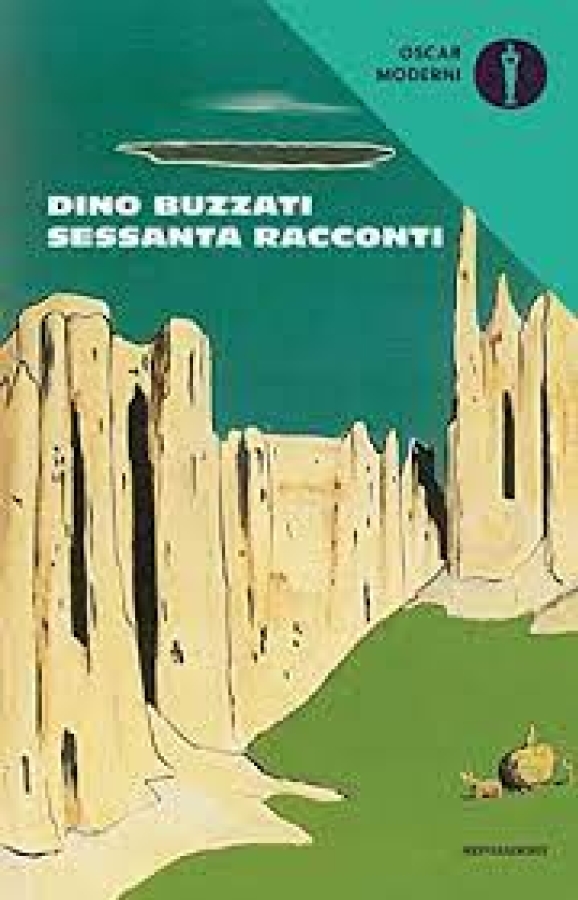
Finished reading on: March 08, 2023
The Sixty Stories
Title of the original version reviewed: «I sessanta racconti»
AI Translation Notice: This review was translated from the original Italian using artificial intelligence. Book quotes and excerpts are translated interpretations and will not match the author's original English phrasing or official published translations.
Dino Buzzati is one of the most fascinating Italian writers of the second half of the twentieth century: suspended between the fantastical and realism, he captured the existential anguish of contemporary man, the absence of hope alongside the intense desire to escape into a better world, beyond reality; he is the Kafka and the Philip Dick of our literature, so often prosaic and lyrical. A great writer to be read in small doses, it is a pity that this vast 1958 collection of short stories was republished, for it also reveals the limits of Buzzati's poetic and spiritual world. Let us start with a short story, A Drop. In an apartment building, a strange event occurs:
a drop of water is climbing the steps of the stairs. Can you hear it? Lying in bed in the dark, I listen to its arcane journey. How does it do it? Does it hop? Tick, tick, tick, it is heard intermittently. (...) But what is this drop, after all, (...) could it perchance be an allegory? (...) Or is it more subtly intended to depict dreams and chimeras? Or places further away still, at the edge of the world, which we will never reach.
No, it is merely a drop. In its banality and strangeness, a hopping drop of water encapsulates the narrative vein of Buzzati's entire work: the bizarre nature of reality, which is not what it should be; the spasmodic need of the human being to take root in something concrete, alongside the anticipation of something else—the whole, however, enclosed in a claustrophobic world from which one cannot escape. Consider another story, an ironic and gentle sketch of the Milanese upper bourgeoisie. In Fear at La Scala, we are at an opera premiere; Milan's most elegant and affluent society has gathered in the great theater. A rumor spreads that revolution is about to break out; and so the spectators remain inside La Scala as though it were a diplomatic mission.
Among so many familiar faces, in an environment alien to politics, (...) they felt protected
. With keen psychology, Buzzati describes the dynamics of this "joyful, noble, and civilized" world, yet frightened and incapable of reacting.
In the square, a stooped little man appeared, pushing a handcart. With extreme calm (...) the little man began to sweep. Bravo! A few strokes of the broom were enough. (...) Nothing had happened
. And what should happen? Recalling a beautiful poem by Caproni (Farewell of the Ceremonious Traveler), in Something Had Happened the travelers, arriving at the station, found it empty,
until the voice of a woman, piercing and violent as a gunshot, gave us a shudder. Help! Help! she screamed, and the cry reverberated beneath the glassy vaults with the hollow sonority of places forever abandoned
. There is nothing waiting for us beyond our dreary existence.
The theme of a claustrophobic world from which one escapes, even by resorting to fantasy, runs through the entire collection of short stories. Each of them captivates the reader, despite variations in stylistic and narrative quality; yet the whole becomes monotonous and looming in its existential pessimism. The book should be taken as a breviary, to be read once in a while, a short story here and there, whenever one feels the need to turn to fantasy and the paradoxical, but without any pretense of uplifting the spirit in the face of the world's ugliness. Or perhaps, as in Seven Floors, a splendid narration of a hospital stay (who among us has not lived through the fears and loneliness of the sick person at the mercy of doctors?), nothing remains but the mysterious fascination of the landscape.
He looked at the green of the trees through the window, with the impression of having entered an unreal world, made of absurd walls and sterilized tiles, of icy, mortuary entrance halls, of white human figures void of soul. It even occurred to him that the trees he seemed to glimpse through the window were not real either; in fact, he ended up convinced of it, noticing that the leaves did not move at all.
To appreciate the stories, one must make generous use of quotations. Indeed, it is not the narrative structure that grips—it is, in fact, repetitive; Buzzati's strength lies in his writing. One is left to wonder how this author manages to blend the fantastical and surreal, even science-fictional style, with a descriptive prose attentive to detail, psychological insight, and context, just as a fine nineteenth-century novel would demand; a narrative that is invariably elegant, fluid, and lexically rich.
Why read it? Keep it on the nightstand like a breviary, of fantasy and elegance.