Finished reading on: July 18, 2013
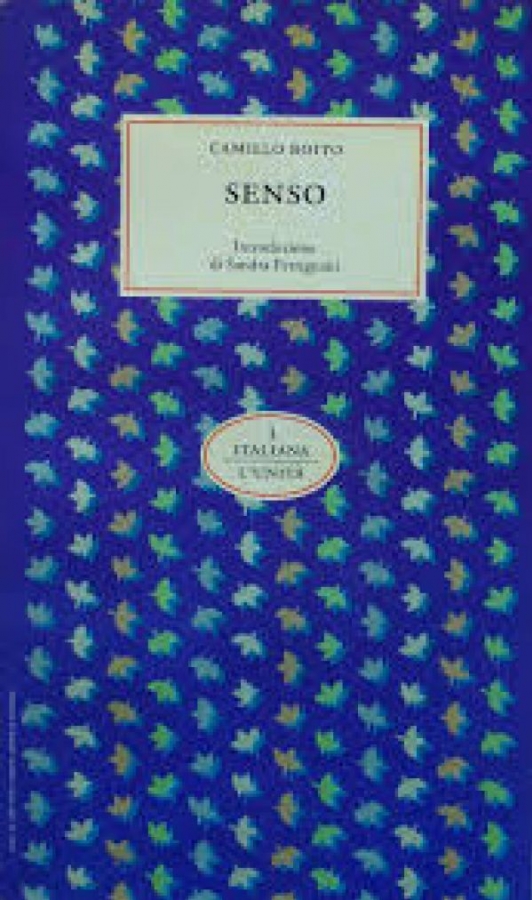
Senso and Other Stories
Title of the original version reviewed: «Senso ed altri racconti»
AI Translation Notice: This review was translated from the original Italian using artificial intelligence. Book quotes and excerpts are translated interpretations and will not match the author's original English phrasing or official published translations.
Camillo Boito, elder brother of the more renowned Arrigo, was an art expert who engaged only marginally in literature.
Yet his short stories are strikingly modern in the cold detachment and amorality with which the author confronts the ambiguous, unspeakable egoism lurking within the human soul.
In his most famous story, Senso, Livia is a harsh, shallow, and conceited woman who entrusts a terrible secret to a “sheaf of papers.”
And she does so with the joy of
confiding solely in oneself, free from scruples, from hypocrisies, from reticence, honoring the truth in memory even regarding that which stupid social affectations make hardest to proclaim: one's own vileness!
Still very young, yet already wed to a wealthy, elderly aristocrat, she takes an Austrian officer as her lover.
Even while acknowledging him to be a dissolute, cynical man of virtually no moral principles, Livia is swept away by physical passion.
The description of the beginning of their affair is a masterclass in literary craft.
With few words, light and veiled, the author captures the profound sensuality of the bond between Livia and her lover.
The woman is in a bath, naked, reclining supine in complacent admiration of her own beauty, of the “rosy beauty of her skin,” when, through the wide apertures connecting the pool to the men's quarters, her lover bursts in.
I did not cry out, I was not afraid.
He seemed carved from marble, so fair and beautiful was he; yet his broad chest heaved with deep breaths....
standing erect, half-veiled by the water, still trembling, he raised his soft, muscular arms: he seemed to thank the gods, as if to say: At last!
But the man soon reveals himself to be a rogue, constantly extorting money from the wealthy countess, even to the point of stripping her of her jewels to bribe doctors and evade the war.
Livia lives in Trento; the man must remain in Verona, where his military regiment is stationed.
The distance allows the man to deceive his mistress further, professing his fidelity while carousing with other women on the countess’s dime.
Yet blind love can transform into cruel hatred.
Livia discovers the betrayal and, out of revenge, denounces her lover, who is executed by firing squad.
Will this infamy weigh forever on Livia’s conscience, or was it merely the wretched conclusion of a whim? The author offers no answer to this question; he is not interested in passing moral judgment, much less in conducting a sociological analysis.
Ultimately, the author is like a painter whose sole task is to depict—with all its chiaroscuro—a landscape, a state of mind, an ensemble of characters: nothing more.
The narrative plot is Boito’s fundamental virtue.
It is linear, simple, yet brimming with suspense.
Another compelling aspect of the author’s style lies in his depictions of landscapes, especially the subalpine foothills, an environment that must have been particularly dear to him.
There is a meticulous attention to detail, almost Verist, accompanied by a transfiguration that hinges on imagery and colors.
Consider, for instance, this excerpt from a minor tale, Il demonio muto.
Between those two barren slopes of a dark, reddish hue, one sees, almost horizontally, the pale blue ridge of a distant mountain.
The clouds had parted, and, across the wide blue field, from that lower corner, a white cloud rose and rose, illuminated by the sun.
At first it seemed a silver crown set upon the peak of the far-off mountain; then it expanded, engulfing a vast portion of the sky.
It took the shape of an immense bull, advancing with its horned head...
Then, in a minute, the bull altered its appearance: its massive head lengthened, turning into the snout of a pig, and the figure, once majestic, became grotesque
.
Why read it? It is enjoyable—entertainment of no trivial sort.