Matei Visniec
Books by this author (1)
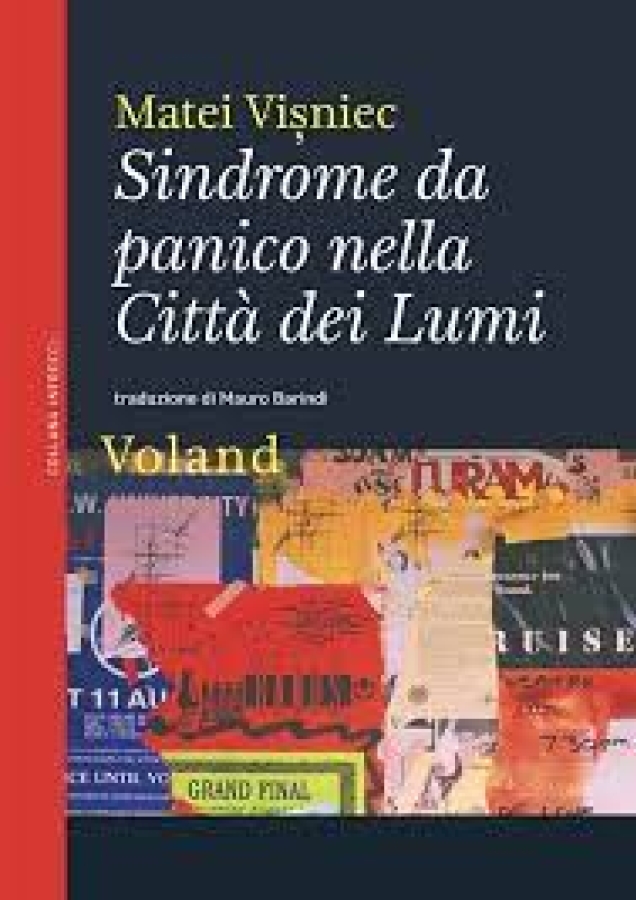
Panic Syndrome in the City of Light
The novel opens with a paradoxical and amusing scene: an eccentric publisher summons his authors to a Parisian café for a "live reading" of their manuscripts. He read them while "expressing himself": > he was capable of biting his tongue, gnashing his teeth, whistling... (...) his lips were in perpetual motion, in a continuous slaughter, (...) even his nose played a role during these readings, (...) he managed to impart a sort of vibration to his nostrils, and even increase the size of his nose as if blowing into a balloon . With such an astonishing beginning, one would have expected a continuation of equal effervescence, an ironic and biting account of the tribulations of an unpublished poet: a Romanian writer who fled to Paris after penning a single successful poem, fiercely caustic toward the communist regime of the time. One would anticipate hilarious scenes of authors vying to see their books published; instead, our poet is engulfed by a chaotic succession of characters and episodes lacking any apparent narrative purpose. At the center, a weaver of invisible threads, stands the visionary and overbearing publisher: he wants to abolish the narcissistic "I" through the mandatory use of the third person (one can only agree with him!), he wants to create a collective book assembled from fragments of each of his authors' work, he roams Paris in search of improbable figures who might be writers, retracing the haunts of famous authors who still inhabit his mind, while their books now languish on dusty library shelves. Books are "dead": all that can be done is to rush to open them and read a few pages to bring them alive, if only for an instant; words overlap in cosmic disarray, and the line between reality and fiction blurs to the point where inanimate objects come alive in a kind of artistic metamorphosis. Perhaps the novel aspires to be a metaphor for a fragmented world, where an epistemological—and consequently narrative—unity can no longer be found; nothing remains but nostalgia for the great nineteenth-century novel. Browsing the reviews on this site, one can find numerous novels in which the book itself is the protagonist. Sosuke Natsukawa's *The Cat Who Saved Books* recounts the journey of a young hero who must overcome various trials to secure a future for books. In Satoshi Yagisawa’s *Days at the Morisaki Bookshop*, a young woman regains serenity among books, only to realize that life is something else entirely. In a devastated and violent Russia, Mikhail Elizarov’s *The Librarian* tells of a group of survivors defending their books as an intangible heritage to be preserved. These are all novels with a positive view of the book and of literature. By contrast, Natsume Sōseki’s *I Am a Cat* casts culture in a negative light, where a stray cat kills itself to escape the idle chatter of humans, literati, and scientists. The novel's theme is therefore hardly original, and it might have been compelling had it been framed within a cohesive narrative plot, highlighting Paris and the splendors of a city that was once the cultural capital of the world. Instead, disorder and arbitrariness predominate, rendering the story incomprehensible, taxing to follow, prolix, and overly intellectual. Why not read it? Intellectualistic and tedious.