Finished reading on: October 23, 2014
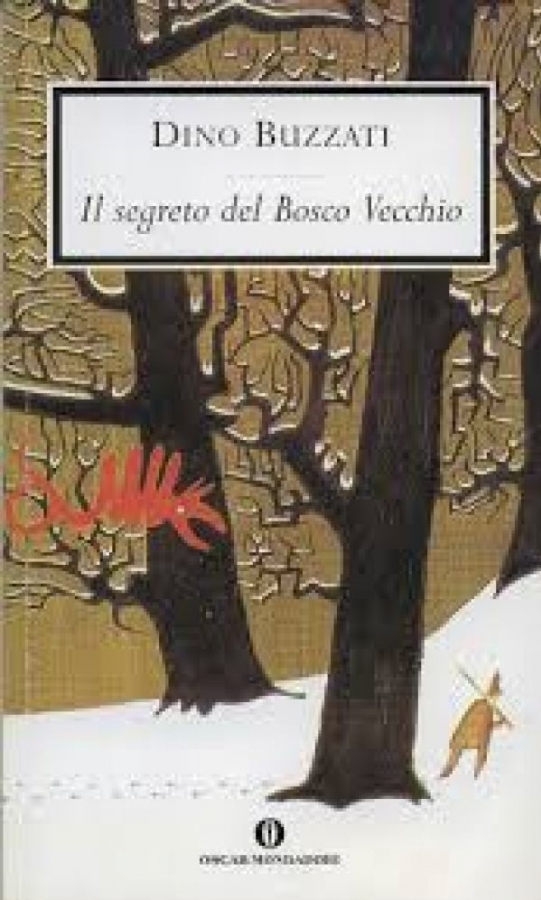
The Secret of the Old Woods
Title of the original version reviewed: «Il segreto del Bosco Vecchio»
AI Translation Notice: This review was translated from the original Italian using artificial intelligence. Book quotes and excerpts are translated interpretations and will not match the author's original English phrasing or official published translations.
At the beginning of the tale, Dino Buzzati imagines a nineteenth-century abbot who, "with succinct and very clear accounts," speaks of "a wondrous vision" upon beholding the old forest; in a footnote, the author observes how some men grasp the secrets of the woods, perceiving them by "nature," while others will never possess this sensitivity,
and will pass impassively (...) along the shadowy forests, without even suspecting what goes on in there
. Communion with the trees, the capacity to perceive their magic, belongs to children; as Bernardo explains—the tree-genie who has taken upon himself the burdensome task of conversing with adults—
at a certain age all of you, men, change. Nothing remains of what you were as children. You become unrecognizable
. Adulthood causes one to lose the quality of feeling part of the whole, of playing in the woods alongside the animals, of understanding the birdsong, of perceiving and distinguishing the vibrant and grandiose orchestra of forest sounds. Because adults will never love nature, the genie Bernardo befriended the old owner, persuading him to leave the old forest untouched. What an ordeal it was to spend evenings in long games of cards, in tedious conversations while
through the window, with the fragrance of precious resins, entered the deep voice of his brothers, singing carefree
! The situation changes when the old owner dies and the new master arrives. Procolo, a retired colonel, is a rigid, somber man, solitary and impervious to any communion with the woods, which he sees merely as an opportunity for exploitation. It is not that he is greedy; he is simply a petty soul, and how can one who lacks generosity find pleasure in the rustlings and scents of the woods? He allies himself with the wind Matteo to bend the tree-genies and force them to work for him in exploiting the forest; he kills the magpie that stands sentinel over the house, only to plummet into the silence of the night, trapped inside his nightmares. Wretched and wicked, he seeks to rid himself of young Benvenuto, heir to the forest, of whom he is the guardian; with the aid of the wind Matteo, he does not hesitate to abandon the child in wild reaches of the woods, where Benvenuto would surely have perished. He fails, yet believes no one knows of his murderous intent. But when he ventures into the thick of the forest,
behold, the birdsong wanes, squirrels and dormice flee, silence settles upon the boughs, and at times ominous clouds even appear in the sky. (...) Clearly he struck a false note in that blissful corner of the woods; clearly the trees and birds could not bear him
. Even his shadow abandons him, so disgusted is it by the barrenness of its lifelong companion. Procolo is alone. And yet, little by little, reluctant and astonished, on a sleepless night Procolo recognized the sounds of the forest. He counted fifteen of them, meticulously noted one by one.
But two or three times, that night, there was also true silence, the solemn silence of ancient woods, comparable to none other in the world, which very few men have ever heard
. And the goodness that resides in all human beings is finally liberated from the representation of self, from that "false self" that had accompanied him throughout his life. Procolo dies, but is saved.
Buzzati’s tale can be interpreted as a fascinating metaphor for the human soul, where the woods are not Dante’s selva oscura, but rather a kind of Shinto paradise in which trees are benevolent genies and winds are hostile, dark forces: a depiction, in short, of the intricate tangle of consciousness. I prefer to interpret The Secret of the Old Forest literally, as a great woodland fairy tale, devoid of ulterior meanings. Raised by parents who loved the mountains and made me spend long summers amidst the greenery of the Alps, walking among the trees has always been part of my life, without my ever understanding why. Reading Buzzati’s tale helped me comprehend my passion. And it is precisely for this reason that I associate it with Petrarch, fully aware of how bold such a connection is. When Francesco Petrarch recounts his walks in Provence and Tuscany, I recognize the feeling that stirs within me whenever I, too, make my way through the forest: the desire for detachment from the world’s frenzy, a reunion with oneself—solitary, silent, absorbed in physical exertion, steeped in the vitality of the trees, conscious of the bond connecting all living beings. Often, as I wander free and aimless amid the light and sounds of the forest, the lines of Canto XXXV of the Canzoniere come to mind:
alone and lost in thought the most deserted fields / I go measuring with steps slow and halting, / and keep my eyes alert to flee / wherever human trace marks the sand
.