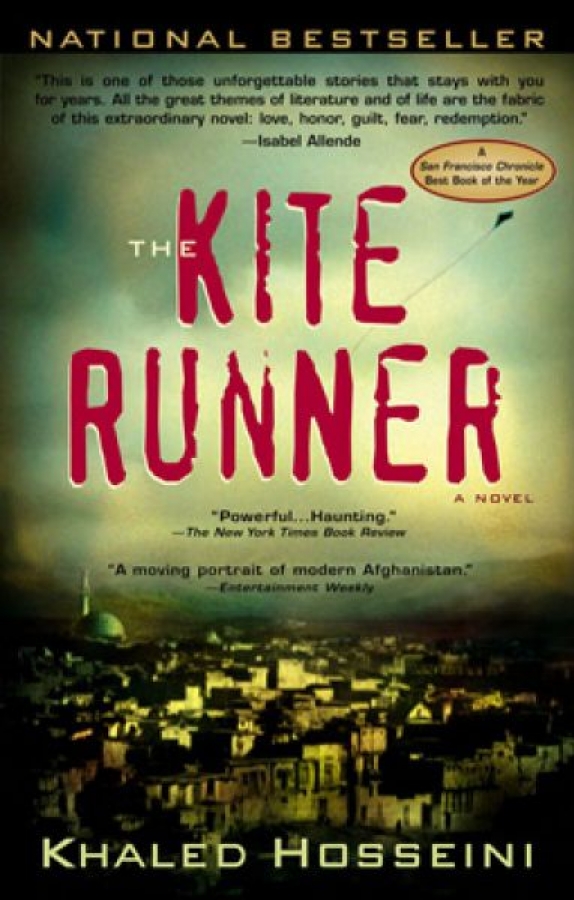
The Kite Runner
It would be wrong to think that this novel is about Afghanistan, which nonetheless constitutes its frame of reference. The theme of the book is cowardice. Amir lives in a fine house in Afghanistan with his father, an important and courageous man, and two servants, Ali and his son Hassan. The latter is Amir’s childhood friend, whom Amir treats with arrogance, albeit tempered by brotherly affection, believing himself superior in caste and culture, and envious of his father’s affection for Hassan. Amir and Hassan are champion kite runners, and on the very day of Amir’s greatest triumph—having won the kite tournament—he fails to intervene to save his friend, who is beaten and raped by Assaf. Amir is a coward, and this guilt haunts him throughout his life, even when he is forced to move to America, marries, and becomes a renowned writer. Only by returning to Afghanistan to rescue Hassan’s son will Amir succeed in redeeming his own cowardice, discovering along the way that his father—to him, an unattainable, flawless figure—was not blameless either, having never told him that Hassan was his brother. The first hundred pages of the book, which recount Amir’s childhood in a peaceful and happy Afghanistan, are very fine, written in a delicate and poetic style. Subsequently, the book loses its luster, ultimately losing its way in the final twenty pages, which recount how the protagonist manages to bring the child to America. The closing scene, a kite tournament in America, is predictable and trite, partly undermining the spiritual and narrative depth of the novel. In this final section, the only scene of real impact is Amir’s fight with Assaf, who has become a ruthless Taliban commander and reduced the boy to his sex slave. Assaf is beating Amir to death, yet Amir is content because he is finally freeing himself from the guilt that has haunted him all his life; he is ultimately saved by the intervention of the boy, who strikes Assaf with a slingshot.
Football in Yellow
The book brings together football-themed short stories by various noir writers, some well-known—such as Aykol, Giménez-Bartlett, Malvaldi, and Manzini—others less familiar: Gian Mauro Costa, Francesco Recami, and Gaetano Savatteri. The plots, characters, and writing styles vary, yet a common thread emerges: football, even at the amateur level or played in the minor leagues, is invariably a sordid, violent affair that brings out the worst in people. The already established authors are predictable: the narrative patterns are those of their novels, unfortunately compressed within the short story form, inherently brief. The contributions of Costa, Savatteri, and Recami are far more engaging; the first two set their stories in Palermo, while the third unfolds against the backdrop of Milan. Recami’s (*«Progresso - Audace 3-2»*) stands out as the finest story, well worth lingering over for its subject matter and deft narration. We find ourselves at a youth match, with parents cheering from the stands. Gianmarco is eleven years old, wrestling with the typical adolescent doubts about his sexual orientation, compounded by the fact that—being gentle, sensitive, and polite—he is mocked by his teammates with taunts like «Giorgi is gay». A talented player, he is targeted by a boy on the opposing team, egged on by his father («break him, take him down, finish him, kill him...»). The man, > an overweight man in his fifties, a third-generation immigrant from Puglia, rather potbellied , «in the throes of an aesthetic crisis», hurls unspeakable abuse at Gianmarco's mother, slaps her, and unleashes the fury of the other mothers, who chase after him intending to beat him. He takes refuge in an abandoned warehouse, where he is caught by Oleg, a giant of a man, clearly a criminal hailing from who knows which Eastern European country. And here the tables turn for our potbellied bully: the braggart turns into a lamb, such a coward that he literally shits himself, completely unable to protect his family from Oleg's threats and violence. Instead, it will be his wife who shields the children and the home, ready to sacrifice herself to do so; yet how could this be? A woman, belonging to the very sex the potbellied man routinely addressed with terms like: «fucking whore...». Meanwhile, Gianmarco makes an astonishing discovery: a famous player, «one of his idols, a tough guy, someone who commanded respect», had come out as gay. How was this possible? «You shouldn’t be surprised in the slightest», Sciacca the school janitor told him from the heights of his wisdom, > in the world of football, they're all faggots. (...) It was undoubtedly the most intense sex education lesson Gianmarco had ever had, and would ever receive in his entire life. He reflected. There was the principle, there was the truth, that’s why at Juventus they’re all faggots. So if I'm gay, does that mean I'm more manly than the pansies who go with women? The female janitor chimes in. > What are you doing, Sciacca, telling the boys your usual dirty little stories? What on earth are you talking about, we were discussing football. The short story format does not lend itself well to noir: it is too brief to allow for the development and suspense that form the very core of a mystery. It feels like watching an episode of *Murder, She Wrote*: at a certain point it must wrap up, and so the story either tumbles into a predictable denouement or remains suspended, leaving the reader unsatisfied. Of greater merit are the settings, the characters, and above all the prose: the latter occasionally proving to be a pleasant surprise. Why read it? It offers the chance to discover lesser-known, yet valuable writers.
The Lament of the Linnet
The novel revolves around a question to which the reader cannot find an exhaustive answer: who is the "Cardillo Addolorato", and what role does this omnipresent and obscure figure play among so many characters? And what is the meaning of the verses that recur throughout the tale, up to its seemingly tragic conclusion: «e vola vola vola lu Cardillo! e vola vola vola... oh! oh!»? To answer, one must venture into the reading of the novel, letting oneself be enchanted by the mystery of narration, which, like life, resides in the > freshness, fluidity, flow and precipitous fall, the continuous vanishing and resurrection of its infinite forms . We are at the end of the eighteenth century, in the midst of the Age of Enlightenment. Three friends—Prince Naville, the merchant Nodier, and the artist Albert—arrive from the cold North in Naples, a "strange city, wretched yet rich, softly colored," alternating "days of a purest, glittering azure" with others rainy and somber. The three young men, > radiant with a gaiety, an excitement, a pride justified by their age and, we might add, by being in a city so full of mirages, pay a visit to a well-known glovemaker. It is in the merchant’s house that the events determining the fate of the three friends unfold. First of all, they meet Elmina. "Full, yet delicate forms, stunning arms," a gaze > grave and reserved... a coldness... a distance, an abyss... that could be conquered (thinks Naville)... that could never be bridged , so it seems to Albert. The impression is so breathtakingly intense as to produce "a bewilderment of the soul"—more mundanely, causing the three young men to fall in love suddenly and like a bolt of lightning. Their lives are marked forever. Yet precisely at this moment of enchantment, a disturbing episode occurs. Elmina's little sister compares Albert to "their old goldfinch," left to die of neglect, without fresh water or millet. From a twofold and contradictory emotion, of ecstatic wonder and gratuitous cruelty, unfolds an apparently senseless story. As in an eternal return, the characters remain the same, events seem to repeat themselves identically, yet continually take on new forms and meanings: the only constant is the presence of the Cardillo, the mysterious bird, "entirely invisible and hidden." After all, is it possible to bestow > a legitimate name on the people and things of this world, all so unclear... and slowly slipping away ? Albert marries Elmina, who has undertaken a mission transcending all love and human bonds, even maternal ones: she must care for a child who might be her secret brother, but, naturally, is not. An imp, an evil spirit, or an innocent soul? In this predicament, poor Albert, a fragile and defenseless soul, cannot but succumb. Nodier, for his part, also in love with Elmina, after daydreaming of marrying her, being the pragmatic and superficial man he is, beats an orderly retreat once the incomprehensible mission the girl has set for herself becomes clear. Naville cannot accept this easy way out; he too is infatuated with Elmina, but, an Enlightenment thinker and cosmopolitan, he stubbornly attempts to find an explanation for incredible and mysterious events, to offer Elmina a definitive and fitting arrangement, showering her with gifts that are always refused, planning to marry her and take her away from Naples. All his efforts are futile, not only because events unfold in an increasingly indecipherable manner (characters are never who he thought they were; even the dead resurface to have their say...), but above all because, at decisive moments, the voice of the Cardillo bursts forth, that agonizing refrain: > Oh, had he never abandoned his home and the dull worldly life of the wealthy, solid, cold, reasonable, and thoroughly respectable society into which he was born! A kind of destiny dragged him to Naples, and against it poor Naville desperately fought, only to end up defeated. The prince returns to his homeland, to his majestic palace in Liège. To anyone who "boasted of that famous, though still newborn Progress," the prince—no longer worldly, no longer amused—would ask whether they > had heard the absolute silence of the world, the imperial joy of dawn.... the presence of the avenging Cardillo . Until one evening, just as he is about to set out once more for Naples, the Cardillo is announced to him. The familiar refrain echoed everywhere, and the prince > (blessed) the Cardillo who was arriving, and would finally explain everything to him. The madness and the separation, the grief and this joy that now arrived with him: all calm, cold, infinite . Who, then, is the Cardillo Addolorato? It is the underworld, the magma bubbling beneath ordering rationality. To grasp the meaning of the goldfinch’s voice, one must be a > patient reader, bereft of common sense and endowed instead with a private antenna to catch the glacial silence of the Universe, the quarrels of the underworld’s children, the spitting, the tears, the nein... nein of their imploring . Only in a Naples both fantastical and sorrowful, generous and cruel, could a book narrating the defeat of Reason take place. The novel’s chief virtue is its style, mesmerizing if not easy. The reader is immersed in an intricate syntax, rich in parenthetical clauses, representative of life’s complexity and vagueness. It is a prose that heralds dream, mystery, a world that refuses to be reduced to overly simple and linear narrative schemes. Its flaw lies in the confusion of the plot and character system. At first, the author manages to maintain order and logical progression; beyond a certain point, disorder bursts in victorious. The reader loses their way, and annoyance and tedium set in. Why read it? Its allure lies in the writing, but one must have the patience to press on through the final hundred pages.
The Professor's Briefcase
Let us imagine a young woman, somewhere between her thirties and forties. She was never a brilliant student, she works a monotonous office job, she has had a few romantic relationships that nevertheless came to nothing. She is alone. > All alone I took the bus, all alone I walked the streets, all alone I did my shopping, all alone I went for a drink (...). A cheerful life. Sad. Pleasant. Sweet. Bitter. Harsh. Stimulating. Irritating. Warm. Cold. Lukewarm. In short, how on earth have I lived for so long? One day, by chance, at the bar where she goes to drink (seemingly her only pastime), she runs into her former Japanese teacher. At first, it is a vague sense of feeling at ease, "settled," like buying a book and choosing to leave its wraparound band intact. Then something else takes over. > The teacher and I do not see each other often. It is only natural; we are not together. Yet I never feel he is distant, not even when he is not beside me . Finally, love emerges. > From what point onward, drawing near to him, did I begin to feel the warmth radiating from his body? Through his starched shirt, I perceived his presence. (...) A presence I was never able to grasp firmly. Just when I am about to seize it, it eludes me. When I feel it growing distant, it draws near once more . In a dream, the young woman searches for the teacher, but cannot find him. > Ah, there it is, I have already put him in the box! Now I remember. I shut him in the big box (...) that I keep at the back of the built-in wardrobe. (...) Now I can no longer take him out. Because the wardrobe is too deep . Yet what does the teacher represent, with his briefcase, his voice and his body, his past laden with mysterious meaning? Is he like the moon that must illuminate the path for a young woman who does not know herself? Is he the conscience unwilling to emerge from the depths of the soul? Or, more simply, an older friend to cling to in order to come of age and escape the loneliness of existence? We shall never know, for the novel offers no conclusion. We know only that when the aging teacher passes away, "on evenings like this," the young woman will open the briefcase and look inside. > But there is nothing in the briefcase, only emptiness, an expanding void. A hopeless void that swallows everything . To characterize this tale in some way—one that resists labels nonetheless—we might say that the novel articulates an existential suffering not confined to youth. Across the narrative, we discover that the teacher, too, has suffered from events beyond his grasp, such as his wife’s flight and sudden death. The older companion is therefore not a font of wisdom and certainty; rather, like the young woman, he is a tangle of certainties and doubts, expectations and disappointments. Their relationship, which becomes intimate and not merely spiritual, is the fruit of two kindred spirits seeking mutual support, facing existence together. The meaning of the tale must not be reduced to the trite story of an affair between a young woman and her former teacher. The slow acceptance of their love stems from the fear of opening oneself to the other, of acknowledging that one is a person only through another person. Distinctly Japanese, the novel thereby takes on a universal resonance. The charm of this brief novel lies in its narrative style: delicately ironic, thoughtfully gentle, the two protagonists, the wondrous Japanese landscapes, and ultimately the prose itself lead us softly and pleasantly along a path that might otherwise have proved somber and oppressive. Regrettably, the plot is fragile, often meandering and repetitive. A curious note: reading the novel reveals that Japanese cuisine is not merely sushi and raw fish; one can discover many intriguing recipes. Why read it? Distinctly Japanese, and therefore unique.
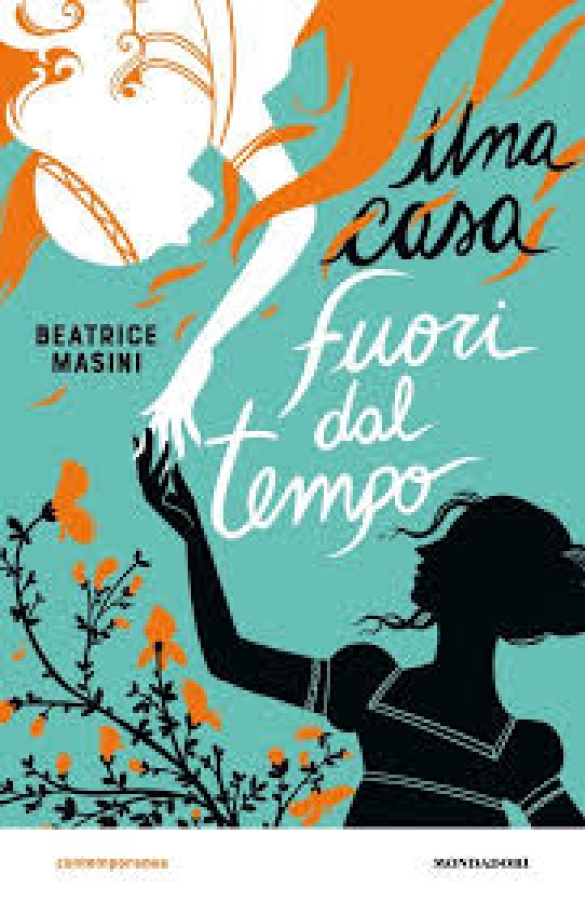
A house out of time
> He sets off between walls, prey to the light..../perhaps it was you, now it is an apparition/or perhaps it is all that knows no peace/ (...) It is a figure, it has no rest.../it is ours, I thought it a chimera (from "S'avvia tra i muri" in the collection *Avvento notturno* by Mario Luzi). These lines come to mind when reading this novel, which speaks of timeless presences, shadows and light dwelling in the realm of the dead during winter and among the living in summer, as in the myth of Persephone. Vera, a timid English girl of the early nineteenth century, certainly could not have expected such an extraordinary experience: becoming friends with Ginestra, whose destiny is to live for eternity like Persephone, poised between the underworld and the world of the living. The story begins in England. Vera is orphaned of both parents and has only an older brother, Caspian, who is passionate about archaeology. Vera studies Italian in the London schools founded by the exiled Mazzini (I appreciated this nod to an important, often forgotten role played by the founder of *Giovine Italia*). Caspian decides to take his sister with him to Pompeii, where he is engaged in the excavations. Vera wanders freely among the stones of the Roman city when Ginestra appears at her side. Just as in Luzi's poem, Vera becomes aware of Ginestra's sudden presence > not by any sound, because she makes none: what makes her turn around is a draft, an air pocket, like when you are swinging too high on a swing. Ginestra is > as tall as she is, (...wears flat sandals of slightly scuffed red leather... , but describing her is pointless; it is better to admire the portrait drawn by illustrator Elisabetta Stoinich of the two girls, together, hands affectionately clasped like two friends, jaunty, full of life—Vera smiling, Ginestra faintly melancholic in her Roman tunic and unruly hair, so alike yet so different from Vera in her composed Victorian attire. Yet why is a faint melancholy sensed in Ginestra? The girl knows she will lose Vera with the coming of winter, just as she will never again be able to live like mortals. There is a turning point in the story: the archaeologists succeed in capturing in a plaster cast the figure of a woman who died in the great eruption of Vesuvius; this woman is Ginestra’s mother. Ginestra's eternal vigil has become pointless; having seen her mother again, she can now leave the realm of the dead. She asks the Goddess for permission to depart the cheerful, vacuous sisterhood of her companions; in exchange for freedom, the Goddess demands Vera. Love prevails, and Ginestra condemns herself to eternal imprisonment. > They slipped away from one another, their clasped hands parted, the weave of their fingers loosened. The earth split before them, driving them apart. (...) Instead of letting Vera fall into the chasm (...) Ginestra looked her in the eyes for a long moment. Returning to cold London, will Vera remember her friend and her sacrifice? Beatrice Masini has written a delicate, subdued, almost evanescent novel. Her passion for Greek mythology and archaeology led her to intertwine Vera's coming-of-age journey—a true rebirth—with the history of the early excavations of Pompeii, suspended between conservation and greed for profit, between new technologies and the grueling, hazardous labor of the workers. One thinks of the evocative figure of little Nico, forced to work while still a child, and the description of the plaster casts, a method widely used in the nineteenth century to both preserve and popularize the works of antiquity. These realistic references frame a story of strong philosophical import: time, > which erodes and leaves nothing intact. Time, which is always hungry, and devours everything. Whereas before -- before, now, after, when it was, when it has been, when it will be -- over there, before, it was, it is all so perfect and polished. Overshadowed by so much metaphysics, the plot ends up crushed, weakened, fragile; the protagonists are not explored in existential and psychological depth, beginning with Vera and Ginestra. The prose is elegant and musical, aptly complementing the faint melancholy of the story. The sentences are concisely flawless, the vocabulary rich yet modern. The reader glides effortlessly through fine Italian prose, but at a certain point is left wondering: where is the fire amid such stylistic virtuosity? Why read it? The plot is fragile, but it makes for an enjoyable read.
Cécile is Dead
This is likely not one of Simenon’s finest novels. The plot is exceedingly simple: the niece, who served as a maid, kills her sick aunt when the latter refuses to give her money for her brother. Rummaging through the drawers, she discovers old papers proving that the aunt, together with her lover, had murdered her husband fifteen years earlier. The aunt’s former lover, who remains her business partner and lives in an adjoining flat, in turn murders Cécile to prevent her from revealing the contents of the documents she uncovered. From the standpoint of the detective genre, the events of the novel feel predictable, and the pacing certainly fails to grip the reader. The atmosphere (the figure of Maigret, the petty-bourgeois life) is sketched in a hurried, almost superficial manner. The fundamental virtue of the novel lies in its style. Even if the French language is not simple (owing to the richness of its vocabulary), it becomes readily intelligible through the sequence of clauses and words, which, even phonetically, help convey the traits of the characters, Maigret’s demeanor, and the salient aspects of the setting. What is to be appreciated is not so much the novel as a whole, but rather certain glimpses, such as the following: > Il arrivait a Maigret de hausser les épaules quand on s’émerveillait devant lui de la résignation des humbles, des malades …..sans horizon…. ; il savait par expérience que la bete humaine s’accomode de n’importe quel nid, du moment qu’elle peut le remplir de sa chaleur, de son odeur, de ses habitudes .
Chicago
The book is a collection of stories of Egyptians working and studying in Chicago, at the medical school. In some cases, they are individuals getting on in years, who have established themselves and seemingly integrated into American society. In others, they are young researchers who have received a scholarship from the Egyptian government and whose career success, therefore, depends upon the authorities of their homeland. They must strive relentlessly to achieve outstanding academic results, but they must also be exceedingly careful not to adopt critical or merely irreverent attitudes toward the Egyptian regime—at that time, Mubarak's. The stories unfold autonomously, interweaving only intermittently. Shaima is a deeply devout young woman who, > despite her exceptional scientific gifts, possessed an abysmal ignorance regarding the tools required to seduce a man . Already in her thirties, she meets an Egyptian colleague, falls in love with him, and discovers the pleasures of sex by his side. This affair seems headed toward a happy ending until Shaima finds herself pregnant and, confronted with the young man's terrified refusal (a child would disrupt his academic career), is forced to have an abortion, squarely against her religious convictions. Prior to moving to America, Marwa married a young man who appeared brilliant and respectable. In truth, her husband turns out to be a sordid individual: greedy, authoritarian, treacherous, with perverse and violent sexual inclinations, and, to top it all, an informant for the Egyptian secret service. Marwa wishes to divorce him but faces her parents' opposition; shrewdly, she engineers a situation whereby separation becomes inevitable: the husband is willing to surrender her to a powerful intelligence figure simply to secure an academic career compromised by his utter incompetence as a researcher. If the young are forced to navigate—some naively, others cunningly—the narrow confines granted by a repressive and hypocritical society, the adults themselves do not escape this fate. Saleh chose to flee Egypt, abandoning the woman he loved, whose harsh reproach still haunts him after so many years: "It is truly a pity that you are a coward!" the young woman exclaimed as she bid him farewell. Saleh married an American woman, but it was a marriage of convenience; so much so that his longing for the motherland eventually becomes uncontrollable, even taking on fetishistic dimensions, such as donning his old Egyptian clothes. He wishes to redeem himself by proving to his beloved that he is a brave man who takes risks for his people's suffering. He fails, because deep down he remains a coward, and so he takes his own life. Rafat, too, married an American woman, with whom he had a daughter. In a dramatic confrontation between father and daughter (in a last-ditch effort to save her from drug addiction), the girl violently unmasks the sham upon which Rafat has rested his entire life: > you are a fraud (she shouts at him), a failed actor playing a moronic role that convinces no one. What are you? Egyptian or American? Naghi is an idealist, receptive to the new experiences afforded him by American society, convinced of the need to fight for his country's freedom and democracy. He refuses to conform, often exposing himself to danger in the treacherous milieu of Egyptians abroad. He meets a Jewish girl and begins a romantic relationship marked by passion, affection, and mutual discovery. He is visited by an agent of the Egyptian intelligence services, who warns him to abandon his revolutionary pretenses and lets him know that they possess video footage of his fiery trysts with the young Jewish woman. Who could have planted a hidden camera in his apartment? Paradoxically, Naghi accuses his lover—so entrenched are the mistrust and the barriers dividing the two peoples. > However strong your love may be (the girl says), you will never forget that I am Jewish. I can be as honest with you as I like; your trust in me will always remain fragile . Naghi, too, an aspiring poet, cannot escape the fate of pretense and suspicion bred by a repressive society. All these stories develop in parallel, generating a kaleidoscope of lives, voices, and imagery so dense that discerning a unified narrative thread proves arduous. The vignettes of Egyptian culture, crafted with subtle irony, the deft sketches of characters and their circumstances, along with the detailed depiction of the erotic inclinations of individuals and couples, form a trap that entraps the reader within minutiae, obscuring the overarching import of the novel. There is unquestionably a critique of Egyptian society. Yet the book’s true significance likely resides in the unhappiness engendered by society’s repressive structures. There exists an indissoluble link between the social and institutional order (the absence of democracy) and individual destiny, reaching even into the realm of intimate, familial emotions. That this is not merely a feature of the Egyptian world becomes apparent in the only storyline whose characters do not hail from the North African country. Graham is a sixty-year-old professor, libertarian and eccentric. He meets Carol, a Black woman, with whom he shares a wonderful romance. Yet Carol, because she is Black, cannot find work, ends up modeling, and is coerced into yielding herself to a prominent corporate executive. They love each other, yet social segregation tears their relationship apart—for there is no escaping the devastating fallout of an unequal society, however formally democratic it may be. Aswani is a skillful writer, yet a narrative structure premised on multiple, parallel plotlines cannot be sustained indefinitely without weighing down the prose and dissipating it into too many tributaries. Moreover, there is no overarching plot to draw together the threads of the novel, leaving the narrative ultimately verbose and underwhelming. Why read it? It remains an assemblage of pleasant, intriguing vignettes.
Two Women
For Moravia, *La Ciociara* > was his tribute as a novelist to the Resistance as a collective act . The setting is Ciociaria, southeast of Rome; the historical context is the period between October 1943 and June 1944, when this region was thrown into turmoil by the protracted stalemate in the Allied advance, caused by the Cassino defensive lines and the failure of the Anzio landings in January 1944. The narrator and protagonist of the novel is Cesira: raised in Ciociaria, she married a Roman shopkeeper, a man who despises her, calling her «la burina». And indeed, Cesira is coarse, plebeian, and rural, yet strong and pragmatic, a formidable, seasoned worker. Her life revolves around the home, the shop, and her daughter Rosetta. This is how her mother describes her at the beginning of the story: > she had a face like a little sheep, with large eyes, an expression sweet and almost poignant ; later she will have to admit > that this perfection was fragile and almost artificial, like that of a flower grown in a hot-house . For Cesira, the war is far away ( > those sons of whores, let them butcher each other all they want, what do we care about their war? ). And as another character will say, > war is only bad for fools. (...) Let the Germans come, let the English come, let the Russians come, what must matter above all to us shopkeepers is still the shop, and if the shop is doing well, all is well . Cesira thinks the same way; indeed, she enriches herself through the black market throughout the war years. After September 8th, Cesira finds herself flush with cash but devoid of provisions, forced to starve. She decides to leave Rome and head to Ciociaria, to stay with her parents. The train takes the two women as far as Fondi, where the railway line ends. They find lodging with a shady family, whom they quickly abandon after Rosetta is subjected to the indecent advances of a petty Fascist hierarch. They flee, then, into the mountains, to a wretched shepherd village where numerous families who fled Fondi have taken refuge. In the extensive pages dedicated to the shared life of the evacuees and peasants, Moravia draws on his personal experience, to the extent that events and figures mirror those in his diary from those terrible days, when he was forced, alongside Elsa Morante, to seek shelter in Ciociaria. The narrative, fluid yet prolix, is skillfully driven forward, thriving on the contrast between the harrowing realities of war (desolation, bombings, roundups, violence) and the splendid indifference of nature, which follows, immutable and cynical, the eternal cycle of the seasons. The tale seems suspended, awaiting the arrival of the Allies, who are expected to bring «abundance». Enter Michele. a young intellectual, steadfast in his ideas and courageous in his conduct. Unlike Rosetta, who owes her innocence to ignorance, Michele is keenly aware of what is transpiring, of the Nazi-Fascist oppression that affects not only the insular world of the evacuees, but all of Italy, driven toward general material and moral ruin. A positive figure, he is trapped, as it were, in the life of the displaced, in the wretched and indolent day-to-day existence of waiting, focused solely on surviving somehow. Finally, the Allies arrive; it ought to be liberation, but instead the situation deteriorates rapidly. Some German soldiers take Michele away and subsequently execute him when the young man stands up in defense of a peasant family: Michele dies a hero. The two women, alone and isolated, are caught off guard by a group of Allied soldiers, who rape Rosetta. The rape changes the girl; once so innocent, she declares to her astonished mother: > him or someone else, it makes no difference to me. (...) I want to make love because it's the only thing I like and feel like doing. And from now on, I will always be like this . The rape, Michele's death, and the war profoundly alter Cesira as well: once a confident woman, she becomes uncertain, tormented, so much so that her sleep is plagued by nightmares, as though only the oneiric world might allow her to regain her original solidity; in one of these dreams, she imagines that Rosetta has married and that «she unbuttoned her bodice and gave her breast to the baby», but was it Rosetta or that poor madwoman she had encountered wandering the countryside amid the desolation of war? Whatever his intentions, the author fails to convey the tragedy of war for civilians, and this for two reasons. First of all, a pervasive pessimism regarding human nature prevails, leading to the passive acceptance of events, to resignation rather than rebellion, to submission—an attitude certainly not redeemed by the final chapter, in which grief would seem to restore perspective to Rosetta and Cesira. It is a hypocritical and sickly-sweet appendix, calculated to avoid an ending too cynical to find favor with readers. Secondly, Rosetta's metamorphosis from a good girl into a «whore» is implausible (is a rape overcome so easily?), smacks of the morbid, and mirrors a typically male conception of female sensuality. In short, the gang rape is treated as an initiation, an abrupt way of discovering the «ugly things» of the world. On the other hand, > she had now developed a taste for what the Moroccans had forced upon her . From a cathartic turning point, rape becomes the inexorable fate of all women. One cannot be accused of being politically correct in stating that this Cesira-Moravia worldview is intolerable, in addition to draining all tension from the entire narrative. The plot is admirably constructed, the characters are well drawn, and the writing is fluid, effortless, and accomplished with its airy phrasing. The reader is led by the hand up to the rape, foreshadowed throughout the narrative by subtle hints and fleeting episodes; when it occurs, it seems inevitable. Moravia confirms his immense gifts as a writer. Why read it? Cesira is a victim, and her story is emblematic of what befalls civilians in all wars.
Through the eyes of the enemy
This book collects four lectures delivered by Grossman between 2004 and 2006. Two of them concern the nature of writing, while the others address the "appalling, ambiguous, and complex" situation of Israel. What unites the reflection on literature with that on politics is the writer's mission: for Grossman, it consists of refusing the > surrender of the possibility of understanding what I truly think... So that, perhaps, it would be better not to think, not to know, to entrust the task of thinking, acting, and establishing moral norms to those who certainly know better than I do . Grossman shares the view expressed by Vargas Llosa in the preface to *Aunt Julia and the Scriptwriter*: literature originates from the writer's dissent from the world, from > what he would like to suppress, add, or correct in life . The starting point is, however, an inward search that recalls Pamuk, for whom > being a writer means being aware of the secret wounds we carry within us (*My Father's Suitcase*). Indeed, for the Israeli author, > the primary impulse that triggers and drives writing is the desire to invent and tell a story, and to know oneself. Moreover, the more I write, the more I realize the power of a second impulse, which cooperates with and completes the first: the desire to know one's fellow man from the inside, from within... to feel what it means to be another person . And thus the fundamental motive > is the yearning to voluntarily remove what defends me from the other , in order to overcome > the effort we make not to expose ourselves completely to the other... to preserve... the framework in which our multiform and erratic psyche is contained, and at times imprisoned . The pivot of this transition from the self to others is constituted by characters. > Writing a novel means, to a large extent, being fully responsible for a few dozen characters . To explain this statement, especially pertinent in light of the descriptive and psychological poverty of so many modern novels, Grossman relies on an apt metaphor. The writer is like someone who keeps dozens of people imprisoned in a cellar. > Every now and then he would do well to have a chat with them... try to defuse tensions... listen to their stories and memories, remind them of everything that is still left to dream of, to mourn, so that for a moment they forget the suffocating pit in which they find themselves . From this focus on characters arise the tasks that Grossman assigns to politics. > If there is one thing I would hope politicians and leaders might sooner or later learn from literature, it is precisely this way of dedicating oneself to a situation, and to the people trapped within it , to no small degree because of the traps those very politicians and leaders helped create. The mention of political responsibility leads directly to the lectures addressing Israel's dramatic situation. One cannot help but admire Grossman’s courage, but also his dignity, in directly calling out the Israeli government's culpability in pursuing an aggressive policy that is distorting the very foundations of the State of Israel, its institutions, and the rule of law itself, setting in motion an apparently irreversible process of "disorientation and dismemberment... of the public, social body." Yet Grossman’s most compelling reflection concerns an aspect seldom emphasized: the gradual disappearance of the > model of the universal, cosmopolitan Jew, who aspires to fulfill an intellectual and moral mission , supplanted by utilitarianism, brute force, and aggressive competitiveness. If the land of Israel was meant, in the ideals of Zionism, to end the Diaspora and render the Jewish people finally "equal" to other nations, fear and hostility toward others (first and foremost toward the Palestinians) perpetuate the psychological and spiritual patterns of the Diaspora—this time in an aggressive key. From oppressed, the Jewish people become the oppressor. It is futile to look in Grossman's lectures for the lightness and subtle irony of Pamuk or Vargas Llosa. This is not merely the author's style, which is invariably solemn, intricate, and meditative. It is the tragedy of the man—as an individual (above all, as a father mourning the loss of his son), as an Israeli witnessing the unraveling of his own people, and as a Jew confronting the betrayal of millennial values—that prevents Grossman from casting aside dark and tragic undertones. The anguish oozing from every word, the philosophical edge of his considerations, and the sense of an inescapable fate that can be counterbalanced only by utopia make for a heavy and demanding, at times repetitive, read. Only at certain moments does one emotionally empathize with the writer. It occurs when, in his magnificent commemoration of Rabin, he asks with dignity not to be judged with pity and indulgence as though driven by a "feeling of anger and vengeance" over the terrible tragedy of his son's death. Even grief can be wielded by power to silence dissent and critique! Why read it? The reflections on the writer and on literature are particularly compelling.
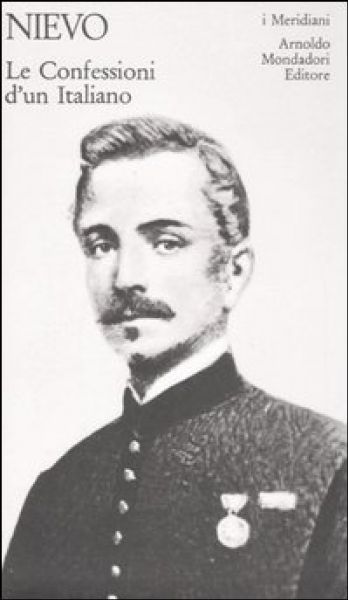
The Confessions of an Italian
Carlino is the natural son of the young Countess of Fratta and grows up in the household of his aunt and uncle, left to the care of the servants and regarded as a «second-class relative». At the castle of Fratta also lives his cousin, a girl younger than Carlino, named Pisana. From his boyhood, Carlino falls in love with Pisana, an increasingly vivacious and unpredictable girl who shares a conflicted relationship with him: she seeks his protection and affection whenever she needs it, only to wound his feelings by keeping company with other boys and treating him poorly. The novel (late 18th to mid-19th century) is the chronicle of this love, accompanied by the nostalgia for a childhood that was poor and neglected, yet happy and carefree. The political events (the old provincial feudal society, the decline of Venice, the Napoleonic era, the Restoration, etc. ) are important, yet remain peripheral to this troubled but profound bond that unites Carlino and Pisana. The two come together and part ways, only to reunite in an ongoing struggle of emotions and reciprocal roles that transcends all the upheavals surrounding them, in which they are deeply immersed. Two themes emerge, typically Romantic yet remarkably relevant today: nostalgia for childhood: > we were happy without effort, happy without knowing it... for me, it is true, there was also the spit to turn; but I forgive even the spit, and would gladly turn it once more to regain the innocent bliss of one of those blessed evenings, at Martino’s knee, or beside Pisana’s cradle . Yet the memory of childhood and of loved ones slowly fades across a long life: > beloved and melancholic shadows of those I loved, you live on in me... youth remained alive in the man’s mind; and the old man gathered without a curse the experience of his manhood . A pervasive sadness therefore dominates, a resignation born of the realization that everything vanishes, just like great love: > forgive me for having loved you in my own way, Pisana says on her deathbed, for having sacrificed you to a strange and inconceivable whim of mine, for having sought in your life nothing but an opportunity to indulge my strange fantasies!... You were not supposed to understand me, you were supposed to hate me, and yet you endured me! . The incomprehensibility of love, of the affection that binds two people and compels them to care for one another despite everything. And the novel closes precisely with an ode to his love for Pisana: > I glimpse you, bluish and compassionate, in the dying ray of the moon (we are in the height of Romanticism)... we hoped and loved together... without you, what would I ever have been? . Another theme of the novel is the transition from aristocratic to bourgeois society, the hopes for a free Italy, and the mounting disillusionment with this design. Yet another theme is undoubtedly the pessimism regarding the Italian spirit, its structural inability to be a free and «ethical» people. These are, as noted, peripheral backdrops, contexts within which the true central threads of the novel unfold. If it is true, as Goffredo Bellonci observes, that this is not merely the novel of Pisana—in that the author intends to depict the journey toward a growing consciousness of the individual and of a people discovering within itself the strength for rebirth—it is equally true that the web of human feeling is what confers modernity and enduring relevance upon the novel. The novel is very long and prolix. The first two hundred pages (childhood at the castle of Fratta) are very fine: swift, fresh, spirited, and ironic. They are read in a single breath. Thereafter, the novel adopts an uneven pace, frequently slow and ponderous, at times superfluous. The reader gets lost and struggles to read on.
To conquer the red spring
Written in the days immediately following April 25, 1945, this book is an autobiographical novel, a recollection of > things experienced, and still alive within, before time has calmed the turmoil of emotions ( Giorgio Amendola, introductory note to the 1975 edition). Lajolo, *nom de guerre* Ulisse, took part—out of genuine conviction—in all the Fascist wars. July 25, 1943, the day of Mussolini's resignation, catches him stunned. > It is the end... people shout with joy... a cold sweat is on my brow, the regulation shirt chokes my throat like a noose.... now begin the long days of sadness . What is to be done? On the one hand, his personal history impels him to commit to the Salò Republic; on the other, he feels inside > something irreconcilable (that) told me not to accept. I did not yet quite know how to discern what it was.... but I understood, however vaguely, that in that place I would be on the wrong path, I would do no good for the country... (and) I would walk out into the countryside. The crusted, parched earth seemed to have retreated into itself, jealous and fearful of being laid bare . For a man of action like Lajolo, spiritual torment cannot last long, nor is it resolved through meditation. It will be the youths of his village (Vinchio d’Asti) and his homeland (the Langhe) that guide his choice of path. > Those boys of mine, who in the dark had all risen at the call, ready to lay down their lives, had told me that this was the true patriotic spirit... (they are) the very same boys who had set off so many times to wage war . > My land! I could not betray it, for I felt it deep within my flesh. My land, with its villages and low, multicoloured houses, with weathered and gleaming roofs, and farmsteads whose vegetable patches are enclosed by slender cane thickets... perhaps never so much as in these times had I known my land so intimately . And it is precisely this solidarity among combatants, punctuated by a meticulous roster of partisan comrades' names, along with the imagery of the “dear Asti land,” that constitute the novel’s distinctive virtues. The author cannot dwell on them for long, as the action unfolds in a crescendo of intensity and drama leading up to the terrible winter of 1944–45. In those months, the Nazi-Fascists mount their fiercest effort to crush the partisan forces, who had succeeded in establishing what came to be known as the Republic of Monferrato in the areas surrounding Asti. It is a manhunt, partisan by partisan, which also unleashes brutal reprisals against the civilian population. Lajolo, by then one of the leaders of the Resistance, hides with a few comrades in burrows and farmhouses concealed in the scrub. The narrative calls to mind the pages of *Partigiano Johnny*, likewise set in the Langhe during the same period. Yet Lajolo’s account is cool, spare, meticulous, and for that very reason moving and compelling. Fraternity with his comrades always prevails in Lajolo—a bond steeped in admiration, affection, and understanding, even toward those who, at a certain point, take flight At times rhetoric surfaces, only to be decisively driven back by a dry style, almost akin to a military report. Lajolo, moreover, is acutely aware that he is fighting a civil war. > Such are the mournful thoughts that the cruelty of civil war unlocks in the heart, when you are forced to wage war among your own homes . And then harrowing questions arise. > Why, I ask myself, have they learned to suffer, why after so many years of war did they feel the need to fight once more? During the partisan war, Lajolo becomes a communist. Fortunately for us, the author devotes little space to political debate, just as he rarely dwells on his ideological maturation. When he does, the narrative swiftly slides into platitudes, read and heard countless times before. To us, disillusioned and pessimistic, what strikes is the immense hope animating the protagonists’ ideal world. The certainty with which they envision the future gives pause: a profound transformation in culture, ethics, and social structure. What are we to make of this steadfast assertion: > no one will daze us with words ever again. We have learned to judge by facts, dispassionately, sifting everyone and everything through the sieve of our conscience . Why read it? A recollection of the Resistance written “in the heat of the moment,” devoid of rhetoric.

Short Circuit
The book consists of a series of short stories dealing with foreign migrants in Italy. In the first, *The Turban*, a Sikh arrives in our country fleeing poverty and finds work on a farm in Tuscany. A process of rapprochement begins, both cultural and personal, between the landlady and the immigrant, leading the former to the discovery of a world and the latter to gradually assimilate into the customs of our country: discarding the turban and shaving his beard represent the visible manifestation of the rupture with his country of origin. In the second story, *Short Circuit*, a power outage in a Roman neighborhood allows the protagonist to discover a camp of Romanian migrants in an abandoned field adjacent to the apartment building. They are the cause of the short circuit, having illegally tapped into the electrical grid; the repairs will also entail the destruction of the squalid dwelling (a hovel without running water or sanitation) in which these poor people lived. The third story, *School Bus*, is undoubtedly the finest, as it joins the theme of immigration with that of childhood. A young girl has a Filipino girl as her babysitter. Usually, it is her mother who walks her to the school bus, a yellow bus. One day, however, the mother falls ill, and it is the Filipino babysitter who takes the girl to the stop and, despite her protests, puts her onto another bus, a blue one. The child thus ends up spending several days at a different nursery school, with different teachers and classmates. She desperately tries to tell her mother about the mistake, but she is not believed; on the contrary, she stokes growing concern in her parents over these fantasies and alleged lies. Eventually, the mother realizes the mistake, but the Filipino girl's blunder has allowed the child to discover a new world. The fourth story, *Suspicions*, centers on two migrant women, a Ukrainian and a Filipina, who care for two elderly women, both in wheelchairs. Due to a momentary lapse of attention by the two young women, a fatal accident occurs: both elderly women die, triggering a police investigation that will ultimately exonerate the caregivers. Finally, the last story, *The Seagull*, takes its title from Chekhov's work of the same name. The narrative is profoundly bleak: a Ukrainian woman, involved with an Italian man, longs to be reunited with her son, who stayed behind in her country of origin. She receives a marriage proposal from an elderly man for whom she works as a caregiver. His children object and cast her out, leaving her without a job. Furthermore, her Italian partner reacts violently, and she decides to leave him, finding herself alone once more. The stories trace a progression both stylistic and thematic. In terms of narrative rhythm and linguistic structure, the author gains ever greater confidence, moving from a style still hesitant and reliant on reflections to increasingly effective narrative modes that allow the meaning of events to emerge from the storytelling rather than from commentary. Likewise, the author moves from discovery to a growing awareness of a desolation and loneliness that is no longer sociological, but existential. In the first story, the cultural and social question still prevails, albeit informed by a writerly sensibility. > The reason I hold back the questions on the tip of my tongue is not merely the difficulty of communicating, but rather the conviction of intruding, with an overly casual and blatantly Western indiscretion, upon his private world, light-years removed from our own, and therefore virtually ungraspable . By the end of the book, the answer to this search for communication is loneliness, which nonetheless envelops both migrant and Italian alike. > You remember words Chekhov? Trigorin says he feels like fox that dogs run after, so feel I. I run, run, run, and dogs run even inside legs. And Masha says that when love enters inside heart, better no, better chase away, better forget. I better without, I better alone . Yet perhaps the answer is to be sought in the openness to discovery that animates the child in *School Bus*: the Filipino girl's mistake allows her to discover two profoundly different nursery schools, one modern and one of a traditional-religious cast, yet the girl likes them both, and her true concern remains her mother's affection. Why read it? It is an ostensibly slender book, yet genuinely profound. It is a pleasure to read and holds within it a veritable minor masterpiece: the story of the little girl with the *School Bus*.

A Heart So White
The novel opens with a mystery (the suicide of the presumed first wife of the father of Juan, the protagonist and first-person narrator) and closes with the resolution of the enigma, which I shall not disclose so as not to deprive the reader of the surprise. Between these two poles of the narrative, the secret unfolds slowly, for deep down it is always known, or suspected: like Lady Macbeth in Shakespeare’s tragedy, Juan would like to remain innocent, not to know, even though he is ashamed of having “a heart so white.” Indeed, the episodes resurfacing in the protagonist’s mind seem to prophesy the unraveling of the mystery. It is a succession of events, real or imagined; an increasingly tangled sequence as it churns within the consciousness: during the honeymoon in Cuba, the mulatto woman glimpsed through the hotel window (while the young bride lies ill in bed) mistakes him for the lover who never arrives and screams at him > I'll kill you ; the grandmother recounting to Juan, while still a child, the legend of a snake said to swallow young brides; the long account of his friend Berta, who seeks casual encounters and forces him to watch videotapes of a certain Bill, who does not reveal his face and makes obscene requests, readily accepted because > the ideal condition is that of waiting and ignorance ; even the girl at the stationery shop who captivated the adolescent Juan, because it made him > happy to contemplate the abstract future, everything was postponed, she was there afternoon after afternoon, always locatable, and there was no reason to materialize the future and make it cease being the future. Were the theme that of how we refuse to acknowledge the “truth,” the novel would oscillate between Teju Cole’s refined *Open City*, in which the protagonist analyzes his own life while failing to remember an ignoble episode from his youth because he does not want to know, and Salvatore Satta’s fascinating narrative, *The Day of Judgment*, where the only hope is “to create ghosts for oneself, to cling to” (see the reviews on this site). In reality, there is more. In one of the most intriguing chapters, Juan, in his work as an interpreter, must translate the conversation between two statesmen: one Spanish, the other British. Weary of the dialogue's laborious progress, he decides to invent what the two are saying to each other, leading them to speak of their feelings, even their most intimate ones. > Telling deforms, telling facts deforms facts and alters and almost negates them, everything that is told becomes unreal and approximate, albeit truthful. (...) The only truth is that which is unknown and untransmitted, concealed and uncontrolled; perhaps that is why people tell so much and tell everything, so that nothing ever actually happened, once it has been told. And so, when at the end of the novel Juan sees and overhears the conversation that reveals the secret—and does so only through the crack of a door—the revelation drives him to recount, desperately hiding the truth in a din of words and images, so that the mystery may be “as pictures and nothing more,” as Shakespeare puts it. In the novel's appendix, Marías emphasizes that only literature and the arts can narrate the vast shadowland of our existence. Yet, while in *Tomorrow in the Battle Think on Me* this approach had cast a kind of spell within which the characters moved along a structured plot, here Marías has surrendered to a muddled stream of memories, to the allure of perpetual return, to the passage of time in which not even words offer so much as a tenuous anchor (see the reviews of the aforementioned book and of *The Man of Feeling* on this site). Quoting Ungaretti, one might say that the mystery within us is unspeakable, but it is literature's task to give order to its expression, lest we lose ourselves in a multitude of vowels and consonants, of syllables and elegant syntactic structures. Why read it? It is prolix, but interesting.