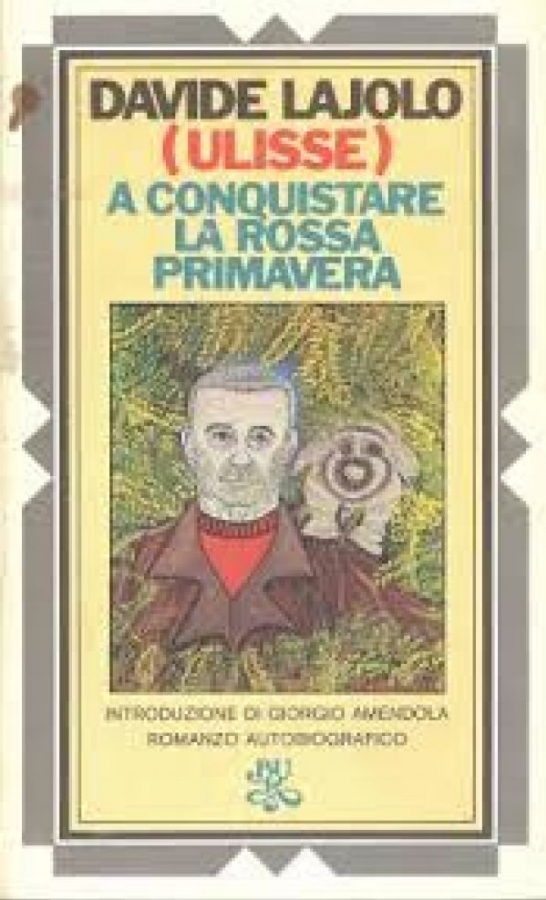
Finished reading on: October 14, 2013
To conquer the red spring
Title of the original version reviewed: «A conquistare la rossa primavera»
AI Translation Notice: This review was translated from the original Italian using artificial intelligence. Book quotes and excerpts are translated interpretations and will not match the author's original English phrasing or official published translations.
Written in the days immediately following April 25, 1945, this book is an autobiographical novel, a recollection of
things experienced, and still alive within, before time has calmed the turmoil of emotions
( Giorgio Amendola, introductory note to the 1975 edition).
Lajolo, nom de guerre Ulisse, took part—out of genuine conviction—in all the Fascist wars.
July 25, 1943, the day of Mussolini's resignation, catches him stunned.
It is the end...
people shout with joy...
a cold sweat is on my brow, the regulation shirt chokes my throat like a noose....
now begin the long days of sadness
.
What is to be done? On the one hand, his personal history impels him to commit to the Salò Republic; on the other, he feels inside
something irreconcilable (that) told me not to accept.
I did not yet quite know how to discern what it was....
but I understood, however vaguely, that in that place I would be on the wrong path, I would do no good for the country...
(and) I would walk out into the countryside.
The crusted, parched earth seemed to have retreated into itself, jealous and fearful of being laid bare
.
For a man of action like Lajolo, spiritual torment cannot last long, nor is it resolved through meditation.
It will be the youths of his village (Vinchio d’Asti) and his homeland (the Langhe) that guide his choice of path.
Those boys of mine, who in the dark had all risen at the call, ready to lay down their lives, had told me that this was the true patriotic spirit...
(they are) the very same boys who had set off so many times to wage war
.
My land! I could not betray it, for I felt it deep within my flesh.
My land, with its villages and low, multicoloured houses, with weathered and gleaming roofs, and farmsteads whose vegetable patches are enclosed by slender cane thickets...
perhaps never so much as in these times had I known my land so intimately
.
And it is precisely this solidarity among combatants, punctuated by a meticulous roster of partisan comrades' names, along with the imagery of the “dear Asti land,” that constitute the novel’s distinctive virtues.
The author cannot dwell on them for long, as the action unfolds in a crescendo of intensity and drama leading up to the terrible winter of 1944–45.
In those months, the Nazi-Fascists mount their fiercest effort to crush the partisan forces, who had succeeded in establishing what came to be known as the Republic of Monferrato in the areas surrounding Asti.
It is a manhunt, partisan by partisan, which also unleashes brutal reprisals against the civilian population.
Lajolo, by then one of the leaders of the Resistance, hides with a few comrades in burrows and farmhouses concealed in the scrub.
The narrative calls to mind the pages of Partigiano Johnny, likewise set in the Langhe during the same period.
Yet Lajolo’s account is cool, spare, meticulous, and for that very reason moving and compelling.
Fraternity with his comrades always prevails in Lajolo—a bond steeped in admiration, affection, and understanding, even toward those who, at a certain point, take flight
At times rhetoric surfaces, only to be decisively driven back by a dry style, almost akin to a military report.
Lajolo, moreover, is acutely aware that he is fighting a civil war.
Such are the mournful thoughts that the cruelty of civil war unlocks in the heart, when you are forced to wage war among your own homes
.
And then harrowing questions arise.
Why, I ask myself, have they learned to suffer, why after so many years of war did they feel the need to fight once more?
During the partisan war, Lajolo becomes a communist.
Fortunately for us, the author devotes little space to political debate, just as he rarely dwells on his ideological maturation.
When he does, the narrative swiftly slides into platitudes, read and heard countless times before.
To us, disillusioned and pessimistic, what strikes is the immense hope animating the protagonists’ ideal world.
The certainty with which they envision the future gives pause: a profound transformation in culture, ethics, and social structure.
What are we to make of this steadfast assertion:
no one will daze us with words ever again.
We have learned to judge by facts, dispassionately, sifting everyone and everything through the sieve of our conscience
.
Why read it? A recollection of the Resistance written “in the heat of the moment,” devoid of rhetoric.