Javier
Books by this author (2)
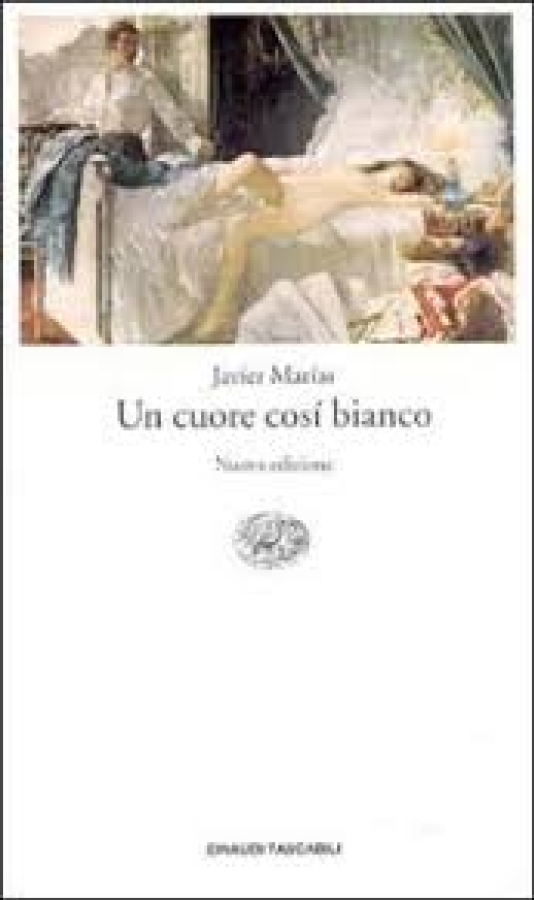
A Heart So White
The novel opens with a mystery (the suicide of the presumed first wife of the father of Juan, the protagonist and first-person narrator) and closes with the resolution of the enigma, which I shall not disclose so as not to deprive the reader of the surprise. Between these two poles of the narrative, the secret unfolds slowly, for deep down it is always known, or suspected: like Lady Macbeth in Shakespeare’s tragedy, Juan would like to remain innocent, not to know, even though he is ashamed of having “a heart so white.” Indeed, the episodes resurfacing in the protagonist’s mind seem to prophesy the unraveling of the mystery. It is a succession of events, real or imagined; an increasingly tangled sequence as it churns within the consciousness: during the honeymoon in Cuba, the mulatto woman glimpsed through the hotel window (while the young bride lies ill in bed) mistakes him for the lover who never arrives and screams at him > I'll kill you ; the grandmother recounting to Juan, while still a child, the legend of a snake said to swallow young brides; the long account of his friend Berta, who seeks casual encounters and forces him to watch videotapes of a certain Bill, who does not reveal his face and makes obscene requests, readily accepted because > the ideal condition is that of waiting and ignorance ; even the girl at the stationery shop who captivated the adolescent Juan, because it made him > happy to contemplate the abstract future, everything was postponed, she was there afternoon after afternoon, always locatable, and there was no reason to materialize the future and make it cease being the future. Were the theme that of how we refuse to acknowledge the “truth,” the novel would oscillate between Teju Cole’s refined *Open City*, in which the protagonist analyzes his own life while failing to remember an ignoble episode from his youth because he does not want to know, and Salvatore Satta’s fascinating narrative, *The Day of Judgment*, where the only hope is “to create ghosts for oneself, to cling to” (see the reviews on this site). In reality, there is more. In one of the most intriguing chapters, Juan, in his work as an interpreter, must translate the conversation between two statesmen: one Spanish, the other British. Weary of the dialogue's laborious progress, he decides to invent what the two are saying to each other, leading them to speak of their feelings, even their most intimate ones. > Telling deforms, telling facts deforms facts and alters and almost negates them, everything that is told becomes unreal and approximate, albeit truthful. (...) The only truth is that which is unknown and untransmitted, concealed and uncontrolled; perhaps that is why people tell so much and tell everything, so that nothing ever actually happened, once it has been told. And so, when at the end of the novel Juan sees and overhears the conversation that reveals the secret—and does so only through the crack of a door—the revelation drives him to recount, desperately hiding the truth in a din of words and images, so that the mystery may be “as pictures and nothing more,” as Shakespeare puts it. In the novel's appendix, Marías emphasizes that only literature and the arts can narrate the vast shadowland of our existence. Yet, while in *Tomorrow in the Battle Think on Me* this approach had cast a kind of spell within which the characters moved along a structured plot, here Marías has surrendered to a muddled stream of memories, to the allure of perpetual return, to the passage of time in which not even words offer so much as a tenuous anchor (see the reviews of the aforementioned book and of *The Man of Feeling* on this site). Quoting Ungaretti, one might say that the mystery within us is unspeakable, but it is literature's task to give order to its expression, lest we lose ourselves in a multitude of vowels and consonants, of syllables and elegant syntactic structures. Why read it? It is prolix, but interesting.
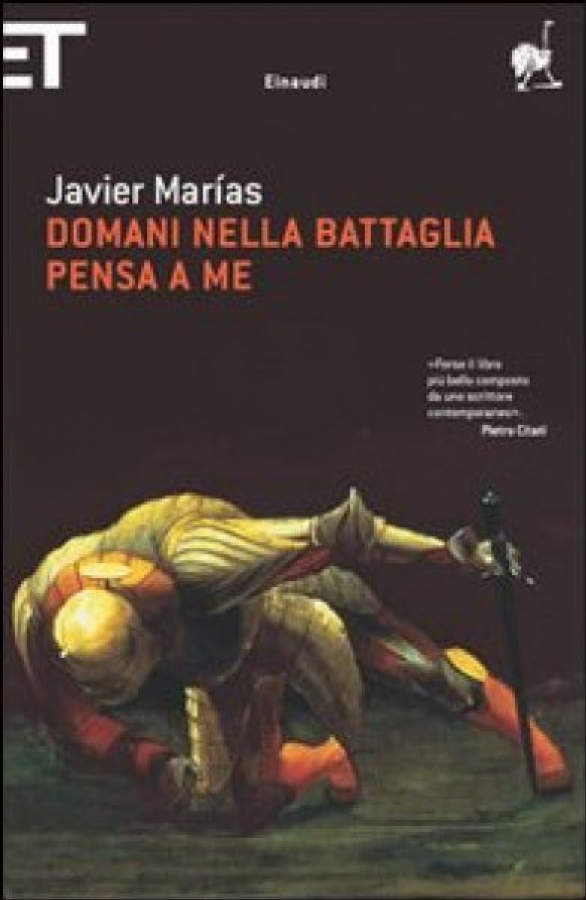
Tomorrow in the battle think on me
The novel recounts the peculiar story of Victor, a ghostwriter who is invited over one evening by a married woman, Marta; however, on the verge of making love, Marta dies, and Victor, frightened and uncertain, leaves the house without alerting anyone. Seized by remorse and curiosity, he manages to make contact with Marta’s family: her father, a Madrilenian gentleman; her sister, with whom he hopes to begin an affair; and her husband, a businessman who was in London at the time Victor was invited by Marta. In the end, Victor confesses that he was the man in Marta’s house, and the husband, in turn, confesses that he was in London with his mistress, who had told him she was expecting a child and wished to have an abortion in the English city. In reality, this was untrue, and the man, in a moment of madness, attempted to kill her; the woman fled and was fatally struck by a taxi. Alongside this main storyline, two parallel plots unfold. Someone has told Victor that Celia, his ex-wife, works as a prostitute. One evening, Victor believes he recognizes his wife in a prostitute named Victoria, whom he picks up in his car in order to determine whether she is indeed his wife or simply another person who resembles her. The difficulty of distinguishing between truth and falsehood, between fiction and reality, recurs in his encounter with a powerful man, the Only One, who has summoned him to ghostwrite a speech. In fact, Victor introduces himself under a friend’s name (another fiction that turns into reality); furthermore, during their conversation, the Only One reveals his despair at being unable to voice the doubts and uncertainties that lie at the foundation of his actions. In his commentary on the book, the author identifies its fundamental theme as deception—not deliberate deception (the outcome of a rational plot or societal hypocrisy), but that which arises from time and memory. > The most complete of biographies is made of nothing but irregular fragments and faded scraps, even one’s own biography. We believe we can recount our lives in a more or less reasoned and precise manner, and when we begin, we realize that they are crowded with shadowy zones, with unexplained and perhaps inexplicable episodes... Deception and its discovery show us that the past, too, is unstable and precarious, that not even what seems fixed and established within it is so once and for all... . Is deception truly the book's leitmotif? I do not believe it exhausts the substance of this novel, in which the characters move through a kind of enchantment, an unreal dimension born of two fundamental forces: time and memory. > What weighs on us, says Marta’s husband, the terrible thing is that the time during which we believe what was not becomes something strange, fluctuating and fictitious, a kind of enchantment or dream that must be suppressed by our memory; suddenly, it is as if we had not lived through that period at all . And again > the dead woman who haunts and spies on and visits him is another, his own dead woman who dwells in his thoughts as mine resides in mine, like an incessant throb in waking or in sleep, his wretched wife and his wretched mistress mingled and lodged together in our heads for lack of more comfortable lodgings, struggling against dissolution and seeking to become incarnate in the only thing left to them to retain their vigor and presence, the infinite repetition and reverberation of what they once did or what took place one day: infinite, yet each time more tired and faint . The protagonists of this novel are swept away by events that appear paradoxical and unpredictable, governed by a rhythm that dissolves the distinction between past, present, and future. Yet an event, the moment it has passed, in turn disperses, and one desperately longs to turn back, wishing that things had never happened or had taken another course. Yet do we truly live, are we truly ourselves, or do we inhabit a continuous fiction, since reality cannot encompass our imagination? In this context, only death seems to be a real fact, yet death is the beginning of a gradual loss of memory. It is an important book, propelled by an irresistible narrative pace, "a literary rap," which demands that one immerse oneself fully in the reading to keep up with its stride.