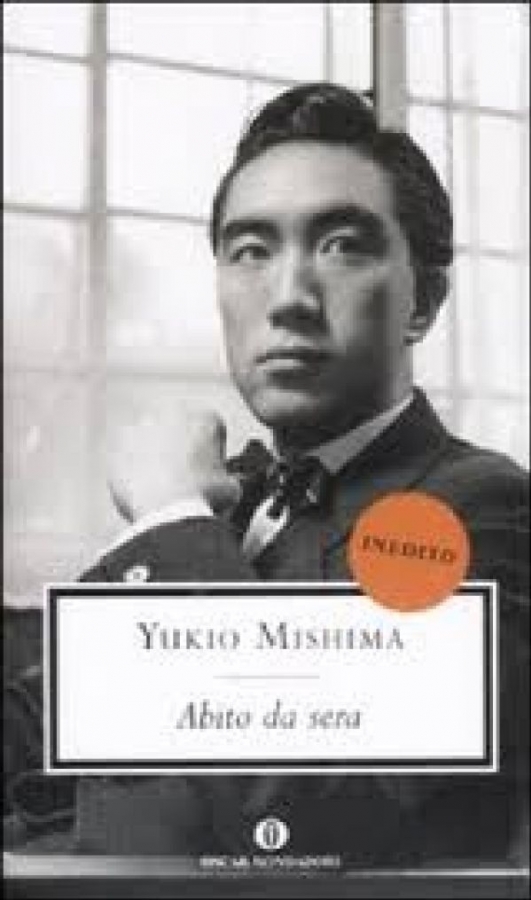
Evening dress
The novel is set in 1960s Japan, when the upper and middle bourgeoisie is becoming Americanized, flirting with Western customs, eager to forge international ties. Ayako is the daughter of a minor yet rising pharmaceutical entrepreneur: she has “amiable” features. > Over those features, even with fashionable makeup, hovered harmony and freshness, and her face, by no means plump, gave the impression that something inner was rising to the surface Ha un carattere pacato, composto e razionale, > but Ayako was by no means obtuse; it was merely that she lacked an inclination toward momentary enthusiasms and toward exaggerating passions . The young woman frequents a fashionable riding club, where she meets Lady Takigawa, the widow of a high-ranking Japanese bureaucrat. Through a stratagem, the woman introduces her to her son, Toshio, whom she herself describes as > egocentric, selfish, stubborn, caustic—in short, a young lion . And yet Toshio has an entirely different self-image: a kind of robot, rigid and somehow other-directed by his mother. An arranged marriage is brokered, readily accepted by the two young people, partly because they are fond of each other and partly out of obedience to their parents’ wishes. The honeymoon strengthens their bond, which evolves from mere mutual liking into passion, genuine love. It would thus seem a lovely fairy tale, upon which Lady Takigawa intrudes, insinuating an alleged betrayal by Toshio—an insinuation that devastates Ayako. Yet who is Lady Takigawa? She is what used to be called a “merry” widow: wealthy and powerful, she has an immense love for high society, receptions, and social networking. Behind a tender, affectionate face hides an “innocent malice, (...) an unpleasant woman,” a split personality. One evening, the young couple is invited to a reception by Lady Takigawa. Yet right at the threshold, Toshio discovers the unbelievable lie and decides to rebel, refusing to go to his mother’s; Ayako tries to object, but then obeys her husband and follows him to eat at a modest diner. It is a scandal; offended, humiliated, and filled with rage, Lady Takigawa demands that they divorce, accusing her daughter-in-law of showing her a lack of respect. How is the matter resolved? Certainly not by telling the scheming mother-in-law where to go, nor by shrugging one’s shoulders and going about one’s business. We are in a world of conventions as well as interests; Lady Takigawa is wealthy and powerful. Toshio visits a princess of the Imperial Court, asking whether she might be accompanied by his mother on a trip abroad. > In that sort of conversation, Toshio was on his home turf, playing a game the youth of today could never imitate The princess knows full well the reasons for the visit, but > her countenance remained imperturbable, tinged with a tender understanding, enchanting as a dawn sky, then in a clear and decisive tone , she accedes to the young man’s request, on one condition alone: the two youths must show toward Lady Takigawa > a sincere tenderness, (...) asking forgiveness with grace, even should his mother deem it unacceptable . In short, conventions must always be respected, even if deception has been used to circumvent them. The narrative lends itself to multiple interpretations. What is clear is that the two young people undergo a transformation: though both belonging to a social class dominated by form, before marriage they were frank, sincere youths; to survive, they too become mere “semblances,” altered by anxiety and fear. > Perhaps marriage was a school where one is taught the lie of life , for one must > foresee the reactions of the outside world from every angle, as if the doors on all sides of a room, previously hermetically sealed, had been thrown wide open . On the other hand, there is no alternative for poor Ayako, > she could have become a little bird flying away, entrusting its shadow to that plain, but there was an emptiness there and it frightened her, not even a tree branch on which to rest her wings . The story is elegant and subtle, yet superficial: many windows open onto the protagonists that one would like to see explored in greater depth, but they remain mere glimpses; the author hurries off at once toward something else. Absorbed by his critique of Japanese society and its frantic Americanization, the author neglects those parts of the novel that most captivate the reader: how social conventions erode authenticity and the carefree joy of living. Why read it? It is read with great pleasure, for its narrative style and because one grows immediately fond of Ayako.

Accabadora
Maria is a *fillus de anima*, > that is what they call children born twice, of the poverty of one woman (who gives them away) and the barrenness of another (who welcomes and raises them). In our case, Maria has been “adopted” by Tzia Bonaria, an elderly widow. The novel’s first part, the most accomplished, recounts Maria’s childhood and adolescence, and in particular her gradual acquaintance with her adoptive mother—a woman always dressed in black, austere, reserved, who ostensibly earns her living as a seamstress. Tzia Bonaria provides the child with relative comfort, ensures her education, and above all constructs a fragile normality around Maria, behaving “as though the child had been born of her own womb.” For Maria, this filial bond and the acceptance of belonging to two families is a gradual conquest, one that accustoms her to being the focus of public attention, to accepting anomalous situations, and to shaping her own life independently. Her ability to confront the unspeakability of the world and of human nature collides, however, with a jarring and unsettling discovery. Tzia Bonaria is an *accadabora*—that is, a woman who grants a sweet death (euthanasia) to those who ask for it. In a dramatic confrontation, Maria, “with the tearless sob of a strangled beast,” demands that the elderly widow explain “this necessary thing,” the dispensing of a sweet death. And Tzia Bonaria’s justification is startling, lying far beyond Maria’s comprehension. > I learned on my own, says Tzia Bonaria, that children need both the slap and the caress, the breast, and the feast-day wine, and whatever they need, whenever they need it. I had my part to play, too, and I played it.... I was the last mother some ever saw.... When the time comes, Maria, you will discover things about yourself that you do not yet know . The young woman cannot bear the thought of living with a woman who dispenses death and flees far from Sardinia, finding employment with a family in Turin. This marks the second part of the novel, an interlude that also serves as a turning point—albeit a rather obscure one—in the narrative arc. One of the boys entrusted to her care as a governess is a taciturn, hostile, domineering adolescent; yet Maria’s habit of reckoning with the indescribable allows her to unlock the young man’s inner life and uncover a dreadful secret: the boy suffered sexual abuse in his childhood. Sharing so horrific a truth leads to love, for the bond between individuals is never stronger than when it rests upon the profoundest mysteries of the human soul. In the third part of the novel, Maria returns to Sardinia to attend to Tzia Bonaria in her slow agony. The narrative moves gradually, yet also sluggishly, toward the epilogue, without, however, delivering the resolution one ought to expect. Why does Tzia Bonaria die a moment before Maria is about to perform the euthanasia? Is a sweet death a threshold we cannot cross? Something we ultimately cannot accept? In addressing so complex a theme, there was a risk of drifting into redundant prose, fraught with parenthetical digressions and overwrought passages. The author, instead, has navigated the subject with a light, restrained, at times ironic style, relying on vivid character sketches and vignettes typical of rural Sardinian life. The novel’s first part is undoubtedly the finest, both in its prose and its dramatic structure. The storytelling builds in intensity as it approaches the final scene: the clarifying confrontation between Maria and Tzia Bonaria. In the subsequent parts, the narration becomes bloated, forfeiting that spareness and levity that had characterized the preceding pages. The narrative thread itself splinters and dissolves, depriving the reader of a clear sightline toward the conclusion, which disappoints all the more for this very reason. Why read it? The subject is compelling, the prose engaging.

The Adventures of Tom Sawyer
Tom Sawyer is a young boy who lives with his aunt in a small rural town on the banks of the Mississippi. Mark Twain introduces him in this way: > he got back home barely in season to help Jim, the small colored boy, saw next-day's wood and split the kindlings before supper—at least he was there in time to tell his adventures to Jim while Jim did three-fourths of the work. (...) If he had been a great and wise philosopher, like the writer of this book, he would now have comprehended that Work consists of whatever a body is obliged to do, and that Play consists of whatever a body is not obliged to do. Tom is not clear on this distinction and takes a carefree, unencumbered life as serious business, swinging from melancholia—which prompts him to wish he could die temporarily, just to make himself missed—to a fantasy world in which he dreams of being a pirate or an outlaw. And so, with his faithful friends, especially the vagrant Huckleberry Finn, known as Huck, he embarks on a series of exploits, from the pirate life on an island in the middle of the river to wandering through the graveyard at night, witnessing a murder, all the way to setting off in search of treasures surely hidden by bands of robbers. This dizzying flurry of activity does not prevent Tom from courting Becky, a girl from a respectable family, who also finds herself drawn into Tom's reckless escapades. There is no point in recounting the plot, at times convoluted and commonplace yet never dull: it is far more interesting to dwell on two peculiarities of the novel. The first is the rural setting; with gentle and affectionate irony, Mark Twain depicts the school, dominated by the schoolmaster's authoritarianism; the church gatherings with the preacher's tedious and moralizing sermons; and the hilarious ritual of Examination Day, when the best pupils present an essay of their own before the entire community. One can smile, as Mark Twain does, at the ornate English, laden with words that most people likely do not understand, at the puritanical and sanctimonious values, at education imposed by sheer force; nevertheless, a strong communal spirit emerges, seeming to transcend even class divisions. It is a white society, placid in its values, with a single, clear boundary: discrimination against Black people, who remain in the background even as they sustain the small town's agricultural economy; one can sympathize with the vagrant Huck, but not with the servant Jim. The other compelling aspect lies in Tom's powers of fabulation. Unlike the protagonists of other coming-of-age novels, Gian Burrasca or Jim from *Treasure Island* (see the reviews of *Il giornalino di Gian Burrasca* and *Treasure Island* on this site), what surprises is Tom's dialectic: how he manages his aunt, capitalizing on her naive affection; how he cajoles his friends, talking them into adventures and overcoming their reluctance; how he persuades Becky to follow him into dangerous and intimate situations, paradoxical for such a prudish society. And when Mark Twain remarks that he can stop at writing the story of a Boy, because > the story could not go much further without becoming the history of a Man. (...) When one writes of juveniles, he must stop where he best can , he perhaps means that Tom's innocent cunning would turn into a guilty capacity for deceit, as so often happens among adults. In Twain's imaginative world, it is better to keep playing with the petty subterfuges of adolescence. Beyond the character and the plot, the literary merit of *Tom Sawyer* resides in its writing—attentive to detail, magically realist, subtly ironic. Take as an example this passage, which describes Tom's awakening on the island of the imaginary pirates: > when Tom awoke at dawn, he wondered where he was. (...) Now, far off in the trees a bird called; another answered; now the distant strokes of a woodchopper were heard. (...) A little green worm came crawling over a soft leaf, lifting two-thirds of its body into the air from time to time and “sniffing around,” (...) then proceeding again, (...) and when the worm approached him, of its own accord, he sat still as a stone, (...) then (...) when it began a journey across him, his heart was all glad. (...) Now a procession of ants appeared from who knows where. (...) A brown-spotted ladybug climbed the dizzying height of a blade of grass (...) and Tom bent down close and said, > Ladybug, ladybug, fly away home, your house is on fire, your children are alone. These are wonders of a world inhabited at night by spirits, and Nature still seems endowed with a soul. And what of the description of the school, punctuated by that repetitive “showing off” (in Italian, *ostentare* or *vantarsi*)? All the teachers “put on airs”
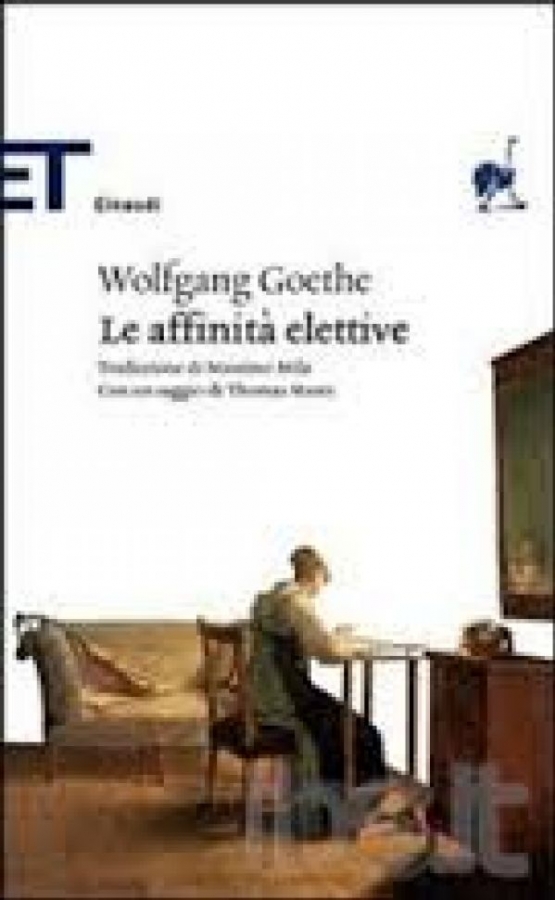
Elective Affinities
In early nineteenth-century Germany, Eduard and Charlotte are two wealthy landowners. Though they loved each other in their youth, they married late in life, after both had been widowed. They possess differing temperaments that seem to complement each other perfectly: Eduard is “in the prime of manhood,” impetuous, generous, but superficial and at times reckless; Charlotte is reflective, patient, and prudent in managing both household and estate. Life flows serenely, as they enjoy “undisturbed the happiness finally attained,” until two guests arrive. The Captain, a friend of Eduard’s, is a poised man of vast experience who places his skills as a planner, engineer, and organizer at their disposal. He cannot help but find himself in tune with Charlotte. Ottilie, Charlotte’s niece, is a graceful, sensitive, introverted, and seemingly quiet young woman. The boyish quality within Eduard cannot fail to resonate with Ottilie’s youth. And very soon > the secret attraction and the power of imagination asserted their rights over reality , with such overwhelming force that in the dark, during the couple’s most intimate moments, > it was none other than Ottilie whom Eduard held in his arms; the phantom of the Captain hovered near or far before Charlotte’s soul, and thus they entwined, the absent and the present, in an exquisite mingling of voluptuous excitement . Seizing the opportunity of the Captain’s departure, Charlotte wisely proposes sending Ottilie to a boarding school, but Eduard abruptly leaves the estate, seemingly relinquishing the happiness of loving the young woman. The two women remain together in an apparent calm, yet without returning to “a full and open harmony.” The marital crisis might be resolved, with a new bond, by the birth of a child, who nevertheless has Ottilie’s eyes and the Captain’s features. It is the physical proof of adultery, having indeed been conceived on that very night when, making love, the spouses were thinking of their respective beloveds. Affection and care for the child bring Charlotte and Ottilie back together: > everything seems to follow its usual course, as happens even in the most extraordinary circumstances, when everything is at stake, yet one still continues to live as if nothing were amiss . New characters enter the scene, such as a talented young architect who lavishes attention on Ottilie. Daily life is disrupted by Charlotte’s lively daughter—cheerful, tumultuous, even excessively so. The two women complete the projects already initiated by the Captain: the rearrangement of the vast park, the merging of several ponds into a lake, the construction of a new dwelling on a magnificent scenic viewpoint, and the restoration of the parish church. The pursuit of perfection pervades the characters’ actions, even driving them to recreate famous paintings through *tableaux vivants*, in which Ottilie commands admiration. Charlotte, out of affection for Ottilie or a secret desire to reunite with the Captain, would be willing to accept divorce and Eduard’s union with Ottilie. Yet it is the girl who refuses, making an entirely spiritual choice, though only seemingly resolute. In this part of the novel, the external narrator is joined by the young woman’s diary: brief entries alternating moral maxims and romantic reflections with the manifestation of the profound yearning of a youthful heart in love. And it is Eduard’s reckless impetuosity that precipitates such a fragile situation. He surprises Ottilie by the lakeside on an autumn evening; the two lovers embrace and > for the first time they kissed openly, freely, and parted with painful effort . The girl remains “troubled and agitated.” To return to the manor, she commits the imprudence of using the boat, despite having the child with her. Through a series of accidental circumstances, the child falls into the water and drowns. At this point, the narrative reaches its inexorable denouement. Ottilie, despite an outward serenity and expressions of diligent expiation, starves herself to death. Goethe, who was by no means religious, closes the novel with a sort of sanctification of the girl, likely indicating her spiritualization—Ottilie’s death as moral elevation. Thomas Mann defined the novel as > the clearest fusion of Eros and Logos, of sensuality and morality, of immediacy and reflection... a German work of the highest moral culture . Ottilie’s death by starvation would express > the obedience rendered to the law of the spirit, paying its tribute, with virile tragedy, to the ethical norm . *Elective Affinities* would thus be “a spiritual construction,” a philosophical text in the form of a novel, a sort of manifesto of Germany’s “moralizing mission,” its “imperious instinct.” Perhaps Merkel had read *Elective Affinities* all too closely when demanding that we Italians do our homework: she personifies Germany’s didactic intent toward the pleasure-seeking Mediterranean peoples. Without detracting in the least from the great writer, Mann’s interpretation freezes the book in the past, as a testament to the history of German thought, overshadowing what still makes it so modern: “the story of the magical attraction” between kindred souls that shatters friendship, mutual esteem, the most sacred institutions—such as marriage—and the orderly, elegant world we desperately strive to build. And Ottilie, taking everything too seriously, falls victim to the superficiality and selfishness of some, like Eduard, and the tedious wisdom of others, like Charlotte, who, often through excessive self-assurance, fail to grasp in time the tragedy of fragile, sensitive souls like Ottilie. Alongside the characters, another protagonist is the landscape. Within it, and in the continuous attempt to reshape it according to human design, the contradiction between present and past is expressed. The present seeks to confer upon everything a more harmonious and rational order; the past returns to us the spontaneity of nature, which also serves as a vessel for transmitting memories. By bestowing a new and more fitting arrangement upon the cemetery, Charlotte unwittingly offends the reverence felt for the departed, as relatives were accustomed to visiting them buried in different spots, however haphazardly scattered across the churchyard. It is as though the notion of time were lost, and with it memory, so inextricably bound to familiar places and their traditional disorder. The novel’s limitation lies in its frequent philosophical and moral dissertations. Particularly in the second half of the narrative, after Eduard has abandoned the house, these digressions weigh down and fragment the reading, breaking up the overall unity and marring both the narrative pace and the psychological depth of the characters. Even Goethe failed to construct the perfect work. Why read it? The story and the characters remain remarkably modern, if one allows oneself to be captivated by the plot.
Aniko
The Nenets are a people of just over 40,000 individuals, settled in the northeastern part of the Ural region: their economy is fundamentally based on reindeer herding. Like many young Nenets, Aniko left to study far from her homeland: first at a boarding school in the nearest town, then further away still, to study geology at the university. She assimilated Russian language and culture to the point of forgetting her origins. She must return to her aging father because news has reached her of the death of her mother and little sister, killed by a wolf dubbed Lame Devil. The return is marked first by revulsion ( > when her father was now close to her: she involuntarily took a step back: he gave off a stench of alcohol, smoke, and filth ), then she slowly reclaims the language and customs, and finally the remembrance of her lost childhood returns: «Evening had fallen; together with her mother, she had lit a fire near the» chum > . She played with her rag dolls that had bird beaks instead of faces. Mother was busy sewing a new jaguska for one of the dolls. For an instant Aniko thought she truly saw her mother's concentrated face again. But once that instant had passed, however hard she tried, she could no longer redraw her features in her memories. They had vanished, perhaps forever . She is confused; until then, «she had done nothing but try to live». Must she accept the reproach-laden invitation of Aleska, her childhood friend, to stay in order to improve the conditions of the Nenets? Or should she let herself be submerged by the spell of the tundra and of an ancestral, motionless, and seemingly harmonious society? It is this that attracts Pavel, a young non-Nenets geologist, prompting him to want to stay, to abandon «the usual ordinary thoughts» and «suddenly discover oneself to be more mature, sincere, and good!» We do not know what Aniko will do; she leaves the tundra, but will she return one day? What will become of her? Aniko is a slight character, and her story is too tenuous to convey the contradictory feelings of a young woman poised between affection for her father—alone now, yet sheltered by the village—and the desire to be part of a society rich in cultural and professional stimuli. Abstracted from the specific setting, and were we to substitute Russian with English, Aniko’s state of waiting and nostalgia is the condition of many young people today. Yet this was not the writer’s purpose: deeply bound to her land, the author leads us into a world of serene concord where men, dogs, reindeer, and even wolves live «in a stillness of inexhaustible joy», as Ungaretti put it when speaking of his birthplace, Alexandria, Egypt. Think of the reindeer Temujko, who was suckled by Aniko’s mother and continually returns to her mistress’s grave; of the dog Buro, the old father’s faithful friend; and of how the father accepts with sorrowful resignation his daughter's abandonment, perhaps definitive. And what of Lame Devil? The description of the wolf, of his loneliness and bitterness, opens the entire tale and leaves its mark on some of the novel's finest pages. Nenets society seems perfect in its centuries-old harmony, but it is not so. As Pavel says to Aniko, > the nenets are confused. Outwardly they appear calm. imperturbable as ever, but I know they are uneasy. They wonder what their future will be like, where their children will end up. (...) And if we don't help them now... And what if the entire story were a fable—and, like any fable, fit for all latitudes—as well as a metaphor for our wretched Italy, a summons to free ourselves from passivity? The writing is melodious and fluid, like the story itself: sweet and graceful, evocative and naturalistic at once when describing the tundra and its inhabitants; concise and effective in dialogue, in the timeless conversation among the Nenets, yet contracted whenever Aniko speaks, as if mirroring the agony of the life choices she must confront, despite herself. The plot is weak in its narrative pacing (it seems as though nothing happens), but the prose is splendid, with assonances resonating from other languages. Why read it? Sweet and graceful.

Dead Souls
> Blessed is the writer who, leaving aside characters that are tedious, repulsive, striking in their sorrowful reality, approaches characters that reveal the highest qualities of man..... > Sublime, universal poet they proclaim him.... > far different is the fate of the writer who dares evoke into the light all that is forever before our eyes, yet which indifferent eyes do not perceive: the entire tremendous, galling sediment of petty things that entangle our lives, all the depth of the cold, fragmentary, everyday characters with which our earthly journey teems, at times bitter and tedious .Gogol develops a caustic yet buoyant analysis of the society of his time, with an inspiration that makes him unique among the great nineteenth-century realist writers, such as Zola, Flaubert, and Verga. Gogol’s stroke of genius lies in bringing to light the squalor and vacuity of his contemporaries by confronting them with an implausible premise. The protagonist of the novel, the prosaic Chichikov ( > neither too young nor too old, neither too stout nor too slender, neither too elevated nor too humble ) travels through the vast Russian provinces proposing to purchase dead serfs (hence the title of the novel), on whom the landowners continue to pay a tax. And what is paradoxical is that not only do the landowners accept the transaction, but institutions and polite society itself fail to perceive the absurdity and immorality of this commerce. Far different are the obstacles the protagonist must encounter along his way! His visits to the landowners force him to endure the idiosyncrasies, at times eccentric but often irksome, of diverse dispositions and lifestyles: the vain, vacuous landlord; the sanctimonious yet covetous old spinster; the wheeling-and-dealing proprietor; the drunkard prone even to violence. It is a panoramic procession of characters and settings that enables the author to sketch, with a few deft strokes, the petty yet profligate life of the Russian petty and middle landowning class. While the characters are delineated with irony and verve, the depiction of the villages is sociological, even if Gogol is entirely devoid of any indignation regarding the condition of the peasantry. When scandal subsequently erupts in the small provincial town where Chichikov is staying, our protagonist is overwhelmed by gossip, conjectures, and false accusations that have nothing to do with the swindle he is perpetrating, yet which compel him to flee. Yet like all Russians, Chichikov too loves the speed of the carriage bearing him swiftly along the road, surrendering to a sense of exhilaration and abandon. > It is as though an unknown power swept you up on its wing, and you fly, and everything flies... Is it not thus that you too, Russia, like a spirited, uncatchable troika, fly away? With Chichikov’s departure concludes the first part of the book, the only one completed and approved by the author. The overall design of the work envisioned two further parts, of which the second has reached us incomplete, while the third was destroyed by Gogol himself. Reading the second part reveals clearly how the fundamental theme of the entire work was meant to be the journey: a kind of aimless reportage, devoid of moral designs, with no other interest than that of capturing, in its immediacy, the very flow of life. And Gogol remarks, with a Pirandellian inflection, > the reader must not be exasperated with the author if the characters who have appeared so far have not met with his favor: the fault lies with Chichikov; here he is the absolute master, and wherever it pleases him, we too must drag ourselves . Gogol’s ability to portray the characters and bourgeois milieux of Russian society constitutes the primary virtue of the novel. From a reading of it, however, there emerges a sense of superficiality and incompleteness, as though the writing still demanded refinement and further depth. Why read it? It is a timely novel (especially for Italy), in that it recounts the ease with which a vacuous and superficial society accepts any circumstance, however implausible and improbable.
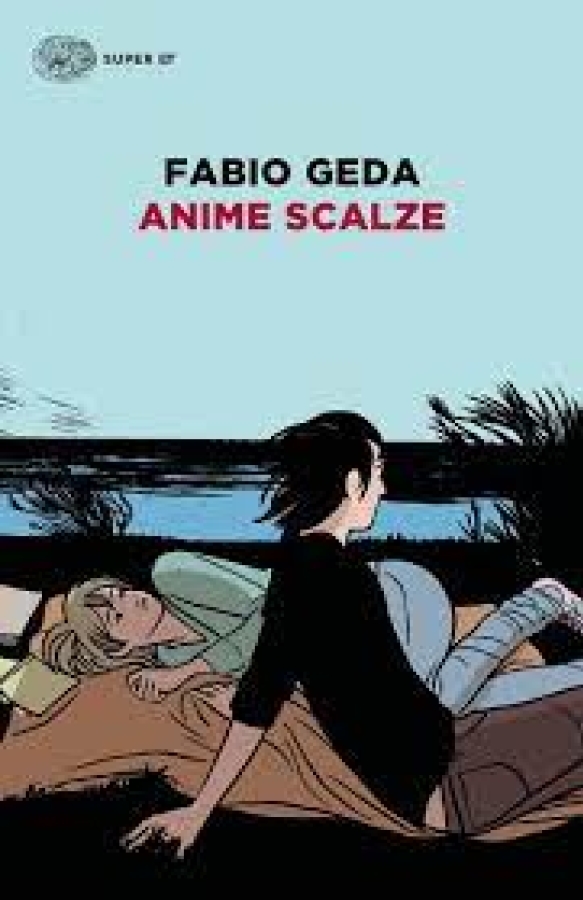
Barefoot Souls
The story opens with Ercole and his little brother Luca on the roof of a shopping mall, with the police yelling at them to come down. From the narrative, we learn that Ercole is fifteen years old, living with his older sister Asia and an absent father who takes whatever work comes his way and frequently gets into trouble. Ercole knows full well that Asia «was strong, yes, brave, but not indestructible. Tied to me, but not with me». When his sister informs him that she is moving in with her boyfriend, Ercole realizes that «mothers contain. Everything. Brothers and sisters accompany». On an old bicycle, he sets off to find his mother in a small mountain village. He gets a flat tire, has to hitch a ride, must ask for money for a train ticket, and when he arrives at the village where his mother lives, finds it difficult to locate her home because she lives in an isolated house. Stubborn and brave, Ercole faces every obstacle and overcomes his fears, yet cannot vanquish the monsters within. He cannot bring himself to ask his mother the questions he longs to ask. > Why did you leave, exactly? (...) Why don’t you ask me if I missed you? (...) That’s just how things are, Ercole. And there’s nothing you can do about it Asia used to say. Then comes a turning point. > Hanging from a spike on the outer wall was an American football helmet, yellow, with the number ten in red . It belongs to Luca, his six-year-old brother. > Life is a billiard ball; every collision makes it change direction; and if you are strong and lucky enough, you can go anywhere . Now Ercole has someone to care for, to protect, even from the world of adults. And when, at Luca's birthday, the boy's father's friends try to get the little child drunk without the mother defending him, it is Ercole who steps in and whisks his little brother to safety. Boldly conquering his fear, he gets behind the wheel of a car. The police surprise him. > Would they have believed me if I had explained what had happened, that I was doing it for Luca? Would they have believed me or the adults? (...) And if they had believed me, where would they have sent Luca? Into whose custody would they have placed him? (...) I heard Obi-Wan's voice whispering to me: use the Force, Luke. Follow your instincts. I heard the cracks crumble and the monsters emerge from the walls. I shifted into first gear. I slammed the gas pedal to the floor. And I fled. If in nineteenth-century novels the adolescent becomes an adult by braving increasingly perilous trials, thereby winning their autonomy from grownups, today the youth always remains somehow tethered to the help of adults. Consider the contrast between Stevenson's *Treasure Island*, where Jim faces perils alone—from the tempest to the pirate Silver—and the story of Harry Potter, who overcomes evil thanks to the salvific role of the arch-wizard Dumbledore (see the reviews on this site: *Treasure Island* and *Harry Potter & the Philosopher's Stone*). In *Anime scalze*, magic happily does not come into play; yet fifteen-year-old Ercole manages not to slide «from confusion to despair» because he finds solid footholds in his older sister Asia and his girlfriend Viola, his peer and yet so steadfast and determined. Woven into the primary narrative thread—that of the *Bildungsroman*—are other ingredients: the fragility and emotional distance of adults, bottling up feelings and refusing to seek help, abandonment, love as a lifeline; too many overlapping themes that are never explored in depth, as though the author wished to touch upon every conceivable facet of adolescent malaise. Coupled with frequent nuggets of wisdom, this narrative dispersion often renders the tale verbose and predictable. A weakness of the narrative lies in its literary style. Unlike the novels co-authored with Marco Magnone (see the reviews on this site of *Berlin* and *Il lato oscuro della Luna*), it lacks narrative pace, the final pages aside; the prose is also frequently prosaic, stripped of context because Turin remains distant in its post-industrial desolation, while the frequent resort to clipped, terse dialogue feels like a lifeline thrown to a narrative struggling to move forward, rather than an effective device to express incommunicability. Why read it? It is a smooth read and examines youth malaise.

A Girl Returned
> My mother from the sea died on the top bunk, on one of those nights. Looking at her, she did not seem ill, perhaps just a little greyer than usual. (...) At the funeral, the other mother accompanied me. PoorAdalgisa poorAdalgisa, she repeated, wringing her hands. But then they threw her out; her nylon stockings were all laddered and she couldn't attend the service in that state. This dream haunts the nights of the Arminuta, the “girl returned”: a thirteen-year-old sent back to her family of origin, to the “mother by necessity,” after spending her childhood with an aunt, the “mother from the sea.” Raised as an only child in an orderly, quiet home, she finds herself catapulted into a large, impoverished family, with uncouth and seemingly indifferent parents, loud brothers always ready for crude jokes, a slightly backward little brother, and an invasive younger sister, already adept at housework, who still wets herself. > Toward evening the older boys came home; one greeted me with a whistle, another didn’t even notice me. They rushed into the kitchen, elbowing their way through (...). They filled their plates amid splatters of sauce; at my corner, only a spongy meatball over a bit of sauce arrived. (...) My first parents remembered after dinner that there wasn't a bed for me in the house. Tonight you'll sleep with your sister, you're both skinny anyway, the father said . What nostalgia for her former life, for the “mother from the sea,” and what shame for such an ignorant, neglectful, and destitute family! Yet what remains inexplicable to the Arminuta are the reasons why she was sent back to her parents “by necessity,” and so hastily. Could the mother from the sea be ill? What if she had died in the meantime? With a troubled soul steeped in melancholy, the Arminuta ventures into a world unknown to her: she finds support in her eldest brother (her first love?), learns to help around the house, and, through subtle signs, discovers a gruff maternal love, even if she cannot accept it. > I had felt my mother's hand move across my back and come to a firm rest on my shoulder blade. I had drawn my head between my shoulders, like a fearful dog pleased by the first caress after a long abandonment. Yet soon I pulled away with an abrupt movement and stepped back a little. I was ashamed of her, of her chapped fingers, the faded mourning clothes she wore, the ignorance that escaped her lips with every word. I never ceased to be ashamed of her language, of that dialect that turned ridiculous whenever she made an effort to speak properly . It is her sister Adriana (“she wore skimpy clothes, dirty shoes, greasy hair”) who shatters the Arminuta’s bourgeois solitude, leading her to understand the emotional wealth born of sisterhood, of a friendship that draws strength from shared habit, from being cast into the world together, from saving each other through complicity. And it could only be Adriana who bluntly tells her the truth: the Arminuta was abandoned by the mother from the sea because the latter was expecting a child and there was no longer room for her, having been wanted only because they had been unable to conceive a child of their own. At the end of the novel, the Arminuta meets the mother from the sea once more, and from that encounter comes to understand herself: > like an improbable flower, grown in a small clod of earth clinging to the rock . There is one word that encapsulates this short novel: authenticity. One is genuine if one does not view the world through forms, rules, and appearances, but seeks deep feelings; one is genuine if culture, education, books, and knowledge acquired at school do not serve as a shield, but as a means to immerse oneself more fully into real life, to seek a mutual sense of humanity beyond divisions of class, ethnicity, religion, and gender; one is genuine if one is not ashamed of one's own language, yet refuses to retreat into a parochial and folkloric dimension. This echoes the theme already explored in Elena Ferrante’s novel (*My Brilliant Friend*), though here the pursuit of an authentic life unfolds within the family, in the relationship between daughter and mother, and among sisters. The question one might ask is this: why, in recent years, is there such a pressing need to return to the primordial wellsprings of Italian society—family and friendship? Why do we feel that culture is insufficient to teach us “resistance”? The plot is slender, and the characters are merely sketched rather than fully explored, beginning with the Arminuta, an improbable narrator. Its fundamental merit lies in the writing: banality and the style of television dramas are finally abandoned in favor of forging a new language, built on short yet unsplintered sentences, a measured blend of standard Italian with dialectal and regional terms, carrying ancient resonances deftly woven into modern syntax. Why read it? An engaging story, even if only sketched; writing that is both intriguing and pleasurable.

The Art of Joy
In the final pages of the book, Modesta, the novel’s protagonist, is accused by her son of never having loved him, > because you lived for everyone, always on the go, damn you, talking and acting familiar with everyone . And Modesta answers him indirectly a few pages later, confessing that “in my eager thirst for life, I ran too far ahead in my mind.” The account of Modesta’s life resembles a long, passionate sprint, devoid of a single moment of quiet, drawing instead ever-renewed vigor from the obstacles it encounters, from new friendships and loves, and from an extended family without boundaries, hierarchies, or defined roles. In the end, the reader is left weary and disoriented, overwhelmed by such sheer energy. The novel is set in Sicily, in Catania. Modesta is born in 1900, and the narrative traverses twentieth-century Italian history, with a keen focus on the fortunes of the Left: the socialist and communist parties. Raised in a destitute peasant family, Modesta is raped at the age of sixteen by a man who may be her father. Out of charity, she is taken into a convent. While this allows her to develop a passion for reading and study, she must endure the bigoted, hypocritical environment of the nuns and submit to rules that mortify intelligence and a fresh, inquisitive sexuality. She becomes the mother superior’s protégée, and through a series of fortuitous circumstances—seized by Modesta with remarkable cunning—she goes to live with an aristocratic family, the Brandifortis. Modesta is no Jane Austen heroine. She has no qualms about sweeping aside every obstacle in the way of her resolve > not to be a petty little woman. Like the princess I wanted to become, now she was truly a strong, willful woman, like a man . She murders the mother superior and the much-admired princess, marries the heir prince, despite his Down syndrome, and carries on two love affairs: with Carmine, the strong and overbearing estate bailiff, and Beatrice, the delicate and sweet little princess. Modesta embraces bisexuality joyously and without guilt, just as she is determined to become the mistress of her own destiny. On the other hand, in the background there always lingers the “ancient fear” of misery—both material and moral—stemming from her peasant roots. > I must not forget... the past, but rather always remember all of it, so as to keep it under control and turn it into strength against the new encounters that were surely lying in wait for me . Still very young, Modesta is already at the pinnacle of Catanian society, censured for her transgressive lifestyle, yet respected for her abilities and erudition. She could stop there. > But even now, as I write, the sun is setting, someone is knocking at the door, a car is waiting at the gate . Her encounter with Carlo, a northern physician steeped in socialist ideals, sweeps Modesta into the world of ideologies, abstract aspirations, and grand illusions. For the earthy, carnal Modesta, there is too much moralizing in Carlo, even if the protagonist appreciates his consistency and rectitude. Far more fraught, by contrast, is her relationship with Joice, herself a restless figure, weighed down by feelings of guilt she attempts to overcome through psychoanalysis. The romantic bond between Modesta and Joice is punctuated by the latter’s suicide attempts, by biting and spiteful arguments in which Joice accuses her friend of superficiality, reproaching her for a joyous, overflowing sensuality that makes no distinction between men and women, between casual lovers and deeper relationships. > Ah, Joice, what good was so much intelligence, so much science, if you failed to chip away at even a millimeter of the vice of guilt? Fortunately, there are the sea, the sun, long swims, and “a crowd of exceptional children,” whom Modesta welcomes with affection, heedless of their birth or family ties. Imposing an abrupt rupture on a romance that had grown stale, overly steeped in intellectualisms and recriminations, prison irrupts. Modesta is arrested, accused of financing and aiding the communists, and locked away in prison. In her cell she meets Nina, and it is a return to a joyous love, made of kisses and caresses, at once affectionate and sensual. With Nina, Modesta can once again abandon herself > to life, always without fear.... I would like to follow her... and keep dreaming..., but murmurs of voices, clatter of trains, the dull roar of crowded mobs tear away from my future and invade the room, pinning me to the armchair . The fall of fascism and the post-war era overwhelm Modesta. The Communist Party seeks to capitalize on her charm and capabilities, yet her ideas do not align with > that engaging, democratic smile... meant to reassure public opinion... One cannot suddenly talk of free love, abortion, divorce; one must proceed by degrees, as Comrade Giorgio (Amendola) says . Modesta is too transgressive for the bourgeois respectability of the Communist Party. Politics proves to be a disappointment, though hardly a surprise. The true novelty, which unsettles the protagonist, is her apprehension toward the young. Modesta discovers that the children, once so beloved, have grown into adults who accuse her, demanding justifications for their lives and asking why they were raised in such an unconventional way. They feel embarrassed by Modesta’s lifestyle; they do not understand it. And > to my astonishment I, too, realize that I fear their judgment . Meeting a new love—Marco, formerly Nina’s partner—gives her the strength to recount her extraordinary life, explaining to herself and to her countless “children” the reasons behind such a joyful eagerness to live. The novel was written between 1967 and 1976, when Goliarda was in her forties. It is a > journey backward into the subterranean woods of memories seemingly forgotten, which, once brought back to light, reorganized, and cleared of mold and crusts, reveal mosaics of gleaming gems for the understanding of one's own life and that of others . It is a sort of Freudian psychoanalysis, in which autobiographical elements intermingle with an imagined world—partly a transposition of the deepest traits of Goliarda’s character, and partly a chronicle of nostalgias and expectations: the large family, the children, the land of Sicily. As Domenico Scarpa observed, > this novel is a continuous victory over fear and uncertainty . Storytelling did not seem to have brought serenity to Goliarda, given that the events of the following years led the writer to a desperate and self-destructive act: the theft of jewelry from a friend, imprisonment, disgrace, and poverty. Perhaps there is too much egocentrism in Goliarda, so much so that the character system resembles the solar system, with a central star (Modesta) and countless planets (the characters) that possess no life of their own other than that which radiates from the center. Goliarda’s world is complex and intricate, yet the figures populating it are mere creations, fragments of an existential and psychological terrain that belongs exclusively to the author. The narrative structure rests fundamentally on dialogues between Modesta and the other characters: dialogues in which the context, the narrative function, and at times even the participants themselves are not entirely clear. They resemble extended soliloquies more than anything else, giving the impression that there is only ever one interlocutor: the protagonist. Because it also lacks a well-defined plot, reading it becomes arduous, and reaching the conclusion requires considerable effort. The publisher Feltrinelli refused to publish the book at the time, asking the author—who declined—to cut it back and make it less rambling and prolix. Its resounding success outside Italy somewhat ridiculed the publishing house’s stern verdict. Yet today, as the novelty of Modesta’s transgressiveness fades, that earlier assessment undoubtedly appears correct. Why read it? If one arms oneself with courage and patience, Modesta’s restless hunger for life delivers a jolt of energy in a contemporary world that is so gray and monotonous.

Ascension
In Greek mythology, Sisyphus is condemned for eternity to push an enormous boulder up to the summit, only to watch it roll back down into the valley and then be forced to haul it to the top once again. For Albert Camus, the myth of Sisyphus shows us how > the struggle itself toward the heights is enough to fill a man's heart. (...) At this subtle moment, when man turns back toward his life, a new Sisyphus returning to his rock, (...) he contemplates that series of unrelated actions which have become his destiny, created by him, brought together under the gaze of memory and soon sealed by death (*The Myth of Sisyphus* in *Opere*, Bompiani, pages 318–9). Viewed in this light, the myth of Sisyphus can serve as the interpretive key to a novel that would be simplistic to define merely as science fiction. Harold, a reclusive and solitary man, has been missing for many years when his brother learns that he has been hospitalized for evident mental disorders; he also discovers letters Harold wrote to his niece, recounting a mountain that mysteriously appeared in the sky, and its exploration by an expedition of scientists, including Harold. > I have wondered at times why I addressed these letters to you, Hattie, what this experience has to do with you. (...) At first, I told myself the letters were little more than a chronicle, a record of events that would allow me to process them at some deeper, subconscious level. (...) That is false. (...) I spent my life hiding from myself, denying my past, concealing my identity beneath new challenges and new mysteries. As Camus perceived, the thirst for knowledge and the flight from oneself are inextricably intertwined. The team of scientists comprises diverse competencies, some scientific, all within the natural sciences, an experienced mountaineer, and several military personnel. An exception is the presence of an anthropologist, whose necessity remains unclear. After being flown by helicopter to base camp, the ascent toward the mountain's summit begins. The climb entails the classic perils of high-altitude mountaineering: ferocious winds and subzero temperatures, ice and snow avalanches, ravines and crevasses. The explorers are also attacked by tentacled monsters and afflicted by paranormal phenomena, such as the collapse of temporal dimensions: a few hours can turn into months, the past and the future overlap with the future in the mind. The narrative is replete with adventure, plot twists, and Harold’s memories, as he painstakingly manages—or seems to manage—to free himself from guilt and achieve self-forgiveness. Only two men reach the summit: Harold, now physically broken, and Bettan, the mountain guide. In a sunlit environment above the clouds, surprisingly sheltered from the winds, the anthropologist appears. He is not a man; he is a Superior Being (God, perhaps?) and their expedition has been an experiment ( > I felt my entire existence shrink to the size of a rat cage ); an experiment to test the capabilities of human beings. It is by the will of the Superior Being that the ape became a hominid, then Homo sapiens, and was ultimately bestowed with the gift of Reason. The Superior Being has always intervened; now the time has come to make another leap—who will be the fortunate one? It can only be Bettan; our Harold is, deep down, a weakling. No sooner had the Superior Being placed the miraculous stone upon his chest than his body > began to glow, first with a deep blue, like that of the ocean, then yellow as the sun. (...) A surge of energy erupted from him like thunder. (...) It is done, said the Superior Being, (...) Welcome, “Other Man,” to the new era of humanity. And precisely at that moment of transformation, Bettan shoots himself in the head, killing himself, crying out: > I am the master of my fate, (...) I am the captain of my soul. The Superior Being retreats in dejection—forever, we hope. Adam preferred to leave the Garden of Eden to be free. Certain angels rebelled against God, choosing eternal damnation over being the applauding courtiers of divinity. In the novel, it is imagined that Harold's letters sparked widespread debate among the public and critics: a confused and delirious work; confirmation of a global conspiracy; an account of a phenomenon plausible from the perspective of theoretical physics; genuine clues pointing to the presence of real people who vanished without a trace; the oneiric construct of an anguished man seeking to metabolize his own guilt. It is difficult to say which of these interpretations is correct: perhaps a little of each. And this is precisely the novel’s shortcoming: attempting to say too much instead of humbly being a good science-fiction novel. The prose is straightforward and readable; a subject of such complexity would have required a more evocative writing style, capable of stirring impressions and fantasy in the reader—a language akin to Paul Lynch's in *Prophet Song* (see the review on this site). The plot is muddled, the result of striving to blend the adventure genre with psychological introspection, alongside excessive intrusions by the author into Einsteinian physics and metaphysics more broadly. Why read it? It is interesting, but do not expect a science-fiction novel.

Waiting by the Sea
The impetus to read Biamonti came to me from a poem by Montale: *Riviere*. In this masterpiece, the Ligurian landscape serves as the occasion for memories, for regret, and also for new dreams. And Pietrabruna, too—the village perched between mountains and sea to which the protagonist returns—evokes conflicting emotions: > the hills trembled in contact with the vault of the sky, shaken by a dense, luminous blue. Yet there were lands that turned their backs to the sun, despondent (as a boy they had made him dream). The rays descended from the peaks without touching them. Lands in perpetual yearning . Edoardo is a ship captain who returns to his home, awaiting a new berth. Welcoming him are > landslides clinging to the hillside and olive groves inside luminous chasms... sea light (that) welded itself to the summits, to the ridges, all the way to Pietrabruna : a village always the same, «yet where was life, outside the sabre-slashes of the sky, outside the wind?». Waiting for him, too, is Clara, who for years has been waiting for Edoardo to settle down. Theirs is an unusual love between a rootless man (like so many sailors) and a woman who is only seemingly placid and resigned: > in her sinuous, bony face, of an irregular sweetness, restlessness and reverie harmonized . Clara is the quintessential Ligurian woman, forced to be independent, and remains throughout the novel a mysterious, inscrutable, multifaceted character. Edoardo, on the other hand, is straightforward: behind financial troubles, he conceals the urge to flee. And indeed, he accepts a perilous assignment. He must deliver a cargo of weapons to Bosnia. He finds himself in command of an old tub. Soon enough, the voyage turns out to be a trap, as they lose contact with the shipowner, and upon reaching their destination, Edoardo is forced to seek out the buyers alone, amidst snipers and clashes between rival factions. The Bosnian village may resemble Pietrabruna, yet «the hills with their white ridge were shadow blue where the sun did not strike». And the woman, too, whom he meets and accompanies, could be Clara, but she had «light, distant eyes... the marks of a withered sweetness». Could the Bosnian village, left unnamed, be the inverted mirror of Pietrabruna, and Edoardo’s journey, therefore, have taken place not across geographical space, but within his own soul? It is one interpretation, as the novel remains suspended in a final, hermetic reflection by Edoardo: > in every land lies the seed of death, it is plain to see in broad daylight..... there are bursts of sunlight on hanging lands . Biamonti possesses a markedly lyrical style of writing, better suited to poetry than to prose. When describing the landscapes and figures of his native Liguria, his style often finds a felicitous balance between narrative movement and the quest for words and consonances. The first part of the novel holds a remarkable charm, especially for anyone enamored of Liguria; in the second part, the writer loses momentum and harmony: one senses that he is out of his element. Then again, current events and history are not the author’s true concerns; he is instead entirely devoted to delving into his own world, into the relationship between the luminosity of the landscape and the torments of the conscience. Why read it? It is a splendid read, though one should not expect a compelling narrative plot.
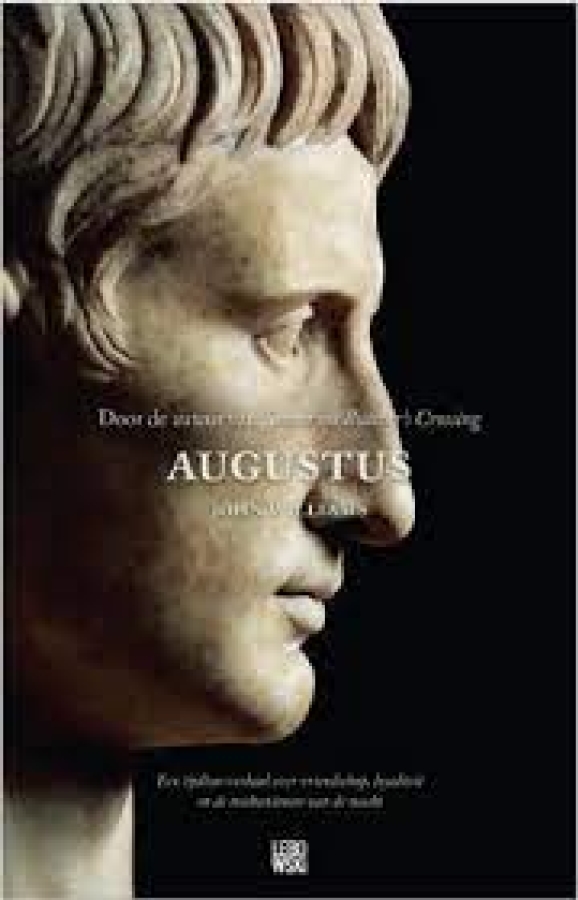
Augustus: a Novel
John Williams wrote three widely acclaimed novels: *Butcher's Crossing* in 1960, *Stoner* in 1965, and this biography of Augustus in 1972 (with this entry, all of his books have now been reviewed on this site). Williams is an exceptionally talented writer who continually reinvents his style, adapting it to the story and the characters. In this case, the author constructs the plot through letters written by various figures; Augustus himself intervenes in the first person only at the very end, allowing us to grasp key turning points—both political and personal—of his life from differing perspectives. It is an exquisite literary device, yet one that fragments the narrative and assumes the reader is already familiar, at least in broad strokes, with the complex events that led first to the Principate and later to the accession of Tiberius. Who was Octavian, later Augustus, in truth? When his great-uncle Caesar dies, naming him his heir, Octavian is an eighteen-year-old youth: he learns the news in Greece, where he is staying with his friends Maecenas, Agrippa, and Salvidienus Rufus. In his journal, the latter recounts how Octavian voices his uncertainties regarding the true loyalty of Caesar's legions and, turning to his companions, states that he will share his fears only with the three of them, > who are truly my friends, (...) a cold sorrow had settled upon him and pulled him away from us . It is as if the young Octavian had realized that youth was over and that upon him fell the grave burden of ending the civil wars and securing peace and prosperity for Rome: to accomplish this, he must become a shrewd and ruthless politician, relegating personal affection to the background and exploiting everything and everyone, even his oldest friends and his beloved daughter Julia. Paraphrasing the myth of Orpheus and Eurydice, Horace recounts Octavian's destiny. > His love was not a woman; his Eurydice was knowledge, a dream of the world, to which he sang his song. But the world of light that was his dream of knowledge was destroyed by a civil war; (...) and his dream vanished, as if evaporating, into the darkness of time and circumstance. He saw the world, and understood that he was alone, fatherless, propertyless, hopeless, without dreams..... It was only then that the gods gave him their golden lyre, and allowed him to play not as they willed, but as he himself desired . It is a magnificent synthesis of Octavian's destiny, elevating him to a singular and immortal role in history, pursuing an end to which everything is subordinated—even Julia's happiness. And it is here that we, too, venture into the darkness of the human soul. With a stroke of literary genius, Williams introduces Julia's journal on the island of Ponza, where she has been exiled. Julia’s sorrowful, resigned account is preceded by the gossip surrounding her dissolute life, almost as if to justify her father's dreadful decision. Yet one cannot help but feel sympathy for this still-young woman, who was forced to marry Agrippa, a man far older than she, and later the unsettling Tiberius. It may well be true that her father exiled her for her immoral conduct to spare her execution for treason against the state; what is certain is that Augustus's cold, cruel severity contrasts starkly with Julia’s gentle melancholy. These are exquisite pages that alone justify reading the novel: the fading of memories, rendered useless and bearing only grief, juxtaposed against the precision in the account of the encounter between Octavian and Julia, father and daughter. > His face was gaunt, and there were lines of weariness around his pale eyes; but in the uncertain light of the room, the face could have been that of the man I remembered from my childhood . Julia learns that the conspiracy has been uncovered by Tiberius, and her father can do nothing other than condemn her to safeguard his authority. > My child, he said, this has nothing to do with love. He turned away from me again and picked up some papers on the desk. (...) I have not seen my father since. I understand that he will (no longer) speak my name . The elegance of the prose, the fictionalized yet masterly reconstruction of events that remain obscure to historians, the lexical richness, and the ability to capture the idiosyncrasies of the various figures (from Mark Antony to Cicero down to the minor players) are literary merits that dazzle the reader. In many reviews it is compared to Robert Graves's *I, Claudius*; yet it is an entirely different matter. Flitting superficially across the history and the dramatis personae, Williams fails to convey passion and mystery; the novel ends up being as detached and rigid as we imagine Octavian Augustus to have been. Why read it? It demands some effort, but Julia's diary is truly beautiful.
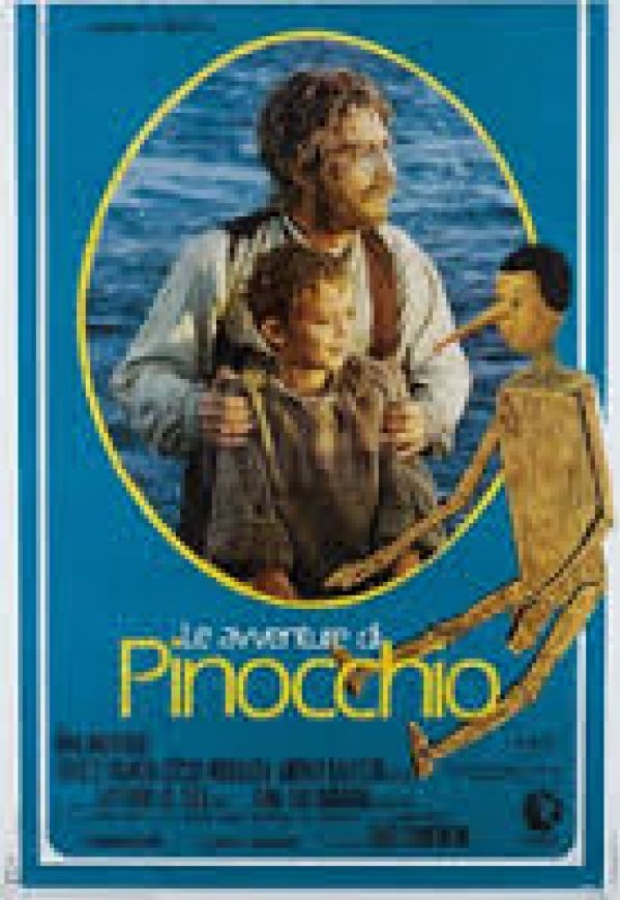
The Adventures of Pinocchio
As soon as one begins reading Collodi’s book, the mind immediately turns to a masterpiece: Gianni Rodari’s *The Adventures of Cipollino*. To our sensibilities, Pinocchio’s tale feels moralistic, with an underlying theme seemingly remote from us: > today (though too late!) I have had to convince myself that to earn an honest penny one must know how to make it, either through the work of one's own hands or the wits of one's own head , so says the Parrot to Pinocchio in the Field of Miracles. How much more amusing and captivating is Rodari’s novel, which speaks of freedom, of the struggle against the powerful, of daring imagination! And yet, looking more closely, one realizes that *The Adventures of Pinocchio* and *The Adventures of Cipollino* address the very same subject: the world is upside down, and it must be set back on its feet, onto the right path. It is evident that Collodi’s tale is a *Bildungsroman*: a child, thick-headed enough to be a puppet, learns from life how to become an adult, discerning good from evil. Yet all the characters are truly singular, beginning with Geppetto, the generous and solicitous father. who wishes to fashion a "fine puppet" in order to > travel the world, to earn myself a crust of bread and a glass of wine , and rightly the hidden "little voice" comments: "Bravo, Polendina!". And what of the Fairy "with the azure hair", the loving, sorrowful mother! Why does she not help Pinocchio, leaving him instead in the dark wood, at the mercy of the assassins? Pinocchio faces his ordeals alone—ordeals he himself brings about through his refusal to abide by social norms: instead of going to school, he goes off with the puppeteer; driven by greed, he allows himself to be duped by the Fox and the Cat; he forgets Geppetto in his destitution; he promises to be diligent only to forget it all to run with the other scamps; and thus he lands in prison, narrowly escapes being fried in a pan, and eventually lets himself be hoodwinked into going to the Land of Toys, turning into a donkey. What is it that redeems him? Good deeds. When the fierce dog Alidoro, who had chased him in order to devour him, is about to drown, after a moment's hesitation Pinocchio saves him: for indeed, > his father had told him many a time that one never loses by doing a good deed . And then, as if by magic, the various characters, the animals themselves, reveal themselves to be generous and obliging. When Pinocchio, searching for Geppetto, is swallowed by the terrible Dogfish, and there in the depths of the enormous stomach finds his "dear papa", it is a Tuna who helps them escape the mouth of the great beast: and > Pinocchio (...) planted a most affectionate kiss upon its mouth. At this display of spontaneous, heartfelt tenderness, the poor Tuna, unaccustomed to such things, was so moved that (...) he plunged his head back under the water and vanished . How it came about that Carlo Lorenzini, the real Collodi, > an implacable provincial, mythically lazy, moody and unpredictable , decided to write *The Adventures of Pinocchio* is a question best left to scholars. Perhaps because, as he wrote in the sketch *A Letter to Fanfulla*, "being born Tuscan is a misfortune that can happen to anyone." And it is precisely this provincial Tuscan character that breathes life and modernity into a novel that would otherwise be prudish and dull. Far removed from lofty, formal Italian, the language infuses the tale with vigor and brio: Pinocchio is a rogue, evoking every child in the world—their yearning for play and amusement, their naive openness to others, their reluctance to be hemmed in by the tedious social rules of adults. All of this makes the tale of Pinocchio timeless, transcending its nineteenth-century setting. Why read it? It is the story of the child we once were.