7-7-2007
In four years, from 2013 to the present day, the author has published 6 novels, all featuring the figure of Rocco Schiavone as their protagonist. Perhaps haste has precluded the necessary care: the narrative is muddled, intertwining the noir genre with personal stories and depictions of social contexts without ever arriving at an effective synthesis. We are in Aosta; a woman has been murdered in the protagonist's apartment. In the lengthy interrogation that ensues, Deputy Police Chief Rocco clarifies the backstory, albeit not entirely. Back in Rome, he had led an investigation into the brutal murder of two youths. Drugs are involved, but we will not delve into the details, leaving it to the reader to discover how Rocco manages to untangle the affair. Alongside the main plot, numerous narrative windows open up, chief among them the tormented love affair with his wife and the close friendship with three childhood companions. Marina > was beautiful. With focused eyes, teeth barely biting her upper lip, hair gathered in a bun held by a pencil, or was it a chopstick? Beautiful, in her immaculate white coat reflecting the lamp's light and creating a halo all around her. Her hair looked blonder and the few specks of dust dancing around her face seemed like stars and comets . Marina left home when she learned that Rocco was corrupt: he had exploited his position as deputy police chief to enrich himself. Responsible for these petty dealings are his childhood friends: a sort of Three Musketeers, congenial, hearty eaters and drinkers, always ready to help their pal, but genuine scoundrels—terrible company for a police officer. It will be Marina who returns home, because she loves Rocco and accepts him as he is. The reconciliation between the two is one of the novel's many disappointments. Consider this dialogue: > Marina stroked his chest. Did you really have to close your eyes to come back home? (Rocco) A little. Now they are wide open and I see beside me the man I love and whom in all likelihood I will always love (Marina). I have an erection (Rocco). Could you for once think of something else? (Marina) Like what? (Rocco) . In short, for Rocco it was all just a matter of sex! Why draw us into a love story if everything boils down to a trite and resigned acceptance on the woman’s part? Rocco manages to find the culprits; behind the murders lies a powerful criminal syndicate which attempts to assassinate Rocco, killing Marina instead. That July of 2007 > had been strange days. Days of heat and sudden downpours, of anxiety and, above all, of stench. The stench of basements, the stench of violent deaths, of vile people, crouching in the sewers, ready to strike... A noir novel demands an intense narrative pace; the reader must be gripped by the plot, participate in the investigation, or be swept along by events and their tension. All of this is missing from the book: sluggish, often predictable, cluttered with unnecessary characters and subplots, the story is trite and dull. The “three musketeers” serve in vain as foils to the protagonist: Rocco, let us be frank, is a failed Marlowe, a character incapable of sustaining the assigned role of the corrupt yet decent cop, an avenger on his own terms. The writing also contributes to the novel's failure; the excessive use of full stops and the frequent recourse to dialogue fragment the narrative, rendering it more akin to a screenplay than to the prose flow of a narrative, which requires room for description and psychological depth. How is it possible that this novel has topped the Italian bestseller lists for weeks? Why not read it? It is tedious and banal.
L'Adalgisa
Il libro è costituito da 10 racconti, che sono altrettanto bozzetti della vita della borghesia milanese degli anni ʼ30. Il tratto comune è una lieve ironia di una società soddisfatta di sè stessa, attenta ai soldi, ai buoni matrimoni, alle occasioni mondane, ma anche alla cultura tecnica, «allʼingegnere». Le scene della vita lombarda sono, poi, lʼoccasione per Gadda per una esplosione di parole, modi di dire, neologismi, sovrapposizioni di forme dialettali a italianismi, che confonde il lettore, il quale perde, spesso, il senso del racconto ma anche il filo del discorso. Sembra, quasi, che lo scrittore abbia lavorato in piena libertà con il linguaggio ed è, quindi, impossibile riferirsi ad una trama, a personaggi, ad episodi, ma la lettura si perde in una serie di impressioni, alcune felici, molte noiose e ripetitive. In uno dei racconti più briosi ( > *Quando il Girolamo ha smesso...*) Gadda racconta le vicende di una onorata ditta che fallisce in quanto ha dato i soldi ad un finanziere creativo: “per levar di tasca, a certi bamboloni con la bocca aperta, lʼanima di quei quattro ruspi o ovverosia sudati risparmi che gli son costati una vita; per spennarli a modino, sti cocchi di mamma, senza gli abbino a strillar troppo forte, e arrivare a farli finalmente contenti dʼun bellʼuscio chiuso, sigillato in piena regola dallʼautorità giudiziaria, per raggiungere questa suprema meta del credito e dellʼattività creditizia, si può bene ingegnarsi adoperare una Croce, la Patria, poi, neanche a parlarne”. In un bozzetto felicissimo sulle abitudini della borghesia milanese (*I ritagli di tempo*), lʼautore racconta il sonnellino durante la lettura del giornale: “bello è il vedere un ingegnere Caviggioni seduto, e quieto, una volta tanto, onninamente immemore del 263.890 e delle filettature normali (dei bulloni Withworth): seduto, dico, anzi nobilmente abbandonato sulla poltroncina del sabato, in attitudine pregustante, indi poco di poi assaporante”. In un altro racconto (*Un concerto di centoventi professori*), viene tratteggiata con benevole sarcasmo lʼabitudine a frequentare il teatro, dove > la società musogonica della città industre, aja di laboriosi pupilli, dopo le molte buone opere, sʼaduna a purgare le sue indigestioncelle farisaiche, i suoi peccatuzzi stitici, col porger orecchio a quegli altri peccati, un pò più cipperimerli per fortuna, di Luigi Dallapiccola e di Igor Strawinski . Perché non leggerlo? Singoli frammenti sono anche deliziosi, ma per gustarli bisogna soffrire per 284 pagine.

Adwa
The publisher presents the book as a novel with two voices, “that of a father and a daughter.” This summary is certainly accurate. Adua fled Somalia to escape an authoritarian father and to fulfill a dream: to work in cinema and become a famous actress. In reality, she managed to make only one film—a pornographic one. Twenty years later, she finds herself a mature woman, an “Old Lira,” as the new immigrants call “the women of the diaspora.” Partly out of compassion and partly for companionship, she marries an immigrant who > hung around drunk in many parts of Rome (...). But it was in Piazza dei Cinquecento (...) in that square that Italy had dedicated to soldiers who died in East Africa, that I concocted a papier-mâché love . Born to a strong and courageous woman, Asha the Daredevil, with a happy nomadic childhood among goats and camels, a sad adolescence in Magalo and Mogadishu, a desolate and mundane life in Rome—what has become of Adua’s dreams? > I wanted to be free to run in the wind. (...) I felt that the big city would devour all my purity, all my dreams . The author offers us glimpses of Adua’s life, but in truth she continually speaks of her disappointments, of her struggle to survive, nevertheless. Zoppe, the father, lives in another era, during Fascism and the ruthless colonialism of the Italians. He collaborates with the latter as a translator, makes himself a servant, witnesses the atrocities, the abuses, the racist and contemptuous conduct of our compatriots, in Italy as in Somalia. Here too, the narrative is made of slices of existence, important not so much for what they say as for what remains beneath the surface: self-contempt and, at the same time, the betrayed fascination with Italy and its language. Zoppe is nevertheless a traditionalist, who does not hesitate to subject his daughters to infibulation, because > afterwards there will only be the happiness of being pure, finally sealed as God commands . He is an authoritarian father; he disapproves of and disdains his daughter's aspirations, cynically and cruelly intent on severing the memory of Adua's mother, who died giving birth to her. > But enough, stop naming her. That woman is nothing, she is just a mistake . The two stories, Adua’s and Zoppe’s, run largely in parallel, like two straight lines that never meet—not because their lives unfold in different times and contexts, but because father and daughter do not speak to each other; they are too distant, both lacking the ability to express their love. > I like Rome in summer, especially its evening light at dusk; it is warm, and even the seagulls become gentler, making you want to hug them. They are the masters of the piazzas, but here you are, little elephant, and they dare not. Away, stay away from Piazza Santa Maria sopra Minerva! I feel safe near you. Here I am in Magalo, at home . Adua’s words “dissolve and are lost.” Look at the nigger, talking to herself”. And Zoppe walks through Fascist Rome and “the vision was still there to comfort him (...) The trees... the dome of Saint Peter’s... then the wisteria in bloom... the scent of the women... the walking sorbets... the martial tread of the soldiers... the rustle of rainbow skirts... their hopes painted blue > . This is what binds father and daughter: the love for Rome. Scego narrates a great deal about Somalia; the reader strongly perceives the desire to return ideally to the homeland, to reclaim the language, its sounds, and its imagery. Yet the novel speaks above all of a betrayal, of an Italy, a city—Rome—a language, and a history that, like beloved women too beautiful to be conquered, reject the courtships and overtures of the new Italians. I must say I was often tempted to abandon reading, and I carried on to the end solely out of sympathy and esteem for the author. It is difficult to write two parallel stories, but even more so if one relies on flashbacks,” dreamlike digressions, and trailing, opaque sentences. Without a plot to bring order to it all, a great confusion emerges, a crowding of thoughts and images that makes reading laborious. In this novel, Scego loses the gentle irony and subtle elegance that distinguish her writing. Perhaps she demanded too much of her abilities; a missed opportunity. Why not read it? It is confused and, in the end, tedious.

Almarina
> I will never be able to tell if it is Naples or if it is me. (...) Or if it is truly the sight of that ugly tenement on the other side of the gate, the swelling yellow wave, the domes beneath the clouds, architraves too heavy for a woman alone to bear. If reality is made of unreachable terraces, unreachable powers as they describe them... . With this opening, the reader is led to believe they are getting a foretaste of the surreal world of Anna Maria Ortese (see *Il mare non bagna Napoli* and *Il Cardillo Addolorato* > ); instead, one is confronted with a love story suspended in midair, swept away by a stream of consciousness that is unchecked precisely because it is entirely interior. A fifty-year-old mathematics teacher, Elisabetta Maiorano teaches in the juvenile prison of Nisida. Whoever crosses the threshold of a prison knows (and if they do not know it, they feel it) that they are crossing over to another side, irreconcilable with the promise made to us as children: that life would not be frightening, and we would never be left alone. Prison, instead, is fear and loneliness > . But is being incarcerated, living within a daily routine at once repetitive and protective, what creates a sense of isolation, or is it rather the recollections of a lifetime, the hopes and disillusions, the mistaken choices, and the misunderstood loves? Following the relentless outpouring of the protagonist-narrator, one begins to think that prison is merely a lockpick to unleash her interior world—and to indulge in self-pity: the unloved husband, the child desperately sought through artificial insemination and then through adoption requests, the tedium of teaching, advancing old age. We take these dossiers and store them in the furthest archive of memory, and then we hide the key. Our hope, I believe, is that on that day, now far off, when they have served their full sentence, this key will return to their hands, and from the flung-open archives blank sheets of paper with no more ink on them will take flight, immaculate, like laundry hung out on the terraces > . But if for the inmate—of whom the protagonist ostensibly speaks—there is the light of normal life, how can a person imprisoned within herself escape her own prosaic and mournful existence? Only if Love breaks in. I became attached to Almarina like that, while we were looking at the sea, and I told her that my husband was a magnificent swimmer. (...) I don't know how to swim, she told me, then.«Reading Valeria Parrella brings to mind Alda Merini, when she writes»and perhaps I will tear from the roots/the repressed hope of love,/I will remember that the fruit of every/human limit is absence of memory,/I will plunge entirely into becoming...". In both authors, one is in the presence of a restless and insatiable quest for a Love that allows memory to be removed, or at least suspended. Prison, much like the asylum for Merini, is a metaphor for the prison of the human soul, a moment of stillness, a place of unexpected encounters. Every page of Parrella's is a cameo, akin to a brief and intense poetic composition. But whereas in Merini the lyricism, speaking of oneself, the hinted-at sentiments, the lexical preciousness are in their proper place because they are typical of a sonnet, especially according to traditional Italian poetry, in Parrella these stylistic and narrative traits compromise the overall narrative, strip momentum from the story, desiccate the characters—particularly that of Almarina, who is, in fact, incomprehensible. The self-mirroring 'I' is ill-suited to the novel, which nonetheless requires a plot. Why not read it? An elegant outpouring, yet detached from a narrative structure.
A Connecticut Yankee in King Arthur's Court
The book is a moralistic fable. A nineteenth-century industrialist finds himself hurled into King Arthur’s court. He attempts to introduce an industrial, capitalist culture, which the author regards as vastly superior—because more rational and efficient—to that prevailing in the Middle Ages. The attempt fails miserably due to the opposition of the Church and an enchantment by the wizard Merlin that casts the protagonist into a deep sleep. The story aspires to be entertaining, yet proves tedious and pedantic.
The Year of the Death of Ricardo Reis
Ricardo Reis is one of the many names under which Fernando Pessoa, the greatest Portuguese writer of the twentieth century, signed his works. The author imagines that a Ricardo Reis, after sixteen years spent in Brazil, returns to Lisbon in the very year of Pessoa’s death, 1935. It is pointless to seek a plot in the novel; as in Joyce’s *Ulysses*, the real subject of the narrative is the wanderings through 1930s Lisbon and the succession of thoughts on reality and on oneself: thoughts that never find an adequate expression in words. > Over the stark nudity of truth the diaphanous cloak of fantasy, the maxim seems clear, clear, neat and definitive, even a child will be capable of understanding it and repeating it in an exam without making a mistake, but this same child would understand and repeat with equal conviction a new sentence, Over the stark nudity of fantasy the diaphanous cloak of truth, and this sentence, yes, gives far more food for thought, and to imagine with relish, fantasy solid and nude, truth barely diaphanous, if overturned maxims became laws, what a world we would make of them, it is a miracle that men do not go mad every time they open their mouths to speak . In this deft literary inversion through which the certainty of reality turns into vagueness and imagination gains the upper hand, the novel’s fundamental theme is revealed: it is no longer possible to “read” the world, the interior one any more than the external context. Ricardo Reis walks through Lisbon as though in a labyrinth, unable to find an exit. He is partly “a spectator of the spectacle of the world” and partly overwhelmed by his own thoughts: it is not he > who is thinking these thoughts, nor one of those innumerable selves living inside him, perhaps it is thought itself that is thinking, or simply thinking, while he watches, surprised at the unravelling of a thread leading him through unknown streets and corridors... But is it Ricardo Reis who is confused, or is it reality itself that becomes representation rather than truth? The book’s most compelling pages concern the protagonist’s journey to Fátima and the description of a sort of war simulation staged by Salazar’s dictatorial regime: an urge to partake in the great slaughter of the 1930s (the Spanish Civil War and subsequently the world conflict). Faced with the shameless exploitation of hopes for a cure, with the petty and grand commerce surrounding the shrine, religion turns into superstition, an occasion for revelry, a contempt for spirituality. In the same way, the military parades, the celebrations of victories that never occurred, the false reports, the propaganda are the unsettling parody of a moral and physical disaster looming over Europe. The protagonist seeks, without much conviction, solid anchors for his life, both inner and political, but it is all in vain: > time drags on like a slow, viscous wave, a paste of liquid glass on whose surface lie myriads of sparkles that catch the eye and deflect meaning, while deep down the tawny and unsettling core shows through, an engine in motion (...) Ricardo Reis lacks a guide dog, a walking stick, a light ahead, for this world and this Lisbon are a dark fog where north and south, east and west are lost, where the only open path leads downward, and if a man lets himself go he plunges straight down, a dummy with neither legs nor head . It is hardly surprising, then, that when Pessoa’s ghost visits the protagonist, Ricardo Reis decides to follow him into the world of the dead, where reading is the first faculty to be lost. “Here (in Lisbon), where the sea has ended and the earth awaits.” Many interpretations can be offered for the novel: the narration of a progression toward death; the desire to evoke a Lisbon now vanished; the contrast between a yearned-for and idealized love (the figure of Marcenda, a notary’s daughter) and a sensual and concrete love (the liaison with the chambermaid Lídia); the subtle irony aimed at Portuguese society; and yet further meanings. The unifying thread of so many explanations is the shattering of the European conscience, aware and terrified yet inert and cowardly before the disaster toward which it moves, as though dragged along by an indecipherable and unstoppable fate. > We have all had a father and a mother, but we are children of chance and necessity, whatever this phrase may mean, Ricardo Reis thought it, let him clarify it . In reading the novel, one encounters sentences that are exceptional from a literary standpoint. One cannot help but feel envious, and captivated, by the following passage. > Only a vague inconsequential sorrow lingers a while at the door of my soul and after gazing at me for a moment passes on, smiling at nothing, he murmured (Ricardo Reis). Yet on the whole, the narrative style is cumbersome and tedious. The phrasing is complex, with frequent shifts of subject; the sentences are long, dominated by commas; the punctuation does not aid the reader; reflections, often philosophical in nature, prevail over plot, characters, and descriptions. There is a total absence of dialogue, which might otherwise lend breath and vitality to the narration. It is a *Ulysses* in which there is no Mr Bloom. Why not read it? It is tedious and prolix.
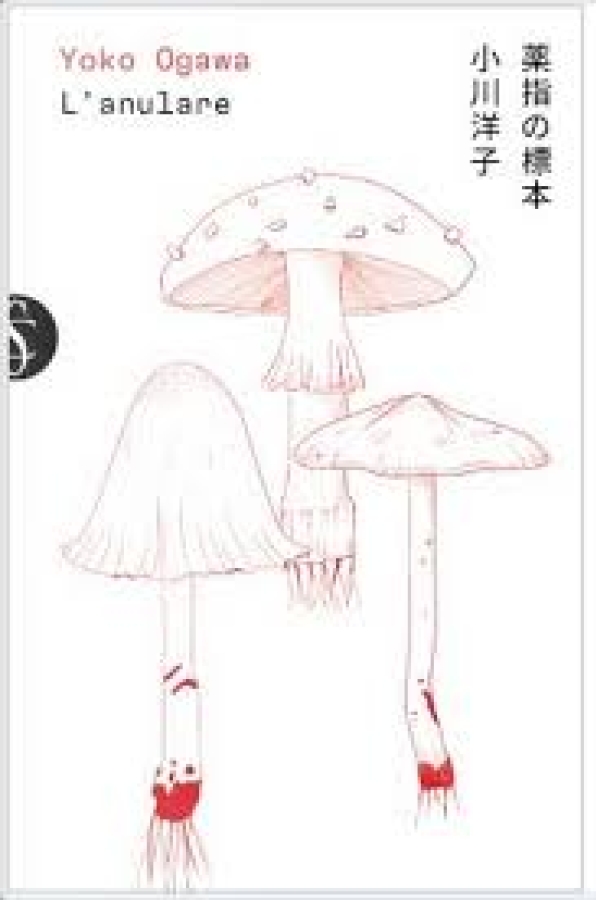
The Ring Finger
While in ancient Egypt embalming was practiced to preserve the deceased for eternity, the Shinto worldview and a certain measure of fetishism lead, in Japan, to the preservation and safekeeping of objects and living beings that are important in one's life. The novel speaks of a "specimen," and the technique employed is perhaps akin to that used for the wet preservation of fluid specimens using formaldehyde. In any case, the method is not explained in the book, perhaps to maintain a magical and mysterious atmosphere. This long preamble was necessary to frame the story. The protagonist is a young woman who left her job at a soft-drink bottling plant following a workplace accident: the gear of a machine severed the tip of her ring finger, > an image haunted me; that seashell-shaped piece of flesh, pink as a cherry petal, tender as the pulp of a ripe fruit, falling in slow motion into the iced soda, only to settle at the bottom, floating among the bubbles, (...) I had lost a part of my body. She goes to work in the city, in a semi-abandoned building. Here, Mr. Deshimaru prepares and keeps specimens of all kinds. > Everything about him was impeccable. The color of his skin, his hair, the shape of his ears, the length of his arms and legs, the line of his shoulders, his voice were all perfectly harmonious. (...) The sun's rays enveloped his white coat, sketching an aura of light around it. One day, Mr. Deshimaru puts new shoes on her and orders her to always wear them; then he undresses her, leaving the shoes on, and they make love. > He neatly unbuttoned my blouse from the top down and unzipped my flared skirt. (...) In the end, I found myself naked. I was wearing only the black leather shoes. (...) He held me tight in his large arms—not in a tender embrace to savor the sensation of our bodies—as if he wanted to press all of me flush against him. (...) I had the feeling of having been transformed into a specimen incorporated into him. From here, the story is a slow slide toward the inevitable question: > couldn't I entrust myself to you and become one of your specimens too? (...) The preserving fluid must have been warm and still. It was not cold and fizzy like the soda. It would have completely enveloped the ring finger, from the tip to the edge down to the faintest lines of the fingertip, while the cork stopper would have shielded it from dust and external noises. The story is disturbing if viewed as a realistic narrative; it becomes sustainable if considered as a metaphor for the deprivation of a part of the body. Having watched a small ring finger detach and vanish created a profound wound in the young woman's psyche. It is as if we were inside a dream, in which a kind of shaman, shadowy and luminous at once, draws the girl to himself, offering her a world that is protective and claustrophobic. Becoming a "specimen" is a way of escaping reality. The writing is limpid and simple, reflecting well the young woman's disorientation; pleasant and fluid, the style contributes to an overarching sense of implausibility that not even the eccentricity of Japanese culture can overcome. Everything remains on the surface; there is no psychological depth in a tale in which only physical contours and objects are delineated in detail, thereby acquiring a semblance of reality. The story flows far too linearly. Why not read it? It is simply too implausible.

Article 353 of the Penal Code
"A vulgar case of fraud, Your Honor, nothing more." Kermeur stands before the judge: he has confessed to killing a businessman, Antoine Lazenec. "We saw him sprout up like a mushroom at the foot of a tree," but in a quiet little town, lacking both ideas and jobs, > when someone like him arrives with such a determined expression on his face, (...) there is something about him that feels like an outstretched hand pulling our very soul out of us, with all those ideas of change, with all those grand schemes . People fall for it, starting with the mayor; the retiree Kermeur invests his severance pay, enthralled by the adventurer Lazenec's dreams of wealth. The beauty of it is that the swindler does not leave town after it has become blatantly obvious that the grand plans will never materialize, that he has pocketed the money, after the mayor has committed suicide; no, he stays right there, flaunting his lavish lifestyle, peddling optimism and falsehoods: > a man like that, Your Honor, a man like that, I realized later: if you don't make him disappear yourself, he will never disappear. He will come back . This is the motive for the murder: a poor man, ruined by a swindler, wound himself up like "an electric battery" and finally exploded, ridding himself and the entire town of a vainglorious scoundrel. What need is there for a lengthy interrogation? That is what we ask ourselves as well. In reality, the narrative is a slow soliloquy, in which Kermeur, the narrating "I," speaks with the "mirroring I," embodied by a laconic judge. It is like the mirror over the mantelpiece, before which the protagonist is accustomed to spending long hours. > And not because I want to see what is reflected in it, I told the judge, but I can't help myself, from staring at it I find myself tangled, as it were, in the thickness of the glass, my brain caught by the fog that could be mistaken for any hellish morning when the sun tries in vain to reflect within it, but made pale, as it were, or deceived by the opaque grain of the mirror . We thus learn the entirety of the retiree's life: his wife's abandonment, the raising of his son, from childhood to an adolescence prematurely marked by run-ins with the law, nostalgia for work and his few friends, a passion for fishing, and the setting of an Atlantic coastal town, where it seemed that > the pines and the ferns and the thick grass of the dunes (...) were in on a secret and whispered against me, beside me, proud to inhabit their peculiar world, a world without sentences and without malicious thoughts . It is, in short, the anatomy of a depression. There is nothing worse than expecting one thing and finding oneself confronted with another. Picking up the book, one hoped for a detective plot or an adroitly told provincial tale; instead, we ran headlong into a rambling spill of words—well-written, it must be said, at times offering intriguing insights, such as when the author observes that "a child is not programmed to feel compassion for you," a truth that we parents should keep firmly in mind! And yet, a sparkling, spirited style is not enough to save us; we are far removed from *Doctor Zhivago*, my dear Viel. The relentless succession of sentences, the lack of action, the excessive introspection, the overindulgent self-narration are all elements that render the novel utterly tedious and pedantic. Why not read it? It is unbearable.

Murder in the Central Committee
The novel chronicles the investigation of a private detective following the murder of the Secretary of the Spanish Communist Party during a meeting of the Central Committee. The narrative unfolds slowly, blending markedly disparate styles and narrative content: a succession of continuous "parentheses" on life in Madrid and the tribulations of the leftist milieu, with a sentence structure reminiscent of *The Pianist* and thus tedious and prolix; a Raymond Chandler-esque approach, particularly in the more action-driven scenes, where the protagonist is pursued, captured, and beaten by secret service operatives; and an articulation closer to the British mystery when the protagonist ultimately unmasks the killer. The overlapping of styles and the predominance of themes tied to the existential and political dilemmas of the Left make the book bad, tedious, and ponderous. It is, therefore, a dated novel that offers little stimulation regarding contemporary issues (or so one hopes!).
The Actor
Mario Soldati was defined as “the first, great media-man of Italian culture” (Aldo Grasso in *Corriere della Sera*, 2016). Indeed, he was a novelist, journalist, screenwriter, film director, and television author. His numerous novels (reviews can be read on this site: *A cena con il Commendatore*, *Lo smeraldo*, and *El Paseo dei Gracia*) reflect his vast experience as a cinematic author, both in style and in narrative content. For Soldati, each of us wears a mask, even without realizing it, because the disguise is part of our deepest consciousness; consequently, our relationships with others are ambiguous, often full of futile deceptions; we like to live as if in a dream, as though we were in a soap opera. In short, we live in a bubble. Unlike his other tales, this novel stems from an episode in the writer’s life that could well be real. Soldati, the narrator, meets an old friend, a modest actor whom he has not seen for many years. Enzo is in dire financial straits because his wife continues to lose substantial sums at the casino: he asks Soldati for work. Our writer attempts to find him a role in a television series, though the moment is hardly favorable as new executives have replaced the old ones with whom Soldati enjoyed an excellent rapport. To inform his friend of what he is doing, he travels to Bordighera, where Enzo lives with his wife. In doing so, Soldati finds himself ensnared in an intricate and ambiguous family dynamic: Enzo’s wife, once a beautiful woman, now obese and infirm, is jealous of her husband, whom she suspects of cheating on her with their maid; Giovanna, the maid, dominates both Enzo and his wife through her mysterious, seductive allure; and finally Enzo, who convincingly claims to love his wife yet plays the role of the unfaithful husband, blatantly attempting to conquer the elusive Giovanna, thereby exasperating his wife and driving her toward killing the maid. Why does Enzo pretend to betray his wife with Giovanna? And why do the others play along with the roles Enzo assigns them, as if on a theatrical stage, never interrupting this cruel and false soap opera? > Every man is, always, a bit of an actor,. (...) every human being must, sometimes, to feel alive, be able to imagine themselves a little . This novel met with great success upon its publication in 1970 and won the Premio Campiello that same year. In truth, the story is dull and trite; especially if approached from a psychological standpoint: the quality of the narrative falls far below that of Soldati’s other novels. What remain are the splendid descriptions, cinematic in their detail and colors. An example: > Giovanna is small, slender, sturdy, dark-haired. A strange, narrow face: dark, close-set eyes, thin and unpainted lips: a face with a closed, motionless, unfeeling expression, as if carved of stone. (...) She wore an amaranth velvet suit, rather vulgar in its elegance, and very loud. (...) She gazed at herself for a long time, admiring her reflection, pacing back and forth like a model, pulling and smoothing the jacket of the suit over her buttocks, turning once more to glance back over her shoulder. Why not read it? It pains one to say it: it is boring.
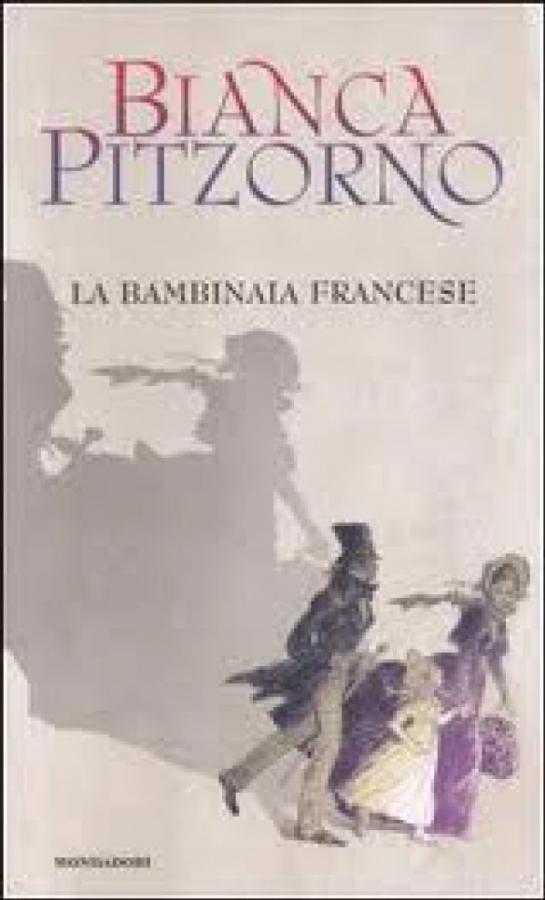
The French Nanny
Nineteenth-century fiction holds an enduring fascination, often inviting modern reinterpretations. Such is the case with *The French Nursemaid*, which rewrites a great classic novel: Charlotte Brontë's *Jane Eyre*. Here, the protagonist is a young French girl. The novel falls essentially into two parts. The first is set in Paris. Sophie is an impoverished child who lost her father during the glorious days of 1830, which brought Louis Philippe, the bourgeois king, to power. Through workers’ mutual aid societies, Sophie learned to read and write, advancing from a “Bear” to a “Monkey”—terms that, in the vernacular of printshop laborers, distinguish the illiterate, fit only for manual tasks, from those educated enough to be entrusted with typesetting. Reading great novels, newspapers, and periodicals secures Sophie a social role within her modest community and, above all, fires her imagination while elevating her ideals and aspirations. This is the finest portion of the book, as the author diverges from much nineteenth-century fiction by embracing a realist, Zolaesque approach rather than a pious, sentimental one. Sophie loses her mother as well, but fortuitously finds shelter with a celebrated actress, Céline, who is married—or rather, believes herself married—to the villainous Edward Rochester. Sophie becomes both nursemaid and companion to Adèle, the couple’s daughter. In Céline’s household, Sophie meets a Black youth, Tùssi, and Céline’s godfather, an elderly French Enlightenment thinker. The author uses this eccentric aristocrat to articulate her ideal school: one where learning is inquiry, open equally to rich and poor without class distinction. Because Tùssi is still legally an enslaved person, this also provides an occasion to address slavery and colonial conditions, though it must be noted that this theme, which tormented the entire nineteenth century, is handled superficially, striking a forced and discordant note throughout the novel. Céline’s fortunes, and by extension Sophie’s, unravel abruptly upon the godfather’s death: grasping relatives have Céline imprisoned and turn Sophie and Adèle out into the street. Tùssi is forced into domestic servitude with one of the relatives. One might expect the wealthy Rochester to intervene; instead, this callous and self-absorbed man reveals that his marriage to Céline was an orchestrated sham and carries Adèle off, even as he disowns her as his daughter. In the second part, the setting shifts to England and the somber manor of Thornfield. Sophie manages to follow Adèle, securing employment as her French nursemaid by pretending not to understand English. This device allows her to recount, from her own vantage point, the narrative of Charlotte Brontë’s masterwork. Needless to say, the story draws to a happy ending for our protagonists, who eventually reunite in France, their fortunes restored once Céline claims the legitimate inheritance left by her godfather. A distinctive feature of the novel is its narrative structure. In the first part, the letters Sophie and Tùssi write to Céline, already behind bars, are juxtaposed with a third-person account of Sophie’s circumstances up to her departure for England. It is a device that enlivens the prose, effectively balancing three viewpoints: the authorial voice and the inner reflections of the two main characters. In the second part, the epistolary mode takes precedence. The correspondence between Sophie and Tùssi chronicles the happenings at Thornfield. It must be said, however, that this narrative device becomes repetitive and dull, not least because the letters possess so little intimacy or genuine emotion. Confronted with detached, formal accounts of the plot, the reader is left disappointed, expecting the two protagonists to probe their feelings and finally declare the love of which we are certain from the outset. In the final pages, Sophie assumes the role of first-person narrator, yet the text never rises above a perfunctory chronicle of events. The novel is plainly an amalgamation of nineteenth-century narrative conventions. The reimagining of Charlotte Brontë’s work is trite, mirroring an overly romanticized and conventional reading of *Jane Eyre*. What weighs the story down most heavily is a sluggish narrative pace, a dearth of action, and an absence of psychological depth in the characters. An encouraging start soon gives way to mounting tedium. Why not read it? It is long and boring.
Five-player Briscola
Massimo runs a bar in a fictional coastal town near Livorno. Like so many provincial establishments, the bar is frequented by a group of old men who pass the time playing *briscola* and talking (or gossiping) about the affairs of the world and those of the small village. Then an extraordinary event comes along to shake up the daily grind: the corpse of a young woman is found in a dumpster. Needless to say, Massimo turns amateur detective, making his share of mistakes, but ultimately playing a decisive role in uncovering the killer. To avoid being accused of spoiling the culprit and the resolution, I will say nothing of the plot, confining myself to noting how trite and predictable it is. At first, Massimo’s attention to certain seemingly insignificant clues entices the reader, but the author’s eagerness to deliver a twist ending ruins the gradual buildup of evidence, motives, and the very logical architecture of the noir. The setting could open up intriguing possibilities if, for instance, the old men played a meaningful role in the detective plot or, conversely, if the writer were capable of portraying the atmosphere of the bar. Nothing of the sort! Setting aside the use of the Livornese dialect, the bar and its patrons remain in the background—flat, insipid, and superficial. The novel’s sole merit is the writing: simple, accessible, and clear. The reader breezes pleasantly through the pages without being subjected to any particular effort of concentration, yet without lapsing into boredom. Why not read it? It is the classic travel novel, but it leaves nothing behind.
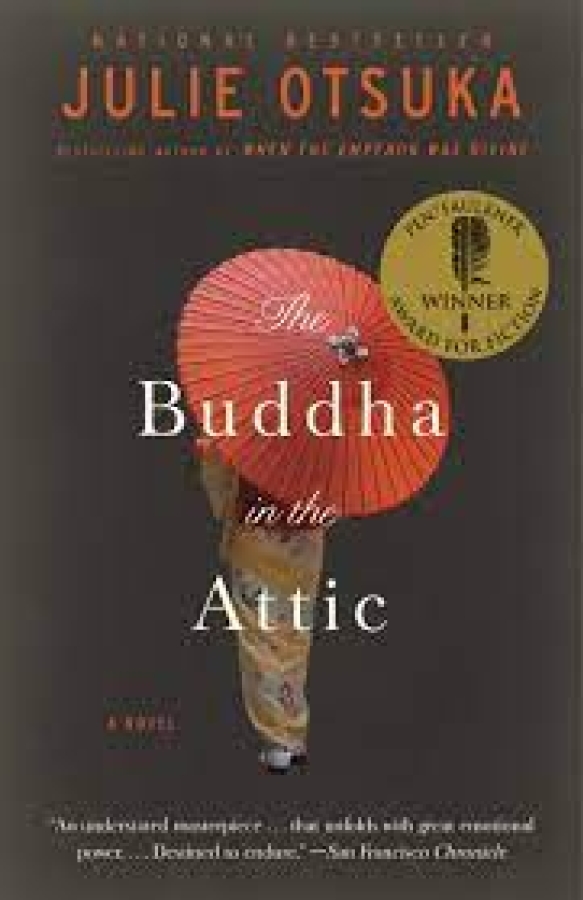
The Buddha in the attic (we all came from the sea)
The novel recounts the experiences of Japanese women sent to the United States to marry compatriots who had immigrated long before. > Some of us were from a small mountain village in Yamanashi and had only recently seen our first train. Others among us were from Tokyo, and had seen everything, and spoke a beautiful Japanese. (...) Many more of us were from Kagoshima and spoke in a thick southern dialect that those from Tokyo pretended not to be able to understand. (...) On the boat we were mostly virgins. (...) We had long black hair and broad flat feet and we were not very tall. What did they think when they saw their husbands, so different from the photographs in age and appearance? “The past was behind us, and there was no way of going back.” The novel follows these women into a reality where they must say > Yes, sir, or No sir, and do as they were told, Better still, say nothing. You belong to the invisible world . They learn to obey, to work hard, to speak English, or at least enough words to survive, and they even take lovers or find husbands among the Americans: they are hardworking and docile, just as men like them to be. When World War II breaks out, from good immigrants the Japanese turn into traitors, spies, and enemies, to be interned in concentration camps. And so Japanese women, even those married to Americans, find themselves locked away. “The Japanese had disappeared from our towns. And soon,” you can still see the official notices posted on telephone poles, (...) but they are already beginning to fray and fade. (...) What those instructions were exactly, no one can clearly remember. (...) In autumn there is no Buddhist harvest festival..(...) All we know is that the Japanese are out there somewhere, in one place or another, and we will probably never meet them again in this world.” To make overall sense of the novel, one can start from the title *The Buddha in the Attic*, banally translated into Italian as *Venivamo tutte dal mare* > . Japanese identity, a blend of Buddhism and Shinto, is put away in the attic the moment the women arrive in America: the new culture must be assimilated, they must become American. It is a mere suspension, because when they are consigned to an unknown place, a non-place > , these women disappear; they are no more; it is as though they had never been. There are two chapters worth reading: *Come, Japanese!* > the journey of these women: nostalgia and the severance of ties, fear and anticipation. These are the components of exile, whatever the origin and destination, feelings common to so many migrants. *The Disappearance* > recounts the evaporation of the Japanese, and the mind wanders to an evanescent novel by Coetzee (see on this site *The Childhood of Jesus* > ). The author intended to give the narrative a choral quality. To achieve this end, she resorted to a literary device: the use of the "we" when recounting the lives of the women, and the impersonal form when narrating the disappearance of the Japanese people. Unwilling to follow the stories of individual women, making them protagonists in their own right, she turned them into a mass, weighing down the narrative and rendering the novel verbose and repetitive. Why not read it? It is boring.
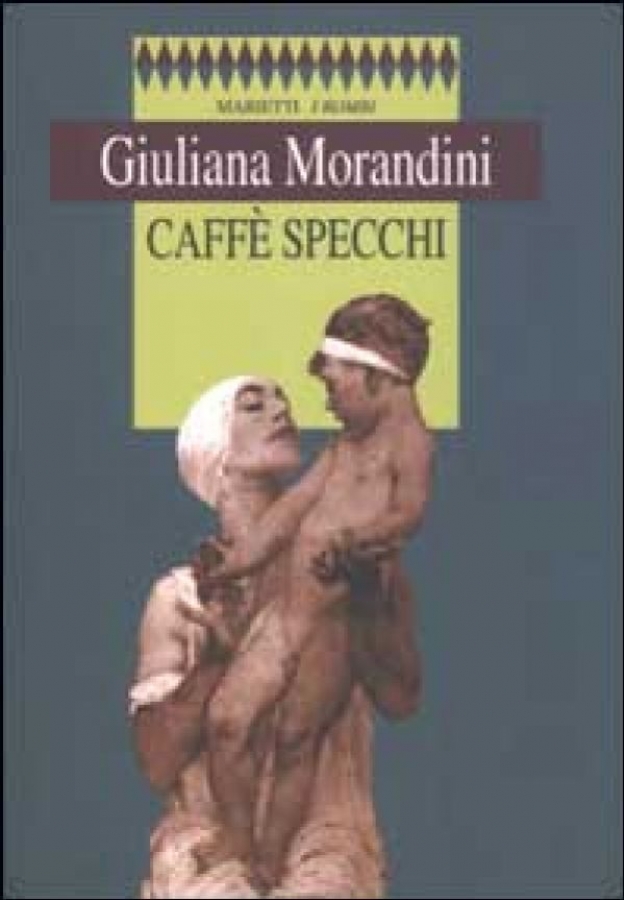
Caffè Specchi
The protagonist returns to Trieste to await custody of her son. In an exhausting wait, mingled with encounters and tragic events (the murder of a young woman), the protagonist experiences the sensation of losing herself. > Suddenly, as if that silence had reached its critical point, the air seemed to congeal, shattering into petals that slipped, swaying, along the pale wall. A rapid decomposition, the dust motes fermenting unforeseen transparencies. In that pause, alarmed glances resumed, and a sense of menace took shape in the atmosphere . The sentence I have quoted encapsulates the virtue and the limitations of the book. One is confronted with refined writing, more akin to poetry than to prose, yet the pursuit of preciousness fragments the narrative, leaving the reader in turn disoriented and struggling considerably to grasp the meaning of the whole. Why not read it? It ought to be read in small doses, but I was unable to finish it.
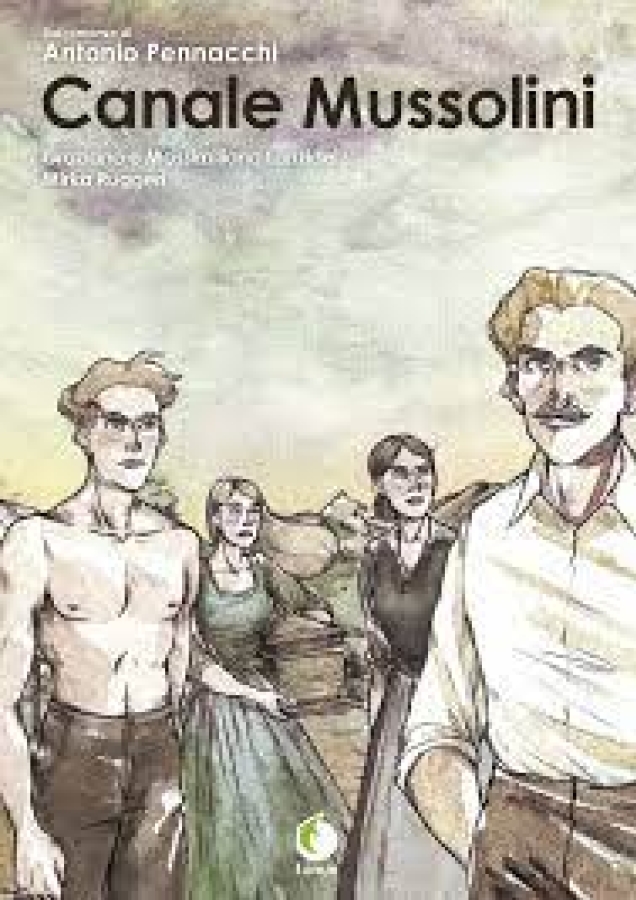
Mussolini Canal
> But look here, my good sir, the two of us cannot go on like this. (...) I haven’t quite grasped what you need, but (...) if I say they did something, they did it, and that is that; you have to believe me, otherwise we might as well drop it. I’m not inventing anything. At most, my memory might fail me . Imagining a dialogue with an interlocutor, Pennacchi adopts a colloquial tone to narrate the saga of the Peruzzis, sharecroppers from the Rovigo area forced to abandon their land under a crushing burden of debt, who travel to the Agro Pontino to colonize the areas reclaimed by the Fascist regime. It is an expansive narrative spanning from the end of the nineteenth century to the early 2000s: a sprawling feast of history and family tribulations that one would wish were a continuation of Riccardo Bacchelli’s *The Mill on the Po*, but unfortunately is not (see the review of Bacchelli’s novel on this site). The Peruzzis are a prototypical large peasant family: anchored by the central figure of the mother and an extensive brood of restless sons and daughters for whom suitable husbands must be found. While in the others the inherited “fury” is tempered by deference to social conventions and expedient cohabitation (with the landlord, the authorities, and fellow peasants), Pericle, the favored second son, cannot contain himself, especially after his experience on the front lines of the First World War. He rebels against the agricultural workers' leagues that still dominated the countryside, throws in his lot with the *squadristi* to the point of murdering an anti-Fascist priest, and, having fallen in love with Armida, a captivating beekeeper, takes her as his own and marries her despite her initial rejection. His active adherence to Fascism enables Pericle to appeal to a powerful *gerarca* to secure a settlement for the family in the Agro Pontino. The Peruzzis' establishment in the still-marshy terrain, the discovery of a different rural reality (with the crucial role played by the cattle), and the founding of Littoria are the most compelling parts of this long novel, not least because it is evident that Pennacchi possesses a thorough knowledge of the region's history, and especially of its reclamation canals, including the Canale Mussolini. Had he explored the colonization of the Agro Pontino more deeply through the perspective of a peasant family, the novel would have attained significant social weight; instead—who knows why?—the author felt compelled to traverse the entirety of modern Italian history: the Ethiopian War, the North African campaign, the partisan resistance, and so forth. The conversational register degenerates into a soliloquy of banal, inaccurate ruminations, a cloud of dust into which Pennacchi dumps his entire ideological baggage; despite the social and political upheavals, the Peruzzis remain frozen like “marble statues,” forever unchanged and deferential to ancestral codes. Even when Armida betrays Pericle, everything is smoothed over beneath the protective wing of the great matriarch, ever vigilant in safeguarding the family’s unity. One detects a sort of nostalgia for a harsh yet orderly world; but perhaps this is merely the reader's yearning to find some genuine sentiment within a narrative that seems to serve only as a pretext for verbose outpourings. The novel has been adapted into a graphic novel by Graziano and Massimiliano Lanzidei alongside Mirka Ruggeri. Setting aside the draughtsmanship, which I am not qualified to appraise, the translation into “comic” form injects dynamism into the plot, bringing several figures into sharper relief: Armida (the carnal passion kindled by her young nephew, the maddened swarm of bees as misfortune gathers), Adelchi, transformed by the Ethiopian War into a racist Fascist, and the young Pericle and Iseo, the designated casualties of an uncritical, opportunistic adherence to Fascism. The graphic novel redeems the book, yet it accentuates the characters’ rigidities—perhaps deliberately—while the Agro Pontino fades, the pencil failing to conjure the atmosphere of the reclaimed lands, much as the author's own pen fails to do. Why skip it? It is verbose; you are better off buying the “comic.”

Quiet Chaos
If the Strega Prize has rewarded the best book of the year, one must conclude that Italian literature is in a truly dire state. The book offers two interesting premises. First, the theme of grief, with the difficulty of feeling sorrow over the death of a loved one. The protagonist has indeed lost his wife, yet he exists in a state of suspended animation (hence the title *Quiet Chaos*), being neither shattered by grief nor capable of resuming normal life. Indeed—and this is the second interesting premise—he decides to spend his days waiting outside his daughter’s school. Within this vigil, his life unfolds through a series of encounters: his sister-in-law and his brother, colleagues concerned with the fallout of an ongoing corporate merger, the company’s owners, the prospective buyer himself, and other minor characters. The protagonist remains indifferent to everything happening around him, continuing to wait for something to break this state of limbo. It will ultimately be his daughter who points out that her classmates mock her for his constant presence outside the school, and that it would therefore be advisable for him to return to normal life. The initial premises are therefore interesting, but they dissolve into the banality and superficiality of episodes that lack any clear connection, rendering the story fragmented, prolix, and inconclusive. The narrative device of a first-person account—a tumble of racing words and clauses meant to convey the illogical flow of thoughts—translates into a tedious, ponderous rhythm that fails to penetrate the depths of the situations and emotions. The themes overlap, ultimately obscuring the central issue: the processing of grief.

What is to be done?
Chernyshevsky was a nineteenth-century Russian revolutionary, a forerunner of the major ideologies and political currents that led to the October Revolution of 1917. An economist, philosopher, and writer, he was imprisoned at the age of thirty-four in 1862 and remained incarcerated until 1888. Written during his early years of imprisonment by a young idealist, the novel bears an overwhelming moral and political imprint, one that compromises its strictly narrative component. The theme remains strikingly timely: women’s freedom and equality. Vera (meaning "faith" in Russian) lives in a narrow-minded bourgeois family and is destined for a marriage of convenience with a wealthy, vulgar suitor. In a splendid depiction provided by one of Vera’s dreams at the end of the book (an extraordinary foreshadowing of Nietzsche’s oneiric style), Queen Astarte commands the young woman, portrayed as "a reclining woman," to submit to her lord. > Brighten his leisure hours. Love him, for he bought you; and if you love him not, he will kill you . But Vera replies that it is not she > depicted in this scene. Back then I did not exist. That woman was a slave. where equality is lacking, there is no place for me . And indeed, Vera rejects her destiny, rebels against her family, and marries a young doctor. It is no mere rebellion of a resolute adolescent. Vera knows full well that she has emerged from "a damp and dark cellar" to liberate other women, who "still lie captive and infirm." Now independent, Vera sets up a sewing workshop, where the seamstresses not only share profits and decide on business matters and organizational structure for themselves, but also dedicate themselves to their own education and the emancipation of women. The marital relationship between Vera and her husband is modeled on friendship, devoid of emotional and sexual ties. > Listen carefully now: this is how we shall live (...). First of all, we will have two rooms, yours and mine: in a third room we will dine, and receive our mutual friends. Secondly, I shall not enter your room (...) nor will you enter my room . Later in the final dream, Vera imagines this female figure being represented by another queen, Virginity. > Man’s primitive brutality was gradually tamed by womanly beauty.(...) Man loved the pure, inaccessible virgin. Yet woman did not yet possess a consciousness . It appears to be a tranquil situation, but a deep unease pervades Vera. It is a dream that reveals this. The young woman imagines that an artist forces her to read her diary. > It spoke of the two of us (Vera recounts to her husband) and how fond we are of each other, and then all of a sudden, at the touch of his hand, vile words appeared, saying that I did not love you . Vera certainly cannot follow the third queen, Aphrodite, who beckons toward an apparent freedom, pursued as it is by "trafficking in pleasure." She must experience true love, founded upon an equality of intellect, feeling, and sex between man and woman. She falls in love with a friend of her husband, Kirsanov: their affair is fraught, as both wish to disavow it and remain faithful—she to her bridegroom, he to his friend. The suicide of Vera’s husband enables their love story to materialize, bringing about "equality between the two beings who love each other." Thus speaks the fourth queen in Vera’s dream. > Once the equality of the sexes is recognized, man no longer regards woman as his property. They love each other because they wish to do so . (...) If you wish to express in a single word what I am, call me equality. The overriding reliance on dialogue between the characters, particularly between Vera, her husband, and Kirsanov, gives the impression of being faced with a Socratic dialogue, reinforcing the philosophical and moralizing character of the writing. It is always Vera who steers the reasoning, while the two men are stereotypes, figures flattened by the woman's personality. Vera is a complex character; at first, she is simply a young woman still uncertain and frightened; she pragmatically seizes the opportunity of a liberating marriage; with typical youthful confidence, she faces a relationship devoid of that gentle, assiduous caress, the need to cradle oneself voluptuously in a feeling of tenderness«. Then, she experiences »the imperiousness of that gentle feeling > , even if she cannot bring herself to call it love. Her husband’s suicide devastates her, but she overcomes it, defining the ensuing guilt as a pointless melodrama". A little selfishness does no harm! In the end, she becomes a woman thoroughly conscious of her own worth and aspirations. It may be that Chernyshevsky identified with Vera, and that the book is therefore a *Bildungsroman*, or the swan song of a lost youth. From a literary standpoint, it is a mediocre tale; the dialogue-driven narrative style and the glut of reflections, digressions, and declarations make it bombastic, repetitive, and prolix. Only the dreams carve out an innovative rupture within a traditional narrative structure that is ill-suited to plumbing the depths of its characters and situations. Why not read it? It is boring.
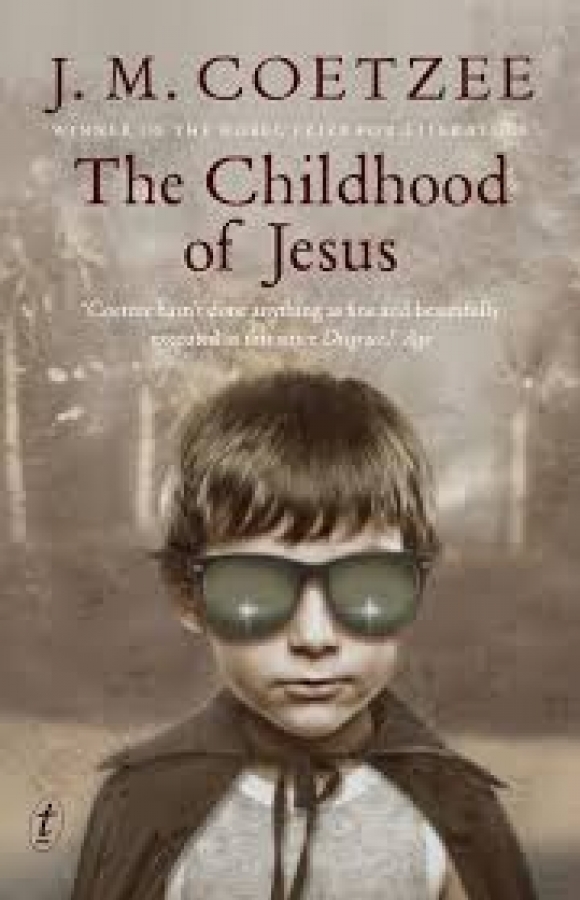
The Childhood of Jesus
In *Age of Iron* (among the reviews), the mother abandoned by her daughter and condemned to solitude cries out in despair, “let me go to myself, (...) it is a hard task, but I am learning.” In *Disgrace* (also among the reviews), the protagonist, a pompous intellectual, moves toward death: > lying on a plastic chair amid the stench of chicken feathers and rotting apples, he feels his interest in the world drain away drop by drop . And what if, instead, we refused to accept death, even if it assumes the shape of Paradise? An adult and a child find themselves in an imaginary world where kindness and friendship prevail, in which everything flows ever identical to itself, where everyone has forgotten their past. > Nothing is missing. The nothing that you think is missing is an illusion. You are living in an illusion. For the protagonist > this life is too placid for his taste, it lacks too much in ups and downs, in drama and tension, it is too much, in fact, like music on the radio. *Anodina*, “is that the Spanish word?” The story itself is nothing but a narrative. Our history is not real. What, then, is our life? A tale? In short, accepting Paradise can only be done by losing oneself. As Dante says in Canto XXXIII of *Paradiso*, > As he who seeing in a dream,/that after the dream the passion impressed/remains, and the other returns not to the mind,/such am I, for almost wholly ceases/my vision, and yet still distills/within my heart the sweetness born of it (lines 58–62). That is to say, only if I surrender to a mystical intuition of God can I dissolve into Paradise and attain a peace, serene and eternal, even if monotonous. Had I continued reading, perhaps I would have understood the role of the child (Jesus accompanying the incredulous Joseph?); I must confess that I abandoned the book by virtue of every reader’s right to drop a story if it is not to their liking. What troubled me was the abstractness of the dialogues and the repetitiveness of the plot. It almost seems as though the author were conversing with Saint Thomas or some other theologian, using the characters not as living subjects rich in emotion, but as feeble stand-ins for concepts. Then again, we are in Paradise. Coetzee has convinced us: with death, it is better to vanish into nothingness. Why not read it? Abstract, boring, and inconclusive.
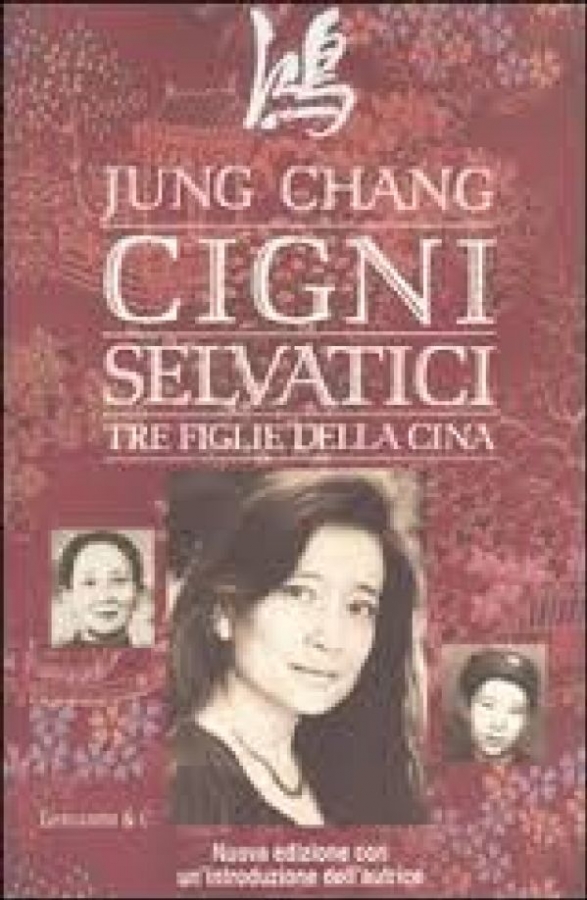
Wild Swans: Three Daughters of China
The book traces the history of China from 1909 to 1978: from feudal and imperial China to the end of the Cultural Revolution, through the Japanese invasion and the struggle for independence, the civil war between the Communists and the Kuomintang, Mao's victory and the birth of the People's Republic, the long years of perpetual revolution waged by the Red Guards, and the ensuing social upheavals. These dramatic events are recounted from the perspective of three women: the grandmother, still a prisoner of traditional society; the mother, who embodies the figure of the emancipated Chinese woman; and finally the daughter, Jung Chang, protagonist and narrator, an expression of the new China. The narrative concludes with Chang’s departure for America. It is a vast historical fresco, so detailed as to become a sort of reportage (neither essay nor novel), with the consequence of flattening individual lives and fragmenting major political and social events, rendering them inexplicable. Summarizing the book is pointless; it is far more worthwhile to dwell on certain fundamental themes. What does it mean to live inside a grand myth that dissolves slowly yet inexorably? The young Chang grew up in the cult of Mao, and until the very end attempts to salvage his figure. > What had turned people into monsters? Why all that useless brutality? It was then that my devotion to Mao began to waver. (...) Doubts about Mao’s infallibility began to creep into my mind, but at that stage, like other people, I blamed mostly Mao’s wife and the Cultural Revolution Authority. Mao, the deified emperor, was still above suspicion . Then, she somehow justifies him. > Mao found the idea of peaceful progress suffocating: he was a restless military leader, a warrior-poet, and he needed action—violent action . And finally, she reaches a definitive turning point: her certainties collapse, shattering her very bond with China. > Now I asked myself: if this is paradise, what then is hell? (...) somewhere in the world there really did exist a place laden with even greater suffering. (...) It was in that frame of mind that I composed the poem. I spoke of the death of my indoctrinated and innocent past as dead leaves torn from a tree by a whirlwind and carried away into a world of no return. What also fractures her deep devotion to Mao is the conflict between familial bonds and communal values. Chang’s mother risked her life for the liberation of China and for the communist ideal, yet because of her independent nature and her regard for life’s authentic values, such as friendship, she is singled out for public disapproval. When she asks what matters she must seek instructions on from the Party, she is answered: “All of them.” There is no individual space. > My mother was eighteen, had just married, and was full of hopes for a new life, yet she felt miserable. (...) She found she could not blame the Party, which seemed to her to be in the right, so she blamed my father—first for getting her pregnant, and then for failing to support her when she was attacked and rejected . Chang’s decision to leave China is also an escape from the fate of her mother, who had so thoroughly internalized the Party’s authority that she failed to realize that the appeal to communal values was hypocritical and absurd, serving only to justify absolute power. In Chang’s detachment from her native country, in her rejection of her homeland and her idealization of the West, her father also plays a part—a man whose devotion to communism is absolute, a man “faithful above all to the revolution.” Yet when he was forced to burn his books, he broke down into a > heart-wrenching, faltering, and wild weeping, the crying of a man unaccustomed to shedding tears . The only response is affection—a “bourgeois” weakness condemned by the Party. > I was so terrified that at first I dared not do anything to comfort him. In the end, I put my arms around him from behind and held him tight, but I did not know what to say. (...) After the bonfire, I had a distinct feeling that something in his mind had changed : Madness is the only outcome of a life wholly consecrated to political faith. The long historical sweep has a happy ending for Chang (she wins a scholarship and is able to go to America), but ends poorly for China: a place no longer loved by the young woman. It would have been a compelling theme had it not been handled by a hybrid book: it is not a work of history because history, to be useful, can only be studied “from above,” so as to provide an overarching view; nor is it a novel, because that would have required a narrative style richer in language and imagery, demanding a deeper exploration of the characters’ feelings and interpersonal relationships, paring back the minutiae rather than merely describing, striving instead to convey and articulate the cultural and social climate. In short, one cannot speak of a place if one no longer loves it. One cannot write history from a microcosm. Why not read it? It is long, flat, prolix; it does nothing to help understand China’s recent history.
The Black Swan
> I went on living and writing. Without enthusiasm, living and writing. (...) With supreme indifference, I watched my young female colleagues, laden with charm and sacred zeal, pass me by without even elbowing me. I myself stepped aside to make way for them . This opening of the novel leads the naive reader to believe they are facing the story of a girl, with “a face like so many others,” searching for herself in the Milan of the 1980s—an up-and-coming, aggressive city greedy for money. A suspicion should arise from the young woman’s improbable name: Arlette, the byline of an advice column in a periodical titled *Dialoghi dʼamore*. All the same, the novel’s clever literary construction would seem promising: the present is narrated by Arlette, while the events that led to today—the 1940s and 1950s—are written in the third person, thereby distinguishing Arlette’s discovery of her life as the fruit of the past from the objective narration of the facts and figures that shaped that past. As one reads on, one realizes that this initial impression is an illusion: we are faced with a missed opportunity. The plot is so far-fetched as to become banal. The setting is the Lombard upper-middle class, forever teetering between Milan and Switzerland. At the beginning of the 1940s, Edison is a shrewd, unscrupulous entrepreneur; with the money of his wife, whom he cheats on repeatedly and openly, he has built a publishing empire. He has an affair with a young female writer, who leaves him when Edison refuses to publish a novel of hers. The wife, instead of following the mistress’s example and leaving her husband, bears it patiently: for the love of her children, like any good mother? out of self-interest, like any good daughter of the bourgeoisie? We will never know, for the novel utterly lacks any character depth. Edison’s wife has a brief affair as well, though not with an ordinary person—none other than a monsignor. When we return to the present, we learn that Arlette is the daughter of Edison’s mistress and has had an affair with Edison’s son. Don’t panic! We are not dealing with incest, because Arlette was fathered by another man; even if Casati Modignani has a penchant for the sordid and the morbid (in one episode, children peek through a peephole at women urinating), there is a limit for a respectable bourgeois writer! From Arlette’s love affair a baby girl was born, heiress to the great publishing empire following her father’s suicide, committed, of course, in an exceptional setting: a suite at the Grand Hotel in Rimini. This brief synopsis offers a taste of a story fraught with intrigue—the kind that ought to surprise us, but instead falls completely flat, because after just a few pages the naive reader realizes that anything is possible. Boredom sets in; but what irks most is the worldview: the male figures are mature, wealthy, powerful men; the female figures are fragile women resigned to a subordinate role, constantly in search of a lover or husband who can provide security and, naturally, a comfortable life. Are there no young men to fall in love with? Marriage is a peaceful harbor, where one sees not > glittering rainbows, but (...) the sweet naturalness of two spouses tested by a life lived together . One dreams of an ordinary life, far from the intrigues of a bourgeoisie ravenous for power and money, while still enjoying its perks. There is nothing wrong with writing about the upper-middle class; what rankles, perhaps, is the shallowness with which the author handles dramatic and momentous events, such as the Second World War and the Resistance—the latter’s depiction steeped in platitudes. What cannot be excused, however, is the vacuity of the characters and the thinness of the settings (the descriptions of drawing rooms and gardens resemble those of interior decorators, cold and impersonal). Casati Modignani cites a nineteenth-century poet and educator: > so on the ocean of life we pass and speak to one another. A look and a voice. Then darkness once again . That may be true, but one must give voice to people, to characters; one must speak of their feelings and their stories, not merely ones fashioned out of intrigue, power, luxury, and money. Why avoid it? It is truly dreadful! Insignificant, tedious, and superficial.
As God commands
A poor book, certainly not on the level of his previous ones. A group of friends live in the provinces, revolving around a young boy who inhabits a bleak and squalid environment. The characters and their stories are pushed to the point of absurdity. The boy's father is a Nazi fanatic, obsessed with brute strength yet fundamentally good-natured and deeply devoted to his son; another friend is an alcoholic, recently separated from his wife, who dies attempting a bank robbery; yet another is mentally disabled and, in a fit of madness, murders a girl before taking his own life. The underlying theme of the book is the strong bond between father and son: an affection that manages to survive and grow even in a squalid environment and among characters seemingly governed by absurd myths. Another positive character is a social worker who helps the boy and eventually finds love. As Francesco Troiano wrote > Ammaniti paints, beyond the plot, the portrait of a country devastated by vulgarity and consumerist flattening: the men have dyed hair and the women designer sunglasses, they vacation at Valtur holiday villages or at the Coral Bay in Sharm el-Sheikh, buy their mobile phones at "Cellulandia," and shop at the "Quattro camini" shopping center > . All around, the misery of those who did not make it, depicted nonetheless without indulging in facile sympathy: the ferocity, perhaps not entirely conscious, of the poor explodes—as it already did in *Io non ho paura* > —in devastating and unpredictable ways that leave no room for justifications of any kind . It is a treacle of episodes, sentiments, and social themes that lapses into the tedious and the predictable.
With the Worst Intentions
The book is set within the affluent Roman bourgeoisie (*pariolina*) of the 1970s and 1980s. A Jewish family, the Sonninos, leads an extraordinarily luxurious and lavish life, even as they weather periods of great prosperity, bankruptcy, and eventual financial recovery. The patriarch, grandfather Bepy, lives in absolute dissoluteness, shaping—for better or worse—the fate of his entire family, his children and grandchildren alike. The Sonninos' story intersects with that of the Cittadinis, whose patriarch, Nanni, was once Bepy's business partner before steadily amassing an even greater fortune, ennobling himself through marriage to a princess. Nanni, too, has dictated the lives of his kin: a son who commits suicide, an alcoholic grandson, and a granddaughter, Gaia, with whom Bepy’s grandson, Daniel, is in love. A primary narrative thread running through the book is the saga of the two families, almost a Roman *Buddenbrooks*. Yet these family chronicles merely serve as an occasion to depict paradoxical characters and settings—in the vein of Jeffrey Eugenides’s *Middlesex*—and to stage Daniel’s personal search for lost time, vaguely reminiscent of Proust. The theme of Jewish identity is also present, with touches and echoes of Woody Allen. It is, therefore, a book heavily indebted to other literary influences, and the style itself calls to mind Saul Bellow or *Barney’s Version*. The pacing and structure are engaging at first, only to grow increasingly tedious, repetitive, and predictable. The excessive reliance on the interrogative form and the jumble of idioms and languages fracture the narrative, which is sustained neither by a thorough depiction of its context (the portrayal of the Roman bourgeoisie comes across as superficial and in some respects inauthentic, given the protagonist's cosmopolitan background) nor by an incisive analysis of the characters, their feelings, and their emotional and spiritual evolution. Perhaps the most genuine aspect of the novel is its portrait of youth: an intellectual, ironic take on the coming-of-age tropes of Moccia.
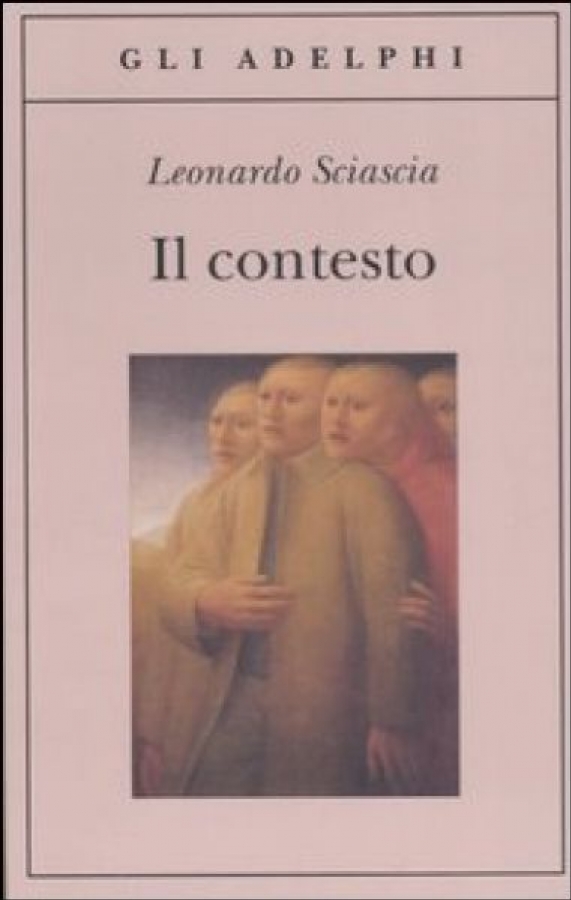
The context
The book recounts the story of Inspector Rogas, who is called upon to investigate the murders of a series of magistrates. The inspector identifies a lead (a wrongly convicted man exacting revenge), but is diverted by his superiors toward a politically motivated track. Pursuing this line, he discovers a plot to assassinate an opposition politician in order to thwart a potential alliance between ruling and opposition forces. Shadowed, a staged crime scene is orchestrated in which the inspector has supposedly killed the opposition leader, only to be slain himself. A friend of the inspector approaches the new head of the opposition to disclose the truth, but is persuaded to back down for the sake of “social peace”. Written in 1971, the book bears the heavy imprint of the era of the Historic Compromise and terrorism; it reflects all too heavily the political dilemmas of that historical juncture, rendering the narrative sluggish, prolix, and largely unengaging. The author’s fundamentally pessimistic outlook regarding any genuine prospect of change in our country is reaffirmed, yet the narrative drive of his other novels is absent, and the underlying irony drowns in tedious philosophizing.
The Corsairs of Bermuda
The book belongs to the Bermuda cycle. The context is the American War of Independence (thus the mid-eighteenth century) and the protagonist is Sir William, an English nobleman of French descent who has become a privateer to fight his half-brother, the cruel Marquis Halifax, who seeks to take his beloved from him. Unhappy love and the grand poetry of the sea seem to be the novel’s points of reference: > ah! that night! embraced on the sand dunes, we listened to the sonorous rhythm of the waves. It is a divine music, a music worth all those created by instruments of brass, of copper, of bronze . And at the beginning, one witnesses a naval battle, just as in Salgariʼs finest novels. Subsequently, the plot takes another direction. The beloved is held prisoner in Boston, a city in British hands and under siege by the Americans. Sir William, together with his stalwarts, Testa di Pietra and Piccolo Fiocco, infiltrates the besieged city, and they attempt to free the woman. A series of adventures follows, but in the end, the cruel Marquis of Halifax manages to escape with Sir Williamʼs beloved. The narrative pace is sluggish, weighed down by the constant exchange of jokes and banter between Testa di Pietra and Piccolo Fiocco: dialogues dominate, relegating the action to the background. On the other hand, the novel’s true protagonist is Testa di Pietra, his cunning, his peasant wisdom, his nostalgia for his native land. Brittany. Yet Salgari fails to depict sentiment. Deprived of action and of characters who are both brooding and heroic, the narrative loses its allure and turns tedious. Why not read it? The sea, love, and tragic destiny are nowhere to be found: the true Salgari, then, is absent.
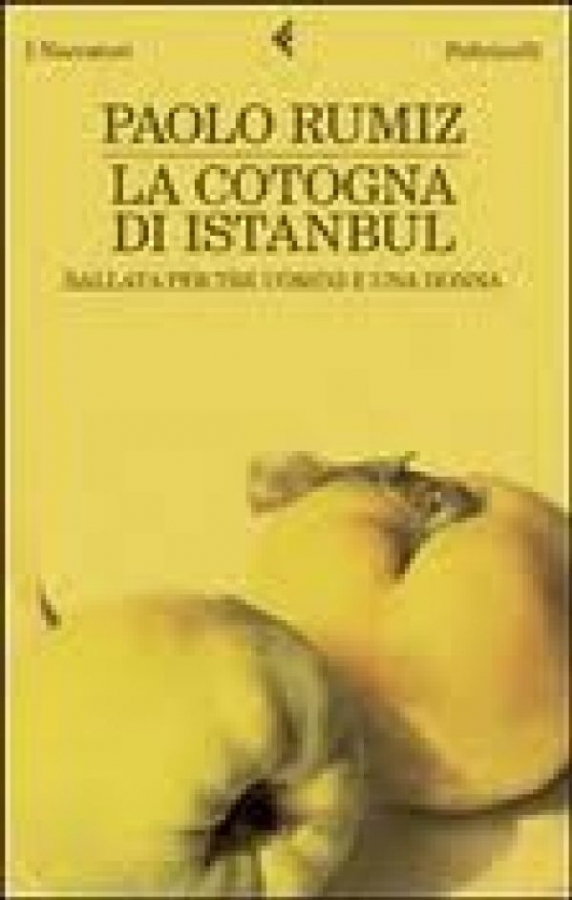
The Quince of Istanbul
The quince is > the only fruit that with time can make its fragrance grow stronger rather than languish. It is ugly, full of bumps, but with time it grows rounder, softer, more beautiful and feminine . The tale is the chronicle of a tenacious love, for a land and for a woman. The land is Bosnia, “the land of long loves and long grudges.” The woman is Masa, “a Tatar face, eyes like black grape berries.” Fate has it that the woman’s fiancé is arrested just days before the wedding. Masa, > flowing dark copper hair, stubborn as a partizanka and strong-willed as a Bosniak woman , waits for her man for ten years (in fact, in the meantime she marries and has two daughters, but it is an interlude of no consequence in the tale, whose purpose remains baffling). When the man returns, after a few days he is killed by a grenade, and then > for Masa the beautiful... an affair ended that had lasted ten years of waiting—if you catch my drift—and ten days of leave . It is at this point in the story that Max steps in, an Austrian engineer who falls in love with Masa and through her with Bosnia and Sarajevo, because > nowhere can you better understand the destiny of Europe... where the last illusion (of great universal brotherhood) had died, toward the houses around the airport riddled with the marks of Armageddon . Yet Max’s great love for Masa is also destroyed, this time by the tumor that will lead to her death. At the news of Masa’s loss. Max becomes convinced that > only one thing could have halted that cursed fate: it was the fruit he was supposed to fetch, and perhaps had not fetched in time, the mysterious zuta dunja, the yellow wonder of the imperial city. And instead Masa, the belle of Bosnia, with eyes like black grape berries, had died aman aman without ever receiving that quince awaited from Istanbul . And so Max sets off on foot in search of the quince. At this point, the story becomes so muddled that all we can say is that Max dies mysteriously in an Istanbul hotel. It often happens that a writer who is very accomplished in one literary genre seeks to test himself against domains, narrative structures, and modes of writing that are not congenial to him, with failure as the result. Consider Ken Follett, who with *Eye of the Needle* had written a fine thriller, only to then devote himself to massive historical novels, through which it became abundantly clear that he was neither Tolstoy nor Victor Hugo. Such is the case with Rumiz, an excellent journalist who set out to tell a story, already muddled in its own right, in the form of a long ballad. What came out of it is a verbose, fragmented, tedious, irritating singer-songwriter ballad. Relying on suggestive impressions and evocative effects may work well for a song consisting of a few stanzas, but enduring all this for some two hundred pages is truly too much. The truth is that not everyone knows how to craft an epic poem! Why skip it? It is irritating, superficial, and dull.

Prohibition of Residence
The book is an investigative narrative, presented through a series of interviews with immigrants. It spans from the Eastern European prostitute to individuals who have achieved success in the economic, social, and political spheres. What emerges is a highly variegated picture, revealing that, paradoxically, integrating and climbing the social ladder was easier for immigrants who arrived in 1970s Italy than for those who have come more recently. In truth, immigration mirrors the deterioration of Italian society: a growing inward turn, indifference toward novelty, and thus a tendency toward an "ostrich" policy—refusing to see that Italy is changing. There are two aspects of the book of considerable interest: the first is encapsulated in the quote cited in the book itself: "We wanted workers, but people arrived" (Max Frisch). As the author notes, it is the cultural and ideological framework underpinning Italian legislation that is flawed: > it is still the economic utility of the migrant's labor that validates their right to live in our country . Or, as a Somali domestic worker puts it in other words: I am treated > essentially well, even though when I told my story I sensed a general indifference. It is a business relationship: I provide a service and they pay me . In political terms, Jean-Léonard Touadi, a commissioner for the Municipality of Rome: > move beyond the logic of social assistance, stop approaching the category of immigrants, however fragile, through the lens of emergency welfare interventions. Instead, each of us needs equal opportunities, access to culture, access to housing, easier access to credit . Yet aren't these the problems of Italians as well? The second aspect concerns how Italians are viewed by immigrants. It is an intriguing perspective, revealing a somber world in which, for example, the elderly have lost much of their authority while spoiling children has become the norm, a division of roles persists between men and women, emotional life is bleak, and indifference prevails. "There is great individual care and little, or rather none, for the collective space." > I happened to share what we eat in my country, and most of the time they looked at me with disgust . The art of getting by prevails, as workers are selected based on referrals from relatives and friends, and consequently > the worker is not chosen based on qualifications and professional training, but as a member of a category of peers sharing the same origin . The book is engaging, yet it relies too heavily on interviews with successful figures and official representatives of the immigrant community, neglecting the essential labor of digging on the ground—that is, among ordinary people. Beneath a clean prose style and a well-constructed narrative, a journalistic weakness and an investigative fragility emerge, lending an impression of artificiality to what is recounted.
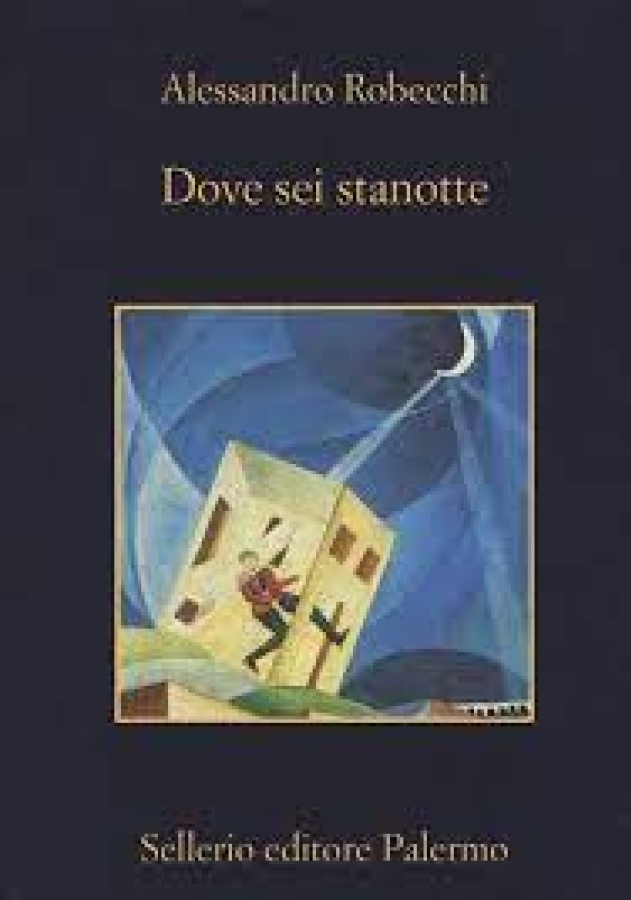
Where are you tonight
> He wears old boots, one gaping open at the toe, like a toothless grin. (...) But ultimately nobody sees him, because in Milan, even with the Universal Exposition and its status as the center of the world, a homeless man pushing a cart filled with his life is merely part of the landscape, and thus invisible . With this image of commonplace social indifference, the novel held out the promise of a Noir with a strong social imprint; especially when paired with another hallmark of Milan as "capital of the world": the world of television and major annual trade fairs, such as the Salone del Mobile. The protagonist, Carlo Monterossi, is a famous producer of a television show that even he despises; he lives in a splendid apartment with an efficient, protective housekeeper: it is a fake, superficial life that could go on forever, comfortable amid parties, fleeting affairs, and self-pity. Until everything is upended. At the end of a party, he finds a Japanese man in his home, dazed and terrified. Who is he? What is he doing in his house? And why is he murdered, and Monterossi's fine residence ransacked? It is from this premise that a Noir sets off, bogged down by an entangled and redundant plot featuring everything except the essential ingredient: suspense. Like a grand mélange of Simenon and De Cataldo (see the citation of *Romanzo Criminale* on this site), we have police intrigue, the secret services, an alienated yet sharp inspector, the cynical, wheeling-and-dealing backdrop of the "Milano da bere," marginalization, illegal immigration, and finally—why not?—even love. In short, it is a miscellany, fortunately seasoned with frequent Bob Dylan quotations steeped in a melancholy romanticism, as in these lines: > In the early morning rain with a dollar in hand / An aching in the heart and pockets full of sand / I am far away from home and I miss my only love so much . The narrative style is dynamic, alternating effective descriptions with tight, rapid-fire dialogue; yet narrative fluency is undermined by the constant entrance and exit of various characters—tiresome and confusing in its repetition—and by the recurrent psychological introspection devoted to Carlo, who slowly evolves from a frivolous dandy into a "real" man. It is, perhaps, an attempt to introduce an inner transformation in the character: a shift that remains unresolved because it is never fully explored, reducing it to a mere literary device. The writing is elegantly simple; it deserved a sturdier, better-constructed story. Why not read it? It is prolix—the worst possible flaw for a Noir.

Echo Mountain (The Echo Girl)
We are in Maine in 1934: in the wake of the Great Depression, a family has had to leave the city and relocate to the foot of a mountain, on the edge of the forest, adapting to life in an environment entirely foreign to their urban past. The mother confesses to her daughter Ellie, still an adolescent: > she looked at her ruined hands. I feel like a stranger in this new skin. I left behind too much of who I had always been. Ellie, by contrast, is fascinated by this new life; she wants to understand and adapt. In this she has been helped by her father, a vital anchor for the young girl. > This bond with my father and the wilderness drove a wedge between me and my mother, and especially my sister, because both seemed to think that I had somehow betrayed them by feeling happy when they were not. To understand what the "mountain’s echo" represents for the girl, one can point to the episode of her encounter with the bear. > But then I made the mistake of reading, in his eyes, that primitive quality I so admired. Of sensing, in him, a love for things I loved: lying in a meadow with the grass growing tall all around, hiding from everything except the sky and swarms of bees, heavy with flower pollen, nodding toward me (a splendid turn of phrase!) bobbing the way bees fly. Or the pink of the sunset. Or the clear whisper of a wood thrush. We are in the throes of a full romantic idealization of nature! In Ellie, contradictory feelings coexist: an aching loneliness because she no longer feels part of the family, and a sense of freedom in an environment where she can roam, exploring the forest, learning to harvest honey, and doing practical chores under her father’s guidance. This precarious situation unravels when her father suffers a grave accident that leaves him in a coma. Ellie takes the blame upon herself, concealing the truth of what had happened: it was her little brother who, chasing a rabbit while the father was sawing a tree, caused the man to move, leading him to be struck by the falling trunk. > Part of me wanted to tell her that it was Samuel’s fault (the little brother), if the little boy could be blamed for anything. But when I thought of saying those words, I felt fragile and sad. (...) I decided that shifting the blame would be worse than shouldering it. If I had learned anything from the mountain, and from my father, it was that I would feel stronger and happier if I were able to face adversity and do it well. So I remained silent. And they took the silence for a confession. How will Ellie overcome the anguish that overwhelms her: the estrangement from her mother and sister, the sight of her paralyzed father, the strained relationship with her little brother, the arduous life in the wilderness, the material hardships of an impoverished and isolated family? She will do so by venturing into mysterious nature, uncovering its magical and salvific secrets. It is certainly a *bildungsroman*, though it must be said that Ellie appears to be a strong, resolute girl right from the outset. It is as if life’s hardships and the forces of nature merely brought out something Ellie already possessed. What weighs upon the entire narrative, rich in characters and adventures, is the banal depiction of a benign nature—the dream of an escape from urban and industrial life. It is too easy! The woods, the mountain, the wild animals are not friends, but primordial forces answering to the blind laws of the primitive world. Ellie ostensibly sets out to discover her new surroundings; in reality, the latter are merely a mirror of what we romantically daydream nature to be. To understand the novel’s limitations, one must turn to *Treasure Island* (see review on this site), where Jim faces dangers alone, evades the allure of evil—which exists regardless of what we might think—and in doing so truly comes of age. The writing is elegant, alternating tight dialogue with fine descriptions rich in musical and captivating phrasing. Across too protracted an expanse, the plot frays, grows prolix, and loses the sharpness of the opening chapters. Why not read it? It is banal.

The Legacy of the Goddesses
> The Kopanice region lies on the border between Moravia (the south-eastern area of today’s Czech Republic) and Slovakia, comprising various villages scattered across the slopes of the White Carpathians. Si tratta di una regione che ha pienamente conservato le sue tradizioni folcloristiche, anche perpetuate in una forma arcaica, soprattutto perché è un luogo quasi isolato dal mondo circostante . The women called goddesses are > subjects who possess, according to widespread belief, specific abilities enabling them to heal illnesses, to see the past, to foretell the future, and to uncover information generally inaccessible to ordinary people . So read Gestapo documents, intent on confirming the theory that a remnant of Germanic population had survived in Moravia, thereby justifying the Third Reich’s claims over Central Europe. It is not political motives, however, that prompt Dora, a young ethnography researcher, to study the goddesses. She herself was raised by a goddess, her aunt Surmena, ever since discovering—still a child—the body of her mother, hacked to death with an axe by her father. > For a long time, she had thought that this was the origin of all her suffering. But that was not true. (...) Dora was not stupid, and the stricken faces of the villagers spoke clearly: her and her brother’s misfortune had begun much earlier, at a time that her short memory could not recall . With the resolve of a scientist and the tension of someone personally implicated, Dora retrieves and scrutinizes archival documents, tracing back the course of history: from the witch hunts to the meticulous Nazi investigations, right through to the socialist era, with its rationalistic and conspiratorial theories. She does not confine herself to analyzing and comparing police reports, research by anthropologists and ethnographers, letters and accounts; she frequently returns to the places of her childhood to gather the women’s testimonies and experience anew > the woods filled with beeches and oaks, (...) the meadows teeming in summer with rare orchids, marsh orchids, and anemones, interspersed with strips of cultivated fields, with low cottages clinging to the ground, (...) with those cold mornings of a sweltering summer, (...) and with those harsh winters. (...) With that round, gigantic moon rising over the dense mountain peaks. (...) And before the doorstep, on the ridge of the hill, one seems to be in heaven, with the entire world unfolding at our feet. Ma perché tornare al passato? Riportare alla luce i mostri? Sulla famiglia di Dora incombe la maledizione di una dea cattiva, contro la quale Surmena aveva combattuto tutta la vita. Se non si affida a «quelle occulte mani che mʼintridono» (come dice Ungaretti) come può spiegare Dora i tragici eventi: il truce omicidio della madre, il fratello minorato in coma per un attacco epilettico, la zia Surmena rinchiusa in manicomio a morire come una povera pazza, il suicidio del padre? > She rested her head against the tiled wall of the hospital and closed her eyes. (...) And what if it really was the fault of the curse that had dragged itself down to them? What would it have meant for her to grow up with that awareness? The novel can be read from many angles: as a historical thriller, a conflict between science and superstition, a romantic immersion into an ancestral world of women, a search for Central Europe’s common roots—Germanic and Slavic at once because steeped in the same Indo-European paganism; and above all the story of Dora, of her loneliness, of her desperate need for a family, of her resilience that refuses to surrender to mystery. Dora cannot accept the vilification of her beloved Aunt Surmena, accused of collaborating with the Nazis and for that reason unjustly persecuted by the socialist regime. The author wanted to tackle too many subjects: the result is an overabundance that wearies the reading, dissolves the plot, and fragments the narrative. And the reader is left with one question: who is Dora? The protagonist is submerged beneath too many facts and too many characters, and we still do not understand who she is, even after more than four hundred pages. Why not read it? It is intriguing at the beginning, but ultimately proves prolix and tedious.

The Examination
> I publish this old story today because I hopelessly love its free language, its fable without a moral, its *porteña* melancholy (typical of the inhabitants of Buenos Aires) and also because the nightmare in which it was born is still awake and roams the streets . With this note Cortázar introduces a story written in 1950, during the years of the first Peronism, between 1945 and 1955. It was a period of profound social change: emerging wealthy from the Second World War, under Perón's leadership Argentina seemed to face a future of development. And yet, unease and pessimism were growing among intellectuals and within the urban middle class; a moral and psychological malaise born of the muted, tacit awareness of the contradiction between a cosmopolitan city, as Buenos Aires was, and a regime obtusely hostile to culture and individual freedoms. The characters of the story—the young couple Juan and Clara, Andrés, Clara, and the chronicler—wander through the night in an unreal city, shrouded in fog. Theirs is a seemingly senseless banter, constantly revolving around the futility of the intellectual. > All this talk, passing papers to one another, these café tables with books and books and books and premieres and exhibitions.... Believe me, there is a swindle here, a betrayal. All that is left for you is to join betrayal to reality, to life, to action, and with this and an emblem on the jacket lapel you are ready to embark on any career . The group has no destination, nor do the events involving them lend a plot to the narrative; alternating between prose and poetry, Argentine, Latin American, and European literary quotations, the youths continue to dwell on the very same theme, in an obsessive and patently futile manner: > a good biologist would laugh his head off hearing our squeaking. Because we don't even scream; ours is the piping of mice . > So absurd to talk at random, thought Juan as they stepped out, to hear oneself talk and know that one is never sufficiently in the right. This is another, perhaps the worst, of our acts of cowardice . Juan, you are truly right! Unfortunately, we are weary of so much idle chatter; we would like a bit of reality, of sound pragmatism. It is for this reason, together with the lack of plot and the shallowness of the characters, that I painfully decided to abandon the book at the end of the first chapter. The story might well proceed to change its narrative pace radically; I shall never know, so be it! «Free language» is fine, provided it is taken in small doses. The question that naturally arises for us Italians of the second millennium is this: how much of this story do we find in our own country? > Creation is born of morality, not of ingenuity (says Juan). Ay, ay, went Clara, we are spineless. Right, spineless, without tension. (...) I mean that we lack a spirit of system (be it freedom or for freedom), and this is above all a moral defect . Why not read it? It is profoundly boring.
Fyodor M. Dostoevsky
The essay is a brief biography of Dostoevsky, accompanied by an in-depth examination of a series of events, figures, and literary works that had a significant impact on the writer’s life. It is a «sort of study guide» that can serve anyone needing to study the author and gain a general framework of the relationships between his life, context, and literary output.
The Ferocity
The book won the 2015 Strega Prize and was framed by many reviews as a sort of Italian-style *Buddenbrooks*: one would expect a fine novel with a pronounced social dimension. Nothing of the sort. It is a dreadful novel, poorly written, intimist-existential, reflecting a perception of reality typical of the 1990s. Bored by the plot, disgusted by the narrative style, I stopped reading at page 237 and can therefore recount the plot only up to a certain point. It begins with the suicide of Clara, the spoiled and eccentric scion of a social-climbing entrepreneurial family from Bari: a scheming and greedy father, a typical Southern building contractor; an absentee mother, placidly satisfied with the affluence they have achieved, and three siblings; an established physician, a twenty-year-old well on her way to becoming just as spoiled as her sister, and Michele, the son of one of the father’s mistresses who died during childbirth. The bond between Clara and Michele is particularly intense, owing also to the young man’s fragility, who finds in his sister—so self-assured—a pillar of support and perhaps an object of love. The novel seeks above all to delve into this relationship, doing so through constant temporal leaps, from the present (Clara dead) to the past, with the young suicide victim still cast as a vivacious girl with an unbridled sex life. Revolving around Clara and Michele, across these different temporal dimensions, are the other family members, all seemingly indifferent to the terrible tragedy that has occurred or to the increasingly morbid nature of the relationship between the two youths. Perhaps because > we are not ourselves, (...) we are driven by forces of which we are unaware, we act without knowing why, we say things whose motive is unknown, crimes without guilt and deaths without apparent cause . Our lives repeat themselves according to the cycle of the seasons, with an inevitability we would like to attribute solely to nature, yet which belongs to us as well. > Startled by the motorbike, the lizard plunged into the blades of grass. It vanished among the branches, tearing in its flight the web of the jumping spider, which, having reassembled the image of the reptile through its eight eyes, had managed to avoid the impact. The spider scurried. The dry, parched ground registered the information, superimposing it onto the alphabet of ants crossing paths, breaking, bifurcating, and then recombining a line that was never the same. The law they obeyed shifted within them, confirming itself in the law of every kindred creature; it received fresh impulses from the depths of the anthill, and further still, from the tremendous force that changes the face of the seasons . It is certainly neither a social novel nor a psychological tale aiming to probe feelings and motivations. The author operates on a metaphysical plane, rooted in the deeply southern conviction of the immutability of the human being and of the socio-political context. Hence, perhaps, the title: *La Ferocia*. Still, a narrative rhythm could have been provided! An intelligible plot! What worsens the literary outcome is the minimalist imprint, reflected in an exaggerated reliance on full stops and the near-total absence of semicolons and colons. In this manner, it is difficult not to splinter the prose, rendering it ponderous and unintelligible. An example: > Michele returned to his room. He made to lie down on the bed. He stopped. From right to left. The nightstand. The wardrobe. He looked around with a worried expression. The half-open window. His heartbeat quickened. Stay calm. She can’t have jumped out of the window already. He sat down on the edge of the bed. And so on and so forth; now one understands why I gave up reading. Why not read it? It is a bad, boring, and dated novel.
Daughters of a New Era
Rudi, the naive and dreamy husband of Kathe, one of the protagonists, encapsulates the novel's overall meaning in a poem: > against the light I saw/that the bridge has fallen/and the faint light/I have now lost/and I surrender myself/to the current that carries me . Four young women are lifelong friends; they fall in love, marry, some of them become mothers, are widowed or divorced—in short, they lead an apparently normal life in Germany between 1919 and 1945. They live through the economic and social crisis of the post-WWI era, hyperinflation, the political turmoil of the Weimar Republic (with the suppression of the Communists by the Social Democrats), the rise of Nazism, racial purity laws (with the reporting of infants born with deformities), the gradual yet inexorable marginalization of the Jews leading up to the Shoah, and the catastrophe of the Second World War. How is it possible to lead a normal life in the face of such dramatic events? > But what was left to do now, if not retreat into the private sphere? The world was no longer an enchanting place . (thinks Bunge, the spendthrift father of Ida, another protagonist). And indeed, the novel develops the stories of Henny, Kathe, Lina, and Ida from a deeply intimist perspective, only superficially grazed by the horrific events that affected the German people. Henny and Kathe have been friends since childhood and mutually decide to pursue careers as midwives, bringing children into the world precisely when one knows not what to expect from the future (a metaphor?). While Henny pursues the idea of family, Kathe makes different choices. The former marries young after becoming pregnant, has a daughter, loses her husband, and marries another, with whom she has another child, only to discover that her second husband was an informant for the Nazis; Kathe does not want children, is a communist, and urges her husband to become politically active, thereby upending both their lives. Ida, on the other hand, was born and raised in luxury; her father, on the brink of bankruptcy, marries her off to a wealthy and powerful banker, condemning her to unhappiness that is only partially redeemed by a long love affair with a handsome Chinese man. Lina soon discovers she is a lesbian and moves in with her partner, in a situation that grows increasingly precarious because homosexuality is condemned by the Nazi regime. There are many other characters, but even from this brief overview of the protagonists one can deduce the fragility of the entire narrative. It is true that war intrudes upon peace and that people strive to the very end to live in indifference; one does not expect *War and Peace*, but one might have expected a plot and character analysis capable of capturing the deep wounds of the human soul when confronted with danger and horror. Peace awaiting war creates a kind of suspension, and people cling desperately to the private sphere, to pale sentiments, customs, friendships, and familial affection. Two splendid novels immediately come to mind: Alba de Céspedes's *There's No Turning Back*, with its young women secluded yet sheltered within a boarding school, and *The Makioka Sisters* by the Japanese writer Tanizaki, a work in which the minute depiction of a 1930s Japanese family serves as a critique of inert familism and, at the same time, of aggressive, warmongering imperialism, so distant from the common sentiment of the people. There is none of this in our novel, so much so that Germany's dramatic events seem merely an excuse to inject some vigor into a plot that would be far too flat and mundane if set in a context of normalcy. It is the beginning of a trilogy, which we leave to other readers. The narrative structure and the writing also warrant a negative verdict. The four young women's stories are developed in parallel through brief paragraphs within a chronological chapter framework. Consequently, the narrative is muddled, making it difficult for the reader to grasp the overarching story, and the plot ultimately proves verbose and repetitive. Too many characters contribute to compromising overall clarity. The writing, in turn, is flat, reliant on short sentences and dialogue; descriptions of the setting (Hamburg) and the social and political context are sorely lacking. Why avoid reading it? Pointless, poorly written, and distasteful, considering what happened in Germany between the two wars.
The Son of the Sea
Let us imagine that in a world—our own—imprisoned in a crystallized social structure, an extraordinary event occurs, upending established arrangements and enabling the destitute to climb the social ladder. Perhaps a revolution is possible only in the wake of a war or a natural disaster. With a tenuous narrative, this novel introduces the theme of change, setting it in an era far removed from our own: 452 AD, when the Huns invaded Italy. We find ourselves in Atesis, modern-day Este, a town then lapped by the Adige River, which shifted its course in 589 following a catastrophic flood. It is a sluggish town, dominated by a powerful Roman family and local notables, the so-called *curiales*. Pietro is a strapping, red-haired lad who works as a swineherd; a hulking fourteen-year-old, timid, withdrawn, illiterate, born of a single night of passion between his mother and a barbarian "who came from the sea, from the lands that lie beyond the great water." Having foolishly humored the curiosity of Giustina, the master's pretty, restless daughter, Pietro earns himself a sound thrashing—just punishment for daring to speak to the girl: a swineherd you are and a swineherd you shall remain; better to consort with the buxom Galla, a commoner like yourself! Everything changes with the arrival of the Huns, received with dread as ferocious, invincible warriors: > they appeared very tall and robust, with compact physiques (...), their steeds had foam frothing at their mouths and eyes full of madness . In reality, toward Pietro and Giustina, who find themselves held captive together, they do not behave as abominably as one might expect: they spare their lives and allow them to return home, where Pietro will fight valiantly in the epic, futile battle to save Atesis. The town is sacked, the countryside is overrun by barbarians and bandits, food and shelter are gone; there is nothing left to do but flee and seek refuge in the lagoons, where the Huns dare not venture for fear of pestilence. They set out on a perilous journey, alone, brutalized by fear and starvation: two teenage boys, Pietro and Tito; a girl accustomed to the comforts and protections of an affluent household, Giustina; and an old black mare. There is little point in following them across the plains and canals leading to the Venetian lagoons: the narrative is trite; it foreshadows *The Adventures of Tom Sawyer* without possessing any of its pace or suspense, gradually devolving into a cloying tale, rife with implausibilities, and thoroughly detached from its historical and natural setting. "There is no journey longer than the one that brings you home," the author declares in the Acknowledgments. After numerous novels set around the globe, Morosinotto turns his attention to his native soil, embarking on a saga that presumably intends to trace the fortunes of Pietro and Giustina—and their heirs?—in the founding of the future, magnificent Venice. Well, he might have applied greater care, rather than relying on timeless adolescent clichés (are we so certain that teenagers in 500 AD were just like our own?) and striving instead to cultivate an atmosphere rooted in the marshy wetlands of the lagoons. One must grudgingly concede that war serves as an effective device for pacing: the defense of Atesis, with its skirmishes and plot twists, engages the reader, evoking an *Iliad* in miniature. The prose flows lightly and smoothly, free of rough edges: an agreeable read, yet one that contributes to the sense of hurried superficiality permeating the novel. I would highlight a stylistic idiosyncrasy: across nearly four hundred pages, the punctuation consists solely of periods and commas; there is only a single colon, and not a single semicolon. A display of virtuosity à la Cesare Pavese, a nod to the journalistic style so in vogue, or pandering to an adolescent readership presumed unaccustomed to articulate syntax? Why not read it? It is trite and dull.
The Fortress of Solitude
The novel is set in the “Negro” neighborhoods of New York. The narrative style proceeds “in little hops,” making for heavy reading. It is difficult to pass judgment because I cannot muster the concentration needed to follow an apparently nonexistent plot and difficult writing, even translated into Italian.
Fire on Naples
The subject of the novel is Naples: “a corpse in an advanced state of decomposition.” Diego Ventre is a brilliant and refined lawyer, but in reality a Camorrista. He learns from a volcanologist that an eruption will destroy a large part of the city. Diego sees in this catastrophe the opportunity to renew Naples, to halt its decline, but he also realizes that enormous profits can be made. He keeps the news secret and begins a series of speculative operations. Meanwhile, he falls in love with Luce, the daughter of a prominent aristocratic family. A courtship begins, through which Diego can display all his classical learning and refined tastes. This does not prevent him from continuing his criminal activities, spinning business schemes, corrupting, and threatening. Naples is destroyed by the fury of nature; Diego and Luce marry, but on their very wedding day Luce discovers that she has married a violent mafioso. She flees, is captured by Diego’s enemy, and raped multiple times as an act of defilement; yet at the very moment of the rape Diego arrives, kills his rival, and points his gun at the young woman’s chest. Does he want to kill her according to a mafia code that cannot tolerate one’s woman having belonged to another man, or is it merely a protective gesture? We will never know, for at that very moment Diego is killed by his brother. The author draws upon an idea from Curzio Malaparte in *The Skin* (the eruption of Vesuvius as the destruction and creation of a new Naples), but this motif remains merely in the background. In truth, the entire novel unfolds around Diego—a villain, yet one ultimately admired, and an instrument for an aestheticizing indulgence in the beauty and ugliness of Naples. The weakness of the plot, the shallow character analysis, the perpetual invocations of an unreal city made solely of monuments, the protagonist’s pedantic and inconclusive soliloquies: these are all factors that reduce the narrative to a sequence of images, of sketches. As the author wrote regarding Naples, > it is a novel without a story, a novel without chapters. The words seem assembled at random, without a true before and without the hope of an after . Why not read it? It is pointless.
A Garibaldian Named Chiara
The year is 1860. Chiara is the daughter of a well-known patriot, a friend of Garibaldi. Disguised as a boy, the girl manages to join the Expedition of the Thousand and thus meets Simone, with whom—predictably—she falls in love. The story is pleasant, but handled far too superficially, both from the standpoint of Chiara’s personal affairs (her desire that her father not marry a Turinese lady, her yearning for adventure, the blossoming of her love for Simone) and with regard to the historical context. The latter emerges in a fragmentary fashion, without illustrating the environmental conditions and political premises of the expedition.
Genoa seemed made of gold and silver
The book is not about Genoa, despite its title. The city is merely a setting, devoid of imagery and depth, in which to recount the life of a police officer. The protagonist is a young man without hope, who believes that life is > merely a scheme of the system, one of many, but men do not control it, not even those gathered at Palazzo Ducale. The system is a headless machine, an autonomous machine . What matters is the group, belonging through courageous and violent actions. This young officer’s entire life is a succession of drills, off-duty leaves, overtime, and interventions against hooligans and protesters. He is assigned to a special squad trained for the G8 summit in Genoa. The drills, grueling and geared toward counter-insurgency tactics, reinforce esprit de corps. In Genoa, the young man’s convictions are put to the test, not so much by what happens, but by his love for a girl who might just convince him that destiny is in our hands, that it is not true that «human beings are what they are». Then everything spirals out of control: the officer takes part in the raid on Via Diaz and discovers that the mysterious girl, met in Genoa, is there among the beaten, bleeding youths. Once again, it was destiny that decided: > I was fucked, I always had been, I cried because Sara was right, I had had my chance to choose, I cried for myself, because I understood that now it really was over . The novel’s overarching theme is cynicism as the consequence of a hopeless life. The story, however, unfolds monotonous and slow, devoid of narrative pace and without the author managing to grant psychological depth to the characters, starting with the protagonist. The greatest disappointment comes from Genoa, which is simply not there (has the author ever set foot in the streets where the G8 clashes took place?), with the result that the whole affair feels cold and artificial. Why not read it? It is boring and pointless.
The Angel's Game
David Martin is a young journalist, who begins writing serialized stories for his newspaper. These stories meet with considerable success, and he is consequently put on salary by a publisher to write a series of novels belonging to a cycle entitled *The City of the Damned*. With the money he earns, he rents a mysterious house, abandoned for many years and previously owned by a strange character, Diego Malasca. Meanwhile, several plotlines intertwine: David is in love with Cristina, who convinces him to secretly write a book for a wealthy friend who wishes to become a famous author. He is contacted by a French publisher—who will later turn out to be the devil, or the personification of evil—who persuades him, for a handsome fee, to devise a new religion. At the request of a bookseller friend, he hires a young girl (Isabella) as his assistant, who aspires to become a writer. David, while continuing to write the commissioned book, launches an investigation to discover who the French publisher is and why he wants to formulate a new religion. At this point, a series of gruesome murders ensues, and David becomes embroiled in surreal and implausible events, all steeped, however, in mystery. In vain does Isabella try to bring him back to reality; David desperately pursues the mystery, and with it, his ill-fated love for Cristina. Everyone close to him, friend and foe alike, dies in a horrific and mysterious manner: Cristina, for example, having lost her mind, drowns in a frozen lake before the eyes of her friend. After a succession of grim events and terrible deaths, David manages to flee to a distant foreign land, only to meet the devil one day, many years later, who entrusts to him Cristina as a child, thereby opening up the prospect of a future. The scene faithfully mirrors a photograph David had found many years earlier, depicting the devil walking hand in hand with Cristina as a young girl. Mystery reigns unchallenged. What is the meaning of this book? There are, undoubtedly, numerous interpretative hypotheses: the construction of a religion of death that is nevertheless overcome by love, an unhappy love story, a "noir > inexplicable, a labyrinth of ideas and situations whose guiding thread remains elusive. I like to think that the common motif is the book itself. Books are the true protagonists of the novel, and with them, fantasy and imagination. At the beginning of the novel, when the author speaks of his childhood, David recalls that where my friends saw traces of ink on incomprehensible pages, I saw light, streets, people. Words and the mystery of their occult science fascinated me, and they seemed a key with which to unlock an infinite world > . At another point in the novel, Samperi, his bookseller friend, predicts that David will become a new Edgar Poe. And this writer indeed seems to be the guiding inspiration of the novel. Are the events narrated real, or the product of imagination and fantasy? Is it not always the *Cities of the Damned* dominating the scene? Could David have invented everything in a fit of delirium within the cursed house, or might he himself be the perpetrator of so many crimes? From this perspective, the character of Isabella gains meaning, embodying reality, concreteness, and pedantry in a situation where unchecked fantasy has run rampant. As the devil remarks, Everything is story, narrative, a sequence of events and characters that convey an emotional content". A complex book that nevertheless proves verbose and constantly in search of sensational effect, failing, however, to generate either genuine suspense or real action. Events unfold predictably, and in certain instances the overt borrowing of literary imagery is glaringly evident. In my view, the novel lacks life; it is formal and merely literary.
The innocent days of the war
During the Second World War, a series of personal storylines unfold across a small provincial town near Rome and in the great city of London. Stefano, a legal enthusiast employed at the courthouse, marries Nina as his second wife—a restless young woman who accepts a much older husband to please her family, but is in truth in love with Sergio. At the same time, Ally is an English pilot, homosexual, who is bound by a deep friendship to Edna, an eccentric English girl. Stefano and Sergio take part in the partisan resistance, to which Nina also makes a significant contribution as a courier. The young woman carries on a clandestine affair with Sergio, unbeknownst to Stefano, who is moreover having a liaison with a prostitute. The situation comes to a head when Ally’s plane crashes and he is hidden by Sergio: the two young men are caught showing affection to one another by Nina and Stefano, who realizes from the young woman's reaction that Sergio was her lover. Stefano returns home and sets it on fire, killing himself in the blaze. Nina realizes, too late, that she loves Stefano, while Edna comes to understand her deep bond with Ally, despite his homosexuality. The war is merely a backdrop that clarifies interpersonal relationships, which nonetheless remain grounded in the complexity and ambiguity of human emotions. As the author states: > life is nothing other than a great confusion. A disorder and a turmoil of things and feelings, which ultimately, however, is all that binds us to others and makes us love them .
Justice
The novel recounts a paradoxical story. A cantonal councillor murders a friend in a restaurant before a crowd of witnesses. Once in prison, he hires an attorney (the author of the manuscript) to identify a different killer. The attorney gathers a body of information that leads to the cantonal councillor’s acquittal before the court of assizes. Convinced he was merely a pawn of the councillor (who is, in truth, the real murderer), the attorney attempts to kill him, but misses his mark. The novel concludes many years later, when the writer (Dürrenmatt himself) comes to learn the underlying motives of the murder and the actual sequence of events that led to the crime. The dominant theme of the novel is the incomprehensibility of reality and its potential inversion into absurd situations, devoid of logic and of any social or historical meaning. As the author writes, > is the story that became real only in my imagination and that now, written down, recedes from me, perhaps more absurd than the history of the world, less solid than the ground upon which we build our cities? . This philosophical theme is translated into a relentless narrative pace which, moving from a traditional structure (reminiscent of a nineteenth-century novel), evolves into a succession of characters and events that overlap and intertwine across different temporal planes. The style likewise turns convulsive, composed of short, truncated sentences so as to manifest the author’s agitation and the absurdity or inherent lack of logic in the events and situations described. It is, however, a novel entirely folded in upon itself: there is effectively no plot to generate a shred of suspense or compel the reader onward; the characters seem devoid of genuine depth and individual character, almost marionettes in the hands of fate; the descriptions of settings are repetitive. It is, in fact, a tedious, intellectualistic novel that fails to give artistic form to the philosophical theme at its foundation. Confirmation of this lies in the fact that its most engaging and readable sections are precisely those that assume the character of an essay.
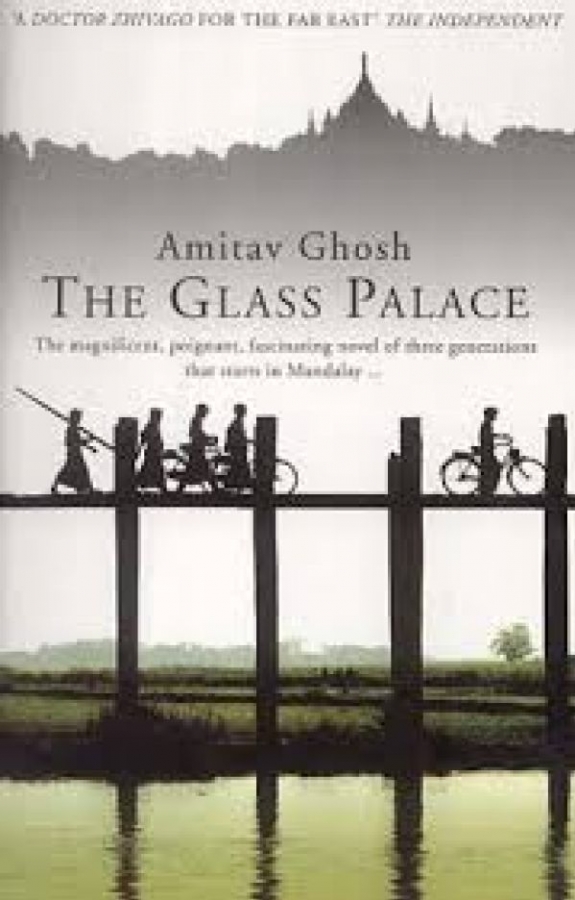
The Glass Palace
It is an insignificant book. It is set in Burma after 1886, when Britain transformed this vast kingdom into a province of British India, exiling its last sovereign. *The Glass Palace*, the novel’s title, is a metaphor for a world overtaken by imperialism and capitalism—forces to which one must adapt on pain of extinction or, at best, oblivion. The protagonist, Rajkumar, is a young boy, > a ragged Indian... with a sort of watchful determination.. there was no simplicity in his face, no innocence: his eyes were full of practicality, curiosity, appetite. He was as he was meant to be . Tradition, cultural roots, and ideal values can find no home when everything is upended and one must survive, and if possible, grow rich. Yet even in Rajkumar, already an adult when still a boy, there is room for bonds of affection and loyalty that are not > related to himself and his immediate needs, which was almost incomprehensible . It is precisely during the looting of the royal palace that the protagonist meets Dolly, the twelve-year-old handmaiden to the little princesses, daughters of the defeated and humiliated monarchs. A love is ignited that will never leave Rajkumar. The story unfolds along parallel tracks, allowing us to follow the protagonist’s social ascent alongside the life of the royal family, isolated and closely watched by the British. Amid the ruin of the ruling dynasty, Dolly matures into a reserved woman, seemingly timid, yet self-assured, cultivated, and independent. She marries Rajkumar, who has in the meantime become a wealthy businessman, young yet already portly. Yet does she do so for love, or simply because she wishes to escape a sort of gilded cloister? I cannot answer the question of whether the marriage of Rajkumar and Dolly is the fruit of true love, or merely the desire of both to trade the old for the new, tradition for the culture of dominant British imperialism. When I realized that after hours of tedious reading I was still only at 40% of the novel, I put the book aside, defeated by the flimsiness of the plot, the shallowness of the characters, and the pedestrian quality of the writing. Reading Ghosh’s book makes one want to reread Kipling’s *Kim*: a sinister bard of British imperialism, to be sure, but a writer of an entirely different caliber! Why not read it? It is tedious, pointless, banal.

The Glassmaker (the master glassmaker)
In this novel, Tracy Chevalier, author of the bestseller *Girl with a Pearl Earring* (see the review on this site), measures herself against Venice, the “City of Water,” and one of its immortal treasures: Murano, the “Glass Island.” In the preface, Chevalier wonders > whether the artisans of the City of Water and the Glass Island seem to age more slowly than those in the outside world. (...) Painters, writers, carvers, knitters, weavers, and—why not?—glassmakers: creators often live in a suspended state that psychologists call flow, where hours pass without them noticing. An admiration for art led the author to devise a narrative that purports to trace Murano's history across the centuries, from a primal state of perfection and isolation to present-day reality, steeped in consumerism and craftsmanship alike. It is a grand historical fresco that prompts Chevalier to resort to a bold device: the story of Orsola and her family recurs through the centuries, with the same characters, passions, and vicissitudes, in an ever-shifting context. We begin in 1486, in a Venice still powerful and wealthy, moving to the early eighteenth century, when the decline of the Serenissima has become undeniable, and then on to the handover to Austria in 1797, when Venice lost its independence, up to the First World War and years closer to our own. A bold device, I said, because Orsola does not age at the pace of History, but much more slowly; and while this may symbolize Venice’s immobility, this literary expedient renders the narrative implausible. It is better, therefore, not to follow the author across the entire novel, but to linger on the first part, “Goblets, Beads, and Dolphins”: set in 1486, it encapsulates the essence of the book. Orsola is a girl, later a young woman, born into a family of Murano glassmakers. She yearns ardently to learn the craft. > Orsola’s life revolved around an endless pile of laundry, tending the vegetable garden, and cleaning chores, but whenever she could, she found ways to slip into the workshop under the pretext of delivering messages or bringing biscuits to the workmen. (...) Then she would have lingered to watch them fashioning vases or tumblers and decorating goblets. Secretly, she visits a rival family, seeking out a woman who is a renowned artisan and merchant. This woman teaches her how to make glass beads and advises her to work on them in the kitchen, away from the workshop. It seems like a minor subterfuge, but these beads will ultimately save the family financially upon the sudden death of Orsola’s father, taking with him much of the workshop’s masterly skill. Chevalier is adept at painting the setting and familial dynamics, explaining glassmaking techniques, and depicting the Venetian merchants who enrich themselves off the isolation to which Murano was condemned by the Republic’s regulations. The incompetence of the eldest brother, who has assumed the role of head of the family and fails to grasp the importance of commercial ties, forces Orsola to venture into Venice—to discover the “City of Water” with its canals and gondoliers, taverns and brothels, the magnificence of its palazzi, and its disreputable quarters. > It seemed as though every gondolier on the canal was cheerfully hurling insults, almost singing: > Buzaròn, Mona!, Magnamerda!, Visdecasso!, Cover your ears, Giacomo shouted, and she laughed at the vulgarities Together with the city and its merchants, Orsola also meets the handsome fisherman, with whom she falls in love, breaking once again the rigid rules of Muranese society, which dictated marrying within the same families to preserve the secrets of the trade and the island's isolation. Maliciously, perhaps, the handsome fisherman > gets hired as an apprentice in the workshop, learns the art of glassmaking, and then flees abroad, taking with him the closely guarded knowledge and skills. Was it love, then, that ended a monopoly ensuring wealth and prestige to Murano and Venice? We may well believe it; yet the fact remains that Orsola is left waiting for a longed-for love, whose sole token will be a glass dolphin > , sent to her across the centuries. We must admit that Chevalier is no Ken Follett, if we wish to frame her within the realm of historical thrillers: she lacks the ability to pace the narrative, to create surprises and plot twists (on this site, one can read reviews of Ken Follett’s *A Place Called Freedom* and *World Without End*). As with the English author, the characters lack psychological depth: for instance, the figure of Orsola, a tenacious yet unhappy heroine (what is this woman's mystery?), is not analyzed in her human and sociological dimensions. Yet how could she be, when the author traverses centuries as though a fifteenth-century artisan shared the exact same inner life as a woman of the eighteenth or twentieth century! Chevalier possesses an elegant style of writing, an enjoyable English with linear, limpid syntax; an extensive yet accessible vocabulary makes for effortless reading without diminishing its quality. Her attention to the Venetian vernacular, the precise environmental descriptions (such as the actual routes between the island and the city), and the explanations of glassmaking techniques and commercial mechanics all demonstrate how deeply the author immersed herself in the history, and above all in the “City of Water” itself. Ravaged by tourism and the abandonment of its inhabitants, Venice still retains an incredible allure, captivating and commanding love, even as we strive to destroy it. Why not read it? In the end, it is prolix and implausible.
American Gothic
The novel is set in New York and chronicles the life of Bruna, an Italian political science professor who relocated to the United States to follow her husband Tom, an Italian-American physician. The mother of two children, Minerva and Mario, she falls in love with one of her African-American students, Yunus, who will later go on to fight for ISIS and die in the defense of Mosul. This alone would offer plenty of themes, yet the author piles on far more: the decline of America, racial and social rifts, the integration of diverse cultures, terrorism, and Islamophobia. In the notes at the end of the book, Farinelli attempts to provide a unifying interpretive thread, locating it in identity and its multifaceted aspects: religious, political, class-based, sexual orientation, and generational conflict. > I believe that beyond national borders and the ethnic, cultural, and religious differences that define and often divide us, we are first and foremost citizens of the world, and I hope that one day we will also be citizens of the same cosmopolitan democracy . Bravo, Professor! But where is Bruna? In spite of everything, the novel is not a political treatise; it is the tale of the protagonist's life. So let us start with Bruna. The narrative opens at the end: Bruna has just learned that her student lover is an ISIS fighter; it is the day of Trump's victory; to put little Mario to sleep, Bruna has recited an episode from the Quran, the moment Yunus was cast into the belly of the whale and saved by God because he was a righteous man. Why does God not save every man, as the Black American slaves once sang? She ought to answer her son, but > the words choke in her throat. (...) With her fist, she keeps clutching the scrap of black silk as if trying to crush that darkness. Mario then takes her face in his hands and softly strokes her cheeks, right where tears have begun to fall, carving pale rivulets through the heavy makeup...(...) I lied to everyone . Her life is in shambles; convinced she could make it on her own, she clashed with Tom's Italian-American family, fighting their prejudices and their meddling—she could have been more conciliatory and submissive; she tried to make Tom into a strong, self-reliant man, refusing to accept his nature as an eternal child; she lacked ambition and a competitive edge, abandoning her academic career; and then Yunus arrived and left; she could have told him she was pregnant, but > silence had swallowed all words, perhaps because nothing they might have wished to say had the power to change the course of their lives. (...) We can smooth the surface, soften the roughness, fill in a few cracks, but change—no, not even for love . And yet, there is an anchor in this desolate resignation. Minerva > slips her cold hands under her mother's nightgown. She rests them on her warm belly, as if to feel. (...) Don't worry about anything, I'll help you . And the fragile Mario, who had become Maria, > had embraced her and then laid her head on her lap, her face pressed against her womb . Dear cosmopolitan professor, in the end it is our very own Italian familism that saves us! The novel is a missed opportunity. The great theme of love remains in the background. We catch a glimpse of how difficult it is to love when so many idealisms engulf us and we remain suspended, unfulfilled, incapable of bringing clarity to the relationships with the people in our lives. Swept away by events and sudden shifts, Bruna could have delved into the reasons behind her presumed failures, perhaps discovering that she had gained a deeper understanding of herself, of what she was and what she had wished to be. Driven by lofty political aims, the author failed to explore what truly mattered in the story, what would have made it compelling. And so Bruna's life slips away like pebbles down a slope; as the poet wrote, > nothing changed within your life / the years that slip so easily into shade / when a single torch suffices in the dusk / and the descent is almost an ascent . (Marino Moretti, “La Madonna del Sassoferrato” from *Poesie Scritte col lapis*, 1919). The narrative is further compromised by the writing and style. The prose unfolds hesitantly; initially marked by short sentences and heavy punctuation, it later grows more expansive, yet remains stubbornly banal, lackluster, and pedestrian. The narrative pace is sluggish, burdened with lengthy ideological lectures and the frequent repetition of a handful of actions, hardly enough to inject dynamism and suspense into the novel. The characterization is flimsy: the characters undergo no evolution over the course of the book; everything feels predictable, thoroughly worn out. Why not read it? Prolix and pointless.
Hotel Bosphorus
Unlike the more accomplished *Appuntamento a Istanbul*, in this novel it is unclear what the author is driving at: a mystery, a novel of local color, or the story of an endearing forty-something woman still searching for herself? What we know for certain is that the protagonist and first-person narrator runs a bookshop specializing in noir fiction, loves spending her time out and about in Istanbul's myriad establishments (take note, anyone planning to visit the city!), and above all dreams of printing on her business card: > Kati Hirschel bookseller - detective, homicide squad consultant . Triggering the story and shaking the listless Kati awake is the arrival of Petra, a childhood friend who soon finds herself implicated as a suspect in the murder of the director of the film in which she is acting. Was it the friend, driven by jealousy or some secret from her past? Was it someone from the crew, perhaps looking to take the director’s place? Or was the man involved in criminal racketeering and taken out by the Turkish mafia? Kati's investigation proceeds slowly and listlessly, with the pieces of the crime never falling into place along any logical trajectory. Surprise twists are lacking as well. The resolution simply arrives in the end, by chance. Instead, the reader is overwhelmed by a whirlwind of characters to whom the protagonist stubbornly and monotonously puts the very same questions. A few erotic scenes clumsily spice up the narrative. Frankly, it is a bad novel. One struggles to find a single redeeming quality. It is not a good noir, because it has no plot. Kati’s personal life is sketched superficially, and we never truly understand who this German woman, infatuated with Istanbul, actually is. The city's atmosphere remains relegated to the background. The observations are indeed trite and cliché, along the lines of: > out of ten million people, it seems no one ever goes home. The streets teem with people and cars at all hours of the day and night . How many metropolises wouldn't fit this description? Only the narrator's mild irony redeems itself, but it is not enough to make the narrative enjoyable. Why not read it? It is boring: a waste of time.
The Family Idiot
In the final years of his life, Immanuel Kant suffered from dementia: expelled from the university, isolated from society, the great philosopher penned thousands of pages in a delirious attempt to arrive at the truth of reality, rather than stop at its interpretation. With an inspired intuition, the author imagines that “Herr Professor”—as he was called by his children and students—met the same fate as Kant: losing his cognitive faculties and sliding into dementia after years of rigorous, frigid teaching of history and philosophy, strictly within the rigid, rational frameworks of Marxism. To care for his ailing father, the son leaves Rome to return to Viareggio; among his father's papers, he discovers a manuscript recounting, in the form of a novel, the “Three Days of Viareggio,” a violent popular uprising in May 1920 that was bloodily suppressed by the Italian government. These are notes written in a muddled hand, forcing the son into an arduous transcription. What comes as a surprise, given the father's unyielding Marxism, is the exaltation of anarchism and the title of the narrative: “*indifeso fervore*”—a celebrated verse by Sandro Penna, a poet whose transgressive poetry was worlds apart from the moral outlook of “Herr Professor” as his son had known him. Who truly was “Herr Professor”? This father forever poised to disapprove of his son, from the way he played tennis (more concerned with keeping his hair tidy than moving on the court) to his decision to drop out of his Philosophy degree to become a translator—and, to make matters worse, from English, a language his father despised. It could have been the occasion to turn Dementia—the cognitive and physical decline of a man—into an opportunity to rediscover his figure and his life, to know him better, and even to finally decipher oneself within one of the fundamental relationships of our existence. Instead, as the author states in the afterword: “I cannot help putting the bookish before the real. May reality not hold it against me if it always comes in second.” The father’s illness, the return to Viareggio, and the departure from Rome serve merely as pretexts for witty dialogue between characters, for subtle ironies regarding the social and cultural dynamics of our society, and for digressions—at times interesting, but more often useless and redundant. A grating, overly intellectualized framework pervades the entire narrative, stripping it of psychological depth and rendering it prolix and rambling. The novel can serve as a starting point for a broader reflection on Italian literature. We often witness authors who enjoy considerable visibility and garner favorable reviews from critics and avid readers alike. *L'idiota di famiglia*, for instance, was featured on *Petrarca*, a prominent television program dedicated to culture and books in particular. One might think of novels vastly different from one another yet consistently showered with accolades, such as *Alma* by Federica Manzon, *Almarina* by Valeria Parrella, *La Ferocia* by Nicola Lagioia, or *Con le peggiori intenzioni* by Alessandro Piperno (see the reviews of the cited books on this site): all acclaimed, yet fragile in plot and prose, and above all trapped within pre-established literary formulas that neither reflect Italian sociological reality nor genuinely probe the feelings and psychology of their characters. An oscillation between nostalgia and pessimism prevails, the plots are frequently insubstantial, and the characters easily slip into stereotypes. One has to wonder whether, in these assessments, membership in certain publishing circles takes precedence over genuine narrative quality. By dint of such “niche” novels, there is a risk that our literature will drift toward irrelevance, dragging the language down with it. Why avoid it? This novel is irritating.
The Secret of the Hudson Queen
It is singular to review this novel immediately after reading Emilio Salgari's *La perla sanguinosa* (see the review on this site): a curious coincidence, almost as if pearls were inherently the bearers of adventure and misfortune. And indeed, when Sally Jones and the Chief find a pearl necklace hidden in a secret compartment within their ship’s steering wheel, Sally, with the wisdom of an intelligent ape, experiences > an unpleasant sensation in the pit of my stomach. (...) The pearls of the necklace (...) seemed to emanate a faint, mysterious light from within. Unlike Salgari’s fantastical setting, here the pearls lead us into the "underworld" of seafaring cities: violent and perilous slums for our ape, seemingly fragile and defenseless. The narrative resumes from the point where we left it in the previous novel (see the review of *The Murderer’s Ape* on this site); yet here the element of surprise is missing because we already know Sally, and we are deprived of both the charm of a seafaring, piratical Lisbon and the savor of noir intrigue. The story unfolds in Glasgow. Sally and the Chief set off in search of the pearls' presumed owner, the orphan Rose, abandoned as a child by her father, who wished to bequeath the jewel to her as a form of redemption. They find themselves plunged into the underworld of the English city: the Chief is forced to captain a ship smuggling alcohol to America, while Sally is held hostage by a criminal gang. Harassment, clashes between underworld syndicates, violent nightlife, and even boxing bouts follow in rapid succession, sweeping up the poor, frightened Sally, who becomes an object of curiosity, derision, and exploitation. Sally is guarded by Bernie the Butcher: a hulking, rather dim-witted young man notorious for his sudden, uncontrollable rages, himself the victim of mockery and abuse at the hands of the other criminals, and even his own sister. It is the friendship between Sally and Bernie that forms the crux of the story. Sally has numerous opportunities to escape, yet she stays to help poor Bernie, not wanting to leave him alone, determined to defend and save him. Faced with the blaze consuming the house in which his sister might perish, Bernie gathered momentum to throw himself into the fire as well, and then > I wrapped my long arms around him, (...) immediately took him by the arm and led him back onto the bridge, away from the burning building. The wise and gentle Sally discovers herself no longer fragile, but a mother figure to the hulking Bernie. How far removed we are from the mysterious and melancholic atmosphere of *The Murderer’s Ape*! All the enchantment of the previous novel has dissolved into a verbose plot, where the twists fail to lend rhythm to the narrative. One plods along, hoping to recover the characters, the drama, and the writing that had once held us so spellbound. It is a futile quest; only the friendship between Sally and Bernie rescues the work from utter disappointment, yet it is a relationship merely sketched, lacking in depth, that fails to truly engage. Why not read it? It is boring.
The Loser
>. If one wishes to attempt to understand this tale, delirious in so many ways, it is best to go to YouTube to watch and listen to Bach's *Goldberg Variations*, played on the piano by the "legendary" Glenn Gould. One must do so because Bernhard speaks of "genius" and of what happens to anyone who encounters a personality unreachable in artistic stature: one cannot help but be a "loser." >. The first-person narrator, Wertheimer, and Glenn find themselves in Salzburg as pupils of a renowned piano teacher. The first two are young virtuoso pianists who could have enjoyed successful concert careers; yet the encounter with genius proves fatal, for both realize they can never measure up to the "legendary" Glenn, that they would never be capable of playing the *Goldberg Variations* as their friend does. Both—the narrator and Wertheimer—abandon music: the former even gives away his splendid Steinway and retreats to Madrid to write about Glenn, caught in a frantic and inconclusive revision of the great pianist's work; the latter shuts himself away in a solitary hunting lodge, strumming an out-of-tune piano. Upon hearing of Glenn's sudden death, Wertheimer kills himself. The narrator seeks to understand the deeper reasons behind his friend's suicide. Had he always been unhappy, like those depressives who carry within themselves the "pain of living"? Is it the fate of "losers"—>? Or was >? To fathom the mystery behind his friend's suicide, the narrator has Wertheimer's final dwelling opened—the place where he had holed up—and discovers a worthless grand piano, >, upon which rests the sheet music for the *Goldberg Variations*; and the narrator, too, longs to return to the piano after years away, to measure himself against genius, and perhaps he as well will lose himself in the attempt to emulate the legendary Glenn. After reading this tale, one might exclaim: "Long live mediocrity!" What suffering lies in every artist who cannot emulate genius! Perhaps Francesco Petrarch's depression stemmed from his jealousy of Dante, as his friend Boccaccio affectionately pointed out to him; and for this reason he attempted, with the *Triumphs* and *Africa*, to write two epic poems that would rival the supremacy of the *Divine Comedy*—and dramatically failed. And what of Dante, who in Canto XXV of the *Inferno* hurls a challenge at Ovid, claiming his own superiority in the poetic invention of metamorphoses: "Let Ovid now be silent of Cadmus and Arethusa, / for if him into a serpent and her into a fountain / he turns in verse, I envy him not" (lines 97–99). To console ourselves, nothing remains but to cage great men >. For the legendary Glenn, the sentence is a YouTube video: having fled the concert stage for an isolated country house, he will be condemned to be listened to for eternity as a pianist "imprisoned" by his own renown; we, mediocre men, shall be truly free because we are anonymous. The plot of the tale is non-existent; it resembles a soliloquy, with a fluid yet at times nonsensical syntax, marked by a cadence reminiscent of theatre rather than prose: everything has unraveled, nothing makes sense, one can only recount the recurrence of thoughts and memories—even then with profound doubts, under the rhetorical refrain "so he said, I thought." Why not read it? It is tremendously exhausting. It can sit nicely on a bookshelf to make a fine show of our culture.
The Iliad
*The Iliad* unfolds over a brief period of time, yet it captures the most salient events of the Trojan War. The incipit is the quarrel between Agamemnon and Achilles over the possession of an enslaved woman, yet in truth, Achilles is calling Agamemnon’s authority into question. The hero resolves to withdraw from the fighting, triggering a sequence of clashes that, despite alternating fortunes, steadily tilt toward the defeat of the Achaeans, culminating in the Trojans setting fire to one of the Greek ships. The assembly of Achaean chieftains repeatedly dispatches embassies to Achilles urging him to rejoin the fray; instead, Patroclus, the hero’s dearest companion, enters the combat and is slain by Hector. Achilles rejoins the war to avenge Patroclus, unleashes wholesale slaughter, and kills Hector. Priam nevertheless succeeds in assuaging Achilles’ wrath and recovering Hector’s body to grant him a proper burial. The plot is relatively simple, yet it is complicated by the presence of multiple narrative tiers: each theme develops across three planes: the community of the gods, the community of men, and individual emotions, the latter perpetually subordinated to the will and unyielding codes of the community, even before the dictates of divinity. The first theme is the struggle for the governance of the community, and consequently, for power. The epic opens precisely with the conflict between Agamemnon and Achilles, yet the striving for the assertion of authority remains a constant. One need only consider Hector's decision not to withdraw behind the walls of Troy and instead fight on open ground solely to assert his authority against Polydamas, who was counseling him to do so: > now, while the son of devious-plotting Cronus has granted me to win glory by the ships, driving the Achaeans back to the sea, fool, you must not utter such advice among the people; no Trojan will obey you, I will not allow it . Yet this very clash for power is equally present among the gods: Poseidon remarks to Hera, who is fearful that Achilles might succumb to a god, > let us go and sit apart, rather, upon the lookout... if then Ares begins the strife, or Phoebus Apollo, or if they hold Achilles back, straightway then from our side will a clash of war arise; and very soon, methinks, beaten, they will return to Olympus, back among the other gods, vanquished by force beneath our hands . The same theme of power emerges distinctly in the assembly of Book XIX, wherein Achilles wishes to rejoin the battle immediately to avenge Patroclus and grant him a worthy burial, while the other chieftains insist that Achilles formally accept Agamemnon’s gifts, thereby affirming the latter’s authority. The second theme is, naturally, war: the most predictable and indeed the most tedious of themes, save for the battle among the gods, which reaches conspicuous peaks of comedy and mockery of the divinities. The martial accounts fragment and seem designed merely to exalt the stature of the heroes and the fallen. The third theme is composed of familial sentiments: affection for friends, filial love, reverence for elders, the grief over the loss of loved ones. This is the theme closest to modern sensibilities, where the epic modulates into pathos in certain passages: the exchange between Hector and Andromache, Thetis’s love for Achilles, and the latter’s agony over Patroclus: Hector > placed his son in his wife's arms: and she drew him to her fragrant bosom, smiling through her tears; her husband was moved to pity as he beheld her, and caressed her with his hand ... yet the community's laws hold greater sway than individual sentiments, > go now, return home, and attend to your own tasks, the loom and the distaff; and bid the handmaidens set about their work; for war shall be the business of men, of all men and of me above all, as many as were born in Ilium (Book VI). Into these themes interweave other narrative threads (parentheses within the epic), such as the magnificent Book XVIII (the forging of Achilles’ armor) and Book XXI, particularly the defense of the Trojans by the river Xanthus and its defeat by fire. On the whole, the epic is tedious and fragmented, and certainly falls short of the *Odyssey*.
I Am a Cat
The protagonist and narrator of this novel is a cat: a stray taken into the home of a teacher, unloved yet tolerated out of sheer inertia. This is how our hero defines himself: > I do not grow fat because I eat no delicacies, but I am in passable condition and get by day after day without limping . Like all of his kind, our cat’s stillness and indolence conceal great wisdom, a profound capacity for reflection on the events of the human world. And this is why whoever were to read > the book distractedly, convinced that it was a work of little value, will suddenly realize they are faced with something very different, something that seems facile but is as profound as the doctrine of Buddha, and will no longer dare read it sprawled on the tatami with legs askew, skipping lines . We are in Japan at the beginning of the twentieth century, during the war with Russia, which would end in the resounding victory of the nascent Japanese empire. It is a long transitional phase, from the traditional, insular culture of the shoguns to an opening toward the Western world, its literature, and its science. Gathered at the teacher’s house in endless, pointless chatter are various intellectuals: the skeptic, witty and superficial; the young physicist, lost in scientific research whose purpose eludes comprehension; the Zen philosopher, yearning for a spirituality no longer truly felt; and finally, the young businessman, eager to strike it rich. At the center is the teacher: misanthropic, closed like «an oyster», selfish, spending all his time in his study, officially to read the countless books he purchases by squandering his modest teacher’s salary > But what is he doing, lying face down on this blanket with a long past, his chin resting on his hands, a cigarette between his fingers? Nothing, he just lies there idling. It is possible that in his dandruff-sprinkled head reflections on the grand schemes of things turn like a wheel of fire, but observing him from the outside, you would never tell. Yet, the cat is immensely grateful to the teacher, for he allows him to witness an emblematic cross-section of human society; a gathering of fabulists, to be sure, but one that provides our hero with «a thousand experiences», and us readers with pearls of wisdom. For instance, the cat visits a public bathhouse, where all men appear equal in their nudity, and suddenly there emerges a > a giant. Nietzsche’s superman. The king of demons, The commander-in-chief of brutes. (...) And on my way, I reflect. Among those men naked as worms, who in their effort to become all equal stripped off their trousers, haori, and hakama, an equally naked hero emerged who imposed his authority upon the others. I deduce from this that human beings may strip down as much as they like, they will never achieve equality . And what of narcissism? Observing the teacher looking in the mirror and lamenting his face, so disagreeable, the cat reflects that > when one is dissatisfied with oneself, when in the grip of discouragement, there is no more effective remedy than looking in the mirror. One gains an immediate and clear perception of beauty and ugliness. One marvels at having lived up to that moment showing such a face to the world. And this sudden awareness is a precious moment in a person’s life. Nothing is more useful to the human being than the perception of their own stupidity . We all know that cats are very patient; but everything has its limits! In the face of senseless babble, the vacuity of words, the poverty of feelings, and a background noise in which traditional philosophies (Buddhism and Confucianism) as well as Western thought dissolve, even a feline can take no more; and so he gets drunk and lets himself die. > Enough now, let it go as it will. I am tired of fighting... (...) Little by little I feel better. (...) Where I am. what I am doing, is completely indifferent to me. I only know that I feel good. (...) I sweep away sun and moon, pulverize heaven and earth and enter the mystery of eternal peace, I am dying, And dying I achieve peace. (...) I give thanks. I give thanks . At a certain point in this long novel, a doubt arises, at once fascinating and unsettling: could the cat and the teacher be parts of the very same person? The sage and the dullard? The engaged and the indifferent? And could this tale, written not long before his death, be Soseki’s spiritual testament? If this were the case, the book takes on an extremely modern, almost psychoanalytic mantle, a fresco of the complexity and ambivalence of the human soul, a precursor to those ambiguous and evanescent traits that would accompany great Japanese literature. The book is decidedly boring. There is no plot; the characters are stereotypes, the dialogues are protracted and serve merely as pretexts for musings; the cat’s digressions are more compelling, yet to be grasped in their fullness they would require a profound knowledge of Japanese history and culture. The translation is of a very high caliber, elevating the prose, which is the novel’s sole redeeming feature; the explanatory notes are meticulous and exhaustive, enriching our knowledge of Japanese society and inviting us to study it. Why not read it? It is boring.
The Shadow of the Wind
The setting is Barcelona during Franco's Spain, in the 1950s. The son of a bookseller is taken by his father (a dealer in antiquarian and rare books) to the Cemetery of Forgotten Books, a repository for all those volumes no one will ever seek out. Here, the boy picks up a novel by a Spanish author. Reading it draws him into a sequence of events that unfolds across his youth, in a sort of parallel narrative: the tribulations that engulfed the author's life (betrayed friendship, love for a girl who turns out to be his sister, her death, and ultimately persecution by a former friend turned brutal police officer) seem to recur in the boy's own existence. The young man gradually uncovers what happened to the author, finds himself similarly hounded by a vicious policeman, and seems destined to lose the woman he loves, just as the writer did. The book concludes with a happy ending: the villain is killed and the young man is free to marry. The opening of the tale seems intriguing, with this premise of forgotten books heralding a plot woven between the mysterious allure of books and the discovery of the life that lies behind the author and the stories told. Yet this promising start is lost in a plot that grows increasingly predictable, where the constant reliance on “telling” (characters recalling episodes from the author’s life) renders the book verbose and often tedious. As so often happens, the novel is too long, overloaded with themes and characters (frequently superfluous to the narrative), and provides far too little sense of place. The result is a touch of boredom.
The Watchmaker of Brest
In his splendid biography of Matteo Ricci (*The Memory Palace of Matteo Ricci*, published in Italy by Adelphi), Jonathan D. Spence recounts how the Jesuit missionary won over the Chinese mandarins with the gift of clocks brought from Europe. What astonished the Confucian elite was the exquisite mechanics of seventeenth-century Europe and the notion that time could be dissected into infinitely small increments, capable of deconstructing and even halting the flow of events. Perhaps this was what de Giovanni had in mind when entitling this novel: a "quasi-noir" that blends the discovery of one's past and identity with the machinations of a shadowy "Entity." There are two temporal dimensions: a washed-out professor of medieval history is prompted by a young journalist to uncover the truth behind the unsolved murder of a magistrate and his driver, only to discover that the killer was his own father—a terrorist from the 1960s and a skilled maker of mechanical devices, ranging from explosives to innocent clocks; on another timeline, set many years earlier, a naive young woman begins a relationship with a powerful cardinal whose assistant, acting on his superior’s instructions, arranges the girl's elimination with the help of a mysterious operative. How do these two storylines intertwine, and how do they culminate, perhaps, on the Atlantic coast—in Brest, no less? We will not reveal that, so as not to spoil the surprise for the reader. Already in a 2022 novel, *L'equazione del cuore* (see the review on this site), the author had departed from classic, deeply atmospheric Italian-style noir to examine the conflict between rationality and emotion, drawing inspiration from the physicist Dirac's equation, according to which bonds of love do not evolve—they remain intertwined forever. Here too, in this narrative, de Giovanni relies on the metaphor of clockwork gears to show how the past incessantly resurfaces, binding two people—the professor and the young journalist—in an unsought yet indissoluble knot. Narratively speaking, the plot is excessively constrained by the criminal schemes of Power, embodied here by the influential Cardinal and his ambitious assistant. Why get bogged down in such an implausible plot, when it would have sufficed to explore the theme of an unaccepted memory—one nonetheless vital if one wishes to live an authentic existence? By attempting to cram together too many subplots and too many literary genres, the author has produced a bloated, redundant potboiler that only fitfully hits the stride of a noir. Further marring the narrative is the layering of temporal planes, which clear up only near the very end, failing to generate any real suspense. Finally, it is regrettable that de Giovanni has severed all ties with Naples, depriving the tale of a rooted setting, which consequently remains entirely evanescent. Why not read it? It is boring.
The Last Lombard
It is a historical novel set in the year 900, during the disintegration of the Lombard world. The protagonist, Arechi, is educated at the papal court, later becomes a powerful lord of Cividale, and returns to the papal court as guardian of the papal throne. He leads a life of crime and intrigue, only to repent on his deathbed. The book is insipid. There is no characterization of the characters, nor of the protagonist himself, who makes inexplicable choices, such as abandoning his beloved wife out of jealousy. Nor is there even any real historical setting, and events simply follow one another as though part of a bare chronicle, with frequent lapses into the macabre and predictable visions of a corrupt and secretive Church.
The Killer's Tears
Children are increasingly the innocent victims of war, violence, and death. One need only consider what we are witnessing today, in Ukraine and Palestine. For a child who has seen their parents murdered, is it still possible to rebuild a life? And can one forge a relationship with the killer capable of saving his soul? This novel is aimed at adolescents, yet it tackles weighty themes—unfortunately through a narrative approach reminiscent of Antoine de Saint-Exupéry's *The Little Prince*: bland, moralistic, implausible (see the review of *The Little Prince* on this site). Pablo lives with his parents in a small house in the far south of Chile, > where no one ever arrives by chance. Angel is a killer. When taken in by Pablo's parents, he cannot help but murder them, because it is the only thing he knows how to do. While Pablo is away from the house, > out there, from the sea, dense rainclouds were rolling in. (...) Angel drew a knife and plunged it into the man's throat, then into the woman's. On the table, wine and blood mingled, staining red all the deep cracks in the wood. Angel does not kill Pablo. > Sparing the brat made him feel relieved. And, besides, he could send him to the well to fetch water. Over time, a complex relationship develops between Angel and Pablo; it is a bond of mutual dependence: for Angel, it is the first time he has ever felt affection for anyone; for Pablo, > Angel is the only person who cared for him, fed him, gave him the fox (which they had taken in when it was still a cub), (...) in a world where only the dead can rest, the living must grit their teeth and endure their existence. One day, walking across the vast and desolate Chilean countryside, Pablo and Angel come across an isolated house in a forest, where an old woodcutter lives. Here, they could live in peace; the goodness inherent in every man could even express itself in Angel. > There are very discreet metamorphoses, said the old man; those that happen to our soul, for example, are not always visible. (...) Angel seized the knife hidden in his pocket; he felt the handle between his fingers. (...) He stepped toward Pablo. (...) He laid his eyes on Pablo. (...) “Here,” he said, “this is for you.” The silence was absolute. The knife blade reflected the flicker of the candles. We can rediscover peace and brotherhood if even the worst of murderers can love a child. An important theme is handled in a superficial and ambiguous way. First and foremost, it is implausible that a child who witnessed the murder of his parents could overcome the trauma as easily as Pablo does: this trivializes Evil, reducing it to something inconsequential. Secondly, love cannot save the soul of a wicked man unless he acknowledges his guilt and seeks forgiveness. Weeping and making a noble gesture are not enough. Why not read it? It is false.
Reading
The book aims to be a middle ground between a praise of books—that is, of reading—and the very meaning of reading. The author surveys numerous writers and texts to ultimately demonstrate how writing manages to portray, in differing ways, seemingly similar situations and contexts. Furthermore, reading is an introspective process through which people actively interpret the resonances emerging from events and words. Writing is thus the conduit between a story and the reader's personal life: rather than merely understanding the writer, the reader pursues their own spiritual path, activated and nourished by reading. Two statements from the book leave a lasting impression, one from the writer’s perspective and the other from the reader’s: Petrarch says in *Epistulae Familiares* > I want my reader, whoever he may be, to think only of me... I do not want him to attend to his business and study at the same time; I do not want him to master effortlessly what I wrote not without effort ; Machiavelli says in a 1513 letter to Vettori: > when evening comes, I return home and enter my study... and for four hours I feel no boredom; I forget every worry, I do not fear poverty; death does not dismay me . The book is an enjoyable read, but it feels a «bit strained», lacking a true underlying thread.
Lion
Social convention would have parents serve as the solid foundation of the family, and children as its fragile walls, in need of guidance and support. In this strange novel, that is not the case. Katia, a divorced mother, lives in uncertainty, > she felt somewhat on the border, between city and countryside, between the world as it had been and the new one just beginning. She was comfortable there, suspended halfway. (...) She had no great desires or hopes. It was merely the notion that perhaps, one fine day, things might take a different turn for her . Leone, on the other hand, a six-year-old boy, possesses an unshakable certainty: he prays, because he believes in Jesus, even if only in the form of a ceramic figurine. What harm is there in that? ask Katia’s friends, mildly incredulous and affectionately wry; yet the child heads in an unexpected direction—and, truth be told, an unconventional one in our falsely devout society. Katia is worried, racked with guilt; Leone of all people, so profoundly disoriented. > A child who seemed to have gotten lost in the middle of something, a wood at night during the age of dinosaurs. (...) At times he seems to her like an angel, stranded in their kitchen, trying to flutter about without a sky . Through a singular lens—the need to pray—the author explores the bond between mother and son. She > felt brimming with tenderness for this child who had come into her life just like that, without her ever having decided on it. Like a mushroom, a flower. (...) A flower might not have any passersby at all, if it happens to grow on a patch of land where no one ever walks. It can happen that a flower is born and no one ever sees it. And what about children? And Leone, who “moved diagonally rather than straight,” who tried to > exist as little as possible. (...) Exercises in nonexistence, one might say. (...) Jesus, please make them stop talking about me . The author avoids any potential psychological detours toward dissecting parent-child relationships; she has no interest in seizing upon the narrative to offer futile wisdom or banal insights: she chronicles the events gently, passing no judgment on the mother or the other adults. This is a virtue—one that might have led us to appreciate the tale had the author managed to impart narrative rhythm to the story, rather than allowing herself to drift into a slow, tedious progression. Perhaps realizing, at a certain point, that the narrative was fraying into nothingness, the author resorted to the miraculous, and even to a new deluge. Prayer becomes redemptive of humanity’s sins, and Leone a miniature, modern-day Jesus. Yet that is not quite it, because—further degrading the quality of the narrative—Mastrocola never commits herself, maintaining a hypocritical, pseudo-secular stance. The reader comes away embittered. It could have been an interesting story; it proved instead to be a cloying tale: if the intention was to demonstrate that there exists within us, from childhood onward, an innate yearning for the sacred, and that prayer is an intrinsic dimension of existence, this theological question is trivialized by a narrative far too inadequate for the subject's complexity. Compounding matters is the prose style: a repetitive writing built upon flat phrasing, marked by an excessive reliance on the full stop, by verbless complete sentences—in short, an approach that willingly slips into the simplistic vernacular of journalistic or television storytelling: there would be nothing wrong with this, were the novel supported by a compelling plot and by a penetrating, evocative analysis of characters and circumstances. Why not read it? It is pointless, and ultimately cloying.
The Lion of Damascus
The novel is meant to be the sequel to *Capitan Tempesta*, a tale set in Famagusta in 1517 during the war between the Venetians and the Turks. The protagonist was a young noblewoman: a skilled swordswoman who, disguised as a man, had set out in search of her betrothed, abducted by the terrible Haradja. Salgari had succeeded in crafting a story full of allure, working upon gender ambiguity, vigorous female figures, and a final plot twist: the love between Capitan Tempesta and the Lion of Damascus—a passion that disregarded different allegiances, both national and religious. One would expect the same intriguing atmosphere and the very same freedom from convention. And the opening shows promise, even if certain signs make it clear from the outset that the story will take a different turn. It begins with the figure of Haradja: > a very beautiful young woman (...) pitch-black eyes, (...) very long, loose hair, of a hue that gleamed like raven wings... (...) the whole of her face had (...) something hard and forceful that instantly betrayed the Turkish woman, ever cruel at heart, as the bloodthirsty sultans of the fifteenth and sixteenth centuries had by then accustomed them to be . Haradja is no longer an unconventional woman: she is part of a cruel and bloodthirsty breed, that of the Turks, and foul black birds, "eaters of the dead," are the living symbol of thousands upon thousands of corpses, left in the sun to be stripped of their flesh. A grim and deathly atmosphere pervades the entire narrative and strips of narrative momentum the adventures that Salgari, despite everything, attempts to construct. Haradja seeks vengeance against Capitan Tempesta, who deceived her by posing as a man and with whom she had become infatuated; she also intends to punish the Lion of Damascus, formerly her betrothed, who had abandoned her for the Christian noblewoman. She therefore kidnaps the couple’s son and the father of the Lion of Damascus. She holds all the cards: overcome by hatred and above all by pride, she challenges Capitan Tempesta to a duel. > The two horses had collided with such impetuosity that they nearly threw their mistresses from the saddle; then came a clattering of weapons against armor. (...) Haradja continued to attack, trying to force down that sword which flashed with fiery gleams beneath the already scorching rays of the sun. (...) By the death of Allah!, cursed the Pasha's niece (Haradja), (...) You stand firm as a rock, do you?.. And yet I shall kill you! (...) A cry was heard, or rather, the howl of a wounded beast; then the great admiral's niece crashed to the ground with a great clash of steel. (...) Finish off the tigress of Hussiff! , shouted the Lion of Damascus; but numerous Turkish soldiers rushed in, preventing Capitan Tempesta from slaying her terrible rival. It is the finest moment of the novel; thereafter, the narrative loses its bite: Haradja and Capitan Tempesta vanish from the story, the Lion of Damascus is present but relegated to the background, faded and irrelevant, while minor characters emerge who, as often happens in Salgari, try to inject brio and establish a dynamic among the roles; meant to act as foils to the protagonist, they merely underscore his insubstantiality. Instead, a real historical figure comes to the fore: Sebastiano Veniero, the great commander of the Venetian fleet, to whom, according to Salgari, the victory of Lepanto against the Turks was owed. The narrative draws to a weary close. The book was published in 1910, a year before the Libyan War (1911–1912), which pitted Italy against the Ottoman Empire. It is possible that Salgari tapped into sentiments widespread among public opinion: the Turk as a cruel oppressor of peoples, bloodthirsty and treacherous. The novel abounds in massacres, tortures, flayings, quarterings, and other gruesome deeds: there is no mercy on the part of the Turks, nor any chivalrous respect for the vanquished. And the Christians know how to die with honor, whispering the *Miserere* "in the excruciating agony of the horrific torment"! Yet there is too much relentless ferocity here to believe that the novel's deathly atmosphere merely answers to an editorial demand or a nationalist resurgence on the author's part. Salgari took his own life the year following its publication, in 1911: the writer was by then living in a profound depression, plagued by frequent self-destructive crises and numerous suicide attempts; the novel mirrors Salgari's despair and his fascination with a gruesome end. At the same time, the narrative suffers from a weariness and an exhaustion of ideas, which the writer desperately tries to compensate for by resorting to prefabricated formulas, no longer embedded within a dynamic narrative framework: evidence of this lies in the repetitiveness of dialogues and scenes, the weakness of the characters, and the sparse descriptions of landscapes—the latter set against a peculiarity of the novel: historical digressions, generally rare in Salgari's oeuvre, a clear sign of a narrative vein that had grown fragile. Why not read it? It is a swan song, a bitter and sorrowful epilogue to a great writer.
The Leopard
The author is billed as a master of the thriller, superior even to Stieg Larsson. In truth, he is merely a pale heir. Harry Hole is a Norwegian crime-squad detective specializing in serial killers. Following an investigation in which the perpetrator attempted to murder his wife and son, Harry quit the force and sank into despair in Hong Kong, amidst alcohol, drugs, and gambling. There, a detective named Kaja tracks him down to convince him to assist the police with another serial killer case. The thriller unfolds, relying primarily on dense dialogue, across several narrative threads: the hunt for the criminal (with multiple investigative leads), the turf war between different factions of the Norwegian police to spearhead the fight against crime, and Harry’s personal struggle in search of his own equilibrium. As one of the potential culprits puts it, > you cannot cheapen your feelings like that. You try to dodge the fact that you, like anyone else, are guided by concepts of right and wrong . And Harry is, deep down, a knight in search of truth, yet he continues to “wander in circles,” unable to find his roots. Throughout the story, he consistently makes the right choices, yet these do not lead him to find “the place to which he belongs.” And the novel closes with Harry, triumphant over crime, but returning to Hong Kong in search of himself. The book is interminable, in the sense that it seems to draw to a close only to reopen again and again, exhausting the reader. The problem is that it lacks suspense, and the protagonists—Harry and Kaja in particular—remain entirely on the surface, their motivations and personal developments never fully coming into focus. Why avoid it? It is a pointless book, fit only for the beach.

The Bookshop on the Hill
Alba Donati lives in Milan and works in the press office of a major publisher. How did she come up with the idea of moving to a remote village in Lunigiana to open a bookshop? The novel revolves around this question, and it does so in diary form, day by day. The author's immediate answer is that > things don't just come to mind; things smolder, ferment, clutter our imagination while we sleep, (...) and at a certain point they knock: here we are, we are your ideas, ready to be heard . Between the folds of the narrative, one can trace another, intimate and familial motive: returning to the house where she had grown up as a child—a house "half habitable and half sunk into nothingness," with two doors, one of which > led to the cellars, a place that added at least a couple of years to the analysis with Dr. Lucia , and the other led up to the attic via a new staircase built by her father, which then continued with a wooden one, because "paternal love had broken off." For anyone who has cherished the dream of opening a bookshop to live among these mysterious and fascinating objects, and at the same time wishes to understand why books sustain us in childhood just as in old age, Alba Donati's diary seems to promise unexplored worlds within the unconscious and the soothing function of literature. Instead, the editor who lived in the publishing world, among critics, publishers, and intellectuals, takes over: rather than a journey toward herself and her roots, the diary takes the shape of a survey of the books beloved by the author. There are numerous reading cues and interesting recommendations, but where is the story of the novice bookseller? Lunigiana dissolves; the daughter, the mother, and the father remain in the background, merely sketched; and even the flock of friends and benefactors remains voiceless. What is worse, however, is that the bookshop itself has no voice—that peculiar kind of shop so difficult to launch and manage today, in the face of such kaleidoscopic confusion. Beyond crowdfunding and "mail-order" sales, was it successful? How much toil did it take? What did she leverage? The diary form places the self at the center and is therefore a means to express anxieties, doubts, sensations, and feelings. Through a diary, one opens up slowly, one step at a time. In this account, the diary is merely a device that weighs down the narrative, rendering it repetitive, fragmented, and prolix. Why not read it? It is dull and banal; only the parade of recommendations holds any interest.
Malombra
Benedetto Croce panned this novel, Fogazzaro’s first, observing that it lacked “the central intuition that dominates all others,” offering instead an irritating confusion. One is tempted to agree with him if one allows oneself to be led merely by the plot, with its innumerable secondary episodes. If, however, the book is read from the perspective of one of its protagonists, Corrado Silla, it becomes evident that one is faced with the narrative of a troubled spiritual journey, unfolding amid existential unrest and the quest for faith—the only thing capable of providing balance and serenity. Silla, behind whom the author conceals himself, is an > intellect lacking lucidity, mystical in its tendencies, powerful through certain fleeting intuitions rather than by any steady, inherent vigor.. he had vague, unpractical ideas, an ardent spiritualist.... he loved, even in slight matters, to lean upon some grand general principle . He has written a short story, ignored by both the public and the critics, which has nevertheless aroused considerable interest in Marina di Malombra, a young aristocrat, orphaned and penniless, taken in on that account by a wealthy uncle. The writer portrays her before the mirror: > from the ample dressing gown emerged, as from a white cloud, the slender, elegant neck, and between two torrents of dark-blonde hair, wherein shone two large, piercing eyes, fashioned for dominion and for voluptuousness... with a toss of her head she cast behind her shoulders the two torrents of hair and who knows how many turbid thoughts . Silla and Marina share many affinities, above all a restlessness that manifests in impulsive actions and in disordered, hallucinatory meditations; yet poor Corrado, weak and insecure, is overwhelmed by the woman, who banishes him, seeks him out, desperately summons him, professes her love, and ultimately kills him. Marina, on the other hand, is ruled by the phantoms of the past—specifically, by the mad determination to avenge the murder of an ancestress, the first wife of her uncle’s father. She sees in Corrado the reincarnation of the murderer and, despite loving him, must nevertheless punish him with death. The relationship between Silla and Marina has no rational, psychological foundation; it belongs entirely to the realm of the magical, the fantastic, and the dream. Silla’s fault lies in succumbing to the dark allure of a spiritualism unanchored to faith, to rationality, and to the order of the Catholic religion. Conversely, the other narrative thread, the pairing of Silla and Edith, develops around the search for faith. Edith is a German girl who has come to Italy to be reunited with her father, an aging exile who had found refuge with Marina’s uncle. > She was graceful in her black dress, exceedingly simple, short but not excessively so, with a small bunch of violets at her waist.... in her delicate, faintly rosy face, the mouth and eyes bore a more pronounced expression of firmness. It is strange how those eyes expressed an understanding of real life, tempered with goodness..... as though another spirit infused into hers, a melancholic spirit, were somewhat revived by her gaiety . Faith governs Edith’s personality and directs her feelings and conduct. “Edith’s elegant, dark figure, which he clothed in poetry,” captivates Silla, who yearns to find in her the balance he so desperately needs. > And he felt within himself a serene light, a warmth so distant, it seemed to him, from indifference as from passion, a rising of some indefinable faith . Yet the summons of Marina’s dark allure proves too potent for Silla, just as Edith is too confined within a religion of sacrifice and duty to fight with the necessary passion for the love she nonetheless harbors for Corrado. And “the demon of somber voluptuousness” leads Silla to his death. Edith is left with nothing but the memory of what her life might have been, a destiny she accepts with Christian resignation. Meager consolation and a thoroughly hypocritical justification for a bloodless love, incapable of fighting for the beloved! And what kind of religion is it that leads to timid passivity, to being mere spectators of one’s own life and that of others? Beyond the lack of cohesion underscored by Croce, the fundamental flaw of the book lies in the purely literary treatment of the characters, who rarely take on real life. Moreover, the entire novel is steeped in, and weighed down by, lengthy philosophical and religious digressions, as abstract as the depiction of its protagonists. The most compelling feature of the book is its landscapes. Nature is painted in bold strokes—at times somber and tempestuous, at others luminous and serene. Above all, nature possesses “a soul,” one that is indeed living and real: a soul that reflects and amplifies the characters’ emotions, thereby bestowing upon them at least a semblance of vitality. Like mankind, nature is fraught with contradictions, admirably synthesized in descriptions of the landscape such as this: > a lake modest in size and fame, passionate, changeable; now violet, now green, now leaden; at times, toward the plain, even azure . The contemplation of the landscape captures the eternal yearning of the human soul: > oh amorous fury of blossoms reaching toward the omnipotent sun, exultant grasses, drunken with wind, what solace to be you, to live your single-day life, to feel memory fall silent, and the heart, and that wearying tumult of thoughts relentlessly battling together, making and unmaking the future . Why avoid reading it? It is a tedious, prolix, inconclusive book.

The Maintenance of the Senses
> They whisper among the neon lights/under the canopy. They want/me to strain my ears/and recognize them one by one/as the night trains arrive/at the station of memory. Who are you?/Where do you come from? I would like to ask,/but my shadow swerves/on the platform of so many sudden/departures, my heart shrivels,/air runs short...: Is my wife with you?/Let me hear her voice once more/I plead, flinging my arms open/in a dream now extinguished (Stefano Simoncelli, from *Terza copia del gelo*, 2014). The protagonist/narrator is a reporter, perpetually abroad; and so he was when his wife Chiara died suddenly. > I wasn't there. I was far away, on an assignment. Photographs of Chiara are everywhere, almost as though he wanted her still present, yet he never speaks of her, > the pain has self-fertilized, has expanded. Burdened by loss and guilt because he was absent at the moment of his wife's death, he lets himself go, neglects his work, abandons friendships, feels like > a usurer of feelings. It is into this state of existential crisis that Martino bursts: an eight-year-old boy with Asperger's syndrome, one of the many forms of autism. His daughter Nina brings him to him, leaving the father to manage the child on his own. It is an unusual encounter: a man who let himself drift with the flow of existence, and a boy for whom it was enough to sit nearby, turn on a computer, without necessarily having to converse or get involved, > always without exchanging too many confidences, but also without distress. From this stems a slender story, in which an adult and a child help each other discover a bond that transcends the dimension of responsibility, solidarity, and sentiment. There is no striking, salvific ending, nothing that offers us a moral, a lesson: the story concludes with an embrace. > I would have liked to embrace him, raise my hand and then my arm, and finally gently take him by the shoulder and hold him tight. (...) "What are you thinking about?", he had asked me, just as my thought was about to be filed away in the drawer of resignation. "About the fact that I'd like to hug you." (...) He hadn't answered, keeping his lips pressed together for a while. Then he had leaned into me, burying his head under my armpit and starting to tap gently. And so the dead can return, > leaving behind only fragments that no longer have a place in memory. What gives us the strength to move forward is not remembrance, but caring for others: call it Love. The novel's title does not reflect the meaning of the story: rather than *maintenance of the senses*, it ought to be titled *discovery of the senses*—not those we habitually think of today: sex or romantic relationships (in truth, the protagonist stumbles into a few fleeting affairs); I refer to that physical bond that employs the entire spectrum of our senses without expecting anything in return, be it play or gratification. It is a pity that Faggiani addressed such an important topic, that of the discovery of the senses, by framing it within an escape from the city, in an exceptional setting such as the mountains. Which of us can afford to go and live in a chalet in the woods? And who can afford to live > as we wanted to live , free, watching > the Earth turn without hearing its noise?. It is not clear whether this is an autobiographical story; what is certain is that the context is too flimsy to give depth to the narrative, beyond some interesting, yet fragmentary and sporadic insights. The writing is the novel’s fundamental merit, even if the style is at times journalistic, with an overabundance of periods, gerunds, and verbless clauses. Take this example: > But he hadn't answered me (already Word's grammar checker would have marked as an error the "but > after the period), probably he was negotiating, reassuring, supporting someone. Someone else, instead of yours truly. Wasn't a comma sufficient before someone else"? And aren't three gerunds in a row too many? The narrative develops slowly, without twists; the characters remain suspended, without their inner turmoil ever truly being understood: so many feelings crowd in, yet always on the surface. Why not read it? Too fragile.
I like you to death
Monica lives in New York and wants to be a writer; instead, she works in a clothing store. After a series of romantic misadventures, she meets an English publisher (a veritable “Prince Charming”), who not only falls in love with her but enables her to publish a book. This is a novel riddled with clichés (Monica lives with a ditzy Puerto Rican woman who gets pregnant, and a gay man), sappy sentimentality, and banalities. The story could just as easily be set in Rome as in New York, and utterly lacks any depth in its exploration of emotions and events. Yet do such books really find success?

Days at the Morisaki Bookshop
The impetus to read this short novel arises from the desire to understand why we read books, and consequently why we are so enthralled by the bookstore—that singular shop where paper volumes, large and small, yet always charming and inviting, rest upon the shelves. Who among us book lovers would not want to work in a bookstore! In this case, we are speaking of a secondhand bookshop, some volumes valuable, others commercial, in a Tokyo neighborhood where one sees nothing but bookstores on either side of the street. “A playground for book lovers,” murmurs Takako, the protagonist and narrator, after emerging from the subway station. She left a secure job after a disastrous love affair and has spent months shut away at home, sleeping all day. An uncle phoned her—an eccentric character who inherited her great-grandfather’s bookstore—proposing that she lend a hand running the shop, while also offering her a small lodging, crammed with books, dusty, with an overpowering smell of mold: a perfect den for a depressed soul like Takako. There is the risk that daily life will not truly change; after a few hours in the bookstore, she can slip back under the covers to sleep. But there are the books. > Those old books concealed stories unimaginable to me. And I do not refer only to what they recounted. In each one I found traces of the past . In particular, the young woman was struck by a sentence by Kajii Motojiro (a Japanese writer who lived in the first half of the twentieth century): > what does it mean to look? It means transferring onto an object part of our soul, if not its entirety . It is an evident Shinto approach, typical of Japanese culture, which reveals our relationship with the book: in reading, one feels an affinity with the writer and at the same time understands oneself better, in a mysterious involvement nourished by the words as well as by the scent and touch of ink and paper. The book is like a tree, like flowers and their insects, like animals, a landscape, a work of art: it is something that speaks through physical signs. Soon, however, Takako perceives the limits of the book. > In the bookstore I had found warmth and serenity, but I could not settle for that, or I would never have grown. I would have remained fragile. I had to leave, to take back the reins of my existence . We are at page 59; up to this point, the story is intriguing: from here on, it slips into a banal, saccharine tale of a girl in search of herself. To be sure, it would have been an exaggeration to expect a book on literature like Azar Nafisi's (*Reading Lolita in Tehran*, see the review on this site); we would have settled for Sosuke Natsukawa's *The Cat Who Saved Books* (see the review on this site), a verbose and at times banal tale, yet captivating in its hazy, mysterious atmosphere. Treating our indecipherable bond with books and the bookstore as the author has done stirs in us both disappointment and indignation. Why not read it? It is superficial.
The Monster of Casoretto: Six Stories from the Casa di Ringhiera
I read Recami’s *La Casa di Ringhiera* in one breath (see review on this site), finding it one of the finest noirs in the vast panorama of Italian literature: the felicitous conjunction of a comedy of manners with the pacing typical of the best detective fiction. That is why, as soon as I read the review of *Il mostro del Casoretto*, I rushed out to buy it, anticipating the pleasure I had experienced with *La Casa di Ringhiera*. Perhaps because my expectations were so high, the disappointment proved all the more painful. The book is a collection of short stories which, with the exception of the last, feature the pensioner Amedeo Consonni, the grandfatherly detective. In the first story, *Il mostro del Casoretto*, Consonni is accused of sexually molesting a young girl; to punish him, the child’s relatives lock him in an abandoned farmhouse to make him pay. Consonni manages to break free, but is persuaded by Angela—whom we discover to be his aging sweetheart—to return to the scene of his captivity so the police can catch his tormentors red-handed. It is a flimsy plot, relying on salacious situations rather than narrative twists and social atmosphere. The second story, *Chi ha pane non ha denti, chi ha denti non ha pane*, is undoubtedly the most pleasant of the collection. Here we find the return of several characters and situations already familiar from *La Casa di Ringhiera*: Mr. De Angelis holds a grudge against a neighbor’s dog that keeps urinating on the wheels of his BMW, and decides to lock the animal inside an abandoned cold-storage unit in the building’s basement. It will be Gianmarco and Margherita, two children from the tenement, who inadvertently free the little dog, sparing De Angelis an indictment for pet theft and animal cruelty. It is a light and wry tale, in which Consonni returns to being the kindly grandfather figure. Later, perhaps at a loss for how to further develop the world of the tenement, Recami departs from the Lombard setting, moving the stories to Florence and Sardinia, with Consonni cast as the victim of misunderstandings. It is pointless to dwell on these stories. The verdict cannot be anything but harsh. The stories lack both plot and character development. Consonni emerges reduced to the figure of a lecherous, rather foolish old man who takes Viagra to engage in sexual intercourse, with the sole result of being caught in his underpants with an erect male member (why insist on such vulgarities?). His girlfriend Angela is a stout woman still in pursuit of sex, and the relationship between Amedeo and the lady bears none of the grace found in the poems of an elderly Ungaretti, still capable of falling in love: > you appeared at the doorway/in a red dress(...) it was on a Monday/to hold hands/and speak happily/no refuge was found/save in a sad garden/of the convulsive city . (September 12, 1966, from the collection *Ungà 1966-1968*). How difficult it is to chronicle the affections and dreams of us old folk! Why read it? It is a disappointment.

Mrs. Dalloway
The novel unfolds in London over the course of a single day, in the years immediately following the First World War: for most of the time, the characters move, reflect, and dream in the streets and parks of the British capital, readily recognizable locations. One’s mind immediately turns to Joyce’s *Ulysses*, a comparison valid only due to the "anti-novel" nature of Woolf’s book, just as with that of the Irish writer. While the latter intends to write an "Homeric poem"—and thus a mythic one—grounded upon a fiercely realistic premise (Dublin and its inhabitants are flesh and blood before Bloom), Woolf operates within a stream of consciousness in an interior space and time, transcending external context, present, and past. As the writer remarked in a 1919 essay > life is not a series of gig lamps symmetrically arranged; life is a luminous halo, a semi-transparent envelope surrounding us from the beginning of consciousness to the end . (from the introduction by Sergio Perosa, Oscar Mondadori Edition, 1979). It is > a magical suspense like that of a swimmer before diving into the deep, bright sea beneath him, with waves threatening to break, yet gently parting only the surface, stirring it, hiding and covering it as if spreading pearls over water lilies. We should not expect a plot; we must instead look for flashes of suggestion and poetry within a story that is simple, mundane, and intense all at once, because it speaks of the recognition of oneself. There is a first core, consisting of Clarissa Dalloway, an English noblewoman in her fifties, well-married with offspring, who awaits the return of an old flame from India. Is it the moment to reflect on her past, on missed opportunities? Only in part; in truth, Clarissa, entirely absorbed in her role, is particularly disturbed that her husband has left her at home to attend Lady Bruton's renowned gatherings. Walking through London’s noisy and crowded streets—so deeply loved by her for that very reason—Clarissa > felt the oddest sense of being invisible; unseen; unknown; there being no more marrying, no more having of children now, but only this astonishing and rather solemn progress with the rest of them, up Bond Street, being Mrs. Dalloway, not even Clarissa any more, only Mrs. Richard Dalloway . In those moments, a contradictory feeling overcomes her: of estrangement from life and, at the same time, immersion in it, in its background noise without the filter of imagination and poetry: in this frame of mind, locked within her own consciousness in a baffling autism, Clarissa recognizes herself, her prosaic contentment in a solid and socially accepted life. Ultimately, what has she suffered? The absence of an erstwhile presumed lover. Far more dramatic is the second core, unfortunately merely sketched out. It is the tale of Septimus’s madness and the desperate love of his wife, Rezia. The man fought in the First World War, witnessed massacres, was present at the death of his closest friend. He suffered profoundly; what point is there in living on? > Rezia put on her hat, and ran through fields of wheat, where could it ever be?, up a hill, somewhere near the sea, for ships could be seen, gulls and butterflies; and they were sitting on the top of a cliff, (...) and the caress of the sea, which seemed to cradle them in the hollow of a shell, and murmured in her ear; and she lay upon the beach, strewn it seemed to her she was, like flowers scattered over a grave. He is dead, she said, smiling at the poor old woman watching over her . The narrative style is highly poetic and constitutes the novel's defining feature. Plot and characters dissolve within consciousness, serving merely as an occasion for a richly evocative prose, abundant in metaphors and heavily reliant on reverie. Woolf fails to give realistic depth to the narrative, and whenever she abandons the poetic style, she easily lapses into melodrama, as in the cited conclusion of Rezia’s ravings. The writer rejects involvement; she pursues, regrettably, philosophical and psychological aims prevalent in her time, seeking detachment from her characters and their story, and in doing so, she pulverizes and renders sterile the entire narrative. Why not read it? Boring, prolix, inconclusive.
Nineteenth-Century Southern Fiction Writers
As the editors, Alda and Elena Croce, have noted, Southern Italian literature is strongly influenced by the great French authors, such as Zola, Flaubert, and Maupassant: heedful, therefore, of social conditions, yet marked by a peculiar accent—a blend of ironic, fairy-tale fabulation and melodramatic tones. The survey is limited to 10 writers, some of them well known, such as Capuana, Serao, and De Roberto; how representative it is remains unclear, but within it one can single out two singular pieces. Salvatore Di Giacomo is a prolific Neapolitan writer, journalist, poet, and scholar. He favors tragic spectacles, mixtures of ferocity and goodness; his characters are harlots, *camorristi*, and beggars; his settings are filthy, picturesque alleyways. The short story *La Taglia* offers an effective portrait of a dramatic and forgotten chapter of our history: the great brigandage between 1860 and 1870. We find ourselves in a "disconsolate little village" over which weighed "a silence of death": today the sacking of the mayor's house, yesterday a severed ear to extort a ransom, then a herdsman roasted over firewood like a ram; a horror to which the soldiers react, > without the stir of a trial, without lawyers or courts. Down there, behind the little church, they shot them on the dirt ground . Mariangela is seized by labor pains, surrounded only by her children because her husband has gone off to capture a ruthless bandit on whose head a bounty has been placed; it is a poor wretch's desperate bid to escape destitution. > The toddler had crawled up to the doorstep. (...) The other, the red-haired one, grabbed him from behind and pulled him onto his chest. The naked infant shrieked, growing restless, with his little hands trying to fend him off.(..) The July sun burst inside with a blaze that scorched the flesh and took away one's breath;(...) the broody hen pecked among the scattered grains, (...) a little dog braced its paws on the rim of the pitcher and stretched its dirty snout into it, (...) outside, a heavy silence... The woman is in labor; the eldest boy, the red-haired one, runs off terrified to look for his father. As he makes his way into the brush, he finds a lizard, which he slips into his pocket. He calls desperately for his father, then catches sight of him: > the murdered man's face was barely visible, (...) flies swarmed all over him, (...) a hand stuck out, all bruised and bloody, open. (...) Tata! Tata!, called the little boy, Tata, mama is crying and wants you!... Oi, tata! He grew restless. He lay flat on his belly on the low wall, brought out the lizard, tied a string to the bloody stump of its tail and made it walk, jerking it back with sudden tugs, yelling after it: Ah, Ah!... Isce!... > Vittorio Imbriani, also a Neapolitan, was a university professor, patriot, and combatant, but also an imaginative writer attentive to popular literature. Bearing witness to this is the tale *Le tre Maruzze* > , a true rarity, having been published in an edition of only twenty-eight copies in 1875. In Neapolitan maruzza > means snail; in the story, these little creatures are the guardians of three precious gardens: a rose garden, a wondrous field of maize, and an orange grove. Don Peppino, a young peasant, rescues three filthy beasts (the grass snake, the lizard, and the sewer rat), in truth three fairies, who, as Parini sings, make lovers blissful and in the blink of an eye mingle earth and sea at their whim > . And indeed the good man becomes the King’s gardener, held in high esteem because Don Peppino is sincere and faithful. One day, the Queen and the other Royal Highnesses, piqued and envious at hearing repeatedly that Don Peppino was the only one who never lied, proposed a wager to the King: to tempt the gardener by every means, and if Peppino were to blurt out > a lie, the King’s head would fall; otherwise, those of the Royal Highnesses. Don Peppino resists the princes' overtures, but when the Queen offers herself in exchange for a rose, as Girolamo Fontanella sings, the mawkish versifier, > upon the happy lover she falls and joins breast to breast, mouth to mouth, and heart to heart . And what is to be done now? Telling a lie means incurring the Sovereign's wrath; telling the truth will mean the King loses his head. What weighs most heavily on Don Peppino is the grief of the three fairies (now in the form of a spade, hoe, and shovel), because the man could not resist and “tomorrow will tell the little lie.” But to the Sovereign’s question: “How fare my little snails?” Don Peppino replies: > Mouth of Truth no Lie shall tell, your wife came asking for them; she offered what I might ask, and three she obtained. As price for the first, I kissed her; (...) Spade, hoe, and shovel, that know all, as I have told you shall bear witness to the truth . What moral is to be drawn from this fairy tale? While the powerful amuse themselves with pointless games and foolish wagers, the poor man acts wisely, even if he too has allowed himself to be deceived. Could it be true? "...Cuccurucù...". I have chosen only two stories, because the others add little to literature or even to the narrative of our *Mezzogiorno*. Journalism, the fantastic, and melodrama mingle together, giving us a languid and pessimistic vision of the South. The only story of great power is Federico De Roberto’s (*La Paura*), set in a World War I trench and dealing with foretold death; several soldiers must advance to an outpost, fully aware that they will surely die. It is death, > crouching, watchful, poised to spring and seize; if one must go out to meet it, staring into its eyes, the eyes grow dim, the legs give way, the veins run dry, every fiber trembles, all of life ebbs away. It is a tragic and intensely timely page; yet we are in 1927, a world away from the weary and repetitive tales of the late nineteenth century. Why not read it? Nothing evocative or stimulating.
Born Twice
The book, autobiographical in nature, recounts the relationship between the writer and his disabled son. The chief merit of the narrative, structured into self-contained chapters and thus devoid of an overarching plot, lies in its spare style, which eschews easy sentimentality and false solidarity. The disabled boy functions almost as a mirror to the author, the embodiment of a personal history fraught with friction—evident, for instance, in his relations with his wife and with the school, the writer’s own workplace. In reality, it is a tedious book, at times reduced to aphorisms and assertions that are ends in themselves, detached from any narrative framework. Even the portrait of the son falls flat, devoid of nuance and consequently bent on projecting a positive view, despite the grave misfortune.
The Lightship
> A lightship has no propeller, no engine; on the bridge there is no helm: it can do nothing but sway, somewhat forlorn, an animal tugging in vain at a chain On this ship that will never sail and will never see distant lands, the crew members vanish > into the dark labyrinth where all the days of their working lives were digested into an almost inextricable mass of memories . Into this sort of prison, into a fragile balance of lives and memories, bursts a young goat. The cook brings it aboard, intending to slaughter it to make a savory dish. > Such an animal on a ship (the peasant woman shouted at him), watch out, because it'll want to escape. (...) A goat always wants to get away , but on this ship we are all prisoners, says the cook. It is only natural to wonder why the cook wanted to bring the young goat on board; its meat is certainly exquisite, but culinary motives are irrelevant; in the man’s childhood lies an image that resurfaces ceaselessly. While still a child, a household servant induced him to slit a chicken's throat. > Blood spurted from the neck, the chicken flapped its wings violently. (...) he ran inside looking for his mother. (...) He put his thumb in his mouth and rested his head against her chest. The finger had the sweet taste of the chicken's blood. (...) He closed his eyes . The cook does not have much butchering experience, let alone with goats, but no matter: in his subconscious, he seeks to repeat the childhood ritual through which he conquered fear and reclaimed his mother. The cook does not realize that he is not the only one subject to the dark fascination of the young goat. Days of dense fog set in, which > deadened the wind, dissipated sounds, petrified the motion of the waves, encircled the lightship. (...) Now it was a defenseless animal, chained, surrounded, (...) invisible to passing vessels . The danger of a collision is palpable, the tension among the crew is at its peak; there is nothing to do but wait, peering into the gloom of the fog. To anyone who has not been hardened by years of waiting and is unable to repress fear, the young goat—a frisking, restless creature—might seem like the devil, who has brought disorder to a life as regimented as that of the lightship. There is a sailor who > sometimes heard things that weren't there and struggled to shake off the thoughts that plagued him . His duty on board is to take readings for the Meteorological Service, but the meticulous, detailed records have become "a shadow bookkeeping of his anxiety and unease." He convinces himself that the young goat is the root of the evils afflicting the crew, of that dark fog enveloping the vessel: a condition that prevents him from filling in his daily log. He decides to put the goat to death in a ritual to exorcise the evil. But if the animal is the devil, how can a mere sailor be expected to save the small community? Whether due to the author's limited grasp of maritime life or the translator's difficulty in rendering nautical terminology into Italian, the lightship remains in the background of the narrative; it can only be brought to light as a metaphor for evil and the fragility of the human soul. At a certain point, the cook contracts malaria and plunges into a fever-induced suspension of consciousness. A respite for memory at last, says the author! What is this obsession with memories, never real but always imagined? Would it not be better to dissolve into the void of the present, without past or future? Saint Augustine maintained that nothing exists except the present, since the past is memory in the present and the future is merely today's anticipation of what is to come. Giving the tale a philosophical reading, one might conclude that the young goat is the lockpick used to drag the past into the present—everything dark within the human soul that originates in memory. The writing is stark: short sentences with frequent full stops resulting in a fragmented narrative, sketched and somehow suspended characters, a simple, even banal plot. It reads like a cold, journalistic report of an affair that is not meant to have an explanation, unless one settles for a few psychological traits, which are, moreover, underdeveloped. The allure of the maritime world is entirely absent, both in language and situations, save for the descriptions of the dark, terrifying fog. Why not read it? It is fragile from a narrative standpoint, useless when it comes to content.
In the Sea There Are Crocodiles
The novel bears the subtitle *The True Story of Enaiatollah Akbari*. It is, in fact, Akbari who recounts his journey from Afghanistan to Italy to Geda. Whether this is a literary device or an actual interview matters little; the journalistic reportage format lends the requisite credibility to the boy's tribulations, to his dream of freedom and peace. Akbari lives in northern Afghanistan, near the border with Pakistan: he belongs to a Shia ethnic minority persecuted by the Taliban. Still a child, he is forced to witness the execution by firing squad of his schoolteacher, who stubbornly insisted on keeping the school open. To escape Taliban repression, Akbari's mother takes him to Kandahar and entrusts him to an acquaintance who gets him across to Quetta, Pakistan. In this city, Akbari must find a way to survive, taking on even foul jobs such as unclogging sewers, submerged in waste. Quetta serves as a sort of crucible of formation, where Akbari learns to navigate adversity, picks up new trades—such as petty street theft—and meets other boys with whom to play soccer and dream of a better future. He has heard of > a lot of kids going to Iran. (...) I would hear these voices in the air, as if broadcast from a loudspeaker in place of the muezzin’s prayer; I sensed them in the flight of birds, and I believed them, because I was little, and when you are little what can you know of the world? Listening and believing were one and the same. I believed everything they told me. And above all, when one is still a child, one believes friendship gives such strength that any hardship can be overcome. Unfortunately, one later discovers that *in the sea there are crocodiles*. Akbari will realize this upon traveling to Iran and then to Turkey, always thinking he has found the right place to live. While the pages devoted to Quetta are still imbued with a sense of adventure—the places, people, and events portrayed as if in a dream of reality from which one might escape by returning home—later, in Iran, Turkey, and Greece, everything turns raw and vicious, and Akbari himself becomes harder, disillusioned, and ready to save himself even by abandoning his friends. Consider the sea crossing by dinghy to reach the Greek coast, when, amid the waves, they lost a friend:. > we kept rowing and shouting Liaqat's name. And rowing. And shouting. (...) Nothing. The darkness had swallowed Liaqat. At that point—I don’t really know how it happened: it must have been the exhaustion, it must have been the despair, it must have been that we felt too small, yes, infinitely too small not to succumb to it all—at that point, it just happened that we fell asleep. Now alone, Akbari manages to reach Italy, a wonderful, still welcoming Italy, where an unaccompanied minor received care and foster placement—and that was only fifteen years ago! In *Anime scalze* (see the review on this site), Geda writes that > life is a billiard ball: every collision makes it change direction; and if you are strong and lucky enough, you can go anywhere. Beyond the account of the journey—in which the most compelling aspect is Iran's role as a hinge and immigration country—Akbari's story is a coming-of-age novel that transcends its specific events. One reaches adulthood by facing and overcoming hardships, by learning from circumstance, not without a certain measure of opportunism and pragmatism. It is the happy ending that trivializes the narrative, imparting a cloying tone and thereby compromising the sheer drama of child migration. The novel maps out migrant itineraries, yet everything comes across as too easy, devoid of suffering other than the physical. Separation from family, parting from friends left to their fate, the abandonment of one's roots—all appear effortless, easy to overcome. Why not read it? In the end, it is banal.
Knot in the gut
The plot of the novel is surreal. Paul, a small-time crook, falls in love with an unusual girl, Jeanne, who introduces him to the high-stakes world of armed robbery, only to betray him with another man. Following the betrayal, Paul begins living in a hallucinatory state, constantly dreaming of a little man with a mustache. During a bank heist, he believes he sees this figure in one of the clerks and, to free himself from the nightmare, kills him. A police pursuit ensues, during which Paul begins a "descent" into the underworld: both physically and spiritually. Paul loses control of his life and lapses into a paranoid state. In this condition, he murders a woman who had taken him into her home and shielded him from the police. The book chronicles the decline of an individual and his transition from a precarious equilibrium to a neurotic and self-destructive condition. In this sense, it stands as the representation of a broader situation, one that could happen to anyone; yet the author develops it in a paradoxical and inexplicable manner, leaving the reader bewildered and disappointed by the superficiality of the narrative.

I had understood nothing
An unsuccessful, penniless lawyer takes part, almost as an onlooker and without realizing it, in a series of events—both romantic and professional—that deeply embroil him. He continues his relationship with his ex-wife; becomes the object of love for a brilliant and beautiful female lawyer; learns, without reacting, that his son falls into «bad company» and is inclined toward homosexuality; becomes the defense counsel for a notorious Camorra criminal; secures a series of courtroom victories, unexpected for him, as a point of contact for the Camorra; and ultimately discovers that he had failed to understand he was merely an instrument in the hands of the judiciary to ensnare his client. The narrator is the lawyer himself, whose surname, Malinconico, aptly encapsulates his personality: an underlying sadness, accompanied nonetheless by a keen self-irony and a philosophy of life that allows him to accept the world as it is. In a conversation with his mistress, the latter reproaches him for not knowing why he does things: > which is absolutely true, even if I don’t find anything strange about it. Since I lack the courage to say so, however, and at the same time have no original ideas at the moment, I fish among the most recent information. No, it’s that I don’t see myself while I’m doing them. How’s that? That I only understand things once I’ve done them . For the author, life is a tumbling sequence of events upon which one cannot intervene, and everyone moves as though being captured by a camera, behaving in a false, inauthentic manner. The Camorra itself is a reality to be accepted for what it is, and of which certain aspects of its code of conduct can even be appreciated: what would be desirable is «a sustainable Camorra». The novel is best appreciated for the author’s digressions—often felicitous and incisive—on contemporary life. As the author himself puts it: > the fact is that I am an incoherent narrator. I am far too interested in the incidental chatter that takes you somewhere else. When I tell a story, I’m like someone searching for a bill in the receipt drawer. First I grope around a bit, just to get a feel for the organic material, then I fish at random, hoping to hit the mark . Yet the plot is flimsy, devoid of any genuine narrative momentum, reliant as it is more on sketches—invariably incomplete—than on any minimally cohesive storytelling structure. The pervasive fragmentation, the narcissistic vacuity of the situations, and the implausibility of both behaviors and settings (for instance, the premises where the lawyer maintains his office, or the curious benevolence shown toward him by the Camorra) are not sufficiently redeemed by the style, undeniably elegant and nimble, nor by the ironic lightness of the prose. In the end, the novel proves tedious, insubstantial, and grating in its excessively superficial and resigned treatment of the Camorra. It is a novel that mirrors our Italy: resigned, withdrawn into the private sphere of friendships and family, ready to seize opportunities just as they come along.
Don't Move
The book’s plot appears intriguing: prompted by his daughter’s accident, the protagonist recounts (to whom?) his extramarital affair with a woman. She is someone entirely outside his social milieu, not beautiful, yet a woman with whom he has fallen in love for reasons he himself cannot fathom. Yet the struggle to abandon his own world and the birth of his daughter ultimately lead the protagonist to desert this woman, who is expecting a child. Feeling betrayed, the woman undergoes a clandestine abortion and dies. The central thread rests on the transition from an attraction that is fundamentally sensual and transgressive to a deeper affection (yet is it sincere?) that manifests only in a desperate attempt to save her. Indeed, at the outset the protagonist wonders whether “the body can love what the mind despises,” yet fails to arrive at an answer: this failure lies at the very root of the tragedy. Thus, while the premise is compelling, it is undermined by a verbose, inessential style and an overt striving for effect; furthermore, several episodes prove overlong, redundant, and tedious.
Olives Included
We are in 1930s Italy, at the height of the Fascist era. In a small village on Lake Como, four good-for-nothings spend their time lingering in taverns and playing pranks. One day, as a favor to the village prostitute, they poison the pigeons that typically congregate in the squares and streets. One of these pigeons is given to an elderly woman, who dies from the poison. From this incident unfolds a whole sequence of events centered on the village *maresciallo*. He is the classic figure of the *carabiniere*: dutiful, stern yet pragmatic and sensible, attempting to resolve the locals' troubles by acting as a «benevolent paterfamilias». The narrative moves swiftly, buoyed by a lively, stripped-down style, weaving through somewhat absurd situations—such as a brother fretting that his skinny, pious sister might marry a friend endowed with exceptionally exaggerated sexual attributes—and singular characters, like the wife of the *podestà*, who believes herself to be three people in one and is constantly shifting personalities. The atmosphere evoked by the author is the familiar one handed down to us regarding Fascist Italy: an absurd regime, unloved yet endured, while at the same time paternalistic and condescending. The book’s greatest virtue is that it is a very smooth read, yet both characters and settings remain superficial and distant. The former verge on mere caricatures; the latter (Lake Como and village life) ultimately prove irrelevant. The deft narrative pacing fails to compensate for the vacuity of its content. Why not read it? Because it only makes sense to read it on a train, when one is thoroughly exhausted.
Beyond the River
Gee’s Bend is an arm of land, bordered on three sides by the Alabama River, where the water forms a sort of vast, arcing hairpin bend. To reach the nearest town, the "Benders" must undertake an hour-and-a-half drive or a fifteen-minute ferry ride—had the ferry not been abolished in the 1960s by the county sheriff with the following unassailable reasoning: > we didn’t close the ferry because they were black, (...) we closed it because they forgot they were black . Gee’s Bend is a unique enclave: all its residents are descendants of the sixteen slaves who settled this strip of land in 1816; geographical isolation and the land's meager appeal allowed the small community to remain untainted by the momentous social and political upheavals that marked American history: the Civil War, racial segregation, the Great Depression, Martin Luther King’s freedom movement. Even when the latter drew them in, holding them up as a paradigm of the exploitation of the African American people, the "Benders" went "over the river," as the great Black leader urged them, fought for him, and grieved his death, but then returned to their land, because > for a woman of color, descended from slaves, (...) the river begs to be crossed, and at the same time bars the way . Yet today this small community, now dwindled to a few hundred survivors, risks vanishing. The project of a new ferry will shatter its isolation once and for all. Moehringer deftly captures this moment, narrating it through the eyes and mind of a small woman of Gee’s Bend. > Mary is made entirely of circles. Her body is round, her face is round, her river is round. In Mary Lee’s world everything is round, because only at the end of something, of a century, of a story, of a sentence, does one truly understand its beginning. (...) She has spent her entire life in this timeless place. How did age manage to track her down? Through Mary Lee, Moehringer retraces the history of Gee’s Bend, interweaving social events with episodes from the woman’s life. It is a gentle, melancholic narrative: there are moments of revolt, there is immense endurance, yet the whole is steeped in resigned benevolence; and this not merely because Mary Lee > is a kind person (... if I can’t laugh and joke with you, if I can’t be nice and friendly, we might as well leave it alone) , but because > a lifetime ago Mary Lee counted on the river to protect her from those who were anything but friendly. (...) Her river is a strong brown God, (...) Eternal, Silent, Gives life, and takes it without hesitation. It is the force that shaped Mary Lee’s world. (...) There are people who spend their lives fighting against what limits them. Mary Lee was baptized in the water that limits her. To her it is a gift, and for what she has been given she gives thanks. This long story brings to mind a great Italian novel: *The Mill on the Po*. As in Riccardo Bacchelli’s book, here too the subject is the humble, the victims, and it is approached just as the conservative Catholic Bacchelli approached it: with nostalgia, as if to say life was better then, when one was isolated, schooling was out of reach, poverty reigned, and one suffered the abuses of white people, but at least one lived sheltered by the great river (here the Alabama, there the Po), in a tranquil, timeless existence. But history marches on, my dear Moehringer, and the exploitation of Black people, of peasants, of the "wretched of the earth" cannot simply be a trite occasion for folklore, for winning an undeserved Pulitzer Prize with a Hollywood-style tale. Why not read it? Trite; better *The Mill on the Po*.
The Palio of the Dead Contrade
It is likely not one of the two authors’ best books. Beyond its brisk and lively style, the plot is utterly inconclusive: a husband and wife, their marriage frayed and dull, find themselves by chance in a patrician residence near Siena, where they witness a crime (the murder of a well-known Palio jockey), embark on affairs with the master of the house and his daughter, respectively, and take part in the Palio, in which the *contrade morte* (those excluded from the race) take revenge for their non-participation through the “ghost” of the slain jockey. A detective novel, a work of the fantastic, a reflection on the desolation of human relationships, or simply the pursuit of a paradoxical story: it is impossible to tell, and one is left, in truth, disappointed.
The past is a foreign country
Perhaps it is not the author’s best book. A brilliant young student is dragged by a friend into a descent into hell: first gambling, then drugs, until he even risks becoming implicated in a rape. Faced with extreme violence, he reacts by saving the girl, and in some measure saves himself as well. The narrative premise could well be interesting, but it drags sluggishly along, offering neither plot twists nor any psychological probing of the motives behind behavior so vastly divergent from his past life. It almost seems as though the character were weak, someone who had always passively endured what was expected of him, only for his true personality to surface under his friend’s pressure. The style wavers between that typical of atmospheric crime fiction and that used in introspective narratives: the synthesis is sheer tedium in the reading.
The Electric Fish
The book recounts the journey of three journalists to Turkey to meet a friend of theirs, imprisoned in an asylum by the authorities for being a friend of the Kurds, who is about to be released. It is unclear whether it is an introspective tale (a search for oneself), a portrait of Turkey, or a detective story. In truth, it is a dull book, poor in its descriptions and mediocre in its dialogue. I was unable to finish it.
The Pianist
The book belongs to a period prior to the "detective-style" novels and deals with the years immediately following Franco’s death, marked by the initial disillusionment with the democratic system and the left’s inability to bring about genuine change. It is a tedious novel in both content and style, far removed from the detective fiction of the subsequent period, even in its setting and depiction of life in Barcelona. Dialogue predominates, often repetitive and sluggish, in which the protagonists seem to fulfill preordained roles as bearers of broad thematic meanings (by now bound to distant debates and events) rather than expressing personal stories.
The Little Prince
*The Little Prince* is, perhaps, one of the most famous and widely read books in the world. The narrative opens with an episode from the narrator’s childhood, an aviator like Saint-Exupéry himself. At the age of six, he had drawn a "boa constrictor digesting an elephant," which to those who lack imagination—such as grown-ups—merely looked like a hat. Indeed, they > advised me to lay aside my drawings of boa constrictors, whether from the inside or the outside, and devote myself instead to geography, history, arithmetic, and grammar . From then on, the narrator spent "his life alone, with no one to truly talk to," until, having crashed with his plane in the desert (an actual event in Saint-Exupéry’s life), he encounters a "little fellow" (*the little prince*), who has arrived from outer space. The little prince lived on a minuscule world, so tiny that > you only had to move your chair a few steps to watch the twilight whenever you wished On this planet, the little prince tended to a flower, the only one in his world, "but he was too young to know how to love her." And, as so often happens to those who take no joy in what is close at hand, he sets off on a journey in search of something else. In his wanderings, he encounters six tiny worlds, each inhabited by a solitary soul: a king who "demanded from each what each could give"; a conceited man, who wished to be admired as the handsomest man on the planet, even though he was its sole inhabitant; a drunkard, who drank to forget that he was ashamed of drinking; a businessman, who endlessly counted; a fellow who constantly lit and extinguished a street lamp, because his planet spun so fast that day turned into night in an instant; and finally a geographer who had never explored the rivers, mountains, and seas he recorded on his map. Eventually, he lands on Earth, where the little prince makes several interesting discoveries, such as a fox who reminds him that "what is essential is invisible to the eye," and therefore his flower is unique not because other flowers do not exist (indeed, the little prince had already come across a field of roses), but because he had cared for that specific flower: > men have forgotten this truth. You become responsible, forever, for what you have tamed —that is to say, that to which you have bound yourself through an act of care. > Whether it be a house, the stars, or the desert, what makes them beautiful is invisible and it lies in loyalty to something, to an idea, to someone. And indeed, the little prince leaves Earth because he must return to tend to his little flower. Once he has departed, the narrator (Saint-Exupéry) realizes he forgot to add the leather strap to the muzzle drawn for the little prince's sheep. Will the sheep now eat the flower as well?! > Look up at the sky. Ask yourselves: has the sheep eaten the flower or not? And you will see how everything changes... One must ask oneself unpredictable, irrational questions aimed at probing the mysteries of the universe and the human soul: only the pursuit of the impossible can prevent life from lapsing into the prosaic nature of mere existence. The tale is autobiographical, recounting an exceptional and misunderstood life. The device of the fable allows the author, unburdened by the constraints of verisimilitude, to assert the necessity of holding onto a dream—which, in Saint-Exupéry's case, means flight, exploration, and adventure. Beneath the gentleness of the prose and the delicate lightness with which various existential themes are addressed (the allure of nature and mystery, friendship and loyalty, human flaws and the grandeur of the universe, imagination versus economic rationality), an enormous conceit actually emerges: the notion of being unique in the universe, the belief that the pursuit of one's dreams must know no bounds, and that when one realizes they are no longer attainable, death is preferable. The parade of little worlds serves as a vehicle to mock figures loathed by the author, yet it also mirrors an individualistic worldview, positing that only in isolation can our personality be fully realized. In the same vein, the desert setting encapsulates a longing for solitude, a state in which the author appears to indulge himself: it is far easier to converse with a child (the "little fellow") than with adults who fail to understand us. *The Little Prince*, despite all its sweetness and delicacy, stands as an allegory for a delusion of omnipotence—that of a man, and of a humanity, unwilling to accept limits: the swan song of the twentieth-century cultural superhero. Why not read it? It can certainly be read, as it is very brief, albeit pointless. A word of caution, however: do not give it to children to read, for it lacks any pedagogical value.
The Pirates of the Mountains
According to Daniel Pennac, the reader's second right is the right not to finish a book. “Does the book drop from your hands? Let it fall.” And he goes on to say that there are thousands of reasons to abandon a book, the principal one being: we never have time, and it is better to spend what little time we have reading what we like. In the past, I used to try to finish a novel or an essay even when I was not enjoying it. What torture! The eldest of my sons persists in this error; for example, he stubbornly insists on finishing *All the Pretty Horses*, despite finding it ponderous and tedious (see the review of Cormac McCarthy's novel on this site). A few years ago, I decided that I would let a book drop “from my hands” after eighty pages if I found its story uninteresting, its characters poorly drawn, and its prose unappealing, or simply if I preferred to read another book. I applied these superficial rules in this instance. We find ourselves in the midst of the Resistance. Among unidentified hills, but likely along the north-eastern border of Italy, a small contingent of partisans fights against the Nazi-Fascists: they are of various nationalities, united by the shared necessity of survival rather than by hatred toward the Germans and Fascists. There is also a nine-year-old boy: Giorgio, nicknamed the Cabin Boy because the partisans imagine themselves to be the fabled pirates of Tortuga and their band akin to Buccaneers sailing the Caribbean seas. A truly bizarre metaphor, given that they are in the mountains! Why not a group of mountaineers striving to conquer a peak, or the *Alpini* in the First World War? It is not clear why Giorgio left his home and parents; as we read, we learn that > it had begun, for him, with collaborationist fascists chasing after him. (...) With him running like a hare along the path that, past Capodistrada, climbs for another eight hundred paces—nine hundred if you are tired—before slipping through the brush and into the tangle of brambles, to emerge, already on all fours, at the barn and thus reach that hiding place. Here the boy was adopted by a group of men and women, already accustomed to war and death: loyal, brave, profoundly honest, and protective of Giorgio, as though they were the Tigers of Mompracem. Giorgio learns to live like a partisan, learning step by step to endure cold and hunger, to hide, to remain on alert for a sudden German attack, to forget his family, and finally to fight. > Giorgio, known as the Cabin Boy, narrowed his eyes and, trying to recover that sensation of invisibility, rolled himself up in the rough woolen blanket, waiting for the dawn when > the contours of things are more under the mind's control and those very things loom less large. The novel's opening pages promised an interesting story: an adolescent coming of age by confronting a harsh life and fighting for freedom. Unfortunately, the narrative quickly succumbed to the three golden rules. First of all, the storytelling is dull, devoid of plot twists or moments of tension—a predictable and repetitive succession of wartime events and partisan life. Secondly, the characters lack depth, especially Giorgio, whose personality accepts these new, dramatic experiences far too easily. Lastly, the writing is cluttered with pointless, banal dialogue at the expense of setting descriptions and the creation of an atmosphere that aspires to the imaginative, yet remains flatly prosaic. Consequently, I decided to let the book drop; I had another to read, and time is so scarce! Why not read it? It is boring.

I have probably lost my way
The protagonist is a young woman: she lives in Tehran with a young child, is separated, is seeing a therapist, and has a friend: Gandom. The story unfolds over the span of a few hours. Waking up disoriented to the ringing of her ex-husband's call, she finds herself covered in bruises, with a black eye (was she beaten?); she barely remembers sending her child to kindergarten by taxi; immediately, she begins an imaginary dialogue with Gandom. > Why didn't I ever tell her that sometimes dreams accompanied by fears, anxieties, and worries are more beautiful than reality, and sometimes even more real than reality... They were childhood friends; they grew up in the same provincial town and left it together to study in Tehran; they fell in love with the same man, but then the protagonist married the one chosen by her family. She leaves the house; the traffic is heavy and noisy; the radio invades the car's interior with commercials, news items steeped in political propaganda, religious appeals: > Cick, Cick, Cick... the chocolate for young and old, (...) Economic troubles are a plot by the enemy, (...) Women and men are essentially different. If a woman strays from the path of purity, she brings dishonour upon her husband, but if a man..., (...) When a child is to be born, an angel comes from God (...). The angel ushers it into this world and watches over it for life... She keeps talking to Gandom, and so we learn that her father and brothers have died, and that she grew up in a family ruined by debt, with a cold, severe mother. > Since when, since when have I covered myself with this heavy, black chador? (...) Perhaps I left something behind somewhere, in the past. (...) Ah, if only it were possible, with a single deep breath, to swallow the past and gulp it down forever.... Gandom is altogether different: full of life, joyful, confident, with an affectionate father, a kind grandmother, and plenty of money to spend on shopping. They are inseparable, with the friend ever ready to assert her superiority, knowing her better than she knows herself. > Gandom always had to humiliate me, both when she threw my fears in my face and when she didn't. My entire life went to shit with this person, a person who seemed to know everything about me, as if she knew my hidden corners, as if she were closer to me than I was to myself... my entire life... it makes me laugh... . She hasn't seen her in many years; she must find her because she cannot live without her; she seeks her out through the man they both loved. > I am thirty-five years old. Tomorrow I will take Samiar to kindergarten, and when I walk out the front door, I will see a thirty-five-year-old woman standing there, watching me with a smile. This time, after all these years, I recognize her, with those bright black eyes, with that smooth, amber skin, with all that hair escaping here and there from her headscarf and framing her face... with that smile that brings two dimples to her cheeks... I go toward her and grasp her hands tightly in mine. She says: how warm they are. I would like to tell her that it is not my hands that are warm... I say nothing... I just hold them tight in mine and smile... after all these years, I know that when I smile, dimples appear on my face too . It is the story of a split personality. Oppressed by the nightmares of the past, from which she tried in vain to escape by moving to the big city—only to find herself even more isolated and desperate—the protagonist has slipped into schizophrenia. > I placed my hand on hers. Her perpetual presence was better than her absence. Her presence, with all the suffering it caused me, and perhaps with all the suffering I caused myself... (...) It is as if I had lost myself years ago, lost under that star-filled sky of Zahedan . To find herself again, she would have to return to childhood, deep into the past, and that is impossible. Will maternal love save her? > I weep... I weep out loud, (...) Samiar strokes my hair and I sink into his embrace... . The narrative is constructed on several levels: the real, insignificant plot; the rapid-fire dialogues with Gandom, which are obviously soliloquies; the visits to the therapist, brief and useless for understanding the protagonist; and contemporary Iran, caught between modernity and traditionalist Islam. What emerges is a fragmented, disjointed narrative, further marred by an exasperating overuse of ellipses—intended to convey a stream of consciousness, but in truth merely a trite literary device to avoid delving into the protagonist's existential drama. One is left perplexed and unsatisfied, with the impression of a superficial, contrived, overly intellectualized story, lacking the weight of genuine lived experience. Why skip it? Inconsequential and pointless.
Proletkult
In 1906, Aleksandr Bogdanov, the pseudonym of Bolshevik revolutionary Aleksandr Malinovsky, wrote *Red Star*, a science-fiction novel in which real socialism had been fully realized on the planet Mars. With exceptional prophetic insight, he imagines that the new society modeled on Marxist utopia had not proved immune to imperialism, seeking to colonize Earth after exterminating its population. Leonid, the protagonist of *Red Star*, opposes the project and is banished to Earth as punishment, ending up in an asylum. The Wu Ming collective envisions a possible sequel. Denni, Leonid’s frail daughter, descends to Earth to search for her father and goes straight to Bogdanov, who, besides being a writer, is a philosopher and a scientist. The man finds himself facing a > strange girl who looks like a boy. Impeccably white, perfect teeth. Very small, well-shaped ears. Pale, perhaps overly so. The year is 1927, and Bogdanov has shut himself away in his clinic, wanting no further involvement in perilous affairs amid the first Stalinist purges. He takes refuge behind fiction: drawing on the hallucinations of poor Leonid, he invented a science-fiction story, setting it on Mars because it is the Red Planet. From here, the novel could take any number of directions: a nostalgically ideological work about an utopia—the communist one—that can only be built on another planet; Denni's search for her father across an Earth ravaged by wars, repression, and famine; Bogdanov's realization that Leonid was not mad and that his book mirrored an actual society. This last path would have been the most compelling, leading toward the unsettling visions of Philip K. Dick. Instead, Wu Ming wander between historical digressions and a tenuous plot, unsupported by narrative twists or vivid depictions of settings and characters. It is regrettable that in 2018 these talented writers remain entangled in the disappointments of an unrealized world revolution, spellbound by figures that have vanished after a century of history. The Wu Ming collective consists of five writers: often they succeed in blending their voices, producing a narrative that is cohesive from both a historical and literary standpoint (see the review of *L'Armata dei Sonnambuli* on this site). Here, the operation falls flat, perhaps because the events and characters are emotionally and politically too close to us compared to those depicted in *L'Armata dei Sonnambuli*, a tale set during the French Revolution. The novel's sole virtue is that it prompts us to read *Red Star*. Why not read it? Boring.
The Betrothed
*I Promessi Sposi* is set in the seventeenth century, in the Duchy of Milan, then a Spanish possession; it is not a historical novel, even if many events actually took place; rather, it speaks to the present, bearing a distinctly conservative message: we must entrust ourselves to Divine Providence, for we are part of a grand design, incomprehensible to us. Thus Cardinal Federigo Borromeo explains to Lucia, having just been freed by the Unnamed: > Poor young woman, God has allowed you to be put to a great trial; but He has also shown you that He had not taken His eyes off you, that He had not forgotten you. He has restored you to safety; and He has used you for a great work, to show great mercy to one man, and to comfort many at the same time . The plot, the characters, the prose possess no autonomy of their own; they are subservient to a “morality,” to a vision of society that demands the common people remain quiet, awaiting the salvific intervention of God and His Church. To each section of the book corresponds a slogan. The first block of chapters, from I to VIII, is set in a small village near Lecco, recounting the lives of the humble, unwittingly overwhelmed by misfortunes through no fault of their own. We meet the two protagonists, Renzo and Lucia: the young man a blend of peasant cunning and plebeian impetuousness; the girl a combination of superstitious devotion and apparent docility. Then there are the other characters: Agnese, Lucia’s mother, who embodies peasant common sense; Don Abbondio, the village curate, representative of the moral and character flaws of the lower clergy; Fra Cristoforo, a Capuchin friar with a troubled past, who in turn personifies the torment of a faith hard-won between the urge to rebel and obedience to the Lord; and finally the villain, Don Rodrigo, the symbol of abuse and caprice, of power wielded without justice. The story is the age-old tale, in the Italian countryside as in so many other lands. Lucia is the object of Don Rodrigo’s desire, and neither Agnese’s cunning nor Fra Cristoforo’s stratagems are of any avail: Renzo and Lucia must part ways and flee their native village. Just as the novel opens with the famous description of the mountains around Lecco, wild and pleasant at once, the opening chapters draw to a close with one of the most poignant passages in the entire book. > Farewell, mountains rising from the waters and elevated to the sky, familiar to whoever grew up among you, and impressed upon their mind no less than the features of their closest kin; (...) How sorrowful is the step of one who, raised among you, departs! (...) One who, torn simultaneously from their fondest habits and thwarted in their dearest hopes, leaves those mountains behind to set out in search of strangers whom they never wished to know, unable even in imagination to fix upon a time appointed for return! Were we to possess even a fraction of this affectionate compassion, perhaps we could face immigration with humanity, rather than letting ourselves be overcome by fear and hatred! The two subsequent chapters, IX and X, recount the story of the Nun of Monza: a young woman forced into a cloistered convent who refuses to accept her fate. Manzoni speaks to us of the Christian virtue of resignation: failing to entrust herself to faith—and therefore to God’s will—leads the wretched woman to impiety, to the point of betraying Lucia, who had been entrusted to her care, and handing her over to the Unnamed’s bravi. At times it seems Manzoni is on the verge of plumbing the undeniably conflicted feelings of this wretched woman; then, the writer retreats to a dry biography of the nun and vague psychological sketches, refusing to linger because it serves no purpose for his ends; real life does not interest him; what matters to him is delivering a universal moral lesson. In chapters XI to XVIII, the narrative turns to the great bread riot that convulsed Milan in 1628, and Renzo's role in it as he naively turns into a popular ringleader. It is a lengthy digression whose purpose is this: rebellion is futile and harmful, it achieves nothing, and above all, the common people, in their gullibility and fickleness, allow themselves to be duped and are effectively manipulated. As Renzo will say, > to conduct myself better in the future. I have learned not to get involved in riots: I have learned not to preach in the public square, I have learned to watch whom I speak to... We have arrived at what ought to be the novel’s centerpiece: the conversion of the Unnamed, a man so wicked and powerful that people dared not even utter his name, > it signified something irresistible, strange, fabulous... his life was the subject of popular tales . The chapters concerning him run from XIX to XXVII; the plot would have them be the turning point, the struggle between good and evil, with good triumphant: none of the sort. Federigo Borromeo’s dialogue with the Unnamed is nothing more than a long, cloying sermon by the former, with the latter listening, already defeated before even stepping into the room. Moreover, the crisis of the Unnamed is not ethical in origin (the consciousness of the evil he has wrought), nor does it stem from an act of love (toward wretched Lucia); at its foundation lie the terror of God and the dread of death. > To grow old! to die, and then? (...) now there rekindled from time to time in his soul the vague yet terrible idea of an individual judgment, of a reason independent of example, (...) the sense of a dreadful solitude. (...) That God of whom he had heard, but whom for a long time he had cared neither to deny nor acknowledge, (...) he seemed to hear Him shouting within him: I am, nonetheless . And this is the meaning of the lengthy chapters recounting the conversion of the Unnamed: to affirm that God exists. Mind you! Not Christ, who suffered upon the Cross, but the God of the Old Testament, implacable and elusive, before whom one can only bow. The abstract moralism underpinning the encounter between Federigo and the Unnamed becomes glaringly apparent when one contrasts this exchange with the drama and depth of the chapter "The Grand Inquisitor" in *The Brothers Karamazov*; there, faith is a torment poised between freedom of conscience and Church-enforced tutelage. Like the Grand Inquisitor, Manzoni believes that > it is not free decision (...) that matters, nor even love, but mystery, to which [men] must blindly bow, even against their conscience . Let us return to *I Promessi Sposi*. > Finally, new events, more sweeping, more potent, more extreme, reached even them, even the lowest among them according to the world’s scale: like a vast, driving, wandering whirlwind, tearing down and uprooting trees, stripping roofs... (...) searches out in the corners the withered, light leaves that a lesser wind had confined there, and carries them off whirled into its plunder . It is the plague (chapters XXVIII through XXXV). The pivotal chapter is the Thirty-Fourth, which deserves to be read and reread for its evocative power and raw realism. Manzoni prefaces it with an interesting historical digression, explaining the causes of the epidemic (famine, war, the indifference and incompetence of the authorities, superstition) and delving into the political, cultural, and individual mechanisms that overwhelmed a seemingly well-ordered society. They are > a confused hum of suppliant voices, (...) a vast, bewildered mass of public folly , in which only the Church is capable of ministering to the derelict, the sick, and the dying. And we arrive, finally, at the masterpiece: Renzo enters Milan in search of Lucia, whom he will find unharmed in the lazaretto; the description of his wandering through the Lombard city offers the occasion for a moving fresco of the plague and its victims. > Descending from the threshold of one of those doorways (...) was a woman whose appearance bespoke an advanced, though not bygone, youth, (...) Her gait was weary, yet not faltering; her eyes shed no tears, but bore the mark of having wept many; there was in that grief a certain quiet and profound quality that attested to a soul fully conscious and present in feeling it. (...) She carried in her arms a little girl of perhaps nine years, dead, yet neatly arranged, her hair parted on her forehead, in a dress of purest white, as though those hands had adorned her for a feast promised long ago and granted as a reward. (...) A foul monatto went to take the child from her arms, (...) "No," she said, "do not touch her for now; I must lay her upon the cart myself" . This passage, along with many others, bears witness to an empathy so profound as to shatter the frigid moralism; it leads us, without ideological filters, to the suffering of so many peoples, past and present: in Syria, in refugee camps scattered everywhere, to the millions fleeing cruelty and violence. Here, Manzoni truly rises to the universal, transcending time and space like a Platonic ideal that encapsulates the sorrow of all the wretched of the earth. After the plague, the subsequent chapters (the final ones, from XXXVI to XXXVIII) amount to very little indeed. Like a neat fairy tale, everything ends for the best: Renzo and Lucia marry and will live happily ever after. Troubles befall us, but > trust in God softens them and turns them to account for a better life . Is that truly so? Like many, I read *I Promessi Sposi* in school and did not like it. I blamed the obligation and the oral exams. Re-reading it many years later, I found my initial judgment confirmed: it is a truly dreadful novel. Its suffocating moralism saps the narrative pace, rendering it tedious and prolix; it fails to breathe life into the characters, who remain stereotypes and often lapse into caricature (such as Don Abbondio); and ultimately, it withers the prose. Manzoni’s celebrated Italian, held up as a benchmark by grammars, is an artificial tongue. I am referring not so much to the fact that peasants like Lucia and Renzo speak flawless Italian (fleeing dialect is, regrettably, a constant in our literature), but rather to the extreme use of punctuation, which chops up sentences, weighs down the syntax, and prevents the creation of atmosphere: the prose reduces discourse to mere reportage, accentuates haughtiness, and fails to evoke anything. To say nothing of the moralizing judgments with which the novel is saturated: let us be frank, Manzoni could have spared us them, for they are truly irritating. If it is such a dreadful novel, why did it become a pillar of literature? Why not place Fogazzaro, Ippolito Nievo, Federico Tozzi, Collodi, Matilde Serao, and the great Deledda at the center? It would be interesting to see critics answer these questions. I venture an explanation: *I Promessi Sposi* mirrors the worldview of the post-unification ruling class, a narrow elite that desired an absent and supine populace. Manzoni’s novel helped cement this vision, turning it into an undercurrent in our culture from which we have never managed to break free. Why not read it? Boring, dry, insufferable.
Four Investigations in Màkari
Saverio Lamanna was the spokesperson for a prominent politician and was brutally dismissed after drafting a press release stating that his boss supported the liberalization of cannabis. Was it an error, or did Saverio simply wish to walk away from a job he no longer enjoyed? We do not know; at any rate, he was forced to leave Rome and return to Sicily, moving into his parents' house in the small, quiet village of Màkari, near the more renowned resort of San Vito Lo Capo. It is the house where he spent his childhood, deeply cherished by his mother, who had passed away some years prior. The book consists of four short stories, previously published by Sellerio in earlier collections; brief tales bound by the same common thread: «we often look for the big game, but sometimes the game is small». When set against our conventional view of Sicily, where everything is traced back to the Mafia, Saverio introduces us to an island far closer to home than we might suppose. It is the same approach adopted by other Sicilian authors, such as Andrea Camilleri and Cristina Cassar Scalia (see the review of *Sabbia nera* on this site). One might wonder whether this pursuit of ordinary crimes does not end up diverting attention from the fight against the Mafia, understandable though the weariness with stereotypes and crude readings of Sicily may be. In the first story, *Il lato fragile*, a prominent figure in the war against the Mafia is killed by a boy, a fragile youth under the care of a priest who is likewise an adversary of Mafia society. It might appear to be a Mafia-related hit or a sexually motivated crime. Could that be true? In *Il fatto viene dopo*, a friend of Saverio's has been fired from the firm where he had worked for many years; he asks Saverio, who has in the meantime become a celebrated author, if he would tell his sad tale: > there is still someone who believes in books, right now when they are of virtually no use anymore . But crafting literature is one thing, and real life—where events can take a turn for the worse—is quite another. In the third story (*La regola dello svantaggio*), Saverio's house has been leased for the summer without his knowledge: he intends to file a police report, but the shrewd real estate agent reminds him that it is better not to play the disadvantage rule, just as in football when play is waved on after a foul. Saverio would have to explain why he accepted under-the-table cash, the French tourists would have to testify and be left with a sour memory of their Sicilian holiday, and the island's tourism would suffer were the fraud to come to light: far better to do nothing, «so that everyone is happy». Alongside this quintessentially Italian affair, Saverio discovers that an elderly, wealthy gentleman did not die of natural causes, but was murdered with an overdose of insulin: was it the son, or the attractive young wife? The title of the final novella (*È solo un gioco*) could easily be turned into a question, for behind an innocuous football team lurks a murky secret that may well lead to murder. Savatteri is an incisive and ironic writer. Crime serves merely as an occasion to discourse lightly on Italy, without taking oneself too seriously and without any illusion of changing anything. The characters are very well drawn, and the Sicilian setting (Palermo, Màkari and its beach, the island's mythical cuisine) is depicted with charm; yet there is perhaps too much dialogue, often repetitive and tedious. The fundamental flaw is the total absence of suspense and mystery—the core ingredients of any compelling noir. Why not read these stories? Tedious, overlong, and devoid of suspense, albeit amusing at times.
A Matter of Constancy
Costanza is a single mother from Messina with a degree in medicine and a specialization in anatomical pathology. Unemployed, she wins a competition for a one-year research fellowship at the University of Verona in paleopathology. > Utterly ignorant of everything concerning the Holy Roman Empire, the *Signorie*, and pre-Columbian mummies, (...) the truth is that I am interested in this grant neither more nor less than as an ATM . The novel presents itself as a historical mystery, very much in vogue today: archival and laboratory research carried out on human remains from the 1200s belonging to a high-ranking knight. In reality, there are three narrative strands that coexist uneasily. The dominant plotline concerns the experiences of a young mother: settling her daughter into a nursery school in Verona, her guilt toward the child—born of a casual encounter and forced to grow up without a father figure—and the search for the father (a wealthy Milanese architect) who, once tracked down, rekindles Costanza’s desires. It is a banal tale sustained by juvenile writing: it escapes monotonous ordinariness only when Costanza speaks of her erotic dreams, > which cannot be told to anyone, not even to one of those psychotherapists obsessed with the unconscious mind’s subliminal messages . A little courage, please! Dear Costanza, do not merely tell us that upon waking you are confused and bewildered; in any case, we shall turn to Patrizia Valduga: > in this cursed dark night/I was assailed by a temptation/whose shame still lingers in my heart./I, so modest, so proper,/saw a man come softly toward me/and embrace my waist almost greedily;/another came, and with his hand/oh delicately he opened me;... (From *La Tentazione*, 1985). The second narrative strand is more strictly a detective story. Starting from locks of red hair, Costanza and her colleagues trace their way back to Biancofiore, daughter of Frederick II, who lived in a French monastery where she purportedly extracted a perfume from roses, traces of which were identified in the human remains found in Verona. How did a princess of imperial rank—normally destined to be wed into houses advantageous for alliances—end up in a convent? The author imagines that Biancofiore was lame, and therefore useless for matrimonial purposes, and that she had furthermore fallen in love with a Guelph knight who betrayed Frederick II and was subsequently murdered. With the third narrative strand, we move to the 1200s, to the court of the Emperor and then to that of the Lord of Verona: the cruel Ezzelino. First, there is Selvaggia, a natural daughter of Frederick II, given in marriage to Ezzelino, who supposedly murdered her according to legend—though in reality, she died in childbirth. Then unfolds the sorrowful tale of Biancofiore, ultimately the protagonist of the detective plot. How do these three narrative strands come together? It is difficult to say. Straining one’s imagination, one might say that Selvaggia and Biancofiore bear a slight resemblance to Costanza; still in love with her daughter’s rediscovered father, she too must accept that he is marrying another woman. Together, the three young women can do nothing but resign themselves to fate, accepting it: > I will show no disappointment, I will show no disappointment. I will show no disappointment. (...) But inside I feel liquefied. My hidden hopes, liquefied. The small, great, draining infatuation, liquefied . The writing is far too puerile to support a plotless story, which would require an articulated style capable of lending depth to the characters and context. Why not read it? It is simply too banal.
The Wild Boy: A Mountain Notebook
It is difficult not to be swayed by the news of the severe depression that struck Cognetti (see the *Corriere della Sera* website, 20 December 2024). The long “mountain notebook” (the story’s subtitle) seems to herald that “bipolar syndrome with manic episodes” which required involuntary psychiatric treatment. Or rather, was leaving the city to go live in an isolated cabin the last illusory attempt to overcome a void that > I had never experienced?. The story is written in the form of a diary, following the cycle of the seasons, each corresponding to a state of mind for Cognetti: winter is solitude, spring the company of others, summer exploration and the end of the adventure, autumn the return to the city. The first stage of this redemptive journey is solitude, in a house in the woods, far from the noise of other human beings. Then came neighbors, the shepherds and the livestock of the alpine pastures, > so I had something to watch, besides the clouds bringing endless rain. (...) If I woke up early in the morning I could spy on the elderly shepherd moving the pasture’s boundaries, advancing the stakes by a few meters each day so as to ration the grass. (...) And then seven calves and some thirty adult cows would come rushing down, toward the new strip of tall grass. (...) But the biggest change in my daily life was brought about by the dogs, (...) they had a bell hanging from their neck thanks to which I could hear them coming from afar. (...) After almost two months at the cabin, along with spring my season of solitude was coming to an end. These neighbors—the shepherds, the dogs, the goats, and the “baracche,” that is, the cows—are described minutely, yet without evoking any sort of atmosphere; they seem alien to the psychology of the author-narrator, useless secondary players in an inner drama. Indeed, with the arrival of summer Cognetti takes another step. > I wanted to push beyond the area I knew, to discover what lay two or three days’ walk away. I set off weighed down with gear, and yet shutting the door behind me, I felt as though I were unburdening myself. (...) What else are we fleeing from if we flee from home? Farewell, the wild boy said to the domestic one, then turned his back on him and once again took the path that climbed upwards. Here, once again, is the trap of the mountain! Imagining there is something magical up there, something capable of freeing us from the mystery within us. It is not so! The much-fancied lake at an altitude of 2,700 meters is nothing more than a mundane body of water, > you could easily walk right by without even noticing it. (...) It was then that I felt a lump rise in my throat, my eyes blurring. Go ahead and cry, I thought, nobody is watching you. I began to sob, lying on that rock because I was exhausted, I missed everyone, and I no longer knew where I was. (...) More than a cabin in the woods; solitude was like a hall of mirrors: wherever I looked, I found my own reflection, distorted, grotesque, multiplied ad infinitum. Why is the notion that the mountain elevates the human spirit and imparts balance and serenity so widespread? Pastures, alpine lakes, wooded paths, and towering peaks are merely places that we mythologize out of romanticism, or because we are desperate, immersed as we are in the chatter of the city, or, more banally, because we are driven by a competitive urge to exalt our own power. Cognetti chronicles the collapse of this mirage: there is no peace except by working upon oneself. The prose is straightforward, facile, and fluid. These are indisputable virtues; yet they neither succeed in probing the author’s inner world nor do they manage to kindle the reader’s imagination. One reads on through sheer inertia, wholly unengaged. Why not read it? It is pointless.
Distant Relations
The novel is set in Paris and recounts the strange parallel story of two homonymous families: a peculiar Mexican figure living in France in a secluded villa, and the young, unlikable son of a friend of the narrator. It is a surreal narrative that unfolds in a tedious and prolix manner. I was unable to finish the novel.
The Human Resources Manager
The novel revolves around the affairs of the human resources manager of a large company. An employee is killed in a terrorist attack, and the personnel director is tasked with overseeing the identification of the body and its transport to her native land: a nation of the former Soviet Union. Thus begins a journey that constitutes, in some sense, a path of purification and at the same time an escape from a state of war, such as the one in which Israel finds itself. The protagonist undergoes a rebirth from an existential condition—both private and collective—of uncertainty and anxiety: confidence in life and in one's own abilities is regained. As usual, the novel is very well written, but it is exceedingly weak in terms of content and narrative pacing, so much so that it proves tedious and insipid.
Regenesis
The novel hinges on the daughter’s account of her parents’ story, of their love and how the latter dissolved into incommunicability. I did not finish the book because I found it tedious and difficult to understand. According to the Encyclopedia: > Madsen has centered his inquiry on literary experimentation and on the exacerbated problem of identity, incommunicability, and the futile pursuit of reality; he fits squarely within the sphere of a literature—the Danish one—that seems profoundly focused on the existential themes of a society in crisis .
Red as a Bride
The book is by an Albanian writer who writes in Italian. In the first part of the novel, the author retraces the history of her family in a small mountain village. It is a story of female characters, and in particular of the author’s grandmother: Saba. > It is a life caught in the boundless web of silence of the mountain. Disturbed only by the murmuring of trees stirred by the wind. People went about their usual chores. They occupied themselves with past stories that continually returned to life as though they had occurred the evening before . In this motionless and timeless world, the griefs and the burden of life fall upon the women: courageous, hardened, determined to defend their families, yet also ruthless toward other women when any of them fail to abide by the community’s rigid rules. In this world, “which begins and ends here,” the fate of women is inexorable, and they are not permitted to experience love. Only death establishes a powerful bond between men and women. Before her dying husband, who never knew how to love her, Saba > weeps thus, for the time, right or wrong, that has passed... lies down beside him, takes his face in her hands. Strokes his wrinkles, strokes the years lost without love . The first part of the novel is undoubtedly the most effective, not least because the author did not experience it directly; memory thus breathes life into imagination and into a lyrical, deeply evocative style. The second part is more autobiographical and recounts the dissolution of old Albania, showing how a country steeped in strong traditions loses its identity upon contact with Western society, particularly Italian. The loss of the mother tongue, Albanian, in favor of Italian epitomizes this dissolution and renders any dialogue with the past impossible. The author wishes to speak with Saba, her beloved grandmother, but can no longer manage to do so. > I speak an idiom unknown to her, and so we chase one another from one side to the other. Yet her tongue, azure, green, yellow, like the seasons of her fields, the one she would wish to hear from me, is no longer mine . It is a novel composed of numerous vignettes, often very fine, but which come at the expense of the overarching narrative. The pursuit—stylistic as well—of individual fragments compromises the novel’s cohesion. While in the first part the reader is captivated by the individual stories, by the intense emotions arising from the depiction of a harsh and atavistic society, in the second part of the book the events feel predictable, at times banal, and fail to convey the profound social and personal transformations that defined Albanian society. Ultimately, there is a rift, also in the narrative’s efficacy, between a peasant world, now distant and clouded by nostalgia, and the new urban, industrial life, which cannot help but be Italian. Why not read it? Certain fragments of the narrative are very beautiful. On the whole, however, the narrative fails to sustain interest precisely when it shifts to depict the transition of Albanian society toward the West: consequently, even the representation of the peasant world remains suspended, reduced to a kind of folkloric anthropology.
The Noise of the World
The novel is set between 1838 and 1848 in Savoyard Turin, poised between the Restoration and Risorgimento values, between conservatism and the desire for change, not least economic. In those years, Great Britain—and London in particular—served as a touchstone for technological innovation, the growth of trade and manufacturing, and the dissemination of new ideas, which also encompassed the condition of women. The author imagines Anne, the young daughter of a wealthy cloth merchant, given in marriage to Prospero, a Piedmontese nobleman raised under the most rigid and traditional Savoyard tenets: military discipline, an obtuse allegiance to the crown and to social conventions, and a disdain for economic matters—even for the very landed estates from which, nonetheless, he derives handsome revenues. It is an improbable match, one might say; it allows the author to investigate how to “recognize something of oneself in a country that is not one's own,” how to remain oneself while forced to adapt to foreign customs and to languages so vastly different from English as Italian and the Piedmontese dialect. Anne, moreover, grew up frequenting warehouses and shops, accustomed to discerning the quality of textiles from across the globe, to speaking of fabrics, innovations, and trade. These are modern values, fostered by a grandfather with Jacobin leanings and a governess who grants the utmost intellectual freedom to her charges, Anne and her sister—independent spirits receptive to the new. The first question Anne's father posed to Prospero was the following. > “So tell me, are you interested in silk?” (...) An expression of disdain crossed Prospero's gaze. While he knew nothing of commerce, he was well versed in good breeding, and he was at a loss as to how to take his father-in-law's vulgarity. (...) In Turin, he thought, tradesmen enter through the service door and wait in the anteroom . It is not smallpox, then—which strikes Anne on her journey to Turin and mars her skin—that ruins the marriage; rather, it is the cultural divide between her, forced to adapt, and Prospero, obtuse and aloof. In a letter to her sister, Anne confesses that > several months had to pass before I came to understand that the journey meant to deliver me to Prospero was not an approach, but a departure—both from all I held immensely dear and from the person I had been until that moment. No one parts willingly from what they love and know, so you can imagine my state of mind now that I have understood that the person I was about to abandon once and for all was myself. To be estranged from oneself is the deepest sorrow . And yet, in the Piedmont of the 1840s, swept by a quest for innovation in agriculture and manufacturing, Anne—pragmatic, tenacious, economically adept, and immensely wealthy—could well find her way; and for a moment we dare to hope, when she strikes up a friendship with Enrico, an adventurous entrepreneur, and when the obtuse Prospero dies on the battlefield in 1848. Instead, the frail and overly faithful Anne > ever since arriving in Piedmont has had but a single desire: to be left alone, to fade. As happens with bitter griefs, generously tempered by time . Anne belongs to the multitude of characters who marked the transition from the Restoration to the new Italy: > their opinions, their hopes—often naively grand—their desires and their failures belong to that twilight realm that is literature . The book suffers from numerous flaws, both in content and narrative structure, which compromise its quality despite starting from an interesting premise and a potentially intriguing protagonist. The author attempted to say too much: to paint a sweeping fresco of 1840s Piedmont, to recreate the allure of Italy in the English imagination by introducing the theme of the “Grand Tour,” to flesh out the differences between London and Piedmont with a painstaking detail that obscures the broader picture, and to crowd the canvas with secondary characters who overshadow the protagonist, herself rigidly immobilized in her sorrowful fate. The narrative structure lacks rhythm: it unfolds in a slow, verbose manner, fragmented by ceaseless leaps in time and space, and above all weighed down by an excessive reliance on the literary device of correspondence—not only the protagonist’s, but that of the other characters as well. In the end, it all becomes redundant; the novel ought to be rewritten with sweeping cuts. Why not read it? The premise is interesting, but the narrative structure renders it prolix and tedious.
Black sand
> *La Muntagna* had awakened that morning. A dense black cloud of ash loomed over the city, enveloping it. (...) The volcanic sand fell relentlessly, forming a crunching carpet on the ground and sliding off open umbrellas... E as the sky is darkened by the ashes of Mount Etna, so Vice Questore Guarrasi must unravel the mystery of an unknown woman found mummified in a dumbwaiter of a villa on the slopes of the volcano. Transferred from Palermo's anti-mafia squad to Catania's homicide division, Guarrasi possesses that "Palermitan shell," and even as she attempts to assimilate the customs and idiom of the Etnean city, she remains at heart a Palermitana: > and a native of Palermo in Catania is convinced they could never feel at home, even if in truth that is not so . The Vice Questore is a legend within the police force, having saved a magistrate from a mafia hit by killing the hitmen; she is resolute, intelligent, and intuitive, with a penchant for complex, obscure cases that defy easy resolution. The mummified corpse is in many respects an enigma. First and foremost, her identity must be established and the time of death determined. Tracing back the threads of the affair, Guarrasi discovers a link between this body and the murder of Gaetano Burrano, which occurred some twenty years earlier and had been attributed to the mafia—supposedly in retaliation against a man who refused to yield to the syndicate's demands. But "Gaetano Burrano had been described" as someone who *arriminava* (stirred the pot), *macari* in dirty water at times > . Could there have been something more? And why did the widow, wealthy and powerful, abandon the villa following her husband's death, obstructing the investigation at every turn? *Incutto*, one might say in Sicilian of an irritating person like the widow Burrano, "one of the dialect terms that Vice Questore Guarrasi strove to learn, jotting it down in a dedicated note on her iPhone entitled 'Catanesate'." Guarrasi discovers that Gaetano financed a brothel run by the deceased woman, who was also his mistress and by whom he had fathered a daughter whose trail has long gone cold. The scandalous affair had *«i na fatta morta»* (utterly crushed) the widow: could she be the murderer? And > what if the south wind that had cleared the city of the volcanic rain had also begun to dispel the dark haze shrouding that investigation ? The impression is strong that the author intended to emulate Camilleri through Vice Questore Guarrasi, offering a female counterpart set in Sicily akin to Inspector Montalbano. Yet the flaws lie precisely in the setting and in the protagonist's characterization. Catania is sketched superficially: the motif of the ash cloud feels trite, just as the fleeting glimpses of chaotic city traffic remain inconsequential; far more engaging is the recourse to Sicilian dialect, evocative and inscrutable to unaccustomed ears. In delineating her character, the author perhaps had Alicia Giménez Bartlett’s Petra Delicado in mind (see the site's reviews of *Il silenzio dei chiostri* and *Serpenti nel Paradiso: Riti di Morte*); despite the attempt to lend depth to Guarrasi through allusions to her murdered father and her love for the magistrate whose life she saved, and notwithstanding the depiction of a solitary, disordered existence tempered by the care of a neighbor, the Vice Questore’s personality fails to enrich the narrative, lingering in the background and frequently verging on the stereotypical. The plot alone carries the story, and that is simply not enough. Why not read it? It is banal.
Six Four
Mikami works in the police department of a provincial city, designated generically by the author as D. After many years spent in criminal investigation, Mikami has been transferred to administrative management, put in charge of the press office. Alongside his new post, two events occur that form the cornerstones of the entire story. A visit from Tokyo by the police chief is scheduled to commemorate the murder of a young girl kidnapped fourteen years earlier, whose perpetrators were never found. It was a humiliating setback for D, and officially the police chief intends to reaffirm the determination to catch the killers. It falls to Mikami to organize the press conference and persuade the girl's father to attend: two grueling tasks, given the strained relations with the media and a family aggrieved by the police's failure. Like a true cop who has not lost his appetite for investigation, Mikami discovers that a dense shroud of mystery surrounds the *Six Four* case, as it is known in D's jargon; the detective division covered up a grave blunder by the investigators: having failed to identify the kidnapper's voice due to a mundane technical glitch. Then, Mikami learns that the police chief's visit is merely an opportunity to place D's detective division under administrative supervision, bringing it under Tokyo's direct control. Power struggles, investigative missteps, omertà, a lack of transparency, and fraught relations with the news media are the main threads of a crime novel set in Japan, but one that could easily take place in Italy. Mikami faces a dilemma: is he still a policeman, and therefore part of the detective division, or is he now an administrative official who must dutifully orchestrate the trap meant to ensnare his former unit? Mikami resolves the dilemma in the only way he knows: he reverts to being a detective to uncover what lies behind the blunder of years past and identify the kidnapper who killed the child. Alongside his new assignment, Mikami's only daughter has run away from home and has yet to be found. The author offers us glimpses of a household where the father is perpetually dedicated to his work and the wife fully discharges her duties as mother and spouse; a pity they failed to notice—or chose not to see—their daughter's burgeoning distress. > "Perhaps it was us who were not right," >. Words that every parent should etch into their mind and heart! And then, quietly, beneath a veil of the unspoken, we discover that Mikami has an exceptionally ugly face, so much so that people often laugh behind his back when looking at him, and that his daughter resembles her father, suffering from that very same ugliness. > She refused to go out with her father. (...) she made sure her parents could not see her face. (...) With her head turned away (...) she said: (...) I want to change everything, anything at all. (...) It had felt to him as though she were saying: I am ceasing to be your daughter. There is a mystery here as well, prompting Mikami to wonder why his wife, universally considered very beautiful, ever chose to marry him. To this question the novel offers no answer, for the human soul is far more indecipherable than any detective mystery. The family drama is swallowed up by the narrative of a grand intrigue, where the most compelling element lies in the relations between the police and the news media. The author meticulously describes the fraught management of the press office, caught between the demands of journalists and directives of little to no transparency. A penchant for detail and introspective analysis defines the entire narrative, offering sparse plot twists and lingering in the protagonist's often tortuous ratiocinations. One emerges from it like someone buried beneath a heap of dirt, only occasionally catching sight of a pretty little flower. Metaphor aside, the novel is long-winded and tedious. Why not read it? The story is intriguing, but the narrative is dull.

Separate Flights and Other Stories
*Separate Flights* is part of a short-story collection centered on a single theme: the disintegration of marital relationships within the nuclear family, now typical of the middle class. One need only dwell on the short story that lends its title to the entire volume to grasp the author’s literary traits and flee, as quickly as possible, from the tedious repetitiveness of the situations, characters, and dialogue. Beth cannot sleep and refuses to take sleeping pills: she wants to know why she cannot do something as simple as sleeping. > So night after night she went to bed to lie awake. (...) she was not equipped to solve a problem of this sort, (...) what she needed was to look into herself, and that was a painful, unsuccessful task. For when she looked into herself she found, oh God, she found nothing. There was nothing left to do but fix a gin. Lee, her husband, has to attend a corporate event; as they often do, the two take separate flights to avoid both perishing in a potential plane crash (it’s the portfolio theory of finance: spread the risk!). Beth meets a man with whom she has a casual affair. And it is precisely this fleeting and intense encounter that brings to light the root causes of her malaise: she no longer loved her husband. For a long time > you suspected that something had died in your house, so you looked around and saw it was long dead in everyone else's house too; then you could come back and look under your own bed and find, truly, a corpse. She accepted this death. It was as natural and predictable as a wrinkled face . And indeed, there is no outlet for the marital crisis, for the loss of love, because it is something that "just happens and there is nothing we can do about it." In a society in which everything disintegrates, even love, all that remains is turning to alcohol: loneliness is an existential dimension that cannot be escaped because it is grounded in the stasis of human relations, in our inability to truly love or to overturn our lives. The author’s deep pessimism leaves the stories hanging, deliberately arresting the narrative’s development to create a static plot; the characters are cold, soulless, imprisoned in a flat, lackluster existence. And Beth’s daughter is right to react violently to her mother’s warnings ( > oh my baby, save yourself. (...) it's a farce, love, marriage, fidelity..), and scream: oh why did you come in tonight! Why! Why! Why didn't you stay upstairs and mind your own dirty business!" There is no hope, perhaps that is true; but one would have wished for a better story, with intense dialogue, a few plot twists, and, above all, deeper insight into the characters and situations. Instead, one is confronted with a tedious and oppressive narrative pace; a pity, because the writing is of a very high standard. Why not read it? Oppressive and tedious.
The Sixty Stories
Dino Buzzati is one of the most fascinating Italian writers of the second half of the twentieth century: suspended between the fantastical and realism, he captured the existential anguish of contemporary man, the absence of hope alongside the intense desire to escape into a better world, beyond reality; he is the Kafka and the Philip Dick of our literature, so often prosaic and lyrical. A great writer to be read in small doses, it is a pity that this vast 1958 collection of short stories was republished, for it also reveals the limits of Buzzati's poetic and spiritual world. Let us start with a short story, *A Drop*. In an apartment building, a strange event occurs: > a drop of water is climbing the steps of the stairs. Can you hear it? Lying in bed in the dark, I listen to its arcane journey. How does it do it? Does it hop? Tick, tick, tick, it is heard intermittently. (...) But what is this drop, after all, (...) could it perchance be an allegory? (...) Or is it more subtly intended to depict dreams and chimeras? Or places further away still, at the edge of the world, which we will never reach. No, it is merely a drop. In its banality and strangeness, a hopping drop of water encapsulates the narrative vein of Buzzati's entire work: the bizarre nature of reality, which is not what it should be; the spasmodic need of the human being to take root in something concrete, alongside the anticipation of something else—the whole, however, enclosed in a claustrophobic world from which one cannot escape. Consider another story, an ironic and gentle sketch of the Milanese upper bourgeoisie. In *Fear at La Scala*, we are at an opera premiere; Milan's most elegant and affluent society has gathered in the great theater. A rumor spreads that revolution is about to break out; and so the spectators remain inside La Scala as though it were a diplomatic mission. > Among so many familiar faces, in an environment alien to politics, (...) they felt protected . With keen psychology, Buzzati describes the dynamics of this "joyful, noble, and civilized" world, yet frightened and incapable of reacting. > In the square, a stooped little man appeared, pushing a handcart. With extreme calm (...) the little man began to sweep. Bravo! A few strokes of the broom were enough. (...) Nothing had happened . And what should happen? Recalling a beautiful poem by Caproni (*Farewell of the Ceremonious Traveler*), in *Something Had Happened* the travelers, arriving at the station, found it empty, > until the voice of a woman, piercing and violent as a gunshot, gave us a shudder. Help! Help! she screamed, and the cry reverberated beneath the glassy vaults with the hollow sonority of places forever abandoned . There is nothing waiting for us beyond our dreary existence. The theme of a claustrophobic world from which one escapes, even by resorting to fantasy, runs through the entire collection of short stories. Each of them captivates the reader, despite variations in stylistic and narrative quality; yet the whole becomes monotonous and looming in its existential pessimism. The book should be taken as a breviary, to be read once in a while, a short story here and there, whenever one feels the need to turn to fantasy and the paradoxical, but without any pretense of uplifting the spirit in the face of the world's ugliness. Or perhaps, as in *Seven Floors*, a splendid narration of a hospital stay (who among us has not lived through the fears and loneliness of the sick person at the mercy of doctors?), nothing remains but the mysterious fascination of the landscape. > He looked at the green of the trees through the window, with the impression of having entered an unreal world, made of absurd walls and sterilized tiles, of icy, mortuary entrance halls, of white human figures void of soul. It even occurred to him that the trees he seemed to glimpse through the window were not real either; in fact, he ended up convinced of it, noticing that the leaves did not move at all. To appreciate the stories, one must make generous use of quotations. Indeed, it is not the narrative structure that grips—it is, in fact, repetitive; Buzzati's strength lies in his writing. One is left to wonder how this author manages to blend the fantastical and surreal, even science-fictional style, with a descriptive prose attentive to detail, psychological insight, and context, just as a fine nineteenth-century novel would demand; a narrative that is invariably elegant, fluid, and lexically rich. Why read it? Keep it on the nightstand like a breviary, of fantasy and elegance.
Bet's Outburst
The novel is set in Turin, during these years of economic crisis and social malaise. Elisabetta, who wants to be called Bet, is the first-person narrator of a neorealist story with a happy ending. > We were a family like any other, neither too loud nor too quiet, neither rich nor poor, a working-class family like those in our building and those in the buildings next door : a normal family, until the death of her little sister shatters their precarious domestic equilibrium: the father abandons the family, the mother finds a new partner, and Bet finds herself angry at the world without any clear reason: > I think that I am a girl of my time, and that I am not. That I live in the world, and I do not like the world, and I do not feel suited to it . The first part of the novel, undoubtedly the most accomplished for its freshness, chronicles Bet’s anger: the loneliness, the tedium of the school environment, the conflict with her mother—upon whom she heaps all the blame—the idealization of her father, by whom she is bound to be disappointed, and the unexpected encounter with a young pregnant woman, with whom she strikes up a friendship. Disrupting the gentle, light-footed realism of the narrative, however, comes an unfortunate magical overtone: in the evening, before falling asleep, Bet—if she is at peace and has behaved well (sic!)—sees tiny luminous spheres emerge from her hands and rise toward the sky (the guardian angel? the soul of her deceased little sister?). This alone is a worrying sign that the publishing house’s marketing team has tampered with the story. And indeed, the second part of the novel is replete with mawkish and far-fetched contrivances: Bet rebuilds solidarity with her mother by taking part alongside her in an ill-fated union action (a dash of class struggle is always in fashion); in a fit of rage, she chains herself to the radiator in the principal’s office and becomes famous enough to be invited on television; and, in the story's climax, she finds herself trapped in an elevator with her friend who is about to give birth. The power goes out, yet despite these absurd predicaments, Bet manages to deliver the baby, aided by the little luminous spheres. If one were to stop at the first part of the novel, one might speak of neorealism, as several critics have done. One could appreciate the narrative style—simple yet effective, wry at times—which deftly conveys what sustains today’s youth when confronted with a paternalistic and indifferent society: > the only thing that can keep me alive, present, and alert in the rush of days unfolding before me is not hope, but the curiosity to see how it will end, whether I will pull through and in what way, without trampling on the few principles I have cultivated up to this point . Was it really necessary to spoil everything with a concoction of the supernatural and soap opera? Why not read it? Because we are weary of sentimentality and would prefer a dose of sound, genuine realism.

Shanghai Baby
Anyone expecting the China routinely churned out by the mass media—whether to disparage or exalt it—will be disappointed. This novel is set in Shanghai ( > an epicurean metropolis that produced euphoric froth, a new generation of human beings, and was steeped, throughout its streets and alleys, in a frivolous, mournful, and mysterious atmosphere ), but the story could just as easily unfold in New York, London, or any other metropolis. The protagonist, Ni Ke, “though my friends call me Coco,” is a twenty-four-year-old girl who belongs to > a group of wealthy, decadent youths who resort to increasingly hyperbolic and unhinged words to procure unbridled pleasure... we are a swarm of disoriented caterpillars, with fanciful wings more virtual than real, sentimental and dependent on one another; a swarm of larvae clinging to the skeleton of our city, sensual and brimming with a sweet dynamism . When it was published in 1999, the book was banned by the Chinese authorities because it depicted and glorified the lifestyle of “Mian Mian,” the Chinese Beat Generation, branded as “garbage to be swept away,” outlawed, and eradicated. From this perspective, the novel is undeniably dated, as headlong development has standardized > the attire, hairstyle, way of speaking, and manner of lovemaking of Coco, rendering her indistinguishable from affluent, educated young women anywhere in the world. There is, however, one theme that keeps it compelling: can love exist without sex? > Was I supposed to maintain a certain distance between man and woman, with no intimate physical contact? Or were they meant to end up in bed, becoming two inseparable lovers? Coco has just published a collection of short stories that made her famous ( > I received many love letters from male readers, almost all accompanied by pornographic photographs ); she works as a waitress in a bar, where she meets Tiantian, a young man of an > indescribable beauty, which betrayed a weariness of life and a longing for love. We were two diametrically opposed individuals: I was ambitious, brimming with vitality, ready to bite into the world as if it were ripe fruit; while he was taciturn, mournful, depressed, regarding life as a cake dusted with arsenic powder . A love affair begins—a deep bond that would satisfy Coco completely, were it not for the fact that Tiantian is impotent, unable to engage in full sexual intercourse. Coco is “like a caterpillar determined to bore into a big apple”; she wants to live intensely, without missing out on a thing. She meets Mark, a handsome, blond German, with whom she openly cheats on Tiantian. The encounters between Coco and Mark are consistently tumultuous, unbridled, visceral, and violent, counterbalanced by the tender, lascivious intimacies the girl continues to share, to her great satisfaction, with Tiantian. In the background, parties, celebrations, and a cast of characters—all transgressive and over-the-top—chaotically pursue one another across a cosmopolitan, youth-obsessed Shanghai. Everything seems natural: discussing art and literature, having sex—both heterosexual and homosexual—smoking joints, getting drunk, and visiting parents, who are always ready to welcome them into the safety of the traditional family, joyfully and without too many questions, yet laden with anxieties, much like parents the world over. In such an environment, there is no room for guilt in Coco, even when Tiantian lets himself die of an overdose, crushed by his inadequacy as a lover and incapable of shaking off the nightmares that have gripped him since childhood. Behind Tiantian’s persona lies an existential tragedy born of the conviction that his mother, an ambitious Chinese businesswoman, murdered his father. Coco does nothing to save her friend, far too absorbed in living Shanghai’s frantic scene to the full. On her way to deliver the manuscript of her new novel—which recounts precisely her story with Mark and Tiantian—Coco feels thoroughly exhausted. > The taxi sped wildly along the ring road, with me and a friend inside, yawning incessantly . And boredom is indeed the prevailing impression left upon the reader. The narrative unfolds at a sluggish, verbose, somewhat predictable pace. Shanghai feels too distant for the reader to be truly seduced by this great metropolis, just as Coco’s musings and digressions often ring banal, literary, and generic. A profound superficiality reigns supreme. Why skip it? The underlying premise is intriguing, but the novel is dull.
The Silence of the Wave
Roberto and Emma come from two different backgrounds: Roberto is a former carabiniere who spent years working undercover within criminal organizations; Emma is an ex-actress, a single mother to a twelve-year-old boy. Their paths cross because they are seeing the same psychiatrist; both need to free themselves > from thoughts or memories. When they arrive, one must observe them with detachment and let them slip away . The narrative centers on the figure of Roberto. Born in the United States, he returned to Italy with his mother following the suicide of his father (a corrupt police officer). The absence of his father is not the only wound waiting to heal. He enlists in the Carabinieri and is soon successfully deployed in undercover operations. > My job was to be someone else. And it isn’t bad at all to be someone else, from time to time: it makes you feel free.(...) The problem arises when you have to be someone else just to feel like yourself . Deception leads one to tolerate violence, even against young girls, and to betray the trust of the woman one loves, simply because she is the daughter of a crime boss. > I am a coward and a bastard. (...) I was so good at working with criminals because I am just like them : it is a torment that drives Roberto to the brink of suicide. By comparison, Emma’s story is prosaic; after yet another marital row sparked by her infidelities, her husband walks out for several weeks, cutting off all contact and refusing to see their son. The man’s death in a car crash leaves her burdened with profound guilt, as she feels responsible for having denied her son one final meeting with his father. Roberto and Emma approach their relationship with great caution, even if both feel that, at long last, everything around them is beginning to shift. What accelerates their romance and steers it toward a happy ending is Emma’s son, who confides his suspicion that a female classmate has become entangled in a child prostitution ring. Roberto’s intervention is, predictably, decisive in dismantling the criminal racket and rescuing the teenager. Carofiglio is a successful author, blessed with a simple and elegant prose style. One is left wondering why he chose to write a story so vacuous and superficial: there is no real action, the characters are poorly delineated, and the plot is thoroughly predictable. Compounding the already fragile narrative structure is the frequent reliance on dreams—premonitory and revelatory of truths hidden in the unconscious: a “New Age” cliché, far too ubiquitous today in contemporary fiction and countless American TV series. Why skip it? Pointless, hollow, inconclusive.
Panic Syndrome in the City of Light
The novel opens with a paradoxical and amusing scene: an eccentric publisher summons his authors to a Parisian café for a "live reading" of their manuscripts. He read them while "expressing himself": > he was capable of biting his tongue, gnashing his teeth, whistling... (...) his lips were in perpetual motion, in a continuous slaughter, (...) even his nose played a role during these readings, (...) he managed to impart a sort of vibration to his nostrils, and even increase the size of his nose as if blowing into a balloon . With such an astonishing beginning, one would have expected a continuation of equal effervescence, an ironic and biting account of the tribulations of an unpublished poet: a Romanian writer who fled to Paris after penning a single successful poem, fiercely caustic toward the communist regime of the time. One would anticipate hilarious scenes of authors vying to see their books published; instead, our poet is engulfed by a chaotic succession of characters and episodes lacking any apparent narrative purpose. At the center, a weaver of invisible threads, stands the visionary and overbearing publisher: he wants to abolish the narcissistic "I" through the mandatory use of the third person (one can only agree with him!), he wants to create a collective book assembled from fragments of each of his authors' work, he roams Paris in search of improbable figures who might be writers, retracing the haunts of famous authors who still inhabit his mind, while their books now languish on dusty library shelves. Books are "dead": all that can be done is to rush to open them and read a few pages to bring them alive, if only for an instant; words overlap in cosmic disarray, and the line between reality and fiction blurs to the point where inanimate objects come alive in a kind of artistic metamorphosis. Perhaps the novel aspires to be a metaphor for a fragmented world, where an epistemological—and consequently narrative—unity can no longer be found; nothing remains but nostalgia for the great nineteenth-century novel. Browsing the reviews on this site, one can find numerous novels in which the book itself is the protagonist. Sosuke Natsukawa's *The Cat Who Saved Books* recounts the journey of a young hero who must overcome various trials to secure a future for books. In Satoshi Yagisawa’s *Days at the Morisaki Bookshop*, a young woman regains serenity among books, only to realize that life is something else entirely. In a devastated and violent Russia, Mikhail Elizarov’s *The Librarian* tells of a group of survivors defending their books as an intangible heritage to be preserved. These are all novels with a positive view of the book and of literature. By contrast, Natsume Sōseki’s *I Am a Cat* casts culture in a negative light, where a stray cat kills itself to escape the idle chatter of humans, literati, and scientists. The novel's theme is therefore hardly original, and it might have been compelling had it been framed within a cohesive narrative plot, highlighting Paris and the splendors of a city that was once the cultural capital of the world. Instead, disorder and arbitrariness predominate, rendering the story incomprehensible, taxing to follow, prolix, and overly intellectual. Why not read it? Intellectualistic and tedious.
The Dream of the Celt
Roger Casement was born in 1864, in the century of the West’s conquest of the world—of that which styled itself as civilization. And the young Roger believes firmly in this civilizing and adventurous spirit, to the point of deciding to go to the Congo, then a land of Belgian conquest. Yet there, reality confronts him in a profoundly different way: > those poor people whipped, mutilated, those children with hands and feet severed, dying of hunger and disease. Those beings squeezed to the point of extinction and murdered on top of that. Thousands, tens, hundreds of thousands. By men who had received a Christian upbringing. I saw them go to Mass, pray, take communion, both before and after committing those crimes. Perhaps in those years I lost my mind. And everything that happened to me afterwards was the work of someone who, even if he did not realize it, was mad . Yet Roger still believes in Western civilization and thus devotes his life to denouncing the crimes perpetrated against these peoples. First in the Congo and then in Brazil, he carries out an investigation on behalf of the British government into the conditions of exploitation and the atrocities being committed. His name becomes famous in Britain and the United States, to the point that he is conferred the title of baronet. Yet it is easy to stand on the side of justice when it concerns distant lands, subject to the dominion of other powers—in this case, Belgium and Peru. It is far harder to confront what lies close at hand, such as Ireland. Roger is Irish, and he decides to dedicate the final years of his life to the struggle for his country's independence, going so far as to pursue the mad scheme of seeking assistance from Germany during the First World War. He is arrested in 1916 and sentenced to death. The life of Roger Casement is recounted in the form of a novel, but here Vargas fails, or refuses, to transfigure history. The result is a well-written chronicle, yet one that neither offers a documented inquiry shedding light on the facts and motives of such a singular and momentous figure, nor manages to impart to the reader the sense of suffering and disillusionment that must somehow have dominated the protagonist. It is, without question, an indictment of colonialism, yet it remains merely that, without ever truly stirring the conscience. Why read it? The sole reason is to discover a truly singular and remarkable figure.
The Kimono Room
Asako works for a company specializing in wedding ceremonies. Her father's illness forces her to leave a well-paying job to devote herself to the family kimono shop. > She had been intimately familiar with kimonos since childhood, but nowadays almost no one wears them, except for the most important ceremonies. An anachronistic folklore, destined in any case for decline, a luxury permitted only to wealthy, idle women; an instrument for putting on airs: that was what they seemed to her . The grandmother shows her granddaughter the collection of antique kimonos, until then hidden away in numerous chests of drawers. Driven by her entrepreneurial spirit, Asako decides to open another shop, specializing in antique kimonos, veritable rarities. The novel shows promise; until, with no apparent connection to the title, the narrative slips into a tale of romantic entanglements, the classic infidelities of weary, monotonous couples. Asako meets the handsome Masataka, a successful real estate agent who puts her in touch with families ready to part with their old kimono collections. The respective spouses also enter the scene: Asako's husband, apathetic and long indifferent to sex, and Masataka's wife, who still suffers from the abuse inflicted upon her in childhood by an uncle. The four weave reciprocal “love affairs,” unbeknownst to their respective partners: relationships that unleash hitherto repressed sadomasochistic fantasies. The kimonos are lost along the way, supplanted by scenes verging on pornography and long, pointless dialogues. The protagonists attain sexual satisfaction; the reader slips into boredom, deciding to abandon the book. The question is as follows: what do kimonos have to do with sex scenes and a banal story of infidelity and weary marriages? One might assume the author intended to suggest that rigid, formal traditions have never truly shaped Japanese society; beneath the ostensible devotion to rules and detail, erotic drives are unleashed, all the more irrepressible for being repressed. *The Kimono Room* is a useless, cruel prison, a cage easily shattered at the first opportunity, from which one can never fully break free; one can only come to better understand oneself and those around them (see the epilogue). This dreadful novel is weighed down by reliance on a literary device all too often overused by writers. Each chapter describes the events and feelings from the point of view of each of the protagonists. As so often happens, the narrative is repetitive and prolix, forfeiting its overall cohesion. Why not read it? Insipid.

A star crowned with darkness
On May 28, 1974, in Piazza della Loggia in Brescia, a bomb killed eight people and wounded one hundred and two. > Eye to eye, she waves to him. Just then, the bomb explodes. A roar. Then smoke (light grey, white, pale blue, pages upon pages of witness testimonies, poignant, grueling...)... Livia must have felt practically nothing. The image she took with her is the smiling blue eyes of her husband coming toward her . The book opens with the dramatic and poignant description of the massacre, to conclude conceptually with the scene—equally turbulent and gripping—of the reading of the verdict by which the Court of Assizes acquitted all defendants on November 16, 2010. Moreover, the judicial saga has not yet concluded: on February 12, 2014, the Court of Cassation overturned the acquittal of two of the six defendants. Forty years have passed, and light has still not been shed on one of the gravest events of the 1970s, confirming what Gianfranco Fini declared on a television broadcast: “the massacres are a mystery.” Yet this is precisely what Benedetta Tobagi cannot accept, and alongside her Manlio Milani, president of the association of victims of the Brescia massacres: not out of a quest for vengeful justice, but “to pass on the memory of what happened” and > to truly understand a period of such mad loves and hatred... and look upon one’s past in a secular light . This undertaking, at once an act of bearing witness and of comprehension, is carried out by the author on two levels. The first, undoubtedly the most effective from a literary standpoint, retraces the lives of four of the eight victims: Livia, Manlio’s wife, the couple Clem and Alberto, and Giulietta. They are four teachers, engaged in education, politics, and social activism. > We have the things that truly matter, (Livia) wrote to Manlio when they were engaged : it was the faith “in being able to reshape the world in one’s own image.” With terrorism, not only were lives lost; the hope of a generation dissolved. A wound was inflicted on the national consciousness that has not yet healed, for the instigators, the facts, and the motives have remained obscure. The book's second level concerns precisely the author’s attempt to unravel, or at least comprehend, the social and cultural world underlying the massacres of the 1970s. Drawing on extensive documentation and resorting also to interviews with key figures, Tobagi probes, perhaps in excessive detail, the history of the subversive right, from *Ordine Nuovo* down to the role played by the *Movimento Sociale*. The reader emerges even more bewildered than before, finding themselves inundated with events and figures, without being guided toward a synthesis. Yet perhaps this is not what the author seeks; she holds neither dogmas nor certainties, but is interested in > breaking the cycle of mutual recriminations and making pity possible, opening a space for genuine human understanding even for the victims of the opposing side, who were trapped in the conflict as scapegoats . This book pursues too many objectives: the chronicle of the victims, of their lives, and of how they unwittingly met their death; the relationship with Manlio Milani and thus the account—regrettably merely sketched—of the bond between two individuals so far apart in age yet both caught up in a bereavement made devastating because it was born of violence: Benedetta, daughter of the journalist Tobagi, murdered by the Red Brigades, and Manlio, Livia’s husband; the impassioned, meticulous reconstruction of the young people who aligned themselves with the subversive right out of an “impulse toward an existential fascism,” through the “cult of physical strength, fascination with weapons,” and pernicious mentors. In this medley of genres and purposes, the journalistic investigation takes over, creating an overlapping clutter of information and considerations that makes for tedious reading. In short, not everyone is Roberto Saviano. Why not read it? In the end, it is tedious and does not help in understanding what took place.
Provincial Road Three
The premise of the book is very interesting. Vera, an apparently happy wife, abandons husband, family, and job. She begins walking down a provincial road: > she started by walking, then picked up speed, her strides growing longer, quicker, tighter. One after the other . > The road is a wide road cutting across a ruined countryside. A precise, geometric destruction . > Beneath her eyes, the road. The cracked, rough asphalt. Pitted with holes, craters, fissures, cigarette butts, condoms, dried dog shit, flattened cats, bird feathers, crumpled cans, fragments of blown-out tires, nails, bolts, scraps of rusted iron, unrecognizable animal carcasses. It is the world seen from below . «You are free, I think. I am free. And I am running. There is no memory». In these opening sentences lies the essence and the finest part of the narrative, which then unfolds repetitively and without any real development. Vera encounters various characters (an old man, a young immigrant) and suffers the violence of the road. Through this rush down the road, Vera actually discovers a world she previously did not know: the poor, the abandoned, the derelict, the violent. Yet this is not a novel with a social theme. In truth, it is an intimist story: a continuous oscillation between memory and imagination. All the characters recall their lives and the dreams they realized. Vera thought she could live on nothing, alone with her drawings, and then dreamed of having twins, two identical children. In reality, Vera wants to escape a nightmare, a dream to which she continually returns: the grief of an abortion, of a child never had. And she begins running again, knowing she will remain forever still, because there is no possibility of escape. > Perhaps she could stay right here, rooted like a tree, watching the seasons pass and return, watching the trucks, the cars, all these passing people who care nothing about her, not a soul wondering who that woman is, standing motionless by the road, and why she is there. Just an insignificant detail of a landscape glimpsed at speed from a car window, out of the corner of an eye. A bush, a tree, a wall, a stone embedded in the asphalt, a fence hidden by the grass . The novel is paced like a series of poems: metaphors and meditations expressed effectively, yet lost in the repetitiveness, in the lack of rhythm and action that characterizes the narrative. There is no narrative development, but rather a constant return to the initial theme, to the representation of an existential and environmental anguish. The conjunction between individual lives (each person’s «story») and a bleak setting, stripped of its identity, constitutes a theme of major significance. The way it is conveyed by the author seems more suited to poetic form than to that of a narrative. And ultimately, it proves heavy and in many respects hermetic.
The Tent (Microfiction)
The book is a collection of minimal tales: hence the title *Microfiction* of the Italian edition, which nevertheless fails to convey the overarching meaning of the stories. From the very outset, the writer declares that > she is working on the story of her life, (but whoever) wanted a storyline should have asked for it earlier. (...) Before I discovered the virtues of scissors, the virtues of piecing together . These minimal tales are fragments of life, the expression of a reality that can no longer be reassembled. In the story *Horatio's Version*, Atwood takes Hamlet's tragedy as her starting point to arrive at a reflection on herself as a narrator of human affairs. > So I went back to the stories of individual facts. (...) The French Revolution, the Terror, the slave trade, (...) Vietnam, the Middle East, Cambodia, you name it. I was there. Sometimes I was a merchant of goods, sometimes a courier, sometimes a spectator, sometimes a dispenser of aid. (...) I spoke to victims of famine, war orphans, survivors of massacres and rapes, those who committed them—all sorts of people, with clean hands and dirty. (...) I think I am ready to speak. To tell how things are, now, in this world. Finally, I am ready to begin . But what can I truly say? > So shall you hear of carnal, bloody, and unnatural acts; of accidental judgments, senseless slaughters; of deaths perpetrated by force and deceit; and, in essence, mistaken ends devised by their creators' minds. All this can I truly deliver . Yet everything terrible that happens in the world is nothing more than a "magic mirror" of the human mind. > Look into the magic mirror, gentle reader. Look deep into the eternal desire for good. Ask yourself. But Atwood, like all of humanity, is lost in an "impenetrable forest," in which refuge can only be found in a tent—a metaphor for writing. > Why do you imagine this writing of yours, this graphomania in a fragile cave, this scribbling back and forth, up and down the walls of what is beginning to look like a prison, incapable of protecting anyone? It is an illusion, the conviction that your scribbling is a sort of armour—almost seductive, for no one knows better than you how fragile your refuge is . These minimal tales are not isolated fragments, stylistic gems of a great writer, but rather represent a meditation on the destiny of humankind and the function of the intellectual, of the writer. Can we still represent our era through a grand narrative? Or, just as conflicts, destruction, and deaths follow one another and overlap without reason, incapable of even being explained, must the writer inevitably take refuge in a tent, there to voice flashes of grief and rationality? It is no longer even possible to narrate; one can only evoke. As often happens, the virtues are also the shortcomings. Atwood creates poetry with the syntax and style of prose. The boundary between the two literary genres is tenuous; evocative impressions prevail over discourse. Without a narrative structure to provide synthesis and rhythm, each tale slips into paradox and repeated phrasing, often without any discernible meaning. Except for a few flashes, such as the exquisite *Impenetrable Forest* and *The Tent*, the whole comes across as prolix and ponderous. Why avoid reading it? It is tedious and intellectualistic.
Nobel's Will
Annika is a journalist, married to a dull, unpleasant civil servant. Their marriage is in crisis. By chance, Annika is the only person who caught a glimpse of the murderer—or rather, the murderess—of the chairwoman of the Nobel Prize selection committee. From this event branch numerous narrative threads, perhaps far too many: the rivalries and secrets of the Swedish scientific community, a series of heinous crimes committed to eliminate potential Nobel contenders, the abuses perpetrated by European governments to appease the CIA in the war on terror, the attempt to curb civil liberties by legalizing wiretapping, the crisis of journalism and the press, and the strain of a domestic life borne entirely by the woman. Woven into this tangle of events is also an allusion to a sixteenth-century tale (a young woman had brutally killed the father who was sexually abusing her): a story that had fascinated Alfred Nobel in his day, and which has inspired the killer, an ambitious and sadistic scientist. The diverse narrative threads overlap without ever reaching a true resolution—save for the unmasking of the culprit, as in any self-respecting noir. Yet the author manages neither to pace the events nor to create an atmosphere of suspense. The pages drag by, tedious and at times repetitive; the novel's finest moments are reduced to the opening scene—the murder of the committee chair—and the finale, in which the protagonist miraculously escapes an arson attack. Why not read it? It is long and seems written more to induce sleep than to captivate the reader.

Stick out your tongue
> The sky was so blue and transparent that it seemed there was no air. (...) In the distance, at the foot of a mountain, I could see the village (...). A hundred or so mud houses lined the slopes, and on every roof a prayer flag. Higher up, halfway to the summit, stood a small Buddhist temple with walls painted in red and white stripes and a band of blue beneath the eaves. (...) Everything that moved—clouds, sheep, dogs, prayer flags, women with children in their arms, and I, a drifting Chinese newly arrived from the east—did so in slow motion . The protagonist and narrator has undertaken the journey to Tibet in the hope of regaining the will to live, a renewed spiritual energy. But > in this sacred land, Buddha seemed unable to save even himself; how could I expect him to save me? Tibet reveals itself to be a nightmare, where > the people endure hardships that lie beyond the modern world’s capacity for comprehension. I write this story in the hope that I may begin to forget it . The book is a collection of stories, of such savage brutality as to leave the reader with “a foul, acrid regurgitation rising to the mouth.” Take the final story in the collection: our Chinese traveler recounts the tale of a young girl chosen to be the new living Buddha. Here we are confronted with the pinnacle of Tibetan religious spirituality. The girl grows into adolescence in the monastery, where she studies and prepares for her exalted station. Like any young girl, she feels the first stirrings of love—a youthful, romantic, modest love woven of glances, thoughts, and sensations. Yet the moment of initiation arrives, the Ceremony of Full Powers: what does it entail? First, she is raped by a monk before the entire community; then, according to ritual, she must meditate in the ice for three days before her Buddha-nature can manifest. The girl dies on the second night in the frozen river and becomes > a body of ice resting upon the ice. (...) Everyone looked at the organs floating inside the transparent body. (...) Now the skull rests on my desk. (...) I will accept any offer, so long as it is sufficient to cover the expenses of my travels to the northeast . Censorship is always to be condemned: one cannot ban the publication of a book, whatever its content and artistic merit. I share, however, the verdict of the Chinese authorities: the book is “vulgar and obscene.” While it is true that idealizing Tibetans “amounts to denying their humanity,” the author’s depiction of Tibetan customs excessively reflects the perspective of one who considers himself superior and makes no attempt to investigate the distinctiveness of a people, dwelling solely on the most brutal and incomprehensible aspects. Why not read it? It is useless for understanding Tibet and implicitly justifies the suppression of this civilization by the Chinese. It is a neo-colonialist book.
The Grandmother's Braid
The theme of this novel is closely akin to that of Domenico Starnone’s *Vita mortale e immortale della bambina di Milano*, recently reviewed on this site. Just as the Neapolitan writer’s narrative turns on the figure of the “servant grandmother” and her love—subsequently betrayed—for her grandson, here too a grandmother stands at the center of the story: a grandmother ready to place herself at the service of the young orphan—frail, sickly, somewhat dim-witted, and on that account a dead weight. > When we arrived in Germany, the first thing my grandmother did was take me to the pediatrician. In fact, she explained on the way, that was the real reason we had emigrated: so that a proper doctor could finally treat me, someone who might give us hope (...) that one day I would reach adulthood . The grandson nests comfortably beneath his grandmother’s maternal wing, establishing an affectionate relationship steeped in an unmentionable eroticism. And for this reason, it is the boy, still a child, who is the first to notice that the grandfather, the “handsome Asian,” has fallen in love with another woman. The novel opens with this discovery. > To me he was already an old codger (...) and his new, tender secret swept over me in a wave of admiration mixed with gloating , thus writes the boy, who serves as narrator and protagonist alongside the grandmother. If the story had explored the complex, perhaps incestuous relationship between an overbearing mother figure (authoritarian, intrusive, and overpowering) and a personality that could mature only through emancipation, the novel would undoubtedly have been intriguing and well worth reading. Instead, the author focuses on the figure of the grandmother to the point of turning her into a caricature. Confined to her matriarchal role, once she realizes her husband's infidelity, the woman does not fly into a rage, does not throw him out, nor does she even seem to suffer: everything is permitted to the “handsome Asian”—it is simply his nature. She goes further still. She takes charge of the child born of the man’s affair with a young woman; she takes in the young woman herself when she sinks into severe depression; she opens a dance studio and takes over the management of her husband’s company upon his death. It is all too much to remain plausible. Confronted with such excess, the grandson’s emancipation takes the form of betrayal. The boy cuts off his grandmother’s magnificent braid. > Wrap it in newspaper. Keep it as a keepsake. You’ll be leaving soon. I can smell traitors a kilometer away upwind. (...) She brought her face so close to mine that I could make out my reflection in her pupils. I can see it, she repeated vehemently, and pushed me away . Despite being well-written, fluid, and effortless, charming and witty (one need only think of the grandson’s embarrassment over his grandmother’s presence at school), the novel is insignificant. The author, for instance, fails to delve into the question of language: the grandmother who continues speaking Russian despite living in Germany, and the grandson whose emancipation is achieved partly through the acquisition of German—a fascinating theme of identity addressed by Starnone in the aforementioned novel, as well as by other authors: Jhumpa Lahiri’s *The Namesake* and NoViolet Bulawayo’s splendid *We Need New Names* come to mind (two books reviewed on this site). Here, by contrast, the social, political, and anthropological implications of language are developed in a superficial and trite manner. Why not read it? Insignificant.

Sad, lonely and final
The novel chronicles Marlowe and Soriano’s investigation into the vicissitudes of Stan Laurel and Oliver Hardy. The style aspires to evoke that of Chandler, and the narrative is punctuated by frequent clashes in which the two protagonists invariably come off worst. The vision of society that emerges is one wherein interpersonal relations are consistently resolved through violence, most often at the hands of the police themselves. The result is a bleak pessimism regarding the prospects of civil coexistence.
A Socialist Love
> Here I live as I lived everywhere, that is, as Kuliscioff: cited in a fine publication edited by Vittorina Maestroni and Thomas Casadei (*Medicina, politica, emancipazione. Anna Kuliscioff e noi*, Mucchi editore 2024), this phrase aptly encapsulates Anna Kuliscioff’s personality: so many professions, so many commitments, and so many nationalities, yet always herself. It is no coincidence that this proud assertion is drawn from a letter to Andrea Costa, then her life partner and father of her only daughter, Andreina. Anna was in Naples studying medicine, and their relationship was unraveling, soon to reach its end. But who was Anna Kuliscioff? Born Anja Rosenstein between 1853 and 1857 in Russia to a wealthy Jewish merchant family, she was initially an anarchist, rechristening herself "Anna Kuliscioff" as an allusion to the noun *kules*: the gruel that was then the sole meal of the poor. In 1877, she met Andrea Costa, with whom she had an intense romantic relationship and co-founded the Italian Socialist Party. Costa was the classic Romagnolo—fine moustache, impetuous, and daring. Thus far, we can understand the allure of the young revolutionary for the slender, elegant, polyglot aristocrat. All portraits of Anna concur in depicting her as > a young blonde woman with a high forehead, very fair complexion, and blue eyes, and as Filippo Turati put it, > the moment I saw her, Anna was breathtakingly beautiful. An apparition of light. It is less clear what Anna saw in Filippo Turati when she met him in 1885 and embarked on a common-law relationship with him that would last a lifetime, until Anna’s death in 1925. Filippo himself described himself as *a faun*, big and burly, awkward, plagued by nervous ailments, so attached to his mother that he slept at her house every night rather than in the shared home he and Anna maintained in Milan. It is from this complex relationship that a fictionalized biography should have set out to comprehend Anna's contradictory personality: at the center of one of Milan's most exclusive salons, welcomed by the Lombard aristocracy for her refined manners, a scientist esteemed by Cesare Lombroso himself, a "doctor of the poor" whose practice was always open to working-class women—and therefore a feminist who placed the condition of working women at the heart of her struggle, even in conflict with other prominent feminists of the time—the inspiration behind the earliest legislation protecting maternity and infants, and finally the most cosmopolitan of the socialist leaders of the era, capable of engaging in dialogue with Engels and German Social Democracy. > The harmony between genius and heart is so rare, and this is Turati's gift, so Anna wrote to Napoleone Colajanni in 1885; and thus she found in Filippo a good man, who knew how to act as a father to young Andreina without being overbearing: a filial bond that must have been deep, given that Anna’s daughter introduced her fiancé to Filippo before facing her mother, whom she knew would be disappointed that Andreina had chosen the scion of a wealthy, traditional bourgeois business family. Yet Anna was a woman both ambitious and realistic; she knew that as a woman she could carry no political weight of her own, and so she "used" Turati—a gentle, devoted man—to bring political battles into parliament and society. More often than not, Filippo disagreed; at times he did not listen to his partner; yet frequently he championed Anna's ideas, amidst the malicious barbs of his colleagues. Thus far, an image might emerge of a woman bound to Filippo out of opportunism, almost exploiting Turati's position. Yet if one studies the letters between the two beyond the political realm, an immense love emerges on Anna’s part. In the famous "family feud," Anna openly accused Turati of conservatism and of being submissive to the party leadership, which refused to extend universal suffrage to women; yet immediately afterward, she worried whether Filippo had put on his wool undershirt because of his frail health, addressing him with an affectionate Milanese pet name. What desperate love can be felt in these words: > I swear to you that perhaps no one has ever loved you as much as I do, and perhaps that is my misfortune. Far from you, with the doubt already taking root that it might be better for you were I to disappear, so that you might meet another woman capable of making you truly happy, the slightest indifference from you looms large and plants itself between the two of us like an insurmountable reef. (Letter from Kuliscioff to Turati, 1900, from Salsomaggiore). Writing a "fictionalized" biography is exceptionally difficult: one must frame the subject's life historically while simultaneously being able to lend depth to figures that are often intricate and elusive. Take, for instance, Sebastiano Vassalli’s *La notte della cometa*, in which Dino Campana is portrayed in his most secretive facets, contextualizing the great poet’s life within the milieu of early twentieth-century Marradi, within the family dynamics of a provincial bourgeoisie, and in light of the 1904 asylum law. The trope of the "mad poet" dissolves beneath Vassalli’s impassioned pen. Without even calling upon a literary giant, consider Raffaele Messina’s *Artemisia e i colori delle stelle*, in which the author takes the liberty of imagining the celebrated painter reflecting upon her life and the lifelong sentence she carries with her—of being remembered for the infamous rape rather than for her art. This narrative device lends rhythm to the biography, together with the Neapolitan setting so finely portrayed by the author (see the reviews of both books on this site). All of this is sorely lacking in *Un amore socialista*: there is no passion, it lacks the courage to invent, to let the imagination take flight, and it must be said that the prose itself is simply not there. It is a flat chronicle, all the more flawed because it assumes readers can contextualize the events on their own—and we are talking about history spanning the nineteenth and twentieth centuries. Why skip it? It is thoroughly disappointing, especially for those of us enamored of Anna Kuliscioff.
The Fish-Men
Antonia Nevi is a young geographer at the University of Padua who has inherited from her uncle, Ilario Nevi, a house in Focomorto in the Ferrara area, a plot of land in Isola di Ariano in the Polesine, and a sizable sum of money. We find ourselves in the Po Delta, a vast territory that, as Antonia herself describes in one of her essays, the great river > has carved out, altered, and nourished, but also terrified and devastated , and which was definitively overwhelmed in the post-war period, from the concreting over of the coastline to the land drainage projects that left behind a scarred landscape and vast, depopulated spaces. For Antonia, this is an opportunity to return to a cherished place following painful personal experiences (she lost twins she was carrying in her womb) and a troubled romantic relationship; above all, however, it is a way to evoke the memory of her uncle, a figure of great importance to her. From whom could her passion for the Po Delta have come if not from Ilario Nevi, who first experienced this land as a partisan, then documented its poverty and devastation, and finally retreated there to hole up through the long years of old age? Ilario Nevi > had never looked his age. At seventy he looked like a man in his fifties; at almost a hundred you would have taken him for eighty. Still a decent amount of hair, a lean physique just slightly broad at the hips, an upright gait, an alert gaze. Impeccably dressed until the very end -- always in a suit, never seen wearing a tracksuit -- and, naturally, clean-shaven. During her scouting of the inherited land, Antonia discovers in a shed > statuettes and statues of various sizes. (...) Pencil drawings, charcoal sketches, watercolours... All replicas of the same creature. The being was vaguely anthropomorphic, its posture more or less that of the Vitruvian Man, but the head, white and neckless, was that of a fish. (...) The skin of its back and limbs was covered in golden scales, while the belly was white, like the head, and diaphanous. (...) The being had gills, and its four limbs ended in webbed fingers and hooked claws. Between the legs, or whatever they were, one could see, sharply delineated, now a penis, now a vulva, now both. The story raises high expectations: are we in the presence of a witness to a past in which land and water coexisted, giving rise to hybrid beings? We expect Antonia to set out to investigate this mystery, piecing together the final years of her uncle's life: years devoted to environmental activism. A few pages seem to point in this direction; instead, as happens when an author tries to say too much, we are dragged into a partisan tale, into Ilario Nevi's escapades in the cinematic Rome of the 1980s, and above all, the Fish-Man is no hybrid creature: banal though it is, the uncle was simply a woman who lived her entire life hidden in the guise of a man. Such was my disappointment that I abandoned the book on page 309, abiding by Daniel Pennac’s rule: “Does a book drop from our hands? Let it drop” (from *Come un Romanzo*, 1993). When I attended the book launch, quite a storm had broken out. Several institutions in Ravenna had refused to host the author; it seemed Wu Ming 1 intended to blame the disastrous floods of 2023 and 2024 on the abysmal management of the land (how could one deny it?) and, by extension, on the regional and local authorities. Indeed, I had assumed—mistakenly—that *Gli uomini pesce* was meant to critique land reclamation and foreshadow a reconquest of the territory by the waters: a thesis perhaps unrealistic, but undeniably thought-provoking. The novel is nothing of the sort. Are we still to be scandalized by someone who is “transgender”? Another reason that prompted me to “drop” the book was the prose and the narrative structure. The former is fractured into short sentences, with a reliance on the now all-pervasive habit of verbless clauses between full stops; yet why not use semicolons and colons instead? The plot is rambling and muddled, not least because of the pile-up of disparate storylines that end up dispersing the main narrative thread, which ought to revolve around Antonia, her love for the Po Delta, and her affection for her uncle. Why avoid it? Tedious and prolix.
Go to hell, Dante!
Vasco Guidobaldi, scion of an ancient and wealthy Florentine family, is a spoiled, arrogant, and selfish adolescent, accustomed to always having his way—at home, at school, and with his friends. Having recently lost his mother, his father has retreated into deep isolation; beneath the veneer of a carefree boy lies acute suffering, a blend of remorse and resignation. He vents his rage through Fortnite, a video game, a virtual battlefield where he often emerges victorious. > To clearly separate my real life from Fortnite there is no river, there is no mountain, but only an imaginary frontier that I often cross without realizing it....) I like the game, because the adrenaline rushing into my gut drives away the lion gnawing at my heart, just as hatred does when I play Fortnite. At least for that hour. When, out of nowhere, a new player bursts into Fortnite and wipes the floor with Vasco; calling himself Dante, he issues a warning: > you were not made to kill the B.R.U.T.E./but ever to succumb to Dante's might./Soon you shall know why I have come . Perhaps too early for the narrative's suspense, we discover that this new competitor is none other than Dante Alighieri himself, descended to Earth at the behest of Vasco's mother, who worries for her son. > In that fair heaven of blessed souls/a gentle shade approached me/with the elegance of fairies./(...) be his guide as Virgil was to me, /teach him love and wisdom,/as though he were your son and not mine. (...) This thing drives me wild with joy, but also just drives me mad. It’s as if I saw her through unbreakable glass; our hands can draw close, but never truly touch . And while it is predictable that maternal love works the miracle of redemption, there is genuine interest in the inversion of Dante’s character: from an unwitting traveler journeying toward beatitude through the grace of Virgil and Beatrice, he here becomes the Guide himself along an adolescent's path. His relationship with Vasco, to whom he is both mentor and friend, humanizes the great poet, so often depicted as haughty, aloof, and prematurely aged. It would have been a fine lesson for so many tedious Dantists and pedantic schoolmasters, yet this brilliant intuition is left undeveloped by the author: much like Manzoni’s Unnamed (see the review of *I Promessi Sposi* on this site), Vasco undergoes an effortless conversion, turning into a well-behaved boy—studious, gentle, ready to offer solidarity and love. Three hundred useless pages follow. We are presented with a coming-of-age novel in which quintessentially youth settings—video games, soccer, and rap music—are effectively blended with the *Divine Comedy*, retold in this manner for a teenage audience. The author is clearly an attentive reader of Dante Alighieri, perceptive of the profoundly contemporary resonances of his poem, as when he puts these words into the poet's mouth: > Learn that love is not coin. /A thousand kisses will not make you rich/if with your feelings you remain a miser.(...) I, instead, loved as the sun teaches/who never laid a hand upon the moon/(...) At every dusk, he yields the sky to her . One feels the full presence of *Paradiso*, where love for Beatrice, and for the supreme Good, allows Dante to «trasumanar» [transhumanize] and renders him «one who sees in dreaming» (Canto I, line 70 and Canto XXXIII, line 58 of *Paradiso*). Once again, as in *Harry Potter* (see the review of *Harry Potter and the Philosopher's Stone* on this site), the transition from adolescence to adulthood requires the intervention of an external force endowed with magical powers, precluding any autonomous development of consciousness—unlike what occurs in *Treasure Island* (see the review of *Treasure Island* on this site). Considering that this book is addressed to young readers, one must regretfully note how, once more, the message remains paternalistic and overprotective, ultimately failing to foster any genuine individual growth. Why not read it? It is boring.
Truth and Lie
Questo libro uscì postumo, ad un anno dalla morte dell'autore. Nel sito sono presenti le recensioni di *Lettere di una novizia* del 1941 (senza dubbio il migliore dei romanzi di Piovene) e di *Le stelle fredde* del 1971. Se in quest'ultimo racconto il confine tra la vita e la morte è dato da un vecchio ciliegio, la natura (il Carso, i colori, le antiche case) nella loro infinitezza e immobilità non offrono alcuna barriera. Come scrive Mario Luzi in *Diana, risveglio*, > nascono lieti immagini,/ filtra nel sangue, cieco nel ritorno, /lo spirito del sole, aure ci traggono/con sé: a esistere, a estinguerci in un giorno . Sergio lavora alla soprintendenza di Milano e scrive di politica, anche se ormai da tempo non ci crede più. Una telefonata del padre da Gorizia lo invita con urgenza ad una riunione familiare per decidere della sorte di Nico, un fratello con gravi problemi psichici. In realtà l'obiettivo è un altro: comunicare al figlio che intende suicidarsi. Tanti sono stati i presagi di questa cupa e drammatica decisione. Quando rivede il padre dopo molti anni Sergio si trova dinanzi ad una faccia, nella quale > c'era qualcosa di spaurito, la recessione verso il bambino magro che riappare per mescolarsi con il vecchio pesante, senile, uno sconcerto di crisalide in attesa di metamorfosi che non possono più avvenire . Così il padre ha cambiato casa, è andato a vivere in una grande dimora in campagna, con un salotto ammobiliato da un arredatore, una biblioteca dove i libri sono predisposti a caso (lui vecchio professore universitario), stanze disabitate, un ampio giardino trascurato, un automobile di lusso (lui così frugale). > Ecco quello che capita ai vecchi quando vogliono cambiar vita anziché sbrigarsi a lasciarla. (...) Non possediamo nulla fuorché il nostro passato. Cosa siamo, se non c'è più, o si rivolta contro rendendosi repellente, orribile? A questo punto il suicidio è avvenuto . Solo con la morte > il passato non fa più male. Non c'è più. Non esiste più niente di passato alle nostre spalle, nulla ci manda nulla, siamo appesi in un vuoto . Se il ragionamento del padre è razionale, il ritorno alla città della sua infanzia, ad un genitore distante ma ammirato, ad una natura, quella del Carso, ricca di «esistenze innumerevoli» (luce, colori, alberi protesi verso il cielo con le loro sagome contorte, voci diverse «non ancora confuse, d'amore, invocazione, lamento, sfida, desiderio di fuga», tutte queste immagini spingono Sergio al delirio. E' come «una di quelle zattere della memoria che affondano in un eccesso d'anima»; o come dice Luzi in *Anno* > tempo passato e prossimo si libra.../ Io, come sia, son qui venuto, avanzo/da tempi inconoscibili, ardo, attendo;/ senza fine divengo quel che sono,/trovo riposo in questa luce vuota . Sergio non ha la determinazione e la forza intellettuale del padre, si lascia trascinare nella depressione, con allucinazioni, deliranti affollamenti di incubi, che lo sovrastano e lo conducono, sempre e inesorabilmente, al cane della moglie, amico-nemico, vivo-morto micidiale, apparentemente senza un corpo: come un fantasma, > tornava, solo dal fondo buio, grande come una tigre, col pelo molto lungo agitato da un vento, gli occhi più strabici che mai e la corona d'oro in testa. Vicino alla morte, estenuato dalla «delusione, rinuncia, tristezza della verità, gusto di vivere esaurito»,Piovene cerca di imbastire una storia, qualcosa che, forse, avrebbe voluto essere un ritorno ai luoghi dell'infanzia e un tentativo di recuperare il rapporto con il padre e con la famiglia d'origine; decisamente non ci riesce perché i sogni, le divagazioni, i vaneggiamenti hanno la meglio sulla narrazione. Non c'è né una verità né una menzogna: la vita non brancola tra questi due capisaldi alternativi, si scivola invece nel vuoto verso la morte. Resta la scrittura a sorreggere il racconto, ma non è sufficiente. Perché non leggerlo? E' un delirio.
The Truth About the Harry Quebert Affair
Marcus is a successful young writer, but he has lost his inspiration. In a state of panic, he decides to turn to his mentor: Harry Quebert, a renowned author who, in the 1970s, sold over fifteen million copies of his second book, *The Origin of Evil*. Harry’s advice is reassuring, albeit unsettling in light of the novel’s conclusion: > blank pages are nonsense, exactly like sexual debacles caused by performance anxiety and he advises Marcus to come stay with him, in the quiet town of Aurora. The young man accepts, only to find himself at the center of a police investigation that directly implicates Harry. The remains of a fifteen-year-old girl, who vanished in 1975, are unearthed, and numerous clues point to Harry as the killer: the body was found buried in the garden of his home alongside the manuscript of the famous novel; Harry had carried on a love affair with the girl and likely murdered her to prevent a scandal from erupting. Marcus refuses to accept the police’s conclusions and sets to work to refute the accusations and unmask the real killer. Slowly—far too slowly—the events that led to the teenager’s tragic end unravel. The reconstruction of the truth unfolds across two narrative tiers, nested within one another. The first tier chronicles Marcus’s investigation and thus the gradual discovery of what actually transpired all those years ago. The accounts of Harry and the other characters also allow for the development of the second tier: the present-tense narration of the events back then. While the first tier exhibits more of the hallmarks of a classic small-town “noir”, the flashbacks seem aimed above all at probing the individual backstories of the characters, particularly Harry and the girl. Why did his friend choose to become embroiled in a romance with a fifteen-year-old: out of superficiality, genuine love, or because he was hunting for material for a novel? Just as Marcus exploits his friend’s and the other characters’ long-guarded secrets, so Harry had “stolen” another man’s book to achieve literary stardom. > I was terrified, Marcus! That summer, writing was an enormous struggle. I thought I would never make it... and in my hands I held the original manuscript of what I considered a masterpiece. So I decided to make it my own. There it is: that is how I built my career and my life on a lie . As the saying goes, “too much of a good thing spoils everything.” The author has weighed down the novel with an excessive number of ambitions: constructing a detective story; reconstructing, through an exasperating use of the “back-and-forth” technique, provincial life with its hidden mysteries beneath a bleak everyday serenity; addressing the unchecked ambitions of writers, willing to do anything to succeed in the greedy, ruthless world of publishing. The outcome is an overlong tale, devoid of suspense as well as the requisite psychological and atmospheric depth: in short, a noir too tedious to captivate, and an inward and social exploration far too superficial to sustain interest. The novel’s two-tiered, matryoshka-like structure is a sophisticated literary device; however, it renders the narrative repetitive and muddled when it fails to bring thematic and character-driven innovations to the story and lacks a recognizable formal cadence—two rules ignored in this book, often giving the reader the impression of pointlessly rereading the very same events. The overwhelming predominance of dialogue over exposition does nothing to foster moments of suspense, as the “noir” genre demands, nor to better define the situations and characters, as the novel’s non-detective ambitions require. Why not read it? It is dull, laborious, and inconclusive. One is left wondering why it ever enjoyed such immense success.
Camellia Street
Cecilia was abandoned as an infant on the doorstep of a couple, Señor Jaime and Señora Magdalena, who raised her as a daughter. Her appearance and her name, found on a note left inside the cradle, are a mystery: why Cecilia? Perhaps her father was a musician, or else «he must have been a very wicked man and that I had the ears of a criminal». Cecilia feels like an outsider, attuned to the world (flowers, the fragrance of gardens, stars, dresses, and sets of jewelry), but not to mankind. > Era come se la casa e i signori che mi avevano raccolto, con le tazze di tiglio e la torretta e la poltrona gialla e la storia della spilla da balia e del biglietto fossero una di quelle storie che si raccontano ai bambini per fargli paura nelle sere dʼinverno o per farli ridere, secondo come viene . An existential loneliness hangs over Cecilia, leading her to love only herself: observing her teenage reflection in a mirror, the girl realizes she is different from others, because «I was the one who made people fall in love, and inside the mirror I was the one in love». This emotional self-sufficiency leads Cecilia to drift, first accepting loveless romantic relationships, then turning to prostitution, and ultimately becoming the opportunistic mistress of wealthy, powerful men. Cecilia endures a joyless existence, a «living until death». And it is precisely the weary awareness of the futility of her existence that prompts the woman to retrace her steps in life to investigate how she had been abandoned, to unravel the mystery of her birth—the root of all her suffering. And she discovers that many loved her, that her adoptive parents were shattered by grief over losing her, and that her appearance and her name had a thoroughly mundane origin. A night watchman «had found a baby girl, like a kitten, who would be named Cecilia». In the novels of Mercè Rodoreda, there is always an initial, almost primordial wound that shapes the protagonist's entire life. In this case, the existential angst is the very meaning of birth: feeling that we do not know where we come from breeds a sense of estrangement toward humanity, an inability to forge authentic relationships—something Cecilia manages instead to achieve with objects and animals. Yet why not accept that we are all born like kittens, and that our true parents are those who took us in with affection? It is a demanding novel, with a slow narrative pace and rich in symbolism, rendering it frequently cryptic and elusive. There is never a shift in tone, never an acceleration, almost as if the plot simply rolls on like life itself, which, as the author puts it, consists of «many days». Why not read it? It is so surreal and cryptic as to be tedious.
The Road to Kabul
The year is 1939. Annemarie, having emerged from drug rehabilitation, undertakes a journey to Kabul with her friend Ella Maillart. The journey, which was meant to be an opportunity for rebirth for Annemarie and to strengthen the bond with her friend, fails in every respect. It would, however, be a mistake to expect references to drugs or to the romantic relationship between Annemarie and Ella (the latter’s name appears only a handful of times in the narrative), just as it would be illusory to seek an analysis of the places and diverse societies the two friends encounter. The real subjects of the book are the car, a Ford, and the journey as an escape. The various sketches that make up the narrative describe a social environment and a natural world—ever harsh and at times captivating—that nevertheless remain in the background, often proving repetitive and characterized by a dominant aestheticism. > I am amazed by the notes taken during the journey. I have forgotten most of the names. I do not even want to recount the legends I collected . The only real anchor is the car, struggling up impossible ascents, swallowed by sand, its engine boiling in the extreme heat and failing to start in the cold, constantly having to be repaired by local mechanics, who are always kind and accommodating. Everything else is illusion! Yet even the journey as an escape is an illusion. In a beautiful passage, Annemarie thus sums up her journey toward Kabul: > to tell the truth, I was simply tired of traveling and wanted to go home. I feared I had pushed myself too far and had unwittingly crossed the boundary of the space allotted to human beings... That is why one day I wanted to break free, from what fate I do not know exactly... Yet when once again the magic of twilight descends, when the shadowless day fades, and the roe deer stand on the grassy slope already shrouded in mist; when once again such an innocent hour is granted to me, I am ready to lower my eyes and repent and indulge temptation no longer, to admit that we are rooted in a narrow space and can traverse only a very short span, while beyond, in an incalculable distance, the ships were putting in at the shores of death . From a reading of this passage, the narrative’s limitations become evident: it is made of small elegies (almost prose poems) that have little to do with the events of the journey, with the setting and nature. The narrative is, in fact, introspective; yet, because the protagonist’s personal drama (drugs and despair) never emerges except between the lines, it ultimately proves too bloodless to make for an engaging read. Why not read it? It is repetitive, tedious, and insubstantial.
Traveling in Giallo
The publisher Sellerio has launched a series of crime anthologies centered on specific themes: it began with *Calcio in giallo* and now tackles the subject of travel. It is an excellent idea, but Gimenez-Bartlett, Malvaldi, Manzini, Recami, Rebecchi, and Savatteri ought to have applied themselves, rather than simply “dashing it off,” striving instead to cultivate the link between the assigned theme and the noir genre. This was not the case; the results are dull, banal, and pointless stories. Let us dwell on the only one worth discussing. In Gaetano Savatteri’s short story, *La segreta alchimia*, Saverio is an unemployed Sicilian; he has written a moderately successful novel and has a girlfriend who works in Milan. He finds himself in a supermarket with his friend Pippo, pretending to shop for a television just to pass the time. Unable to resist the temptation of a promotional deal, he buys some Duracell batteries, turns out to be the millionth customer, and wins a prize trip to Prague. Thus, entirely by accident, he finds himself on a flight to the “magic” city, accompanied by his friend Pippo and bound for his girlfriend, who awaits him in the Czech city. The algorithm that randomly assigns seats (an “electronic god,” a modern Jupiter) places a stunning girl next to Saverio; > as the engineer Gadda used to say, unexpected catastrophes are never the consequence or the effect, if you will, of a single cause, but are like a vortex , Larisa (“a high-class escort or one of Putin’s spies...?”) sweeps the young Sicilian off his feet; with > the movement of her red-painted lips, (...) the pressure of her arm, (...) her crossed legs , she leads him to reflect > on the destiny of peoples, the dictatorship of the proletariat, the gulags, Stalin... , which is to say, on all those historical events that made it possible to > sit serenely beside the splendid Bolshevik comrade Larisa . Yet the “god of low-cost travel” can be exceedingly spiteful: Larisa is an international spy carrying a flash drive loaded with crucial industrial secrets—a drive she slips into Saverio’s jacket to keep it from falling into the hands of other shady traffickers. The vacation turns into a thriller, complete with all its typical ingredients: stakeouts, trashed hotel rooms, nocturnal escapades that are risky but not excessively so, the indifference of the Czech police, and the investigations of the Italian authorities, culminating in a denouement surprising in its sheer prosaicness. There is little real suspense—Savatteri is no le Carré—but above all, the plot is not what interests him: he wants to recount how a young Italian, who fancies himself quite the hotshot, can be duped by the first female fellow traveler who comes along, provided she is slender, blonde, and buxom. Why write crime stories about travel if one has nothing to say? The rules of engagement were clear and simple: situate a noir story within the context of a journey, whether for business or leisure, in a neighboring or distant country, in a great metropolis or an exotic setting—in short, wherever the author pleased. Well, the authors produced an utter fiasco: perhaps they have never traveled, or perhaps, more simply, they just couldn’t be bothered. I suspect it was an act of rebellion: one cannot assign a schoolmasterly task to a writer, penning them within predefined boundaries; the “prompt,” evoking memories of the classroom, withers the imagination and creativity. Why not read it? It is dull and banal: the worst possible failing for a mystery and a travel story alike.
Life is not in alphabetical order
> On the first day of school, the teacher placed a wooden box on his desk. Then he lifted the lid, peered inside, and one after the other began to pull out the letters of the alphabet... with twenty-one letters... you can build and destroy the world . Letters can be arranged according to the alphabet. To each letter corresponds a word capable of describing and qualifying, yet, unlike the alphabet, there is no logical or causal sequence among words. For example, Bandiera and Buio are words that both begin with the letter b, but what connection is there between them? And such is life: episodes, emotions, relationships crowd in and follow one another without reason, without rule. The book is a collection of very short stories, just a few lines long, which, taking their cue from a single word, capture the essence of a state of mind, of a social and familial context, of an existential condition. Entrata is a mundane word. Proceeding from it, from its very self-evidence, the author describes the profound bond between mother and son: > she hears you, inside your trousers, and laughs, and in the room where every evening you return to the world, together with her you smile . How many times has one gone to a pastry shop, to sip a coffee with a fine pastry? And yet, the word Pasticceria holds the sense of a forbidden indulgence, yet tasted ever anew: > so you drink a coffee at the counter, never taking your eyes off the chosen pastry, held captive with downcast eyes behind the glass. And you think....when you will be able to enter the pastry shop, part the crowd, set it free. And then offer it in sacrifice to your desires . What links the adverb Senza to nostalgia? When the child leaves school and > finds not only his mother but also fathers waiting for his classmates.... the child understands that inside his box there was one piece less, even though his mother was remarkable at keeping the world standing all the same. It is thus that, all at once, the child comes to know nostalgia for things that never were... above all he feels the melancholy of when one realizes they have stopped looking for something, of when one notices that among the many things learned, one has learned to live without . If one reads the novel a second time, with greater detachment than the first—when one had let oneself be enchanted by the delicate, muted imagery of the short stories—one perceives how the juxtaposition between life's disorder and the alphabet's order, the latter emblematic of the rules that loom over us, is merely a literary device. The short stories, which compose the book without any apparent logic, are traversed by a single underlying vision: sadness. There may be profound affection, such as a mother's, just as families may dissolve after quarrels and silences, but melancholy, a sweet ache of living, the sense of ineluctable and unhappy destinies always prevail. Yet then life does answer to a rule of its own; it simply has an order different from that of the alphabet. It is difficult to encapsulate states of mind and life situations in just a few lines. One runs the risk of lapsing into evocative yet fleeting imagery, necessarily superficial. The narrative remains suspended. The reader always expects something more at the conclusion of each very short story. It is a literary exercise that flatters the author, and fellow writers, more than it does the readers. The latter would expect a thorough, articulated development, worthy of the complexity of the existential condition. Why not read it? It is superficial.
You, Me & other People
Having struggled to finish this book, I find myself asking: are we men such narcissists that we think only of ourselves even when declaring our love and begging for forgiveness? At the novel’s conclusion, faced with the self-victimizing grievances of Adam, the feckless husband (my parents “didn't love me enough, and lately, neither did you”), Beth, the betrayed wife, takes his hand and declares, > I loved you with all my heart. (...) The problem was never how much, or whether, I loved you. It was the way you returned that love. You put yourself first, not me . Betrayals, secrets, and lies run through the entire narrative. Beth has discovered that Adam had been cheating on her for some time with another woman, younger and endowed with great erotic allure. She throws him out of the house: Adam despairs, yet does nothing to win his wife back, nor does he abandon his mistress. Adam had an affair many years earlier: by his account, a fleeting encounter which nevertheless resulted in a child. He saw no reason to tell his wife because, as he claims once uncovered, the child’s mother wished to raise him alone. Leaving aside the fact that this woman is the primary client of his investment fund (hardly a casual affair, then!), Adam is forced to disclose the secret: the boy has leukemia, and only a bone marrow transplant from his half-sister (Adam and Beth’s daughter) offers any hope of survival. Adam had always told his wife that his parents died in a car accident: naturally, this is not true; they committed suicide. Let us recap: he betrayed Beth, concealed the fact that he had a son, and hid the truth regarding the real reasons he was orphaned. As if that were not enough! Beth decides to sell the marital home; while moving, she finds photographs and gifts for the boy among her husband’s belongings, proving that Adam had followed his son’s life all along. Yet another lie! And there are still more, which we shall spare the poor reader! Alongside Adam’s secrets and lies are the stories of other characters, beginning with Beth’s experiences and emotions. While the others evolve and change, freeing themselves from the past and finding new paths, Adam remains stagnant: he proclaims his love, takes forgiveness for granted, and is astonished not to be welcomed back. And Beth? True, she has built a new life, yet she turns her ex-husband away with maternal gentleness, almost with a sense of guilt. And so I wonder: could it be that we men are simply made this way—fatuous, self-centered, fragile, and ever eager to elicit pity, because women's affection for us is boundless? The plot is excessively cluttered with events, many of them implausible, at the expense of psychological depth, leaving the characters repetitive and predictable. The structure weighs the novel down considerably: the chapters alternate the first-person perspective—Beth in one, Adam in the next, and so on throughout the story. This literary device, ostensibly original, fails to generate narrative momentum; furthermore, dialogue dominates, amounting essentially to soliloquies in which the interlocutors serve as mere megaphones for the narrating “I.” It almost seems as though the author was incapable of analyzing the characters or the context (which is utterly deficient) and defaulted instead to conversation: a mode that cannot sustain narrative prose, unlike the theater, where flesh-and-blood actors lend vitality to the characters. Why avoid reading it? An implausible and superficial story, a tedious narrative pace, a prolix tale.