Julie Otsuka
Books by this author (1)
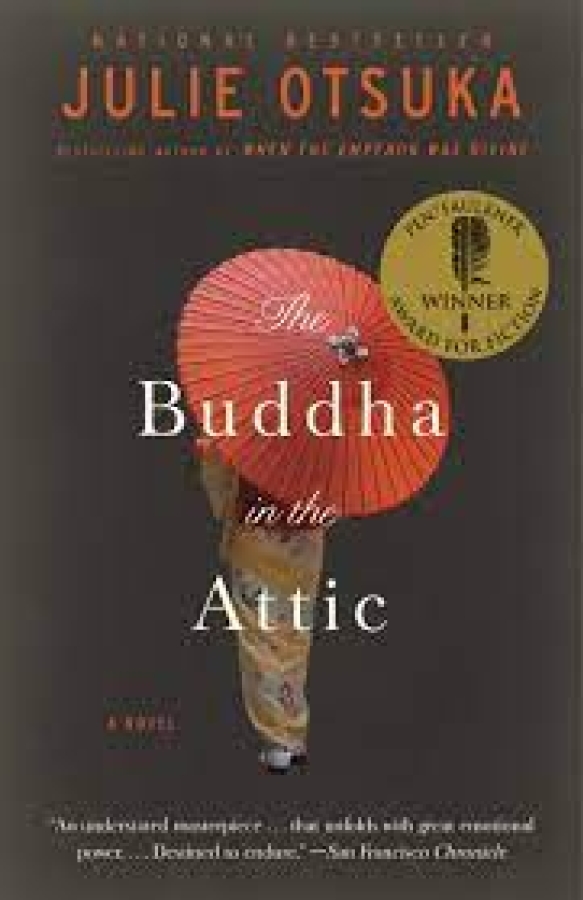
The Buddha in the attic (we all came from the sea)
The novel recounts the experiences of Japanese women sent to the United States to marry compatriots who had immigrated long before. > Some of us were from a small mountain village in Yamanashi and had only recently seen our first train. Others among us were from Tokyo, and had seen everything, and spoke a beautiful Japanese. (...) Many more of us were from Kagoshima and spoke in a thick southern dialect that those from Tokyo pretended not to be able to understand. (...) On the boat we were mostly virgins. (...) We had long black hair and broad flat feet and we were not very tall. What did they think when they saw their husbands, so different from the photographs in age and appearance? “The past was behind us, and there was no way of going back.” The novel follows these women into a reality where they must say > Yes, sir, or No sir, and do as they were told, Better still, say nothing. You belong to the invisible world . They learn to obey, to work hard, to speak English, or at least enough words to survive, and they even take lovers or find husbands among the Americans: they are hardworking and docile, just as men like them to be. When World War II breaks out, from good immigrants the Japanese turn into traitors, spies, and enemies, to be interned in concentration camps. And so Japanese women, even those married to Americans, find themselves locked away. “The Japanese had disappeared from our towns. And soon,” you can still see the official notices posted on telephone poles, (...) but they are already beginning to fray and fade. (...) What those instructions were exactly, no one can clearly remember. (...) In autumn there is no Buddhist harvest festival..(...) All we know is that the Japanese are out there somewhere, in one place or another, and we will probably never meet them again in this world.” To make overall sense of the novel, one can start from the title *The Buddha in the Attic*, banally translated into Italian as *Venivamo tutte dal mare* > . Japanese identity, a blend of Buddhism and Shinto, is put away in the attic the moment the women arrive in America: the new culture must be assimilated, they must become American. It is a mere suspension, because when they are consigned to an unknown place, a non-place > , these women disappear; they are no more; it is as though they had never been. There are two chapters worth reading: *Come, Japanese!* > the journey of these women: nostalgia and the severance of ties, fear and anticipation. These are the components of exile, whatever the origin and destination, feelings common to so many migrants. *The Disappearance* > recounts the evaporation of the Japanese, and the mind wanders to an evanescent novel by Coetzee (see on this site *The Childhood of Jesus* > ). The author intended to give the narrative a choral quality. To achieve this end, she resorted to a literary device: the use of the "we" when recounting the lives of the women, and the impersonal form when narrating the disappearance of the Japanese people. Unwilling to follow the stories of individual women, making them protagonists in their own right, she turned them into a mass, weighing down the narrative and rendering the novel verbose and repetitive. Why not read it? It is boring.