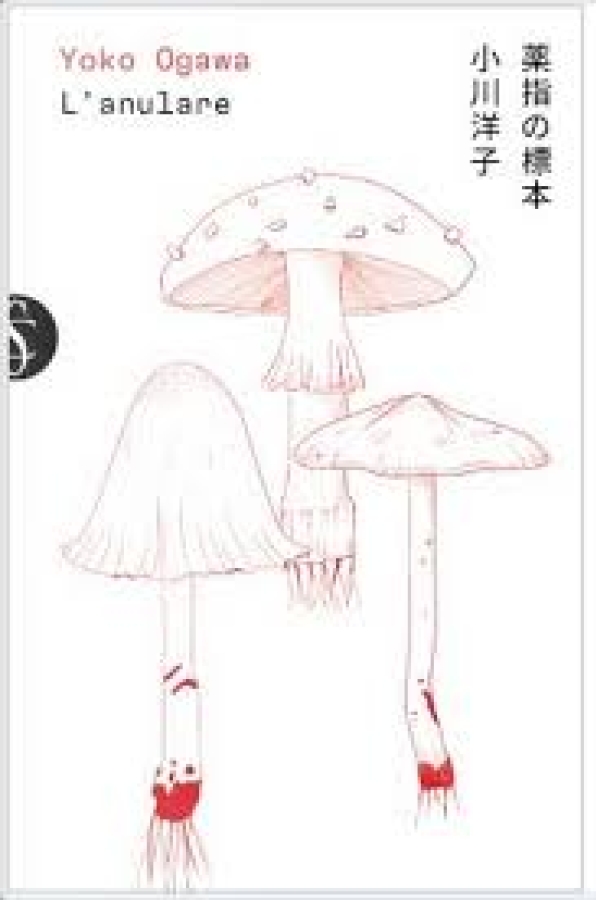
Finished reading on: March 11, 2025
Corriere della Sera
1994
103
Italiano
The Ring Finger
Title of the original version reviewed: «L'anulare»
AI Translation Notice: This review was translated from the original Italian using artificial intelligence. Book quotes and excerpts are translated interpretations and will not match the author's original English phrasing or official published translations.
While in ancient Egypt embalming was practiced to preserve the deceased for eternity, the Shinto worldview and a certain measure of fetishism lead, in Japan, to the preservation and safekeeping of objects and living beings that are important in one's life. The novel speaks of a "specimen," and the technique employed is perhaps akin to that used for the wet preservation of fluid specimens using formaldehyde. In any case, the method is not explained in the book, perhaps to maintain a magical and mysterious atmosphere. This long preamble was necessary to frame the story. The protagonist is a young woman who left her job at a soft-drink bottling plant following a workplace accident: the gear of a machine severed the tip of her ring finger,
an image haunted me; that seashell-shaped piece of flesh, pink as a cherry petal, tender as the pulp of a ripe fruit, falling in slow motion into the iced soda, only to settle at the bottom, floating among the bubbles, (...) I had lost a part of my body. She goes to work in the city, in a semi-abandoned building. Here, Mr. Deshimaru prepares and keeps specimens of all kinds.
Everything about him was impeccable. The color of his skin, his hair, the shape of his ears, the length of his arms and legs, the line of his shoulders, his voice were all perfectly harmonious. (...) The sun's rays enveloped his white coat, sketching an aura of light around it. One day, Mr. Deshimaru puts new shoes on her and orders her to always wear them; then he undresses her, leaving the shoes on, and they make love.
He neatly unbuttoned my blouse from the top down and unzipped my flared skirt. (...) In the end, I found myself naked. I was wearing only the black leather shoes. (...) He held me tight in his large arms—not in a tender embrace to savor the sensation of our bodies—as if he wanted to press all of me flush against him. (...) I had the feeling of having been transformed into a specimen incorporated into him. From here, the story is a slow slide toward the inevitable question:
couldn't I entrust myself to you and become one of your specimens too? (...) The preserving fluid must have been warm and still. It was not cold and fizzy like the soda. It would have completely enveloped the ring finger, from the tip to the edge down to the faintest lines of the fingertip, while the cork stopper would have shielded it from dust and external noises.
The story is disturbing if viewed as a realistic narrative; it becomes sustainable if considered as a metaphor for the deprivation of a part of the body. Having watched a small ring finger detach and vanish created a profound wound in the young woman's psyche. It is as if we were inside a dream, in which a kind of shaman, shadowy and luminous at once, draws the girl to himself, offering her a world that is protective and claustrophobic. Becoming a "specimen" is a way of escaping reality.
The writing is limpid and simple, reflecting well the young woman's disorientation; pleasant and fluid, the style contributes to an overarching sense of implausibility that not even the eccentricity of Japanese culture can overcome. Everything remains on the surface; there is no psychological depth in a tale in which only physical contours and objects are delineated in detail, thereby acquiring a semblance of reality. The story flows far too linearly.
Why not read it? It is simply too implausible.