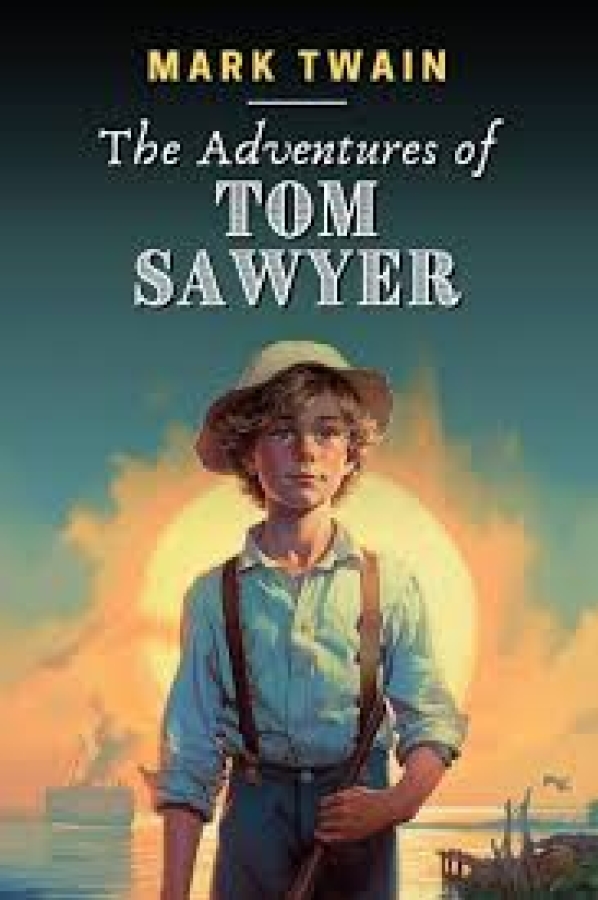
The Adventures of Tom Sawyer
Tom Sawyer is a young boy who lives with his aunt in a small rural town on the banks of the Mississippi. Mark Twain introduces him in this way: > he got back home barely in season to help Jim, the small colored boy, saw next-day's wood and split the kindlings before supper—at least he was there in time to tell his adventures to Jim while Jim did three-fourths of the work. (...) If he had been a great and wise philosopher, like the writer of this book, he would now have comprehended that Work consists of whatever a body is obliged to do, and that Play consists of whatever a body is not obliged to do. Tom is not clear on this distinction and takes a carefree, unencumbered life as serious business, swinging from melancholia—which prompts him to wish he could die temporarily, just to make himself missed—to a fantasy world in which he dreams of being a pirate or an outlaw. And so, with his faithful friends, especially the vagrant Huckleberry Finn, known as Huck, he embarks on a series of exploits, from the pirate life on an island in the middle of the river to wandering through the graveyard at night, witnessing a murder, all the way to setting off in search of treasures surely hidden by bands of robbers. This dizzying flurry of activity does not prevent Tom from courting Becky, a girl from a respectable family, who also finds herself drawn into Tom's reckless escapades. There is no point in recounting the plot, at times convoluted and commonplace yet never dull: it is far more interesting to dwell on two peculiarities of the novel. The first is the rural setting; with gentle and affectionate irony, Mark Twain depicts the school, dominated by the schoolmaster's authoritarianism; the church gatherings with the preacher's tedious and moralizing sermons; and the hilarious ritual of Examination Day, when the best pupils present an essay of their own before the entire community. One can smile, as Mark Twain does, at the ornate English, laden with words that most people likely do not understand, at the puritanical and sanctimonious values, at education imposed by sheer force; nevertheless, a strong communal spirit emerges, seeming to transcend even class divisions. It is a white society, placid in its values, with a single, clear boundary: discrimination against Black people, who remain in the background even as they sustain the small town's agricultural economy; one can sympathize with the vagrant Huck, but not with the servant Jim. The other compelling aspect lies in Tom's powers of fabulation. Unlike the protagonists of other coming-of-age novels, Gian Burrasca or Jim from *Treasure Island* (see the reviews of *Il giornalino di Gian Burrasca* and *Treasure Island* on this site), what surprises is Tom's dialectic: how he manages his aunt, capitalizing on her naive affection; how he cajoles his friends, talking them into adventures and overcoming their reluctance; how he persuades Becky to follow him into dangerous and intimate situations, paradoxical for such a prudish society. And when Mark Twain remarks that he can stop at writing the story of a Boy, because > the story could not go much further without becoming the history of a Man. (...) When one writes of juveniles, he must stop where he best can , he perhaps means that Tom's innocent cunning would turn into a guilty capacity for deceit, as so often happens among adults. In Twain's imaginative world, it is better to keep playing with the petty subterfuges of adolescence. Beyond the character and the plot, the literary merit of *Tom Sawyer* resides in its writing—attentive to detail, magically realist, subtly ironic. Take as an example this passage, which describes Tom's awakening on the island of the imaginary pirates: > when Tom awoke at dawn, he wondered where he was. (...) Now, far off in the trees a bird called; another answered; now the distant strokes of a woodchopper were heard. (...) A little green worm came crawling over a soft leaf, lifting two-thirds of its body into the air from time to time and “sniffing around,” (...) then proceeding again, (...) and when the worm approached him, of its own accord, he sat still as a stone, (...) then (...) when it began a journey across him, his heart was all glad. (...) Now a procession of ants appeared from who knows where. (...) A brown-spotted ladybug climbed the dizzying height of a blade of grass (...) and Tom bent down close and said, > Ladybug, ladybug, fly away home, your house is on fire, your children are alone. These are wonders of a world inhabited at night by spirits, and Nature still seems endowed with a soul. And what of the description of the school, punctuated by that repetitive “showing off” (in Italian, *ostentare* or *vantarsi*)? All the teachers “put on airs”
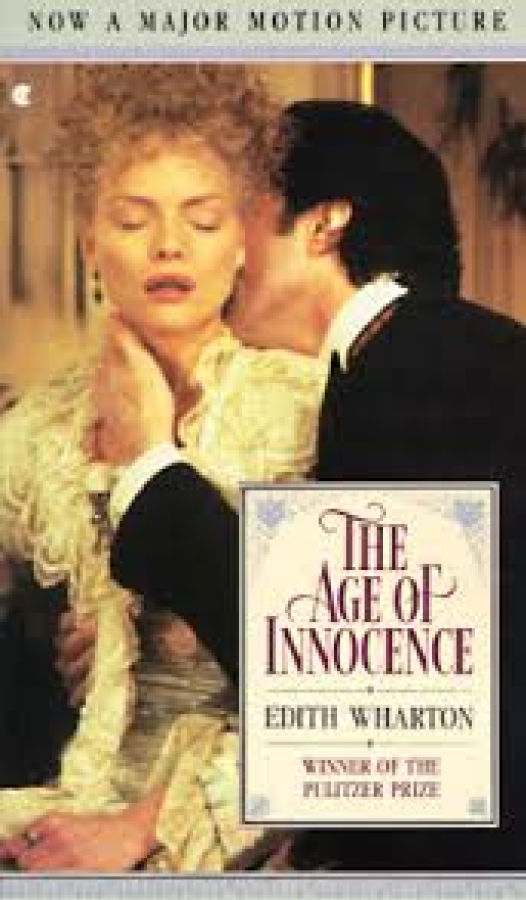
The Age of Innocence
The novel is set in New York at the end of the nineteenth century, when the old New York elite, with its oppressive social rituals, was overwhelmed by a new, upwardly mobile bourgeoisie—prejudiced and aggressive; it reacted by trying to ignore the changes, > until they crashed down upon them. What mattered was preserving the "traditional pleasantness" of social life. It is no coincidence that the tale opens with opening night at the Opera, meticulously described by the author: the arrangement of families in the boxes according to a rigid social hierarchy, the placement of individuals within them respecting family roles, the elegant gowns in the latest Parisian fashion, the hushed gossip that must cease when the solo is sung; an aristocratic atmosphere steeped in American Puritanism, and therefore superior to the frivolous European world. Amidst a crowd of minor characters, the three protagonists appear from the very beginning. Archer is a young lawyer with a passion for literature and a history of typical bourgeois transgressions (a mistress, perhaps a few young ladies), yet well aware that he must make a "good marriage." Reckless reading leads him to make nonconformist statements ( > women ought to be free—as free as we are ), but > he was a quiet young man endowed with strong self-control. Adherence to the discipline of a small society had become almost a second nature to him. Yet a restlessness stirred within him, leading him to feel as > though he were being buried alive under his future. Still at the Opera, in the family box in an unobtrusive position, as rigid etiquette dictates, sits the very young May, who > that very afternoon had allowed him to think there was on her part "an inclination" (the official New York phrase for a girl to declare an interest) ; a consummate representative of wholesome American society, who > would probably go through life facing each experience to the best of her ability, but never anticipating what was to happen by so much as a fleeting glance. Perhaps this heedlessness was what gave her eyes that innocence, and her face the semblance of a type rather than a person. Beside May is > a slim young woman, (...) with brown hair curling in thick locks around her temples, held by a narrow band of diamonds, (...) with a dark blue velvet skirt gathered beneath the bust by a belt with a broad, old-fashioned buckle. Her unusual carriage and attire catch Archer's attention: she is "poor Ellen Olenska," May's cousin, who has returned to America after separating from a Polish nobleman. Being taken in by the family is one thing, but displaying her in public, on opening night at the Opera, before all of New York's foremost families! From this opening scene, so voluptuously baroque, the story branches out: Archer is drawn to the mysterious and intoxicating Countess Olenska, who represents to him the promise of a different life, glimpsed through literature and now attainable through falling in love with the beautiful, melancholic Ellen. If we look beyond the haze of reverie, we discern that the figure of Ellen > had built up within him a kind of sanctuary where she reigned enthroned among his secret thoughts and desires. Little by little, this image became the scene of his real life, of his every rational activity. (...) Outside of this, on the stage of his actual life, he moved with a growing sense of unreality and inadequacy, blundering against family prejudices and traditional viewpoints, much like a madman colliding with the furniture of his own room. And yet, he imprisons himself in a bourgeois existence: he advances his marriage to May, counsels Ellen against seeking a divorce from her husband, leads an ordinary life beside an affectionate and understanding young wife, frequenting New York's customary social venues and fulfilling his duties to May's family. Slowly and silently, a muted curtain of protection forms around him: officially, no one knows of Archer's infatuation with Ellen—a burgeoning love marked by petty lies, abrupt business trips, and fleeting, supposedly clandestine meetings, as happens with all lovers. Then, all at once, May comes out into the open, having previously been eclipsed by the vitality of the splendid Countess Olenska; in a conversation made of insinuations, of truths half-spoken and withheld, May preempts Archer's irreparable confession by declaring that she is expecting a child and that, bold and cynical, she has used this still-uncertain pregnancy to induce Ellen to leave America. Innocent May has revealed herself to be an astute wife—not because she possesses any singular intelligence, but because she adhered to the well-worn patterns of the society to which she belongs. At a farewell reception for Countess Olenska (for appearances must always be kept!), Archer realizes that everyone knew about the affair and acted in solidarity to avert the scandal of a separation: in old New York, everything must proceed > without bloodshed: the way of people who dreaded scandal more than disease, who placed decency above courage. And on the other hand, Archer too shared these values, even if > he seemed to be witnessing the scene in a state of strange weightlessness, as if floating somewhere between the chandelier and the ceiling, nothing astonishing him so much as his own share (as a spectator) in what was happening. Written after the First World War, *The Age of Innocence* recounts the end of an era, narrating the loss of innocence of the American bourgeoisie. If in Alcott's books (see the reviews of *Little Women* and *Good Wives* on this site) the family is woman's natural destination, thus giving concrete form to her social role, in Wharton's novel marriage is a cage, a place of renunciation and duty. From this perspective, Countess Olenska is the longed-for figure, capable of living outside convention, like a butterfly flitting from flower to flower. This interpretation, emphasized by Martin Scorsese's 1993 film, does not encompass the tale's truest meaning. We must look from Archer's vantage point and from Wharton's conservative vision. In her introduction, Sarah Blackwood notes that two alternative endings to the book have been discovered. In both, the marriage is dissolved and Archer is able to go and live in Paris with the beautiful Countess Olenska. Why did the author decide that Archer should instead retreat into a flat bourgeois life, into the social and marital duties of old New York? The novel's primary theme is the weight of social rules, whose strength lies in their internalization within the conscience; they are a prison that charts our destiny, beyond our "secret thoughts and desires." And as occurred with Archer, nothing is left to us but to live in fantasy, to anchor ourselves to dreams and imagination, creating a parallel reality in our minds. Ever-renewed Don Quixotes of Cervantes or Quichottes of Rushdie (see the reviews on this site), we move about, lost and imprisoned in a world we would wish to be different, until, like Archer, we adapt, settled into a quiet life. How long can we keep doing so? Wealthy, influential, and surrounded by artists during her life in Paris, Wharton was also passionately devoted to being an "interior designer"; this accounts for the detailed descriptions of interiors and attire—veritable theatrical stagings, already cinematic, so rich in imagery, resonance, and symbols. It is a meticulous, seemingly realistic prose that radiates a dreamy, suspended, and evanescent charm. Whether Wharton ever knew Joyce or Proust I cannot say; yet behind the superficial nineteenth-century patina, we are clearly in the presence of an innovative narrative, an anti-novel. The lexicon is rich, with a distinctly American stamp, coupled with an articulate and refined syntactic structure; without question, fine English! Why read it? Archer is an interesting and modern figure, splendidly baroque.
Age of iron
The novel is set in South Africa in the mid-1980s, during the era of apartheid. An elderly classics teacher learns that she has incurable cancer. She resolves to recount the final days of her life to her daughter, who left the country many years ago: > I tell you the story not so that you may take pity on me, but so that you may learn how things are. It would be easier, I know, if the story came from someone else, if it were a stranger’s voice resounding in your ears. But the fact is, there is no one else. I am alone, the only one writing. Do not pass it over, do not forgive easily. Read everything with a distant eye . This declaration by the protagonist encapsulates the novel’s multifaceted meanings: the events, and above all the companions, of the old woman’s final days, the loneliness and nostalgia for the past, the exile from her daughter. An alcoholic vagrant and a stray dog find shelter at the protagonist’s home; initially wary, but growing increasingly trusting, she takes them in, finding solace and friendship. Meanwhile, the plight of two Black youths draws the elderly teacher into the grueling living conditions of the Black population and, above all, into the brutal repression of the Afrikaner police. Upended by events that shatter a hitherto tranquil existence, the letter to her daughter changes in meaning: intended as a way to reinforce their bond, the woman instead finds herself swept into turmoil and uncertainty. Her love for her daughter grows more abstract and distant, while her feelings deepen toward those closest to her in suffering and in the face of death: the vagrant, the dog, and the two Black youths. And a plea for love rises from the old teacher: > and this long letter, I say it now, is a plea toward the sunset, toward the west (the daughter lives in the United States) for you to return to me. Come and hide your head in my lap as a child does, as you used to do. I cannot live without a child, I cannot die without a child. What I endure, in your absence, is grief. I produce pain. You are my pain. This is an accusation. Yes, I accuse you. I accuse you of having abandoned me . It is a powerful, ancestral novel, dominated by classical themes typical of Greek tragedy—those of Aeschylus and Sophocles. The relationship between mother and child is explored not in psychological terms, but by tracing it to an ineluctable destiny: the detachment of offspring from their parents. The daughter’s flight from South Africa begets the mother’s exile, her solitude, and with it the awareness that she will not be remembered after death > let me go from myself, let me go from you, letting go of a house still alive with memories: it is a difficult task, but I am learning . > Do not be afraid, says the protagonist, I will not seek you out. It is not my soul that will remain with you, but the spirit of my soul, the breath, the movement of the air around these words, the faintest turbulence traced in the air by the otherworldly passage of my pen across the page your fingers now hold . Why read it? It is not an easy read, not least because the author frequently opens philosophical digressions, but the novel’s cosmic depth and the evocative power of many of its pages are well worth the effort.
All Our Names
The protagonist is a young Ethiopian; the adolescent longing to leave his remote village behind drives him to choose a purpose and a city: to become a great writer in Kampala, which, despite being the capital of Uganda, like him «belonged to no one and no one could claim it». It is therefore a non-place, where the young man hides, forgets, or simply abandons the twenty-five names by which he was called in his village. In Kampala, he meets his friend. > Isaac and I became friends the way two stray dogs find each other following the same trail every day in search of food and companionship . Both are unversed in urban life, but Isaac projects confidence and takes the protagonist under his protective wing—naive, fragile, and too much of a dreamer to survive on his own in a violent and chaotic metropolis. Having no names left, Isaac gives the boy several nicknames (no fewer than thirteen), all tied to his air of an intellectual and a man of letters. At first, the two young men frequent the university campus, a kind of "oasis > in a country increasingly torn apart by clashes between opposing factions, which soon culminate in dictatorship and repression. If students were initially allowed to voice dissent, demonstrations are subsequently banned and smothered in blood. For the protagonist, the situation is particularly dire because he is a foreigner; Isaac must step in repeatedly to save him and hide him in safe places. The political struggle has degenerated into gang warfare. Isaac, growing ever more mysterious due to the life he leads and the company he keeps, enters the service of a clan leader. The protagonist watches in horror as violence, executions by firing squad, and outright massacres unfold. Yet above all, he is appalled by his friend’s transformation: from a slightly provocative, somewhat playful young man, Isaac reveals himself to be a cynical killer, a skilled manipulator of men, an unscrupulous opportunist, perhaps even a double-dealer. But who is Isaac, really? What do we know of him, of his past? The situation deteriorates rapidly, and Isaac provides the protagonist with a passport and a plane ticket to flee to the United States. In doing so, he also gives him a name: his own. The young man, now Isaac, holds a temporary visa as a political refugee and is monitored by social services, in particular by a young caseworker, Helen. A love affair begins, but can one truly love someone whose past remains unknown? During their troubled relationship, Isaac asks what he can do for her: yes, I told her, promise me you won’t disappear one day > . Yet so it will be, because this is the fate of migrants, placeless and nameless: all they can say, promising to return one day, is that no one will ever have loved each other more than we did. For the sake of clarity, the plot has been presented according to a possible logical sequence: first the events in Uganda, then the love affair in America. In truth, the author does not construct the novel this way; the narrative unfolds through two parallel storylines: in the first, the narrator is the protagonist and the subject is his friendship with Isaac; in the second, the narrator is Helen, recounting her relationship with the protagonist. Only in the final lines do the two narratives intersect, when we discover that the phrase the false Isaac utters to Helen at the moment of parting was written by the real Isaac on a slip of paper for the protagonist. One is left to wonder whether the love for Helen is cut from the same cloth as the friendship between the real Isaac and the false one: extraordinary bonds in an age when relationships between human beings are like those of two men who meet unexpectedly in the middle of a desert after traveling so long they have begun to believe the world is uninhabited > .. Yet what does this strange novel mean? It conveys a sense of rootlessness, that special loneliness that comes from having nothing that is truly yours«, which drives Helen to search Isaac’s room to »seek proof of his existence > . This rootlessness possesses a dark allure of its own because it offers us a world weightless«, allowing one to confront a reality that »breaks you into pieces slowly« and to overcome the fear of »what comes next. It is an interesting book. It is, however, marred by an excess of intellectualism, discernible in many passages of the novel and in its overarching design: the reliance on two parallel narratives fragments the story, weighing it down needlessly and causing it to lose both narrative momentum and emotional tension. The almost Pirandellian interplay of the two Isaacs is pushed to an exaggerated degree, yet fails to surprise the reader upon discovering that Helen’s Isaac is not the real Isaac. The author sought to pack too much substance into a storyline and its characters, when it would have been enough to narrate them in their spontaneity, in their real lives as migrants of the world". Why not read it? It is boring.
All the Pretty Horses (Wild Horses)
Two boys, sixteen-year-old Grady and seventeen-year-old Rawlins, rest on their saddle blankets after dismounting their horses. > The night was cold and clear and the sparks rising from the fire spread warmth and reddish glows among the stars. They could hear the trucks out on the highway and they could see the lights of the town reflected far in the desert fifteen miles to the north. What do you think you’ll do? Rawlins asked. I don’t know. Nothing , Grady replied. After three hundred pages—some of them arduous reading—to the same question (“where is your country?”), Grady answers: “I don’t know. I don’t know where it is. (...) He touched the horse with his spurs and moved on. He rode while the sun turned his face copper-colored and the reddish wind blew from the west across the evening plain and the small desert birds sang among the dry ferns; horse and rider advanced and their long shadows moved together as the shadow of a single being. They passed and paled into the evening plain, toward the world to come > There is nowhere to stop; nothing remains but to keep moving, with only two certainties: the horses and the great untamed plain. The novel recounts the adventure of an adolescent. profoundly alone and in search of himself across the vast expanses of a West now overtaken by modern American society. We are like the Comanches were two hundred years ago. We don’t know what will show itself come daylight. We don’t even know what color it will be > . So his father told him, almost as if urging Grady to leave, perhaps to flee. And the boy embarks on a long journey on horseback, together with Rawlins. They strike out into the great expanses toward Mexico, into a swarm of stars, so that they rode not under but among them (...), like thieves newly loosed in that electric black, like young thieves in a luminous garden, ill-equipped against the cold and ten thousand worlds to choose from > . Along the way they encounter Blevins, a thirteen-year-old boy on horseback, solitary, perhaps on the run. They realize he may be a source of trouble: he is impulsive, stubborn, devoid of judgment, still a child. They take him in, and after feeding him, Blevins began to take off his clothes and walk naked across the grass, and, passing by the horses, plunged into the water. (...) The horses watched him > . The kid gets drunk and lets his horse get stolen by a group of Mexicans; he then drags the two friends into an attempt to recover the animal, and the whole thing ends in a shootout and a pursuit, from which Grady and Rawlins barely escape, nonetheless losing all trace of Blevins. The two young men seem to find a safe haven and employment at a large hacienda > ; Grady earns esteem for his exceptional skills as a breaker of wild horses; he also meets the master’s daughter, with whom he has a love affair. It is a situation fraught with peril: a poor cowboy in love with a wealthy heiress. And indeed, Grady and Rawlins are arrested by the Mexican police and accused of being accomplices to Blevins, whom they meet again in prison and who has allegedly killed a man. During the transfer from the police station to the prison, Blevins is killed; in the horrific Mexican penitentiary, the two young men are attacked and stabbed, and only the intervention of the aunt of the girl Grady has fallen in love with saves them from the hell they have landed in. It would seem that we have reached the end of the adventure, but Grady insists on getting the horses back, and consequently the novel concludes with a gunfight in which the young man reclaims the animals. Then again, what is more beautiful and more true than a horse? That night he dreamed of horses in a high plain where the spring rains had made the grass and the wildflowers grow and the flowers spread all blue and yellow as far as he could see in the dream he was among the running horses and in the dream he himself could run with the horses (...) and they ran he and the horses together out on the high ground where the earth resonated under the galloping hooves (...) in a resonance that was like a music..." It is a circular story, one in which the plot lacks any genuine development, continually folding back on itself—namely, onto the figure of Grady, his loneliness and despair. The characters are sketched superficially; in some instances, they are incomprehensible. If one wishes to appreciate the novel, one must focus on the contrast between the austerity of the dialogues between Grady and Rawlins—spare, minimalist, and precisely for that reason expressive of their existential condition—and the descriptions of the horses and the magical landscapes of the great wild plain. Yet a level of minute detail consistently predominates, encumbering the narrative and wearying the reader. As for the disquisitions on Mexican history, let us draw a charitable veil over them. Why not read it? It is prolix, overlong, and rambling.

American Pastoral
The book is divided into three chapters, each possessing its own distinct identity. In the first, bearing the evocative title *Paradise Remembered*, the narrator is the writer himself. The idol of his youth is Seymour Levov, “the Swede”: handsome, blond, athletic, a formidable sportsman. The memory of his feats epitomizes a golden era where harmony triumphs. Now in his sixties, the writer is invited to lunch by Seymour under a pretext. The meeting turns out to be mundane and pointless; later, however, at a reunion of old classmates, the writer learns that Seymour was suffering from cancer and had been shattered by the actions of his daughter, who had bombed a general store, killing a bystander. > The gentle man with his delicate ways of dealing with conflict and contradiction, the confident former athlete, responsive and resourceful in any fair-minded struggle with fair-minded foes, is up against a foe who is not fair-minded, a devil rising out of the human feelings, and he is overwhelmed. He learns to live behind a mask . The writer decides to write a book about Seymour, even as he wonders—with a deeply autobiographical undertone—whether the man inside the man is ultimately knowable, whether he is a “jar you cannot open.” Yet does the story he writes conform to reality, or is it merely the author's invention? In the two subsequent chapters, the writer shifts to a third-person narrative. In the second chapter, titled *The Fall*, the dramatic story of Merry is recounted: Seymour’s stuttering daughter who, at sixteen, vanishes after committing a heinous crime, sinking ever deeper into hiding and self-destruction. At the root of the daughter’s conduct lies a hatred for her parents, their orderly home, their life built on bourgeois values—and, by extension, for American society itself. Yet how could > his daughter be so blind as to want to destroy the very system that had granted her family so many opportunities for success? To destroy her capitalist parents as though their wealth were anything other than the product of the steadfast labor of three generations? . Is Merry, then, an inexplicable anomaly? In truth, in the final chapter, *Paradise Lost*—which largely details a dinner party among the Levovs and their friends (a dinner that concludes tragically with the stabbing of Seymour’s father)—it becomes evident that the “moral disease” afflicts not merely the girl, but an entire society in which > what was supposed to exist did not exist. Deviance prevailed. You cannot stop it. Undeniably, what was not supposed to happen had happened, and what was supposed to happen had not. The old system that created order no longer works. All it has left behind is fear and dismay, now concealed by nothing . The themes of this undoubtedly formidable book are essentially two: generational relations and, above all, the agony of a parent who views himself as blameless, who wishes to protect his family and cannot fathom why a daughter so cherished grew up so estranged from his world; and the unraveling of a society built by immigrants who toiled tirelessly to integrate and be embraced as successful citizens, only to watch the foundational values of social cohesion disintegrate. Seymour’s ordeal is that of a father, but it is also the tragedy of the American pastoral. Roth’s narrative structure is exceptionally rich and intricate. It relies neither on a lavish surplus of adjectives, as with Updike, nor on the expansive periodization of Bellow (all chroniclers of the crisis of American society). It is precisely this syntactic framework that constitutes Roth’s strength, yet also proves to be his weakness: the sentences are often overly convoluted, making for an exhausting read and fostering a redundancy of phrasing and, above all, of syntactic constructions. A greater frugality would certainly have served the book’s otherwise compelling themes far better. Why pass on it? It is deeply demanding, particularly the third chapter. It should be taken in small doses.
American Rust
Paul Krugman, the American Nobel laureate in economics, begins his recent book (*End This Depression Now!*) by recalling how unemployment is "an immense human disaster," not only because of the resulting financial hardships, but because the effects on one's dignity, self-respect, and sense of control over one's life can be devastating. One no longer feels like a protagonist, and a profound malaise sets in—born, as the author of *American Rust* puts it, "from the pain of watching the world change without you." With this novel, the author sets out to do precisely this: to narrate the deindustrialization of a steel town through the eyes of its victims—not so much the workers who found themselves unemployed, but rather their children, who have lost the social and psychological anchor their fathers once possessed. The novel's protagonists are two young men, Isaac and Poe. The former, intelligent and a dreamer, is the son of a retired technician who, after working for decades in steel mills, is now confined to a wheelchair following a severe industrial accident. Isaac has given up his aspirations (he would like to become an astrophysicist) to care for his father, while his sister, equally intellectually gifted, severed ties with the past, leaving town to become a successful lawyer. Poe, by contrast, was once a local hero, a football star, but has been reduced to scraping by at the expense of his mother—an impoverished woman who lives in a trailer and supports the household through precarious employment at a small tailor's shop. The setting is the decline of an industrial town, painted by the author in somber tones yet devoid of nostalgia, with descriptions that highlight the ruin of mills and buildings alongside nature's reclamation of a space no longer dominated by man. > The mill had been a small city... now it stood like an ancient ruin, its structures overwhelmed by wild vines.... tracks of deer and coyote crossed the grounds: there were only the human signs of occasional squatters . A theme dear to American literature—including contemporary writing—resurfaces: the myth of the wilderness, of a rural society where man finds for himself, in total freedom and autonomy, the means of survival. Isaac steals his father's savings and decides to run away to pursue his dreams, finally free from the past. Before departing, he meets with Poe, his best friend, who once saved his life by thwarting a suicide attempt. They decide to spend one last night together in an abandoned mill. There, however, they run into a gang of thugs, whom Poe provokes with his customary recklessness. To save his friend, who is in danger of being murdered or severely beaten, Isaac kills one of the assailants. The two young men take flight. Poe is accused of the murder, while Isaac flees on foot toward California. The paths of the two young men diverge, each unaware of the other's fate, yet both endure the violence of a disintegrating society. Poe experiences the ruthless law of prison, which does not tolerate anyone failing to belong to a gang, and for this he is assaulted and left on the brink of death. Isaac, naive and fragile, suffers the violence of the road: he is deceived, robbed, and forced in turn to steal to survive. All Poe would have to do is tell the truth—that it was Isaac who killed the man—yet he refuses, feeling guilty for what occurred and, above all, knowing that his friend would never survive prison life. Isaac, in turn, realizes that flight is not the answer: he must return and confess to the crime, and, above all, he must live where his roots lie. Friendship is the central theme of the book: it is, indeed, the profound bond that unites the two young men, as well as the novel's secondary characters, shielding them from the unraveling of society. Why does Poe not choose to turn his friend in rather than endure the brutality of prison? Why does Isaac return to surrender himself when he could escape to California? From the standpoint of dominant economic rationality (grounded in the pursuit of self-interest), their behavior is irrational, inexplicable; yet it is, instead, the primal force that holds society together. Delving deep into the impact of economic decline on human relationships, the author probes the inner workings of the human mind during a phase of social disintegration, finding a solid foundation in the bonds between individuals. Yet does this offer us hope for the future? The narrative is driven forward through a literary device. Each of the protagonists tells their own story across dedicated chapters, whose sequence apparently follows no order but seems random. Consequently, only the reader possesses knowledge of the overarching plot and must construct an overall picture for themselves. This approach, undoubtedly refined from a literary standpoint, asks too much of the reader. Left without a guide, one gets lost in the characters' analyses, which are often a bit too intellectualized and introspective. Everything remains as if suspended, merely sketched, failing to grip the reader, failing to captivate. Moreover, the novel is deficient in action, meaning that only the psychological introspection of the characters and the examination of their relationships could offer points of interest. Yet this is precisely what remains unresolved, as the exploration of the mind's inner workings appears endless, lacking any definitive development. If the author does not wish to be all-pervasive and intrusive like the great Dostoevsky, he fails—or refuses—to untangle the narrative threads and bring them to a resolution, as the Russian master does so brilliantly. Consequently, the sluggishness and thinness of the plot render the novel tedious and ponderous. Why not read it? It is boring.
Ask the Dust
The third book of the Bandini saga represents a further transition, both in terms of narrative content and stylistic and expressive aspects. Arturo is in Los Angeles, where he scrapes by, trying to write and get his short stories published. At the outset, the novel retains the defining elements of its predecessor: a strong predominance of imagination, a narrative rhythm still grounded in subjective expression, and a style characterized by strong lyrical accents rich in evocative power. Arturo falls in love with Camilla, a Mexican girl who works in a bar, and embarks on a tormented love affair marked by verbal clashes, written notes from Arturo, and an outing to the seashore, during which the young man fails to translate his feelings into sexual consummation, despite the girl’s expectations. Arturo still lives in a sort of delirium, swinging between phases of exaltation and depressive states. However, an episode occurs (imagined or real?) that seems to mark the turning point in the novel’s narrative and stylistic structure: a woman seeks Arturo out to pursue a romantic affair with him. From this moment on, his relationship with Camilla is inverted: the girl turns to Arturo for help and confesses that she is in love with another man, who nevertheless does not want her. Arturo accepts the situation, not least because he has realized that Camilla is using drugs and he wishes to help her. A complex relationship unfolds, through which Arturo matures, coming of age as an adult. The young man wants to take her to a house by the sea, but Camilla flees and vanishes into the desert: > across the desert was an utter indifference, the rhythm of night and another day, and yet the secret intimacy of these hills, their mystery, secret and comforting, made death of no great importance. You could die, but the desert would hide the secret of your death, it would remain after you, to cover your memory with ageless wind and heat and cold…. I carried the book a hundred paces into the desert, toward the southeast. With all my strength I threw it far out there in the direction she had gone. Then I went to the car, started the engine, and drove back toward Los Angeles . Coming to grips with the reality of emotions, rather than merely the delirium of his own aspirations and fantasies, spurs Arturo’s transition from youth to adulthood. The style also evolves in this direction. It preserves its richness of language, with a sentence structure and a choice of words particularly attuned to phonetic qualities and the evocative power of rhythm. The style, however, becomes leaner, less lyrical and redundant; the narrative structure is distinguished by dialogues, previously virtually absent due to the lack of characters of significant weight.