Finished reading on: July 02, 2017
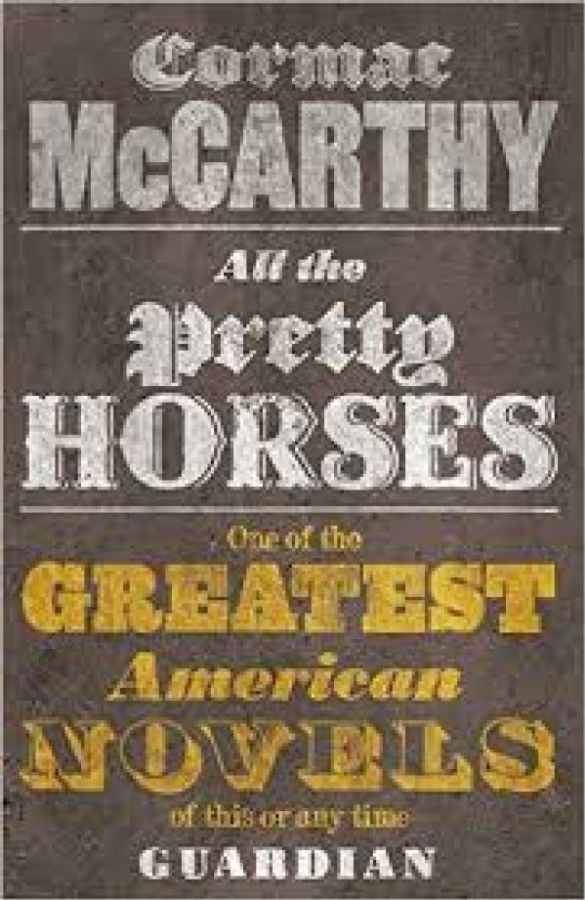
All the Pretty Horses (Wild Horses)
Title of the original version reviewed: «All the Pretty Horses (Cavalli Selvaggi)»
AI Translation Notice: This review was translated from the original Italian using artificial intelligence. Book quotes and excerpts are translated interpretations and will not match the author's original English phrasing or official published translations.
Two boys, sixteen-year-old Grady and seventeen-year-old Rawlins, rest on their saddle blankets after dismounting their horses.
The night was cold and clear and the sparks rising from the fire spread warmth and reddish glows among the stars.
They could hear the trucks out on the highway and they could see the lights of the town reflected far in the desert fifteen miles to the north.
What do you think you’ll do? Rawlins asked.
I don’t know.
Nothing
, Grady replied.
After three hundred pages—some of them arduous reading—to the same question (“where is your country?”), Grady answers: “I don’t know.
I don’t know where it is.
(...) He touched the horse with his spurs and moved on.
He rode while the sun turned his face copper-colored and the reddish wind blew from the west across the evening plain and the small desert birds sang among the dry ferns; horse and rider advanced and their long shadows moved together as the shadow of a single being.
They passed and paled into the evening plain, toward the world to come
There is nowhere to stop; nothing remains but to keep moving, with only two certainties: the horses and the great untamed plain.
The novel recounts the adventure of an adolescent.
profoundly alone and in search of himself across the vast expanses of a West now overtaken by modern American society.
We are like the Comanches were two hundred years ago.
We don’t know what will show itself come daylight.
We don’t even know what color it will be
.
So his father told him, almost as if urging Grady to leave, perhaps to flee.
And the boy embarks on a long journey on horseback, together with Rawlins.
They strike out into the great expanses toward Mexico,
into a swarm of stars, so that they rode not under but among them (...), like thieves newly loosed in that electric black, like young thieves in a luminous garden, ill-equipped against the cold and ten thousand worlds to choose from
.
Along the way they encounter Blevins, a thirteen-year-old boy on horseback, solitary, perhaps on the run.
They realize he may be a source of trouble: he is impulsive, stubborn, devoid of judgment, still a child.
They take him in, and after feeding him, Blevins
began to take off his clothes and walk naked across the grass, and, passing by the horses, plunged into the water.
(...) The horses watched him
.
The kid gets drunk and lets his horse get stolen by a group of Mexicans; he then drags the two friends into an attempt to recover the animal, and the whole thing ends in a shootout and a pursuit, from which Grady and Rawlins barely escape, nonetheless losing all trace of Blevins.
The two young men seem to find a safe haven and employment at a large
hacienda
; Grady earns esteem for his exceptional skills as a breaker of wild horses; he also meets the master’s daughter, with whom he has a love affair.
It is a situation fraught with peril: a poor cowboy in love with a wealthy heiress.
And indeed, Grady and Rawlins are arrested by the Mexican police and accused of being accomplices to Blevins, whom they meet again in prison and who has allegedly killed a man.
During the transfer from the police station to the prison, Blevins is killed; in the horrific Mexican penitentiary, the two young men are attacked and stabbed, and only the intervention of the aunt of the girl Grady has fallen in love with saves them from the hell they have landed in.
It would seem that we have reached the end of the adventure, but Grady insists on getting the horses back, and consequently the novel concludes with a gunfight in which the young man reclaims the animals.
Then again, what is more beautiful and more true than a horse?
That night he dreamed of horses in a high plain where the spring rains had made the grass and the wildflowers grow and the flowers spread all blue and yellow as far as he could see in the dream he was among the running horses and in the dream he himself could run with the horses (...) and they ran he and the horses together out on the high ground where the earth resonated under the galloping hooves (...) in a resonance that was like a music..."
It is a circular story, one in which the plot lacks any genuine development, continually folding back on itself—namely, onto the figure of Grady, his loneliness and despair.
The characters are sketched superficially; in some instances, they are incomprehensible.
If one wishes to appreciate the novel, one must focus on the contrast between the austerity of the dialogues between Grady and Rawlins—spare, minimalist, and precisely for that reason expressive of their existential condition—and the descriptions of the horses and the magical landscapes of the great wild plain.
Yet a level of minute detail consistently predominates, encumbering the narrative and wearying the reader.
As for the disquisitions on Mexican history, let us draw a charitable veil over them.
Why not read it? It is prolix, overlong, and rambling.