Cormac McCarthy
Books by this author (2)
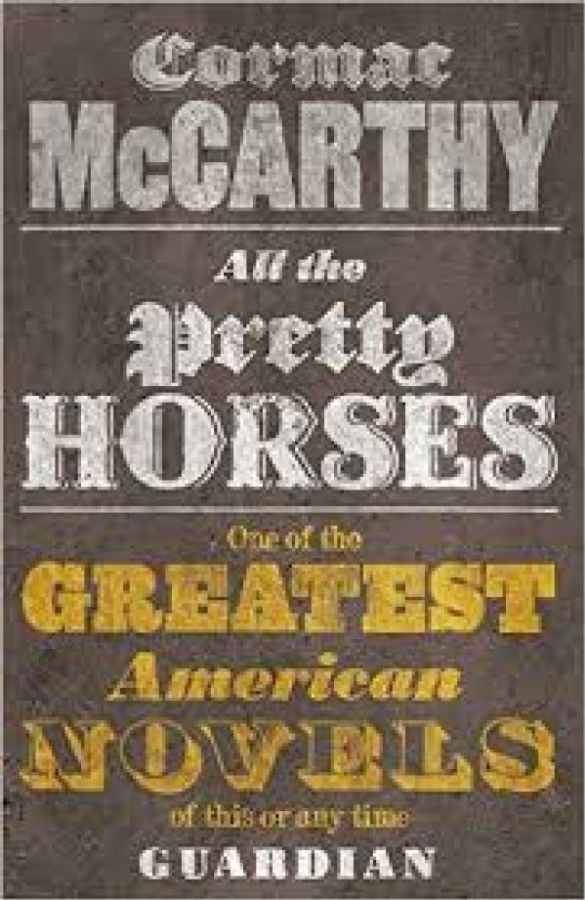
All the Pretty Horses (Wild Horses)
Two boys, sixteen-year-old Grady and seventeen-year-old Rawlins, rest on their saddle blankets after dismounting their horses. > The night was cold and clear and the sparks rising from the fire spread warmth and reddish glows among the stars. They could hear the trucks out on the highway and they could see the lights of the town reflected far in the desert fifteen miles to the north. What do you think you’ll do? Rawlins asked. I don’t know. Nothing , Grady replied. After three hundred pages—some of them arduous reading—to the same question (“where is your country?”), Grady answers: “I don’t know. I don’t know where it is. (...) He touched the horse with his spurs and moved on. He rode while the sun turned his face copper-colored and the reddish wind blew from the west across the evening plain and the small desert birds sang among the dry ferns; horse and rider advanced and their long shadows moved together as the shadow of a single being. They passed and paled into the evening plain, toward the world to come > There is nowhere to stop; nothing remains but to keep moving, with only two certainties: the horses and the great untamed plain. The novel recounts the adventure of an adolescent. profoundly alone and in search of himself across the vast expanses of a West now overtaken by modern American society. We are like the Comanches were two hundred years ago. We don’t know what will show itself come daylight. We don’t even know what color it will be > . So his father told him, almost as if urging Grady to leave, perhaps to flee. And the boy embarks on a long journey on horseback, together with Rawlins. They strike out into the great expanses toward Mexico, into a swarm of stars, so that they rode not under but among them (...), like thieves newly loosed in that electric black, like young thieves in a luminous garden, ill-equipped against the cold and ten thousand worlds to choose from > . Along the way they encounter Blevins, a thirteen-year-old boy on horseback, solitary, perhaps on the run. They realize he may be a source of trouble: he is impulsive, stubborn, devoid of judgment, still a child. They take him in, and after feeding him, Blevins began to take off his clothes and walk naked across the grass, and, passing by the horses, plunged into the water. (...) The horses watched him > . The kid gets drunk and lets his horse get stolen by a group of Mexicans; he then drags the two friends into an attempt to recover the animal, and the whole thing ends in a shootout and a pursuit, from which Grady and Rawlins barely escape, nonetheless losing all trace of Blevins. The two young men seem to find a safe haven and employment at a large hacienda > ; Grady earns esteem for his exceptional skills as a breaker of wild horses; he also meets the master’s daughter, with whom he has a love affair. It is a situation fraught with peril: a poor cowboy in love with a wealthy heiress. And indeed, Grady and Rawlins are arrested by the Mexican police and accused of being accomplices to Blevins, whom they meet again in prison and who has allegedly killed a man. During the transfer from the police station to the prison, Blevins is killed; in the horrific Mexican penitentiary, the two young men are attacked and stabbed, and only the intervention of the aunt of the girl Grady has fallen in love with saves them from the hell they have landed in. It would seem that we have reached the end of the adventure, but Grady insists on getting the horses back, and consequently the novel concludes with a gunfight in which the young man reclaims the animals. Then again, what is more beautiful and more true than a horse? That night he dreamed of horses in a high plain where the spring rains had made the grass and the wildflowers grow and the flowers spread all blue and yellow as far as he could see in the dream he was among the running horses and in the dream he himself could run with the horses (...) and they ran he and the horses together out on the high ground where the earth resonated under the galloping hooves (...) in a resonance that was like a music..." It is a circular story, one in which the plot lacks any genuine development, continually folding back on itself—namely, onto the figure of Grady, his loneliness and despair. The characters are sketched superficially; in some instances, they are incomprehensible. If one wishes to appreciate the novel, one must focus on the contrast between the austerity of the dialogues between Grady and Rawlins—spare, minimalist, and precisely for that reason expressive of their existential condition—and the descriptions of the horses and the magical landscapes of the great wild plain. Yet a level of minute detail consistently predominates, encumbering the narrative and wearying the reader. As for the disquisitions on Mexican history, let us draw a charitable veil over them. Why not read it? It is prolix, overlong, and rambling.
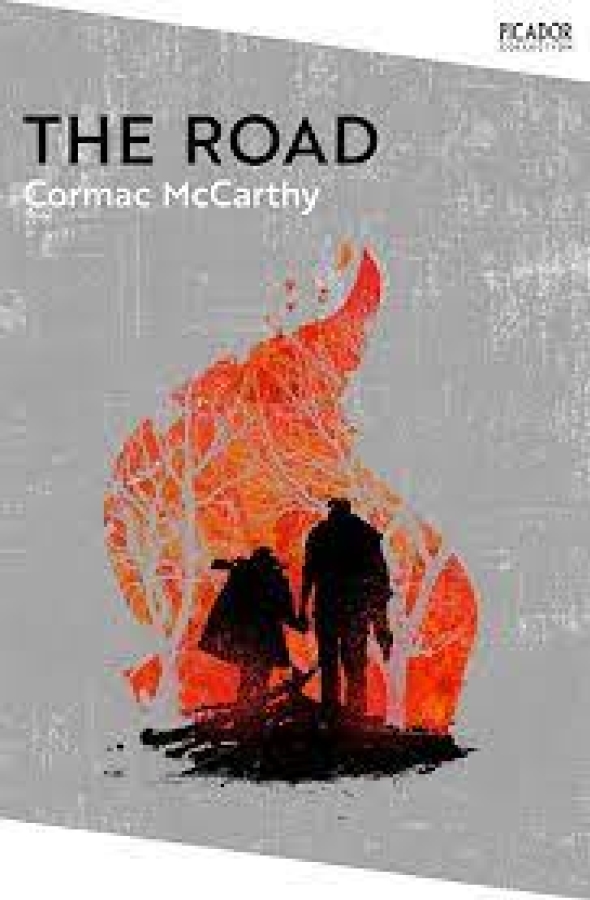
The road
> The ashes of the lost world spread across the desolate wasteland, (carried) hither and thither into the void by storm winds. Hauled and tossed and hauled again. Everything torn from its roots. Unsupported in the dusty air. Sustained by a breath, trembling and brief. If only my heart were stone . In a post-apocalyptic era (following an unspecified catastrophe) > all food stores had been exhausted and murder was everywhere upon the earth. The world was soon largely peopled by men who would eat their children before their very eyes, and the cities themselves were ruled by bands of filthy scavengers who rummaged through the rubble and crawled from the refuse, (lit only) by the white of teeth and eyes, carrying charred and anonymous tins of food in nylon bags, like patrons in the restaurants of hell. (...) Out on the road the pilgrims sank down, fell, and died, and the veiled and barren earth (like a shroud) continued to glide with the sun and revolve again like the trackless, unmarked course of any sister world, unnamed and unreachable in the primordial dark. This lengthy quotation gives a sense of this novel’s style: lyrical, rich in evocative imagery, syntactically and lexically intricate, difficult to translate, captivating to critics, far less so to ordinary readers. Evoking the author’s own words introduces the setting of the slender plot: a father and his son, still a young boy, journey through a devastated world of charred trees and desolate wastes, bereft of animals and plant life, amid other human beings who have turned to cannibalism to survive. The father knows he will soon die (the dust is killing him) and wants to lead his son to the sea: he is convinced that along the coast there are still "good people." They could stop, but they cannot, for they risk being ambushed by murderous gangs. > Ten thousand dreams buried within their wandering souls. They went on. Crossing the lost world on a cart, hidden like rats. The dead nights in their fixity and deader still in the darkness. So cold . The father shows no pity; he does not answer cries for help, refuses to be moved by human beings who will likely become food for others and desperately beg for aid; he cannot afford to, having a mission: to survive and bring the boy to safety. The son, by contrast, is the critical conscience; not only does he plead for humanity, but he demands that his father remain consistent with the stories he tells him. "You want me to tell you stories," the man says. > The boy looked at him and looked away. (...) Those stories are not true. They don't have to be true. They are stories. Yes (says the boy). But in stories we are always helping people and instead we don't help other people.(...) Well. I think we are still here. A lot of bad things have happened but we are still here . When they reach the coast, there is no scent of the sea; the water is not blue but gray, covered in ash, > only fish bones in their millions scattered along the beach as far as the eye can see like a line of death. A huge salt sepulchre. Senseless. Senseless . The novel can be interpreted in many ways. One can read the narrative literally, as the tale of what will become of us after a catastrophe—whether climatic, pandemic, or nuclear; yet too many narrative elements are missing (not least the causes of the environmental disaster) to suggest that the author intended to write a standard dystopian work. One might turn to another of McCarthy's books (see the review of *All the Pretty Horses* on this site), in which the writer dwells on the demise of the cowboy world and wild horses across the green plains of the West; *The Road*, too, is set across vast prairies, albeit ravaged by catastrophe, as if the author had returned to mourn, now without hope, the inexorable and agonizing loss of his world—transformed into an apocalyptic landscape by the disorderly and pervasive spread of factories, reckless overdevelopment, and shopping malls with their glut of commodities. How vast our hoard of goods and food must be if, even after years of looting, we can still unearth something useful amid the rubble and refuse! Reading it imparts a metaphysical sense of existence, beyond time and space, transcending the individual story. The journey of the two pilgrims is a metaphor for Death, a march toward the end of being. Not only is there no meaning in living in a horrifying reality where even memory slips away and dreams can only be nightmares; death is our inevitable arrival, yet dying is an agonizing ordeal in a world devoid of peace. Viewed from this perspective, the narrative centers entirely on the bond between father and son. Why does the man go on living and struggling? Why does he insist on recounting stories falsely steeped in humanity? Why does he deceive the boy? A powerful message emerges: our attachment to life must not reside in material possessions, in the mundane routine of an increasingly futile, fragile, and painful existence; we insist on not dying because we must still protect our loved ones. When an eschatology no longer exists—be it the City of God or the Sun of the Future—all that remains is to anchor ourselves to our responsibilities toward those nearest to us, in foundational bonds such as that between father and son. The narrative is structured in brief paragraphs, like a collection of prose poems that could almost stand alone. The fascination of the reading lies precisely in the sound that springs from the lexical richness of the words and an unconventional syntactic structure, hovering as if suspended and inexplicable. It is a tour de force of stylistic mastery, yet a quest for effect that comes at the expense of the story: everything repeats in an eternal return; the landscapes, situations, and dialogues (effectively confined to father and son) unfold monotonically and, in the end, predictably. One waits anxiously for something to break the tedium, yet nothing comes, save for an improbable ending. A sense of oppression lingers, and perhaps that was precisely the author’s intent. Still, the book's immense success remains hard to fathom; it is prolix, and reaching the end is a struggle. Why read it? Solely out of obligation, and drawn by its stylistic mastery.