Philipp Meyer
Books by this author (1)
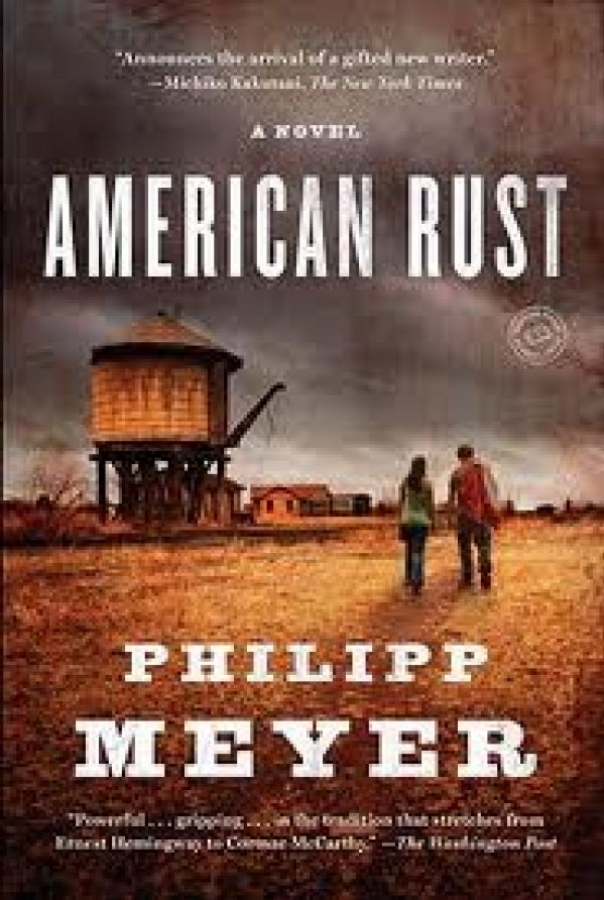
American Rust
Paul Krugman, the American Nobel laureate in economics, begins his recent book (*End This Depression Now!*) by recalling how unemployment is "an immense human disaster," not only because of the resulting financial hardships, but because the effects on one's dignity, self-respect, and sense of control over one's life can be devastating. One no longer feels like a protagonist, and a profound malaise sets in—born, as the author of *American Rust* puts it, "from the pain of watching the world change without you." With this novel, the author sets out to do precisely this: to narrate the deindustrialization of a steel town through the eyes of its victims—not so much the workers who found themselves unemployed, but rather their children, who have lost the social and psychological anchor their fathers once possessed. The novel's protagonists are two young men, Isaac and Poe. The former, intelligent and a dreamer, is the son of a retired technician who, after working for decades in steel mills, is now confined to a wheelchair following a severe industrial accident. Isaac has given up his aspirations (he would like to become an astrophysicist) to care for his father, while his sister, equally intellectually gifted, severed ties with the past, leaving town to become a successful lawyer. Poe, by contrast, was once a local hero, a football star, but has been reduced to scraping by at the expense of his mother—an impoverished woman who lives in a trailer and supports the household through precarious employment at a small tailor's shop. The setting is the decline of an industrial town, painted by the author in somber tones yet devoid of nostalgia, with descriptions that highlight the ruin of mills and buildings alongside nature's reclamation of a space no longer dominated by man. > The mill had been a small city... now it stood like an ancient ruin, its structures overwhelmed by wild vines.... tracks of deer and coyote crossed the grounds: there were only the human signs of occasional squatters . A theme dear to American literature—including contemporary writing—resurfaces: the myth of the wilderness, of a rural society where man finds for himself, in total freedom and autonomy, the means of survival. Isaac steals his father's savings and decides to run away to pursue his dreams, finally free from the past. Before departing, he meets with Poe, his best friend, who once saved his life by thwarting a suicide attempt. They decide to spend one last night together in an abandoned mill. There, however, they run into a gang of thugs, whom Poe provokes with his customary recklessness. To save his friend, who is in danger of being murdered or severely beaten, Isaac kills one of the assailants. The two young men take flight. Poe is accused of the murder, while Isaac flees on foot toward California. The paths of the two young men diverge, each unaware of the other's fate, yet both endure the violence of a disintegrating society. Poe experiences the ruthless law of prison, which does not tolerate anyone failing to belong to a gang, and for this he is assaulted and left on the brink of death. Isaac, naive and fragile, suffers the violence of the road: he is deceived, robbed, and forced in turn to steal to survive. All Poe would have to do is tell the truth—that it was Isaac who killed the man—yet he refuses, feeling guilty for what occurred and, above all, knowing that his friend would never survive prison life. Isaac, in turn, realizes that flight is not the answer: he must return and confess to the crime, and, above all, he must live where his roots lie. Friendship is the central theme of the book: it is, indeed, the profound bond that unites the two young men, as well as the novel's secondary characters, shielding them from the unraveling of society. Why does Poe not choose to turn his friend in rather than endure the brutality of prison? Why does Isaac return to surrender himself when he could escape to California? From the standpoint of dominant economic rationality (grounded in the pursuit of self-interest), their behavior is irrational, inexplicable; yet it is, instead, the primal force that holds society together. Delving deep into the impact of economic decline on human relationships, the author probes the inner workings of the human mind during a phase of social disintegration, finding a solid foundation in the bonds between individuals. Yet does this offer us hope for the future? The narrative is driven forward through a literary device. Each of the protagonists tells their own story across dedicated chapters, whose sequence apparently follows no order but seems random. Consequently, only the reader possesses knowledge of the overarching plot and must construct an overall picture for themselves. This approach, undoubtedly refined from a literary standpoint, asks too much of the reader. Left without a guide, one gets lost in the characters' analyses, which are often a bit too intellectualized and introspective. Everything remains as if suspended, merely sketched, failing to grip the reader, failing to captivate. Moreover, the novel is deficient in action, meaning that only the psychological introspection of the characters and the examination of their relationships could offer points of interest. Yet this is precisely what remains unresolved, as the exploration of the mind's inner workings appears endless, lacking any definitive development. If the author does not wish to be all-pervasive and intrusive like the great Dostoevsky, he fails—or refuses—to untangle the narrative threads and bring them to a resolution, as the Russian master does so brilliantly. Consequently, the sluggishness and thinness of the plot render the novel tedious and ponderous. Why not read it? It is boring.