
The House by the Medlar Tree
The setting is a fishing village in late nineteenth-century Sicily. The Malavoglia are a family of fishermen, owners of a boat (the *Provvidenza*) and a home with a small plot of land (the house by the medlar tree). Life unfolds serenely and with dignity within a community that respects the Malavoglia because they are economically self-sufficient. In short order, a succession of misfortunes plunges the family into poverty and grief: the *Provvidenza* is shipwrecked, claiming the life of Bastianazzo, the son of Padron ’Ntoni, and a cargo of lupins is lost. The family is forced into debt to repair the boat and repay the loan contracted to purchase the lupins. Then one of the sons, Luca, dies as a soldier, and a second shipwreck forces the sale of the house by the medlar tree as well. ’Ntoni, Padron ’Ntoni’s other grandson, turns to smuggling; surprised by the police, he severely wounds an officer in the ensuing scuffle. To spare him a life sentence, the defense lawyer invokes the officer’s pursuit of one of the Malavoglia daughters, who, consumed by disgrace, flees the village. Following this series of catastrophes, the novel appears to conclude on a positive note: Alessi, Padron ’Ntoni’s other grandson, manages to repurchase the house by the medlar tree. In reality, this positive note bears witness to the cyclical nature of history, the perpetual struggle for survival composed of positive moments and negative ones—the latter far more frequent. Alongside the Malavoglia family, the book’s other primary subject is the community itself, embodied by a gallery of characters, their mutual entanglements, and their utilitarian logic, but also by a continuous intertwining of economic concerns with gossip, the hunt for husbands, moral hypocrisy, and, ultimately, indifference toward misfortune. No one aids the Malavoglia, save for fellow unfortunates, while the propertied families—or those who perceive themselves as such—abandon them, as misfortune is, at bottom, regarded as evidence of guilt. It is a complex work, layered with manifold themes. In the background lies an absolute fatalism, reflecting a destiny already sealed by social hierarchy and economic utilitarianism: > What ails you? he would ask him. Nothing ails me, only that I am a poor devil. And what can you do if you are a poor devil? We have to live as we were born . "When a man cannot catch good fortune, he is a fool, as everyone knows." It would be reductive, however, to limit the novel to a mere mirror held up to society, or to subsume it under a kind of philosophy of history. In truth, the vitality of the various characters, the narrative tempo, and above all the language—highly idiosyncratic in that it is non-dialectal yet profoundly representative of its milieu—are all elements that elevate the narrative into a realm that is non-realistic, imaginative, and expressive of universal sentiments. If one compares Verga’s work with those of Émile Zola, particularly *La Terre*, a profound difference clearly emerges. Verga’s novel seeks neither to sensationalize nor to incite revolt or desolation; instead, it operates on the terrain of "lightness," steeped in irony toward a society locked within its own rigid codes and incapable of comprehending the heroic spirit that animates the Malavoglia. The clash between individual (and familial) heroism and the narrow-minded conservatism of society constitutes an inherently Italian theme, and is thus emblematic of a culture and a country.

Matterhorn
The novel is set in Vietnam and recounts the dramatic ordeal of a company of the American military, forced first to garrison an outpost in the middle of the jungle, then to abandon it when deemed useless by military command, and finally to retake it in a bloody battle. Matterhorn is a mountain, a circumscribed territory, a microcosm that allows the author (a highly decorated former Marine) to narrate the absurdity of war and the perverse mechanisms that sustain it. And he does so from the perspective of the soldiers, all very young. In war, a soldier is nothing but > the ash of a cruel game... nothing more than a collection of empty events that will end up as a faded photograph above his parents' mantelpiece. They too will die, and relatives who do not know whose photograph it was will throw it away . In war > the people one loves will die to give meaning and life to what was always thought to be senseless words, a language of death . The novel is structured in three parts, which can also be interpreted as a kind of military life path of a young man, still a student: from his initiation as an officer to his forging in the epic struggle against the enemy, down to existential despair and the loss of the only bond that holds value in war: friendship. Mellas is a nineteen-year-old officer who, as dictated by an absurd military tradition, is sent to the front despite his inexperience. Mellas must make decisive choices for his own survival and that of the soldiers entrusted to him. They move through a hostile environment, amid fog, jungle, aggressive insects, and ferocious beasts. The enemy is invisible, and one often fires without knowing whether anyone is truly there or if a target has been hit. Yet the young officer is never alone, for the commanders—comfortably safe, drinking and smoking—hound him over the radio, demanding his position, the enemy body count (often fabricated to pacify them), and the reasons why he does not act with greater resolve. > Already weary from lack of sleep, Mellas was now fighting the physical exhaustion of hacking a path through almost impenetrable brush, climbing muddy slopes to gain a ridgeline, to search for a path, a trail. He was drenched in both sweat and rain. Strain, Weight, Flies, Cuts. Vegetation. He no longer cared where they were or why.... (still) three hundred and ninety-nine days and then stand up and walk away . Yet Mellas, too, is seized by ambition, by the desire to advance his career. He volunteers to go on patrol with a few soldiers. Deep within the dense tropical forest, they finally encounter a Viet Cong fighter, who is mortally wounded. He is a young man, just like him and his comrades. Terrified, he begs for help, but Mellas knows that the only real mercy would be to kill him rather than leave him as prey for the tigers. He cannot bring himself to do it and returns to the outpost in tears. He cannot accept that this is what war is, and > in doing so he opened himself up to the pain of seeing thrown away the bonds tying those slain enemies to those who loved them: mothers, sisters, friends, and wives. Command has decided that the company must abandon the outpost and reach another location as quickly as possible, still deep in the jungle. And the Marines are forced into an exhausting march, dragging behind them the wounded and even the corpses of fallen soldiers—one mauled by a tiger, another killed by a strain of malaria found only in that specific region of Vietnam. Because they failed to reach this new outpost—every bit as useless as the last—within the allotted time, the company is designated as an emergency reserve for the front’s most precarious sectors. Mellas wants to protest such an unjust decision, but his friend Hawke reminds him that one must play politics—not for one's own sake, since they are merely reserve officers after all, but because command, out of spite, might withhold the helicopters needed to resupply companies at the front and evacuate the wounded and the dead. The helicopter is a weapon of blackmail! In the novel's second part, Mellas's company is sent to retake Matterhorn, now occupied by the enemy. Military command does not know how many Vietnamese there are, but it does not matter. A heroic feat must be performed to cast the regiment’s senior officers in a favorable light and advance their careers. The company finds itself embroiled in a horrific battle. It is an epic narrative, a kind of *Iliad*, complete with its heroes and martial episodes. What drives the American soldiers is certainly no ideal (why are we here? the soldiers ask themselves; does Vietnam have gold, oil, or some other raw material?). What moves them to extraordinary acts of valor is brotherhood and rage: saving their comrades, recovering the wounded or at least the dead; fighting with the conviction that their true enemies are the very men who led them into this butchery. And then there is the taste of killing for killing's sake. Tension and fear forge a bond between enemies, who are as if bound together in a web of violence and death. In the third part of the story, Mellas is wounded in combat and consequently sent to convalesce. Yet upon his return, he discovers that during the lull, the company has been gripped by the racial strife between whites and blacks that plagues American society—a conflict that had temporarily vanished during combat operations. The solidarity and friendship forged in combat merely suspend social and racial rivalries. War is not a moment of genuine change; it only habituates one to violence. Indeed, his friend Hawke is killed in an attack orchestrated by a faction affiliated with the Black brothers. Nothing truly changes; they are merely shadows, > moving through this landscape of mountains and valleys, changing the character of things as shadows move but leaving nothing changed when they leave. Only the shadows themselves can change . War triggers an individual transformation, not a collective one. It is undeniably a war book, one in which the epic element prevails. Yet it would be reductive to view this novel merely as an account of the Vietnam conflict, a sort of prose poem, a modern *Iliad*. It is not merely that. It is an indictment of war. Narrating it from such a circumscribed space—Matterhorn and its surrounding territory—already allows the reader to enter the mundane yet tragic reality of individual men's experience, shedding the overarching, particularizing frame of the Vietnam conflict. It speaks of war—of any war. Then there is the figure of Mellas, undoubtedly autobiographical. The young man refuses to accept the inexorable laws of military life and war. Yet he rejects them not out of nostalgia for civilian life, which for him, as for the others, is already considered forfeit. He refuses to accept the futility of the decisions, the gratuitous suffering inflicted upon the soldiers, and the killing of enemies—unknown to him, yet fellow human beings with lives back home, young men who also had a future. It is the chronicle of the tragedy of all wars. The book is very long, meticulously detailed, and at times slips into reportage. By the end, one grows somewhat weary of so much slaughter. Yet this is perhaps the author's very intent: to sicken us with war. Why read it? It is a magnificent war book.
Miguilim
> A certain Miguilim lived with his mother, his father, and his siblings, very far from here, (...) in the Mutùm. In the middle of the Campo Gerais, but in a hollow within forest country, black earth, at the foot of the mountains. Miguilim was eight years old . With this fairy-tale incipit, Guimarães Rosa narrates an extended peasant family through the eyes of a child. > Miguilim had no desire to grow up, to become a grown-up; grown-ups' talk was always the same dry things, with that need to be violent, frightened things . In a family plunged into poverty (the father > shouted that he was poor, on the verge of becoming destitute, of having to beg for alms ), Miguilim lives at the heart of a complex social nucleus made of people and animals: the violent father, the uncle carrying on an affair with the mother, the eccentric grandmother possessing a severe and atavistic wisdom, the witch-servant, "so pitch-black, as Death must be," the cowherds and the village folk, the farmyard animals, and so much more; yet none is like his brother Dito—self-assured, protective, capable of standing up to their father. > All at once, it burst. (...) And then came the thunder! It thundered tremendously, again and again; everyone covered their ears, closed their eyes. Then Dito held Miguilim close. Dito wasn't trembling, only he was more serious. (...) Dito was clever and peaceful. (...) Dito never truly quarreled with anyone, (...) Miguilim always wanted not to quarrel, yet ended up quarreling with everyone. How wonderful to be like Dito: suited to all people's hours... . Miguilim is fragile, unsuited to peasant labor, afraid to venture alone into the forest to bring lunch to his father working in the fields; nothing comes of the cowherd's reassuring words when Miguilim asks if he is deformed, nor of the hugs and kisses of the witch-servant, nor even of the purring rubs of the cat Sossoe, > eyes of a green so much less empty --- it was a light inside another inside another, inside another, without end . It is as though Miguilim lived in a world of his own: magical, incomprehensible, wondrous, and terrifying. It is no wonder that Dito's death shatters the boy; he nearly loses his mind, can no longer hide behind his brother's reassuring certainty, and must himself go to work in the fields, grueling hoeing beneath the sun. As in an exquisite fairy tale, a knight on horseback arrives to save him; he addresses little Miguilim directly and hands him a pair of spectacles. > And Miguilim looked at everyone, with such intensity. (...) He looked at the dark forests on the mountain crest, here the house, the hedge of wild beans and sao-caetano; the sky, the cattle pen, the yard, the round eyes and the high windowpanes of the morning. (...) The Mutùm was beautiful. Now he knew it. If in Anna Maria Ortese's *Il mare non bagna Napoli* (see the review on this site), eyeglasses unleash an unbearable reality upon an impoverished girl from the slums, here, instead, the lenses possess a salvific power, as though only the true knowledge of reality could make it bearable. A fairy-tale ending brings little Miguilim's childhood to a splendid close, foreshadowing the great social narrative of João Guimarães Rosa's masterpiece (see the review of *Grande Sertao* on this site). The extended peasant family characterized the social fabric of our country until the 1950s. And yet there are no great novels chronicling the sharecropping and tenant-farming world. *Pinocchio* is the son of an artisan, the Malavoglias in *I Malavoglia* are fishermen, Giannino in *Il giornalino di Gian Burrasca* is the quintessential bourgeois lad, the stories in *Cuore* are too edifying to mirror a social reality; perhaps only the splendid chapter "The Four Seasons" in *Il mulino del Po* investigates the dynamics typical of the peasant world (for *Pinocchio*, *I Malavoglia*, *Il mulino del Po*, and *Il giornalino*, see the reviews on this site). Here, however, Guimarães Rosa retraces a child's early years within the intricate web of relationships of an impoverished reality, entirely geared toward survival, yet one in which emotions churn and dreams remain possible. The relationship between Miguilim and Dito denotes an informal hierarchy in which the more fragile child seeks the support of the stronger personality, forging a privileged and steadfast bond that offers security—one that only the fairy-tale conclusion can replace. In his intense preface, Antonio Tabucchi defines the novella > an operetta with a Mozartian timbre, performed on the magic flute of an uncommon narrator . It is a particularly apt definition: it is the fluctuating cadence between hyperrealistic moments and fantastic ones, of "non-story," that imparts the sense of ambiguous allure that characterizes the narrative. Behind the easy screen of the fairy tale (but is it truly one?), the story > stirs unease and always retains an unattributable valence, on the margins of (or beyond) speculative formulation. Something reminiscent of the savage mind, bound to the mystery of Being . (Tabucchi's Preface). Why read it? Magnificent!
The Thousand and One Nights, Volume I
*The Thousand and One Nights* is an Arabic manuscript likely dating back to the Abbasid Caliphate, between 750 and 900 AD: the setting is the fabulous empire of Baghdad, stretching from North Africa across the Arabian Peninsula to Central Asia and India. Its discovery is credited to Antoine Galland in the early eighteenth century, and from that moment the text spread throughout the West, sparking wonder and scandal: Orientalism was born. Owing to the many versions of the work, it should be clarified that this review refers to the text established from the original manuscripts by René R. Khawan. Let us begin with *The Weaver of Nights*. The king has been betrayed by his wife: a Moor “lifted her legs in the air, slipped between her thighs, and penetrated her.” From that moment on, the sovereign resolves to take a maiden as his bride each night and execute her at dawn. The vizier's daughter, Shahrazad, who “had read books and writings of every kind,” asks her father to arrange her marriage to the king, saying: > either I shall rise in the esteem of my fellows by freeing them from the peril that threatens them, or I shall die or perish with no hope of deliverance, sharing the fate of those who have died and perished before me . Her father attempts to dissuade her with tales urging a prudent, unassuming life, but the daughter, obstinate and self-assured, replies that she could offer him other stories leading to entirely different conclusions. And herein lies the crux of *The Thousand and One Nights*: the word. Through literary invention, fabulation, and poetry, one can confront the direst straits, vanquish evil spirits, and even bend the will of God to one’s favor. According to the widely accepted interpretation—though not strictly corroborated by the work’s architecture—each night Shahrazad tells a story to the king: enthralled, the sovereign spares the maiden's life out of the desire to hear another tale, ultimately making her his lifelong bride. A miracle of the word! The work follows a recursive pattern: a frame narrative within which other stories unfold, all designed to persuade and astonish the listener. The prose narrative is interspersed with verses in a style characteristic of Abbasid civilization. One does well to surrender to its spell; nevertheless, certain common threads can be traced. In the celebrated *The Fisherman and the Jinni*, the central motif is cunning. A fisherman frees a demon imprisoned for centuries inside a jar at the bottom of the sea. Once liberated, the Jinni seeks to kill the poor man. The fisherman preys upon the demon's vanity, challenging him to demonstrate how he could possibly fit into such a small vessel; it is a ruse to seal the Jinni away once more. To the creature's pleas and promises, the fisherman replies with tales displaying the wisdom of poetry: > they might have remained just and pure,/but they abused their power/ and the world in turn oppressed them/(...) behold them restored to their squalor... One would gladly sink into the allure of the tales of the *Fisherman and the Jinni* (echoing the line “if you return, we shall return”), yet we must hasten to illuminate another magnificent tale: *The Porter and the Ladies*. Here the theme is clemency, itself the fruit of love. A porter finds himself in the house of three ladies of consummate beauty, which prompts the poet to say: > inviolate...when I beseech her to grant me/the embrace. Beauty advises her/to show herself generous,/ but Coquetry forbids her to yield . Three one-eyed mendicants arrive, and presently even the sultan and his vizier. A banquet ensues in which the guests are bound by an oath: > whatever you see us do, whatever you observe around us...do not seek to understand the reason . Yet the strangeness of what they witness is too great for the guests to refrain from questioning. Ten Moors appear, poised to behead the reckless intruders who failed to honor their pledge. To appease the wrath of the three ladies, the mendicants recount their life stories and plead for mercy: it will be granted to all the guests, so profound is the wonder inspired by the tales and the pleasure derived from them by the three magnificent maidens! How can one punish when love is being sung? > The woman took the weapon and advanced until she stood before me. (...) I looked at her for a long time. (...) Her cheeks then expressed the feelings that occupied her soul, and the verses of the poet came to my mind: if my mouth is silent, my glances speak/and they will tell you what I cannot say,/for love makes manifest/the feelings hidden within me.(...)/the one is a writer of genius, though his rhetoric is beholden only to the play of eyelids;/the other is no less fine a man of letters/though he expresses himself solely through the eye . We grasp from these lines how the bewitching word is also the fruit of oral and gestural performance, all within delightful company amidst pleasing music, sweet perfume, and the bliss of embrace, consummate > only if supplied with these four elements/youthful age, wine,/a beloved body, gold coins... One may investigate the myriad underlying themes of the work, from the philosophical to the depiction of a society centered on beauty, art, wealth, the supernatural, and magic, set against a prevailing backdrop of sovereign violence and tyranny. Let us not ask too many questions; let us lose ourselves in the tales, in their astonishing plots, in their incredible deeds and figures, the harvest of an exuberant and irrepressible imagination; let us indulge in the pleasure of the many verses, as seductive and mysterious as the following: > the oath that binds me, I have sworn/by the intoxication stirred within me by the flutter/of her eyelid, by the curve of her hips,/by the bewitched arrows she looses at me/(...) the sorrows have fled as at the radiant rising/of the sun, leaving the moon perplexed./Was the star of day ahead of time?/Did it perhaps already wish to put her to flight?... Why read it? Astonishing, magnificent, spellbinding, an explosion of the imagination.
Minaret
Najwa is a Sudanese young woman, the daughter of a wealthy and influential family. Following a coup d'état in which her father is imprisoned and sentenced to death, Najwa moves to England with her mother and brother. Here, her life changes radically: her mother dies, her brother is convicted of drug use, and she is forced to work as a maid for wealthy London families, mostly of Arab descent. She crosses paths again with a Sudanese friend with whom she had had a flirtation in her youth, one she had ended because of his accusations regarding her father's corruption. It is a fraught and contradictory relationship: the young man often proves selfish, self-centered, possessive, yet at the same time fragile, while continuing to voice criticism of Najwa's father. In the wake of her mother's death, Najwa is drawn to the mosque community and begins to pay closer attention to Islam, which evolves into a profound faith as her relationship with her partner unravels. Moreover, faith also offers a way to reclaim her roots—no longer national, but religious. Years pass, and Najwa goes to work for a wealthy Egyptian family, where she begins a relationship with a young student, who is likewise steeped in religious ideas. Yet by now the social divide is insurmountable, and their relationship ends the moment it is discovered. The book operates on two levels. The first, and more superficial, is tied to the Muslim milieu. The quest for roots through religion is an ever-present theme, though one left largely unexplored, both in terms of analyzing the underlying motivations for the protagonist's ideological evolution (from a largely indifferent background to deep religiosity) and in the depiction of the mosque community. The second, far more substantial level concerns Najwa's personal plight: her loneliness, her attachment to her family, her yearning to recapture—if only vicariously—the tranquil world of her childhood, and ultimately her ill-fated encounters with men. Najwa's fragility and her desires are ultimately transcended through the very serenity granted by her rediscovered faith. This enables her to take the most painful and difficult step: giving the young student's mother the "key" to persuade him to leave Najwa. > She does not know, she does not know that he has his own frustrations and ideas of the world. She does not know that he is not an extension of her. I tell her. And by telling her I lose him. I give the key into her hands . In this way, Najwa forfeits the hope of a romantic and family life of her own, resigning herself to a vicarious existence, like a nun or an elderly aunt. The novel thus chronicles Najwa's inner evolution from the carefree days of adolescence through life's disillusionments to a restored inner balance—one fostered by faith, but above all by a growing awareness of solitude as a deliberate choice. It is beautifully written in a lucid style, devoid of rhetoric yet felicitously expressive. It is somewhat reminiscent of Nadine Gordimer, albeit less dense and complex.
My Name Is Red
The book unfolds across multiple plotlines, difficult to trace back to a single narrative thread. A first path concerns the decline of the miniature painting technique, which had flourished in the sixteenth century under the influence of Persian and Chinese art. Ottoman miniature art justified the depiction of images to accompany books on the grounds that real individuals were never portrayed and no personal style existed; rather, figures and landscapes represented the world through the eye of God, constantly reiterating images and styles codified by the old masters and thus legitimized by the authority of the past. In truth, this approach served both as a justification and an ideal, since the miniaturist and the workshop to which he belonged would inevitably introduce subtle variations or innovatively assemble the iconography established by the great masters of the past. The Sultan decides to commission a book illustrated in the European style, introduced to the Ottomans via Venice. Given the sensitivity of the request—which risked provoking a fierce backlash from the orthodox—the execution of the book is not entrusted to the court workshop, but to an elderly artist, Uncle Effendi, who assigns individual illustrations to the workshop’s miniaturists themselves. The account of how the illustrations are executed is rendered by the author in a unique manner: from the perspectives of the various subjects depicted—the dog, the tree, the coin, the horse, Death, the color red. Through this narrative device, the author charts the history of miniature art, which has reached its twilight: following the Sultan’s death, it will be abandoned, deemed non-compliant with Islamic precepts. The history of this art form also opens up glimpses into the history of Islamic civilization (notably the Mongol invasions and the Ottoman-Persian wars) and into its predominant narrative themes, most notably the love story of *Khosrow and Shirin*. A second narrative arc takes the form of a murder mystery. One of the miniaturists murders a colleague and Uncle Effendi. Multiple motives intertwine: jealousy and envy, career ambition, and the conviction that a blasphemous book was being forged and had to be stopped. Here too, the author employs the device of narrating events from the viewpoints of different characters. The manner in which the investigation unfolds is striking: the Sultan entrusts the master of the miniature workshop with identifying the murderer among his own disciples, under penalty of torture and death for all of them. The master detects a peculiarity in the rendering of a horse—a distinctive trait that identifies the illustrator—and subsequently requests the Sultan’s permission to enter the treasury to study the antique manuscripts, thereby tracing the historical lineage of that stylistic mark and identifying the miniaturist through knowledge of his life and artistic development. In truth, the master has little concern for the investigation itself. Resolute in his desire to punish his disciples for betraying him by agreeing to collaborate on the book, his true interest lies in beholding the Sultan’s magnificent treasury one final time. An artistic heritage on the brink of vanishing, along with a history of struggles and creative breakthroughs, unfolds before the master, who resolves to blind himself in accordance with an ancient ritual of the great masters. A third narrative thread follows the romance between Black, returned to Istanbul after many years, and Shekure: a somber tale, for the woman does not truly love Black, consenting to marry him merely to secure her position and provide a father for her sons. These three narrative strands intertwine, drawn together into unity less by their plotlines than by a pervasive atmosphere of nostalgia and sorrow: a world is fading away. It is the great Ottoman Empire, and the confluence of civilizations and cultures rooted in the Islamic faith. Miniature painting cannot withstand the twofold assault of Western culture—which captures “the real” and asserts the artist's individuality—and religious orthodoxy. The master deliberately chooses to dismantle the workshop, realizing he can no longer rein in the aspirations of his disciples. The city’s streets and houses are desolate, love is reduced to mere expediency, and the children themselves appear as pale imitations of childhood. Black, who risked his life to unmask the killer out of love for Shekure, is destined to lead a somber, solitary existence beside a woman who does not love him. Why is it that we either do not change, or we change too fast, relinquishing what was handed down from the past? As the master says: > now I understand that thousands of miniaturists, drawing the very same designs in delicate secrecy for centuries, had drawn the secret and delicate transformation of the world into another world . It is not the plot events that engender this atmosphere of melancholy and decline, but the author’s style, which succeeds—through the juxtaposition of themes and the deliberate choice of adjectives—in creating a lingering sense of suspension and tender melancholy.

Morning in Jenin (every morning in Jenin)
"I wonder: is there, in the listener, / a place where my voice may rest? / A harpoon, / tiny and concealed, / to hold memory fast before it scatters." (from Francesca Mannocchi, “The Harpoon of Memory,” from the collection *Crescere, La Guerra*, 2026). Is it possible to anchor ourselves to something within, so as not to forget "the particles of blood-soaked dust and the sickly-sweet smell of decay exhaled by unravelling lives and desertified soils"? Is it right to "live within the serene depths of the sea, where cries and weapons cannot be heard, and the stench of death does not reach"? Amal, the protagonist, lives between these two sides of consciousness: a dilemma not of her choosing, yet one that ensnares her entire life. She was born into a happy family, in a Palestine glowing with olive trees and vibrant hues: an ancient society that weathered the various empires that dominated it, forever anchoring itself to the land, its genealogies, and its sweet, centuries-old narratives. "Amal with the long vowel means hopes, dreams, (...) we place all our hopes in you." So her father told her when Amal was still a child, but he added: "we come from the land, we give our love and toil for it, and it feeds us in return. When we die, we return to the land. In a sense, it owns us. Palestine owns us and we belong to it." Amal's life is punctuated by the tragic milestones of post-WWII Palestinian history: the Nakba (the catastrophe) of 1948, with the forced exodus of 700,000 Palestinians and the Jenin refugee camp, where up to 50,000 people were interned, and where Amal’s family was forced to live in the narrative; the Sabra and Shatila massacre of 1982, when several thousand Palestinians were slaughtered by Lebanese Phalangists under the compliant gaze of the Israelis, and where Amal lost her husband and her brother's family; the Second Intifada in 2002, when Israeli troops assaulted Jenin, massacring hundreds of civilians, and where Amal met her death. After the Nakba, Amal had the opportunity to go to the United States on a scholarship, resigning herself to being called "'Amy', Amal without the hope, (...) a word drained of all meaning. A woman hollowed out of her past." In her heart dwell the profound sentiments of longing and abandonment: longing for "the sun that embraced everything it touched while the sumptuous aroma of lamb and cumin dispelled anguish, (...) the air filled with joyous sounds from people drunk on the fruit of trees that had survived across centuries, piercing the fog of exile"; abandonment, through the estrangement from her brother Yousef and her childhood friend Huba, the inability to understand why her mother had never embraced her as other mothers did, and the yearning to see her missing father once more: "I closed my eyes and kept them that way for as long as I could, opening them only as much as was necessary to banish the images from my mind." Amal returns to Palestine, reunites with her brother, and reclaims the familiar sights, sounds, and colors of her people. She falls in love with Majid, marries him, and becomes pregnant. Everything is suffused with Love and a serene anticipation. This is mere months before the 1982 massacre, preceded by the Israeli army's siege of Beirut. As an American citizen, Amal can return to the United States, while her husband remains behind in Lebanon to lend his medical skills to hospitals in critical need; and it is there that Majid meets his death. Amal, once again "Amy," gives birth to a daughter. The Palestinian tragedy recedes once more into memory, yet it seeps deep into Amal's heart, barring her from bestowing Love upon her child. "God forgive me, the more she grew, the more I feared being close to her, touching her. I was afraid of passing on to her my icy hardness, that my touch might have hardened her, that it would be the wrong complement to her soft, unconditional tenderness. So, I fulfilled the duties of motherhood, containing the ardor of my love behind the cold walls of fear and long hours of work." Only a feminine sensibility could grasp the sheer depth of pain inflicted upon a refugee's heart by the loss of what is gone: one's homeland, one's culture, and one's loved ones. It is no coincidence that the author titles the final section *Nihaya* and *Bidaya*, with the seemingly contradictory subtitle "an end and a beginning." In Arabic, *Nihaya* means "end," and Amal knows that in returning to Jenin in 2002 she is going to meet her death, for this is her destiny, foretold by her father. *Bidaya* in Arabic means "the beginning of a story." During the Israeli siege of Jenin, "I kept my daughter sheltered in a dream entirely my own, falling in love with her as though I had just given birth to her anew. We spoke for nine days, dismantling the unspoken words of a lifetime. As death rained from the sky and bullets struck the outer walls of the house, Sara and I laid bare the grief and bitterness each of us held so dear, finding our shared sorrow for Majid despite, or perhaps because of, the terror we felt." And so, as the poet sang: "if in the twilight of memory we / should meet once more, / we shall speak together again / and you shall sing / to me a deeper song. / And if our hands should meet / in another dream, we / shall build another tower in the sky." The writer has struck a difficult balance between Grand History and the "small" stories of the human beings who are simultaneously its protagonists and its victims. We traverse the tragic fate of the Palestinian people, horrified and at once embarrassed as Europeans. The author does not shrink when forced to delve into the horrors of persecution; she does so almost like a historian, albeit an engaged one, and when she fears losing composure, she relies on the pen of a great journalist like Robert Fisk, who penned monumental reportage in his *Pity the Nation* (*The Martyrdom of a Nation*). Beside the dramatic events of "Grand History" lies the world of emotion: on one hand, that which is universal and eternal (such as the bond between mother and daughter); on the other, how such emotions are shattered by events unfolding beyond the pale of fundamental human relationships. Horror induces indifference in those who can keep their distance; for those trapped within it, however, grief leads to emotional desiccation, to a feeling of incapacity to bestow Love, to the dread of passing on one's own barrenness—the necessary armor—to someone untainted by it. And yet, one cannot withhold the truth from those one loves, for sparing the beloved means betraying them. In the relationship between Amal and Sara, one senses the author's own fraught experience, confronted with the dilemma of whether to shelter her daughter or make her part of her people's destiny. Within such an intense narrative, the father's friendship with an Israeli and Amal's reunion with her brother—abducted as a young boy and adopted by a Jewish family—feel redundant. Did the author wish to grant humanity to the "enemy"? Eighty years of war have inflicted suffering upon the Israeli people as well: one need only think of David Grossman's *To the End of the Land* (see the review on this site), but let each people bear the duty of mourning their own fate. The prose reflects the balance of the narrative. Shifting deftly from passages of intense lyricism to analyses of remarkable psychological depth, the language is rich in cadence, interweaving the musicality of Arabic with the resonance of English. The lexicon is played like a piano keyboard, with a harmonious and evocative command of words, particularly verbs—words consistently woven into elegant, fluid grammatical structures. It would be fascinating to know the linguistic gestation of this novel, especially considering the author's scientific background and how she came to write this book spurred by a surge of indignation—a cry that lends vigor to the entire narrative. If one truly feels something within, one can become a great writer without being one by profession. It is a welcome sign of hope, and a lesson for many Western—and Italian—authors! Why read it? It is a masterpiece, a stinging slap in the face to our timid and hypocritical selves.
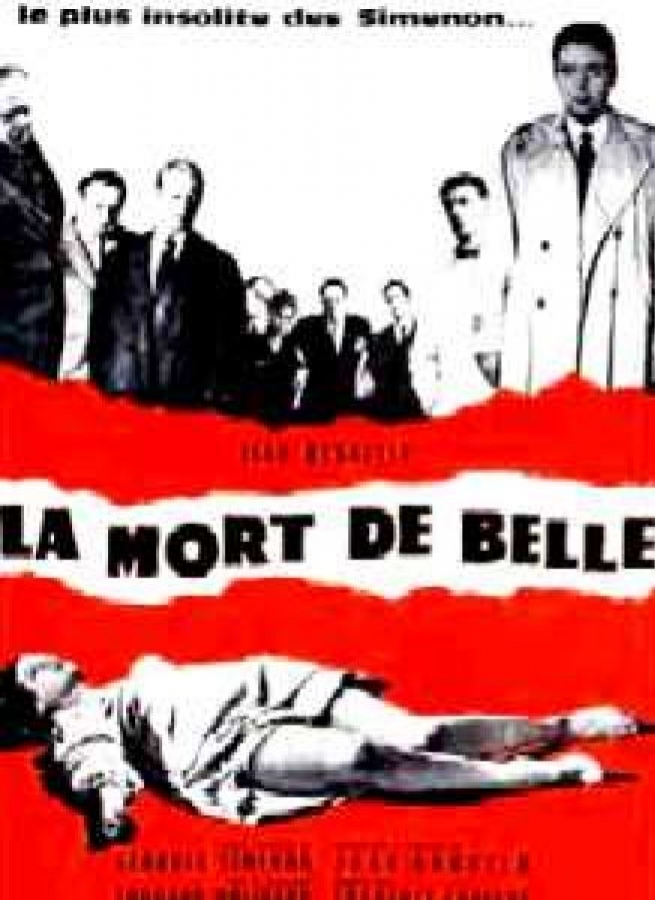
The Death of Belle
A teacher who has always led a quiet, monotonous life is thrown into turmoil by the murder of a young woman who had been staying with him for several months. One evening, in fact, the protagonist finds himself home alone, as his wife has gone out to play cards with friends. The girl returns home, gives an absent-minded greeting, and goes straight to her room. In the morning, she is found dead. The suspicions of the police, as well as those of the neighborhood, turn immediately toward the man. The protagonist sees his world collapse; he feels ostracized by the community, whose members felt bolstered listening to the pastor's words, writes Simenon: > they felt they were the law, they were justice, every new sentence uttered over their heads made them stronger, while Ashby, in their midst, grew weaker and more isolated . The police also delve into the protagonist’s past, discovering that his father was a drunkard who squandered the family fortune before committing suicide. This inquiry casts the protagonist back to the anguish of his youth—to the prospect, that is, of becoming like his father: > what struck him was not so much this or that particular vice, a definite danger; what drew him was something vague, belonging to certain quarters of big cities, to certain streets, certain lights, even certain smells . The fear of being inexorably drawn toward vice and depravity had driven him to seek security, peace, and order, to the point of marrying a woman for whom friendship prevailed over passion. Feeling unjustly accused, abandoned by friends and community alike, along with the resurfacing of his past, are elements that bring this fatal attraction back into the open, shattering the shell the protagonist had fashioned for himself. Inexorably, as if driven by a fateful force, the protagonist murders a young woman, committing the very crime of which he had been falsely accused. This is only ostensibly a detective story. In truth, Simenon masterfully outlines the falsehood of life within a hypocritical community that ambiguously casts out one of its members merely because he is suspected of a crime. To everyone, it seems only natural that Ashby had become infatuated with the girl and killed her in a fit of murderous passion. Yet Simenon’s skill also lies in crafting a protagonist torn between two opposing forces: social order and the lure of lust and violence. When the rules of social coexistence—in which the protagonist believed and which had served as a bulwark against his own impulses—dissolve and reveal their utter vacuity, he gives free rein to his true inclinations. A profoundly relevant theme is thus explored: the relationship between communal ties and the complexity of individual feelings and dispositions. The crime is nothing more than the catalyst for a polarity rooted both within society (solidarity versus hypocrisy and confinement) and within the individual (the pursuit of peace and stability versus the urge toward transgression).
Death in Venice
The protagonist is a renowned man of letters. > He had never known idleness, never the carefree negligence of youth . He had led > a life of self-conquest and of "in spite of all," a harsh, tenacious, and temperate life, which he had shaped into a symbol of a delicate heroism commensurate with the times . Yet deep within him there had always been an inner restlessness, “a strange expansion of the soul,” channeled by an unyielding daily discipline toward ideal perfection in art and the representation of elevated moral values. Now in his sixties, at the pinnacle of his fame, during a walk through the city streets he happens upon a foreigner whose gypsy-like, exotic features leave a deep impression on him, stirring within him > a youthful thirst for distant lands, a longing so intense, so new, or at least so long set aside and unlearned... he questioned his heavy, weary heart to discover whether a new enthusiasm, a new perturbation, a belated adventure of the sensibilities might still be in store for the indolent traveler . It is therefore not merely a desire to travel, but a dream-like vision of > all the wonders and horrors of the multiform terrestrial globe . With this “enigmatic desire,” his destination could only be Venice, > the flattering beauty, the city, half fairy-tale, half foreigner’s trap, in whose miasmas art once bloomed in voluptuous profusion, and which inspired musicians with lulling, caressingly languorous notes . He takes up lodging in an elegant hotel, frequented by the wealthy and variegated bourgeoisie of early twentieth-century Europe. He spends his days contemplating the sea, visiting “on warm nights” St. Mark’s Square and the *calli* of that marvelous city. > The pleasantly constant rhythm of that existence had already held him in its thrall, the soft and luxurious sweetness of that way of life had swiftly seduced him . When, as he lost himself in the “vast expanses of the sea,” > the horizontal line that marked the boundary of the earth was suddenly intersected by a human figure... he saw the beautiful boy pass before him on the sand and from that moment > mind and heart were intoxicated; the demon that delights in trampling human reason and dignity guided his steps . He, an aging man, a man of letters acclaimed for his classicism and for the rigorous rules of his art, becomes infatuated with, and ultimately falls in love with, the splendid youth, and > his soul savored the lust and the frenzy of dissolution . After all, > what value could he still ascribe to art and virtue, faced with the advantages of chaos? Falling in love is accompanied by the draining of energy in an already frail body, by “an ever more violent anguish,” by a “sense of the absence of any way out and of all hope”: he moves toward a voluptuous death. Before the expanse of the sea and the beloved boy gazing at the horizon, “an absolutely isolated and unrelated figure,” the protagonist lets himself die, as if absorbed in a deep slumber, “hovering into an immensity full of promise.” The novella, clearly autobiographical, can be interpreted in three distinct ways. The first interpretive key is the simplest. An elderly gentleman discovers, at the end of his life, his own homosexual orientation, perpetually repressed to conform to narrow-minded bourgeois norms. The author seems intent on lending this revelation the sense of a moral dissolution, yet in truth the protagonist willingly lets himself be carried away by passion, seeing it even as a liberation. > Joy, surprise, admiration could openly depict themselves there when his gaze met... the beloved image . And he was overcome by the desire > to kiss the sweet lips of his shadow, coquettish, curious and faintly anguished, seduced and seducing . It is an explicitly erotic and sexual desire. The second interpretive key, conversely, regards the novella as a spiritual construct, a sort of meditation on the author’s artistic journey. We will never know whether Thomas Mann was homosexual, but it is clear that the dichotomy of “reflection and restlessness,” “order and eros,” constituted the undercurrent that gave life to a literary oeuvre outwardly nestled within the riverbed of the typical bourgeois novel. In this sense, the boy embodies this contradiction between classical beauty and decadent disorder: the failure of that civilizing mission (we are, after all, on the eve of the First World War) which the writer entrusted to Germany. Yet this was also a phase in which the bourgeois novel was opening itself to new ventures, searching for innovative forms capable of narrating the European conscience, now in crisis. > The face, pale and gracefully impenetrable, framed by ringlets of honey-colored hair, with its straight-descending nose, charming mouth, and expression of sweet and divine gravity, recalled Greek sculptures of the golden age , but > care had been taken never to touch with scissors his beautiful hair, which curled over his forehead, above his ears, and even more thickly at the nape of his neck . And finally, the last interpretive strand, undoubtedly the most complex, is the oneiric, composed of dreams and imagery. Here the author abandons himself to fantastical visions, which find their transposition into reality through the description of Venice. And what if Venice were the synthesis of these three interpretive strands? Voluptuous decay, forms both classical and unbound at once, dreamlike wonders—these are the traits that make the city the mirror of the poet’s disheveled soul. Venice is not merely a background context, but the dominant protagonist of the narrative. Why read it? It is magnificent, above all for its writing—alluring, baroque, multiform, yet wholly consistent with the novella’s aims and its overarching narrative design. A true masterpiece!

White Musk
To comprehend this literary "gem," one must return to an earlier novel by the author: *Aniko*, a review of which can be read on this site. Aniko has abandoned her people, the Nenets, to live far away, leaving behind Aleska, her childhood companion, and her father, Petko. The tale begins with the decision of Aleska’s mother to find a wife for her son. > Her husband had died, (...) yet the hearth had not gone out after the master's departure. There remained another task to accomplish (...): to engender a living current that would not scatter or dry up like a puddle in spring, but would continue to flow like a river within its banks. At twenty-six, her son was not yet a true man. (...) He had to be married at all costs. Aleska's heart, however, is weighed down by his love for Aniko. If as a child he felt > like a defenseless fledgling with wings not yet formed , now he is > a spiteful, wounded vulture. He felt like a bird of prey that, spreading the talons of self-regard, leans against the deaf wall of life without anyone being able to understand his sorrow. At night he dreams of Ilne (as Aniko is called in the book), of her seductive smile, and he possesses her. (...) When he realizes that it is merely a dream and not reality, he is consumed by longing. Longing is like a black, hairy spider. The touch of its legs poisons the soul. The novel recounts Aleska's liberation from awaiting Aniko's return, and it does so within a society—that of the Nenets—now in dissolution, yet still anchored to old values, to the stubborn determination to preserve its own culture. At the center of this world lies the hearth, the fire kept perpetually alight—the woman's duty and prestige; hers is the task of bearing and raising children, hers the burden of preserving and passing on Nenets culture. Hence arises the enormity, for the old mother and the entire community, of a man who refuses to marry, obstinately bound to a "distant" love. The two narrative planes, the individual and the collective, overlap, alternating oneiric moments with choral tales. In the dream, > Ilne stared at him and smiled. She was no longer the same Ilne who had invited him to follow her. A sly, knowing smile, which he had never seen on her face and which for some reason unsettled him, never left her lips. (...) He realized that he wanted to wipe that smile from her face; (...) hers was an invitation to a game of love that was nothing but an illusion. If Aniko turns into a painful remembrance before fading from Aleska's heart, with the surrender of her sledges old Petko declares before the community that Aniko will never return; there is no need to keep the dowry, > ten abandoned sledges (...), like orphans, guilty before men and life. (...) The chum was silent, as though immersed in sleep. Yet the young man knew that, motionless, the two women (the mother and the young bride) awaited him, kneeling before the fire. (...) Parting the tent behind his shoulders with a wide gesture, he entered. Thus enters a boy who has become a man. There is a hidden protagonist, and it is Aniko. She appears suddenly, unexpected, with a sort of declaration of love in which Nerkagi seems no longer able to restrain her own "I," in a novel where the narrator is "omniscient." > I love old trees, says Aniko, (...) I love them for all the summers gone by, for the mystery of life they conceal, for the murmur of the leaves that might be mistaken for a song or a lament, a confession or a tale. Ancient trees resemble the old. And it would be wonderful to be certain that they, indeed, are still the keepers of that Golden word of truth, forgotten by mankind heaven knows when. Moreover, in this deceptively simple narrative—much as Dante stands behind the figures of the *Commedia*—there are certain characters behind whom Nerkagi conceals herself. To be sure, one of these is Aleska's mother, the emblem of a stubborn attachment to tradition; yet there is another figure, so delicate as to seem superfluous to the plot. It is the young bride rejected by Aleska, reverent toward the mystery of her husband's soul. Through a splendid simile, Nerkagi thus sings the sorrowful and resigned plight of an unreceived bride: > the girl's world was like that of a tiny flower blossomed by the will of fate at the bottom of a ravine, where the rays of the sun penetrate only in the early morning and the hostile stones exude cold. Covered in a slimy moss, they emit a foul stench and envy the beauty and sweetness of the flower's petals, blind to the light that its corolla radiates into the darkness. I have remained silent for too many years, the author confesses, and now it is time for the moss to turn white. The style is a gentle flow of words, at times elegiac, at others lyrical, rich in similes drawn from the natural world, from trees and animals; a seemingly motionless nature that contrasts with the shifts in the Nenets world and the enigmas of the human soul. Such is the sweetness of the prose that a kind of metamorphosis takes place within the reader, allowing one to measure oneself against the mystery without deciphering it. Why read it? Outside of time and space, it is a hymn to our human condition.