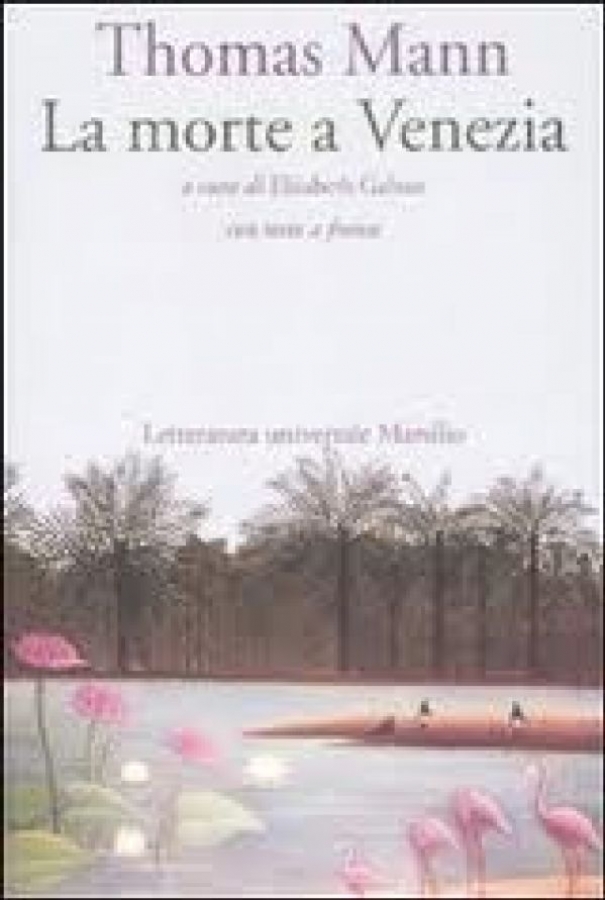
Finished reading on: June 01, 2013
Death in Venice
Title of the original version reviewed: «La morte a Venezia»
AI Translation Notice: This review was translated from the original Italian using artificial intelligence. Book quotes and excerpts are translated interpretations and will not match the author's original English phrasing or official published translations.
The protagonist is a renowned man of letters.
He had never known idleness, never the carefree negligence of youth
.
He had led
a life of self-conquest and of "in spite of all," a harsh, tenacious, and temperate life, which he had shaped into a symbol of a delicate heroism commensurate with the times
.
Yet deep within him there had always been an inner restlessness, “a strange expansion of the soul,” channeled by an unyielding daily discipline toward ideal perfection in art and the representation of elevated moral values.
Now in his sixties, at the pinnacle of his fame, during a walk through the city streets he happens upon a foreigner whose gypsy-like, exotic features leave a deep impression on him, stirring within him
a youthful thirst for distant lands, a longing so intense, so new, or at least so long set aside and unlearned...
he questioned his heavy, weary heart to discover whether a new enthusiasm, a new perturbation, a belated adventure of the sensibilities might still be in store for the indolent traveler
.
It is therefore not merely a desire to travel, but a dream-like vision of
all the wonders and horrors of the multiform terrestrial globe
.
With this “enigmatic desire,” his destination could only be Venice,
the flattering beauty, the city, half fairy-tale, half foreigner’s trap, in whose miasmas art once bloomed in voluptuous profusion, and which inspired musicians with lulling, caressingly languorous notes
.
He takes up lodging in an elegant hotel, frequented by the wealthy and variegated bourgeoisie of early twentieth-century Europe.
He spends his days contemplating the sea, visiting “on warm nights” St. Mark’s Square and the calli of that marvelous city.
The pleasantly constant rhythm of that existence had already held him in its thrall, the soft and luxurious sweetness of that way of life had swiftly seduced him
.
When, as he lost himself in the “vast expanses of the sea,”
the horizontal line that marked the boundary of the earth was suddenly intersected by a human figure...
he saw the beautiful boy pass before him on the sand
and from that moment
mind and heart were intoxicated; the demon that delights in trampling human reason and dignity guided his steps
.
He, an aging man, a man of letters acclaimed for his classicism and for the rigorous rules of his art, becomes infatuated with, and ultimately falls in love with, the splendid youth, and
his soul savored the lust and the frenzy of dissolution
.
After all,
what value could he still ascribe to art and virtue, faced with the advantages of chaos?
Falling in love is accompanied by the draining of energy in an already frail body, by “an ever more violent anguish,” by a “sense of the absence of any way out and of all hope”: he moves toward a voluptuous death.
Before the expanse of the sea and the beloved boy gazing at the horizon, “an absolutely isolated and unrelated figure,” the protagonist lets himself die, as if absorbed in a deep slumber, “hovering into an immensity full of promise.”
The novella, clearly autobiographical, can be interpreted in three distinct ways.
The first interpretive key is the simplest.
An elderly gentleman discovers, at the end of his life, his own homosexual orientation, perpetually repressed to conform to narrow-minded bourgeois norms.
The author seems intent on lending this revelation the sense of a moral dissolution, yet in truth the protagonist willingly lets himself be carried away by passion, seeing it even as a liberation.
Joy, surprise, admiration could openly depict themselves there when his gaze met...
the beloved image
.
And he was overcome by the desire
to kiss the sweet lips of his shadow, coquettish, curious and faintly anguished, seduced and seducing
.
It is an explicitly erotic and sexual desire.
The second interpretive key, conversely, regards the novella as a spiritual construct, a sort of meditation on the author’s artistic journey.
We will never know whether Thomas Mann was homosexual, but it is clear that the dichotomy of “reflection and restlessness,” “order and eros,” constituted the undercurrent that gave life to a literary oeuvre outwardly nestled within the riverbed of the typical bourgeois novel.
In this sense, the boy embodies this contradiction between classical beauty and decadent disorder: the failure of that civilizing mission (we are, after all, on the eve of the First World War) which the writer entrusted to Germany.
Yet this was also a phase in which the bourgeois novel was opening itself to new ventures, searching for innovative forms capable of narrating the European conscience, now in crisis.
The face, pale and gracefully impenetrable, framed by ringlets of honey-colored hair, with its straight-descending nose, charming mouth, and expression of sweet and divine gravity, recalled Greek sculptures of the golden age
, but
care had been taken never to touch with scissors his beautiful hair, which curled over his forehead, above his ears, and even more thickly at the nape of his neck
.
And finally, the last interpretive strand, undoubtedly the most complex, is the oneiric, composed of dreams and imagery.
Here the author abandons himself to fantastical visions, which find their transposition into reality through the description of Venice.
And what if Venice were the synthesis of these three interpretive strands? Voluptuous decay, forms both classical and unbound at once, dreamlike wonders—these are the traits that make the city the mirror of the poet’s disheveled soul.
Venice is not merely a background context, but the dominant protagonist of the narrative.
Why read it? It is magnificent, above all for its writing—alluring, baroque, multiform, yet wholly consistent with the novella’s aims and its overarching narrative design.
A true masterpiece!